Recognition: unknown
Interaction-controlled localization in one-dimensional chain: From edges to domain walls
Pith reviewed 2026-05-08 16:30 UTC · model grok-4.3
The pith
In the interacting SSH chain, the ratio 2V/U switches bound-state localization from edge spin-density waves to mid-chain charge-density-wave domain walls.
A machine-rendered reading of the paper's core claim, the machinery that carries it, and where it could break.
Core claim
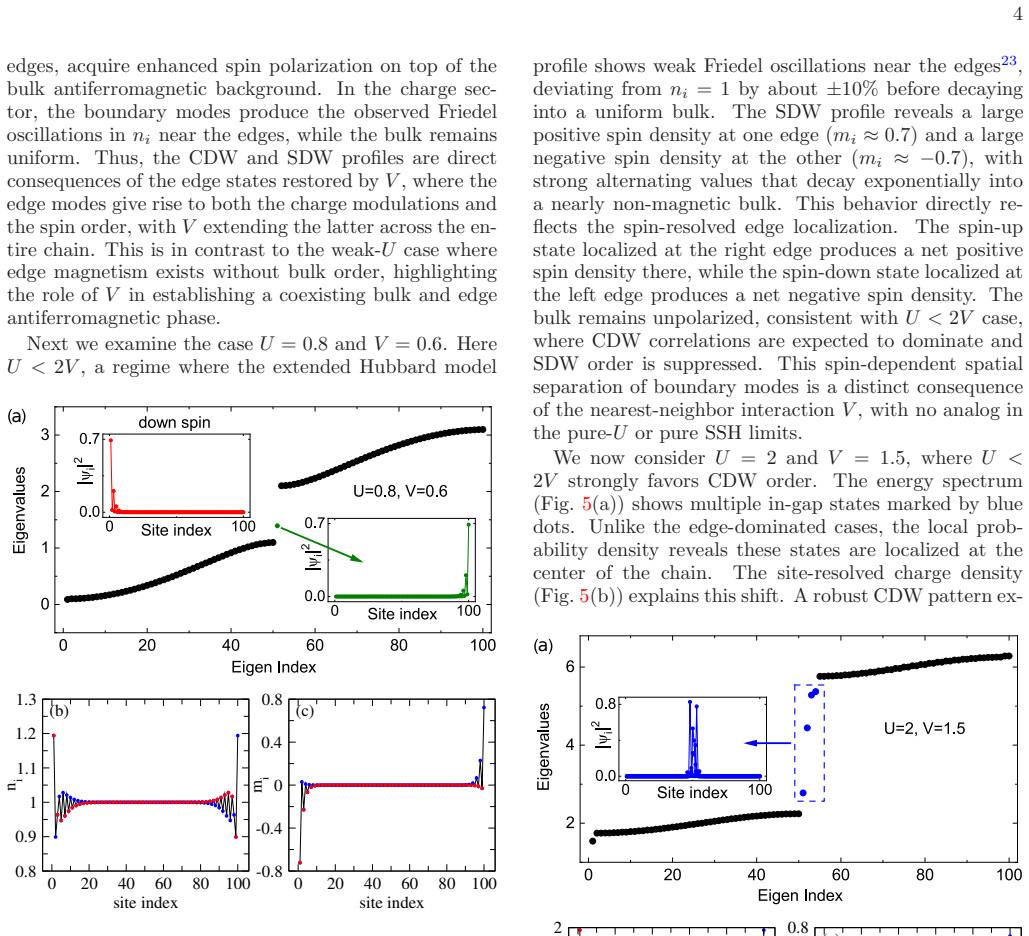
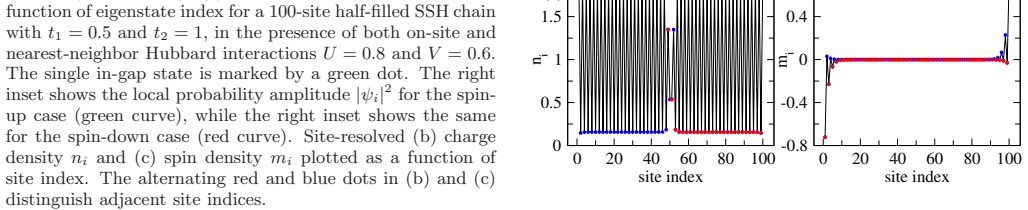
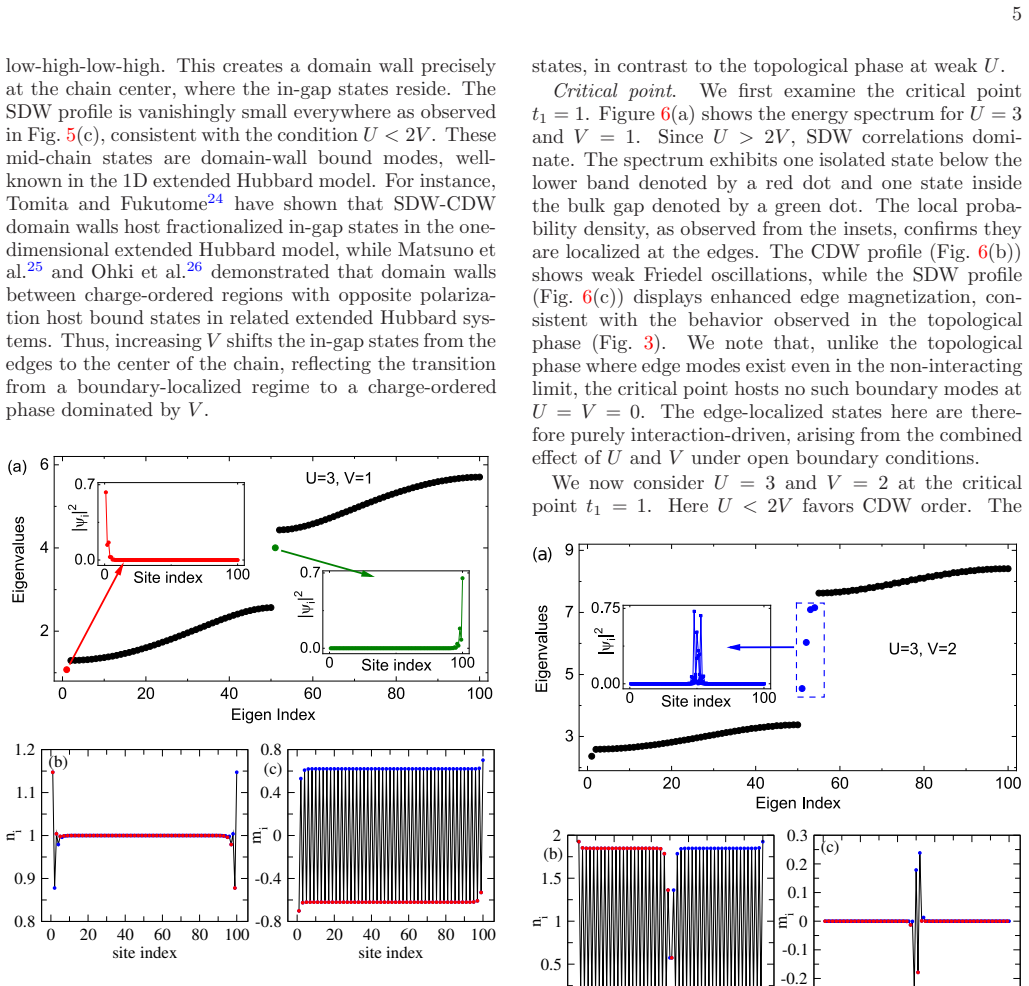
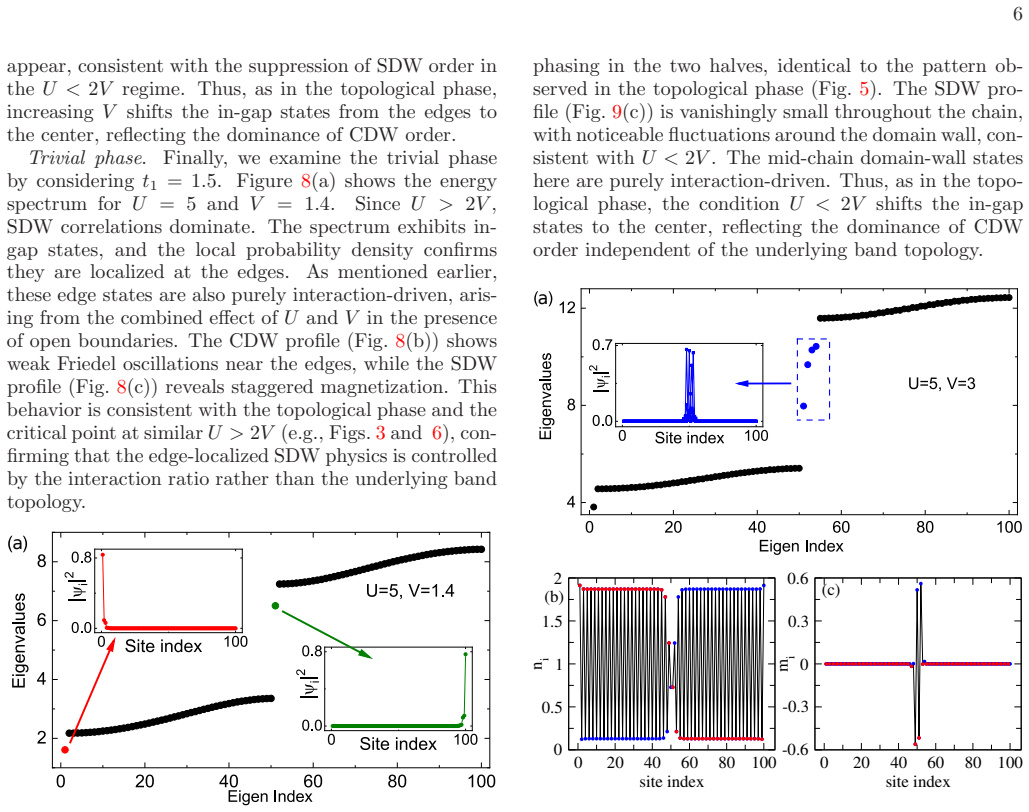
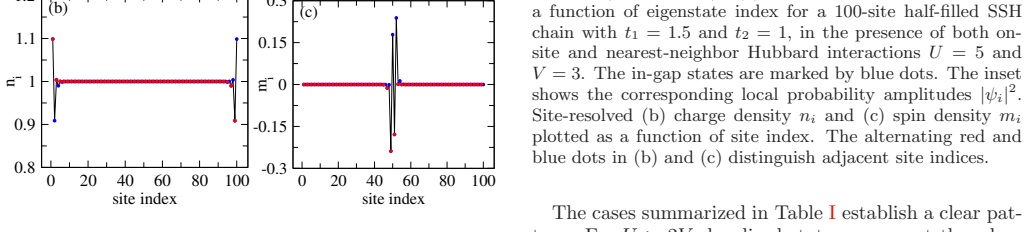
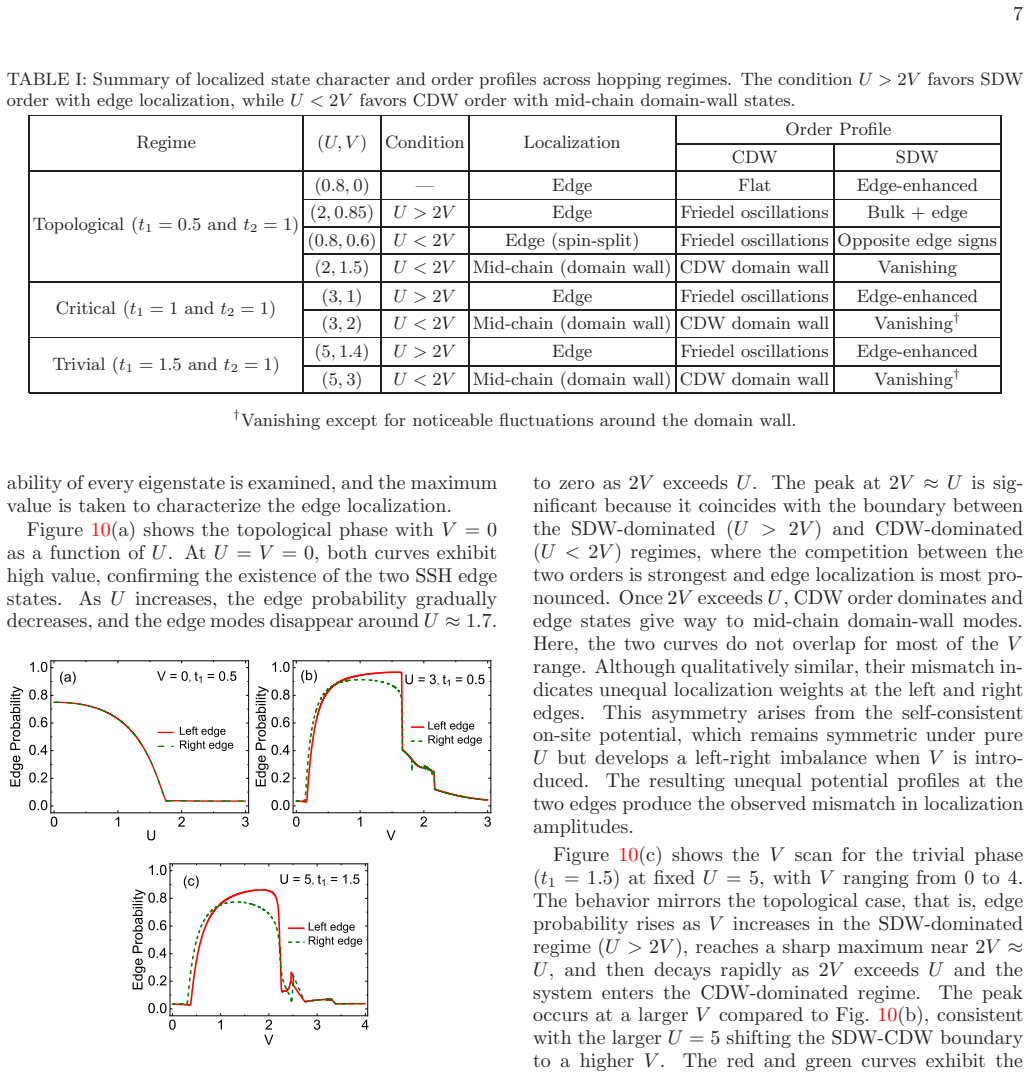
The localization of bound states is controlled by the ratio 2V/U, with edge spin-density-wave modes for U>2V and mid-chain charge-density-wave domain walls for U<2V, independent of band topology. These results establish the correlation-driven origin of localized states in finite one-dimensional chains.
What carries the argument
The dimensionless ratio 2V/U that selects between edge spin-density-wave localization and interior charge-density-wave domain walls under Hartree-Fock decoupling of the extended Hubbard model on the SSH lattice.
If this is right
- Localized states can be moved from the edges to the chain interior simply by increasing the relative strength of extended repulsion V.
- Band topology loses its control over localization site once interactions are turned on.
- The character of the localized density changes from spin-density-wave to charge-density-wave as the ratio crosses unity.
- The same interaction-controlled behavior appears in all three hopping regimes: topological, critical, and trivial.
Where Pith is reading between the lines
- Tuning the ratio 2V/U in cold-atom or quantum-dot realizations of the SSH chain could provide a direct experimental test of interaction-driven relocation of bound states.
- In the presence of strong one-dimensional fluctuations, the critical ratio at which domain walls appear may shift away from 2V/U.
- Analogous ratio-controlled switches between edge and interior localization may operate in other one-dimensional interacting models that lack the SSH dimerization.
Load-bearing premise
The Hartree-Fock mean-field treatment accurately captures the localization physics without significant beyond-mean-field fluctuations or correlation effects that are known to be strong in one dimension.
What would settle it
Exact diagonalization or density-matrix renormalization group results on finite chains showing the switch between edge and mid-chain localization at a ratio clearly different from 2V/U.
Figures


read the original abstract
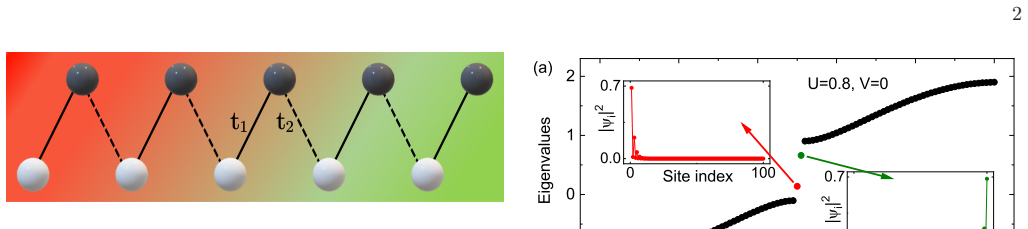
Using Hartree-Fock mean-field approach, we study the role of on-site ($U$) and extended ($V$) Hubbard interactions on the existence and evolution of edge modes in a half-filled Su-Schrieffer-Heeger (SSH) chain. We analyze the energy spectrum, local probability amplitudes, and site-resolved charge and spin density profiles across topological, critical, and trivial hopping regimes. We find that the localization of bound states is controlled by the ratio $2V/U$, with edge spin-density-wave modes for $U>2V$ and mid-chain charge-density-wave domain walls for $U<2V$, independent of band topology. These results establish the correlation-driven origin of localized states in finite one-dimensional chains.
Editorial analysis
A structured set of objections, weighed in public.
Referee Report
Summary. The manuscript applies the Hartree-Fock mean-field approximation to a half-filled Su-Schrieffer-Heeger chain with on-site U and nearest-neighbor V interactions. It reports that the localization of bound states is governed by the ratio 2V/U, producing edge spin-density-wave modes for U>2V and mid-chain charge-density-wave domain walls for U<2V; this crossover is stated to hold independently of whether the non-interacting band structure is topological, critical, or trivial. The analysis is based on self-consistent solutions for the energy spectrum, local amplitudes, and site-resolved charge and spin densities across the three hopping regimes.
Significance. If the mean-field results are robust, the work would demonstrate a simple, interaction-tuned mechanism for relocating and recharacterizing localized states in finite 1D chains, with potential implications for correlation effects in topological wires or quantum-dot arrays. The systematic scan across topological regimes and the identification of a single control parameter (2V/U) constitute the main technical contribution.
major comments (2)
- [§3] §3 (Hartree-Fock decoupling): The central claim that localization switches at 2V/U and is independent of band topology rests entirely on the Hartree-Fock site densities. In one dimension, however, quantum fluctuations are known to suppress long-range SDW/CDW order and can qualitatively alter or eliminate mean-field crossovers; the manuscript contains no comparison to DMRG, exact diagonalization, or bosonization results that would test whether the reported 2V/U threshold survives beyond mean-field.
- [§4.2] §4.2 (density profiles): The edge SDW versus mid-chain CDW distinction is illustrated only via mean-field charge and spin densities. Because the Hartree-Fock ansatz assumes a product state, it cannot capture the Luttinger-liquid character or power-law correlations expected at half-filling; this directly affects the load-bearing assertion that the localization character is controlled solely by 2V/U.
minor comments (2)
- [§2] The definition of the SSH hopping parameters t1 and t2 and the precise form of the interaction terms should be stated explicitly in the model section before the Hartree-Fock equations are introduced.
- [Fig. 3-6] Figure captions for the density plots should include the precise values of U/V used and the system size N to allow direct reproduction.
Simulated Author's Rebuttal
We thank the referee for the careful reading of the manuscript and the recommendation for major revision. The comments correctly identify the mean-field character of the study and the absence of beyond-Hartree-Fock benchmarks. We respond to each point below and will incorporate clarifications in the revised version.
read point-by-point responses
-
Referee: [§3] §3 (Hartree-Fock decoupling): The central claim that localization switches at 2V/U and is independent of band topology rests entirely on the Hartree-Fock site densities. In one dimension, however, quantum fluctuations are known to suppress long-range SDW/CDW order and can qualitatively alter or eliminate mean-field crossovers; the manuscript contains no comparison to DMRG, exact diagonalization, or bosonization results that would test whether the reported 2V/U threshold survives beyond mean-field.
Authors: We agree that strong quantum fluctuations in one dimension generally suppress true long-range order and that the Hartree-Fock approximation cannot capture them. Our work is explicitly limited to the self-consistent Hartree-Fock treatment, within which the crossover at 2V/U and its independence from the non-interacting topology emerge consistently from the site densities and spectra. This mean-field picture still provides a transparent mechanism for how the relative strength of U and V relocates and recharacterizes the bound states. We will add a paragraph in the discussion section that explicitly states the mean-field limitation, references the expected suppression of order by fluctuations, and notes that DMRG or bosonization studies would be required to assess the survival of the 2V/U threshold. revision: partial
-
Referee: [§4.2] §4.2 (density profiles): The edge SDW versus mid-chain CDW distinction is illustrated only via mean-field charge and spin densities. Because the Hartree-Fock ansatz assumes a product state, it cannot capture the Luttinger-liquid character or power-law correlations expected at half-filling; this directly affects the load-bearing assertion that the localization character is controlled solely by 2V/U.
Authors: The Hartree-Fock ansatz is indeed a product state and therefore yields only average densities without Luttinger-liquid power-law correlations. The reported distinction between edge SDW and mid-chain CDW follows directly from the self-consistent solutions for the charge and spin profiles under the chosen decoupling. Within this framework the ratio 2V/U controls which instability dominates. We will revise the text around §4.2 to emphasize that the results are mean-field densities and to discuss briefly how the observed crossover relates to the competition between on-site and nearest-neighbor terms, while noting that a full Luttinger-liquid treatment lies outside the present scope. revision: partial
Circularity Check
No circularity: localization crossover emerges as output of Hartree-Fock computation
full rationale
The paper applies the Hartree-Fock mean-field decoupling to the interacting SSH Hamiltonian, computes the self-consistent site-resolved charge and spin densities, and reports that the bound-state localization switches character at the ratio 2V/U. This ratio is not inserted by definition or by fitting a subset of data and then relabeling the fit as a prediction; it is an observed outcome across the scanned parameter space. No self-citation is invoked to justify a uniqueness theorem or to smuggle an ansatz. The independence from band topology is likewise stated as a numerical finding obtained by repeating the same mean-field procedure in topological, critical, and trivial regimes. The derivation chain therefore remains self-contained against external benchmarks and does not reduce to its own inputs.
Axiom & Free-Parameter Ledger
axioms (1)
- domain assumption Hartree-Fock mean-field approximation sufficiently describes the ground-state and excitation properties of the interacting half-filled SSH chain.
Reference graph
Works this paper leans on
-
[1]
W. P. Su, J. R. Schrieffer, and A. J. Heeger, Solitons in Polyacetylene , Phys. Rev. Lett. 42, 1698 (1979)
1979
-
[2]
W. P. Su, J. R. Schrieffer, and A. J. Heeger, Soliton excitations in polyacetylene , Phys. Rev. B, 22, 4 (1980)
1980
-
[3]
M. Z. Hasan and C. L. Kane, Colloquium: Topological insulators , Rev. Mod. Phys. 82 , 3045 (2010)
2010
-
[4]
J. K. Asb\' o th, L. Oroszl\' a ny, and A. P\' a lyi, A Short Course on Topological Insulators , Volume 919. Springer, Berlin (2016)
2016
-
[5]
Ryu and Y
S. Ryu and Y. Hatsugai, Topological origin of zero-energy edge states in particle-hole symmetric systems , Phys. Rev. Lett. 89 , 077002 (2002)
2002
-
[6]
A. J. Heeger, Nobel Lecture: Semiconducting and metallic polymers , Rev. Mod. Phys. 73 , 681 (2001)
2001
-
[7]
L. Lu, J. D. Joannopoulos, and M. Solja c i\' c , Topological photonics , Nat. Photon. 8, 821 (2014)
2014
-
[8]
Ozawa, H
T. Ozawa, H. M. Price, A. Amo, N. Goldman, M. Hafezi, L. Lu, M. C. Rechtsman, D. Schuster, J. Simon et al., Topological photonics , Rev. Mod. Phys. 91 , 015006 (2019)
2019
-
[9]
Atala, M
M. Atala, M. Aidelsburger, J. T. Barreiro, D. Abanin, T. Kitagawa, E. Demler, and I. Bloch, Direct measurement of the Zak phase in topological Bloch bands , Nat. Phys. 9 , 795 (2013)
2013
-
[10]
E. J. Meier, F. Alex An, and B. Gadway, Observation of the topological soliton state in the Su-Schrieffer-Heeger model , Nat. Commun. 7 , 13986 (2016)
2016
-
[11]
S. D. Huber, Topological mechanics , Nat. Phys. 12 , 621 (2016)
2016
-
[12]
G. Ma, M. Xiao, and C. T. Chan, Topological phases in acoustic and mechanical systems , Nat. Rev. Phys. 1 , 281 (2019)
2019
-
[13]
Ye, L.-Z
B.-T. Ye, L.-Z. Mu, and H. Fan, Entanglement spectrum of Su-Schrieffer-Heeger-Hubbard model , Phys. Rev. B 94 , 165167 (2016)
2016
-
[14]
Barbiero, L
L. Barbiero, L. Santos, and N. Goldman, Quenched dynamics and spin-charge separation in an interacting topological lattice , Phys. Rev. B 97 , 201115(R) (2018)
2018
-
[15]
N. H. Le, A. J. Fisher, N. J. Curson, and E. Ginossar, Topological phases of a dimerized Fermi-Hubbard model for semiconductor nano-lattices , npj Quantum Inf. 6 , 24 (2020)
2020
-
[16]
Mikhail and S
D. Mikhail and S. Rachel, Su-Schrieffer-Heeger-Hubbard model at quarter filling: Effects of magnetic field and nonlocal interactions , Phys. Rev. B 110 , 205106 (2024)
2024
-
[17]
Wang and Y
Y.-X. Wang and Y. Zhong, Ground-state phase diagram of the quarter-filled interacting Su-Schrieffer-Heeger chain , Phys. Rev. B 112 , 245122 (2025)
2025
-
[18]
Bisht, S
J. Bisht, S. Jalal, and B. Kumar, Phys. Rev. B, 110, 245110 (2024)
2024
-
[19]
T. Jin, P. Ruggiero, and T. Giamarchi, Bosonization of the interacting Su-Schrieffer-Heeger model , Phys. Rev. B, 107, L201111 (2023)
2023
-
[20]
Hubbard, Electron Correlations in Narrow Energy Bands , Proc
J. Hubbard, Electron Correlations in Narrow Energy Bands , Proc. Roy. Soc. A, 276, 238 (1963)
1963
-
[21]
J. E. Hirsch, Charge-Density-Wave Transition in the Extended Hubbard Model , Phys. Rev. Lett. 53 , 2327 (1984)
1984
-
[22]
P. G. J. van Dongen, Extended Hubbard model at weak coupling , Phys. Rev. B 50 , 14016 (1994)
1994
-
[23]
Bed\" u rftig, B
G. Bed\" u rftig, B. Brendel, H. Frahm, and R. M. Noack, Friedel oscillations in the open Hubbard chain , Phys. Rev. B 58 , 10225 (1998)
1998
-
[24]
Tomita and H
N. Tomita and H. Fukutome, Elementary Defects, Halfons, Connecting the SDW and CDW in the One-Dimensional Extended Hubbard Model , J. Phys. Soc. Jpn. 62 , 1634 (1993)
1993
-
[25]
Matsuno, Y
G. Matsuno, Y. Omori, T. Eguchi, and A. Kobayashi, Topological Domain Wall and Valley Hall Effect in Charge Ordered Phase of Molecular Dirac Fermion System -(BEDT-TTF) _2 I _3 , J. Phys. Soc. Jpn. 85 , 094710 (2016)
2016
-
[26]
D. Ohki, G. Matsuno, Y. Omori, and A. Kobayashi, Domain Wall Conductivity with strong Coulomb interaction of two-dimensional massive Dirac Electrons in the Organic Conductor -(BEDT-TTF) _2 I _3 , J. Phys. Soc. Jpn. 87 , 054703 (2018)
2018
discussion (0)
Sign in with ORCID, Apple, or X to comment. Anyone can read and Pith papers without signing in.