Recognition: unknown
The NUV transit of XO-3 b
Pith reviewed 2026-05-08 15:51 UTC · model grok-4.3
The pith
NUV transit of hot Jupiter XO-3b is 30-70% deeper than optical and arrives 22 minutes late.
A machine-rendered reading of the paper's core claim, the machinery that carries it, and where it could break.
Core claim
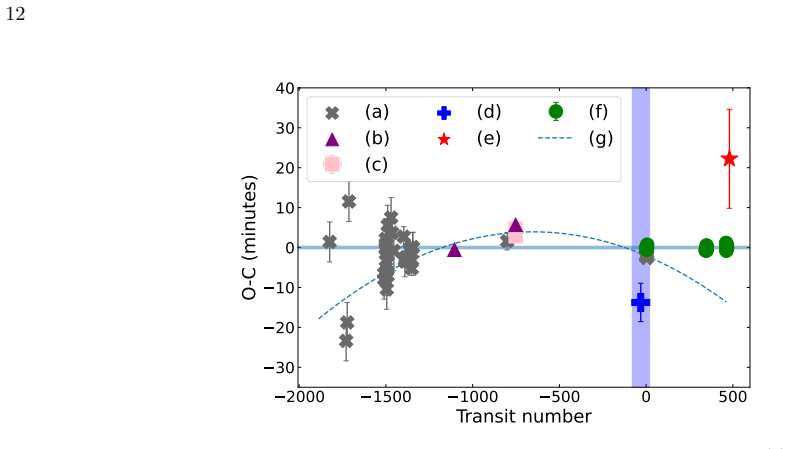
We find a NUV transit depth of Rp,NUV/R⋆ = 0.1371+0.016−0.019, which is 30-70% deeper than the optical transit. Although the optical transits show no transit timing variations, the NUV transit center is 22+13−11 minutes late compared to the optical ephemeris. The X-ray data yield an extremely small mass-loss rate of ∼10^4 g/s, and the analytic magnetic bow-shock model predicts an early rather than late transit.
What carries the argument
Joint fitting of the NUV light curve from the XMM-Newton Optical Monitor against concurrent optical and TESS photometry, followed by X-ray luminosity conversion to mass-loss rate and analytic estimation of bow-shock geometry from planetary magnetic field strength.
If this is right
- The planet possesses an extended layer that absorbs NUV light at radii larger than the optical photosphere.
- Atmospheric escape contributes negligibly to the observed NUV absorption given the low mass-loss rate.
- Planetary magnetic fields can shift the apparent transit timing by tens of minutes through bow-shock effects.
- Standard analytic bow-shock models are insufficient and require full MHD treatment to match the observed late timing.
- Optical ephemerides remain stable while NUV timing deviates, indicating the offset is wavelength-specific.
Where Pith is reading between the lines
- Similar NUV offsets may appear in other eccentric hot Jupiters if bow shocks or asymmetric atmospheres are common.
- Multi-wavelength transit campaigns could map the vertical structure of the absorbing layer by measuring how depth changes with wavelength.
- If MHD simulations reproduce a late transit, the same geometry could be tested against existing UV observations of other planets.
- The low mass-loss rate implies that any extended NUV absorber must be static or slowly replenished rather than outflowing.
Load-bearing premise
That the deeper NUV depth and late timing offset are produced by atmospheric escape or a magnetic bow shock.
What would settle it
A repeat NUV observation that measures a transit depth consistent with the optical value or a timing offset earlier than the optical ephemeris would undermine the claim of an anomalously extended NUV-absorbing region.
Figures


read the original abstract
Near-UV (NUV) measurements of exoplanet transits offer a means to probe atmospheric escape, cloud formation, and planetary magnetic fields. We examine a 2024 XMM-Newton Optical Monitor NUV observation of the transit of XO-3~b, a massive hot Jupiter on an eccentric orbit with a previously observed abnormally large NUV-absorbing atmosphere. We analyze this NUV data jointly with a concurrent ground-based optical observation and all TESS transit observations, and find a NUV transit depth of $R_{p,NUV}/R_{\star} = 0.1371^{+0.016}_{-0.019}$, which is 30-70% deeper than the optical transit. Although the optical transits do not show signs of transit timing variations, the transit center in the NUV is $22^{+13}_{-11}$ minutes late compared to the optical ephemeris. We investigate atmospheric escape as a potential explanation of the properties of this NUV transit by examining X-ray data from XMM-Newton, characterizing the X-ray luminosity of XO-3 for the first time and estimating an extremely small mass-loss rate of $\sim10^4$ g/s ($\sim10^{-19}$ M$_{\text{jup}}$/yr). Finally, we investigate the likelihood of an NUV-absorbent bow-shock by estimating the magnetic field of the planet. While such a mechanism is capable of producing NUV transit offsets on the order of tens of minutes, our analytic approximations predict an early rather than late transit, indicating a need for further magnetohydrodynamic simulations.
Editorial analysis
A structured set of objections, weighed in public.
Referee Report
Summary. The manuscript presents a joint analysis of XMM-Newton NUV transit data for the hot Jupiter XO-3b together with concurrent ground-based optical photometry and all available TESS transits. It reports a NUV radius ratio Rp,NUV/R⋆ = 0.1371+0.016−0.019 (30–70 % deeper than the optical value) and a transit center delayed by 22+13−11 min relative to the optical ephemeris. The paper also reports the first X-ray luminosity measurement of the host star, derives an extremely low mass-loss rate of ∼10^4 g s^−1 (∼10^−19 Mjup yr^−1), and explores an NUV-absorbing bow shock via analytic magnetic-field estimates, while noting that the model predicts an early rather than late transit.
Significance. The multi-band transit measurement and first X-ray detection of XO-3 constitute useful observational additions to the study of extended atmospheres around massive hot Jupiters. The joint light-curve modeling and direct reporting of the low mass-loss rate are strengths. However, because the paper’s own calculations show that neither atmospheric escape nor the analytic bow-shock geometry can account for the reported depth increase and late timing, the physical implications remain limited unless the interpretation is substantially revised or additional modeling is supplied.
major comments (2)
- [X-ray luminosity and mass-loss estimates] X-ray luminosity and mass-loss section: the derived mass-loss rate of ∼10^4 g s^−1 is orders of magnitude below the values required by standard hydrodynamic escape models to inflate an NUV-absorbing envelope large enough to produce a 30–70 % deeper transit. This internal result directly undermines the atmospheric-escape interpretation offered for the observed NUV depth.
- [Bow-shock timing prediction] Bow-shock and magnetic-field discussion: the analytic approximations for the planetary magnetic field and bow-shock geometry are stated to predict an early transit, yet the data show a late offset of 22 min. This sign mismatch is load-bearing for any claim that the timing offset arises from a bow shock and requires either revised modeling or substantially stronger caveats.
minor comments (2)
- [Abstract and §5] The abstract and conclusions should explicitly note that the proposed mechanisms fail to reproduce the observed timing direction and that the mass-loss rate is too low to explain the depth, rather than presenting the mechanisms as viable explanations.
- [Results section and figures] Figure captions and text should clarify whether the reported NUV depth and timing uncertainties already incorporate the joint fit with TESS and optical data or are derived from the NUV data alone.
Simulated Author's Rebuttal
We thank the referee for their constructive comments on our manuscript. Their feedback has helped us clarify the limitations of the proposed physical interpretations for the NUV depth and timing offset. We have revised the manuscript to more explicitly state that neither atmospheric escape nor the analytic bow-shock model accounts for the observations, framing the work as providing new constraints that challenge existing models. Below we respond point by point to the major comments.
read point-by-point responses
-
Referee: [X-ray luminosity and mass-loss estimates] X-ray luminosity and mass-loss section: the derived mass-loss rate of ∼10^4 g s^−1 is orders of magnitude below the values required by standard hydrodynamic escape models to inflate an NUV-absorbing envelope large enough to produce a 30–70 % deeper transit. This internal result directly undermines the atmospheric-escape interpretation offered for the observed NUV depth.
Authors: We agree that the mass-loss rate of ∼10^4 g s^−1 derived from the new X-ray luminosity measurement is far too low to inflate an extended NUV-absorbing envelope via hydrodynamic escape. The manuscript reports this rate as a direct observational result and does not claim that escape explains the 30–70% deeper NUV transit; rather, the low value is presented to demonstrate that escape is insufficient. We have revised the X-ray and mass-loss section to state explicitly that this rate rules out standard hydrodynamic escape as the cause of the depth increase. This change strengthens the paper by positioning the result as a quantitative upper limit on escape for this massive hot Jupiter, highlighting the need for alternative explanations such as high-altitude clouds or other absorbers. revision: yes
-
Referee: [Bow-shock timing prediction] Bow-shock and magnetic-field discussion: the analytic approximations for the planetary magnetic field and bow-shock geometry are stated to predict an early transit, yet the data show a late offset of 22 min. This sign mismatch is load-bearing for any claim that the timing offset arises from a bow shock and requires either revised modeling or substantially stronger caveats.
Authors: The referee is correct that our analytic bow-shock model predicts an early transit, opposite to the observed 22-minute late offset. The manuscript already notes this sign mismatch and concludes that further magnetohydrodynamic simulations are required. In the revised version, we have strengthened the caveats in the bow-shock discussion to emphasize that the simple analytic geometry cannot reproduce the late timing and that the offset's physical origin remains unexplained by this mechanism. We do not assert that the bow shock accounts for the data but explore it as one candidate whose current implementation fails to match the observations, thereby underscoring the need for more advanced modeling. revision: yes
Circularity Check
No significant circularity; core results are independent observational fits
full rationale
The paper's central results (NUV radius ratio 0.1371^{+0.016}_{-0.019} and 22 min late timing offset) are obtained directly from joint modeling of XMM-Newton NUV data, concurrent ground-based optical photometry, and all TESS transits. The X-ray luminosity is a new measurement from the same XMM-Newton dataset, converted to mass-loss rate via external scaling relations (not defined or fitted within the paper). The bow-shock timing offset is computed from an analytic magnetic model using planetary parameters and standard assumptions; the model output (early transit) is reported as mismatched to the data rather than forced to agree. No equations reduce by construction to the fitted transit parameters, no self-citations are load-bearing for the measurements, and no ansatz or uniqueness claim is smuggled in. The derivation chain is self-contained against external benchmarks.
Axiom & Free-Parameter Ledger
free parameters (1)
- NUV radius ratio =
0.1371
axioms (1)
- domain assumption The optical ephemeris from TESS and ground data accurately represents the true transit times in the absence of significant transit timing variations.
Reference graph
Works this paper leans on
-
[1]
Abril-Pla, O., Andreani, V., Carroll, C., et al. 2023, PeerJ Computer Science, 9, e1516, doi: 10.7717/peerj-cs.1516
-
[2]
2020, AJ, 159, 123, doi: 10.3847/1538-3881/ab4fee 15
Agol, E., Luger, R., & Foreman-Mackey, D. 2020, AJ, 159, 123, doi: 10.3847/1538-3881/ab4fee 15
-
[3]
Albrecht, S., Winn, J. N., Johnson, J. A., et al. 2012, ApJ, 757, 18, doi: 10.1088/0004-637X/757/1/18
-
[4]
Arnaud, K. A. 1996, in Astronomical Society of the Pacific Conference Series, Vol. 101, Astronomical Data Analysis Software and Systems V, ed. G. H. Jacoby & J. Barnes, 17
1996
-
[5]
Asplund, M., Grevesse, N., Sauval, A. J., & Scott, P. 2009, ARA&A, 47, 481, doi: 10.1146/annurev.astro.46.060407.145222 Astropy Collaboration, Robitaille, T. P., Tollerud, E. J., et al. 2013, A&A, 558, A33, doi: 10.1051/0004-6361/201322068 Astropy Collaboration, Price-Whelan, A. M., Sip˝ ocz, B. M., et al. 2018, AJ, 156, 123, doi: 10.3847/1538-3881/aabc4f
-
[6]
2026, arXiv e-prints, arXiv:2603.27093
Badman, S. T., Stevens, M. L., Bale, S. D., et al. 2025, arXiv e-prints, arXiv:2509.17149. https://arxiv.org/abs/2509.17149 Beaug´ e, C., & Nesvorn´ y, D. 2012, ApJ, 751, 119, doi: 10.1088/0004-637X/751/2/119
-
[7]
Bodenheimer, P., Hubickyj, O., & Lissauer, J. J. 2000, Icarus, 143, 2, doi: 10.1006/icar.1999.6246
-
[8]
S., Desidera, S., Benatti, S., et al
Bonomo, A. S., Desidera, S., Benatti, S., et al. 2017, A&A, 602, A107, doi: 10.1051/0004-6361/201629882
-
[9]
2021, A&A, 655, A30, doi: 10.1051/0004-6361/202141497 —
Caldiroli, A., Haardt, F., Gallo, E., et al. 2021, A&A, 655, A30, doi: 10.1051/0004-6361/202141497 —. 2022, A&A, 663, A122, doi: 10.1051/0004-6361/202142763
-
[10]
Cash, W. 1979, ApJ, 228, 939, doi: 10.1086/156922
-
[11]
R., Holzwarth, V., & Reiners, A
Christensen, U. R., Holzwarth, V., & Reiners, A. 2009, Nature, 457, 167, doi: 10.1038/nature07626
-
[12]
2017, A&A, 600, A30, doi: 10.1051/0004-6361/201629705
Claret, A. 2017, A&A, 600, A30, doi: 10.1051/0004-6361/201629705
-
[13]
Corrales, L., Ravi, S., King, G. W., et al. 2021, AJ, 162, 287, doi: 10.3847/1538-3881/ac2c67
-
[14]
Dang, L., Bell, T. J., Cowan, N. B., et al. 2022, AJ, 163, 32, doi: 10.3847/1538-3881/ac365f
-
[15]
Dawson, R. I., & Johnson, J. A. 2018, ARA&A, 56, 175, doi: 10.1146/annurev-astro-081817-051853
-
[16]
2023, AJ, 166, 112, doi: 10.3847/1538-3881/ace105
Dong, J., & Foreman-Mackey, D. 2023, AJ, 166, 112, doi: 10.3847/1538-3881/ace105
-
[17]
Astronomy & Astrophysics , author =
Duann, Y., Lai, S.-H., Hoeijmakers, H. J., et al. 2025, A&A, 703, A24, doi: 10.1051/0004-6361/202556404
-
[18]
Ehrenreich, D., Bourrier, V., Wheatley, P. J., et al. 2015, Nature, 522, 459, doi: 10.1038/nature14501
-
[19]
Espinoza, N., Kossakowski, D., & Brahm, R. 2019, MNRAS, 490, 2262, doi: 10.1093/mnras/stz2688
-
[20]
Evans-Soma, T. M., Sing, D. K., Barstow, J. K., et al. 2025, Nature Astronomy, 9, 845, doi: 10.1038/s41550-025-02513-x
-
[21]
B., Havlickova, M., & Rasio, F
Ford, E. B., Havlickova, M., & Rasio, F. A. 2001, Icarus, 150, 303, doi: 10.1006/icar.2001.6588
-
[22]
Ford, E. B., & Rasio, F. A. 2008, ApJ, 686, 621, doi: 10.1086/590926
-
[23]
2018, Research Notes of the American Astronomical Society, 2, 31, 10.3847/2515-5172/aaaf6c
Foreman-Mackey, D. 2018, Research Notes of the American Astronomical Society, 2, 31, doi: 10.3847/2515-5172/aaaf6c
-
[24]
Foreman-Mackey, D., Agol, E., Ambikasaran, S., & Angus, R. 2017a, AJ, 154, 220, doi: 10.3847/1538-3881/aa9332
-
[25]
Foreman-Mackey, D., Agol, E., Angus, R., & Ambikasaran, S. 2017b, ArXiv. https://arxiv.org/abs/1703.09710
-
[26]
2021, arXiv e-prints, arXiv:2105.01994
Foreman-Mackey, D., Luger, R., Agol, E., et al. 2021, arXiv e-prints, arXiv:2105.01994. https://arxiv.org/abs/2105.01994
-
[27]
2021b, exoplanet-dev/exoplanet v0.5.1, Zenodo, doi:10.5281/zenodo.1998447
Foreman-Mackey, D., Savel, A., Luger, R., et al. 2021, exoplanet-dev/exoplanet v0.5.1, doi: 10.5281/zenodo.1998447 Gaia Collaboration, Prusti, T., de Bruijne, J. H. J., et al. 2016, A&A, 595, A1, doi: 10.1051/0004-6361/201629272 Gaia Collaboration, Brown, A. G. A., Vallenari, A., et al. 2018, A&A, 616, A1, doi: 10.1051/0004-6361/201833051
-
[28]
Gapp, C., Evans-Soma, T. M., Barstow, J. K., et al. 2025, AJ, 169, 341, doi: 10.3847/1538-3881/ad9c6e
-
[29]
Goldreich, P., & Tremaine, S. 1980, ApJ, 241, 425, doi: 10.1086/158356 H´ ebrard, G., Bouchy, F., Pont, F., et al. 2008, A&A, 488, 763, doi: 10.1051/0004-6361:200810056
-
[30]
Ivshina, E. S., & Winn, J. N. 2022, ApJS, 259, 62, doi: 10.3847/1538-4365/ac545b
-
[31]
Software and Cyberinfrastructure for Astronomy IV , year = 2016, editor =
Jenkins, J. M., Twicken, J. D., McCauliff, S., et al. 2016, in Society of Photo-Optical Instrumentation Engineers (SPIE) Conference Series, Vol. 9913, Software and Cyberinfrastructure for Astronomy IV, ed. G. Chiozzi & J. C. Guzman, 99133E, doi: 10.1117/12.2233418
-
[32]
Johns-Krull, C. M., McCullough, P. R., Burke, C. J., et al. 2008, ApJ, 677, 657, doi: 10.1086/528950
-
[33]
Johnstone, C. P., Bartel, M., & G¨ udel, M. 2021, A&A, 649, A96, doi: 10.1051/0004-6361/202038407
-
[34]
King, G. W., Corrales, L. R., Fern´ andez Fern´ andez, J., et al. 2024, MNRAS, 530, 3500, doi: 10.1093/mnras/stae1054
-
[35]
King, G. W., Wheatley, P. J., Salz, M., et al. 2018, MNRAS, 478, 1193, doi: 10.1093/mnras/sty1110
-
[36]
Kipping, D. M. 2013, MNRAS, 435, 2152, doi: 10.1093/mnras/stt1435
-
[37]
Knutson, H. A., Fulton, B. J., Montet, B. T., et al. 2014, ApJ, 785, 126, doi: 10.1088/0004-637X/785/2/126
-
[38]
2022, ApJS, 258, 40, doi: 10.3847/1538-4365/ac3a10 —
Kokori, A., Tsiaras, A., Edwards, B., et al. 2022, ApJS, 258, 40, doi: 10.3847/1538-4365/ac3a10 —. 2023, ApJS, 265, 4, doi: 10.3847/1538-4365/ac9da4 16
-
[39]
Kraft, R. P., Burrows, D. N., & Nousek, J. A. 1991, ApJ, 374, 344, doi: 10.1086/170124
-
[40]
2015, PASP, 127, 1161, doi: 10.1086/683602 Lightkurve Collaboration, Cardoso, J
Kreidberg, L. 2015, PASP, 127, 1161, doi: 10.1086/683602
-
[41]
Kumar, R., Carroll, C., Hartikainen, A., & Martin, O. A. 2019, The Journal of Open Source Software, doi: 10.21105/joss.01143
-
[42]
Lammer, H., Selsis, F., Ribas, I., et al. 2003, ApJL, 598, L121, doi: 10.1086/380815 Lecavelier des Etangs, A., Vidal-Madjar, A., McConnell, J. C., & H´ ebrard, G. 2004, A&A, 418, L1, doi: 10.1051/0004-6361:20040106 Lecavelier Des Etangs, A., Ehrenreich, D., Vidal-Madjar, A., et al. 2010, A&A, 514, A72, doi: 10.1051/0004-6361/200913347 Lightkurve Collabor...
-
[43]
Lothringer, J. D., Fu, G., Sing, D. K., & Barman, T. S. 2020, ApJL, 898, L14, doi: 10.3847/2041-8213/aba265
-
[44]
Lothringer, J. D., Sing, D. K., Rustamkulov, Z., et al. 2022, Nature, 604, 49, doi: 10.1038/s41586-022-04453-2
-
[45]
Lothringer, J. D., Bennett, K. A., Sing, D. K., et al. 2025, AJ, 169, 274, doi: 10.3847/1538-3881/adc117
-
[46]
2019, AJ, 157, 64, doi: 10.3847/1538-3881/aae8e5
Luger, R., Agol, E., Foreman-Mackey, D., et al. 2019, AJ, 157, 64, doi: 10.3847/1538-3881/aae8e5
-
[47]
2017, ApJ, 835, 283, doi: 10.3847/1538-4357/835/2/283
Marin, F., & Grosso, N. 2017, ApJ, 835, 283, doi: 10.3847/1538-4357/835/2/283
-
[48]
Mason, K. O., Breeveld, A., Much, R., et al. 2001, A&A, 365, L36, doi: 10.1051/0004-6361:20000044
-
[49]
Micela, G., Sciortino, S., Kashyap, V., Harnden, Jr., F. R., & Rosner, R. 1996, ApJS, 102, 75, doi: 10.1086/192252
-
[50]
2015, MNRAS, 453, 3821, doi: 10.1093/mnras/stv1857 19
Parviainen, H., & Aigrain, S. 2015, MNRAS, 453, 3821, doi: 10.1093/mnras/stv1857
-
[51]
Patel, J. A., & Espinoza, N. 2022, AJ, 163, 228, doi: 10.3847/1538-3881/ac5f55
-
[52]
2019, A&A, 628, A41, doi: 10.1051/0004-6361/201731674
Pizzocaro, D., Stelzer, B., Poretti, E., et al. 2019, A&A, 628, A41, doi: 10.1051/0004-6361/201731674
-
[53]
Ricker, G. R., Winn, J. N., Vanderspek, R., et al. 2015, Journal of Astronomical Telescopes, Instruments, and Systems, 1, 014003, doi: 10.1117/1.JATIS.1.1.014003
-
[54]
2025, ApJL, 983, L42, doi: 10.3847/2041-8213/adc129
Rusznak, J., Wang, X.-Y., Rice, M., & Wang, S. 2025, ApJL, 983, L42, doi: 10.3847/2041-8213/adc129
-
[55]
Salz, M., Schneider, P. C., Fossati, L., et al. 2019, A&A, 623, A57, doi: 10.1051/0004-6361/201732419
-
[56]
Seach, J. M., Marsden, S. C., Carter, B. D., et al. 2020, MNRAS, 494, 5682, doi: 10.1093/mnras/staa1107
-
[57]
2023, ApJS, 264, 37, doi: 10.3847/1538-4365/aca65f
Shan, S.-S., Yang, F., Lu, Y.-J., et al. 2023, ApJS, 264, 37, doi: 10.3847/1538-4365/aca65f
-
[58]
2025, arXiv e-prints, arXiv:2509.18677, doi: 10.48550/arXiv.2509.18677
Shimura, T., Mitsuishi, I., Kunitomo, M., et al. 2025, arXiv e-prints, arXiv:2509.18677, doi: 10.48550/arXiv.2509.18677
-
[59]
Sing, D. K., Lavvas, P., Ballester, G. E., et al. 2019, AJ, 158, 91, doi: 10.3847/1538-3881/ab2986
-
[60]
Raymond, J. C. 2001, ApJL, 556, L91, doi: 10.1086/322992
-
[61]
Southworth, J. 2010, MNRAS, 408, 1689, doi: 10.1111/j.1365-2966.2010.17231.x
-
[62]
Speagle, J. S. 2020, MNRAS, 493, 3132, doi: 10.1093/mnras/staa278
-
[63]
Spiegel, D. S., Burrows, A., & Milsom, J. A. 2011, ApJ, 727, 57, doi: 10.1088/0004-637X/727/1/57
-
[64]
Stassun, K. G., Collins, K. A., & Gaudi, B. S. 2017, AJ, 153, 136, doi: 10.3847/1538-3881/aa5df3
-
[65]
1982, ApJ, 259, 677, doi: 10.1086/160204
Topka, K., Golub, L., Gorenstein, P., et al. 1982, ApJ, 259, 677, doi: 10.1086/160204
-
[66]
Tsantaki, M., Sousa, S. G., Santos, N. C., et al. 2014, A&A, 570, A80, doi: 10.1051/0004-6361/201424257
-
[67]
Turner, J. D., Leiter, R. M., Biddle, L. I., et al. 2017, Monthly Notices of the Royal Astronomical Society, 472, 3871, doi: 10.1093/mnras/stx2221
-
[68]
Vidotto, A. A. 2025, ARA&A, 63, 299, doi: 10.1146/annurev-astro-021225-030604
-
[69]
Vidotto, A. A., Jardine, M., & Helling, C. 2010, ApJL, 722, L168, doi: 10.1088/2041-8205/722/2/L168 —. 2011a, MNRAS, 411, L46, doi: 10.1111/j.1745-3933.2010.00991.x —. 2011b, MNRAS, 414, 1573, doi: 10.1111/j.1365-2966.2011.18491.x
-
[70]
2024, ApJS, 270, 14, doi: 10.3847/1538-4365/ad0847
Wang, W., Zhang, Z., Chen, Z., et al. 2024, ApJS, 270, 14, doi: 10.3847/1538-4365/ad0847
-
[71]
Williams, D. M. 2003, American Journal of Physics, 71, 1198, doi: 10.1119/1.1578073
-
[72]
Wilms, J., Allen, A., & McCray, R. 2000, ApJ, 542, 914, doi: 10.1086/317016
-
[73]
Winn, J. N., Holman, M. J., Torres, G., et al. 2008, ApJ, 683, 1076, doi: 10.1086/589737
-
[74]
Winn, J. N., Johnson, J. A., Fabrycky, D., et al. 2009, ApJ, 700, 302, doi: 10.1088/0004-637X/700/1/302
-
[75]
Wong, I., Knutson, H. A., Cowan, N. B., et al. 2014, ApJ, 794, 134, doi: 10.1088/0004-637X/794/2/134
-
[76]
2022, AJ, 163, 158, doi: 10.3847/1538-3881/ac4e1a
Worku, K., Wang, S., Burt, J., et al. 2022, AJ, 163, 158, doi: 10.3847/1538-3881/ac4e1a
-
[77]
Wright, J. T., Marcy, G. W., Howard, A. W., et al. 2012, ApJ, 753, 160, doi: 10.1088/0004-637X/753/2/160
-
[78]
2003, ApJ, 589, 605, doi: 10.1086/374598
Wu, Y., & Murray, N. 2003, ApJ, 589, 605, doi: 10.1086/374598 17
-
[79]
Yadav, R. K., & Thorngren, D. P. 2017, ApJL, 849, L12, doi: 10.3847/2041-8213/aa93fd
-
[80]
2022, PASP, 134, 024401, doi: 10.1088/1538-3873/ac495a
Yang, F., & Wei, X. 2022, PASP, 134, 024401, doi: 10.1088/1538-3873/ac495a
discussion (0)
Sign in with ORCID, Apple, or X to comment. Anyone can read and Pith papers without signing in.