Recognition: unknown
Photonic-crystal microresonator-based LiDAR engine
Pith reviewed 2026-05-08 16:05 UTC · model grok-4.3
The pith
Photonic-crystal microresonator with engineered feedback enables controlled chirps for FMCW LiDAR
A machine-rendered reading of the paper's core claim, the machinery that carries it, and where it could break.
Core claim
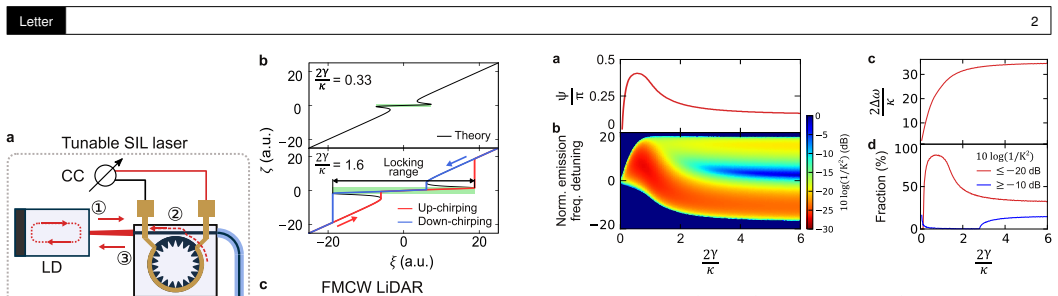
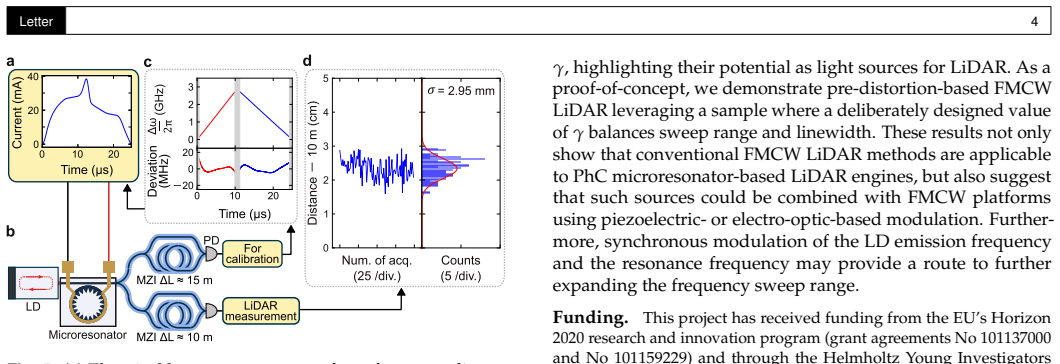
By setting the self-injection-locking feedback via corrugation in a photonic-crystal microresonator, the frequency modulation characteristics become controllable through resonator tuning. This leads to demonstrations of 224 THz/s up- and down-chirps over 3 GHz using sub-1 V microheaters and ranging a 10 m fiber to better than 3 mm standard deviation.
What carries the argument
Corrugated photonic-crystal microresonator that sets the designed self-injection-locking feedback strength to govern the sweep range and phase noise during modulation.
If this is right
- Linearized frequency chirps at 224 THz/s become possible with sub-1 V tuning.
- A trade-off exists where stronger feedback widens the sweep range but impacts noise performance.
- Compact CMOS-compatible LiDAR sources can achieve sub-3 mm ranging precision in proof-of-concept tests.
- Up- and down-chirps are both linearized for bidirectional operation.
Where Pith is reading between the lines
- This design could be adapted for integration into silicon photonics platforms for full on-chip LiDAR.
- The feedback engineering principle might apply to other high-Q resonator lasers to reduce reliance on stochastic effects.
- Further optimization of corrugation could extend the sweep range while maintaining acceptable noise for longer distance ranging.
Load-bearing premise
The observed self-injection-locking sweep range and noise are governed by the designed corrugated feedback rather than by uncontrolled backscattering within the resonator.
What would settle it
Fabricating and testing an otherwise identical microresonator without the corrugation and observing whether the frequency sweep range and noise characteristics remain unchanged during modulation.
Figures

read the original abstract
Self-injection-locked (SIL) narrow-linewidth lasers based on high-Q microresonators are promising sources for frequency-modulated continuous-wave (FMCW) LiDAR, but the SIL mechanism as well as its key characteristics such as the frequency sweep range and the noise performance are often determined by uncontrolled backscattering in the resonator. Here, we investigate a tunable SIL laser based on a corrugated photonic-crystal (PhC) microresonator in which the feedback strength is set by design. Numerical and experimental results show that stronger SIL feedback expands the sweep range accessible through resonator modulation while also impacting the phase-noise and linewidth during sweeping, revealing a trade-off between frequency tunability and noise performance. Using CMOS-compatible microheater tuning (sub-1 V driving voltage), we demonstrate linearized up- and down-chirps with 224 THz/s over approximately 3 GHz and, in a proof-of-concept ranging experiment, measure a 10 m fiber length with a standard deviation below 3 mm. These results establish PhC microresonators with engineered SIL feedback as robust, compact, CMOS-compatible LiDAR engines.
Editorial analysis
A structured set of objections, weighed in public.
Referee Report
Summary. The paper claims to demonstrate a tunable self-injection-locked (SIL) laser based on a corrugated photonic-crystal microresonator in which feedback strength is set by design rather than uncontrolled backscattering. Numerical and experimental results show a trade-off between sweep range and noise performance under resonator modulation; using CMOS-compatible microheater tuning at sub-1 V, the authors report linearized up- and down-chirps of 224 THz/s over ~3 GHz and a proof-of-concept ranging measurement of a 10 m fiber with standard deviation below 3 mm, positioning these devices as robust LiDAR engines.
Significance. If the central attribution to engineered corrugation holds, the work offers a compact, low-voltage, CMOS-compatible FMCW LiDAR source with competitive chirp rates and ranging precision. The explicit demonstration of design-controlled SIL feedback and the quantified trade-off between tunability and phase noise would be valuable for integrable photonic systems, provided the numerical-experimental agreement is robust.
major comments (1)
- [Experimental results and methods] The manuscript does not provide a control experiment (e.g., identical resonator without corrugation) or a quantitative isolation of feedback strength (measured coefficient versus corrugation amplitude) to confirm that the designed PhC corrugation dominates residual backscattering, surface roughness, or fabrication defects. This is load-bearing for the central claim, as the abstract itself notes that conventional SIL behavior is typically set by uncontrolled backscattering; without such isolation, the reported 224 THz/s sweep range, noise characteristics, and robustness cannot be unambiguously attributed to the engineered geometry.
Simulated Author's Rebuttal
We thank the referee for the constructive and detailed review. The major comment raises an important point about experimental isolation of the engineered feedback mechanism, which we address below.
read point-by-point responses
-
Referee: The manuscript does not provide a control experiment (e.g., identical resonator without corrugation) or a quantitative isolation of feedback strength (measured coefficient versus corrugation amplitude) to confirm that the designed PhC corrugation dominates residual backscattering, surface roughness, or fabrication defects. This is load-bearing for the central claim, as the abstract itself notes that conventional SIL behavior is typically set by uncontrolled backscattering; without such isolation, the reported 224 THz/s sweep range, noise characteristics, and robustness cannot be unambiguously attributed to the engineered geometry.
Authors: We agree that unambiguous attribution requires isolating the corrugation contribution. Our numerical model explicitly compares resonators with and without corrugation (and across a range of corrugation amplitudes), demonstrating that the designed feedback strength sets the locking range and sweep behavior while residual backscattering at typical fabrication levels produces negligible effect. Experimentally, multiple devices with varying corrugation depths show sweep ranges and noise scaling that match the simulated dependence on designed feedback coefficient rather than exhibiting the device-to-device variability characteristic of uncontrolled scattering. We acknowledge that a physical control device with identical geometry but zero corrugation would provide the strongest confirmation; however, achieving precisely matched Q and coupling in such a device is limited by fabrication tolerances. In revision we will add a dedicated subsection presenting the numerical isolation results, quantitative extraction of feedback coefficients from measured locking dynamics versus corrugation amplitude, and a comparison against literature values for residual backscattering in similar silicon-nitride resonators. These additions will make the attribution explicit while remaining within the existing data set. revision: partial
Circularity Check
No circularity: experimental demonstration with independent measurements
full rationale
The manuscript is an experimental report on a tunable SIL laser using a corrugated PhC microresonator. All central performance metrics (224 THz/s chirp rate over ~3 GHz, <3 mm ranging std. dev., trade-off between sweep range and phase noise) are obtained from direct laboratory measurements under microheater tuning and from numerical simulations of the designed geometry. No derivation chain exists that reduces a claimed prediction to a fitted parameter or to a self-citation by algebraic identity. The assertion that corrugation sets feedback strength is supported by design comparison and observed behavior rather than by any self-referential equation or load-bearing prior result from the same authors. The work therefore contains no self-definitional, fitted-input, or self-citation circularity.
Axiom & Free-Parameter Ledger
Reference graph
Works this paper leans on
-
[1]
L. Tang, H. Jia, S. Shao,et al., Photonics Res.9, 1948 (2021)
1948
-
[2]
N. Y . Dmitriev, S. N. Koptyaev, A. S. Voloshin,et al., Phys. Rev. Appl. 18, 034068 (2022)
2022
-
[3]
Lihachev, J
G. Lihachev, J. Riemensberger, W. Weng,et al., Nat. Commun.13, 3522 (2022)
2022
-
[4]
Snigirev, A
V. Snigirev, A. Riedhauser, G. Lihachev,et al., Nature615, 411 (2023)
2023
-
[5]
Lukashchuk, H
A. Lukashchuk, H. K. Yildirim, A. Bancora,et al., Nat. Commun.15, 3134 (2024)
2024
-
[6]
Behroozpour, P
B. Behroozpour, P . A. Sandborn, M. C. Wu, and B. E. Boser, IEEE Commun. Mag.55, 135 (2017)
2017
-
[7]
N. M. Kondratiev, V. E. Lobanov, A. E. Shitikov,et al., Front. Phys.18, 21305 (2023)
2023
-
[8]
R. R. Galiev, N. M. Kondratiev, V. E. Lobanov,et al., Phys. Rev. Appl. 14, 014036 (2020)
2020
-
[9]
Jin, Q.-F
W. Jin, Q.-F . Y ang, L. Chang,et al., Nat. Photonics15, 346 (2021)
2021
-
[10]
B. Li, W. Jin, L. Wu,et al., Opt. Lett.46, 5201 (2021)
2021
-
[11]
A. S. Voloshin, N. M. Kondratiev, G. V. Lihachev,et al., Nat. Commun. 12, 235 (2021)
2021
-
[12]
B. Shen, X. Zhang, Y . Wang,et al., Photonics Res.12, A41 (2024)
2024
-
[13]
Q. Su, F . Wei, C. Chen,et al., J. Light. Technol.41, 6756 (2023)
2023
-
[14]
Wildi, A
T. Wildi, A. E. Ulanov, T. Voumard,et al., Nat. Commun.15, 7030 (2024)
2024
-
[15]
S.-P . Yu, D. C. Cole, H. Jung,et al., Nat. Photonics15, 461 (2021)
2021
-
[16]
Lucas, S.-P
E. Lucas, S.-P . Yu, T. C. Briles,et al., Nat. Photonics17, 943 (2023)
2023
-
[17]
J. A. Black, G. Brodnik, H. Liu,et al., Optica9, 1183 (2022)
2022
-
[18]
A. E. Ulanov, T. Wildi, N. G. Pavlov,et al., Nat. Photonics18, 294 (2024)
2024
-
[19]
Kondratiev, V
N. Kondratiev, V. Lobanov, A. Cherenkov,et al., Opt. Express25, 28167 (2017)
2017
-
[21]
D. A. Chermoshentsev, A. E. Shitikov, E. A. Lonshakov,et al., Opt. Express30, 17094 (2022)
2022
-
[22]
Kikuchi, Opt
K. Kikuchi, Opt. Express20, 5291 (2012)
2012
-
[23]
Nishimoto, K
K. Nishimoto, K. Minoshima, T. Y asui, and N. Kuse, Opt. Lett.47, 281 (2022). Letter 5 FULL REFERENCES
2022
-
[24]
Hybrid integrated low-noise linear chirp frequency-modulated continuous-wave laser source based on self- injection to an external cavity,
L. Tang, H. Jia, S. Shao,et al., “Hybrid integrated low-noise linear chirp frequency-modulated continuous-wave laser source based on self- injection to an external cavity,” Photonics Res.9, 1948–1957 (2021)
1948
-
[25]
Hybrid integrated dual-microcomb source,
N. Y . Dmitriev, S. N. Koptyaev, A. S. Voloshin,et al., “Hybrid integrated dual-microcomb source,” Phys. Rev. Appl.18, 034068 (2022)
2022
-
[26]
Low-noise frequency- agile photonic integrated lasers for coherent ranging,
G. Lihachev, J. Riemensberger, W. Weng,et al., “Low-noise frequency- agile photonic integrated lasers for coherent ranging,” Nat. Commun. 13, 3522 (2022)
2022
-
[27]
Ultrafast tunable lasers using lithium niobate integrated photonics,
V. Snigirev, A. Riedhauser, G. Lihachev,et al., “Ultrafast tunable lasers using lithium niobate integrated photonics,” Nature615, 411–417 (2023)
2023
-
[28]
Photonic-electronic integrated circuit-based coherent LiDAR engine,
A. Lukashchuk, H. K. Yildirim, A. Bancora,et al., “Photonic-electronic integrated circuit-based coherent LiDAR engine,” Nat. Commun.15, 3134 (2024)
2024
-
[29]
Lidar system architectures and circuits,
B. Behroozpour, P . A. Sandborn, M. C. Wu, and B. E. Boser, “Lidar system architectures and circuits,” IEEE Commun. Mag.55, 135–142 (2017)
2017
-
[30]
Recent advances in laser self-injection locking to high-Q microresonators,
N. M. Kondratiev, V. E. Lobanov, A. E. Shitikov,et al., “Recent advances in laser self-injection locking to high-Q microresonators,” Front. Phys. 18, 21305 (2023)
2023
-
[31]
Optimization of laser stabilization via self-injection locking to a whispering-gallery-mode microresonator,
R. R. Galiev, N. M. Kondratiev, V. E. Lobanov,et al., “Optimization of laser stabilization via self-injection locking to a whispering-gallery-mode microresonator,” Phys. Rev. Appl.14, 014036 (2020)
2020
-
[32]
Hertz-linewidth semiconductor lasers using CMOS-ready ultra-high-Q microresonators,
W. Jin, Q.-F . Y ang, L. Chang,et al., “Hertz-linewidth semiconductor lasers using CMOS-ready ultra-high-Q microresonators,” Nat. Photon- ics15, 346–353 (2021)
2021
-
[33]
Reaching fiber-laser coherence in integrated photonics,
B. Li, W. Jin, L. Wu,et al., “Reaching fiber-laser coherence in integrated photonics,” Opt. Lett.46, 5201–5204 (2021)
2021
-
[34]
Dynamics of soliton self-injection locking in optical microresonators,
A. S. Voloshin, N. M. Kondratiev, G. V. Lihachev,et al., “Dynamics of soliton self-injection locking in optical microresonators,” Nat. Commun. 12, 235 (2021)
2021
-
[35]
Reliable intracavity reflection for self-injection locking lasers and microcomb generation,
B. Shen, X. Zhang, Y . Wang,et al., “Reliable intracavity reflection for self-injection locking lasers and microcomb generation,” Photonics Res. 12, A41–A50 (2024)
2024
-
[36]
A self-injection locked laser based on high-Q micro-ring resonator with adjustable feedback,
Q. Su, F . Wei, C. Chen,et al., “A self-injection locked laser based on high-Q micro-ring resonator with adjustable feedback,” J. Light. Technol. 41, 6756–6763 (2023)
2023
-
[37]
Phase-stabilised self- injection-locked microcomb,
T. Wildi, A. E. Ulanov, T. Voumard,et al., “Phase-stabilised self- injection-locked microcomb,” Nat. Commun.15, 7030 (2024)
2024
-
[38]
Spontaneous pulse formation in edgeless photonic crystal resonators,
S.-P . Yu, D. C. Cole, H. Jung,et al., “Spontaneous pulse formation in edgeless photonic crystal resonators,” Nat. Photonics15, 461–467 (2021)
2021
-
[39]
Tailoring microcombs with inverse-designed, meta-dispersion microresonators,
E. Lucas, S.-P . Yu, T. C. Briles,et al., “Tailoring microcombs with inverse-designed, meta-dispersion microresonators,” Nat. Photonics 17, 943–950 (2023)
2023
-
[40]
Optical-parametric oscillation in photonic-crystal ring resonators,
J. A. Black, G. Brodnik, H. Liu,et al., “Optical-parametric oscillation in photonic-crystal ring resonators,” Optica9, 1183–1189 (2022)
2022
-
[41]
Synthetic reflection self- injection-locked microcombs,
A. E. Ulanov, T. Wildi, N. G. Pavlov,et al., “Synthetic reflection self- injection-locked microcombs,” Nat. Photonics18, 294–299 (2024)
2024
-
[42]
Self-injection locking of a laser diode to a high-Q WGM microresonator,
N. Kondratiev, V. Lobanov, A. Cherenkov,et al., “Self-injection locking of a laser diode to a high-Q WGM microresonator,” Opt. Express25, 28167–28178 (2017)
2017
-
[43]
Frequency combs and coherent dissipative structures in nonlinear optical microresonators
T. Herr, A. Tikan, and T. J. Kippenberg, “Frequency combs and co- herent dissipative structures in nonlinear optical microresonators,” arXiv:2604.05897 (2026)
work page internal anchor Pith review Pith/arXiv arXiv 2026
-
[44]
Dual- laser self-injection locking to an integrated microresonator,
D. A. Chermoshentsev, A. E. Shitikov, E. A. Lonshakov,et al., “Dual- laser self-injection locking to an integrated microresonator,” Opt. Ex- press30, 17094–17105 (2022)
2022
-
[45]
Characterization of semiconductor-laser phase noise and estimation of bit-error rate performance with low-speed offline digital coherent receivers,
K. Kikuchi, “Characterization of semiconductor-laser phase noise and estimation of bit-error rate performance with low-speed offline digital coherent receivers,” Opt. Express20, 5291–5302 (2012)
2012
-
[46]
Thermal control of a Kerr microresonator soliton comb via an optical sideband,
K. Nishimoto, K. Minoshima, T. Y asui, and N. Kuse, “Thermal control of a Kerr microresonator soliton comb via an optical sideband,” Opt. Lett. 47, 281–284 (2022)
2022
discussion (0)
Sign in with ORCID, Apple, or X to comment. Anyone can read and Pith papers without signing in.