Recognition: unknown
Microscopic evidence for imaginary charge density wave in a kagome metal
Pith reviewed 2026-05-08 16:12 UTC · model grok-4.3
The pith
Nuclear quadrupole resonance detects ~1 mT local fields from chiral loop currents in CsV3Sb5, confirming imaginary charge density wave order.
A machine-rendered reading of the paper's core claim, the machinery that carries it, and where it could break.
Core claim
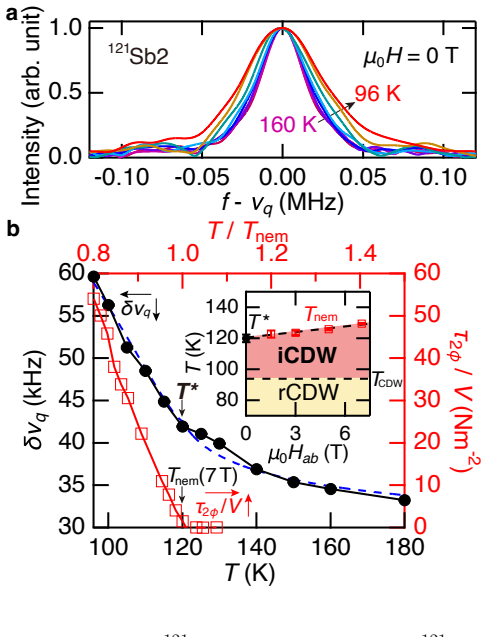
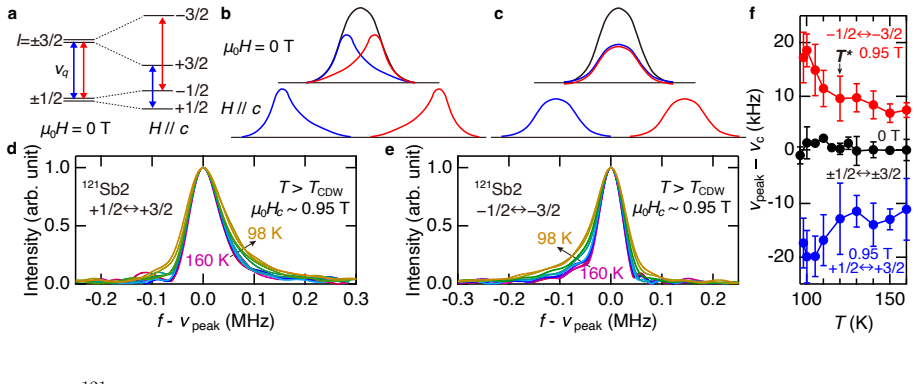
NQR spectra at the out-of-plane 121Sb site reveal anomalous broadening below T* ≈ 120 K that coincides with the nematic transition. Under magnetic fields the spectra develop asymmetric lineshapes, proving the broadening is purely magnetic in origin. The observed shapes are quantitatively consistent with approximately 1 mT local fields generated by chiral loop currents, demonstrating spontaneous time-reversal symmetry breaking associated with imaginary charge density wave order.
What carries the argument
Imaginary charge density wave (iCDW) order, which generates chiral loop currents that produce static local magnetic fields at antimony sites, detected through the broadening and field-induced asymmetry of NQR lineshapes.
If this is right
- Time-reversal symmetry breaking occurs at the nematic transition temperature well above the onset of the real charge density wave.
- The imaginary charge density wave constitutes a distinct quantum ordered state that can exist independently of conventional CDW order.
- Chiral loop currents provide a microscopic mechanism for dissipationless transport phenomena not tied to superconductivity or the quantum Hall effect.
- The same NQR signatures should appear in other kagome metals that exhibit nematicity above a real CDW transition.
Where Pith is reading between the lines
- If iCDW order is confirmed, it may account for anomalous Hall conductivity and other transport features observed in kagome metals without invoking additional orders.
- The NQR technique demonstrated here could be applied to doped or strained variants of CsV3Sb5 to test the stability range of pure iCDW order.
- Theoretical calculations of kagome lattices that include imaginary hopping terms should be checked for consistency with the measured local field strength of ~1 mT.
Load-bearing premise
The observed NQR broadening and asymmetry arise exclusively from static local magnetic fields produced by chiral loop currents rather than from dynamic charge density wave fluctuations, structural distortions, or other quadrupolar or magnetic effects.
What would settle it
Zero-field muon spin relaxation measurements showing no local magnetic fields of order 1 mT, or NQR lineshapes that can be reproduced by quadrupolar models without any magnetic contribution, would falsify the iCDW interpretation.
Figures


read the original abstract
Dissipationless charge transport without any energy loss is one of the most fascinating phenomena in condensed matter physics. This extraordinary state manifests in two well-established systems: superconductors and quantum Hall systems. A proposed third category is associated with chiral loop current order, characterized by the spontaneous formation of microscopic electric current loops. The microscopic origin of these currents stems from imaginary hopping terms, conceptualized as an imaginary charge density wave (iCDW). Despite extensive investigations, its existence remains highly controversial. Here we report site-selective spectroscopic evidence for a pure iCDW in the kagome nonmagnetic metal CsV$_3$Sb$_5$. Nuclear quadrupole resonance spectra at out-of-plane $^{121}$Sb site sensitive to in-plane currents reveal anomalous broadening below $T^*\approx$120 K, coinciding with the nematic transition well above the real charge density wave (CDW). Under magnetic fields, the spectra exhibit asymmetric lineshapes, demonstrating that this broadening purely originates from magnetic effects rather than from electric quadrupolar effects associated with CDW fluctuations. The observed lineshapes are quantitatively consistent with ~1 mT local fields induced by chiral loop currents, indicating spontaneous time-reversal symmetry breaking. This microscopic identification of the long-sought pure iCDW establishes a novel form of quantum order, potentially revolutionizing our understanding of exotic electronic states in quantum materials.
Editorial analysis
A structured set of objections, weighed in public.
Referee Report
Summary. The manuscript reports site-selective 121Sb NQR spectroscopy on the kagome metal CsV3Sb5. It identifies anomalous spectral broadening below T* ≈ 120 K that coincides with the nematic transition, well above the real CDW. Application of magnetic fields produces asymmetric lineshapes at the out-of-plane Sb site, which the authors interpret as arising from static local magnetic fields of order 1 mT generated by chiral loop currents of an imaginary CDW. This is presented as microscopic evidence for spontaneous time-reversal symmetry breaking in a pure iCDW state.
Significance. If the interpretation is sustained, the result would supply direct microscopic support for iCDW order in kagome metals, a long-standing and controversial proposal. The use of NQR to detect small local fields via lineshape asymmetry is a standard and appropriate technique in the field; the raw spectroscopic data and reliance on established NQR response theory constitute clear strengths. The reported ~1 mT scale is within the range expected from theoretical estimates of loop-current magnitudes.
major comments (3)
- [NQR lineshape analysis and modeling] The quantitative modeling of the observed lineshapes as arising from a ~1 mT local-field distribution is central to the claim of consistency with iCDW currents. The manuscript must supply the explicit functional form of the local-field distribution, the precise convolution with the NQR response function, and the fitting procedure (including any free parameters such as the field magnitude) so that readers can assess uniqueness and rule out alternative broadening mechanisms.
- [Magnetic-field dependence and control experiments] The field-induced asymmetry is used to argue for a purely magnetic (rather than quadrupolar) origin. However, the manuscript does not present simulations demonstrating that dynamic fluctuations of the real CDW order parameter or residual electric-field-gradient variations from lattice distortions would be unable to generate comparable asymmetry under the specific field strengths and orientations employed. This exclusion is load-bearing for the 'pure iCDW' interpretation.
- [Discussion of quadrupolar exclusion] The abstract states that a control experiment rules out quadrupolar effects, yet the main text does not provide a detailed comparison (e.g., temperature or site dependence of the asymmetry, or explicit null-result simulations) that would allow independent verification that no mixed magnetic-quadrupolar mechanism remains viable.
minor comments (2)
- Figure captions should explicitly state the functional form assumed for the local-field distribution and any convolution details used in the lineshape fits.
- Ensure uniform reporting of the value of T* and its uncertainty across the abstract, main text, and figures.
Simulated Author's Rebuttal
We thank the referee for their careful reading of our manuscript and for highlighting the importance of detailed lineshape analysis and control experiments. We have revised the manuscript to incorporate additional details and simulations as requested, which we believe strengthen the presentation of our results on the iCDW in CsV3Sb5.
read point-by-point responses
-
Referee: [NQR lineshape analysis and modeling] The quantitative modeling of the observed lineshapes as arising from a ~1 mT local-field distribution is central to the claim of consistency with iCDW currents. The manuscript must supply the explicit functional form of the local-field distribution, the precise convolution with the NQR response function, and the fitting procedure (including any free parameters such as the field magnitude) so that readers can assess uniqueness and rule out alternative broadening mechanisms.
Authors: We fully agree that these modeling details are necessary to substantiate our interpretation. The original manuscript presented the fits but omitted some technical specifics for brevity. In the revised version, we have added the explicit functional form: the local magnetic field distribution is modeled as a Gaussian P(B) = (1/√(2π)σ) exp(-B²/(2σ²)) with σ ≈ 1 mT. This is convolved with the NQR response function for the 121Sb (I=5/2) transitions, accounting for the Zeeman perturbation on the quadrupolar levels. The fitting procedure uses least-squares minimization with the field magnitude as the main free parameter (other parameters fixed from zero-field spectra). We include the full equations and a table of fit parameters in the revised Methods section and Supplementary Information. Alternative mechanisms are discussed and shown to be inconsistent with the data. revision: yes
-
Referee: [Magnetic-field dependence and control experiments] The field-induced asymmetry is used to argue for a purely magnetic (rather than quadrupolar) origin. However, the manuscript does not present simulations demonstrating that dynamic fluctuations of the real CDW order parameter or residual electric-field-gradient variations from lattice distortions would be unable to generate comparable asymmetry under the specific field strengths and orientations employed. This exclusion is load-bearing for the 'pure iCDW' interpretation.
Authors: This is a valid concern, and we have addressed it by adding simulations in the revised manuscript. For dynamic fluctuations of the real CDW, we model the time-averaged EFG modulation and show that it leads to symmetric broadening without field-induced asymmetry at the applied fields (up to several Tesla). For residual EFG variations from lattice distortions, simulations indicate that the resulting lineshapes lack the characteristic asymmetry observed and do not scale with the applied field in the same manner as our data. These results are now presented in a new supplementary figure, supporting that the asymmetry is uniquely consistent with static local magnetic fields from iCDW currents. revision: yes
-
Referee: [Discussion of quadrupolar exclusion] The abstract states that a control experiment rules out quadrupolar effects, yet the main text does not provide a detailed comparison (e.g., temperature or site dependence of the asymmetry, or explicit null-result simulations) that would allow independent verification that no mixed magnetic-quadrupolar mechanism remains viable.
Authors: We have expanded the main text discussion in the revised manuscript to include a detailed comparison. Specifically, we show the temperature dependence of the asymmetry parameter, which onsets precisely at T* ≈ 120 K and is absent above it, correlating with the nematic transition rather than the lower CDW temperature. Site dependence is highlighted, with asymmetry observed only at the out-of-plane Sb site sensitive to in-plane currents. We also include explicit null-result simulations for mixed mechanisms, demonstrating that a significant quadrupolar component would produce detectable deviations in the lineshape not seen in experiment. This provides the independent verification requested. revision: yes
Circularity Check
No significant circularity; central claim rests on raw NQR data interpreted via standard theory
full rationale
The paper reports site-selective NQR spectra showing anomalous broadening below T* and field-induced asymmetry at the 121Sb site. It interprets these features as arising from ~1 mT static local fields due to chiral loop currents using conventional NQR lineshape modeling. No equation or parameter is defined in terms of the target iCDW result itself, no fitted input is relabeled as a prediction, and no load-bearing uniqueness theorem or ansatz is imported via self-citation. The derivation chain is therefore self-contained against external NQR response benchmarks and does not reduce to its own inputs by construction.
Axiom & Free-Parameter Ledger
free parameters (1)
- local magnetic field magnitude =
~1 mT
axioms (1)
- domain assumption The 121Sb NQR transition at the out-of-plane site is dominantly sensitive to in-plane magnetic fields via the magnetic dipole interaction and insensitive to electric field gradients from CDW order.
Reference graph
Works this paper leans on
-
[1]
Tinkham, M.Introduction to superconductivity(Courier Corporation, 2004)
2004
-
[2]
v., Dorda, G
Klitzing, K. v., Dorda, G. & Pepper, M. New Method for High-Accuracy Determination of the Fine-Structure Constant Based on Quantized Hall Resistance.Phys. Rev. Lett.45, 494–497 (1980)
1980
-
[3]
& Marston, J
Affleck, I. & Marston, J. B. Large-nlimit of the Heisenberg-Hubbard model: Implications for high-Tc superconductors.Phys. Rev. B37, 3774–3777 (1988)
1988
-
[4]
Haldane, F. D. M. Model for a Quantum Hall Effect without Landau Levels: Condensed- Matter Realization of the ”Parity Anomaly”.Phys. Rev. Lett.61, 2015–2018 (1988)
2015
-
[5]
Varma, C. M. Non-Fermi-liquid states and pairing instability of a general model of copper oxide metals.Phys. Rev. B55, 14554–14580 (1997)
1997
-
[6]
Pseudogap in cuprates in the loop-current ordered state.J
Varma, C. Pseudogap in cuprates in the loop-current ordered state.J. Phys. Condens. Matter. 26, 505701 (2014)
2014
-
[7]
Li, Y.et al.Unusual magnetic order in the pseudogap region of the superconductor HgBa2CuO4+δ.Nature455, 372–375 (2008)
2008
-
[8]
S., Kechedzhi, K
Pershoguba, S. S., Kechedzhi, K. & Yakovenko, V. M. Proposed Chiral Texture of the Magnetic Moments of Unit-Cell Loop Currents in the Pseudogap Phase of Cuprate Superconductors. 9 Phys. Rev. Lett.111, 047005 (2013)
2013
-
[9]
Phys.12, 32–36 (2016)
Zhao, L.et al.Evidence of an odd-parity hidden order in a spin–orbit coupled correlated iridate.Nat. Phys.12, 32–36 (2016)
2016
-
[10]
& Bourges, P
Jeong, J., Sidis, Y., Louat, A., Brouet, V. & Bourges, P. Time-reversal symmetry breaking hidden order in Sr 2(Ir, Rh)O4.Nat. Commun.8, 15119 (2017)
2017
-
[11]
Murayama, H.et al.Bond Directional Anapole Order in a Spin-Orbit Coupled Mott Insulator Sr2(Ir1−xRhx)O4.Phys. Rev. X11, 011021 (2021)
2021
-
[12]
& Senthil, T
Wang, F. & Senthil, T. Twisted Hubbard Model for Sr 2IrO4: Magnetism and Possible High Temperature Superconductivity.Phys. Rev. Lett.106, 136402 (2011)
2011
-
[13]
J.et al.Absence of Broken Time-Reversal Symmetry in the Pseudogap State of the High Temperature La 2−xSrxCuO4 Superconductor from Muon-Spin-Relaxation Measurements.Phys
MacDougall, G. J.et al.Absence of Broken Time-Reversal Symmetry in the Pseudogap State of the High Temperature La 2−xSrxCuO4 Superconductor from Muon-Spin-Relaxation Measurements.Phys. Rev. Lett.101, 017001 (2008)
2008
-
[14]
& Keller, H
Str¨ assle, S., Graneli, B., Mali, M., Roos, J. & Keller, H. Absence of Orbital Currents in Su- perconducting YBa2Cu4O8 Using a Zeeman-Perturbed Nuclear-Quadrupole-Resonance Tech- nique.Phys. Rev. Lett.106, 097003 (2011)
2011
-
[15]
P.et al.No evidence for orbital loop currents in charge-ordered YBa 2Cu3O6+x from polarized neutron diffraction.Phys
Croft, T. P.et al.No evidence for orbital loop currents in charge-ordered YBa 2Cu3O6+x from polarized neutron diffraction.Phys. Rev. B96, 214504 (2017)
2017
-
[16]
Adv.4, eaao5235 (2018)
Zhang, J.et al.Discovery of slow magnetic fluctuations and critical slowing down in the pseudogap phase of YBa 2Cu3Oy.Sci. Adv.4, eaao5235 (2018)
2018
-
[17]
Tan, C.et al.Slow magnetic fluctuations and critical slowing down in Sr 2Ir1−xRhxO4.Phys. Rev. B101, 195108 (2020)
2020
-
[18]
R.et al.New kagome prototype materials: discovery of KV 3Sb5,RbV 3Sb5, and CsV3Sb5.Phys
Ortiz, B. R.et al.New kagome prototype materials: discovery of KV 3Sb5,RbV 3Sb5, and CsV3Sb5.Phys. Rev. Mater.3, 094407 (2019)
2019
-
[19]
R.et al.CsV 3Sb5: AZ 2 Topological Kagome Metal with a Superconducting Ground State.Phys
Ortiz, B. R.et al.CsV 3Sb5: AZ 2 Topological Kagome Metal with a Superconducting Ground State.Phys. Rev. Lett.125, 247002 (2020)
2020
-
[20]
& Balents, L
Park, T., Ye, M. & Balents, L. Electronic instabilities of kagome metals: Saddle points and Landau theory.Phys. Rev. B104, 035142 (2021)
2021
-
[21]
& Nandkishore, R
Lin, Y.-P. & Nandkishore, R. M. Complex charge density waves at Van Hove singularity on hexagonal lattices: Haldane-model phase diagram and potential realization in the kagome metalsAV 3Sb5 (A=K, Rb, Cs).Phys. Rev. B104, 045122 (2021)
2021
-
[22]
H., Birol, T., Andersen, B
Christensen, M. H., Birol, T., Andersen, B. M. & Fernandes, R. M. Loop currents inAV 3Sb5 10 kagome metals: Multipolar and toroidal magnetic orders.Phys. Rev. B106, 144504 (2022)
2022
-
[23]
M., Thomale, R
Denner, M. M., Thomale, R. & Neupert, T. Analysis of Charge Order in the Kagome Metal AV3Sb5 (A= K,Rb,Cs).Phys. Rev. Lett.127, 217601 (2021)
2021
-
[24]
& Kontani, H
Tazai, R., Yamakawa, Y. & Kontani, H. Charge-loop current order andZ3 nematicity mediated by bond order fluctuations in kagome metals.Nat. Commun.14, 7845 (2023)
2023
-
[25]
& Kontani, H
Tazai, R., Yamakawa, Y. & Kontani, H. Drastic magnetic-field-induced chiral current order and emergent current-bond-field interplay in kagome metals.Proc. Natl. Acad. Sci.121, e2303476121 (2024)
2024
-
[26]
& Kontani, H
Shimura, K., Tazai, R., Yamakawa, Y., Onari, S. & Kontani, H. Real-Space Loop Current Pattern in Time-Reversal-Symmetry Breaking Phase in Kagome Metals.J. Phys. Soc. Jpn. 93, 033704 (2024)
2024
-
[27]
Adv.6, eabb6003 (2020)
Yang, S.-Y.et al.Giant, unconventional anomalous Hall effect in the metallic frustrated magnet candidate, KV 3Sb5.Sci. Adv.6, eabb6003 (2020)
2020
-
[28]
H.et al.Concurrence of anomalous Hall effect and charge density wave in a supercon- ducting topological kagome metal.Phys
Yu, F. H.et al.Concurrence of anomalous Hall effect and charge density wave in a supercon- ducting topological kagome metal.Phys. Rev. B104, L041103 (2021)
2021
-
[29]
Jiang, Y.-X.et al.Unconventional chiral charge order in kagome superconductor KV 3Sb5. Nat. Mater.20, 1353–1357 (2021)
2021
-
[30]
Guo, C.et al.Switchable chiral transport in charge-ordered kagome metal CsV 3Sb5.Nature 611, 461–466 (2022)
2022
-
[31]
Mielke III, C.et al.Time-reversal symmetry-breaking charge order in a kagome superconduc- tor.Nature602, 245–250 (2022)
2022
-
[32]
Khasanov, R.et al.Time-reversal symmetry broken by charge order in CsV 3Sb5.Phys. Rev. Res.4, 023244 (2022)
2022
-
[33]
Commun.14, 153 (2023)
Guguchia, Z.et al.Tunable unconventional kagome superconductivity in charge ordered RbV3Sb5 and KV3Sb5.Nat. Commun.14, 153 (2023)
2023
-
[34]
Commun.15, 8978 (2024)
Graham, J.et al.Depth-dependent study of time-reversal symmetry-breaking in the kagome superconductorAV 3Sb5.Nat. Commun.15, 8978 (2024)
2024
-
[35]
Phys.18, 1470–1475 (2022)
Xu, Y.et al.Three-state nematicity and magneto-optical Kerr effect in the charge density waves in kagome superconductors.Nat. Phys.18, 1470–1475 (2022)
2022
- [36]
-
[37]
R.et al.High Resolution Polar Kerr Effect Studies of CsV 3Sb5: Tests for Time- Reversal Symmetry Breaking below the Charge-Order Transition.Phys
Saykin, D. R.et al.High Resolution Polar Kerr Effect Studies of CsV 3Sb5: Tests for Time- Reversal Symmetry Breaking below the Charge-Order Transition.Phys. Rev. Lett.131, 016901 (2023)
2023
-
[38]
Li, H.et al.No observation of chiral flux current in the topological kagome metal CsV 3Sb5. Phys. Rev. B105, 045102 (2022)
2022
-
[39]
Li` ege, W.et al.Search for orbital magnetism in the kagome superconductor CsV 3Sb5 using neutron diffraction.Phys. Rev. B110, 195109 (2024)
2024
-
[40]
Guo, C.et al.Correlated order at the tipping point in the kagome metal CsV 3Sb5.Nat. Phys. 20, 579–584 (2024)
2024
-
[41]
Phys.20, 40–46 (2024)
Asaba, T.et al.Evidence for an odd-parity nematic phase above the charge-density-wave transition in a kagome metal.Nat. Phys.20, 40–46 (2024)
2024
-
[42]
Density-wave states of nonzero angular momentum.Phys
Nayak, C. Density-wave states of nonzero angular momentum.Phys. Rev. B62, 4880–4889 (2000)
2000
-
[43]
& Teˇ sanovi´ c, Z
Kang, J. & Teˇ sanovi´ c, Z. Theory of the valley-density wave and hidden order in iron pnictides. Phys. Rev. B83, 020505 (2011)
2011
-
[44]
V., Fernandes, R
Chubukov, A. V., Fernandes, R. M. & Schmalian, J. Origin of nematic order in FeSe.Phys. Rev. B91, 201105 (2015)
2015
-
[45]
Luo, J.et al.Possible star-of-David pattern charge density wave with additional modulation in the kagome superconductor CsV 3Sb5.npj Quantum Mater.7, 30 (2022)
2022
-
[46]
8, 23 (2023)
Feng, X.et al.Commensurate-to-incommensurate transition of charge-density-wave order and a possible quantum critical point in pressurized kagome metal CsV 3Sb5.npj Quantum Mater. 8, 23 (2023)
2023
-
[47]
K.et al.Further conventions for NMR shielding and chemical shifts (IUPAC Recommendations 2008).Pure Appl
Harris, R. K.et al.Further conventions for NMR shielding and chemical shifts (IUPAC Recommendations 2008).Pure Appl. Chem.80, 59–84 (2008)
2008
-
[48]
Commun.12, 6727 (2021)
Xiang, Y.et al.Twofold symmetry ofc-axis resistivity in topological kagome superconductor CsV3Sb5 with in-plane rotating magnetic field.Nat. Commun.12, 6727 (2021)
2021
-
[49]
Mu, C.et al.S-wave superconductivity in kagome metal CsV 3Sb5 revealed by 121/123Sb NQR and 51V NMR measurements.Chin. Phys. Lett.38, 077402 (2021)
2021
-
[50]
Tazai, R., Matsubara, S., Yamakawa, Y., Onari, S. & Kontani, H. Rigorous formalism for unconventional symmetry breaking in Fermi liquid theory and its application to nematicity in FeSe.Phys. Rev. B107, 035137 (2023). 12 METHODS Single crystal growth High-quality single crystals of CsV3Sb5 were grown by a self-flux method with a Cs-Sb binary eutectic mixtu...
-
[51]
& Kontani, H
Tazai, R., Yamakawa, Y. & Kontani, H. Drastic magnetic-field-induced chiral current or- der and emergent current-bond-field interplay in kagome metals.Proc. Natl. Acad. Sci.121, e2303476121 (2024)
2024
-
[52]
Mu, C.et al.S-wave superconductivity in kagome metal CsV 3Sb5 revealed by 121/123Sb NQR and 51V NMR measurements.Chin. Phys. Lett.38, 077402 (2021). 7
2021
discussion (0)
Sign in with ORCID, Apple, or X to comment. Anyone can read and Pith papers without signing in.