Recognition: unknown
BDF2-type integrator for Landau-Lifshitz-Gilbert equation in micromagnetics: a-priori error estimates
Pith reviewed 2026-05-08 15:49 UTC · model grok-4.3
The pith
A linear BDF2 scheme paired with finite elements achieves optimal-order convergence for the Landau-Lifshitz-Gilbert equation.
A machine-rendered reading of the paper's core claim, the machinery that carries it, and where it could break.
Core claim
The fully discrete scheme that combines first-order finite elements in space with the BDF2 method in time satisfies optimal-order a-priori error estimates for the Landau-Lifshitz-Gilbert equation when the exact solution and external field are sufficiently regular. The analysis covers both the spatial and temporal discretization errors, and the combination with prior unconditional weak-convergence results yields convergence to both weak and strong solutions.
What carries the argument
The BDF2-type time integrator combined with linear finite-element discretization in space, which produces a linear algebraic problem at each step while retaining the unit-length constraint in the limit.
If this is right
- The scheme converges at the rate O(h + k^2) in appropriate norms when regularity holds.
- The integrator converges to both weak and strong solutions of the Landau-Lifshitz-Gilbert equation.
- Only one linear solve is required per time step.
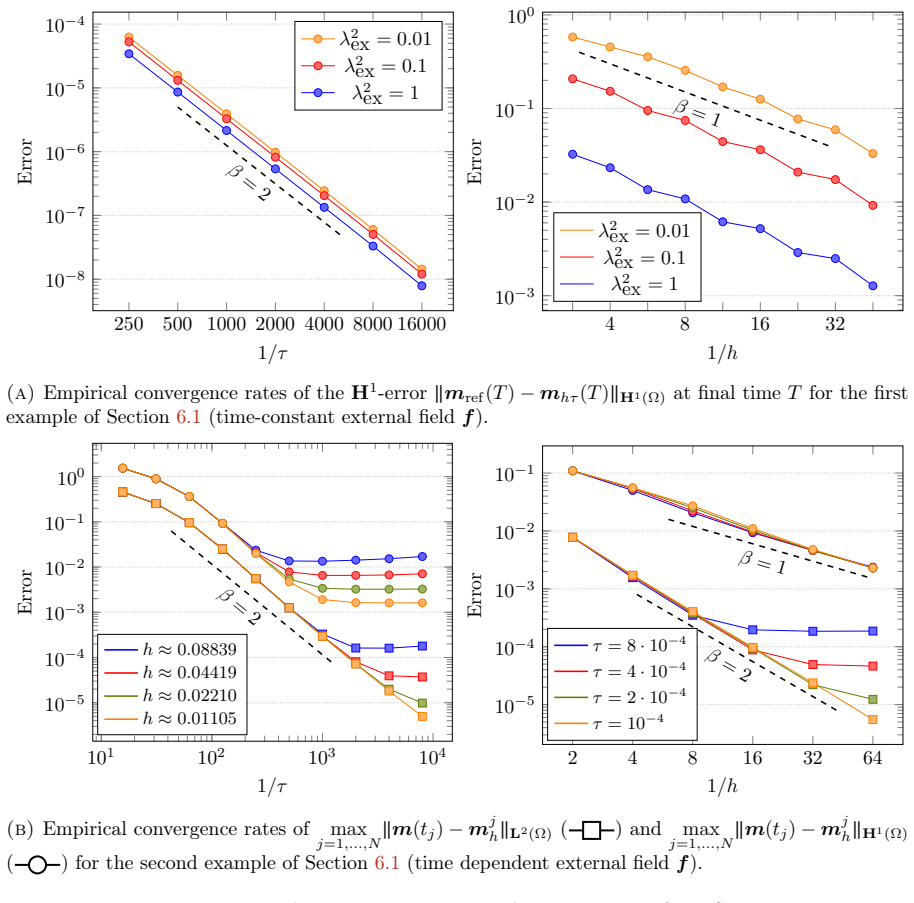
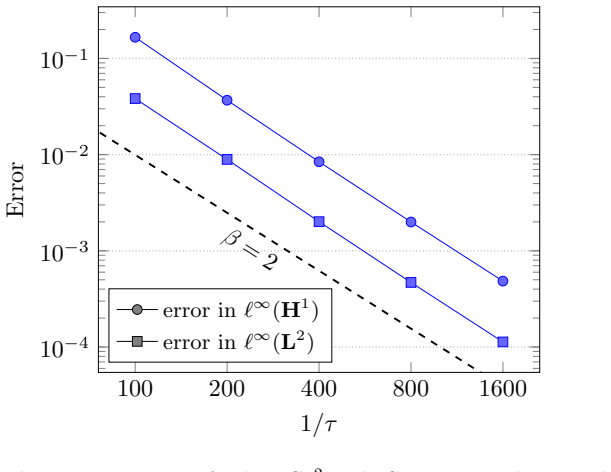
- Numerical experiments confirm first-order spatial and second-order temporal convergence.
Where Pith is reading between the lines
- The linearization strategy may extend to other nonlinear evolution equations with pointwise constraints.
- Such methods could reduce computational cost in large-scale micromagnetic simulations compared with nonlinear implicit schemes.
- The approach suggests that explicit enforcement of the unit-length constraint is unnecessary for convergence when the scheme is designed appropriately.
Load-bearing premise
The exact solution and external field must possess sufficient regularity for the optimal-order error estimates to hold.
What would settle it
A numerical test on a smooth manufactured solution where the observed temporal error fails to decrease at the expected second-order rate as the time step is halved would contradict the claimed convergence.
Figures


read the original abstract
We consider the Landau-Lifshitz-Gilbert equation (LLG), which models time-dependent micromagnetic phenomena. We analyze a fully discrete scheme that combines first-order finite elements in space with a BDF2 method in time. The method requires the solution of only one linear system of equations per time step and does not enforce the pointwise unit-length constraint of the magnetization. While unconditional weak convergence has been analyzed in an earlier work, we now prove optimal-order convergence rates under sufficient regularity assumptions on the exact solution and the external field. In combination with our previous work, this establishes the first higher-order-in-time and linear integrator that converges both to weak and strong solutions of LLG. Numerical experiments confirm first-order convergence in space and second-order convergence in time.
Editorial analysis
A structured set of objections, weighed in public.
Referee Report
Summary. The paper analyzes a fully discrete scheme for the Landau-Lifshitz-Gilbert equation that pairs first-order finite elements in space with a BDF2 time integrator. The scheme is linear and does not enforce the unit-length constraint pointwise. Building on prior unconditional weak convergence results, the authors prove optimal-order a-priori error estimates (first-order in space, second-order in time) under sufficient regularity assumptions on the exact solution and external field. Numerical experiments are presented to confirm the rates.
Significance. If the regularity hypotheses are compatible with the LLG structure and satisfied in the regimes of interest, the result supplies the first linear, higher-order-in-time integrator with rigorous convergence to both weak and strong solutions. This is a meaningful advance for efficient micromagnetics simulation, where nonlinearity and constraint handling are computationally expensive. The combination of the new strong-convergence analysis with the authors' earlier weak-convergence work is a clear strength.
major comments (1)
- [§3] §3 (main error theorem): The optimal-rate statement requires Sobolev regularity on the exact solution (typically H^2 in space and H^2 or higher in time) and on the external field. The manuscript does not discuss whether these assumptions are compatible with the LLG equation or satisfied by the manufactured solutions employed in the numerical tests; without such verification the observed convergence rates do not confirm the theorem under the stated hypotheses.
minor comments (2)
- [Abstract] The abstract and introduction should explicitly state the precise norms in which the error estimates are proved (e.g., L^2 or H^1).
- [§2] Notation for the discrete magnetization and the projection operators should be introduced once and used consistently throughout the analysis section.
Simulated Author's Rebuttal
We thank the referee for the careful reading of the manuscript and the constructive comment on the regularity assumptions. We address the point below and will revise the manuscript to incorporate the requested clarification.
read point-by-point responses
-
Referee: [§3] §3 (main error theorem): The optimal-rate statement requires Sobolev regularity on the exact solution (typically H^2 in space and H^2 or higher in time) and on the external field. The manuscript does not discuss whether these assumptions are compatible with the LLG equation or satisfied by the manufactured solutions employed in the numerical tests; without such verification the observed convergence rates do not confirm the theorem under the stated hypotheses.
Authors: We agree that an explicit discussion of the regularity hypotheses is useful. The manufactured solutions employed in the numerical experiments are constructed analytically as smooth functions that satisfy the precise Sobolev regularity required by the theorem by design. We will add a short paragraph (or remark) in the revised Section 3 clarifying this choice of test solutions and noting that the assumed regularity is compatible with the LLG equation for sufficiently smooth initial data and external fields, consistent with local-in-time existence results available in the literature. This addition will confirm that the observed convergence rates are consistent with the theorem under the stated hypotheses. revision: yes
Circularity Check
Minor self-citation for weak-convergence foundation; new error estimates derived independently via standard techniques
full rationale
The paper's core contribution is the a-priori error analysis for the BDF2 scheme under regularity assumptions, which the abstract describes as built from energy estimates and approximation theory rather than any fitted parameters or self-referential definitions. The combination with prior work to claim 'first' status for both weak and strong convergence is a synthesis step, not a derivation that reduces to the inputs by construction. No self-definitional loops, fitted predictions, or ansatz smuggling appear in the provided abstract or described structure. This matches the expected non-circular case for a follow-up analysis paper.
Axiom & Free-Parameter Ledger
axioms (2)
- domain assumption The exact solution and external field satisfy sufficient regularity assumptions for optimal-order error estimates.
- standard math Standard Sobolev-space approximation properties of linear finite elements and BDF2 time discretization apply.
Reference graph
Works this paper leans on
-
[1]
[AFKL21] G. Akrivis, M. Feischl, B. Kovács, and C. Lubich. Higher-order linearly implicit full discretization of the Landau-Lifshitz-Gilbert equation.Math. Comp., 90(329):995– 1038, 2021.doi:10.1090/mcom/3597. [AFP26a] M. Aldé, M. Feischl, and D. Praetorius. BDF2-type integrator for Landau-Lifshitz- Gilbert equation in micromagnetics: implicit-explicit ti...
-
[2]
[AHP+14] C. Abert, G. Hrkac, M. Page, D. Praetorius, M. Ruggeri, and D. Suess. Spin- polarized transport in ferromagnetic multilayers: an unconditionally convergent FEM integrator.Comput. Math. Appl., 68(6):639–654, 2014.doi:10 . 1016 / j . camwa.2014.07.010. [AJ06] F. Alouges and P. Jaisson. Convergence of a finite element discretization for the Landau-L...
-
[3]
doi:10.1016/j.camwa.2017.11.028. [Alo08] F. Alouges. A new finite element scheme for Landau-Lifchitz equations.Discrete Contin. Dyn. Syst. Ser. S, 1(2):187–196, 2008.doi:10.3934/dcdss.2008.1.187. [ALS25] R. An, Y. Li, and W. Sun. Optimal error analysis of the normalized tangent plane FEMforLandau-Lifshitz-Gilbertequation.IMA J. Numer. Anal.,45(5):3109–313...
-
[4]
doi:10.1137/050631070. [BPP15] L. Baňas, M. Page, and D. Praetorius. A convergent linear finite element scheme for the Maxwell-Landau-Lifshitz-Gilbert equations.Electron. Trans. Numer. Anal., 44:250–270,
-
[5]
Baňas, M
[BPPR14] L. Baňas, M. Page, D. Praetorius, and J. Rochat. A decoupled and unconditionally convergent linear FEM integrator for the Landau-Lifshitz-Gilbert equation with magnetostriction.IMA J. Numer. Anal., 34(4):1361–1385, 2014.doi:10 . 1093 / imanum/drt050. [Bro62] W. F. Brown.Magnetostatic principles in ferromagnetism. North-Holland Publish- ing Compan...
2014
-
[6]
[BS06] Ľ. Baňas and M. Slodička. Error estimates for Landau-Lifshitz-Gilbert equation with magnetostriction.Appl. Numer. Math., 56(8):1019–1039, 2006.doi:10.1016/ j.apnum.2005.09.003. [BS08] S. C. Brenner and L. R. Scott.The mathematical theory of finite element methods. Springer, New York, third edition, 2008.doi:10.1007/978-0-387-75934-0. [BSF+14] F. Br...
-
[7]
doi:10.1142/S0218202514500328. [CCWX22] Y. Cai, J. Chen, C. Wang, and C. Xie. A second-order numerical method for Landau-Lifshitz-Gilbertequationwithlargedampingparameters.J. Comput. Phys., 451:Paper No. 110831, 12, 2022.doi:10.1016/j.jcp.2021.110831. 34 [CCWX23] Y. Cai, J. Chen, C. Wang, and C. Xie. Error analysis of a linear numerical scheme for the Lan...
-
[8]
[Cia02] P. G. Ciarlet.The finite element method for elliptic problems. Society for Industrial and Applied Mathematics, 2002.doi:10.1137/1.9780898719208. [Cim05] I. Cimrák. Error estimates for a semi-implicit numerical scheme solving the Landau- Lifshitz equation with an exchange field.IMA J. Numer. Anal., 25(3):611–634, 2005.doi:10.1093/imanum/dri011. [Ci...
-
[9]
doi:10.1007/BF01932018. [DDPR22] E. Davoli, G. Di Fratta, D. Praetorius, and M. Ruggeri. Micromagnetics of thin films in the presence of Dzyaloshinskii-Moriya interaction.Math. Models Methods Appl. Sci., 32(5):911–939, 2022.doi:10.1142/S0218202522500208. [DIP20] G. Di Fratta, M. Innerberger, and D. Praetorius. Weak-strong uniqueness for the Landau-Lifshit...
-
[10]
35 [HPP+19] G. Hrkac, C.-M. Pfeiler, D. Praetorius, M. Ruggeri, A. Segatti, and B. Stiftner. Convergenttangentplaneintegratorsforthesimulationofchiralmagneticskyrmion dynamics.Adv. Comput. Math., 45(3):1329–1368, 2019.doi:10 . 1007 / s10444 - 019-09667-z. [HS98] A. Hubert and R. Schäfer.Magnetic Domains: The Analysis of Magnetic Mi- crostructures.Springer...
-
[11]
[HW10] E. Hairer and G. Wanner.Solving ordinary differential equations. II. Springer, Berlin, revised edition, 2010.doi:10.1007/978-3-642-05221-7. [LHH23] M. Liu, P. Huang, and Y. He. A linearized Crank-Nicolson/leapfrog scheme for the Landau-Lifshitz equation.Rocky Mountain J. Math., 53(3):821–837, 2023.doi: 10.1216/rmj.2023.53.821. [LL35] L. D. Landau a...
-
[12]
[NO81] O.NevanlinnaandF.Odeh.Multipliertechniquesforlinearmultistepmethods.Nu- mer
arXiv:2602.07571 [math.NA]. [NO81] O.NevanlinnaandF.Odeh.Multipliertechniquesforlinearmultistepmethods.Nu- mer. Funct. Anal. Optim., 3(4):377–423, 1981.doi:10.1080/01630568108816097. [Pro01] A.Prohl.Computational micromagnetism.Teubner,Stuttgart,2001.doi:10.1007/ 978-3-663-09498-2. [PRS18] D. Praetorius, M. Ruggeri, and B. Stiftner. Convergence of an impl...
- [13]
-
[14]
arXiv:2510.25172 [math.NA]. Email address:Michele.Alde@asc.tuwien.ac.at(corresponding author) Email address:Michael.Feischl@asc.tuwien.ac.at Email address:Dirk.Praetorius@asc.tuwien.ac.at TU Wien, Institute of Analysis and Scientific Computing, Wiedner Hauptstraße 8–10, 1040 Wien, Austria 36
discussion (0)
Sign in with ORCID, Apple, or X to comment. Anyone can read and Pith papers without signing in.