Recognition: unknown
Local and global optimization in Parallel Minority Games
Pith reviewed 2026-05-08 15:55 UTC · model grok-4.3
The pith
In Parallel Minority Games, partial population information lets agents best balance competing local and global goals.
A machine-rendered reading of the paper's core claim, the machinery that carries it, and where it could break.
Core claim
In the Parallel Minority Game the local and global optimization objectives compete because an agent's two choices may belong to different underlying games. Among the non-dictated stochastic strategies examined, the variant that incorporates partial information on population sizes achieves both the lowest population fluctuations across all choices and the highest aggregate payoffs.
What carries the argument
Parallel Minority Game with competing local-global objectives, tested via stochastic agent strategies that differ by the scope of population information they receive.
If this is right
- Resource allocation improves when agents receive limited rather than zero or complete population data.
- Local balancing by each agent can still produce near-global uniformity without central control.
- Payoff maximization and fluctuation reduction occur together under the partial-information rule.
- The same information-limited rule can be applied to other multi-choice allocation problems where local and global goals conflict.
Where Pith is reading between the lines
- Selective information policies may outperform both secrecy and full transparency in other adaptive systems with conflicting scales.
- The result invites tests in networks where agents can choose which partial signals to receive.
- Dynamic versions with changing payoffs or agent numbers could reveal whether the partial-information advantage persists.
Load-bearing premise
The non-dictated stochastic strategies tested are representative of realistic agent behavior and the payoff structure is identical to the classic Minority Game.
What would settle it
A direct comparison in the same PMG setup where either a no-information or a full-information strategy produces strictly lower fluctuations and higher payoffs than the partial-information strategy.
Figures

read the original abstract
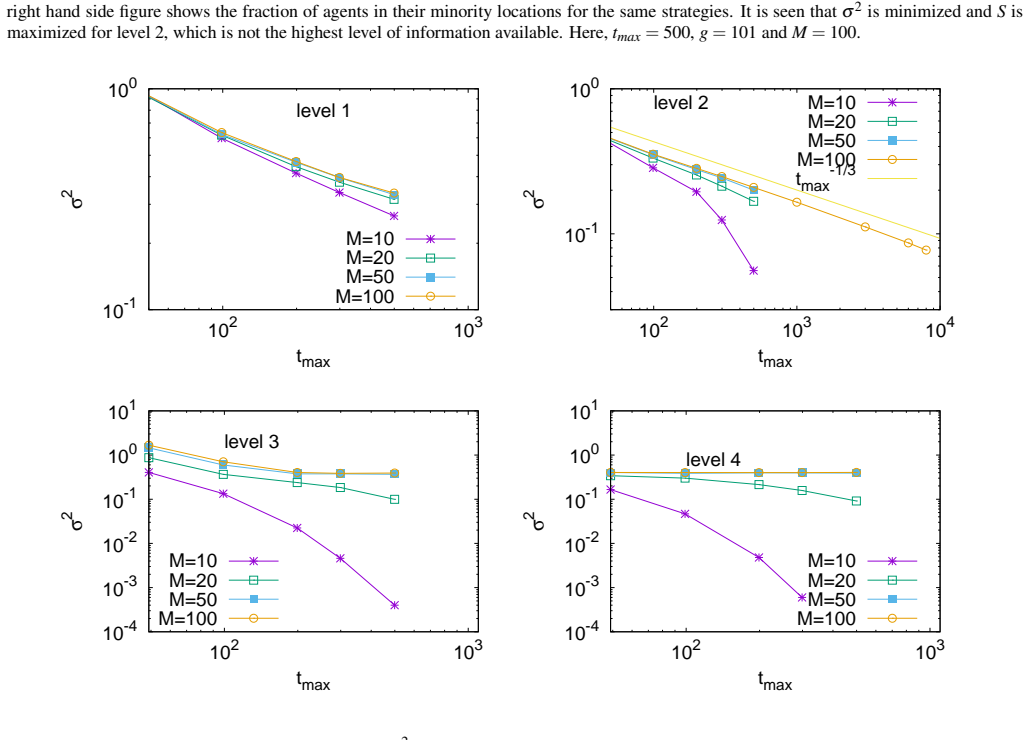
The Parallel Minority Game (PMG) refers to a set of Minority Games (MG), played in parallel, where each agent only has two choices to pick from, but each choice can host agents of many kind i.e., their other alternative can be from any other choices. While the pay-off function remains the same as that in the MG -- agents picking the less crowded of their two choices win positive pay-off -- the optimization of resource allocation is significantly harder in the PMG. While a global optimization demands a uniform population in all choices, a local optimization attempts to balance the population in the two choices for a given agent. In the MG these two objectives coincides, but generally in the PMG these are competing. We study several non-dictated, stochastic strategies and compare their efficiencies in attaining the local and global optimization objectives. Counterintuitively, a strategy with partial information of populations perform the best in terms of population fluctuation and overall payoff maximization.
Editorial analysis
A structured set of objections, weighed in public.
Referee Report
Summary. The manuscript defines the Parallel Minority Game (PMG) as a collection of simultaneous Minority Games in which each agent selects between two options drawn from a larger set of choices. Payoffs follow the standard MG rule (positive payoff for selecting the less-crowded option within an agent's pair), but local pairwise balance and global uniformity across all choices become competing objectives. The authors simulate several non-dictated stochastic strategies and report that the strategy employing partial population information yields the lowest fluctuations and highest average payoffs.
Significance. If the reported ranking is robust, the result supplies a concrete, counter-intuitive example in which limited information outperforms both zero and full information in a coordination setting where local and global optima diverge. This could inform models of multi-resource allocation in economics and complex systems.
major comments (2)
- [§4] §4 (Results): the superiority of the partial-information strategy is asserted on the basis of direct numerical comparisons of fluctuation and payoff, yet the text supplies neither the number of independent runs, error bars, nor any statistical test; without these the claim that it 'performs the best' cannot be assessed for robustness.
- [§2] §2 (Model): the payoff rule is stated to be identical to the classic MG, but the precise definition of 'less crowded' when an option hosts agents whose alternative choices lie in other categories is given only descriptively; an explicit equation for the local minority condition is required to confirm that the reported local-global tension is correctly implemented.
minor comments (2)
- [Abstract] Abstract: the phrase 'non-dictated, stochastic strategies' is used without enumerating the strategies; a one-sentence list would improve readability.
- [Throughout] Notation: symbols for local versus global population counts are not consistently distinguished throughout the text, leading to occasional ambiguity in the strategy definitions.
Simulated Author's Rebuttal
We thank the referee for their detailed review and valuable comments. We will revise the manuscript to address the concerns about statistical details and the explicit payoff definition. Our point-by-point responses are as follows.
read point-by-point responses
-
Referee: [§4] §4 (Results): the superiority of the partial-information strategy is asserted on the basis of direct numerical comparisons of fluctuation and payoff, yet the text supplies neither the number of independent runs, error bars, nor any statistical test; without these the claim that it 'performs the best' cannot be assessed for robustness.
Authors: We agree that providing the number of independent runs, error bars, and statistical tests is necessary to substantiate the robustness of our findings. In the revised manuscript, we will specify that the simulations were averaged over 100 independent runs, include error bars representing the standard error of the mean, and add a note confirming that the performance advantage of the partial-information strategy is statistically significant. revision: yes
-
Referee: [§2] §2 (Model): the payoff rule is stated to be identical to the classic MG, but the precise definition of 'less crowded' when an option hosts agents whose alternative choices lie in other categories is given only descriptively; an explicit equation for the local minority condition is required to confirm that the reported local-global tension is correctly implemented.
Authors: We thank the referee for this suggestion. To address the ambiguity, we will include an explicit equation in the model section. The local minority condition for an agent with choices i and j is defined such that the agent receives a positive payoff if they select the option with the smaller number of agents choosing it. Mathematically, if N_i and N_j denote the populations choosing i and j respectively, the payoff is sign(N_j - N_i) for choosing i. This will be added to confirm the implementation of the local-global tension. revision: yes
Circularity Check
No significant circularity identified
full rationale
The paper's central claim rests on direct numerical comparisons of explicitly defined stochastic strategies in the PMG, evaluating population fluctuations and payoffs under local versus global optimization objectives. No derivations, fitted parameters, self-referential definitions, or load-bearing self-citations appear in the provided text; the reported ranking of strategies follows from the simulation rules and information sets as stated, without reducing to inputs by construction. The distinction between local and global objectives is introduced as a modeling choice rather than derived from prior results.
Axiom & Free-Parameter Ledger
Reference graph
Works this paper leans on
-
[1]
Chakraborti, D
A. Chakraborti, D. Challet, A. Chatterjee, M. Marsili, Y .-C . Zhang, B. K. Chakrabarti, Statistical mechanics of competi tive resource allocation using agent-based models. Phys. Rep. 552, 1 (2015)
2015
-
[2]
W. B. Arthur, Inductive reasoning and bounded rationality. Am. Econ. Rev. 84, 406–411 (1994)
1994
-
[3]
Challet, Y .-C
D. Challet, Y .-C. Zhang, Emergence of cooperation and orga- nization in an evolutionary game, Physica A 246, 407 (1997); ibid On the minority game: Analytical and numerical studies, Physica A 256, 514 (1998)
1997
-
[4]
D. Dhar, V . Sasidevan, B. K. Chakrabarti, Emergent coopera- tion amongst competing agents in minority games, Physica A 390, 3477 (2011)
2011
-
[5]
Biswas, A
S. Biswas, A. Ghosh, A. Chatterjee, T. Naskar, B. K. Chakrabarti, Continuous transition of social efficiencies in the stochastic-strategy minority game, Phys. Rev. E 85, 031104 (2012)
2012
-
[6]
A. S. Chakrabarti, B. K. Chakrabarti, A. Chatterjee, M. Mitr a, The Kolkata Paise Restaurant problem and resource utilizat ion, Physica A 388, 2420 (2009)
2009
-
[7]
Ghosh, A
A. Ghosh, A. Chatterjee, M. Mitra, B. K. Chakrabarti, Statis - tics of the Kolkata Paise Restaurant problem, New J. Phys. 12, 075033 (2010)
2010
-
[8]
Biswas, A
S. Biswas, A. Mandal, Parallel Minority Game and it’s applic a- tion in movement optimization during an epidemic, Physica A 561, 125271 (2021)
2021
-
[9]
A. R. V emula, S. Biswas, Efficient strategy for Parallel Minority Games, Physica A 688, 131373 (2026)
2026
-
[10]
Tyagi, S
A. Tyagi, S. Biswas, A. Chakraborti, Active-Absorbing Phas e Transitions in the Parallel Minority Game, arxiv:2512.228 26 (2025)
2025
discussion (0)
Sign in with ORCID, Apple, or X to comment. Anyone can read and Pith papers without signing in.