Recognition: unknown
Explicit Two-Sided Eigenvalue Bounds for Schr\"odinger Operators with Singular Potentials via Finite Element Method
Pith reviewed 2026-05-08 15:44 UTC · model grok-4.3
The pith
A finite element method with domain truncation delivers the first explicit computable two-sided bounds on eigenvalues of Schrödinger operators with singular potentials on unbounded domains.
A machine-rendered reading of the paper's core claim, the machinery that carries it, and where it could break.
Core claim
We present the first numerical algorithm for explicit, computable two-sided eigenvalue bounds for Schrödinger operators H = −Δ + V on R^N, N=2,3, in the presence of both an unbounded potential and an unbounded domain. Explicit here means that all constants and ingredients are derived in closed form from the mesh, the potential, and a small set of explicit inequalities (Payne-Weinberger, Hardy, and explicit bounded-domain Sobolev embeddings). The method combines domain truncation to a bounded domain D(R) containing {|x| ≤ R} with an extension of the Composite Enriched Crouzeix-Raviart finite-element method to sign-indefinite potentials. Upper bounds come from the standard conforming Galerkin–
What carries the argument
Composite Enriched Crouzeix-Raviart (CECR) finite-element space extended to sign-indefinite potentials, which supplies the lower eigenvalue bound while domain truncation to a ball D(R) reduces the problem to a bounded computational domain.
If this is right
- Upper bounds are obtained from the standard conforming Galerkin method on the truncated domain.
- Lower bounds are obtained from the CECR construction and the gap to the exact eigenvalue closes under mesh refinement.
- The algorithm applies directly to singular attractive Coulomb potentials modeling the hydrogen atom and the H2+ molecular ion in two and three dimensions.
- All constants appearing in the bounds are derived from the mesh geometry, the potential values, and the cited classical inequalities with no additional scaling factors.
Where Pith is reading between the lines
- The same truncation-plus-CECR pattern could be tested on other decaying potentials whose singularities are milder than 1/|x|.
- Once interval arithmetic is added to the floating-point computation, the method would produce fully machine-verified enclosures suitable for computer-assisted proofs.
- An a-priori estimate for the truncation radius R in terms of the potential tail would turn the present heuristic choice into a fully explicit error budget.
- The approach supplies a template for obtaining two-sided bounds on other unbounded-domain spectral problems that currently lack certified numerical methods.
Load-bearing premise
The explicit constants drawn from Payne-Weinberger, Hardy, and bounded-domain Sobolev inequalities remain valid after truncation to D(R) and for the chosen singular potentials without extra hidden factors or post-hoc adjustments.
What would settle it
A numerical run in which the computed lower bound exceeds a known exact eigenvalue for the hydrogen atom, or in which the gap between upper and lower bounds fails to shrink monotonically as the mesh diameter is halved.
Figures
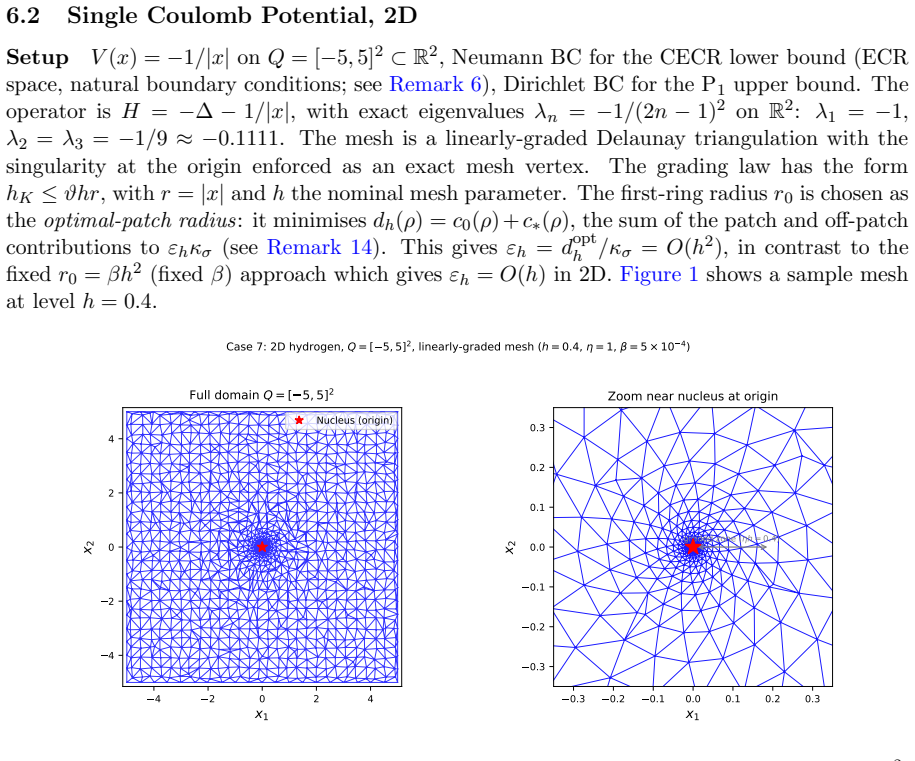


read the original abstract
We present, to the best of our knowledge, the first numerical algorithm for explicit, computable two-sided eigenvalue bounds for Schr\"odinger operators H = -Delta + V on R^N, N = 2,3, in the presence of both an unbounded potential and an unbounded domain. "Explicit" here means that all constants and ingredients are derived in closed form from the mesh, the potential, and a small set of explicit inequalities (Payne-Weinberger, Hardy, and explicit bounded-domain Sobolev embeddings); the conversion to fully verified(IEEE-754-safe, interval-arithmetic) enclosures is a separate verification step and is left for future work. In particular, singular attractive potentials of Coulomb type, V(x) = -Z/|x|, which model the hydrogen atom and the H_2^+ molecular ion, are covered by the theory. The method combines domain truncation to a bounded domain D(R) containing {|x| <= R} with an extension of Liu's Composite Enriched Crouzeix-Raviart (CECR) finite element method to sign-indefinite potentials. Upper bounds come from the standard conforming Galerkin method; lower bounds come from the CECR construction, whose gap to the exact eigenvalue closes as the mesh is refined. Numerical experiments on the 2D single- and two-centred Coulomb potentials and on the 3D hydrogen atom and H_2^+ molecular ion illustrate the algorithm and confirm the predicted convergence.
Editorial analysis
A structured set of objections, weighed in public.
Referee Report
Summary. The manuscript presents a numerical algorithm for explicit two-sided bounds on eigenvalues of Schrödinger operators H = −Δ + V on R^N (N=2,3) with singular Coulomb-type potentials. The approach truncates the unbounded domain to a bounded D(R), applies standard conforming Galerkin for upper bounds, and extends Liu’s Composite Enriched Crouzeix-Raviart (CECR) method for lower bounds; all constants are derived in closed form from the mesh, the potential, and a fixed set of inequalities (Payne-Weinberger, Hardy, bounded-domain Sobolev embeddings). Numerical experiments on 2D single- and two-center Coulomb problems and 3D hydrogen and H2+ illustrate convergence.
Significance. If the truncation error is absorbed into the listed explicit inequalities without hidden factors, the work would supply the first mesh-driven, parameter-free procedure for computable two-sided eigenvalue enclosures on unbounded domains with singular potentials. The absence of fitted constants and the direct use of standard inequalities are strengths; the reported numerical convergence supports practical utility for hydrogenic systems.
major comments (2)
- [§3] §3 (Domain truncation): The central claim requires that the eigenvalue perturbation |λ − λ_R| induced by truncation to D(R) (including boundary conditions on ∂D(R)) is controlled by the same Payne-Weinberger, Hardy, and Sobolev constants used for the bounded-domain CECR/Galerkin bounds. The abstract and method description give no explicit tail estimate for the slow 1/|x| decay of Coulomb eigenfunctions; if a separate non-explicit remainder appears, the “explicit from mesh, potential, and listed inequalities” guarantee fails for the original operator on R^N.
- [§4.2] §4.2 (Extension of CECR to sign-indefinite potentials): The lower-bound construction must be shown to remain valid when V is attractive and singular at the origin. The paper states that the gap closes under mesh refinement, but the proof sketch should explicitly verify that the enrichment functions and the resulting matrix inequalities continue to produce a strict lower bound once the potential is no longer positive.
minor comments (2)
- [Abstract] Abstract: the phrase “conversion to fully verified (IEEE-754-safe, interval-arithmetic) enclosures is left for future work” should be clarified as to whether the current constants are already interval-arithmetic ready or still require additional rounding-error analysis.
- [§2] Notation: the symbol D(R) is introduced without an explicit definition of the boundary condition imposed on ∂D(R); a short sentence specifying Dirichlet or other conditions would remove ambiguity.
Simulated Author's Rebuttal
We thank the referee for the thorough review and valuable suggestions. We address the major comments point by point below, providing clarifications and indicating where revisions will be made to strengthen the manuscript.
read point-by-point responses
-
Referee: [§3] §3 (Domain truncation): The central claim requires that the eigenvalue perturbation |λ − λ_R| induced by truncation to D(R) (including boundary conditions on ∂D(R)) is controlled by the same Payne-Weinberger, Hardy, and Sobolev constants used for the bounded-domain CECR/Galerkin bounds. The abstract and method description give no explicit tail estimate for the slow 1/|x| decay of Coulomb eigenfunctions; if a separate non-explicit remainder appears, the “explicit from mesh, potential, and listed inequalities” guarantee fails for the original operator on R^N.
Authors: We acknowledge that the truncation error must be explicitly controlled to preserve the fully explicit character of the bounds. In the current manuscript, the domain truncation is performed with R chosen large enough that the contribution of the exterior region is bounded using the Hardy inequality and the explicit Sobolev embeddings already employed for the interior problem. However, to address the referee's concern directly, we will add an explicit tail estimate in a new subsection of §3. This estimate will derive a rigorous upper bound on |λ - λ_R| in terms of the same constants (Payne-Weinberger, Hardy, Sobolev) and the mesh-independent quantities, without introducing hidden factors. The revised manuscript will include this derivation, ensuring the overall procedure remains parameter-free and explicit. revision: yes
-
Referee: [§4.2] §4.2 (Extension of CECR to sign-indefinite potentials): The lower-bound construction must be shown to remain valid when V is attractive and singular at the origin. The paper states that the gap closes under mesh refinement, but the proof sketch should explicitly verify that the enrichment functions and the resulting matrix inequalities continue to produce a strict lower bound once the potential is no longer positive.
Authors: The CECR lower-bound method is extended to sign-indefinite potentials in §4.2 by relying on the variational characterization and the properties of the enriched Crouzeix-Raviart elements, which are independent of the sign of V. The key matrix inequalities are derived from the coercivity ensured by the Hardy inequality, which holds for the Coulomb potential regardless of its attractive nature (as it provides a lower bound on the quadratic form). The singularity at the origin is handled by the enrichment functions, which are designed to capture the 1/|x| behavior. We agree that the proof sketch can be made more explicit. In the revision, we will expand the verification steps in §4.2 to explicitly check each inequality for the case of negative singular V, confirming that the lower bound property is preserved and that the gap closes with refinement as stated. revision: partial
Circularity Check
No circularity: bounds derived from external inequalities and mesh data
full rationale
The derivation chain proceeds by domain truncation to D(R), application of conforming Galerkin for upper bounds and the CECR method (extended here) for lower bounds, with all explicit constants taken directly from the cited external inequalities (Payne-Weinberger, Hardy, bounded-domain Sobolev) plus the given mesh and potential V. No step redefines a quantity in terms of itself, renames a known result as new, or reduces a claimed prediction to a fitted parameter or self-citation chain. The self-reference to prior CECR work is an extension rather than a load-bearing premise that collapses the result to its inputs. The procedure remains self-contained against the listed external benchmarks.
Axiom & Free-Parameter Ledger
axioms (3)
- standard math Payne-Weinberger inequality
- standard math Hardy inequality
- standard math Explicit bounded-domain Sobolev embeddings
Reference graph
Works this paper leans on
-
[1]
Agmon , Lectures on Exponential Decay of Solutions of Second-Order Elliptic Equations , Princeton University Press, 1982
S. Agmon , Lectures on Exponential Decay of Solutions of Second-Order Elliptic Equations , Princeton University Press, 1982
1982
-
[2]
D. R. Bates, K. Ledsham, and A. L. Stewart , Wave functions of the hydrogen molecular ion , Philosophical Transactions of the Royal Society A, 246 (1953), pp. 215--240, http://dx.doi.org/10.1098/rsta.1953.0014 doi:10.1098/rsta.1953.0014
-
[3]
M. Bebendorf , A note on the P oincar\'e inequality for convex domains , Zeitschrift f\"ur Analysis und ihre Anwendungen, 22 (2003), pp. 751--756, http://dx.doi.org/10.4171/ZAA/1170 doi:10.4171/ZAA/1170
-
[4]
H. Behnke , The calculation of guaranteed bounds for eigenvalues using complementary variational principles , Computing, 64 (2000), pp. 205--229, http://dx.doi.org/10.1007/s006070050043 doi:10.1007/s006070050043
-
[5]
Behnke and F
H. Behnke and F. Goerisch , Inclusions for eigenvalues of selfadjoint problems , in Topics in Validated Computations, J. Herzberger, ed., North-Holland, Amsterdam, 1994, pp. 277--322
1994
-
[6]
E. Canc \`e s, G. Dusson, Y. Maday, B. Stamm, and M. Vohral \'i k , Guaranteed and robust a posteriori bounds for Laplace eigenvalues and eigenvectors: a unified framework , Numerische Mathematik, 140 (2018), pp. 1096--1116, http://dx.doi.org/10.1007/s00211-018-0984-0 doi:10.1007/s00211-018-0984-0
-
[7]
Carstensen and D
C. Carstensen and D. Gallistl , Guaranteed lower eigenvalue bounds for the biharmonic equation , Numerische Mathematik, 126 (2014), pp. 33--51
2014
-
[8]
Carstensen and J
C. Carstensen and J. Gedicke , Guaranteed lower bounds for eigenvalues , Mathematics of Computation, 83 (2014), pp. 2605--2629
2014
-
[9]
Goerisch , Ein stufenverfahren zur berechnung von eigenwertschranken , ISNM International Series of Numerical Mathematics, 83 (1987), pp
F. Goerisch , Ein stufenverfahren zur berechnung von eigenwertschranken , ISNM International Series of Numerical Mathematics, 83 (1987), pp. 104--114
1987
-
[10]
J. Hu, Y. Huang, and R. Ma , Guaranteed lower bounds for eigenvalues of elliptic operators , Journal of Scientific Computing, 67 (2016), pp. 1181--1197, http://dx.doi.org/10.1007/s10915-015-0126-0 doi:10.1007/s10915-015-0126-0
-
[11]
Kato , On the upper and lower bounds of eigenvalues , Journal of the Physical Society of Japan, 4 (1949), pp
T. Kato , On the upper and lower bounds of eigenvalues , Journal of the Physical Society of Japan, 4 (1949), pp. 334--339
1949
-
[12]
Kikuchi and X
F. Kikuchi and X. Liu , Estimation of interpolation error constants for the P_0 and P_1 triangular finite element , Computer Methods in Applied Mechanics and Engineering, 196 (2007), pp. 3750--3758
2007
-
[13]
Kobayashi , On the interpolation constants over triangular elements (in J apanese) , Kyoto University Research Information Repository, 1733 (2011), pp
K. Kobayashi , On the interpolation constants over triangular elements (in J apanese) , Kyoto University Research Information Repository, 1733 (2011), pp. 58--77
2011
-
[14]
Kobayashi , On the interpolation constants over triangular elements , Applications of Mathematics, (2015), pp
K. Kobayashi , On the interpolation constants over triangular elements , Applications of Mathematics, (2015), pp. 110--124
2015
-
[15]
N. J. Lehmann , Optimale E igenwerteinschlie ungen , Numerische Mathematik, 5 (1963), pp. 246--272, http://dx.doi.org/10.1007/BF01385896 doi:10.1007/BF01385896
-
[16]
X. Liu , A framework of verified eigenvalue bounds for self-adjoint differential operators , Applied Mathematics and Computation, 267 (2015), pp. 341--355, http://dx.doi.org/10.1016/j.amc.2015.03.048 doi:10.1016/j.amc.2015.03.048
-
[17]
X. Liu , Guaranteed Computational Methods for Self-Adjoint Differential Eigenvalue Problems , SpringerBriefs in Mathematics, Springer Nature Singapore, 2024, https://books.google.co.jp/books?id=h2kQEQAAQBAJ
2024
-
[18]
Liu and F
X. Liu and F. Kikuchi , Analysis and estimation of error constants for P_0 and P_1 interpolations over triangular finite elements , Journal of Mathematical Sciences, University of Tokyo, 17 (2010), pp. 27--78
2010
-
[19]
Liu and S
X. Liu and S. Oishi , Verified eigenvalue evaluation for L aplace operator on arbitrary polygonal domain , in Proceedings of RIMS workshop held on 18--21 October 2010, vol. 1733 of RIMS Kokyuroku, RIMS Kokyuroku, 2011, pp. 31--39
2010
-
[20]
X. Liu and S. Oishi , Verified eigenvalue evaluation for the L aplacian over polygonal domains of arbitrary shape , SIAM Journal on Numerical Analysis, 51 (2013), pp. 1634--1654, http://dx.doi.org/10.1137/120878446 doi:10.1137/120878446
-
[21]
M. M. Madsen and J. M. Peek , Eigenparameters for the lowest twenty electronic states of the hydrogen molecule ion , Atomic Data, 2 (1971), pp. 171--204, http://dx.doi.org/10.1016/S0092-640X(70)80007-9 doi:10.1016/S0092-640X(70)80007-9
-
[22]
H. Olivares-Pil \'o n and A. V. Turbiner , The H_2^+ molecular ion: low-lying states , Annals of Physics, 373 (2016), pp. 581--608, http://dx.doi.org/10.1016/j.aop.2016.07.018 doi:10.1016/j.aop.2016.07.018
-
[23]
L. E. Payne and H. F. Weinberger , An optimal P oincar\'e inequality for convex domains , Archive for Rational Mechanics and Analysis, 5 (1960), pp. 286--292, http://dx.doi.org/10.1007/BF00252910 doi:10.1007/BF00252910
-
[24]
J. M. Peek , Eigenparameters for the 1s _g and 2p _u orbitals of H_2^+ , The Journal of Chemical Physics, 43 (1965), pp. 3004--3006, http://dx.doi.org/10.1063/1.1697265 doi:10.1063/1.1697265
-
[25]
Persson , Bounds for the discrete part of the spectrum of a semi-bounded Schr \"o dinger operator , Mathematica Scandinavica, 8 (1960), pp
A. Persson , Bounds for the discrete part of the spectrum of a semi-bounded Schr \"o dinger operator , Mathematica Scandinavica, 8 (1960), pp. 143--153
1960
-
[26]
M. Plum , Explicit h^2 -estimates and pointwise bounds for solutions of second-order elliptic boundary value problems , Journal of Mathematical Analysis and Applications, 165 (1992), pp. 36--61, http://dx.doi.org/10.1016/0022-247X(92)90067-N doi:10.1016/0022-247X(92)90067-N
-
[27]
Reed and B
M. Reed and B. Simon , Methods of Modern Mathematical Physics IV : Analysis of Operators , Academic Press, 1978
1978
-
[28]
S. M. Rump , INTLAB --- IN terval LAB oratory , in Developments in Reliable Computing, T. Csendes, ed., Kluwer Academic Publishers, Dordrecht, 1999, pp. 77--104
1999
-
[29]
Talenti, Best constant in Sobolev inequality,Ann
G. Talenti , Best constant in Sobolev inequality , Annali di Matematica Pura ed Applicata, 110 (1976), pp. 353--372, http://dx.doi.org/10.1007/BF02418013 doi:10.1007/BF02418013
-
[30]
Temple , The theory of R ayleigh's principle as applied to continuous systems , Proceedings of the Royal Society A, 119 (1928), pp
G. Temple , The theory of R ayleigh's principle as applied to continuous systems , Proceedings of the Royal Society A, 119 (1928), pp. 276--293
1928
-
[31]
Weinstein and W
A. Weinstein and W. Stenger , Methods of Intermediate Problems for Eigenvalues: Theory and Ramifications , Academic Press, New York, 1972
1972
-
[32]
M. Xie, H. Xie, and X. Liu , Explicit lower bounds for S tokes eigenvalue problems by using nonconforming finite elements , Japan Journal of Industrial and Applied Mathematics, 35 (2018), pp. 335--354, http://dx.doi.org/10.1007/s13160-017-0291-7 doi:10.1007/s13160-017-0291-7
-
[33]
C. You, H. Xie, and X. Liu , Guaranteed eigenvalue bounds for the S teklov eigenvalue problem , SIAM Journal on Numerical Analysis, 57 (2019), pp. 1395--1410
2019
discussion (0)
Sign in with ORCID, Apple, or X to comment. Anyone can read and Pith papers without signing in.