Recognition: unknown
Frustrated magnetic order in hybrid Kitaev spin-orbital models
Pith reviewed 2026-05-08 15:55 UTC · model grok-4.3
The pith
Hybrid Kitaev spin-orbital models on a shared lattice produce magnetic order in the spin sector while the orbital sector keeps topological order, and regain exact solvability with one Majorana flavor when couplings are equal and opposite.
A machine-rendered reading of the paper's core claim, the machinery that carries it, and where it could break.
Core claim
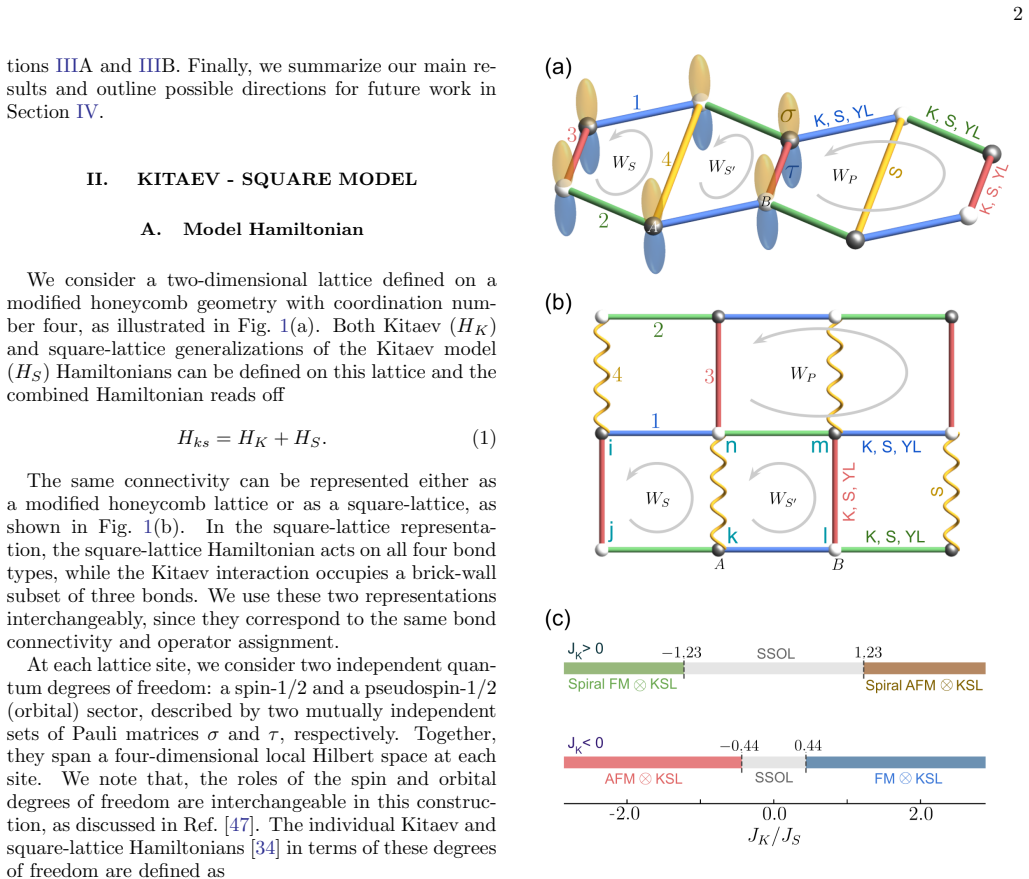
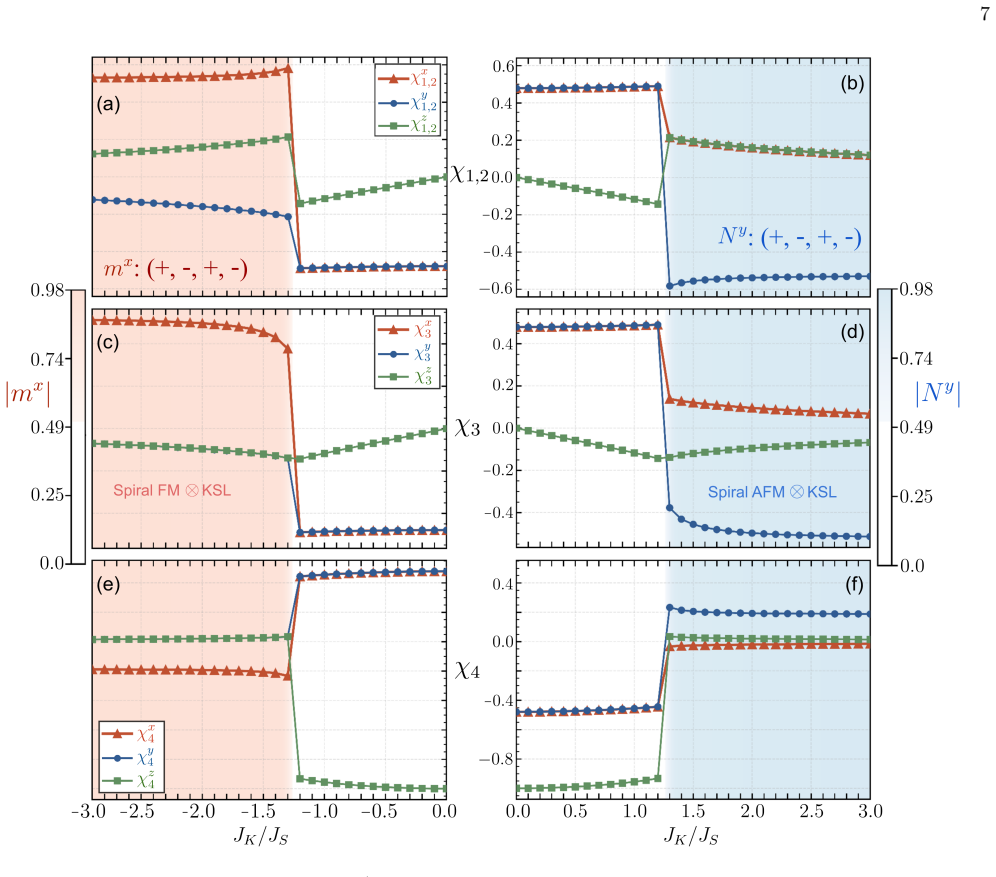
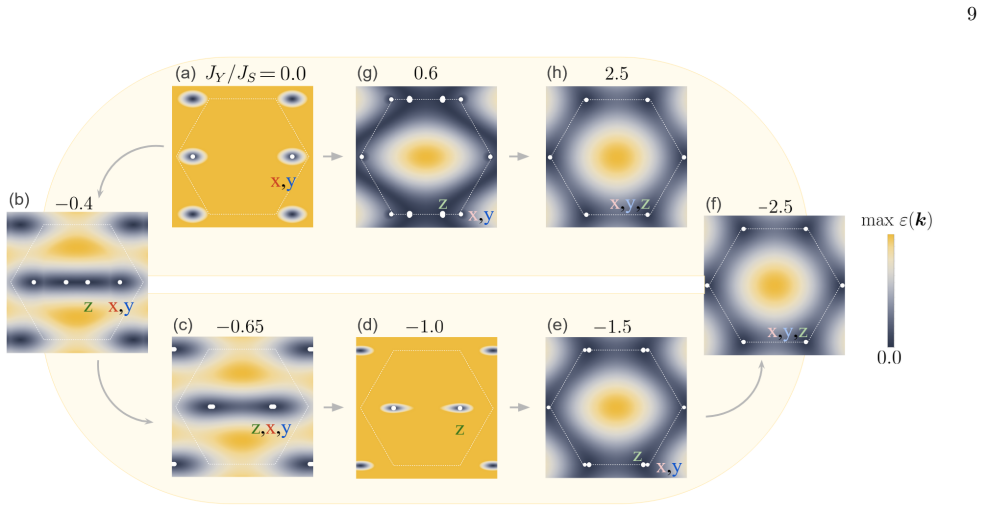
When two independent exactly solvable spin liquid Hamiltonians formulated on different lattice geometries are combined on a common lattice, the strong-Kitaev regime yields magnetic order in the spin sector while the orbital sector retains its topological order. Hybridization of the Yao-Lee and square-lattice models produces a rich evolution of Majorana Dirac bands and Lifshitz transitions. When the Yao-Lee and square-lattice couplings are equal and opposite, the model restores its exact solvability with a single itinerant Majorana flavor.
What carries the argument
The hybrid Hamiltonian formed by superposing Kitaev and Yao-Lee interactions on a shared lattice, which reduces at equal-and-opposite coupling strengths to a solvable model with a single itinerant Majorana flavor.
If this is right
- Strong Kitaev coupling produces magnetic order in the spin sector.
- The orbital sector continues to support topological order even in the magnetically ordered phase.
- Varying the relative strength of the hybridized couplings drives a sequence of Majorana Dirac band rearrangements and Lifshitz transitions.
- Equal and opposite couplings restore exact solvability through reduction to a single itinerant Majorana flavor.
Where Pith is reading between the lines
- Hybrid constructions of this type offer a systematic way to generate magnetic order while retaining some topological character that would be absent in purely classical frustrated magnets.
- The exact solvability recovered at the special coupling point may allow direct computation of spin and orbital correlation functions that are otherwise inaccessible in frustrated systems.
- Similar hybridization strategies could be explored on other lattices or in three-dimensional extensions to produce additional solvable or nearly solvable phases.
Load-bearing premise
Self-consistent mean-field theory and perturbative expansions are assumed to capture the ground-state phases without uncontrolled higher-order corrections or lattice-specific effects that would change the reported order.
What would settle it
A finite-size exact diagonalization or density-matrix renormalization group calculation that checks whether magnetic order appears in the spin sector and whether the single-Majorana spectrum is recovered exactly at the equal-and-opposite coupling point.
Figures




read the original abstract
Spin-orbital generalization of Kitaev model provides a robust extension to the original Kitaev model. However, real materials often exhibit competing interactions that break exact solvability which can give rise to new phases. Motivated by recent microscopic proposals of coexisting Yao-Lee and Kitaev couplings, we investigate the fate of the ground state when two independent exactly solvable spin liquid Hamiltonians each originally formulated on different lattice geometries are combined on a common lattice environment. We first focus on the hybrid Kitaev's honeycomb and square-lattice model. Using self-consistent mean-field analysis and perturbative calculation, we show that the strong-Kitaev regime yields magnetic order in the spin sector, while the orbital sector retains its topological order. We further analyze the hybridization of the Yao-Lee and square-lattice models and find that the model exhibits a rich evolution of Majorana Dirac bands and Lifshitz transitions. Remarkably, when the Yao-Lee and square-lattice couplings are equal and opposite, the model restores its exact solvability with a single itinerant Majorana flavor. These results demonstrate that hybrid spin liquid platforms may host various emergent phases beyond conventional exactly solvable limits.
Editorial analysis
A structured set of objections, weighed in public.
Referee Report
Summary. The paper examines hybrid Kitaev spin-orbital models formed by combining Yao-Lee and Kitaev interactions (originally on different lattices) on a shared lattice geometry. Using self-consistent mean-field theory and perturbative expansions, it reports that the strong-Kitaev regime produces magnetic order in the spin sector while the orbital sector retains topological order; the hybridized Yao-Lee/square-lattice case shows evolving Majorana Dirac bands and Lifshitz transitions; and, remarkably, equal-and-opposite Yao-Lee and square couplings restore exact solvability with a single itinerant Majorana flavor.
Significance. If the mean-field results hold, the work is significant because it identifies an analytically tractable limit (restored exact solvability) inside a frustrated hybrid model and maps out how competing spin-orbital couplings can stabilize ordered phases alongside topological features. This provides a concrete route to study emergent Majorana physics beyond the original Kitaev and Yao-Lee solvable points, with potential relevance to material candidates exhibiting coexisting interactions.
major comments (2)
- [main results on hybrid Kitaev honeycomb/square model] The phase diagram for the hybrid honeycomb/square Kitaev model in the strong-Kitaev regime (magnetic order in spin sector, retained orbital topology) is obtained exclusively from self-consistent mean-field decoupling; without any exact-diagonalization checks on small clusters, DMRG benchmarks, or error estimates on the decoupling, it remains unclear whether higher-order corrections or lattice-geometry mismatches shift the reported boundaries or gap the Majorana modes.
- [hybridization of Yao-Lee and square-lattice models] The central claim that equal-and-opposite Yao-Lee and square-lattice couplings restore exact solvability with a single itinerant Majorana flavor is load-bearing for the paper's novelty; the manuscript should explicitly show the Hamiltonian reduction to a free Majorana model at this point (rather than relying on the mean-field ansatz) and confirm that no residual interactions survive.
minor comments (2)
- [model definition] The definition of the hybrid Hamiltonian and the precise ratio of couplings should be stated with explicit equations early in the text to avoid ambiguity when discussing the equal-and-opposite limit.
- [figures on band evolution] Figure captions for the Majorana band structures and Lifshitz transitions could include the specific parameter values used and a brief note on how the mean-field self-consistency was converged.
Simulated Author's Rebuttal
We thank the referee for their careful reading and constructive comments on our manuscript. We address each major point below and indicate the revisions made to the manuscript.
read point-by-point responses
-
Referee: [main results on hybrid Kitaev honeycomb/square model] The phase diagram for the hybrid honeycomb/square Kitaev model in the strong-Kitaev regime (magnetic order in spin sector, retained orbital topology) is obtained exclusively from self-consistent mean-field decoupling; without any exact-diagonalization checks on small clusters, DMRG benchmarks, or error estimates on the decoupling, it remains unclear whether higher-order corrections or lattice-geometry mismatches shift the reported boundaries or gap the Majorana modes.
Authors: We agree that the reported phase diagram is obtained from self-consistent mean-field decoupling supplemented by perturbative expansions. This is the standard approach for mapping out phases in extended Kitaev models, especially in the strong-Kitaev limit. The perturbative results provide independent support for the stability of the ordered phases and the persistence of the orbital topological order. We acknowledge, however, that direct numerical benchmarks (ED or DMRG) are absent and that higher-order corrections or geometry effects could in principle modify the boundaries. In the revised manuscript we have added an explicit discussion of the mean-field approximation, including a qualitative estimate of higher-order corrections from the perturbative expansion and a note on possible lattice-geometry mismatches. We have also included error estimates on the decoupling parameters. Full numerical confirmation remains computationally challenging for the hybrid model and is left for future work. revision: partial
-
Referee: [hybridization of Yao-Lee and square-lattice models] The central claim that equal-and-opposite Yao-Lee and square-lattice couplings restore exact solvability with a single itinerant Majorana flavor is load-bearing for the paper's novelty; the manuscript should explicitly show the Hamiltonian reduction to a free Majorana model at this point (rather than relying on the mean-field ansatz) and confirm that no residual interactions survive.
Authors: We thank the referee for emphasizing the importance of an explicit derivation. The restoration of exact solvability when the Yao-Lee and square-lattice couplings are equal and opposite is indeed a central result. In the original manuscript we stated the outcome but did not display the algebraic reduction. In the revised version we have added a dedicated subsection that performs the term-by-term cancellation: all quartic and higher interaction terms vanish identically when the couplings are equal and opposite, leaving a quadratic Hamiltonian of a single itinerant Majorana flavor with no residual interactions. This reduction is performed directly on the microscopic Hamiltonian and does not rely on the mean-field ansatz. revision: yes
Circularity Check
No circularity: results follow from explicit Hamiltonians via standard mean-field and perturbation
full rationale
The paper begins with explicit hybrid Kitaev/Yao-Lee Hamiltonians on combined lattices, applies self-consistent mean-field decoupling to the spin sector and perturbative expansions to the orbital sector, and directly substitutes the equal-and-opposite coupling condition to recover a single itinerant Majorana mode. None of these steps reduce by construction to fitted parameters, self-citations, or ansatzes imported from the authors' prior work; the solvability restoration is an algebraic consequence of the model definition itself. The derivation remains independent of any load-bearing self-citation loop and is self-contained against the stated approximations.
Axiom & Free-Parameter Ledger
free parameters (2)
- Kitaev coupling strength
- Yao-Lee to square-lattice coupling ratio
axioms (1)
- domain assumption Mean-field decoupling of spin-orbital operators yields a reliable variational ground state
Reference graph
Works this paper leans on
-
[1]
Kitaev, Anyons in an exactly solved model and be- yond, Annals of Physics321, 2 (2006), january Special Issue
A. Kitaev, Anyons in an exactly solved model and be- yond, Annals of Physics321, 2 (2006), january Special Issue
2006
-
[2]
Matsuda, T
Y. Matsuda, T. Shibauchi, and H.-Y. Kee, Kitaev quan- tum spin liquids, Rev. Mod. Phys.97, 045003 (2025)
2025
-
[3]
Y. Zhou, K. Kanoda, and T.-K. Ng, Quantum spin liquid states, Rev. Mod. Phys.89, 025003 (2017)
2017
-
[4]
Knolle and R
J. Knolle and R. Moessner, A field guide to spin liq- uids, Annual Review of Condensed Matter Physics10, 451–472 (2019)
2019
-
[5]
Wen, Colloquium: Zoo of quantum-topological phases of matter, Rev
X.-G. Wen, Colloquium: Zoo of quantum-topological phases of matter, Rev. Mod. Phys.89, 041004 (2017)
2017
-
[6]
Hermanns, I
M. Hermanns, I. Kimchi, and J. Knolle, Physics of the ki- taev model: Fractionalization, dynamic correlations, and material connections, Annual Review of Condensed Mat- ter Physics9, 17–33 (2018)
2018
-
[7]
Broholm, R
C. Broholm, R. J. Cava, S. A. Kivelson, D. G. Nocera, M. R. Norman, and T. Senthil, Quantum spin liquids, Science367, eaay0668 (2020)
2020
-
[8]
Balents, Spin liquids in frustrated magnets, Nature 464, 199 (2010)
L. Balents, Spin liquids in frustrated magnets, Nature 464, 199 (2010)
2010
-
[9]
Savary and L
L. Savary and L. Balents, Quantum spin liquids: a re- view, Reports on Progress in Physics80, 016502 (2016)
2016
-
[10]
Moessner and J
R. Moessner and J. E. Moore,Topological Phases of Mat- ter(Cambridge University Press, 2021)
2021
-
[11]
Mandal, A primer on kitaev model: basic aspects, material realization, and recent experiments, Journal of Physics: Condensed Matter37, 193002 (2025)
S. Mandal, A primer on kitaev model: basic aspects, material realization, and recent experiments, Journal of Physics: Condensed Matter37, 193002 (2025)
2025
-
[12]
Takagi, T
H. Takagi, T. Takayama, G. Jackeli, G. Khaliullin, and S. E. Nagler, Concept and realization of kitaev quantum spin liquids, Nature Reviews Physics1, 264 (2019)
2019
-
[13]
Hwan Chun, J.-W
S. Hwan Chun, J.-W. Kim, J. Kim, H. Zheng, C. C. Stoumpos, C. Malliakas, J. Mitchell, K. Mehlawat, Y. Singh, Y. Choi,et al., Direct evidence for dominant bond-directional interactions in a honeycomb lattice iri- date na2iro3, Nature Physics11, 462 (2015)
2015
-
[14]
Kitagawa, T
K. Kitagawa, T. Takayama, Y. Matsumoto, A. Kato, R. Takano, Y. Kishimoto, S. Bette, R. Dinnebier, G. Jackeli, and H. Takagi, A spin–orbital-entangled quan- tum liquid on a honeycomb lattice, Nature554, 341 (2018)
2018
-
[15]
I. Lee, F. G. Utermohlen, D. Weber, K. Hwang, C. Zhang, J. van Tol, J. E. Goldberger, N. Trivedi, and P. C. Hammel, Fundamental spin interactions underlying the magnetic anisotropy in the kitaev ferromagnet cri 3, Phys. Rev. Lett.124, 017201 (2020)
2020
-
[16]
M. Blei, J. L. Lado, Q. Song, D. Dey, O. Erten, V. Pardo, R. Comin, S. Tongay, and A. S. Botana, Synthesis, engi- neering, and theory of 2d van der waals magnets, Applied Physics Reviews8, 10.1063/5.0025658 (2021)
-
[17]
S. M. Winter, Y. Li, H. O. Jeschke, and R. Valent´ ı, Chal- lenges in design of kitaev materials: Magnetic interac- tions from competing energy scales, Phys. Rev. B93, 214431 (2016)
2016
-
[18]
S. M. Winter, A. A. Tsirlin, M. Daghofer, J. van den Brink, Y. Singh, P. Gegenwart, and R. Valenti, Models and materials for generalized kitaev magnetism, J. Phys.: Condens. Matter29, 493002 (2017)
2017
-
[19]
Q. Luo, J. Zhao, and X. Wang, Interplay of kitaev in- teraction and off-diagonal exchanges: Exotic phases and quantum phase diagrams, Chin. Phys. Lett.42, 027501 (2025)
2025
-
[20]
J. G. Rau, E. K.-H. Lee, and H.-Y. Kee, Spin-orbit physics giving rise to novel phases in correlated systems: Iridates and related materials, Annual Review of Con- densed Matter Physics7, 195 (2016)
2016
-
[21]
Vijayvargia, U
A. Vijayvargia, U. F. P. Seifert, and O. Erten, Topologi- cal and magnetic phase transitions in the bilayer kitaev- ising model, Phys. Rev. B109, 024439 (2024)
2024
-
[22]
C. Wu, D. Arovas, and H.-H. Hung, Γ-matrix generaliza- tion of the kitaev model, Phys. Rev. B79, 134427 (2009)
2009
-
[23]
Yao and D.-H
H. Yao and D.-H. Lee, Fermionic magnons, non-abelian spinons, and the spin quantum hall effect from an ex- actly solvable spin-1/2 kitaev model with su(2) symme- try, Phys. Rev. Lett.107, 087205 (2011)
2011
-
[24]
D. I. Khomskii and K. I. Kugel, Degenerate hubbard model in a magnetic field. application to jahn-teller sys- tems, physica status solidi (b)79, 441 (1977)
1977
-
[25]
K. I. Kugel and D. I. Khomskii, The jahn-teller effect and magnetism: transition metal compounds, Phys. Usp.25, 231 (1982)
1982
-
[26]
S. Yang, D. L. Zhou, and C. P. Sun, Mosaic spin models with topological order, Phys. Rev. B76, 180404 (2007)
2007
-
[27]
Yao and S
H. Yao and S. A. Kivelson, Exact chiral spin liquid with non-abelian anyons, Phys. Rev. Lett.99, 247203 (2007)
2007
-
[28]
Yao, S.-C
H. Yao, S.-C. Zhang, and S. A. Kivelson, Algebraic spin liquid in an exactly solvable spin model, Phys. Rev. Lett. 102, 217202 (2009)
2009
-
[29]
Mandal and N
S. Mandal and N. Surendran, Exactly solvable kitaev model in three dimensions, Phys. Rev. B79, 024426 (2009)
2009
-
[30]
G. Baskaran, G. Santhosh, and R. Shankar, Exact quan- tum spin liquids with fermi surfaces in spin-half models (2009), arXiv:0908.1614 [cond-mat.str-el]
-
[31]
K. S. Tikhonov and M. V. Feigel’man, Quantum spin metal state on a decorated honeycomb lattice, Phys. Rev. Lett.105, 067207 (2010)
2010
-
[32]
V. Chua, H. Yao, and G. A. Fiete, Exact chiral spin liq- uid with stable spin fermi surface on the kagome lattice, Phys. Rev. B83, 180412 (2011)
2011
-
[33]
Nakai, S
R. Nakai, S. Ryu, and A. Furusaki, Time-reversal sym- metric kitaev model and topological superconductor in two dimensions, Phys. Rev. B85, 155119 (2012)
2012
-
[34]
Chulliparambil, U
S. Chulliparambil, U. F. P. Seifert, M. Vojta, L. Janssen, and H.-H. Tu, Microscopic models for kitaev’s sixteenfold way of anyon theories, Phys. Rev. B102, 201111 (2020). 12
2020
-
[35]
Akram, E
M. Akram, E. M. Nica, Y.-M. Lu, and O. Erten, Vi- son crystals, chiral, and crystalline phases in the yao-lee model, Phys. Rev. B108, 224427 (2023)
2023
-
[36]
M. A. Keskiner, O. Erten, and M. O. Oktel, Kitaev-type spin liquid on a quasicrystal, Phys. Rev. B108, 104208 (2023)
2023
-
[37]
Chulliparambil, L
S. Chulliparambil, L. Janssen, M. Vojta, H.-H. Tu, and U. F. P. Seifert, Flux crystals, majorana metals, and flat bands in exactly solvable spin-orbital liquids, Phys. Rev. B103, 075144 (2021)
2021
-
[38]
Dutta, A
I. Dutta, A. Mukherjee, O. Erten, and K. Saha, Exactly solvable spin liquids in kitaev bilayers and moir´ e super- lattices, Phys. Rev. B112, 245118 (2025)
2025
-
[39]
V. S. de Carvalho, H. Freire, E. Miranda, and R. G. Pereira, Edge magnetization and spin transport in an su(2)-symmetric kitaev spin liquid, Phys. Rev. B98, 155105 (2018)
2018
-
[40]
Poliakov, W.-H
V. Poliakov, W.-H. Kao, and N. B. Perkins, Topological transitions in the yao-lee spin-orbital model and effects of site disorder, Phys. Rev. B110, 054418 (2024)
2024
-
[41]
Corboz, M
P. Corboz, M. Lajk´ o, A. M. L¨ auchli, K. Penc, and F. Mila, Spin-orbital quantum liquid on the honeycomb lattice, Phys. Rev. X2, 041013 (2012)
2012
-
[42]
Keskiner, M
M. Keskiner, M. Oktel, N. B. Perkins, and O. Erten, Magnetic order through kondo coupling to quantum spin liquids, Materials Today Quantum6, 100038 (2025)
2025
-
[43]
A. Vijayvargia, E. Day-Roberts, A. S. Botana, and O. Erten, Altermagnets with topological order in kitaev bilayers (2025), arXiv:2503.09705 [cond-mat.str-el]
-
[44]
Vijayvargia, E
A. Vijayvargia, E. M. Nica, R. Moessner, Y.-M. Lu, and O. Erten, Magnetic fragmentation and fractionalized goldstone modes in a bilayer quantum spin liquid, Phys. Rev. Res.5, L022062 (2023)
2023
-
[45]
U. F. P. Seifert, X.-Y. Dong, S. Chulliparambil, M. Vo- jta, H.-H. Tu, and L. Janssen, Fractionalized fermionic quantum criticality in spin-orbital mott insulators, Phys. Rev. Lett.125, 257202 (2020)
2020
-
[46]
E. M. Nica, M. Akram, A. Vijayvargia, R. Moessner, and O. Erten, Kitaev spin-orbital bilayers and their moir´ e superlattices, npj Quantum Materials8, 9 (2023)
2023
-
[47]
Churchill, E
D. Churchill, E. Z. Zhang, and H.-Y. Kee, Microscopic roadmap to a kitaev-yao-lee spin-orbital liquid, npj Quantum Materials10, 26 (2025)
2025
- [48]
-
[49]
Fornoville and L
M. Fornoville and L. Janssen, Fractionalized fermionic multicriticality in anisotropic kitaev spin-orbital liquids, Phys. Rev. B112, 125142 (2025)
2025
-
[50]
I. M. Lifshitz, Anomalies of electron characteristics in the high pressure region, Zhur. Eksptl’. i Teoret. Fiz.Vol: 38 (1960)
1960
-
[51]
G. E. Volovik, Quantum phase transitions from topol- ogy in momentum space, inQuantum Analogues: From Phase Transitions to Black Holes and Cosmology, edited by W. G. Unruh and R. Sch¨ utzhold (Springer Berlin Hei- delberg, Berlin, Heidelberg, 2007) pp. 31–73
2007
-
[52]
Baskaran, S
G. Baskaran, S. Mandal, and R. Shankar, Exact results for spin dynamics and fractionalization in the kitaev model, Phys. Rev. Lett.98, 247201 (2007)
2007
-
[53]
E. H. Lieb, Flux phase of the half-filled band, Phys. Rev. Lett.73, 2158 (1994)
1994
-
[54]
Petit, E
S. Petit, E. Lhotel, B. Canals, M. Ciomaga Hatnean, J. Ollivier, H. Mutka, E. Ressouche, A. R. Wildes, M. R. Lees, and G. Balakrishnan, Observation of magnetic frag- mentation in spin ice, Nature Physics12, 746 (2016)
2016
-
[55]
M. E. Brooks-Bartlett, S. T. Banks, L. D. C. Jaubert, A. Harman-Clarke, and P. C. W. Holdsworth, Magnetic- moment fragmentation and monopole crystallization, Phys. Rev. X4, 011007 (2014)
2014
-
[56]
Lefran¸ cois, V
E. Lefran¸ cois, V. Cathelin, E. Lhotel, J. Robert, P. Le- jay, C. V. Colin, B. Canals, F. Damay, J. Ollivier, B. F˚ ak, L. C. Chapon, R. Ballou, and V. Simonet, Fragmentation in spin ice from magnetic charge injection, Nature Com- munications8, 209 (2017)
2017
-
[57]
Zorko, M
A. Zorko, M. Pregelj, M. Klanjˇ sek, M. Gomilˇ sek, Z. Jagliˇ ci´ c, J. S. Lord, J. A. T. Verezhak, T. Shang, W. Sun, and J.-X. Mi, Coexistence of magnetic order and persistent spin dynamics in a quantum kagome anti- ferromagnet with no intersite mixing, Phys. Rev. B99, 214441 (2019)
2019
-
[58]
Mauws, A
C. Mauws, A. M. Hallas, G. Sala, A. A. Aczel, P. M. Sarte, J. Gaudet, D. Ziat, J. A. Quilliam, J. A. Lussier, M. Bieringer, H. D. Zhou, A. Wildes, M. B. Stone, D. Abernathy, G. M. Luke, B. D. Gaulin, and C. R. Wiebe, Dipolar-octupolar ising antiferromagnetism in sm2ti2o7: A moment fragmentation candidate, Phys. Rev. B98, 100401 (2018)
2018
-
[59]
Y. Luo, M. Powell, J. A. Paddison, B. R. Ortiz, J. R. Stewart, J. W. Kolis, and A. A. Aczel, Magnetic moment fragmentation in an all-in-all-out pyrochlore Nd 2Sn2O7, arXiv preprint arXiv:2510.04845 (2025)
work page internal anchor Pith review Pith/arXiv arXiv 2025
-
[60]
J. M. Luttinger and L. Tisza, Theory of dipole interaction in crystals, Phys. Rev.70, 954 (1946)
1946
-
[61]
J. M. Luttinger, A note on the ground state in antiferro- magnetics, Phys. Rev.81, 1015 (1951)
1951
discussion (0)
Sign in with ORCID, Apple, or X to comment. Anyone can read and Pith papers without signing in.