Recognition: unknown
Quantum collapse, local conservation of charge, and possible experimental consequences
Pith reviewed 2026-05-09 16:35 UTC · model grok-4.3
The pith
Idealized quantum state reductions can produce local violations of charge conservation, requiring modified electrodynamics.
A machine-rendered reading of the paper's core claim, the machinery that carries it, and where it could break.
Core claim
We investigate the possibility that idealized quantum state-reduction processes may produce a local violation of charge conservation. If this occurs, the corresponding electromagnetic fields cannot be consistently described within Maxwell electrodynamics, and a natural alternative is provided by Aharonov-Bohm electrodynamics, which reduces to Maxwell theory when local charge conservation holds, but remains compatible with non-conserved sources. Within this framework we first analyze how state reduction may generate non-conserved local currents, including statistically compensated cases and biased tunnelling configurations with persistent average current. We then study the interaction ofgauge
What carries the argument
Aharonov-Bohm electrodynamics, which extends Maxwell theory to remain consistent when local charge conservation is violated.
If this is right
- State reduction events generate non-conserved local currents, sometimes with net average current in biased tunneling setups.
- Gauge waves from these events interact with fermionic and bosonic quantum systems through a modified Schrödinger equation for bosons.
- Superconductors can effectively shield the gauge waves associated with non-conserved charges.
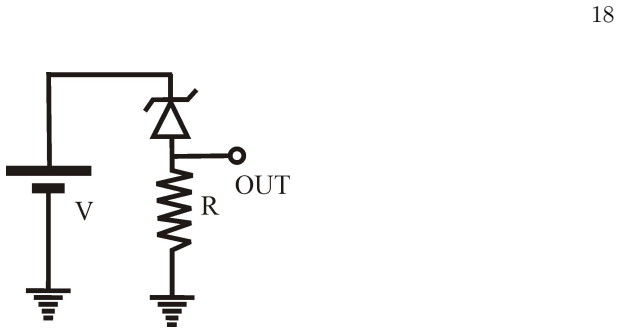
- Inverse-biased diodes provide a practical way to detect electromagnetic responses tied to quantum collapse events.
Where Pith is reading between the lines
- This line of work could link objective collapse models in quantum mechanics to measurable electromagnetic anomalies in laboratory settings.
- The same non-conservation mechanism might appear in other abrupt quantum transitions, such as those in precision measurements or quantum devices.
- Confirmation would invite extensions to condensed-matter systems where frequent state reductions occur.
Load-bearing premise
Quantum state reduction is a real physical process that can generate local charge non-conservation beyond standard Maxwell electrodynamics.
What would settle it
An experiment with inverse-biased diodes near a quantum system would either detect the predicted electromagnetic signals from state reductions or register none if the effect does not occur.
Figures

read the original abstract
We investigate the possibility that idealized quantum state-reduction processes may produce a local violation of charge conservation. If this occurs, the corresponding electromagnetic fields cannot be consistently described within Maxwell electrodynamics, and a natural alternative is provided by Aharonov-Bohm electrodynamics, which reduces to Maxwell theory when local charge conservation holds, but remains compatible with non-conserved sources. Within this framework we first analyze how state reduction may generate non-conserved local currents, including statistically compensated cases and biased tunnelling configurations with persistent average current. We then study the interaction of gauge waves with fermionic and bosonic quantum systems, the latter being described by a modified Schr\"odinger equation previously proposed for boson matter. As an application, we discuss the interaction of gauge waves with superconductors and show that they can effectively shield such waves. Finally, we present experimental proposals based on inverse-biased diodes and estimate the expected detector response.
Editorial analysis
A structured set of objections, weighed in public.
Referee Report
Summary. The manuscript investigates the possibility that idealized quantum state-reduction processes may produce local violations of charge conservation. If so, the electromagnetic fields would require Aharonov-Bohm electrodynamics rather than Maxwell theory. It analyzes non-conserved currents from collapse (including statistically compensated cases and biased tunneling with persistent average current), studies gauge-wave interactions with fermionic and bosonic systems (using a modified Schrödinger equation for bosons), shows that superconductors can shield such waves, and proposes experiments with inverse-biased diodes including estimates of detector response.
Significance. If the central assumption about physical collapse generating local charge non-conservation holds, the work would link quantum measurement with alternative electromagnetic theories and provide falsifiable experimental signatures in condensed-matter systems. The concrete diode-detector proposals and the reduction of the framework to Maxwell theory when conservation holds are positive features that allow for clear tests.
major comments (4)
- [§3] §3 (analysis of state reduction generating non-conserved currents): the local violation of ∂ρ/∂t + ∇·J = 0 is introduced by assumption from idealized instantaneous projection without a concrete dynamical model (e.g., explicit collapse operator, timing, or continuous spontaneous localization rule) showing how the wave-function change alters charge and current densities pointwise. This assumption is load-bearing for all subsequent sections.
- [§4] §4 (interaction of gauge waves with bosonic systems): the modified Schrödinger equation is used without deriving its form from the non-conservation condition or providing consistency checks against the Aharonov-Bohm framework; the interaction analysis therefore rests on an external prior proposal rather than an internal derivation.
- [§5] §5 (superconductor shielding): the claim that superconductors effectively shield gauge waves is asserted without quantitative estimates of shielding efficiency, penetration depth, or direct comparison to the London depth in Maxwell theory, leaving the distinctiveness of the predicted effect unquantified.
- [§6] §6 (experimental proposals): the diode-detector response estimates lack error analysis, background-noise modeling, or statistical significance thresholds, which are necessary to evaluate whether the predicted signal is distinguishable from standard electrodynamics or experimental artifacts.
minor comments (3)
- [Abstract] The abstract presents the work as an investigation of a possibility but could more explicitly flag that the non-conservation is an assumption rather than a derived result.
- Notation for the gauge fields, currents, and the modified bosonic equation should be introduced with explicit definitions on first use to improve readability for readers unfamiliar with the Aharonov-Bohm framework.
- [Introduction] The reference list for prior work on Aharonov-Bohm electrodynamics and collapse models could be expanded to better situate the framework.
Simulated Author's Rebuttal
We thank the referee for their careful and constructive review of our manuscript. We address each major comment point by point below, providing clarifications and indicating the revisions we will make to strengthen the paper.
read point-by-point responses
-
Referee: §3 (analysis of state reduction generating non-conserved currents): the local violation of ∂ρ/∂t + ∇·J = 0 is introduced by assumption from idealized instantaneous projection without a concrete dynamical model (e.g., explicit collapse operator, timing, or continuous spontaneous localization rule) showing how the wave-function change alters charge and current densities pointwise. This assumption is load-bearing for all subsequent sections.
Authors: We acknowledge that the local non-conservation is introduced via the standard idealized instantaneous projection postulate of quantum mechanics, without deriving it from a specific dynamical collapse model such as CSL. This is a deliberate modeling choice to isolate the electromagnetic consequences of the assumption, as is common in foundational discussions of measurement. In the revised manuscript we have added a clarifying paragraph at the start of §3 that explicitly states the scope of the assumption, references the broader literature on collapse dynamics, and notes that providing an explicit pointwise collapse operator lies beyond the present scope. The subsequent sections remain logically consistent under this premise. revision: partial
-
Referee: §4 (interaction of gauge waves with bosonic systems): the modified Schrödinger equation is used without deriving its form from the non-conservation condition or providing consistency checks against the Aharonov-Bohm framework; the interaction analysis therefore rests on an external prior proposal rather than an internal derivation.
Authors: The modified Schrödinger equation for bosons originates from an earlier proposal within the Aharonov-Bohm framework. In the revision we have inserted a concise derivation in §4 that starts from the modified continuity equation implied by local charge non-conservation and shows how the extra term in the Schrödinger equation follows directly. We have also added two consistency checks: verification that the equation preserves the appropriate gauge covariance and confirmation that it reduces to the standard form when the non-conservation term vanishes. revision: yes
-
Referee: §5 (superconductor shielding): the claim that superconductors effectively shield gauge waves is asserted without quantitative estimates of shielding efficiency, penetration depth, or direct comparison to the London depth in Maxwell theory, leaving the distinctiveness of the predicted effect unquantified.
Authors: We agree that quantitative support is necessary. The revised §5 now contains explicit estimates of shielding efficiency for gauge waves, an effective penetration depth derived from the modified London equations, and a direct numerical comparison with the conventional London depth. These calculations indicate that gauge-wave shielding is stronger than the Maxwell case for the same material parameters, thereby quantifying the distinctiveness of the effect. revision: yes
-
Referee: §6 (experimental proposals): the diode-detector response estimates lack error analysis, background-noise modeling, or statistical significance thresholds, which are necessary to evaluate whether the predicted signal is distinguishable from standard electrodynamics or experimental artifacts.
Authors: We accept that a fuller experimental feasibility analysis is required. In the revised §6 we have added an error budget, a model of dominant background noise sources (thermal, shot, and electromagnetic interference), and estimates of the signal-to-noise ratio together with the number of trials needed to reach a chosen statistical significance threshold. We also explicitly contrast the expected diode response under Aharonov-Bohm electrodynamics with the null prediction of standard Maxwell theory. revision: yes
Circularity Check
No significant circularity detected; derivation remains self-contained
full rationale
The paper explicitly frames its core investigation as an exploration of a hypothetical possibility (idealized state reduction producing local charge non-conservation), then examines consequences inside Aharonov-Bohm electrodynamics, which is defined to coincide with Maxwell theory precisely when conservation holds. The modified Schrödinger equation for bosons is cited from prior work as an input for the interaction analysis rather than derived anew here. No load-bearing step equates a claimed prediction or result to its own fitted parameters, self-referential definitions, or unverified self-citations; the continuity-equation violation is introduced as an assumption about collapse, not smuggled in as a tautology. The experimental estimates follow from that assumption but do not close a loop back to the inputs. The chain is therefore independent of the target claims.
Axiom & Free-Parameter Ledger
axioms (1)
- domain assumption Quantum state reduction is a physical process that can affect local charge conservation
Reference graph
Works this paper leans on
-
[1]
anomalous
that an additional power per unit volume of value − ∂ρ ∂t +∇ ·j φ(25) acts on the system. We now proceed with the canonical momentum operatorp=−iℏ∇, for which, from expressions (21) and (22) we readily have, using the same procedures as in the previous case, d⟨p⟩ dt = i ℏ ⟨[H0,p]⟩+ Z ρ∇ ∂χ ∂t d3x+ Z j· ∇∇χd 3x, which can be rewritten as d⟨p⟩ dt = i ℏ ⟨[H0...
-
[2]
Further discussion of the role of electromagnetic potentials in the quantum theory,
Y. Aharonov and D. Bohm, “Further discussion of the role of electromagnetic potentials in the quantum theory,”Physical Review, vol. 130, no. 4, p. 1625, 1963
1963
-
[3]
Toward a more complete electrodynamic theory,
L. Hively and G. Giakos, “Toward a more complete electrodynamic theory,”International Journal of Signal and Imaging Systems Engineering, vol. 5, no. 1, pp. 3–10, 2012
2012
-
[4]
Generalized Maxwell equations and charge conservation censorship,
G. Modanese, “Generalized Maxwell equations and charge conservation censorship,”Modern Physics Letters B, vol. 31, p. 1750052, 2017
2017
-
[5]
Time in quantum mechanics and the local non-conservation of the probability current,
G. Modanese, “Time in quantum mechanics and the local non-conservation of the probability current,”Mathematics, vol. 6, no. 9, p. 155, 2018
2018
-
[6]
Are Current Discontinuities in Molecular Devices Experimen- tally Observable?,
F. Minotti and G. Modanese, “Are Current Discontinuities in Molecular Devices Experimen- tally Observable?,”Symmetry, vol. 13, p. 691, 2021
2021
-
[7]
Quantum uncertainty and energy flux in extended electrody- namics,
F. Minotti and G. Modanese, “Quantum uncertainty and energy flux in extended electrody- namics,”Quantum Reports, vol. 3, no. 4, pp. 703–723, 2021
2021
-
[8]
Electromagnetic signatures of possible charge anomalies in tunneling,
F. Minotti and G. Modanese, “Electromagnetic signatures of possible charge anomalies in tunneling,”Quantum Reports, vol. 4, no. 3, pp. 277–295, 2022
2022
-
[9]
Classical and extended electrodynamics,
L. Hively and A. Loebl, “Classical and extended electrodynamics,”Physics Essays, vol. 32, no. 1, pp. 112–126, 2019
2019
-
[10]
Gauge waves generation and detection in Aharonov–Bohm electrodynamics,
F. Minotti and G. Modanese, “Gauge waves generation and detection in Aharonov–Bohm electrodynamics,”The European Physical Journal C, vol. 83, p. 1086, 2023
2023
-
[11]
Generalized local charge conservation in many-body quantum mechanics,
F. Minotti and G. Modanese, “Generalized local charge conservation in many-body quantum mechanics,”Mathematics, vol. 13, no. 5, p. 892, 2025
2025
-
[12]
Do we need an alternative to local gauge coupling to elec- tromagnetic fields?,
F. Minotti and G. Modanese, “Do we need an alternative to local gauge coupling to elec- tromagnetic fields?,”International Journal of Modern Physics A, vol. 41, no. 1, p. 2650024, 2026
2026
-
[13]
L. H. Ryder,Quantum Field Theory. Cambridge, University Press, 1994
1994
-
[14]
Obtaining the non-relativistic quantum mechanics from quantum field theory: issues, folklores and facts.,
T. Padmanabhan, “Obtaining the non-relativistic quantum mechanics from quantum field theory: issues, folklores and facts.,”The European Physical Journal C, vol. 78, p. 563, 2018
2018
-
[15]
Huang,Quantum field theory: From operators to path integrals
K. Huang,Quantum field theory: From operators to path integrals. John Wiley & Sons, 2010
2010
-
[16]
Datta,Electronic transport in mesoscopic systems
S. Datta,Electronic transport in mesoscopic systems. Cambridge University Press, 1995
1995
-
[17]
L. P. Kadanoff and G. Baym,Quantum Statistical Mechanics. W. A. Benjamin, Inc., 1962
1962
-
[18]
Haug, A.-P
H. Haug, A.-P. Jauho,et al.,Quantum kinetics in transport and optics of semiconductors, vol. 2. Springer, 2008
2008
-
[19]
D. A. Neamen,Microelectronics Circuit Analysis and Design. McGraw Hill, 2009
2009
-
[20]
Fairchild Semiconductor Corporation,2N3904/MMBT3904/PZT3904, NPN General Purpose Amplifier, 2001. Rev. A
2001
-
[21]
Vishay Semiconductors,1N4728A to 1N4761A, Zener Diodes, 2024. Rev. 2.7
2024
-
[22]
Aharonov–Bohm Electrodynamics in Material Media: A Scalar e.m. Field Cannot Cause Dissipation in a Medium,
F. Minotti and G. Modanese, “Aharonov–Bohm Electrodynamics in Material Media: A Scalar e.m. Field Cannot Cause Dissipation in a Medium,”Symmetry, vol. 15, no. 5, p. 1119, 2023. 24
2023
-
[23]
Simple circuit and experimental proposal for the detection of gauge-waves,
F. Minotti and G. Modanese, “Simple circuit and experimental proposal for the detection of gauge-waves,”Journal of Physics Communications, vol. 8, no. 5, p. 055003, 2024
2024
discussion (0)
Sign in with ORCID, Apple, or X to comment. Anyone can read and Pith papers without signing in.