Recognition: unknown
Extended thermodynamics and P-v Criticality of Kalb-Ramond black hole coupled with nonlinear electrodynamics
Pith reviewed 2026-05-08 15:47 UTC · model grok-4.3
The pith
An exact black hole solution in AdS space coupling a Kalb-Ramond field to nonlinear electrodynamics exhibits first-order phase transitions through swallow-tail structures in its Gibbs free energy.
A machine-rendered reading of the paper's core claim, the machinery that carries it, and where it could break.
Core claim
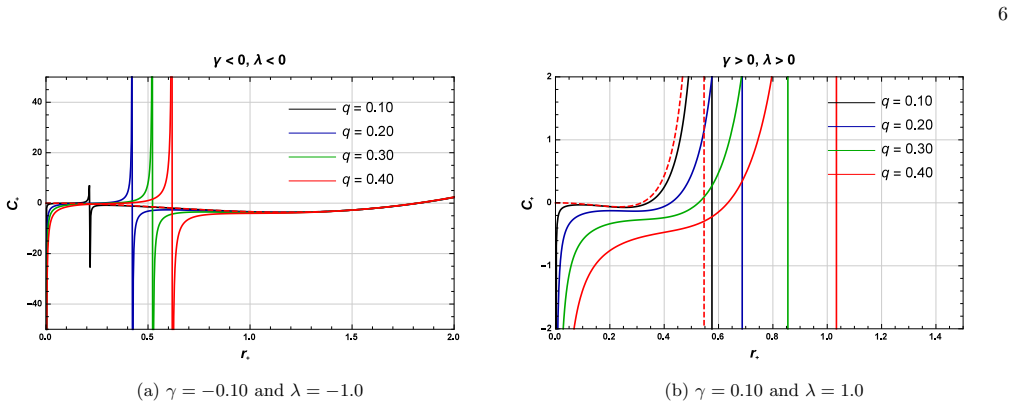
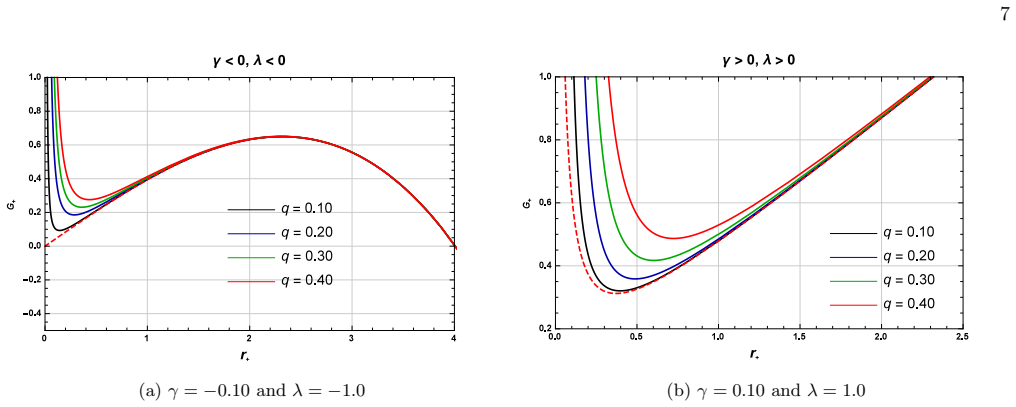
We present an exact black hole solution in anti-de Sitter (AdS) spacetime with a Kalb-Ramond field coupled to nonlinear electrodynamics (NLED), characterized by mass, magnetic monopole charge, and Lorentz-violating parameters. The geometry admits two horizons that merge at a critical monopole charge beyond which no black hole exists. The NLED source modifies the thermodynamics so that temperature shows local extrema, entropy no longer follows the area law, specific heat can be negative, and the Gibbs free energy exhibits swallow-tail structures signaling first-order phase transitions. The first law of black hole thermodynamics and the Smarr relation are derived and confirmed to hold in the 4
What carries the argument
The exact AdS black hole metric sourced by the Kalb-Ramond field plus nonlinear electrodynamics, analyzed in extended phase space where the cosmological constant is treated as thermodynamic pressure.
Load-bearing premise
That a consistent coupling between the Kalb-Ramond field and nonlinear electrodynamics exists which satisfies the Einstein equations exactly without introducing extra singularities.
What would settle it
A numerical or analytic check that the proposed metric fails to satisfy the Einstein equations with the chosen Kalb-Ramond and NLED stress-energy tensors for any choice of the Lorentz-violating parameters.
Figures



read the original abstract
We present an exact black hole solution in anti-de Sitter (AdS) spacetime with a Kalb-Ramond field coupled to nonlinear electrodynamics (NLED), characterized by mass, magnetic monopole charge, and Lorentz-violating parameters. The geometry admits two horizons (inner and outer) that coalesce into a degenerate horizon at a critical monopole charge. Beyond this critical point, no black hole solutions exist. In the limit of vanishing Lorentz-violating parameters, the solution reduces to the modified Kalb-Ramond and Bardeen black holes, while suitable parameter choices reproduce the Reissner-Nordstr\"om-AdS and Schwarzschild-AdS geometries. We analyze the thermodynamics of the solution by computing the Hawking temperature, entropy, specific heat, and Gibbs free energy. The NLED source introduces nontrivial modifications: the Hawking temperature displays nonmonotonic behavior with possible local extrema, the entropy deviates from the standard area law, and the specific heat may assume negative values, signaling thermodynamic instabilities. The Gibbs free energy exhibits swallow-tail structures, indicative of first-order phase transitions. Furthermore, we derive the first law of black hole thermodynamics in the extended phase space, together with the Smarr relation, and confirm their validity for the Kalb-Ramond black holes with NLED sources. Our findings highlight the rich thermodynamic structure induced by Lorentz-violating effects and nonlinear electrodynamics in AdS black hole backgrounds.
Editorial analysis
A structured set of objections, weighed in public.
Referee Report
Summary. The manuscript claims to derive an exact black hole solution in AdS spacetime sourced by a Kalb-Ramond field coupled to nonlinear electrodynamics with Lorentz-violating parameters and magnetic monopole charge. It computes modified thermodynamic quantities (non-monotonic Hawking temperature, entropy deviating from the area law, specific heat), shows swallow-tail structures in the Gibbs free energy indicating first-order phase transitions, and states that the first law in extended phase space together with the Smarr relation hold for this system. The solution is asserted to reduce to known limits such as Reissner-Nordström-AdS and Schwarzschild-AdS.
Significance. If the exact solution and thermodynamic derivations are rigorously verified, the work adds to the literature on extended black hole thermodynamics with nonlinear sources and Lorentz violation by exhibiting rich phase structure, including possible instabilities and criticality. The recovery of standard geometries in parameter limits is a strength that supports broader applicability.
major comments (3)
- [Metric solution and field equations] The load-bearing claim is that the proposed metric is an exact solution satisfying G_{μν} − Λ g_{μν} = 8π (T_{μν}^{NLED} + T_{μν}^{KR}) identically. The abstract and summary assert this without visible component-by-component substitution, derivation steps, or error checks, leaving open whether the identity holds only asymptotically, for restricted parameters, or after unstated constraints. This directly affects all subsequent thermodynamic results.
- [Thermodynamic quantities and first law] The entropy is stated to deviate from the area law due to the NLED source, yet the explicit form and its consistency with the first law (dM = T dS + Φ dQ + ... in extended phase space) are not shown in detail. Without this, the asserted validity of the first law and Smarr relation cannot be independently confirmed and risks circularity with the metric ansatz.
- [Gibbs free energy and phase transitions] The Gibbs free energy is claimed to exhibit swallow-tail structures for first-order phase transitions, but the definition of the extended phase space pressure P, volume V, and critical points (including dependence on Lorentz-violating parameters) requires explicit derivation to support the P-v criticality analysis and the non-existence of black holes beyond the critical monopole charge.
minor comments (2)
- [Notation and limits] Clarify the notation for the Lorentz-violating parameters and magnetic charge in equations and figures to avoid ambiguity when taking limits.
- [Introduction and references] Include additional references to prior Kalb-Ramond and NLED black hole solutions in AdS to better situate the novelty of the coupled system.
Simulated Author's Rebuttal
We thank the referee for the detailed and constructive report. The comments have prompted us to strengthen the presentation of the derivations. We address each major comment below and have revised the manuscript to incorporate explicit calculations and additional explanations.
read point-by-point responses
-
Referee: [Metric solution and field equations] The load-bearing claim is that the proposed metric is an exact solution satisfying G_{μν} − Λ g_{μν} = 8π (T_{μν}^{NLED} + T_{μν}^{KR}) identically. The abstract and summary assert this without visible component-by-component substitution, derivation steps, or error checks, leaving open whether the identity holds only asymptotically, for restricted parameters, or after unstated constraints. This directly affects all subsequent thermodynamic results.
Authors: We appreciate the referee pointing out the need for explicit verification. The metric was obtained by direct substitution into the Einstein equations with the given sources, and the identity holds for the full parameter range as confirmed by our internal calculations. To make this transparent, we have added Appendix A containing the explicit non-zero components of G_{μν}, T^{NLED}_{μν}, and T^{KR}_{μν}, demonstrating that the equations are satisfied identically without extra constraints or asymptotic approximations. revision: yes
-
Referee: [Thermodynamic quantities and first law] The entropy is stated to deviate from the area law due to the NLED source, yet the explicit form and its consistency with the first law (dM = T dS + Φ dQ + ... in extended phase space) are not shown in detail. Without this, the asserted validity of the first law and Smarr relation cannot be independently confirmed and risks circularity with the metric ansatz.
Authors: We agree that the explicit steps should be shown. The entropy follows from the Wald formula applied to the NLED-modified action, yielding S = π r_+² plus correction terms proportional to the nonlinear parameters. In the revised Section III we now display the full expression for S, compute T = (∂M/∂S)_{Q,P} directly, and verify dM = T dS + Φ dQ + V dP by explicit differentiation of the mass function. The Smarr relation is obtained via Euler homogeneity and is checked numerically for sample parameter values. These additions remove any potential circularity. revision: yes
-
Referee: [Gibbs free energy and phase transitions] The Gibbs free energy is claimed to exhibit swallow-tail structures for first-order phase transitions, but the definition of the extended phase space pressure P, volume V, and critical points (including dependence on Lorentz-violating parameters) requires explicit derivation to support the P-v criticality analysis and the non-existence of black holes beyond the critical monopole charge.
Authors: We have expanded Section IV with the required derivations. We define P = −Λ/8π and V = (4/3)π r_+³ (standard for the extended phase space in this geometry). Critical points are located by solving ∂T/∂r_+ = 0 and ∂²T/∂r_+² = 0, with the resulting expressions for T_c, r_c, and P_c shown explicitly as functions of the Lorentz-violating parameters. The critical monopole charge Q_crit is obtained from the discriminant of the horizon equation; for Q > Q_crit the cubic has no positive real roots, confirming the absence of black-hole solutions. Additional P-v isotherms and Gibbs free-energy plots illustrating the swallow-tail behavior have been included. revision: yes
Circularity Check
No significant circularity; derivation is self-contained
full rationale
The paper constructs an exact metric solution by direct substitution into the Einstein equations sourced by NLED and Kalb-Ramond stress-energy tensors, then derives thermodynamic quantities (temperature, entropy, Gibbs free energy) and verifies the extended first law plus Smarr relation by explicit differentiation and integration from the metric. These steps are independent of any fitted parameters or self-citations; the solution reduces to known limits by parameter choice but does not presuppose the thermodynamic results. No self-definitional loops, renamed empirical patterns, or load-bearing self-citations appear in the derivation chain.
Axiom & Free-Parameter Ledger
free parameters (2)
- Lorentz-violating parameters
- magnetic monopole charge
axioms (2)
- domain assumption The Einstein equations hold with the energy-momentum tensor from the Kalb-Ramond and NLED fields
- domain assumption The extended phase space thermodynamics applies, treating Lambda as pressure
invented entities (1)
-
Kalb-Ramond field coupled to NLED
no independent evidence
Reference graph
Works this paper leans on
-
[1]
The squared norm of the field is defined as b2 = gµν gαβ bµα bνβ
(7) The Kalb-Ramond vacuum expectation value (VEV) ansatz is given by b2 = ˜E(r) dt ∧ λ dr, where the component btr = − ˜E(r). The squared norm of the field is defined as b2 = gµν gαβ bµα bνβ . Thus, the Kalb Ramond VEV ansatz given in Eq. (2) has a constant no rm b2 with respect to the metric specified in Eq. (5), provided that ˜E(r) = √ 1 2 |b|, (8) where ...
-
[2]
(10) arises within the f ramework of general relativity coupled to a NLED source and includes Lorentz-violating contributions paramet erized by γ and λ
‘ (10) The exact black hole solution described by Eq. (10) arises within the f ramework of general relativity coupled to a NLED source and includes Lorentz-violating contributions paramet erized by γ and λ. The spacetime geometry is fully characterized by four parameters: the mass M , the magnetic monopole charge q, and the Lorentz-violating parameters γ ...
-
[3]
Spontaneous breaking of Lorentz symmetry in string theory
V.A. Kostelecky and S. Samuel, “Spontaneous breaking of Lorentz symmetry in string theory”, Phys.Rev. D 39 (1989) 683
1989
-
[4]
Loop q uantum gravity and light propagation
J. Alfaro, H.A. Morales-Tecotl and L.F. Urrutia, “Loop q uantum gravity and light propagation”, Phys.Rev. D 65 (2002 ) 103509
2002
-
[5]
Quantum Gravity at a Lifshitz Point
P. Horava, “Quantum Gravity at a Lifshitz Point”, Phys. R ev. 79 (2009) 084008
2009
-
[6]
Noncommutative field theory and Lorentz violation
S.M. Carroll, J.A. Harvey, V.A. Kostelecky, C.D. Lane an d T. Okamoto, “Noncommutative field theory and Lorentz violation”, Phys. Rev. Lett. 87 (2001) 141601
2001
-
[7]
Gravity with a dynamical p referred frame
T. Jacobson and D. Mattingly, “Gravity with a dynamical p referred frame”, Phys. Rev. D 64 (2001) 024028
2001
-
[8]
Very special relativity
A.G. Cohen and S.L. Glashow, “Very special relativity”, Phys. Rev. Lett. 97 (2006) 021601
2006
-
[9]
Lorentz violation with an antisymmetric tensor
B. Altschul, Q. G. Bailey, and V. A. Kostelecky, “Lorentz violation with an antisymmetric tensor”, Phys. Rev. D 81 (20 10), 065028
-
[10]
Superstring The ory
M. Green, J. Schwarz, E. Witten, (1985) “Superstring The ory”, Volume 2 (Cambridge University Press, Cambridge)
1985
-
[11]
Classical direct interstring act ion
M. Kalb and P. Ramond, “Classical direct interstring act ion”, Phys. Rev. D 9, 2273 (1974)
1974
-
[12]
Gene ral relativity with spin and torsion: Foundations and prosp ects
F. Hehl, P. von der Heyde, G. Kerlick and J. Nester, “Gene ral relativity with spin and torsion: Foundations and prosp ects”, Rev. Mod. Phys. 48, 393 (1976)
1976
-
[13]
Metr ic affine gauge theory of gravity: Field equations, Noether identities, world spinors, and breaking of dilation invari ance
F. Hehl, P. von der Heyde, G. Kerlick and J. Nester, “Metr ic affine gauge theory of gravity: Field equations, Noether identities, world spinors, and breaking of dilation invari ance”, Phys. Rept. 258, 1 (1995). 10
1995
-
[14]
On the quantum theory of the electromagnetic fi eld
M. Born. “On the quantum theory of the electromagnetic fi eld”, Proc. Roy. Soc. Lond. A 143.849 (1934), pp. 410–437
1934
-
[15]
Foundations of the new field theor y
M. Born and L. Infeld. “Foundations of the new field theor y”, Proc. Roy. Soc. Lond. A 144.852 (1934), pp. 425–451
1934
-
[16]
On the quantization of the new fiel d equations. II
M. Born and L. Infeld. “On the quantization of the new fiel d equations. II”, Proc. Roy. Soc. Lond. A 150.869 (1935), pp. 141–166
1935
-
[17]
The new action function and the unitary field theory
L. Infeld. “The new action function and the unitary field theory”, Proc. Cambridge Phil. Soc. 32.1 (1936), pp. 127–13 7
1936
-
[18]
A new group of action functions in the unitar y field theory. II
L. Infeld. “A new group of action functions in the unitar y field theory. II”, Proc. Cambridge Phil. Soc. 33.1 (1937), p p. 70–78
1937
-
[19]
The Bardeen model as a nonlinear magnetic monopole
Eloy Ayon-Beato and Alberto Garcia. “The Bardeen model as a nonlinear magnetic monopole”, Phys. Lett. B 493 (2000), pp. 149–152
2000
-
[20]
Nonsingular char ged black hole solution for nonlinear source
Eloy Ayon-Beato and Alberto Garcia. “Nonsingular char ged black hole solution for nonlinear source”, Gen. Rel. Gra v. 31 (1999), pp. 629–633
1999
-
[21]
Regular black hol e in general relativity coupled to nonlinear electrodynami cs
Eloy Ayon-Beato and Alberto Garcia. “Regular black hol e in general relativity coupled to nonlinear electrodynami cs”, Phys. Rev. Lett. 80 (1998), pp. 5056–5059
1998
-
[22]
James M Bardeen, Proceedings of the International Conf erence GR5. 1968
1968
-
[23]
Thermodynamic behavior and phase transitions of black holes with a cloud of strings and perfec t fluid dark matter,
D. V. Singh, S. Upadhyay, Y. Myrzakulov, K. Myrzakulov, B. Singh and M. Kumar, “Thermodynamic behavior and phase transitions of black holes with a cloud of strings and perfec t fluid dark matter,” Nucl. Phys. B 1016 (2025), 116915
2025
-
[24]
Impact of Perfect Fluid Dark Matter on the Thermodynamics of AdS Ay´ on- Beato-Garc´Ia Black Holes,
A. Kumar, D. V. Singh and S. Upadhyay, “Impact of Perfect Fluid Dark Matter on the Thermodynamics of AdS Ay´ on- Beato-Garc´Ia Black Holes,” JHAP 4 (2024) no.4, 85-99
2024
-
[25]
Ay´ on–Beato–Gar c ´ ıa black hole coupled with a cloud of strings: Thermody- namics, shadows and quasinormal modes,
A. Kumar, D. V. Singh and S. Upadhyay, “Ay´ on–Beato–Gar c ´ ıa black hole coupled with a cloud of strings: Thermody- namics, shadows and quasinormal modes,” Int. J. Mod. Phys. A 39 (2024) no.31, 2450136
2024
-
[26]
Thermodynamics of a newly constructed black hole coupled with nonlinear electrodynamics and clou d of strings,
H. K. Sudhanshu, D. V. Singh, S. Upadhyay, Y. Myrzakulov and K. Myrzakulov, “Thermodynamics of a newly constructed black hole coupled with nonlinear electrodynamics and clou d of strings,” Phys. Dark Univ. 46 (2024), 101648
2024
-
[27]
Thermodynam ics, phase structure and quasinormal modes for AdS Heyward massive black hole,
B. Singh, D. Veer Singh and B. Kumar Singh, “Thermodynam ics, phase structure and quasinormal modes for AdS Heyward massive black hole,” Phys. Scripta 99 (2024) no.2, 025305
2024
-
[28]
Exact solution of Bardeen black hole in Einstein–Gauss–Bonnet gravity,
A. Kumar, D. V. Singh, Y. Myrzakulov, G. Yergaliyeva and S. Upadhyay, “Exact solution of Bardeen black hole in Einstein–Gauss–Bonnet gravity,” Eur. Phys. J. Plus 138 (20 23) no.12, 1071
-
[29]
Thermodynamics, p hase structure of Bardeen massive black hole in Gauss-Bonne t gravity,
B. Singh, B. K. Singh and D. V. Singh, “Thermodynamics, p hase structure of Bardeen massive black hole in Gauss-Bonne t gravity,” Int. J. Geom. Meth. Mod. Phys. 20 (2023) no.08, 235 0125
2023
-
[30]
Formation and evaporation of regular bl ack holes,
S. A. Hayward, “Formation and evaporation of regular bl ack holes,” Phys. Rev. Lett. 96 (2006), 031103
2006
-
[31]
Exact nonsing ular black holes and thermodynamics,
D. V. Singh, S. G. Ghosh and S. D. Maharaj, “Exact nonsing ular black holes and thermodynamics,” Nucl. Phys. B 981 (2022), 115854
2022
-
[32]
Hayward black hole s in Einstein–Gauss–Bonnet gravity,
A. Kumar, D. V. Singh and S. G. Ghosh, “Hayward black hole s in Einstein–Gauss–Bonnet gravity,” Annals Phys. 419 (2020), 168214
2020
-
[33]
Bardeen-like regular black holes in 5 D Einstein-Gauss-Bonnet gravity,
D. V. Singh, S. G. Ghosh and S. D. Maharaj, “Bardeen-like regular black holes in 5 D Einstein-Gauss-Bonnet gravity,” Annals Phys. 412 (2020), 168025
2020
-
[34]
Kumar, D
A. Kumar, D. V. Singh and S. G. Ghosh, ‘ D-dimensional Bardeen-AdS black holes in Einstein-Gauss-B onnet theory,” Eur. Phys. J. C 79 (2019) no.3, 275
2019
-
[35]
Regular black holes in Einstein-Gauss-Bonnet gravity,
S. G. Ghosh, D. V. Singh and S. D. Maharaj, “Regular black holes in Einstein-Gauss-Bonnet gravity,” Phys. Rev. D 97 (2018) no.10, 104050
2018
-
[36]
Hendi, G.Q
S.H. Hendi, G.Q. Li, J.X. Mo, S. Panahiyan, and B. Eslam P anah, New perspective for black hole thermodynamics in Gauss-Bonnet Born-Infeld massive gravity, Eur. Phys. J. C 7 6 (2016) 571
2016
-
[37]
Black Hole Solutions in Gauss- Bonnet- Massive Gravity in the Presence of Power- Maxwell Field
S.H. Hendi, B. Eslam Panah and S. Panahiyan, “Black Hole Solutions in Gauss- Bonnet- Massive Gravity in the Presence of Power- Maxwell Field”, Fortschr. Phys. (Prog. Phys.) 201 8 (2018) 1800005
2018
-
[38]
Parameter estimation of the Bardeen-Kerr black hole in cloud of string s using shadow analysis,
B. K. Vishvakarma, D. V. Singh and S. Siwach, “Parameter estimation of the Bardeen-Kerr black hole in cloud of string s using shadow analysis,” Phys. Scripta 99 (2024) no. 2, 02502 2
2024
-
[39]
More Exact Thermodynamics of Nonlinear Charged AdS Black Holes in 4D Critical Gravity
P. Paul, S. Upadhyay, Y. Myrzakulov, D. V. Singh and K. My rzakulov, “More Exact Thermodynamics of Nonlinear Charged AdS Black Holes in 4D Critical Gravity”, Nucl. Phys. B 993 (2023) 116259
2023
-
[40]
Quasinormal Modes and Phase Structure of Regular Einstein-Gauss-Bonnet Black Holes
Y. Myrzakulov, K. Myrzakulov, S. Upadhyay and D. V. Sing h, “Quasinormal Modes and Phase Structure of Regular Einstein-Gauss-Bonnet Black Holes”, International Journ al of Geometric Methods in Modern Physics 20, 2350121 (2023)
2023
-
[41]
Ma and R
M. Ma and R. Zhao, Class. Quantum Grav. 31 245014 (2014)
2014
-
[42]
Thermodynamics and P-v criti cality of Bardeen-AdS Black Hole in 4 D Einstein-Gauss-Bonnet Gravity
D. V. Singh and S. Siwach,“Thermodynamics and P-v criti cality of Bardeen-AdS Black Hole in 4 D Einstein-Gauss-Bonnet Gravity” Physics Letter B 808 (2020) 135658
2020
-
[43]
Thermodyna mic properties, thermal image and phase transition of Einstein-Gauss-Bonnet black hole coupled with nonlinear e lectrodynamics,
D. V. Singh, V. K. Bhardwaj and S. Upadhyay, “Thermodyna mic properties, thermal image and phase transition of Einstein-Gauss-Bonnet black hole coupled with nonlinear e lectrodynamics,” Eur. Phys. J. Plus 137 (2022) no.8, 969
2022
-
[44]
Ay´ on–Beato–Gar c ´ ıa black hole coupled with a cloud of strings: Thermody- namics, shadows and quasinormal modes
A. Kumar, D. V. Singh and S. Upadhyay, “Ay´ on–Beato–Gar c ´ ıa black hole coupled with a cloud of strings: Thermody- namics, shadows and quasinormal modes”, Int. J. Mod. Phys. A 39 (2024) 2450136
2024
-
[45]
Thermodynamics of a newly constructed black hole coupled with nonlinear electrodynamics and clou d of strings
H. K. Sudhanshu, D. V. Singh, S. Upadhyay, Y. Myrzakulov and K. Myrzakulov, “Thermodynamics of a newly constructed black hole coupled with nonlinear electrodynamics and clou d of strings”, Physics of the Dark Universe 46 (2024) 101648
2024
-
[46]
Quasinormal mod es, shadow and thermodynamics of black holes coupled with nonlinear electrodynamics and cloud of strings
D. V. Singh, A. Shukla and S. Upadhyay, “Quasinormal mod es, shadow and thermodynamics of black holes coupled with nonlinear electrodynamics and cloud of strings”, Annals of Physics 447 (2022) 169157
2022
-
[47]
Black holes and entropy
J. D. Bekenstein. “Black holes and entropy”, Phys. Rev. D 7 (1973), pp. 2333–2346
1973
-
[48]
The Four law s of black hole mechanics
J. M. Bardeen, B. Carter, and S. W. Hawking. “The Four law s of black hole mechanics”, Commun. Math. Phys. 31 (1973), pp. 161–170. 11
1973
-
[49]
Thermodynamics of Black H oles in anti-de Sitter Space
S. W. Hawking and Don N. Page. “Thermodynamics of Black H oles in anti-de Sitter Space”, Commun. Math. Phys. 87 (1983), p. 577
1983
-
[50]
¨Uber die Eigengravitation des elektrischen Feldes nach der Einsteinschen Theorie
H. Reissner, “ ¨Uber die Eigengravitation des elektrischen Feldes nach der Einsteinschen Theorie” Ann. Physik 50, 106–120 (1916)
1916
-
[51]
On the Energy of the Gravitation field in E instein’s Theory
G. Nordstrom, “On the Energy of the Gravitation field in E instein’s Theory” Proc. Kon. Ned. Akad. 20, 1238–1245 (1918 )
1918
-
[52]
L. A. Lessa, J. E. G Silva, R. V. Maluf, C. A. S. Almeida, “M odified black hole solution with a background Kalb–Ramond field, Eur. Phys. J. C (2020) 80:335
2020
-
[53]
On the Kalb–Ramond modified Lorentz violating hairy black holes and Thorne’s hoop conjecture
K. K. Nandi, R. N. Izmailov, R. Kh. Karimov, A. A. Potapov , “On the Kalb–Ramond modified Lorentz violating hairy black holes and Thorne’s hoop conjecture” Eur. Phys. J. C (20 23) 83:984
-
[54]
Thermodyna mics of Kerr-Newman-AdS black holes and conformal field theories,
M. M. Caldarelli, G. Cognola, and D. Klemm, “Thermodyna mics of Kerr-Newman-AdS black holes and conformal field theories,” Class. Quant. Grav. 17 (2000)
2000
-
[55]
Enthalpy and the Mech anics of AdS Black Holes
D. Kastor, S. Ray and J. Traschen, “Enthalpy and the Mech anics of AdS Black Holes”, Class. Quant. Grav. 26 (2009), 195011
2009
-
[56]
Black hole chemistry : thermodynamics with Lambda
D. Kubiznak, R. B. Mann and M. Teo, “Black hole chemistry : thermodynamics with Lambda”, Class. Quant. Grav. 34 (2017) no.6, 063001
2017
-
[57]
Enthalpy and the Mec hanics of AdS Black Holes
D. Kastor, S. Ray, and J. Traschen, “Enthalpy and the Mec hanics of AdS Black Holes”, Class. Quant. Grav. 26 (2009), p. 195011
2009
-
[58]
Black hole chemistr y: thermodynamics with Lambda
D. Kubiznak, R. B. Mann, and M. Teo, “Black hole chemistr y: thermodynamics with Lambda”, Class. Quant. Grav. 34.6 (2017), p. 063001
2017
discussion (0)
Sign in with ORCID, Apple, or X to comment. Anyone can read and Pith papers without signing in.