Recognition: unknown
Microsopic Theory of Spin Polarons in Chern Ferromagnets
Pith reviewed 2026-05-08 15:44 UTC · model grok-4.3
The pith
Spin polarons binding any number of spin flips are exact eigenstates in ideal Chern-1 bands with contact interactions.
A machine-rendered reading of the paper's core claim, the machinery that carries it, and where it could break.
Core claim
In an ideal Chern-1 band with a normal-ordered contact interaction, these polarons are exact eigenstates of the Hamiltonian with the same energy as single-hole excitations. The momentum-space wavefunctions admit two equivalent representations: a ratio of Jastrow factors of Weierstrass functions of relative momenta or an antisymmetrized geminal product of particle-hole wavefunctions. The latter enables efficient evaluation of overlaps and expectation values for large system sizes and many spin flips. Benchmarking in the lowest Landau level shows the single-spin-flip ansatz achieves high overlap with exact diagonalization while multi-spin-flip energies interpolate toward the skyrmion regime.
What carries the argument
The spin polaron wavefunction in momentum space, represented equivalently as a ratio of Jastrow factors of Weierstrass functions or an antisymmetrized geminal product of particle-hole wavefunctions.
If this is right
- These exact eigenstates enable direct computation of properties of doped Chern ferromagnets without approximation in the ideal limit.
- The variational family with a size parameter and geometry-informed dressing can be used to study realistic moiré systems.
- Binding energies decrease slowly and the bound state size increases as quantum geometry becomes more concentrated when dispersion is suppressed.
- Multi-spin-flip energies connect smoothly to the large-texture skyrmion regime.
- The wavefunctions lay groundwork for variational descriptions of multi-polaron excitations and phases in topological flat bands.
Where Pith is reading between the lines
- Similar exact or variational polaron constructions might extend to other flat-band systems with nontrivial topology beyond Chern insulators.
- Materials engineering to minimize interaction-generated dispersion while preserving quantum geometry could stabilize these bound states for potential applications in topological quantum matter.
- Numerical tests in specific moiré platforms could check whether the predicted binding persists and influences magnetic or transport properties at finite doping.
Load-bearing premise
The single-particle dispersion generated by interactions can be suppressed or tuned independently of the quantum geometry of the band.
What would settle it
Exact diagonalization on a finite-size Chern band with non-uniform geometry and unsuppressed interaction dispersion, where the variational polaron energy lies above the single-hole plus unbound spin-flip continuum.
Figures

read the original abstract
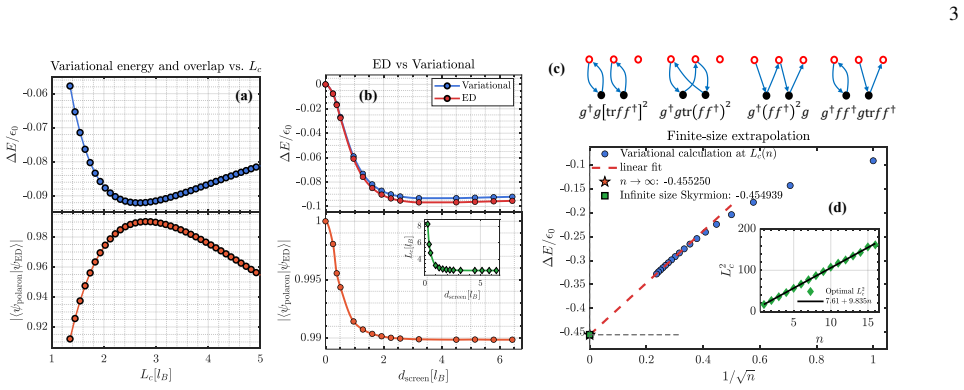
We develop a microscopic theory of charged excitations in an SU(2) Chern ferromagnet and obtain closed-form wavefunctions for a hierarchy of charge-$e$ spin polaron states binding an arbitrary number of spin flips. In an ideal Chern-$1$ band with a normal-ordered contact interaction, we show that these polarons are exact eigenstates of the Hamiltonian with the same energy as single-hole excitations. Away from this ideal limit, we promote these states to a variational family by introducing a single size parameter and a geometry-informed single-particle dressing. Our momentum-space wavefunctions admit two equivalent representations: a ratio of Jastrow factors of Weierstrass functions of relative momenta or an antisymmetrized geminal product of particle-hole wavefunctions. The latter enables efficient evaluation of overlaps and expectation values for large system sizes and many spin flips. Benchmarking in the lowest Landau level, the single-spin-flip ansatz achieves $\gtrsim 99\%$ overlap with exact diagonalization and accurately captures binding energies, while the multi-spin-flip energies interpolate smoothly toward the large-texture (skyrmion) regime. For Chern bands with tunable quantum geometry, we find that interaction-generated single particle dispersion quickly destabilizes the spin polarons once quantum geometry becomes sufficiently non-uniform. When such dispersion is suppressed, however, the bound states persist deeper into the non-uniform regime, with the binding energy slowly decreasing and the bound state becoming larger as the quantum geometry becomes more concentrated. Our results provide a microscopic foundation for analyzing doped Chern ferromagnets in moir\'e platforms and lay the groundwork for variational wavefunctions of multi-polaron excitations and phases.
Editorial analysis
A structured set of objections, weighed in public.
Referee Report
Summary. The manuscript develops a microscopic theory of charged excitations in SU(2) Chern ferromagnets, deriving closed-form wavefunctions for a hierarchy of charge-e spin polaron states that bind an arbitrary number of spin flips. In an ideal Chern-1 band with normal-ordered contact interaction, these polarons are shown to be exact eigenstates of the Hamiltonian with the same energy as single-hole excitations. The wavefunctions admit equivalent representations as ratios of Jastrow factors of Weierstrass functions of relative momenta or as antisymmetrized geminal products of particle-hole wavefunctions. Away from the ideal limit, the states are promoted to a variational family via a single size parameter and geometry-informed single-particle dressing. Benchmarks in the lowest Landau level demonstrate ≥99% overlap with exact diagonalization for the single-spin-flip case, with multi-flip energies interpolating to the skyrmion regime. For tunable quantum geometry, the work finds that interaction-generated dispersion destabilizes the polarons unless suppressed, in which case bound states persist with slowly decreasing binding energy and increasing size.
Significance. If the central results hold, the paper supplies a valuable microscopic foundation for analyzing doped Chern ferromagnets in moiré platforms and provides groundwork for variational studies of multi-polaron excitations and phases. The analytical demonstration that the polaron wavefunctions are exact eigenstates in the ideal limit (with energy matching single-hole excitations) is a clear strength, as is the efficient geminal-product representation that enables large-system calculations. The high-fidelity LLL benchmarks against exact diagonalization and the smooth interpolation to the skyrmion limit add substantial credibility to the variational ansatz. These elements distinguish the work from purely numerical or phenomenological approaches.
minor comments (2)
- [Section on variational extension] The transition from the ideal-limit exact eigenstate proof to the variational treatment with a single size parameter would benefit from an explicit statement of how the geometry-informed dressing is constructed (e.g., which single-particle orbitals are modified and by what criterion).
- [Tunable geometry results] In the discussion of non-uniform Chern bands, the quantitative criterion for 'sufficiently non-uniform' quantum geometry (where dispersion destabilizes the polarons) could be stated more precisely, perhaps with a plot or table of binding energy versus a geometry parameter.
Simulated Author's Rebuttal
We thank the referee for their careful reading of the manuscript and for the positive assessment of our results on spin polarons in Chern ferromagnets. We are pleased that the referee recognizes the value of the closed-form wavefunctions, the exact eigenstate property in the ideal limit, the efficient geminal representation, and the benchmarks against exact diagonalization and the skyrmion regime. We appreciate the recommendation to accept.
Circularity Check
No significant circularity
full rationale
The paper constructs explicit closed-form wavefunctions for spin polarons as ratios of Jastrow factors of Weierstrass functions or antisymmetrized geminal products. In the ideal Chern-1 limit with normal-ordered contact interaction, it analytically shows these states are annihilated by the projected interaction Hamiltonian, yielding exactly the single-hole eigenvalue. This follows from the holomorphic structure enabled by uniform quantum geometry, not from any fit, self-definition, or unverified self-citation. The single size parameter is introduced explicitly only for the variational family away from the ideal limit. LLL benchmarks provide independent numerical validation. The derivation chain is self-contained with no load-bearing step that reduces to its inputs by construction.
Axiom & Free-Parameter Ledger
free parameters (1)
- size parameter
axioms (2)
- domain assumption SU(2) symmetry of the Chern ferromagnet
- domain assumption Normal-ordered contact interaction in ideal Chern-1 band
Reference graph
Works this paper leans on
-
[1]
spin polaron
and so is any state with any number of holes [37]. On the other hand, it is non-trivial to construct zero modes that involve electron operatorsc † r,↑ which generally do not com- mute with ˆM(r)[38] . For charge+eand one flipped spin, the unique (up to gauge choices) nontrivial operator satisfying[ ˆO, ˆM(r)] = 0is [34] Ψ(1) ξ E = ˆSξ cξ,↓ |↓⟩, ˆSξ = Z d2...
-
[2]
Y . Cao, V . Fatemi, A. Demir, S. Fang, S. L. Tomarken, J. Y . Luo, J. D. Sanchez-Yamagishi, K. Watanabe, T. Taniguchi, E. Kaxi- ras, R. C. Ashoori, and P. Jarillo-Herrero, Correlated insulator behaviour at half-filling in magic-angle graphene superlattices, Nature556, 80 (2018)
2018
-
[3]
Y . Cao, V . Fatemi, A. Demir, S. Fang, S. L. Tomarken, J. Y . Luo, J. D. Sanchez-Yamagishi, K. Watanabe, T. Taniguchi, E. Kaxi- ras, R. C. Ashoori, and P. Jarillo-Herrero, Unconventional su- perconductivity in magic-angle graphene superlattices, Nature 556, 43 (2018)
2018
-
[4]
Yankowitz, S
M. Yankowitz, S. Chen, H. Polshyn, Y . Zhang, K. Watanabe, T. Taniguchi, D. Graf, A. F. Young, and C. R. Dean, Tuning su- perconductivity in twisted bilayer graphene, Science363, 1059 (2019)
2019
-
[5]
X. Lu, P. Stepanov, W. Yang, M. Xie, M. A. Aamir, I. Das, C. Urgell, K. Watanabe, T. Taniguchi, G. Zhang, A. Bachtold, A. H. MacDonald, and D. K. Efetov, Superconductors, orbital magnets and correlated states in magic-angle bilayer graphene, Nature574, 653 (2019)
2019
-
[6]
A. L. Sharpe, E. J. Fox, A. W. Barnard, J. Finney, K. Watan- abe, T. Taniguchi, M. A. Kastner, and D. Goldhaber-Gordon, Emergent ferromagnetism near three-quarters filling in twisted bilayer graphene, Science365, 605 (2019)
2019
-
[7]
Serlin, C
M. Serlin, C. L. Tschirhart, H. Polshyn, Y . Zhang, J. Zhu, K. Watanabe, T. Taniguchi, L. Balents, and A. F. Young, Intrin- sic quantized anomalous hall effect in a moir ´e heterostructure, Science367, 900 (2020)
2020
-
[8]
Y . Tang, L. Li, T. Li, Y . Xu, S. Liu, K. Barmak, K. Watan- abe, T. Taniguchi, A. H. MacDonald, J. Shan, and K. F. Mak, Simulation of hubbard model physics in wse2/ws2 moir´e super- lattices, Nature579, 353 (2020)
2020
-
[9]
E. C. Regan, D. Wang, C. Jin, M. I. Bakti Utama, B. Gao, X. Wei, S. Zhao, W. Zhao, Z. Zhang, K. Yumigeta, M. Blei, J. D. Carlstr ¨om, K. Watanabe, T. Taniguchi, S. Tongay, M. F. Crommie, A. Zettl, and F. Wang, Mott and generalized wigner crystal states in wse2/ws2 moir´e superlattices, Nature579, 359 (2020)
2020
-
[10]
X. Liu, Z. Hao, E. Khalaf, J. Y . Lee, Y . Ronen, H. Yoo, D. Haei Najafabadi, K. Watanabe, T. Taniguchi, A. Vishwanath, and P. Kim, Tunable spin-polarized correlated states in twisted double bilayer graphene, Nature583, 221 (2020)
2020
- [11]
-
[12]
M. He, Y . Li, J. Cai, Y . Liu, K. Watanabe, T. Taniguchi, X. Xu, and M. Yankowitz, Symmetry breaking in twisted double bi- layer graphene, Nature Physics17, 26 (2021)
2021
-
[13]
S. Chen, M. He, Y .-H. Zhang, V . Hsieh, Z. Fei, K. Watan- abe, T. Taniguchi, D. H. Cobden, X. Xu, C. R. Dean, and M. Yankowitz, Electrically tunable correlated and topological states in twisted monolayer–bilayer graphene, Nature Physics 17, 374 (2021)
2021
-
[14]
F. Xu, Z. Sun, T. Jia, C. Liu, C. Xu, C. Li, Y . Gu, K. Watan- abe, T. Taniguchi, B. Tong, J. Jia, Z. Shi, S. Jiang, Y . Zhang, X. Liu, and T. Li, Observation of Integer and Fractional Quan- tum Anomalous Hall Effects in Twisted Bilayer MoTe 2, Phys. Rev. X13, 031037 (2023)
2023
-
[15]
Y . Zeng, Z. Xia, K. Kang, J. Zhu, P. Kn ¨uppel, C. Vaswani, K. Watanabe, T. Taniguchi, K. F. Mak, and J. Shan, Thermody- namic evidence of fractional Chern insulator in moir ´e MoTe2, Nature622, 69 (2023)
2023
-
[16]
J. Cai, E. Anderson, C. Wang, X. Zhang, X. Liu, W. Holtzmann, Y . Zhang, F. Fan, T. Taniguchi, K. Watanabe, Y . Ran, T. Cao, L. Fu, D. Xiao, W. Yao, and X. Xu, Signatures of fractional quantum anomalous Hall states in twisted MoTe2, Nature622, 63 (2023)
2023
-
[17]
H. Park, J. Cai, E. Anderson, Y . Zhang, J. Zhu, X. Liu, C. Wang, W. Holtzmann, C. Hu, Z. Liu, T. Taniguchi, K. Watanabe, J.-H. Chu, T. Cao, L. Fu, W. Yao, C.-Z. Chang, D. Cobden, D. Xiao, and X. Xu, Observation of fractionally quantized anomalous Hall effect, Nature622, 74 (2023)
2023
-
[18]
H. Zhou, T. Xie, A. Ghazaryan, T. Holder, J. R. Ehrets, E. M. Spanton, T. Taniguchi, K. Watanabe, E. Berg, M. Serbyn,et al., Half-and quarter-metals in rhombohedral trilayer graphene, Na- ture598, 429 (2021)
2021
-
[19]
Y . Choi, Y . Choi, M. Valentini, C. L. Patterson, L. F. Holleis, O. I. Sheekey, H. Stoyanov, X. Cheng, T. Taniguchi, K. Watan- abe, et al., Superconductivity and quantized anomalous hall ef- fect in rhombohedral graphene, Nature639, 342 (2025)
2025
-
[20]
Z. Lu, T. Han, Y . Yao, A. P. Reddy, J. Yang, J. Seo, K. Watan- abe, T. Taniguchi, L. Fu, and L. Ju, Fractional quantum anoma- lous hall effect in multilayer graphene, Nature626, 759 (2024)
2024
-
[21]
Zhang, D
Y .-H. Zhang, D. Mao, Y . Cao, P. Jarillo-Herrero, and T. Senthil, Nearly flat chern bands in moir´e superlattices, Phys. Rev. B99, 075127 (2019)
2019
-
[22]
Bultinck, E
N. Bultinck, E. Khalaf, S. Liu, S. Chatterjee, A. Vishwanath, and M. P. Zaletel, Ground state and hidden symmetry of magic- angle graphene at even integer filling, Phys. Rev. X10, 031034 (2020)
2020
-
[23]
Khalaf, S
E. Khalaf, S. Chatterjee, N. Bultinck, M. P. Zaletel, and A. Vishwanath, Charged skyrmions and topological origin of superconductivity in magic-angle graphene, Sci. Adv.7, eabf5299 (2021)
2021
-
[24]
Lian, Z.-D
B. Lian, Z.-D. Song, N. Regnault, D. K. Efetov, A. Yazdani, and B. A. Bernevig, Twisted bilayer graphene. iv. exact insulator ground states and phase diagram, Phys. Rev. B103, 205414 (2021)
2021
-
[25]
P. J. Ledwith, E. Khalaf, and A. Vishwanath, Strong coupling theory of magic-angle graphene: A pedagogical introduction, Annals of Physics435, 168646 (2021)
2021
-
[26]
S. L. Sondhi, A. Karlhede, S. A. Kivelson, and E. H. Rezayi, Skyrmions and the crossover from the integer to fractional quantum hall effect at small zeeman energies, Phys. Rev. B47, 16419 (1993)
1993
-
[27]
K. Moon, H. Mori, K. Yang, S. M. Girvin, A. H. MacDonald, L. Zheng, D. Yoshioka, and S.-C. Zhang, Spontaneous inter- layer coherence in double-layer quantum hall systems: Charged vortices and kosterlitz-thouless phase transitions, Phys. Rev. B 7 51, 5138 (1995)
1995
-
[28]
H. A. Fertig, L. Brey, R. C ˆot´e, and A. H. MacDonald, Charged spin-texture excitations and the Hartree-Fock approximation in the quantum Hall effect, Physical Review B50, 11018 (1994)
1994
-
[29]
E. Khalaf and A. Vishwanath, Baby skyrmions in chern fer- romagnets and topological mechanism for spin-polaron forma- tion in twisted bilayer graphene, Nature Communications13, 10.1038/s41467-022-33673-3 (2022)
-
[30]
Schindler, O
F. Schindler, O. Vafek, and B. A. Bernevig, Trions in twisted bilayer graphene, Physical Review B105, 155135 (2022)
2022
-
[31]
Y . H. Kwan, G. Wagner, N. Bultinck, S. H. Simon, and S. A. Parameswaran, Skyrmions in twisted bilayer graphene: Sta- bility, pairing, and crystallization, Phys. Rev. X12, 031020 (2022)
2022
-
[32]
J. S. Hofmann, E. Khalaf, A. Vishwanath, E. Berg, and J. Y . Lee, Fermionic monte carlo study of a realistic model of twisted bilayer graphene, Phys. Rev. X12, 011061 (2022)
2022
- [33]
-
[34]
D. E. Parker, T. Soejima, J. Hauschild, M. P. Zaletel, and N. Bultinck, Strain-induced quantum phase transitions in magic-angle graphene, Phys. Rev. Lett.127, 027601 (2021)
2021
-
[35]
Supplemental material, see Supplemental Material for deriva- tions of the exact zero modes and their general-nwavefunc- tions, the mapping to generic ideal Chern bands, details of the variational ansatz and regulator, the diagrammatic evaluation scheme (including the partition formula for generaln), and ad- ditional results for moir´e band structures
-
[36]
This gives rise to a state whereS z is decreased by 1 butS total is unchanged
Adding theq= 0Goldstone mode amounts to rotating the parent state. This gives rise to a state whereS z is decreased by 1 butS total is unchanged. However, for non-zero but smallq, this state has different total spinS total
-
[37]
For a density-density interaction, which differs from the normal-ordered interaction by a constant, a hole costs a con- stant positive energy
-
[38]
Since the holes in the same band cannot interact via contact interaction due to Pauli blocking
-
[39]
As discussed earlier, we are excluding states formed by a com- bination of a hole andngoldstone modes which satisfy this condition trivially
-
[40]
F. D. M. Haldane and E. H. Rezayi, Periodic laughlin-jastrow wave functions for the fractional quantized hall effect, Phys. Rev. B31, 2529 (1985)
1985
-
[41]
A. J. Coleman, Structure of fermion density matrices. ii. anti- symmetrized geminal powers, J. Math. Phys.6, 1425 (1965)
1965
-
[42]
Blaizot and G
J.-P. Blaizot and G. Ripka, Quantum Theory of Finite Systems (MIT Press, Cambridge, MA, 1986)
1986
-
[43]
P. J. Ledwith, G. Tarnopolsky, E. Khalaf, and A. Vishwanath, Fractional chern insulator states in twisted bilayer graphene: An analytical approach, Phys. Rev. Research2, 023237 (2020)
2020
-
[44]
J. Wang, J. Cano, A. J. Millis, Z. Liu, and B. Yang, Exact lan- dau level description of geometry and interaction in a flatband, Phys. Rev. Lett.127, 246403 (2021)
2021
- [45]
- [46]
-
[47]
M.-L. Schleith, T. Soejima, and E. Khalaf, Anyon dispersion from non-uniform magnetic field on the sphere, arXiv preprint arXiv:2506.11211 (2025)
-
[48]
This will provide information about the polaron dispersion
Strictly speaking, we should construct the variational wave- functions at fixed momentum and find the minimum energy as a function of momentum. This will provide information about the polaron dispersion. However, since the momentum wave- functions do not admit a simple geminal form, we take instead the polaron position as a variational parameter and minim...
-
[49]
Thus, the estimated extrapolated value is around54%
This value is sensitive to the data extrapolations: we only in- clude data points that are linear in1/ √n, which we have to exclude data for smalln(polaron limit) and largen(finite size effect). Thus, the estimated extrapolated value is around54%
-
[50]
P. J. Ledwith, J. Dong, A. Vishwanath, and E. Khalaf, Nonlo- cal moments and mott semimetal in the chern bands of twisted bilayer graphene, Phys. Rev. X15, 021087 (2025)
2025
-
[51]
Guinea and N
F. Guinea and N. R. Walet, Continuum models for twisted bi- layer graphene: Effect of lattice deformation and hopping pa- rameters, Phys. Rev. B99, 205134 (2019)
2019
-
[52]
B. A. Bernevig, B. Lian, A. Cowsik, F. Xie, N. Regnault, and Z.-D. Song, Twisted bilayer graphene. v. exact analytic many- body excitations in coulomb hamiltonians: Charge gap, gold- stone modes, and absence of cooper pairing, Phys. Rev. B103, 205415 (2021)
2021
-
[53]
A. T. Pierce, Y . Xie, J. M. Park, E. Khalaf, S. H. Lee, Y . Cao, D. E. Parker, P. R. Forrester, S. Chen, K. Watanabe, T. Taniguchi, A. Vishwanath, P. Jarillo-Herrero, and A. Ya- coby, Unconventional sequence of correlated chern insulators in magic-angle twisted bilayer graphene, Nature Physics17, 1210 (2021)
2021
-
[54]
J. Kang, B. A. Bernevig, and O. Vafek, Cascades between light and heavy fermions in the normal state of magic-angle twisted bilayer graphene, Phys. Rev. Lett.127, 266402 (2021)
2021
-
[55]
J. Dong, T. Wang, T. Wang, T. Soejima, M. P. Zaletel, A. Vish- wanath, and D. E. Parker, Anomalous hall crystals in rhom- bohedral multilayer graphene. i. interaction-driven chern bands and fractional quantum hall states at zero magnetic field, Phys- ical Review Letters133, 206503 (2024)
2024
-
[56]
Z. Dong, A. S. Patri, and T. Senthil, Theory of quantum anoma- lous hall phases in pentalayer rhombohedral graphene moir ´e structures, Physical Review Letters133, 206502 (2024)
2024
-
[57]
B. Zhou, H. Yang, and Y .-H. Zhang, Fractional quantum anomalous hall effect in rhombohedral multilayer graphene in the moir ´eless limit, Physical Review Letters133, 206504 (2024)
2024
-
[58]
Tan and T
T. Tan and T. Devakul, Parent berry curvature and the ideal anomalous hall crystal, Physical Review X14, 041040 (2024)
2024
-
[59]
Chatterjee, N
S. Chatterjee, N. Bultinck, and M. P. Zaletel, Symmetry break- ing and skyrmionic transport in twisted bilayer graphene, Phys. Rev. B101, 165141 (2020). 1 Supplemental Material for ”Theory of microscopic spin polarons in Chern ferromagnets” CONTENTS Overview 1 S1. Review of Landau levels on the torus and Ideal bands 2 S1.1. Setup and conventions 2 S1.2. L...
2020
-
[60]
= Z d2rϕ∗ ke(r)Rkh 1 ,kh 2 (r)(S66) Eq. S63 is fulfilled if and onlyR k,kh 1 ,kh 2 (r)vanishes upon antisymmetrizing relative to its three variables which, together with (S64), implies Rkh 1 ,kh 2 (r) =Aϕ kh 1 (r)fkh 2 (r)(S67) whereAis the antisymmetrization operator relative to the hole momentak h 1 andk h 2 . The requirement thatR k2,k3 is in the LLL p...
-
[61]
It is easy to extend this to a wavefunction satisfying the boundary condition by summing over reciprocal lattice shifts
=Af kh 2 Z d2rϕ∗ ke(r)ϕkh 1 (r) =Af kh 2 δ(ke −k h 1)(S68) Here, we have assumedk h 1,2 are in the first BZ. It is easy to extend this to a wavefunction satisfying the boundary condition by summing over reciprocal lattice shifts. The wavefunction above represents a single hole attached to a Goldstone mode as can be verified by computing itsS 2 eigenvalue ...
-
[62]
Second, notice that the residues of the poles atu=ξandu=−ik 1 vanish upon antisymmetrization
(S75) × A σ(k3 −iξ) Z d2ue − 1 2 u2+ i 2 (u¯k1−¯uk1)¯σ(k1 −iu)σ(k 2 −iu) σ(k2 −k 1 +i(u−ξ)) σ(k2 −k 1)σ(i(u−ξ)) =e i 2 (¯k3+¯k2−¯k1)ξe− 1 4 (k2 1+k2 2+k2 3) Z d2ue − 1 2 u2+ i 2 (u¯k1−¯uk1)|σ(k1 −iu)| 2Fu,ξ(k1,k 2,k 3) =e i 2 (¯k3+¯k2−¯k1)ξe 1 4 (k2 1−k2 2−k2 3) Z d2ue − 1 2 |u+ik1|2 |σ(k1 −iu)| 2Fu,ξ(k1,k 2,k 3)(S76) where Fu,ξ(k1,k 2,k 3) =A σ(k2 −k 1 +...
discussion (0)
Sign in with ORCID, Apple, or X to comment. Anyone can read and Pith papers without signing in.