Recognition: unknown
An X-ray and optical spectral study of the changing-look narrow-line Seyfert 1 2MASX J0413-0050
Pith reviewed 2026-05-08 15:50 UTC · model grok-4.3
The pith
The narrow-line Seyfert 1 galaxy 2MASX J0413-0050 has switched spectral types multiple times over 20 years because of accretion rate changes.
A machine-rendered reading of the paper's core claim, the machinery that carries it, and where it could break.
Core claim
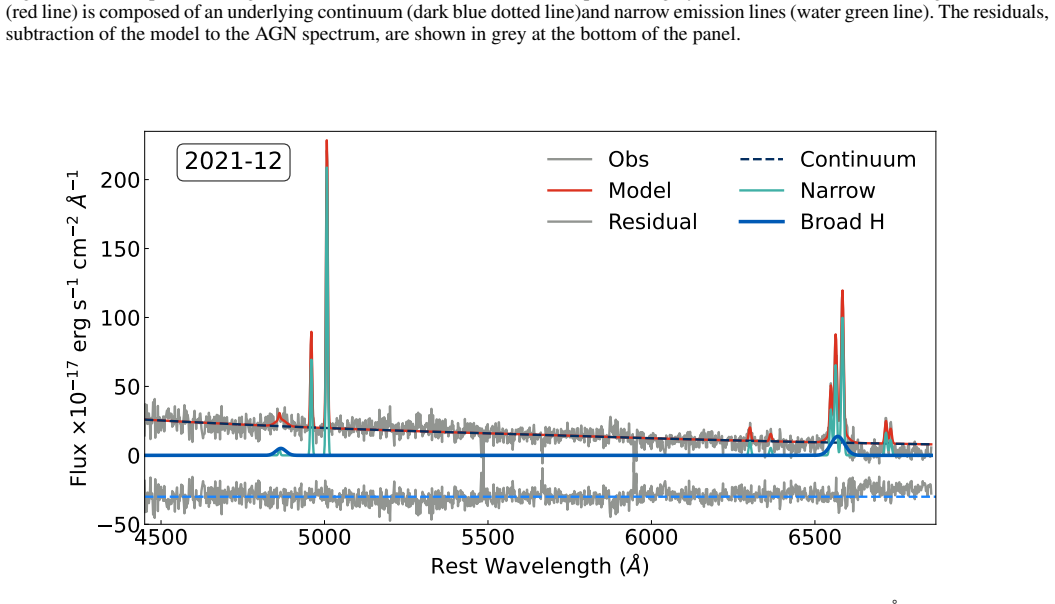
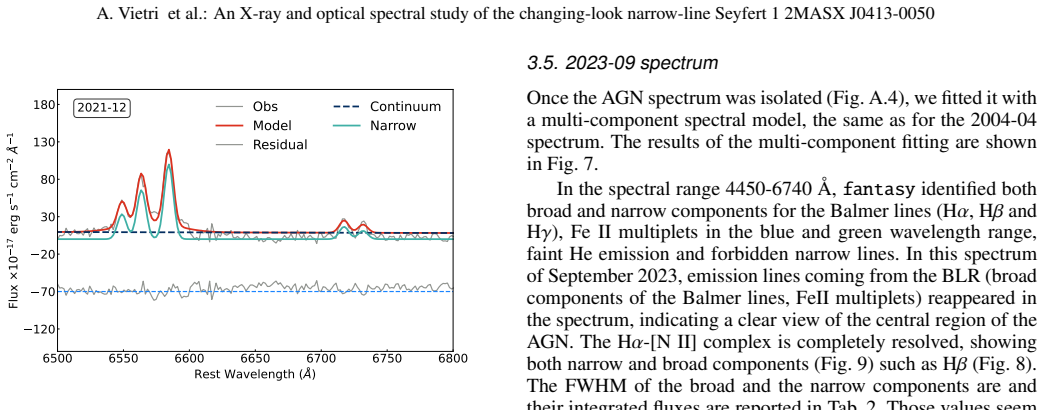
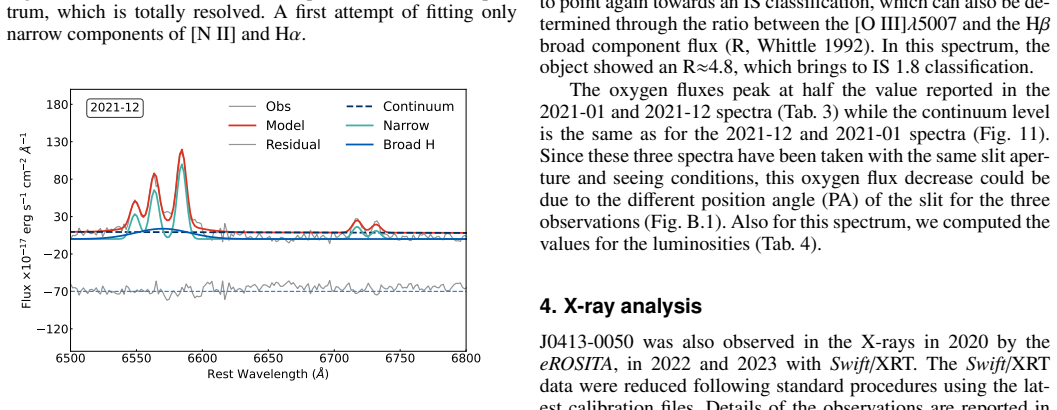
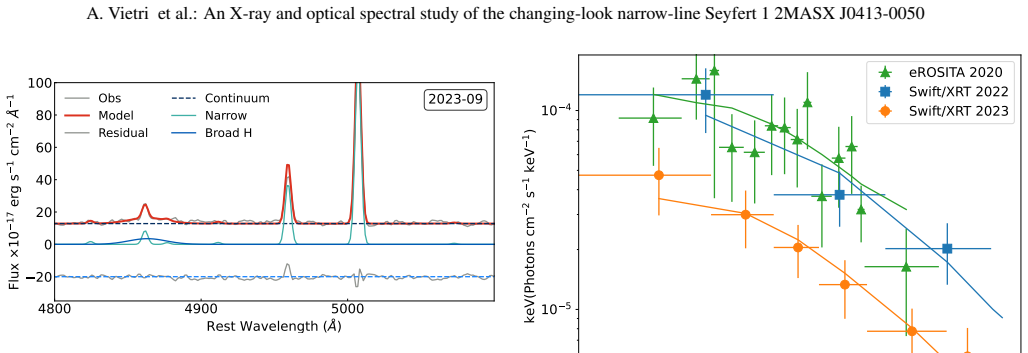
The source 2MASX J0413-0050 changed from a narrow-line Seyfert 1 to a Seyfert 1.9 with complete disappearance of Hbeta, then back toward a Seyfert 1.8 with reappearance of both narrow and broad Hbeta components. These optical shifts occurred alongside a steady decline in X-ray flux. Although line-of-sight column density could not be measured, the data favor intrinsic accretion-rate variations that repeatedly switch the broad-line region on and off rather than variable obscuration, implying several such cycles over the past two decades.
What carries the argument
The changing-state AGN classification, which attributes the spectral type transitions and Hbeta variability to accretion-rate changes that control the broad-line region continuum.
If this is right
- The broad-line region emission lines turn on and off in direct response to changes in the accretion-powered optical continuum.
- X-ray flux declines track the optical spectral changes in this source.
- Narrow-line Seyfert 1 galaxies are capable of exhibiting changing-look AGN phenomena.
- The source has experienced multiple high-to-low accretion state transitions since its 2004 classification.
Where Pith is reading between the lines
- Long-term monitoring programs focused on narrow-line Seyfert 1 galaxies may uncover additional sources with similar repeated transitions.
- The accretion-state changes in this object operate on timescales of years rather than centuries.
- This case provides a concrete example for testing whether changing-look behavior in narrow-line Seyfert 1s is driven by the same disk instabilities proposed for other AGN classes.
Load-bearing premise
The spectral and flux changes result from variations in the accretion rate onto the black hole rather than from changes in line-of-sight obscuration.
What would settle it
An X-ray spectrum taken during a low-Hbeta state that shows a high absorbing column density correlated with the line disappearance.
Figures





read the original abstract
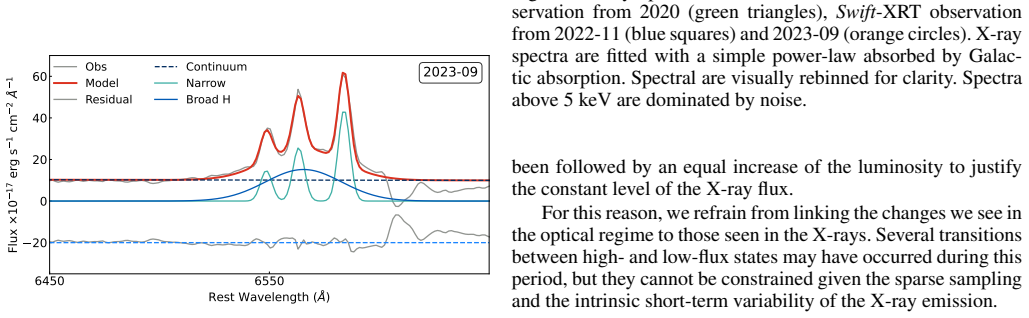
Active galactic nuclei (AGN) showing dramatic spectral and flux variations, either due to changes in the accretion rate (changing-state, CS-AGN) of the supermassive black hole or in the line-of-sight column density (changing-obscuration, CO-AGN), have been classified as changing-look (CL) AGN. Here we present a peculiar source, 2MASX J0413-0050, first identified as a narrow-line Seyfert 1 (NLS1s) galaxy in 2004. When re-observed twice in 2021, it showed a transition in the spectral type (towards a Seyfert 1.9) and the complete and mysterious disappearance of the Hbeta line while source was in a high accretion state. In the meantime, the X-ray flux decreased between observations taken in 2020 and 2022, and again in the most recent spectrum of 2023. Shortly after this, another optical spectrum revealed the re-emergence of both the narrow and broad Hbeta components (Seyfert 1.8). Despite the fact that it was not possible to retrieve the line-of-sight column density from the X-ray spectra, which would have helped in assessing whether this event could be attributed to a CO AGN scenario, the observational evidence does not necessarily support such an interpretation. J0413-0050 may have undergone several switch-on switch-off phases over the past 20 years, on an unknown timescale, which could have affected the accretion power and, consequently, the optical continuum and so the emission lines coming from the broad-line region (BLR). For these reasons, it is reasonable to classify this source as a CS-AGN. The case of J0413-0050 supports the hypothesis that NLS1s can indeed experience CL phenomena.
Editorial analysis
A structured set of objections, weighed in public.
Referee Report
Summary. The manuscript presents multi-epoch X-ray and optical observations of the narrow-line Seyfert 1 galaxy 2MASX J0413-0050 spanning 2004–2023. It documents a transition from NLS1 to Seyfert 1.9 spectral type with complete disappearance of the broad Hβ line (while in a high accretion state), a subsequent X-ray flux decline, and re-emergence of both narrow and broad Hβ components (Seyfert 1.8). Despite the inability to retrieve line-of-sight column density from the X-ray spectra, the authors interpret the changes as multiple accretion-rate switch-on/switch-off phases and classify the source as a changing-state AGN (CS-AGN), arguing that this supports changing-look phenomena occurring in NLS1s.
Significance. If the CS-AGN classification holds, the work adds a useful case to the limited sample of changing-look NLS1s and demonstrates that such objects can exhibit rapid optical and X-ray variability on timescales of years. The direct comparison of spectra across epochs, showing line disappearance and reappearance, is a clear observational strength. The study also usefully highlights the practical difficulty of distinguishing accretion-driven changes from obscuration when X-ray data do not yield N_H constraints.
major comments (2)
- [Abstract] Abstract: The statement that 'the observational evidence does not necessarily support' a CO-AGN interpretation is central to the CS-AGN classification yet remains under-constrained. The paper explicitly notes that line-of-sight column density could not be retrieved from the 2020–2023 X-ray spectra; without measured N_H (or upper limits, partial-covering tests, or other discriminants), the observed flux decline and line changes remain compatible with variable obscuration, weakening the preference for accretion-rate variations.
- [Discussion section] Discussion section: No quantitative modeling of accretion-rate changes, Eddington ratio variations, or BLR response is provided to link the 20-year history of switch-on/switch-off phases to the observed continuum and line flux changes. This omission leaves the physical mechanism for the CS-AGN classification largely qualitative and makes it harder to rule out alternative explanations.
minor comments (1)
- [Abstract and Introduction] The abstract and introduction would benefit from a brief reference to recent statistical studies or reviews on the incidence of CL phenomena in NLS1s to better contextualize the source.
Simulated Author's Rebuttal
We thank the referee for their constructive comments on our manuscript concerning the changing-look behavior in 2MASX J0413-0050. We address each major comment point by point below, indicating revisions where we have incorporated the feedback.
read point-by-point responses
-
Referee: [Abstract] Abstract: The statement that 'the observational evidence does not necessarily support' a CO-AGN interpretation is central to the CS-AGN classification yet remains under-constrained. The paper explicitly notes that line-of-sight column density could not be retrieved from the 2020–2023 X-ray spectra; without measured N_H (or upper limits, partial-covering tests, or other discriminants), the observed flux decline and line changes remain compatible with variable obscuration, weakening the preference for accretion-rate variations.
Authors: We agree that the lack of direct N_H constraints from the 2020–2023 X-ray spectra limits the strength of our argument against a changing-obscuration interpretation. In the revised manuscript we have added the best available upper limits on the line-of-sight column density for those epochs and included the results of partial-covering absorber tests performed on the available spectra. We have also expanded the discussion to emphasize additional supporting evidence for accretion-rate changes, including the source’s persistently high accretion state at the time of broad-line disappearance and the subsequent re-emergence of the broad Hβ component. The abstract has been updated to state these limitations more explicitly while retaining our overall classification. revision: partial
-
Referee: [Discussion section] Discussion section: No quantitative modeling of accretion-rate changes, Eddington ratio variations, or BLR response is provided to link the 20-year history of switch-on/switch-off phases to the observed continuum and line flux changes. This omission leaves the physical mechanism for the CS-AGN classification largely qualitative and makes it harder to rule out alternative explanations.
Authors: We acknowledge that the original submission presented the accretion-rate interpretation largely qualitatively. In the revised manuscript we have added estimates of the Eddington ratio at each available epoch derived from the observed X-ray and optical luminosities, and we discuss the expected BLR response timescales using standard photoionization scaling relations. A full time-dependent hydrodynamic or radiative-transfer simulation of the accretion flow and BLR is, however, beyond the scope of this observational paper and would require assumptions not constrained by the existing data. The multi-epoch spectral comparisons remain the primary observational support for the CS-AGN classification. revision: yes
Circularity Check
No circularity in observational classification
full rationale
The paper is a purely observational multi-epoch spectral study. It reports X-ray flux declines between 2020-2023, Hβ disappearance in 2021 and re-emergence later, and spectral-type shifts from NLS1 to Seyfert 1.9/1.8, then classifies the source as CS-AGN because the data 'does not necessarily support' a CO-AGN interpretation. No equations, fitted parameters, ansatzes, or derivations appear in the provided text. No self-citations are invoked to justify uniqueness or load-bearing premises. The central claim rests on direct empirical comparisons of independent observations across epochs, with the acknowledged lack of N_H constraint stated explicitly rather than hidden or redefined. This is self-contained observational reasoning with no reduction of outputs to inputs by construction.
Axiom & Free-Parameter Ledger
axioms (1)
- domain assumption Standard AGN unification and spectral classification schemes (NLS1 vs Seyfert 1.8/1.9) apply to this source.
Reference graph
Works this paper leans on
-
[1]
The Seventh Data Release of the Sloan Digital Sky Survey. , archivePrefix = "arXiv", eprint =. doi:10.1088/0067-0049/182/2/543 , adsurl =
-
[2]
2004, ApJ, 611, 1005, doi: 10.1086/422091
The Swift Gamma-Ray Burst Mission. , keywords =. doi:10.1086/422091 , archivePrefix =. astro-ph/0405233 , primaryClass =
-
[3]
2021, A&A, 647, A1, doi: 10.1051/0004-6361/202039313
The eROSITA X-ray telescope on SRG. , keywords =. doi:10.1051/0004-6361/202039313 , archivePrefix =. 2010.03477 , primaryClass =
-
[4]
Parameter estimation in astronomy through application of the likelihood ratio. , keywords =. doi:10.1086/156922 , adsurl =
-
[5]
Parameter estimation in X-ray astronomy using maximum likelihood. , keywords =. doi:10.1086/157084 , adsurl =
-
[6]
Principal component analysis , author =
-
[7]
, archivePrefix = "arXiv", eprint =
Fermi/Large Area Telescope Discovery of Gamma-Ray Emission from a Relativistic Jet in the Narrow-Line Quasar PMN J0948+0022. , archivePrefix = "arXiv", eprint =. doi:10.1088/0004-637X/699/2/976 , adsurl =
-
[8]
, archivePrefix = "arXiv", eprint =
Multiwavelength Monitoring of the Enigmatic Narrow-Line Seyfert 1 PMN J0948+0022 in 2009 March-July. , archivePrefix = "arXiv", eprint =. doi:10.1088/0004-637X/707/1/727 , adsurl =
-
[9]
A., Ackermann, M., Ajello, M., et al
Radio-Loud Narrow-Line Seyfert 1 as a New Class of Gamma-Ray Active Galactic Nuclei. , archivePrefix = "arXiv", eprint =. doi:10.1088/0004-637X/707/2/L142 , adsurl =
-
[10]
Fermi Large Area Telescope Observations of Misaligned Active Galactic Nuclei. , keywords =. doi:10.1088/0004-637X/720/1/912 , adsurl =
-
[11]
, archivePrefix = "arXiv", eprint =
Fermi Large Area Telescope First Source Catalog. , archivePrefix = "arXiv", eprint =. doi:10.1088/0067-0049/188/2/405 , adsurl =
-
[12]
2020, ApJS, 247, 33, doi: 10.3847/1538-4365/ab6bcb
Fermi Large Area Telescope Fourth Source Catalog. , keywords =. doi:10.3847/1538-4365/ab6bcb , archivePrefix =. 1902.10045 , primaryClass =
-
[13]
The Fourteenth Data Release of the Sloan Digital Sky Survey: First Spectroscopic Data from the Extended Baryon Oscillation Spectroscopic Survey and from the Second Phase of the Apache Point Observatory Galactic Evolution Experiment. , archivePrefix = "arXiv", eprint =. doi:10.3847/1538-4365/aa9e8a , adsurl =
-
[14]
1988, ApJ, 332, 646, doi: 10.1086/166683
Slim Accretion Disks. , keywords =. doi:10.1086/166683 , adsurl =
-
[15]
The miniJPAS Survey: The radial distribution of star formation rates in faint X-ray active galactic nuclei. arXiv e-prints , keywords =. doi:10.48550/arXiv.2405.06010 , archivePrefix =. 2405.06010 , primaryClass =
-
[16]
Astroparticle Physics , archivePrefix = "arXiv", eprint =
In-flight measurement of the absolute energy scale of the Fermi Large Area Telescope. Astroparticle Physics , archivePrefix = "arXiv", eprint =. doi:10.1016/j.astropartphys.2011.10.007 , adsurl =
-
[17]
, archivePrefix = "arXiv", eprint =
The Third Catalog of Active Galactic Nuclei Detected by the Fermi Large Area Telescope. , archivePrefix = "arXiv", eprint =. doi:10.1088/0004-637X/810/1/14 , adsurl =
-
[18]
The Intermediate-line Region in Active Galactic Nuclei. , keywords =. doi:10.3847/0004-637X/831/1/68 , archivePrefix =. 1606.00284 , primaryClass =
-
[19]
, archivePrefix = "arXiv", eprint =
The Tenth Data Release of the Sloan Digital Sky Survey: First Spectroscopic Data from the SDSS-III Apache Point Observatory Galactic Evolution Experiment. , archivePrefix = "arXiv", eprint =. doi:10.1088/0067-0049/211/2/17 , adsurl =
-
[20]
A test for partial correlation with censored astronomical data. , eprint =. doi:10.1093/mnras/278.4.919 , adsurl =
-
[21]
The Eleventh and Twelfth Data Releases of the Sloan Digital Sky Survey: Final Data from SDSS-III. , archivePrefix = "arXiv", eprint =. doi:10.1088/0067-0049/219/1/12 , adsurl =
-
[22]
MAGIC Observations and multiwavelength properties of the quasar 3C 279 in 2007 and 2009. , archivePrefix = "arXiv", eprint =. doi:10.1051/0004-6361/201116497 , adsurl =
-
[23]
MAGIC Discovery of Very High Energy Emission from the FSRQ PKS 1222+21. , archivePrefix = "arXiv", eprint =. doi:10.1088/2041-8205/730/1/L8 , adsurl =
-
[24]
1986, ApJ, 308, 23, doi: 10.1086/164475
Recurrent Outbursts in the Broad-Line Region of NGC 1566. , keywords =. doi:10.1086/164475 , adsurl =
-
[25]
, archivePrefix = "arXiv", eprint =
Parsec-scale jet properties of the gamma-ray quasar 3C 286. , archivePrefix = "arXiv", eprint =. doi:10.1093/mnras/stw2887 , adsurl =
-
[26]
arXiv , author =:1211.5140 , journal =
Extended Hot Halos around Isolated Galaxies Observed in the ROSAT All-Sky Survey. , keywords =. doi:10.1088/0004-637X/762/2/106 , archivePrefix =. 1211.5140 , primaryClass =
-
[27]
2015, A&A, 575, A55, doi: 10.1051/0004-6361/201425081
Radio jet emission from GeV-emitting narrow-line Seyfert 1 galaxies. , archivePrefix = "arXiv", eprint =. doi:10.1051/0004-6361/201425081 , adsurl =
-
[28]
, archivePrefix = "arXiv", eprint =
The colour of the narrow line Sy1-blazar 0324+3410. , archivePrefix = "arXiv", eprint =. doi:10.1051/0004-6361:20078926 , adsurl =
-
[29]
Spectropolarimetry and the nature of NGC 1068. , keywords =. doi:10.1086/163559 , adsurl =
-
[30]
Extended radio emission and the nature of blazars. , keywords =. doi:10.1086/163284 , adsurl =
-
[31]
Excess 2 Centimeter Emission: A New Continuum Component in the Spectra of Radio-quiet Quasars. , keywords =. 1988. doi:10.1086/185256 , adsurl =
-
[32]
Unified models for active galactic nuclei and quasars. ARA&A , keywords =. doi:10.1146/annurev.aa.31.090193.002353 , adsurl =
-
[33]
Astrophysical Spectropolarimetry , year = 2002, eprint =
Polarization insights for active galactic nuclei. Astrophysical Spectropolarimetry , year = 2002, eprint =
2002
-
[34]
Active galactic nuclei jet-induced feedback in galaxies - I. Suppression of star formation. , keywords =. doi:10.1111/j.1365-2966.2008.13663.x , archivePrefix =. 0806.4570 , primaryClass =
-
[35]
The Largest Blueshifts of the [O III] Emission Line in Two Narrow-Line Quasars. , eprint =. doi:10.1086/426075 , adsurl =
-
[36]
A newborn active galactic nucleus in a star-forming galaxy. , keywords =. doi:10.1051/0004-6361/202348900 , archivePrefix =. 2402.19403 , primaryClass =
-
[37]
The Large Area Telescope on the Fermi Gamma-Ray Space Telescope Mission. , archivePrefix = "arXiv", eprint =. doi:10.1088/0004-637X/697/2/1071 , adsurl =
-
[38]
On the simultaneous analysis of several complete samples - The V/Vmax and Ve/Va variables, with applications to quasars. , keywords =. doi:10.1086/157673 , adsurl =
-
[39]
The Morphology of the Emission-Line Region Of Compact Steep-Spectrum Radio Sources. , eprint =. doi:10.1086/316838 , adsurl =
-
[40]
Classics in Radio Astronomy , year = 1982, editor =
1954, Identification of the Radio Sources in Cassiopeia, Cygnus A and Puppis A. Classics in Radio Astronomy , year = 1982, editor =
1954
-
[41]
Classics in Radio Astronomy , year = 1982, volume =
1954, Identification of the Radio Sources in Cassiopeia, Cygnus A and Puppis A. Classics in Radio Astronomy , year = 1982, volume =. doi:10.1007/978-94-009-7752-5\_29 , adsurl =
-
[42]
The absolute spectrum of Cas A; an accurate flux density scale and a set of secondary calibrators
Reprint of 1977A&A....61...99B. The absolute spectrum of Cas A; an accurate flux density scale and a set of secondary calibrators. , keywords =
-
[43]
Megaparsec Relativistic Jets Launched from an Accreting Supermassive Black Hole in an Extreme Spiral Galaxy. , keywords =. doi:10.1088/0004-637X/788/2/174 , archivePrefix =. 1404.6889 , primaryClass =
-
[44]
The Astrophysical Journal , author =
A powerful local shear instability in weakly magnetized disks. I - Linear analysis. II - Nonlinear evolution. , keywords =. doi:10.1086/170270 , adsurl =
-
[45]
Reviews of Modern Physics , author =
Instability, turbulence, and enhanced transport in accretion disks. Reviews of Modern Physics , keywords =. doi:10.1103/RevModPhys.70.1 , adsurl =
-
[46]
Radio-loud Narrow Line Seyfert 1 under a different perspective: a revised black hole mass estimate from optical spectropolarimetry. , keywords =. doi:10.1093/mnrasl/slw019 , archivePrefix =. 1602.02783 , primaryClass =
-
[47]
The nature of compact radio sources: the case of FR 0 radio galaxies. , keywords =. doi:10.1007/s00159-023-00148-3 , archivePrefix =. 2307.08379 , primaryClass =
-
[48]
, year = 1977, month = jun, volume = 214, pages =
Luminosity Indicators in the Spectra of Quasi-Stellar Objects. , year = 1977, month = jun, volume = 214, pages =. doi:10.1086/155294 , adsurl =
-
[49]
Emission-line properties of optically and radio-selected complete quasar samples. , keywords =. doi:10.1086/167224 , adsurl =
-
[50]
Transformations of Galaxies. II. Gasdynamics in Merging Disk Galaxies. , keywords =. doi:10.1086/177957 , adsurl =
-
[51]
The Lick AGN Monitoring Project 2011: Fe II Reverberation from the Outer Broad-line Region. , keywords =. doi:10.1088/0004-637X/769/2/128 , archivePrefix =. 1304.4643 , primaryClass =
-
[52]
The Burst Alert Telescope (BAT) on the SWIFT Midex Mission. , keywords =. 2005. doi:10.1007/s11214-005-5096-3 , archivePrefix =. astro-ph/0507410 , primaryClass =
-
[53]
An increase in the X-ray absorption of NGC 4151. , keywords =. doi:10.1093/mnras/181.1.43P , adsurl =
-
[54]
Hot dust and the near-infrared bump in the continuum spectra of quasars and active galactic nuclei. , keywords =. doi:10.1086/165571 , adsurl =
-
[55]
Millimeter, Centimeter, and Carbon Monoxide Observations of Radio-quiet Quasars and Luminous Seyfert 1 Galaxies Detected by IRAS. , keywords =. 1989. doi:10.1086/191340 , adsurl =
-
[56]
Multicolor Surface Photometry of Lenticular Galaxies. I. The Data. , eprint =. doi:10.1086/426906 , adsurl =
-
[57]
, year = 1960, volume = 65, pages =
Observations of a Large Redshift. , year = 1960, volume = 65, pages =. doi:10.1086/108083 , adsurl =
-
[58]
, archivePrefix = "arXiv", eprint =
The 70 Month Swift-BAT All-sky Hard X-Ray Survey. , archivePrefix = "arXiv", eprint =. doi:10.1088/0067-0049/207/2/19 , adsurl =
-
[59]
A new catalog of 53,522 4.85 GHz sources. , keywords =. doi:10.1086/191529 , adsurl =
-
[60]
Astronomical Data Analysis Software and Systems III , year = 1994, series =
The VLA's FIRST Survey. Astronomical Data Analysis Software and Systems III , year = 1994, series =
1994
-
[61]
The FIRST Survey: Faint Images of the Radio Sky at Twenty Centimeters. , keywords =. doi:10.1086/176166 , adsurl =
-
[62]
Active Galactic Nuclei, ISBN-13: 978-3527410781
Active Galactic Nuclei. Active Galactic Nuclei, ISBN-13: 978-3527410781. 350 pages. Wiley-VCH Verlag GmbH, 2012 , year = 2012, month = aug, adsurl =
2012
-
[63]
Discovery of millimetre-wave excess emission in radio-quiet active galactic nuclei. , keywords =. 2015. doi:10.1093/mnras/stv988 , archivePrefix =. 1504.01226 , primaryClass =
-
[64]
The Zwicky Transient Facility: System Overview, Performance, and First Results. , keywords =. 2019. doi:10.1088/1538-3873/aaecbe , archivePrefix =. 1902.01932 , primaryClass =
-
[65]
The Interplay Among Black Holes, Stars and ISM in Galactic Nuclei , year = 2004, series =
Comparing AGN broad and narrow line regions. The Interplay Among Black Holes, Stars and ISM in Galactic Nuclei , year = 2004, series =. doi:10.1017/S1743921304002340 , adsurl =. astro-ph/0404278 , editor =
-
[66]
The Low-Luminosity End of the Radius-Luminosity Relationship for Active Galactic Nuclei
The Low-luminosity End of the Radius-Luminosity Relationship for Active Galactic Nuclei. , keywords =. 2013. doi:10.1088/0004-637X/767/2/149 , archivePrefix =. 1303.1742 , primaryClass =
-
[67]
Star Formation in Seyfert 1 and NLS1s. 2010
2010
-
[68]
, keywords =
Parent population of flat-spectrum radio-loud narrow-Line Seyfert 1 galaxies. , keywords =
-
[69]
ArXiv e-prints , archivePrefix = "arXiv", eprint =
Profile of the [O III] emission lines in radio-emitting narrow-line Seyfert 1 galaxies. ArXiv e-prints , archivePrefix = "arXiv", eprint =
-
[70]
ArXiv e-prints , archivePrefix = "arXiv", eprint =
Exploring the parent population of beamed NLS1s: from the black hole to the jet. ArXiv e-prints , archivePrefix = "arXiv", eprint =
-
[71]
ArXiv e-prints , archivePrefix = "arXiv", eprint =
Unveiling the submerged part of the iceberg: radio-loud narrow-line Seyfert 1s with SKA. ArXiv e-prints , archivePrefix = "arXiv", eprint =
-
[72]
, archivePrefix = "arXiv", eprint =
[O III] line properties in two samples of radio-emitting narrow-line Seyfert 1 galaxies. , archivePrefix = "arXiv", eprint =. doi:10.1051/0004-6361/201527056 , adsurl =
-
[73]
, archivePrefix = "arXiv", eprint =
Compact steep-spectrum sources as the parent population of flat-spectrum radio-loud narrow-line Seyfert 1 galaxies. , archivePrefix = "arXiv", eprint =. doi:10.1051/0004-6361/201628171 , adsurl =
-
[74]
Frontiers in Astronomy and Space Sciences , archivePrefix = "arXiv", eprint =
An orientation-based unification of young jetted active galactic nuclei: the case of 3C 286. Frontiers in Astronomy and Space Sciences , archivePrefix = "arXiv", eprint =. doi:10.3389/fspas.2017.00008 , adsurl =
-
[75]
, archivePrefix = "arXiv", eprint =
Radio-emitting narrow-line Seyfert 1 galaxies in the JVLA perspective. , archivePrefix = "arXiv", eprint =. doi:10.1051/0004-6361/201832612 , adsurl =
-
[76]
, archivePrefix = "arXiv", eprint =
The flat-spectrum radio quasar 3C 345 from the high to the low emission state. , archivePrefix = "arXiv", eprint =. doi:10.1051/0004-6361/201731625 , adsurl =
-
[77]
Proceedings of Science, vol
An updated view on the parent population of -ray emitting narrow-line Seyfert 1 galaxies. Proceedings of Science, vol. Revisiting narrow-line Seyfert 1 galaxies and their place in the Universe. 9-13 April 2018 , year = 2018, archivePrefix = "arXiv", eprint =
2018
-
[78]
, archivePrefix = "arXiv", eprint =
The Interacting Late-type Host Galaxy of the Radio-loud Narrow-line Seyfert 1 IRAS 20181-2244. , archivePrefix = "arXiv", eprint =. doi:10.3847/1538-3881/aaf5ca , adsurl =
-
[79]
Broadband X-ray observations of four gamma-ray narrow-line Seyfert 1 galaxies. , keywords =. 2019. doi:10.1051/0004-6361/201935929 , archivePrefix =. 1910.10925 , primaryClass =
-
[80]
The Astronomer's Telegram , keywords =
Spectroscopic observations of the flaring gamma-ray narrow-line Seyfert 1 PKS 2004-447. The Astronomer's Telegram , keywords =
2004
discussion (0)
Sign in with ORCID, Apple, or X to comment. Anyone can read and Pith papers without signing in.