Recognition: unknown
From gas to stars along the spiral wave: CO, HCN, and star formation variations across the spiral arms in NGC 4321 and M51
Pith reviewed 2026-05-08 15:57 UTC · model grok-4.3
The pith
Density waves create a sequence of rising dense gas fraction and star formation efficiency across spiral arms.
A machine-rendered reading of the paper's core claim, the machinery that carries it, and where it could break.
Core claim
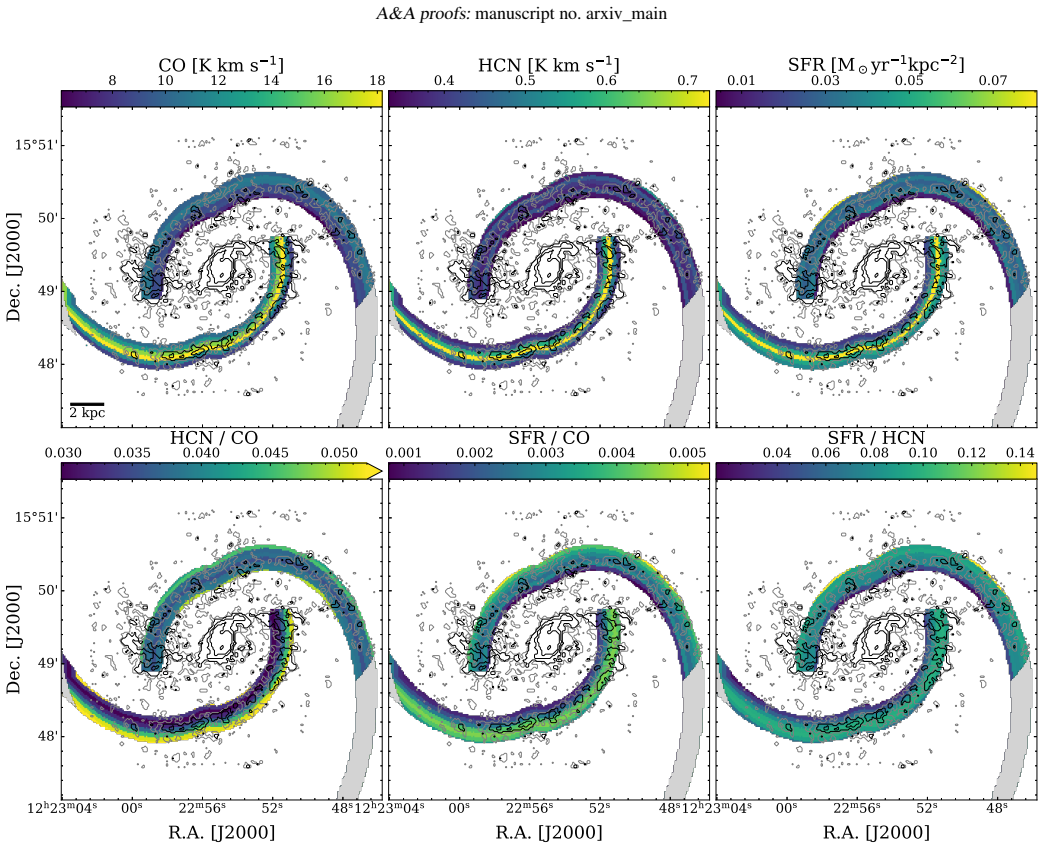
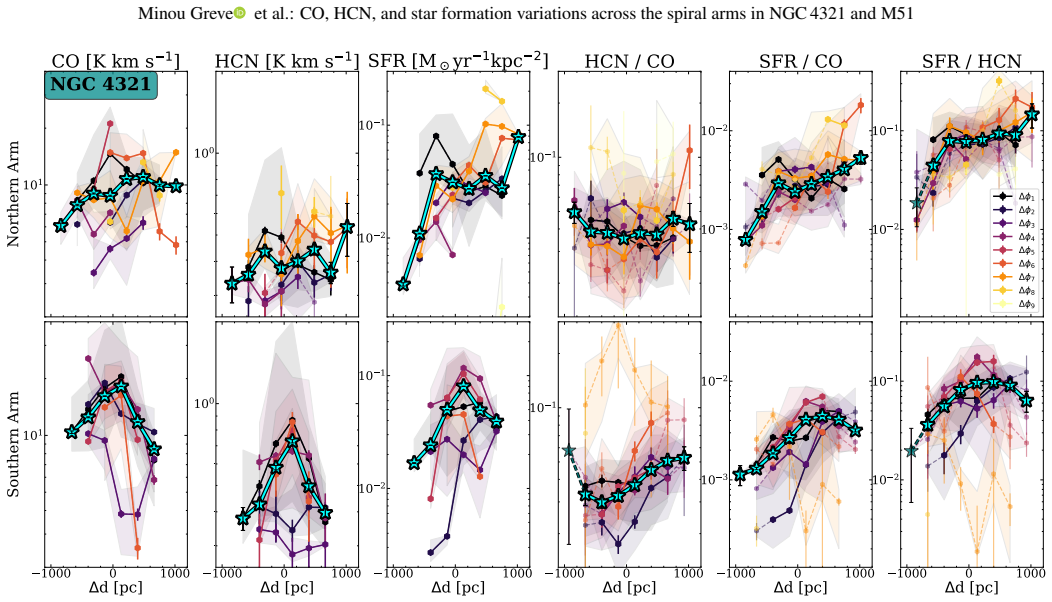
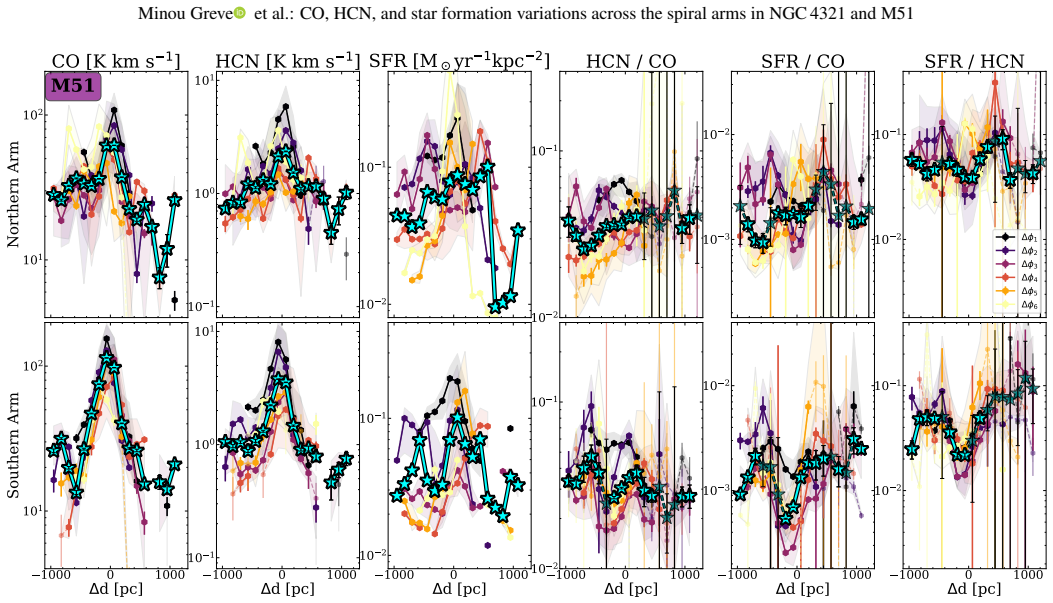
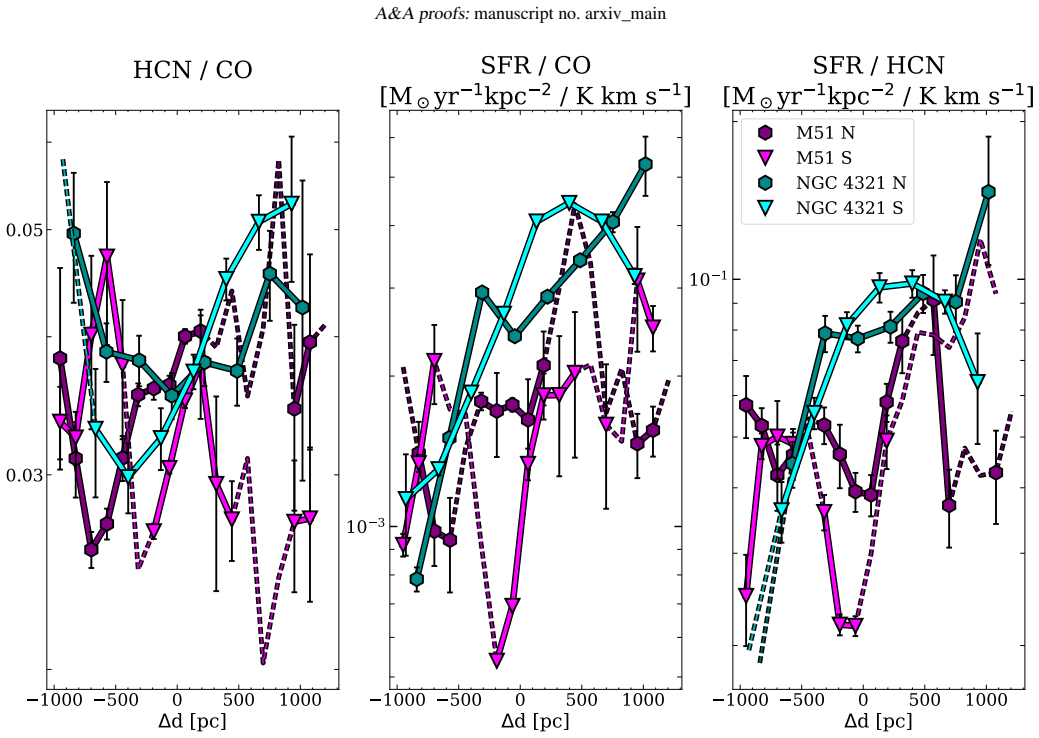
In the spiral arms of NGC 4321 and M51, the ratios HCN/CO, SFR/CO, and SFR/HCN increase from the upstream toward the downstream side at matched physical resolutions of 270 pc and 125 pc. These trends are interpreted as the imprint of density waves that first compress gas into denser phases and then raise the efficiency with which dense gas forms stars. The sequence contributes to the scatter seen among spectroscopic ratios such as HCN/CO and SFR/HCN when measured at sub-kiloparsec scales.
What carries the argument
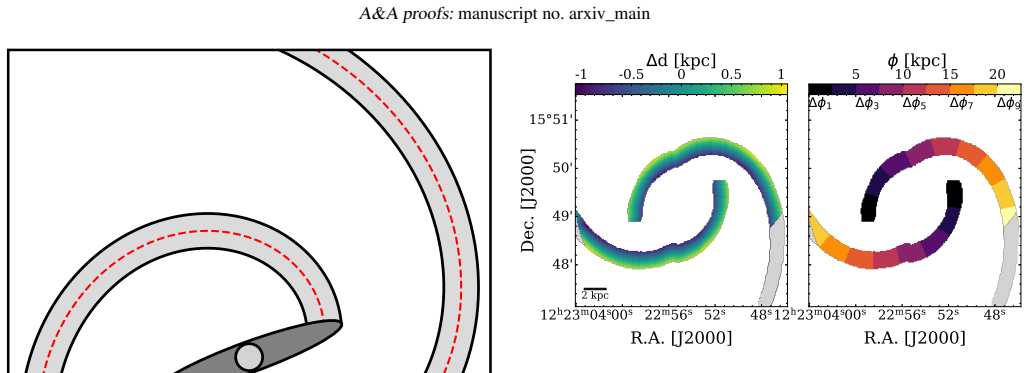
Spiral-arm masks that isolate upstream from downstream gas, allowing measurement of perpendicular trends in HCN/CO (dense-gas fraction) and SFR/HCN (dense-gas star-formation efficiency).
If this is right
- The observed sequence accounts for part of the scatter in HCN/CO and SFR/HCN ratios at sub-kiloparsec scales.
- Large-scale dynamics organize the evolutionary path from low-density molecular gas through dense gas to star formation.
- The effect is stronger in NGC 4321 than in M51, indicating that arm strength or orbital dynamics differ between galaxies.
- Similar perpendicular trends should appear in other tracers of the cloud life cycle when the same upstream-downstream separation is applied.
Where Pith is reading between the lines
- Position relative to spiral arms should be included when deriving global gas-star formation relations from unresolved observations.
- The same arm-crossing sequence could be tested directly in hydrodynamic simulations that resolve both the galactic orbit and individual clouds.
- Higher-resolution observations of additional galaxies would show whether the pattern persists down to the scale of single giant molecular clouds.
Load-bearing premise
The measured increases in the ratios are produced by the spiral density wave rather than by local differences in metallicity, radiation field, or unresolved substructure, and the arm masks correctly separate upstream from downstream gas at the given resolutions.
What would settle it
Absence of any systematic upstream-to-downstream gradient in HCN/CO or SFR/HCN in higher-resolution maps or in additional grand-design spirals would falsify the claimed sequence.
Figures



read the original abstract
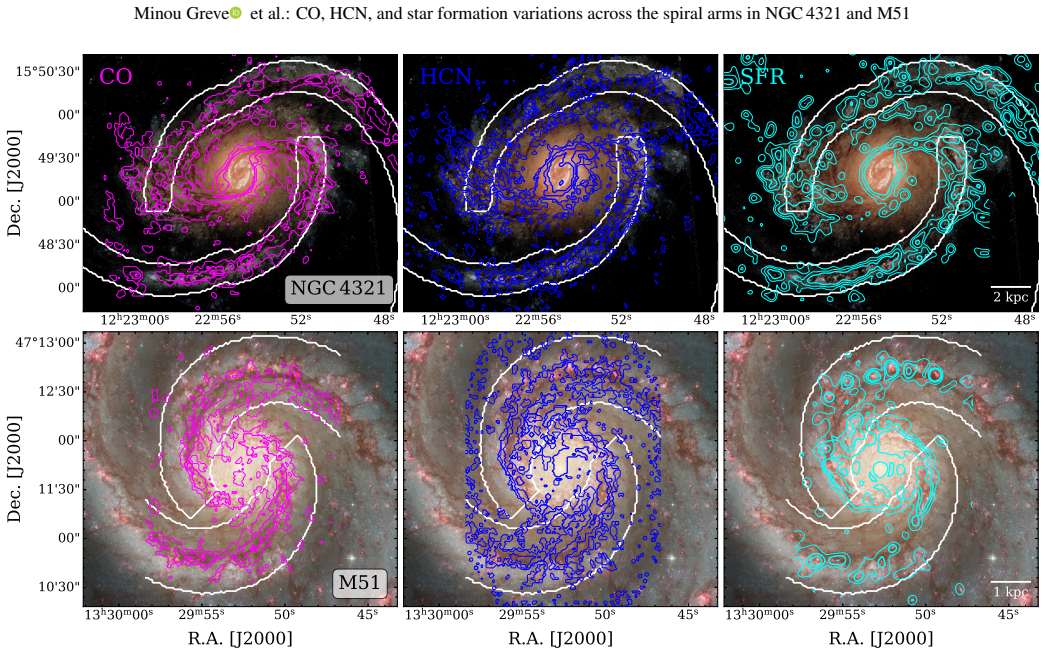
Molecular clouds form stars from the interstellar medium via gravitational collapse, following a sequence from low-density gas to high-density cores and eventually the formation of stars. In classical density wave theory, gas clouds orbiting the galaxy experience gas compression and triggered star formation, while encountering the gravitational well of spiral arms. We aim to trace these different phases of the molecular cloud life cycle via tracers of molecular gas (CO), dense molecular gas (HCN), and star formation (H$\alpha$, 24 $\mu$m) within the spiral arms of two grand-design spiral galaxies: NGC 4321 and M51 (NGC 5194). In the spiral arms of these galaxies, we investigate the relation between molecular gas, dense gas, and star formation (CO-HCN-SFR) at matched physical resolutions of 270 pc and 125 pc in NGC 4321 and M51, respectively. We employed spiral arm masks for these galaxies and investigate trends of HCN/CO and SFR/HCN (SFR/CO), which serve as proxies for the dense gas fraction and dense (molecular) gas star formation efficiency, perpendicular to the spiral arm spines. We find that HCN/CO, SFR/CO, and SFR/HCN increase from the upstream towards the downstream side of both spiral arms of NGC 4321, while their trends are less prominent in M51. Our results indicate that large-scale galactic dynamics (e.g. density waves) can induce a sequence of gas density and star formation-to-gas density variations perpendicular to the spiral arms. This sequence contributes to the increased scatter seen among spectroscopic ratios such as HCN/CO and SFR/HCN at sub-kiloparsec scales.
Editorial analysis
A structured set of objections, weighed in public.
Referee Report
Summary. The manuscript presents an observational study of molecular gas and star formation tracers across the spiral arms of NGC 4321 and M51. At matched resolutions of 270 pc and 125 pc, respectively, the authors use spiral arm masks to measure HCN/CO, SFR/CO, and SFR/HCN ratios on the upstream and downstream sides of the arms. They report monotonic increases in these ratios from upstream to downstream in NGC 4321, with less clear trends in M51, and interpret this as evidence that density waves drive a sequence of gas compression and star formation variations perpendicular to the spiral arms, contributing to scatter in these ratios at sub-kiloparsec scales.
Significance. If the trends hold after controlling for local confounders, the work would provide direct observational support for density-wave theory influencing the molecular cloud life cycle, offering a dynamical explanation for scatter in dense-gas star-formation relations at sub-kpc scales. The multi-tracer approach in two grand-design spirals is a strength, though the weaker signal in M51 already suggests the effect may not be universal.
major comments (3)
- [Abstract/Results] Abstract and Results: the reported upstream-to-downstream increases in HCN/CO, SFR/CO, and SFR/HCN are presented without error bars, uncertainties, sample statistics, or quantitative tests of significance. This omission makes it impossible to evaluate whether the trends are robust, particularly given the explicitly weaker trends in M51.
- [Methods] Methods: no controls or auxiliary maps are used to test alternative explanations such as position-dependent metallicity gradients, FUV radiation field variations, or unresolved GMC substructure within the 125-270 pc beams. These local effects are spatially correlated with the arms and could produce the observed gradients without requiring density-wave compression.
- [Methods] Methods: the sensitivity of the results to the adopted spiral-arm mask definitions is not quantified. No tests with shifted, randomized, or alternative masks are shown to confirm that the upstream/downstream separation is not an artifact of mask choice at the stated resolutions.
minor comments (1)
- [Figures] Figure captions and text should explicitly state the number of independent beams or arm segments sampled to allow readers to judge the statistical weight of the trends.
Simulated Author's Rebuttal
We thank the referee for their constructive feedback on our manuscript. We have revised the paper to address the concerns raised regarding the presentation of results, potential alternative explanations, and the robustness of our spiral arm masks. Our responses to each major comment are detailed below.
read point-by-point responses
-
Referee: [Abstract/Results] Abstract and Results: the reported upstream-to-downstream increases in HCN/CO, SFR/CO, and SFR/HCN are presented without error bars, uncertainties, sample statistics, or quantitative tests of significance. This omission makes it impossible to evaluate whether the trends are robust, particularly given the explicitly weaker trends in M51.
Authors: We agree that quantitative uncertainties and statistical tests are necessary to assess robustness. In the revised manuscript we have added error bars (standard error of the mean) to all upstream-to-downstream ratio plots, reported the number of independent beams per bin, and included Spearman rank correlation coefficients with associated p-values. For NGC 4321 the trends remain significant (p < 0.01), while in M51 they are weaker and statistically marginal, consistent with the original description. These additions allow direct evaluation of the claimed monotonic increases. revision: yes
-
Referee: [Methods] Methods: no controls or auxiliary maps are used to test alternative explanations such as position-dependent metallicity gradients, FUV radiation field variations, or unresolved GMC substructure within the 125-270 pc beams. These local effects are spatially correlated with the arms and could produce the observed gradients without requiring density-wave compression.
Authors: We acknowledge the importance of ruling out local confounders. We have added a dedicated discussion subsection that addresses each alternative: radial metallicity gradients do not produce perpendicular arm gradients at our scales; the combined Hα+24 μm SFR tracer mitigates FUV and extinction biases; and the persistence of trends across two different resolutions argues against pure beam-averaging artifacts. Full auxiliary maps at matched resolution are not available in the current dataset, so we have framed these as caveats rather than definitive exclusions. The density-wave interpretation remains the most parsimonious but is now presented with these qualifications. revision: partial
-
Referee: [Methods] Methods: the sensitivity of the results to the adopted spiral-arm mask definitions is not quantified. No tests with shifted, randomized, or alternative masks are shown to confirm that the upstream/downstream separation is not an artifact of mask choice at the stated resolutions.
Authors: We agree that mask robustness must be demonstrated. The revised manuscript includes an appendix with three additional tests: (1) masks shifted ±50 pc and ±100 pc perpendicular to the arm spines, (2) masks derived from an independent near-infrared arm tracing, and (3) randomized upstream/downstream labels. The NGC 4321 trends persist (with modest amplitude variation) under shifted and alternative masks, while randomized masks yield no trends. These results are now shown in a new figure and confirm that the upstream-to-downstream signal is not an artifact of the specific mask definition. revision: yes
Circularity Check
No circularity: purely observational reporting of measured ratios with no derivation chain or self-referential fits
full rationale
The paper describes direct measurements of HCN/CO, SFR/CO and SFR/HCN trends across spiral-arm masks in NGC 4321 and M51 at fixed resolutions, without any equations, model fits, predictions, or derivations. The abstract and available text present these as empirical trends from data, followed by an interpretive statement that dynamics can induce such sequences. No self-definitional loops, fitted inputs renamed as predictions, load-bearing self-citations, uniqueness theorems, or ansatzes appear. The central claim rests on the observed monotonic increases (stronger in NGC 4321) rather than any construction that reduces to its own inputs. This is a standard observational analysis whose validity hinges on data quality and mask definitions, not on circular reasoning.
Axiom & Free-Parameter Ledger
axioms (2)
- domain assumption CO(1-0) and HCN(1-0) luminosities reliably trace total molecular gas and dense molecular gas, respectively, at the adopted resolutions.
- domain assumption Spiral-arm masks correctly separate gas on the upstream side from gas on the downstream side of the density wave.
Reference graph
Works this paper leans on
-
[1]
S., Lee, J
Anand, G. S., Lee, J. C., Van Dyk, S. D., et al. 2020, MNRAS, 501, 3621
2020
-
[2]
2008, ApJ, 136, 2846
Bigiel, F., Leroy, A., Walter, F., et al. 2008, ApJ, 136, 2846
2008
-
[3]
K., Jiménez-Donaire, M
Bigiel, F., Leroy, A. K., Jiménez-Donaire, M. J., et al. 2016, ApJ, 822, L26
2016
-
[4]
J., Sheth, K., Athanassoula, E., et al
Buta, R. J., Sheth, K., Athanassoula, E., et al. 2015, ApJS, 217, 32
2015
-
[5]
E., Schinnerer, E., et al
Colombo, D., Meidt, S. E., Schinnerer, E., et al. 2014, ApJ, 784, 4 den Brok, J. 2024, PyStructure: PyStructure_v3.0.1, version 3.0.1
2014
-
[6]
S., et al
Dumas, G., Schinnerer, E., Tabatabaei, F. S., et al. 2011, AJ, 141, 41
2011
-
[7]
2009, ApJ, 697, 1870
Egusa, F., Kohno, K., Sofue, Y ., Nakanishi, H., & Komugi, S. 2009, ApJ, 697, 1870
2009
-
[8]
Elmegreen, B. G. 2018, ApJ, 854, 16
2018
-
[9]
G., Elmegreen, D
Elmegreen, B. G., Elmegreen, D. M., & Seiden, P. E. 1989, ApJ, 343, 602
1989
-
[10]
G., Elmegreen, D
Elmegreen, B. G., Elmegreen, D. M., & Montenegro, L. 1992, ApJS, 79, 37
1992
-
[11]
2022, A&A, 659, A191
Emsellem, E., Schinnerer, E., Santoro, F., et al. 2022, A&A, 659, A191
2022
-
[12]
E., Epinat, B., Dobbs, C
Font, J., Beckman, J. E., Epinat, B., Dobbs, C. L., & Querejeta, M. 2024, ApJ, 966, 110
2024
-
[13]
Foyle, K., Rix, H.-W., Walter, F., & Leroy, A. K. 2010, ApJ, 725, 534
2010
-
[14]
J., Leroy, A
Gallagher, M. J., Leroy, A. K., Bigiel, F., et al. 2018, ApJ, 868, L38
2018
-
[15]
& Solomon, P
Gao, Y . & Solomon, P. M. 2004, ApJ, 606, 271
2004
-
[16]
J., & Combes, F
Garcia-Burillo, S., Sempere, M. J., & Combes, F. 1994, A&A, 287, 419
1994
-
[17]
D., Kruijssen, J
Henshaw, J. D., Kruijssen, J. M. D., Longmore, S. N., et al. 2020, Nature As- tronomy, 4, 1064
2020
-
[18]
2015, A&A, 582, A86 Jiménez-Donaire, M
Herrera-Endoqui, M., Díaz-García, S., Laurikainen, E., & Salo, H. 2015, A&A, 582, A86 Jiménez-Donaire, M. J., Bigiel, F., Leroy, A. K., et al. 2019, ApJ, 880, 127
2015
-
[19]
2020, ApJ, 892, 23
Kessler, S., Leroy, A., Querejeta, M., et al. 2020, ApJ, 892, 23
2020
-
[20]
Kim, J., Chevance, M., Kruijssen, J. M. D., et al. 2023, ApJ, 944, L20
2023
-
[21]
Kim, J., Chevance, M., Kruijssen, J. M. D., et al. 2022, MNRAS, 516, 3006
2022
-
[22]
Klessen, R. S. & Glover, S. C. O. 2016, Saas-Fee Advanced Course, 43, 85
2016
-
[23]
E., Rosolowsky, E., et al
Lang, P., Meidt, S. E., Rosolowsky, E., et al. 2020, ApJ, 897, 122
2020
-
[24]
C., Whitmore, B
Lee, J. C., Whitmore, B. C., Thilker, D. A., et al. 2022, ApJS, 258, 10
2022
-
[25]
K., Sandstrom, K
Leroy, A. K., Sandstrom, K. M., Lang, D., et al. 2019, ApJS, 244, 24
2019
-
[26]
K., Sandstrom, K
Leroy, A. K., Sandstrom, K. M., Lang, D., et al. 2020, VizieR Online Data Catalog: A z=0 Multiwavelength Galaxy Synthesis (z0MGS). I. (Leroy+, 2019), VizieR On-line Data Catalog: J/ApJS/244/24. Originally published in: 2019ApJS..244...24L
2020
-
[27]
K., Schinnerer, E., Hughes, A., et al
Leroy, A. K., Schinnerer, E., Hughes, A., et al. 2021, ApJS, 257, 43
2021
-
[28]
H., Balbus, S
Lubow, S. H., Balbus, S. A., & Cowie, L. L. 1986, ApJ, 309, 496
1986
-
[29]
McKee, C. F. & Ostriker, E. C. 2007, ARA&A, 45, 565
2007
-
[30]
McQuinn, K. B. W., Skillman, E. D., Dolphin, A. E., Berg, D., & Kennicutt, R. 2016, ApJ, 826, 21
2016
-
[31]
E., Glover, S
Meidt, S. E., Glover, S. C. O., Kruijssen, J. M. D., et al. 2020, ApJ, 892, 28
2020
-
[32]
E., Rand, R
Meidt, S. E., Rand, R. J., Merrifield, M. R., Shetty, R., & V ogel, S. N. 2008, ApJ, 688, 224
2008
-
[33]
E., Schinnerer, E., Garcia-Burillo, S., et al
Meidt, S. E., Schinnerer, E., Garcia-Burillo, S., et al. 2013, ApJ, 779, 22
2013
-
[34]
T., et al
Neumann, L., Bigiel, F., Barnes, A. T., et al. 2024, A&A, 691, A121
2024
-
[35]
J., Bigiel, F., et al
Neumann, L., Gallagher, M. J., Bigiel, F., et al. 2023, MNRAS, 521, 3348–3383
2023
-
[36]
J., Leroy, A
Neumann, L., Jiménez-Donaire, M. J., Leroy, A. K., et al. 2025, A&A, 693, L13
2025
-
[37]
K., Meidt, S
Querejeta, M., Leroy, A. K., Meidt, S. E., et al. 2024, A&A, 687, A293
2024
-
[38]
E., Cao, Y ., et al
Querejeta, M., Meidt, S. E., Cao, Y ., et al. 2025, A&A, 701, A183
2025
-
[39]
E., et al
Querejeta, M., Schinnerer, E., Meidt, S. E., et al. 2021, A&A, 656, A133
2021
-
[40]
2016, A&A, 593, A118
Querejeta, M., Schinnerer, E., García-Burillo, S., et al. 2016, A&A, 593, A118
2016
-
[41]
2019, A&A, 625, A19
Querejeta, M., Schinnerer, E., Schruba, A., et al. 2019, A&A, 625, A19
2019
-
[42]
Rand, R. J. & Wallin, J. F. 2004, ApJ, 614, 142
2004
-
[43]
& Stewart, G
Roberts, Jr., W. & Stewart, G. R. 1987, ApJ, 314, 10
1987
-
[44]
Roberts, W. W. 1969, ApJ, 158, 123
1969
-
[45]
K., Kostiuk, V
Sakhibov, F. K., Kostiuk, V . S., Gusev, A. S., & Shimanovskaya, E. V . 2025, Astronomy Reports, 69, 348
2025
-
[46]
& Leroy, A
Schinnerer, E. & Leroy, A. K. 2024, ARA&A, 62, 369
2024
-
[47]
E., Colombo, D., et al
Schinnerer, E., Meidt, S. E., Colombo, D., et al. 2017, ApJ, 836, 62
2017
-
[48]
E., Pety, J., et al
Schinnerer, E., Meidt, S. E., Pety, J., et al. 2013, ApJ, 779, 42
2013
-
[49]
Shirley, Y . L. 2015, PASP, 127, 299
2015
-
[50]
K., Pety, J., Schinnerer, E., et al
Stuber, S. K., Pety, J., Schinnerer, E., et al. 2023, A&A, 680, L20
2023
-
[51]
2008, AJ, 136, 2872
Tamburro, D., Rix, H.-W., Walter, F., et al. 2008, AJ, 136, 2872
2008
-
[52]
Tully, R. B. 1974, ApJS, 27, 449
1974
-
[53]
K., Walter, F., et al
Usero, A., Leroy, A. K., Walter, F., et al. 2015, ApJ, 150, 115 V ogel, S. N., Rand, R. J., Gruendl, R. A., & Teuben, P. J. 1993, PASP, 105, 666 Article number, page 12 of 17 Minou Greve et al.: CO, HCN, and star formation variations across the spiral arms in NGC 4321 and M51 Appendix A: Dense gas tracer HCO + Stuber et al. (2025b) recommend HCO + as a mo...
2015
discussion (0)
Sign in with ORCID, Apple, or X to comment. Anyone can read and Pith papers without signing in.