Recognition: unknown
Moving-mesh simulations of spreading dynamics and local electron cooling in structured gamma-ray burst afterglow jets
Pith reviewed 2026-05-08 15:44 UTC · model grok-4.3
The pith
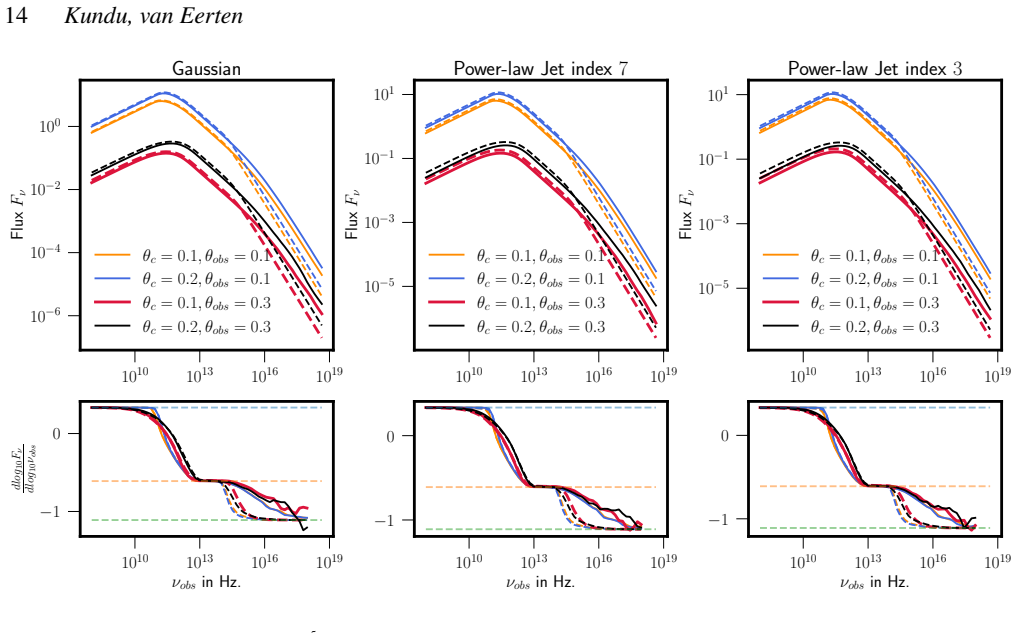
In structured gamma-ray burst afterglow jets, a local electron cooling approach shifts the synchrotron cooling break upward in frequency by more than a factor of ten and smooths the transition.
A machine-rendered reading of the paper's core claim, the machinery that carries it, and where it could break.
Core claim
When computing the afterglow spectrum using a local cooling approach that traces the electron population following shock-acceleration, we observe a significant impact on the synchrotron cooling break. Similar to earlier results for top-hat jets, the cooling break is found to shift upward in frequency by well over a factor of ten relative to approaches that assume a global cooling timescale across the jet. The cooling break transition in the spectrum also becomes substantially smoother. For both local and global cooling, jet breaks become sharper with increasing frequency.
What carries the argument
The local cooling approach that traces the electron population following shock-acceleration, replacing the assumption of a single global cooling timescale across the jet.
Load-bearing premise
The local cooling implementation, which traces individual electron populations post shock-acceleration without full radiation transport or back-reaction, correctly captures the dominant emission physics for the frequencies and times of interest.
What would settle it
Multi-frequency observations of a gamma-ray burst afterglow that place the synchrotron cooling break at frequencies matching global cooling predictions rather than the much higher frequencies and smoother transition predicted by local cooling.
Figures







read the original abstract
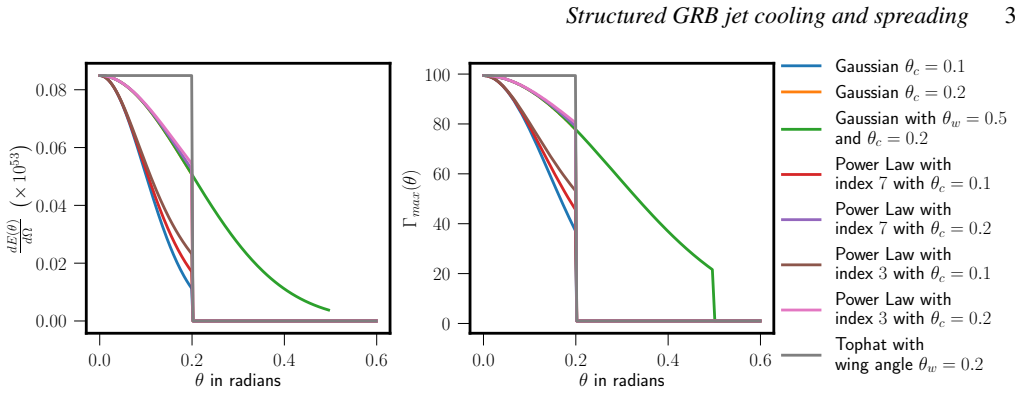
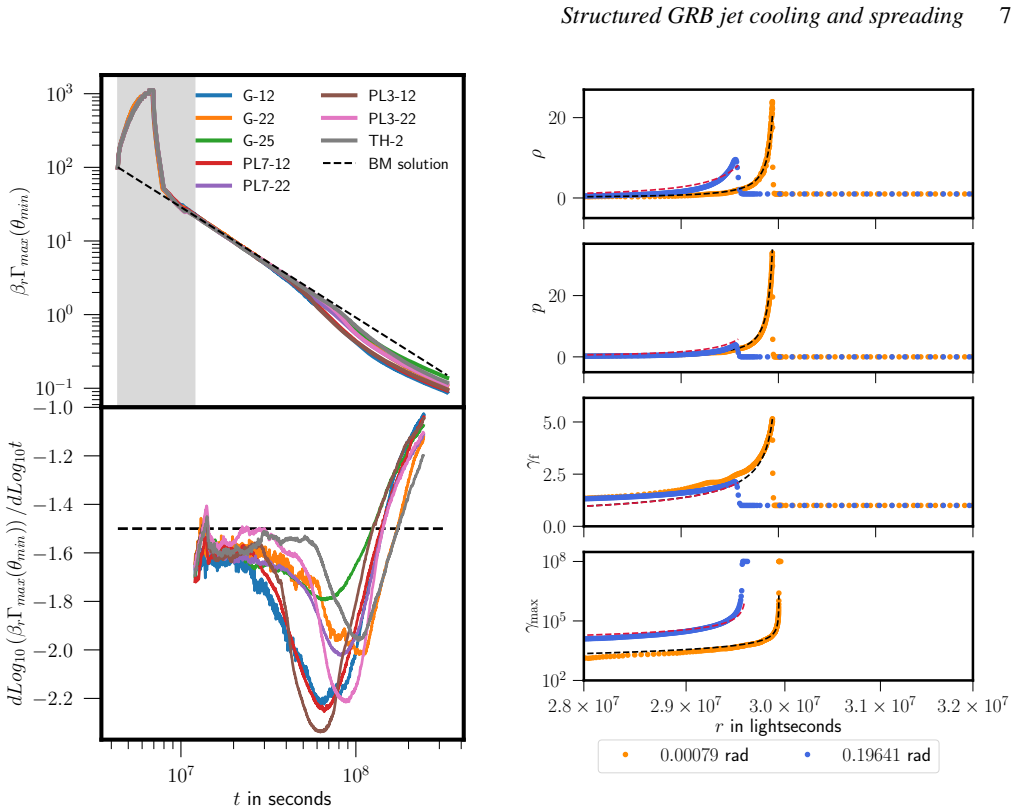
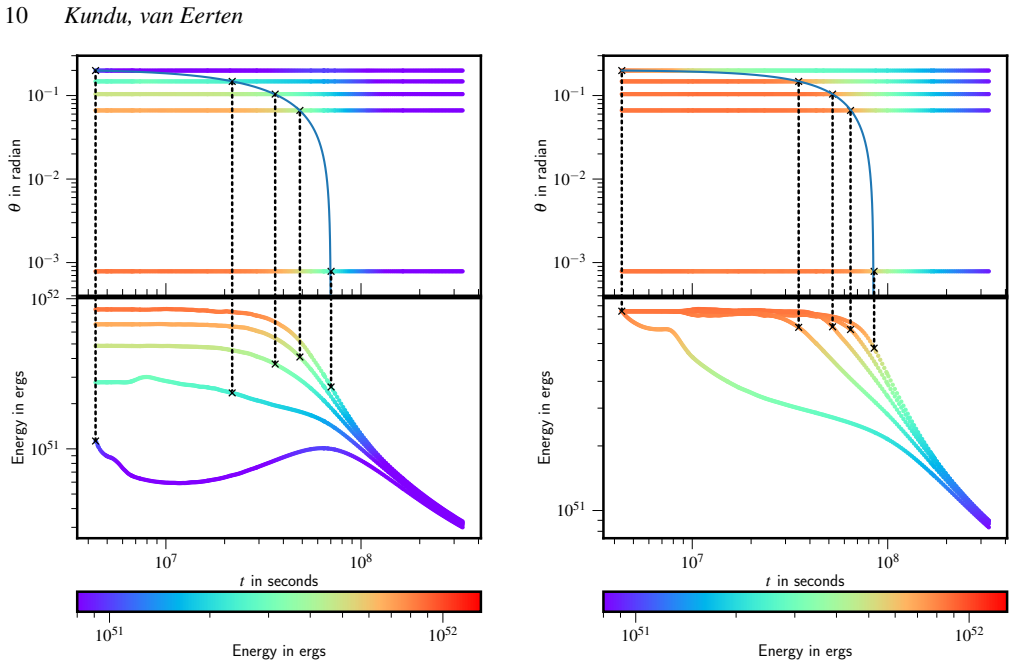
We present the results for the dynamics and emission profiles of axi-symmetric numerical simulations of structured gamma-ray burst afterglow jets, computed using the relativistic moving-mesh hydrodynamics code GAMMA. We find that the spreading of jets of average opening angle is moderately impacted by the initial steepness of the angular structure, although the effect disappears once the working surface of the jet substantially exceeds its initial width, and that the travel time of a sound wave across the front surface remains the best indicator of the onset of spreading also for structured jets. When computing the afterglow spectrum using a local cooling approach that traces the electron population following shock-acceleration, we observe a significant impact on the synchrotron cooling break. Similar to earlier results for top-hat jets, the cooling break is found to shift upward in frequency by well over a factor of ten relative to approaches that assume a global cooling timescale across the jet. The cooling break transition in the spectrum also becomes substantially smoother. For both local and global cooling, jet breaks become sharper with increasing frequency. Local cooling is found to initially lead to a steeper slope post jet-break. The local-cooling emission is shown to originate from a narrow frequency-dependent sized region behind the shock front, as expected, but in strong contrast to a global cooling approach.
Editorial analysis
A structured set of objections, weighed in public.
Referee Report
Summary. This paper presents axi-symmetric moving-mesh hydrodynamical simulations of structured gamma-ray burst afterglow jets using the GAMMA code. It investigates the dynamics of jet spreading as a function of initial angular structure steepness and compares a local electron cooling approach (tracing post-shock electron populations) to global cooling in computing the afterglow spectrum, reporting that local cooling shifts the synchrotron cooling break upward in frequency by well over a factor of ten with a smoother transition, produces sharper jet breaks at higher frequencies, and yields emission from a narrow frequency-dependent region behind the shock.
Significance. If the local cooling results hold under more complete physics, the work would be significant for GRB afterglow modeling by showing that detailed electron population tracking substantially modifies key spectral features such as the cooling break and post-break slopes relative to standard global assumptions. This has implications for interpreting multi-wavelength observations of structured jets. The direct numerical outputs from moving-mesh simulations, without fitted parameters or analytical reductions, and the extension of prior top-hat jet findings provide reproducible, falsifiable predictions for jet dynamics and emission.
major comments (2)
- [Emission profiles] Emission modeling: The local cooling scheme traces individual electron populations after shock acceleration but does not feed synchrotron losses back into the fluid energy equation or solve full radiative transfer. In structured jets, where shock Lorentz factor and magnetic-field strength vary strongly with angle and radius, this decoupled treatment requires a quantitative test (e.g., estimating the fractional energy lost to radiation across the range of simulated shocks) to establish that the reported >10× upward shift in the cooling break is robust rather than an artifact of the approximation.
- [Methods] Methods and results: Convergence tests for the moving-mesh hydrodynamical resolution and the number of tracked electron populations are not presented. Specific figures or tables quantifying the factor-of-ten cooling-break shift and the smoothing of the spectral transition are also absent, preventing full assessment of the quantitative support for the central emission claims.
minor comments (2)
- [Abstract] Abstract: The phrase 'average jet opening angle' is imprecise; the specific values or range adopted in the simulations should be stated explicitly for reproducibility.
- [Abstract] Abstract: The reference to 'earlier results for top-hat jets' should be accompanied by a citation in the main text to allow readers to compare the structured-jet findings directly.
Simulated Author's Rebuttal
We thank the referee for their thorough review and constructive feedback on our manuscript. We address each major comment below and will revise the paper to incorporate the suggested improvements.
read point-by-point responses
-
Referee: [Emission profiles] Emission modeling: The local cooling scheme traces individual electron populations after shock acceleration but does not feed synchrotron losses back into the fluid energy equation or solve full radiative transfer. In structured jets, where shock Lorentz factor and magnetic-field strength vary strongly with angle and radius, this decoupled treatment requires a quantitative test (e.g., estimating the fractional energy lost to radiation across the range of simulated shocks) to establish that the reported >10× upward shift in the cooling break is robust rather than an artifact of the approximation.
Authors: We agree that the local cooling treatment is an approximation that omits radiative back-reaction on the hydrodynamics. To strengthen the claim, we will add to the revised manuscript a quantitative estimate of the fractional energy lost to synchrotron radiation, computed across the range of Lorentz factors and magnetic field strengths present in our structured-jet simulations. This will show that the losses remain small on the relevant dynamical timescales, supporting that the reported upward shift of the cooling break by more than a factor of ten is not an artifact of the decoupling. We will also explicitly note the limitations of the current approach and its relation to more complete radiative-transfer calculations. revision: yes
-
Referee: [Methods] Methods and results: Convergence tests for the moving-mesh hydrodynamical resolution and the number of tracked electron populations are not presented. Specific figures or tables quantifying the factor-of-ten cooling-break shift and the smoothing of the spectral transition are also absent, preventing full assessment of the quantitative support for the central emission claims.
Authors: We acknowledge that convergence tests and explicit quantification of the key spectral changes were omitted. In the revised manuscript we will include dedicated convergence studies that vary both the moving-mesh resolution and the number of tracked electron populations, demonstrating that the reported spectral features are numerically converged. We will also add a new figure (or table) that directly quantifies the cooling-break frequency shift (confirming the factor-of-ten displacement) and the change in transition smoothness between the local- and global-cooling cases for representative observer angles and times. revision: yes
Circularity Check
No circularity: results are direct numerical outputs from moving-mesh hydro simulations
full rationale
The paper reports outcomes from axi-symmetric numerical simulations performed with the GAMMA relativistic moving-mesh hydrodynamics code. Jet spreading dynamics, sound-wave travel times, and afterglow spectra (including the upward shift and smoothing of the synchrotron cooling break under local electron cooling) are computed directly from the evolved hydrodynamical fields and post-processed electron populations. No analytical derivation chain exists that reduces any reported quantity to an input parameter by construction, no fitted parameters are relabeled as predictions, and no load-bearing uniqueness theorem or ansatz is imported via self-citation. The comparison between local and global cooling is performed within the same simulation framework, yielding independent numerical results rather than tautological restatements of the setup.
Axiom & Free-Parameter Ledger
free parameters (2)
- initial angular structure steepness
- average jet opening angle
axioms (2)
- domain assumption The GAMMA moving-mesh code accurately solves the special relativistic hydrodynamics equations for the jet evolution.
- domain assumption The local cooling post-processing correctly traces the electron energy distribution after shock acceleration without significant omitted physics.
Reference graph
Works this paper leans on
-
[1]
Abbott B. P., et al., 2017, @doi [ ] 10.3847/2041-8213/aa91c9 , https://ui.adsabs.harvard.edu/abs/2017ApJ...848L..12A 848, L12
-
[2]
Ayache E. H., van Eerten H. J., Daigne F., 2020, @doi [ ] 10.1093/mnras/staa1397 , 495, 2979
-
[3]
H., van Eerten H
Ayache E. H., van Eerten H. J., Eardley R. W., 2022, Monthly Notices of the Royal Astronomical Society, 510, 1315
2022
-
[4]
Beniamini P., Granot J., Gill R., 2020, Monthly Notices of the Royal Astronomical Society, 493, 3521
2020
-
[5]
Beuermann K., et al., 1999, , https://ui.adsabs.harvard.edu/abs/1999A&A...352L..26B 352, L26
1999
-
[6]
Blandford R. D., McKee C. F., 1976, @doi [Physics of Fluids] 10.1063/1.861619 , https://ui.adsabs.harvard.edu/abs/1976PhFl...19.1130B 19, 1130
-
[7]
De Colle F., Granot J., L \'o pez-C \'a mara D., Ramirez-Ruiz E., 2012a, @doi [ ] 10.1088/0004-637X/746/2/122 , https://ui.adsabs.harvard.edu/abs/2012ApJ...746..122D 746, 122
-
[8]
De Colle F., Ramirez-Ruiz E., Granot J., Lopez-Camara D., 2012b, @doi [ ] 10.1088/0004-637X/751/1/57 , https://ui.adsabs.harvard.edu/abs/2012ApJ...751...57D 751, 57
-
[9]
Downes T. P., Duffy P., Komissarov S. S., 2002, @doi [ ] 10.1046/j.1365-8711.2002.05282.x , 332, 144
-
[10]
Duffell P. C., Laskar T., 2018, @doi [ ] 10.3847/1538-4357/aadb9c , https://ui.adsabs.harvard.edu/abs/2018ApJ...865...94D 865, 94
-
[11]
Duffell P. C., MacFadyen A. I., 2013, @doi [ ] 10.1088/0004-637X/775/2/87 , https://ui.adsabs.harvard.edu/abs/2013ApJ...775...87D 775, 87
-
[12]
Eichler D., Waxman E., 2005, @doi [ ] 10.1086/430596 , https://ui.adsabs.harvard.edu/abs/2005ApJ...627..861E 627, 861
-
[13]
N., 1989, @doi [ ] 10.1038/340126a0 , https://ui.adsabs.harvard.edu/abs/1989Natur.340..126E 340, 126
Eichler D., Livio M., Piran T., Schramm D. N., 1989, @doi [Nature] 10.1038/340126a0 , 340, 126
-
[14]
Filgas R., et al., 2011, Astronomy & Astrophysics, 535, A57
2011
-
[15]
Geng J.-J., Zhang B., K \"o lligan A., Kuiper R., Huang Y.-F., 2019, @doi [ ] 10.3847/2041-8213/ab224b , https://ui.adsabs.harvard.edu/abs/2019ApJ...877L..40G 877, L40
-
[16]
Ghirlanda G., et al., 2019, @doi [Science] 10.1126/science.aau8815 , https://ui.adsabs.harvard.edu/abs/2019Sci...363..968G 363, 968
-
[17]
Gill R., Granot J., 2018, @doi [ ] 10.1093/mnras/sty1214 , https://ui.adsabs.harvard.edu/abs/2018MNRAS.478.4128G 478, 4128
-
[18]
D., Urrutia G., 2019, The Astrophysical Journal, 883, 15
Gill R., Granot J., Colle F. D., Urrutia G., 2019, The Astrophysical Journal, 883, 15
2019
-
[19]
Giri G., Vaidya B., Rossi P., Bodo G., Mukherjee D., Mignone A., 2022, @doi [ ] 10.1051/0004-6361/202142546 , https://ui.adsabs.harvard.edu/abs/2022A&A...662A...5G 662, A5
-
[20]
Gottlieb O., Nakar E., Bromberg O., 2021, Monthly Notices of the Royal Astronomical Society, 500, 3511
2021
-
[21]
Govreen-Segal T., Nakar E., 2024, @doi [ ] 10.1093/mnras/stae1224 , https://ui.adsabs.harvard.edu/abs/2024MNRAS.531.1704G 531, 1704
- [22]
-
[23]
Granot J., Kumar P., 2003, @doi [ ] 10.1086/375489 , https://ui.adsabs.harvard.edu/abs/2003ApJ...591.1086G 591, 1086
-
[25]
Granot J., Piran T., 2012b, @doi [ ] 10.1111/j.1365-2966.2011.20335.x , https://ui.adsabs.harvard.edu/abs/2012MNRAS.421..570G 421, 570
-
[26]
Granot J., Sari R., 2002, @doi [ ] 10.1086/338966 , https://ui.adsabs.harvard.edu/abs/2002ApJ...568..820G 568, 820
-
[27]
Granot J., Piran T., Sari R., 1999, @doi [ ] 10.1086/306884 , https://ui.adsabs.harvard.edu/abs/1999ApJ...513..679G 513, 679
-
[28]
Gamma-ray Bursts in the Afterglow Era , year = 2001, eprint =
Granot J., Miller M., Piran T., Suen W. M., Hughes P. A., 2001, in Costa E., Frontera F., Hjorth J., eds, Gamma-ray Bursts in the Afterglow Era. p. 312 ( @eprint arXiv astro-ph/0103038 ), @doi 10.1007/10853853_82
-
[29]
Granot J., Panaitescu A., Kumar P., Woosley S. E., 2002, @doi [ ] 10.1086/340991 , https://ui.adsabs.harvard.edu/abs/2002ApJ...570L..61G 570, L61
-
[30]
Gruzinov A., 2007, @doi [arXiv e-prints] 10.48550/arXiv.0704.3081 , https://ui.adsabs.harvard.edu/abs/2007arXiv0704.3081G p. arXiv:0704.3081
-
[31]
Guidorzi C., et al., 2014, @doi [ ] 10.1093/mnras/stt2243 , 438, 752
-
[32]
Hallinan G., et al., 2017, @doi [Science] 10.1126/science.aap9855 , https://ui.adsabs.harvard.edu/abs/2017Sci...358.1579H 358, 1579
-
[33]
Kathirgamaraju A., Tchekhovskoy A., Giannios D., Barniol Duran R., 2019, @doi [ ] 10.1093/mnrasl/slz012 , https://ui.adsabs.harvard.edu/abs/2019MNRAS.484L..98K 484, L98
-
[34]
Keshet U., Kogan D., 2015, @doi [ ] 10.1088/0004-637X/815/2/100 , https://ui.adsabs.harvard.edu/abs/2015ApJ...815..100K 815, 100
-
[35]
Kumar P., Granot J., 2003, @doi [ ] 10.1086/375186 , https://ui.adsabs.harvard.edu/abs/2003ApJ...591.1075K 591, 1075
-
[36]
Kumar P., Zhang B., 2015, @doi [ ] 10.1016/j.physrep.2014.09.008 , https://ui.adsabs.harvard.edu/abs/2015PhR...561....1K 561, 1
work page Pith review doi:10.1016/j.physrep.2014.09.008 2015
-
[37]
J., 2022, Astronomy & Astrophysics, 667, A138
Kundu S., Vaidya B., Mignone A., Hardcastle M. J., 2022, Astronomy & Astrophysics, 667, A138
2022
-
[38]
, archivePrefix = "arXiv", eprint =
Lamb G. P., Kobayashi S., 2018, @doi [ ] 10.1093/mnras/sty1108 , https://ui.adsabs.harvard.edu/abs/2018MNRAS.478..733L 478, 733
-
[39]
Lamb D. Q., Donaghy T. Q., Graziani C., 2005, @doi [ ] 10.1086/426099 , https://ui.adsabs.harvard.edu/abs/2005ApJ...620..355L 620, 355
-
[40]
Lamb G. P., Kann D. A., Fern \'a ndez J. J., Mandel I., Levan A. J., Tanvir N. R., 2021, @doi [ ] 10.1093/mnras/stab2071 , https://ui.adsabs.harvard.edu/abs/2021MNRAS.506.4163L 506, 4163
-
[41]
C., 2005, @doi [ ] 10.1086/430877 , https://ui.adsabs.harvard.edu/abs/2005ApJ...629..903L 629, 903
Lazzati D., Begelman M. C., 2005, @doi [ ] 10.1086/430877 , https://ui.adsabs.harvard.edu/abs/2005ApJ...629..903L 629, 903
-
[42]
Lyutikov M., 2012, @doi [ ] 10.1111/j.1365-2966.2011.20331.x , https://ui.adsabs.harvard.edu/abs/2012MNRAS.421..522L 421, 522
-
[43]
MacFadyen A. I., Woosley S. E., 1999, @doi [ ] 10.1086/307790 , 524, 262
-
[44]
Margutti R., et al., 2017, @doi [ ] 10.3847/2041-8213/aa9057 , https://ui.adsabs.harvard.edu/abs/2017ApJ...848L..20M 848, L20
-
[45]
Meliani Z., Keppens R., Casse F., Giannios D., 2007, @doi [ ] 10.1111/j.1365-2966.2007.11500.x , 376, 1189
-
[46]
Meszaros P., Rees M. J., Papathanassiou H., 1994, @doi [ ] 10.1086/174559 , https://ui.adsabs.harvard.edu/abs/1994ApJ...432..181M 432, 181
-
[47]
Mignone A., Bodo G., 2005, @doi [ ] 10.1111/j.1365-2966.2005.09546.x , https://ui.adsabs.harvard.edu/abs/2005MNRAS.364..126M 364, 126
-
[48]
Mizuta A., Ioka K., 2013, @doi [ ] 10.1088/0004-637X/777/2/162 , https://ui.adsabs.harvard.edu/abs/2013ApJ...777..162M 777, 162
-
[49]
Mochkovitch R., Hernanz M., Isern J., Loiseau S., 1995, , 293, 803
1995
-
[50]
, archivePrefix = "arXiv", eprint =
Mooley K. P., et al., 2018, @doi [ ] 10.1038/nature25452 , https://ui.adsabs.harvard.edu/abs/2018Natur.554..207M 554, 207
-
[51]
O’Connor B., et al., 2023, Science Advances, 9, eadi1405
2023
-
[52]
Rees M. J., Meszaros P., 1992, @doi [ ] 10.1093/mnras/258.1.41P , https://ui.adsabs.harvard.edu/abs/1992MNRAS.258P..41R 258, 41
-
[53]
Rezzolla L., Zanotti O., Pons J. A., 2003, @doi [Journal of Fluid Mechanics] 10.1017/S0022112002003506 , https://ui.adsabs.harvard.edu/abs/2003JFM...479..199R 479, 199
-
[54]
E., 1997, @doi [ ] 10.1086/310876 , https://ui.adsabs.harvard.edu/abs/1997ApJ...487L...1R 487, L1
Rhoads J. E., 1997, @doi [ ] 10.1086/310876 , https://ui.adsabs.harvard.edu/abs/1997ApJ...487L...1R 487, L1
-
[55]
E., 1999, @doi [ ] 10.1086/307907 , https://ui.adsabs.harvard.edu/abs/1999ApJ...525..737R 525, 737
Rhoads J. E., 1999, @doi [ ] 10.1086/307907 , https://ui.adsabs.harvard.edu/abs/1999ApJ...525..737R 525, 737
-
[56]
Rossi E., Lazzati D., Rees M. J., 2002, @doi [ ] 10.1046/j.1365-8711.2002.05363.x , 332, 945
-
[57]
Ryan G., van Eerten H., Piro L., Troja E., 2020, @doi [ ] 10.3847/1538-4357/ab93cf , https://ui.adsabs.harvard.edu/abs/2020ApJ...896..166R 896, 166
-
[58]
Ryan G., van Eerten H., Troja E., Piro L., O'Connor B., Ricci R., 2024, @doi [ ] 10.3847/1538-4357/ad6a14 , https://ui.adsabs.harvard.edu/abs/2024ApJ...975..131R 975, 131
-
[59]
Sari R., 1998, @doi [ ] 10.1086/311160 , https://ui.adsabs.harvard.edu/abs/1998ApJ...494L..49S 494, L49
-
[60]
Sari R., Piran T., Narayan R., 1998, @doi [ ] 10.1086/311269 , https://ui.adsabs.harvard.edu/abs/1998ApJ...497L..17S 497, L17
-
[61]
Sari R., Piran T., Halpern J. P., 1999, @doi [ ] 10.1086/312109 , https://ui.adsabs.harvard.edu/abs/1999ApJ...519L..17S 519, L17
-
[62]
Takahashi K., Ioka K., 2020, @doi [ ] 10.1093/mnras/staa1984 , https://ui.adsabs.harvard.edu/abs/2020MNRAS.497.1217T 497, 1217
-
[63]
Troja E., et al., 2017, @doi [Nature] 10.1038/nature24290 , 551, 71
-
[64]
Troja E., et al., 2019, @doi [ ] 10.1093/mnras/stz2248 , 489, 1919
-
[65]
Troja E., et al., 2020, @doi [ ] 10.1093/mnras/staa2626 , https://ui.adsabs.harvard.edu/abs/2020MNRAS.498.5643T 498, 5643
-
[66]
Uhm Z. L., Zhang B., 2014, @doi [ ] 10.1088/0004-637X/780/1/82 , https://ui.adsabs.harvard.edu/abs/2014ApJ...780...82U 780, 82
-
[67]
Wijers R. A. M. J., Galama T. J., 1999, @doi [ ] 10.1086/307705 , 523, 177
-
[68]
Wijers R. A. M. J., Rees M. J., Meszaros P., 1997, @doi [ ] 10.1093/mnras/288.4.L51 , https://ui.adsabs.harvard.edu/abs/1997MNRAS.288L..51W 288, L51
-
[69]
Woosley S. E., 1993, @doi [ ] 10.1086/172359 , https://ui.adsabs.harvard.edu/abs/1993ApJ...405..273W 405, 273
-
[70]
Wygoda N., Waxman E., Frail D. A., 2011, @doi [ ] 10.1088/2041-8205/738/2/L23 , https://ui.adsabs.harvard.edu/abs/2011ApJ...738L..23W 738, L23
-
[71]
Zanotti O., Rezzolla L., Del Zanna L., Palenzuela C., 2010, @doi [ ] 10.1051/0004-6361/201014969 , https://ui.adsabs.harvard.edu/abs/2010A&A...523A...8Z 523, A8
-
[72]
Zhang W., MacFadyen A., 2009, @doi [ ] 10.1088/0004-637X/698/2/1261 , https://ui.adsabs.harvard.edu/abs/2009ApJ...698.1261Z 698, 1261
-
[73]
Zhang B., M \'e sz \'a ros P., 2004, @doi [International Journal of Modern Physics A] 10.1142/S0217751X0401746X , https://ui.adsabs.harvard.edu/abs/2004IJMPA..19.2385Z 19, 2385
-
[74]
Zhang B., et al., 2009, @doi [ ] 10.1088/0004-637X/703/2/1696 , https://ui.adsabs.harvard.edu/abs/2009ApJ...703.1696Z 703, 1696
-
[75]
van Eerten H., 2013, @doi [eConf Proceedings C1304143] 10.48550/arXiv.1309.3869 , https://ui.adsabs.harvard.edu/abs/2013arXiv1309.3869V p. 24
-
[76]
van Eerten H., 2018, @doi [International Journal of Modern Physics D] 10.1142/S0218271818420026 , https://ui.adsabs.harvard.edu/abs/2018IJMPD..2742002V 27, 1842002
-
[77]
van Eerten H. J., MacFadyen A. I., 2012, @doi [ ] 10.1088/0004-637X/751/2/155 , 751, 1
-
[78]
van Eerten H., MacFadyen A., 2013, @doi [ ] 10.1088/0004-637X/767/2/141 , https://ui.adsabs.harvard.edu/abs/2013ApJ...767..141V 767, 141
-
[79]
2009, MNRAS, 396, 1383, doi:10.1111/j.1365-2966.2009.14843.x
van Eerten H. J., Wijers R. A., 2009, @doi [ ] 10.1111/j.1365-2966.2009.14482.x , 394, 2164
-
[80]
2009, MNRAS, 396, 1383, doi:10.1111/j.1365-2966.2009.14843.x
van Eerten H. J., Leventis K., Meliani Z., Wijers R. A. M. J., Keppens R., 2010a, @doi [ ] 10.1111/j.1365-2966.2009.16109.x , 403, 300
-
[81]
van Eerten H., Zhang W., MacFadyen A., 2010b, @doi [ ] 10.1088/0004-637X/722/1/235 , 722, 235
discussion (0)
Sign in with ORCID, Apple, or X to comment. Anyone can read and Pith papers without signing in.