Recognition: unknown
A Quantum Singularity Theorem for the Evaporating Black Hole
Pith reviewed 2026-05-08 16:59 UTC · model grok-4.3
The pith
Evaporating black holes are null geodesically incomplete, as shown by a semiclassical singularity theorem that replaces the null energy condition with the generalized second law.
A machine-rendered reading of the paper's core claim, the machinery that carries it, and where it could break.
Core claim
We prove a singularity theorem in semiclassical gravity without assuming global hyperbolicity or the null energy/curvature condition; the former is replaced by the weaker causality conditions of stable causality and past reflectivity, and the latter is replaced as is standard by the Generalized Second Law. This establishes in particular that the standard models of evaporating black holes are singular - i.e. they are null geodesically incomplete.
What carries the argument
A singularity theorem adapted to semiclassical gravity in which the generalized second law substitutes for the null energy condition under the causality assumptions of stable causality and past reflectivity.
If this is right
- Standard models of evaporating black holes are null geodesically incomplete.
- The incompleteness follows without assuming global hyperbolicity.
- Semiclassical gravity predicts singularities at the end of evaporation when the generalized second law is used.
- Evaporating black hole spacetimes cannot be extended to complete null geodesics under these conditions.
Where Pith is reading between the lines
- Resolving the endpoint of evaporation likely requires physics beyond the semiclassical approximation.
- Any model claiming complete, nonsingular evaporation must violate either the generalized second law or the stated causality conditions.
- The result constrains proposals for the black hole information paradox that rely on fully nonsingular evaporation.
Load-bearing premise
The generalized second law holds in the semiclassical regime for evaporating black holes.
What would settle it
An explicit construction of a null-geodesically complete evaporating black hole spacetime that satisfies stable causality, past reflectivity, and the generalized second law would falsify the theorem.
Figures

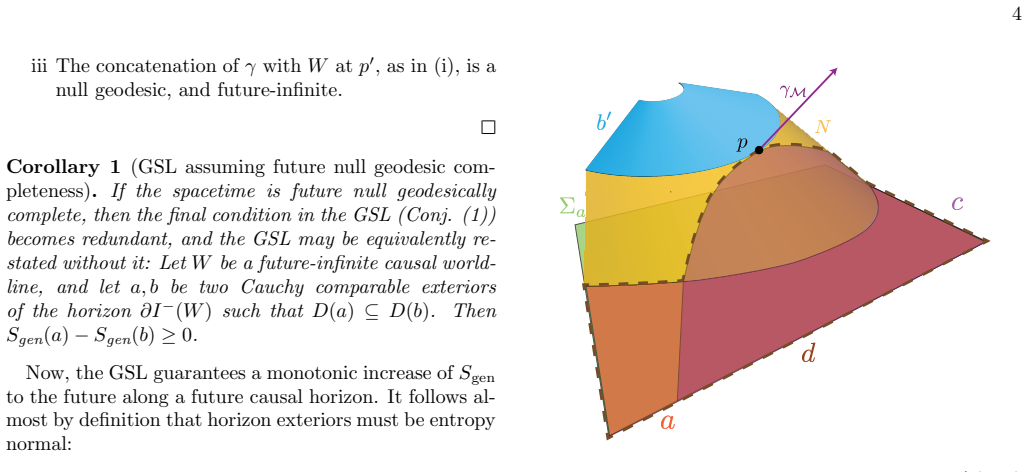
read the original abstract
We prove a singularity theorem in semiclassical gravity without assuming global hyperbolicity or the null energy/curvature condition; the former is replaced by the weaker causality conditions of stable causality and past reflectivity, and the latter is replaced as is standard by the Generalized Second Law. This establishes in particular that the standard models of evaporating black holes are singular - i.e. they are null geodesically incomplete.
Editorial analysis
A structured set of objections, weighed in public.
Referee Report
Summary. The paper proves a singularity theorem in semiclassical gravity applicable to evaporating black holes. It replaces the null energy condition with the Generalized Second Law and global hyperbolicity with the weaker conditions of stable causality plus past reflectivity, concluding that standard models of evaporating black holes are null geodesically incomplete.
Significance. If the central derivation holds, the result would be significant for semiclassical gravity: it supplies a parameter-free mathematical argument establishing geodesic incompleteness without the null energy condition (which is violated by Hawking radiation) and without assuming global hyperbolicity. This directly addresses the status of singularities in evaporating black hole spacetimes and could inform discussions of the endpoint of evaporation.
major comments (2)
- [Theorem statement and GSL invocation (abstract and §2–3)] The central replacement of the null energy condition by the Generalized Second Law (invoked in the abstract and used to obtain the focusing needed for incompleteness) is load-bearing, yet the manuscript provides no derivation of the precise integrated form of the GSL along the relevant null geodesics from the semiclassical Einstein equations or the stress-energy tensor of Hawking radiation. Standard evaporating models (e.g., negative-energy Vaidya-like fluxes) may violate or only approximately obey this inequality once back-reaction is included; if the inequality fails on the geodesics of interest, the incompleteness conclusion does not follow.
- [Causality assumptions and proof outline] The proof relies on past reflectivity together with stable causality to replace global hyperbolicity. The manuscript must explicitly verify that this pair suffices for the causal structure arguments in the semiclassical setting (e.g., that the relevant null geodesics remain in the domain where the GSL can be applied); without that verification the weakening may introduce loopholes.
minor comments (2)
- [Notation and definitions] Notation for the precise statement of the GSL inequality used in the Raychaudhuri equation should be introduced explicitly rather than left as 'standard'.
- [Introduction] A brief comparison paragraph with prior quantum singularity theorems (e.g., those retaining some form of energy condition) would help readers assess novelty.
Simulated Author's Rebuttal
We thank the referee for the careful reading and constructive comments. We address each major point below, clarifying the role of our assumptions and indicating revisions that will strengthen the presentation without altering the core results.
read point-by-point responses
-
Referee: [Theorem statement and GSL invocation (abstract and §2–3)] The central replacement of the null energy condition by the Generalized Second Law (invoked in the abstract and used to obtain the focusing needed for incompleteness) is load-bearing, yet the manuscript provides no derivation of the precise integrated form of the GSL along the relevant null geodesics from the semiclassical Einstein equations or the stress-energy tensor of Hawking radiation. Standard evaporating models (e.g., negative-energy Vaidya-like fluxes) may violate or only approximately obey this inequality once back-reaction is included; if the inequality fails on the geodesics of interest, the incompleteness conclusion does not follow.
Authors: The GSL is adopted as a standard assumption of semiclassical gravity in our theorem, consistent with its use throughout the literature on Hawking radiation and black-hole thermodynamics. The manuscript establishes null geodesic incompleteness conditional on the integrated GSL holding along the relevant geodesics; it does not derive this inequality from the semiclassical Einstein equations or the stress-energy tensor of Hawking radiation, as that would constitute a separate analysis beyond the scope of the singularity theorem. We acknowledge that concrete evaporating models with back-reaction may satisfy the GSL only approximately, and our conclusion is therefore conditional on the GSL being valid in the regime of interest. We will revise the abstract and add a clarifying paragraph in §2 to state the assumption explicitly and discuss its applicability to standard evaporating models. revision: partial
-
Referee: [Causality assumptions and proof outline] The proof relies on past reflectivity together with stable causality to replace global hyperbolicity. The manuscript must explicitly verify that this pair suffices for the causal structure arguments in the semiclassical setting (e.g., that the relevant null geodesics remain in the domain where the GSL can be applied); without that verification the weakening may introduce loopholes.
Authors: We agree that an explicit verification is required. Stable causality supplies a continuous time function, while past reflectivity ensures that the causal pasts are closed, allowing the standard null-geodesic focusing arguments and application of the GSL to proceed without the stronger global-hyperbolicity assumption. To eliminate any potential loopholes in the semiclassical setting, we will expand the proof outline in §3 with a dedicated paragraph that verifies these two conditions suffice to keep the relevant null geodesics inside the domain where the GSL applies, drawing on the appropriate results from causal theory. revision: yes
Circularity Check
No circularity: derivation from stated assumptions is self-contained
full rationale
The paper presents a singularity theorem that replaces the null energy condition with the Generalized Second Law (invoked as standard) and global hyperbolicity with stable causality plus past reflectivity. No step in the provided abstract or described chain reduces a claimed prediction or result to a fitted parameter, self-definition, or load-bearing self-citation by construction. The central claim follows from the modified assumptions without the output being equivalent to the inputs via renaming or smuggling. This is the expected non-finding for a theorem paper whose logic is externally falsifiable against the stated premises.
Axiom & Free-Parameter Ledger
axioms (2)
- domain assumption Stable causality and past reflectivity replace global hyperbolicity
- domain assumption Generalized Second Law replaces the null energy/curvature condition
Reference graph
Works this paper leans on
-
[1]
a relaxation of the global hyperbolicity requirement of [1]); 1 Cosmological singularity theorems (e.g
A global causality condition weak enough to allow topology change of timeslices (i.e. a relaxation of the global hyperbolicity requirement of [1]); 1 Cosmological singularity theorems (e.g. for closed universes) have a different structure altogether, see [6] for a review
-
[2]
A matter or curvature condition that allows large violations of the null curvature condition (NCC), Rabkakb ≥0 for all null vectorsk a, or equivalently under the semiclassical Einstein equation violations of the null energy condition (NEC),⟨T ab⟩kakb ≥
-
[3]
These violations are essential for the Hawking evaporation process [9, 10]
-
[4]
A Quantum Singularity Theorem for the Evaporating Black Hole
Initial data involving a notion of trapped surfaces which is sufficiently robust and stable to include large entropy gradients that compete with area gra- dients (weighted by 1/G), without a parametric separation between the two (e.g. [11, 12]). Significant progress on the front of (2) was made by Wall in [13] by replacing trapped surfaces by “quantum tra...
work page internal anchor Pith review Pith/arXiv arXiv 2026
-
[5]
Stable causality, past reflectivity, and spatial open- ness
-
[6]
The Generalized Second Law on future causally complete causal horizons 2
-
[7]
robustly quantum trapped sur- face
The existence of a “robustly quantum trapped sur- face”, closely related to the notion of trapped used in [21], with a compact inner region, defined more precisely below. Under these assumptions, we prove that the spacetime is future null geodesically incomplete. This establishes that evaporating black holes typically studied in the literature indeed have...
2023
-
[8]
ThusU 0 satisfies (2)
By construction, for each x∈edge(a),f(x, λ xi)≥f xi /2> lfor somei= 1, ..., m, so Φa(γ(x, λxi))∈a ′\U0. ThusU 0 satisfies (2). ∗ engeln@mit.edu † ivri@mit.edu
-
[9]
Penrose, Gravitational collapse and space-time singu- larities, Phys
R. Penrose, Gravitational collapse and space-time singu- larities, Phys. Rev. Lett.14, 57 (1965)
1965
-
[10]
M. Eichmair, G. J. Galloway, and D. Pollack, Topological censorship from the initial data point of view, J. Diff. Geom.95, 389 (2013), arXiv:1204.0278 [gr-qc]
- [11]
-
[12]
S. W. Hawking, Singularities in the universe, Phys. Rev. Lett.17, 444 (1966)
1966
-
[13]
S. W. Hawking and R. Penrose, The Singularities of grav- itational collapse and cosmology, Proc. Roy. Soc. Lond. A314, 529 (1970)
1970
-
[14]
Minguzzi, Lorentzian causality theory, Living Rev
E. Minguzzi, Lorentzian causality theory, Living Rev. Rel.22, 3 (2019)
2019
-
[15]
S. W. Hawking, Particle creation by black holes, Com- mun. Math. Phys.43, 199 (1975)
1975
-
[16]
D. N. Page, Information in black hole radiation, Phys. Rev. Lett.71, 3743 (1993), arXiv:hep-th/9306083
work page Pith review arXiv 1993
-
[17]
P. C. W. Davies, S. A. Fulling, and W. G. Unruh, En- ergy Momentum Tensor Near an Evaporating Black Hole, Phys. Rev.D13, 2720 (1976)
1976
-
[18]
L. H. Ford, Quantum field theory in curved space-time, in9th Jorge Andre Swieca Summer School: Particles and Fields(1997) pp. 345–388, arXiv:gr-qc/9707062
work page internal anchor Pith review arXiv 1997
-
[19]
G. Penington, Entanglement Wedge Reconstruc- tion and the Information Paradox, JHEP09, 002, arXiv:1905.08255 [hep-th]
-
[20]
A. Almheiri, N. Engelhardt, D. Marolf, and H. Maxfield, The entropy of bulk quantum fields and the entangle- ment wedge of an evaporating black hole, JHEP12, 063, arXiv:1905.08762 [hep-th]
-
[21]
A. C. Wall, The Generalized Second Law implies a Quan- tum Singularity Theorem, Class.Quant.Grav.30, 165003 (2013), arXiv:1010.5513 [gr-qc]
work page Pith review arXiv 2013
-
[22]
J. D. Bekenstein, Black holes and the second law, Nuovo Cim. Lett.4, 737 (1972)
1972
-
[23]
J. D. Bekenstein, Generalized second law of thermody- namics in black hole physics, Phys. Rev. D9, 3292 (1974)
1974
- [24]
- [25]
-
[26]
B. Freivogel, E.-A. Kontou, and D. Krommydas, The Re- turn of the Singularities: Applications of the Smeared Null Energy Condition, SciPost Phys.13, 001 (2022), arXiv:2012.11569 [gr-qc]
-
[27]
E.-A. Kontou, B. Freivogel, and D. Krommydas, A singu- larity theorem for evaporating black holes, in16th Marcel Grossmann Meeting on Recent Developments in Theoret- ical and Experimental General Relativity, Astrophysics and Relativistic Field Theories(2021) arXiv:2110.11922 [gr-qc]
- [28]
-
[29]
Bousso, Robust singularity theorem, Phys
R. Bousso, Robust singularity theorem, Phys. Rev. Lett. 135, 011501 (2025)
2025
-
[30]
R. Bousso and A. Shahbazi-Moghaddam, Quantum singularities, Phys. Rev. D107, 066002 (2023), arXiv:2206.07001 [hep-th]
-
[31]
R. Bousso and A. Shahbazi-Moghaddam, Singularities from Entropy, Phys. Rev. Lett.128, 231301 (2022), arXiv:2201.11132 [hep-th]
-
[32]
Kodama, Inevitability of a naked singularity associ- ated with the black hole evaporation, Prog
H. Kodama, Inevitability of a naked singularity associ- ated with the black hole evaporation, Prog. Theor. Phys. 62, 1434 (1979)
1979
-
[33]
W. A. Hiscock, Models of evaporating black holes. I, Physical Review D23, 2813 (1981)
1981
-
[34]
Lesourd, Causal structure of evaporating black holes, Class
M. Lesourd, Causal structure of evaporating black holes, Class. Quant. Grav.36, 025007 (2019), arXiv:1808.07303 [gr-qc]
-
[35]
Minguzzi, A gravitational collapse singularity theorem consistent with black hole evaporation, Lett
E. Minguzzi, A gravitational collapse singularity theorem consistent with black hole evaporation, Lett. Math. Phys. 110, 2383 (2020), arXiv:1909.07348 [gr-qc]
-
[36]
R. M. Wald,General Relativity(The University of Chicago Press, Chicago, 1984)
1984
-
[37]
S. W. Hawking and G. F. R. Ellis,The large scale struc- ture of space-time(Cambridge University Press, Cam- bridge, England, 1973)
1973
-
[38]
O’Neill,Semi-Riemannian geometry : with applica- tions to relativity, Pure and applied mathematics ; 103 (Academic Press, New York, 1983)
B. O’Neill,Semi-Riemannian geometry : with applica- tions to relativity, Pure and applied mathematics ; 103 (Academic Press, New York, 1983)
1983
-
[39]
Minguzzi, Causally simple inextendible spacetimes are hole-free, J
E. Minguzzi, Causally simple inextendible spacetimes are hole-free, J. Math. Phys.53, 062501 (2012), arXiv:1204.3012 [gr-qc]
-
[40]
R. Bousso and N. Engelhardt, Proof of a New Area Law in General Relativity, Phys. Rev.D92, 044031 (2015), arXiv:1504.07660 [gr-qc]
- [41]
discussion (0)
Sign in with ORCID, Apple, or X to comment. Anyone can read and Pith papers without signing in.