Recognition: unknown
Perturbations in the parametrized wormhole spacetime and their related quasinormal modes
Pith reviewed 2026-05-08 15:41 UTC · model grok-4.3
The pith
A parametrized model of galactic wormholes constrained by Sgr A* shadow data shows that quasinormal mode damping rates vary with compactness while oscillation frequencies remain stable.
A machine-rendered reading of the paper's core claim, the machinery that carries it, and where it could break.
Core claim
Using the Bronnikov-Konoplya-Pappas parametrization, the metric functions of Damour-Solodukhin and braneworld wormholes together with their galactic extensions are expressed in a compactified radial coordinate; far-field terms govern post-Newtonian behaviour while the near-throat continued-fraction expansion describes the strong-field region. After identifying the range of validity for isolated wormholes and noting convergence limits for non-polynomial functions, the galactic Damour-Solodukhin case is constrained by Sgr A* shadow observations to produce an observationally viable metric. Within the resulting parameter space, transfer-matrix calculations of the fundamental electromagnetic qu<f
What carries the argument
The Bronnikov-Konoplya-Pappas parametrization, which decomposes the metric into far-field coefficients controlling asymptotic structure and a near-throat continued-fraction expansion that encodes the strong-field geometry near the wormhole throat.
If this is right
- Shadow observations can directly constrain the galactic compactness and deformation parameters of parametrized wormhole spacetimes.
- The damping rate of quasinormal modes supplies a dynamical probe of galactic compactness that is more responsive than the oscillation frequency.
- The framework supplies a systematic link between geometric parametrization, shadow data, and the time-domain ringdown signals of horizonless objects.
- Spectral shifts in the ringdown remain small inside the observationally allowed region, preserving consistency with current data while permitting future tests.
Where Pith is reading between the lines
- Similar parametrizations could be applied to other classes of horizonless compact objects to test whether the same damping sensitivity appears.
- Future gravitational-wave detectors might resolve the small spectral shifts and thereby distinguish galactic wormhole models from black-hole templates.
- The approach could be extended to rotating wormhole metrics or to different dark-matter halo profiles to broaden the range of testable configurations.
- Constraints from gravitational lensing or orbital dynamics around galactic centers could be combined with the shadow bounds to tighten the allowed parameter space further.
Load-bearing premise
The Bronnikov-Konoplya-Pappas parametrization accurately represents the chosen Damour-Solodukhin and braneworld wormhole metrics, including their galactic extensions, despite limitations that non-polynomial metric functions can impose on convergence of the near-throat expansion.
What would settle it
A measurement of the fundamental quasinormal mode damping rate for electromagnetic perturbations around Sgr A* or an analogous compact object that shows no variation with galactic compactness within the shadow-allowed parameter range would contradict the reported sensitivity.
Figures





read the original abstract
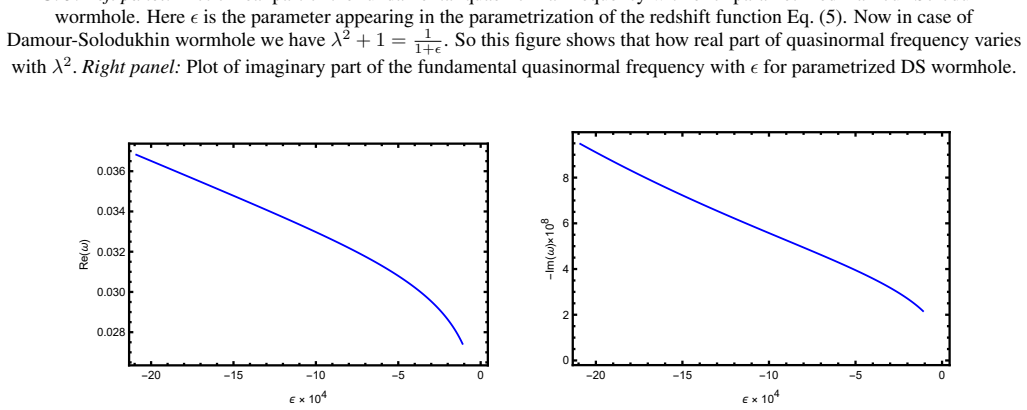
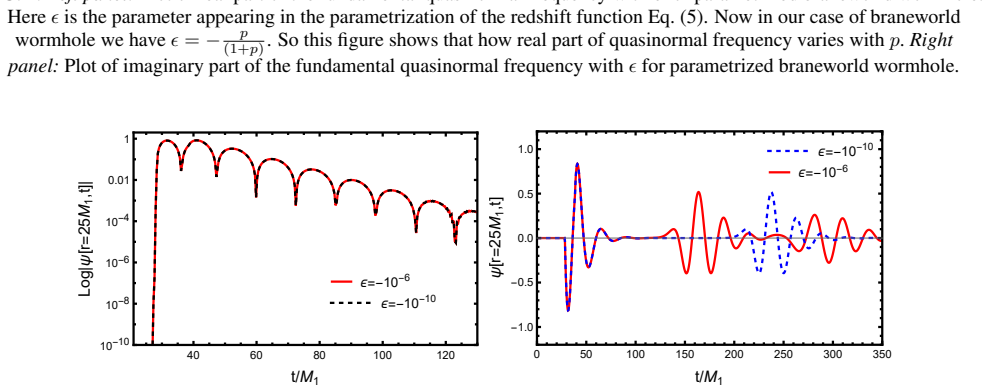
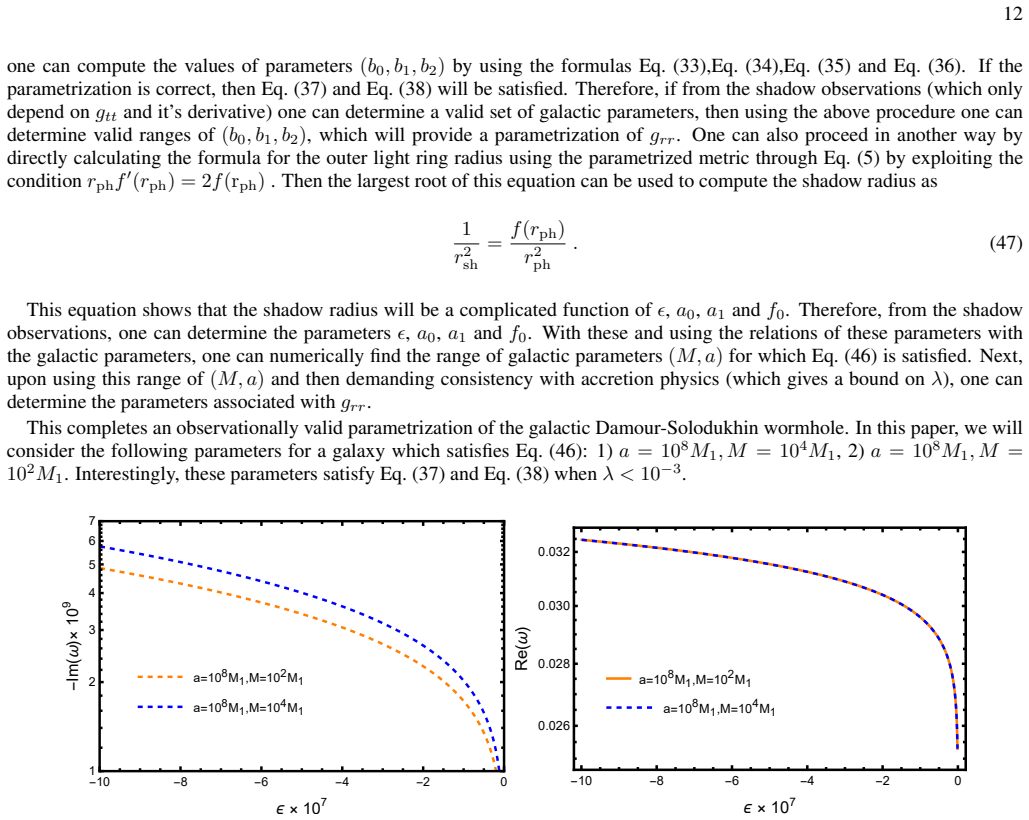
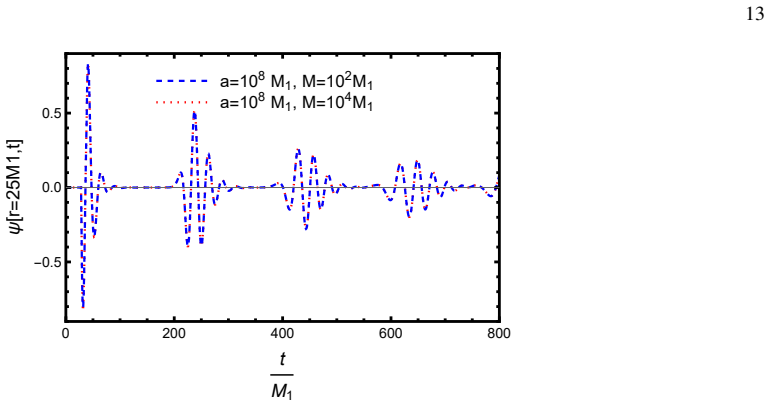
We study electromagnetic perturbations and the associated quasinormal modes (QNMs) of parametrized static, spherically symmetric wormhole spacetimes, focusing on Damour-Solodukhin and braneworld geometries as well as their galactic extensions. Using the Bronnikov-Konoplya-Pappas parametrization, we express the metric functions in terms of a compactified radial coordinate and characterize the spacetime through far-field and near-throat parameters. The far-field coefficients govern the asymptotic structure and post-Newtonian behaviour, while the near-throat continued-fraction expansion captures the strong-field geometry near the throat. We first apply the parametrization to isolated wormholes and identify its range of validity, showing that non-polynomial metric functions can limit the convergence of the near-throat expansion and hence the accuracy of a truncated representation. We then extend the framework to a galactic Damour-Solodukhin wormhole embedded in a Hernquist dark matter halo. Imposing observational bounds from the shadow of Sgr A$^*$, we constrain the galactic compactness and deformation parameters and obtain an observationally viable parametrized metric. Within the allowed parameter space, we compute the fundamental QNM frequencies using the transfer matrix method and analyze the corresponding time-domain ringdown signals. We find that the damping rate is more sensitive to galactic compactness, whereas the oscillation frequency remains comparatively stable. Although the spectral shifts are small within the shadow-allowed region, the framework provides a systematic link between geometric parametrization, shadow constraints, and dynamical response. Our results establish an observationally consistent parametrized description of wormhole perturbations for strong-field tests of horizonless compact objects.
Editorial analysis
A structured set of objections, weighed in public.
Referee Report
Summary. The manuscript develops a parametrized description of static spherically symmetric wormhole spacetimes (Damour-Solodukhin and braneworld) using the Bronnikov-Konoplya-Pappas (BKP) formalism, which separates far-field coefficients from a near-throat continued-fraction expansion. It extends the framework to galactic embeddings via a Hernquist dark-matter halo, imposes constraints from the Sgr A* shadow, and computes fundamental electromagnetic QNMs with the transfer-matrix method. Within the shadow-allowed parameter region the authors report that the damping rate is more sensitive to galactic compactness while the oscillation frequency remains comparatively stable, thereby linking geometric parametrization, observational bounds, and ringdown dynamics.
Significance. If the BKP truncation faithfully reproduces the target metrics inside the shadow window, the work supplies a concrete, observationally anchored pipeline from parametrized strong-field geometry to dynamical signatures. The explicit treatment of the parametrization's range of validity, the use of the transfer-matrix technique for QNMs, and the separation of galactic-compactness effects from deformation-parameter effects are genuine strengths that could be useful for future strong-field tests of horizonless objects.
major comments (1)
- Abstract and the section on the range of validity of the parametrization: the manuscript correctly notes that non-polynomial metric functions restrict convergence of the near-throat continued-fraction expansion. The galactic Damour-Solodukhin + Hernquist extension introduces additional non-polynomial terms; it is therefore necessary to demonstrate (e.g., by direct comparison of the truncated BKP metric with the exact target metric near the throat, or by reporting the size of the omitted continued-fraction coefficients) that the truncation error remains small for the specific parameter values allowed by the Sgr A* shadow. Without such a check the reported sensitivity of the damping rate to galactic compactness cannot be unambiguously attributed to the intended spacetime rather than to an approximation artifact.
Simulated Author's Rebuttal
We thank the referee for the careful reading of our manuscript and for the constructive major comment. We agree that an explicit check of the truncation error is required for the galactic extensions and will incorporate the requested verification in the revised version.
read point-by-point responses
-
Referee: Abstract and the section on the range of validity of the parametrization: the manuscript correctly notes that non-polynomial metric functions restrict convergence of the near-throat continued-fraction expansion. The galactic Damour-Solodukhin + Hernquist extension introduces additional non-polynomial terms; it is therefore necessary to demonstrate (e.g., by direct comparison of the truncated BKP metric with the exact target metric near the throat, or by reporting the size of the omitted continued-fraction coefficients) that the truncation error remains small for the specific parameter values allowed by the Sgr A* shadow. Without such a check the reported sensitivity of the damping rate to galactic compactness cannot be unambiguously attributed to the intended spacetime rather than to an approximation artifact.
Authors: We agree with the referee that while the range of validity was examined for the isolated wormhole cases, an explicit demonstration is needed for the galactic Damour-Solodukhin + Hernquist models inside the Sgr A* shadow window. In the revised manuscript we will add a dedicated subsection (or appendix) that (i) directly compares the truncated BKP metric functions with the exact target metric near the throat for representative shadow-allowed values of galactic compactness and deformation parameters, and (ii) reports the numerical size of the first few omitted continued-fraction coefficients. This will quantify the truncation error and confirm that the reported sensitivity of the QNM damping rate to galactic compactness arises from the underlying spacetime rather than from the approximation. revision: yes
Circularity Check
No circularity: QNMs computed numerically from externally constrained parametrized metric
full rationale
The derivation applies the external BKP parametrization to Damour-Solodukhin and braneworld metrics (with galactic extensions), imposes independent shadow bounds from Sgr A* to fix compactness and deformation parameters, and then evaluates fundamental QNMs via the transfer-matrix method on the resulting metric functions. None of the reported frequencies or damping rates are obtained by algebraic rearrangement of the input metric coefficients or by a self-citation chain; the transfer-matrix step is a distinct numerical procedure whose output is not forced to equal any fitted input by construction. The paper explicitly notes the convergence limitation for non-polynomial functions, but this is a validity caveat rather than a circular reduction. The central claim therefore remains self-contained against external benchmarks.
Axiom & Free-Parameter Ledger
free parameters (4)
- far-field coefficients
- near-throat continued-fraction coefficients
- galactic compactness parameter
- deformation parameters
axioms (3)
- domain assumption The spacetime is static and spherically symmetric
- domain assumption Electromagnetic perturbations obey the wave equation on the given background metric
- ad hoc to paper The Bronnikov-Konoplya-Pappas parametrization provides a usable representation of the metric functions
Reference graph
Works this paper leans on
-
[1]
Testing General Relativity with Present and Future Astrophysical Observations
E. Bertiet al., “Testing General Relativity with Present and Future Astrophysical Observations,”Class. Quant. Grav.32(2015) 243001, arXiv:1501.07274 [gr-qc]
work page internal anchor Pith review arXiv 2015
-
[2]
Living Reviews in Relativity , keywords =
V . Cardoso and P. Pani, “Testing the nature of dark compact objects: a status report,”Living Reviews in Relativity22no. 1, (July, 2019) . http://dx.doi.org/10.1007/s41114-019-0020-4
-
[3]
Visser,Lorentzian wormholes: From Einstein to Hawking
M. Visser,Lorentzian wormholes: From Einstein to Hawking. 1995
1995
-
[4]
The Particle Problem in the General Theory of Relativity,
A. Einstein and N. Rosen, “The Particle Problem in the General Theory of Relativity,”Phys. Rev.48(1935) 73–77
1935
-
[5]
Wormholes in space-time and their use for interstellar travel: A tool for teaching general relativity,
M. S. Morris and K. S. Thorne, “Wormholes in space-time and their use for interstellar travel: A tool for teaching general relativity,” Am. J. Phys.56(1988) 395–412
1988
-
[6]
V . Cardoso, S. Hopper, C. F. B. Macedo, C. Palenzuela, and P. Pani, “Gravitational-wave signatures of exotic compact objects and of quantum corrections at the horizon scale,”Phys. Rev. D94no. 8, (2016) 084031,arXiv:1608.08637 [gr-qc]
-
[7]
A recipe for echoes from exotic compact objects,
Z. Mark, A. Zimmerman, S. M. Du, and Y . Chen, “A recipe for echoes from exotic compact objects,”Physical Review D96no. 8, (Oct.,
-
[8]
http://dx.doi.org/10.1103/PhysRevD.96.084002
-
[9]
Cool horizons for entangled black holes,
J. Maldacena and L. Susskind, “Cool horizons for entangled black holes,”F ortschritte der Physik61no. 9, (Aug., 2013) 781–811. http://dx.doi.org/10.1002/prop.201300020
-
[10]
J. C. Baez and J. Vicary, “Wormholes and Entanglement,”Class. Quant. Grav.31no. 21, (2014) 214007,arXiv:1401.3416 [gr-qc]
-
[11]
V . Cardoso, E. Franzin, and P. Pani, “Is the gravitational-wave ringdown a probe of the event horizon?,”Phys. Rev. Lett.116no. 17, (2016) 171101,arXiv:1602.07309 [gr-qc]. [Erratum: Phys.Rev.Lett. 117, 089902 (2016)]. 15
-
[12]
Instability of wormholes with a nonminimally coupled scalar field,
K. A. Bronnikov and S. Grinyok, “Instability of wormholes with a nonminimally coupled scalar field,”Grav. Cosmol.7(2001) 297–300, arXiv:gr-qc/0201083
work page internal anchor Pith review arXiv 2001
-
[13]
Instabilities of wormholes and regular black holes supported by a phantom scalar field,
K. A. Bronnikov, R. A. Konoplya, and A. Zhidenko, “Instabilities of wormholes and regular black holes supported by a phantom scalar field,”Phys. Rev. D86(2012) 024028,arXiv:1205.2224 [gr-qc]
-
[14]
Instability of wormholes supported by a ghost scalar field. I. Linear stability analysis,
J. A. Gonzalez, F. S. Guzman, and O. Sarbach, “Instability of wormholes supported by a ghost scalar field. I. Linear stability analysis,” Class. Quant. Grav.26(2009) 015010,arXiv:0806.0608 [gr-qc]
-
[15]
E. Maggio, V . Cardoso, S. R. Dolan, and P. Pani, “Ergoregion instability of exotic compact objects: electromagnetic and gravitational perturbations and the role of absorption,”Phys. Rev. D99no. 6, (2019) 064007,arXiv:1807.08840 [gr-qc]
-
[16]
General parametrization of wormhole spacetimes and its application to shadows and quasinormal modes,
K. A. Bronnikov, R. A. Konoplya, and T. D. Pappas, “General parametrization of wormhole spacetimes and its application to shadows and quasinormal modes,”Phys. Rev. D103no. 12, (2021) 124062,arXiv:2102.10679 [gr-qc]
-
[17]
Quasinormal modes of black holes and black branes
E. Berti, V . Cardoso, and A. O. Starinets, “Quasinormal modes of black holes and black branes,”Class. Quant. Grav.26(2009) 163001, arXiv:0905.2975 [gr-qc]
work page internal anchor Pith review arXiv 2009
-
[18]
Quasinormal modes of black holes: from astrophysics to string theory
R. A. Konoplya and A. Zhidenko, “Quasinormal modes of black holes: From astrophysics to string theory,”Rev. Mod. Phys.83(2011) 793–836,arXiv:1102.4014 [gr-qc]
work page internal anchor Pith review arXiv 2011
-
[19]
Black hole spectroscopy: from theory to experiment
E. Bertiet al., “Black hole spectroscopy: from theory to experiment,”arXiv:2505.23895 [gr-qc]
work page internal anchor Pith review arXiv
-
[20]
Quasinormal modes of rapidly rotating ellis-bronnikov wormholes,
F. S. Khoo, B. Azad, J. L. Bl ´azquez-Salcedo, L. M. Gonz´alez-Romero, B. Kleihaus, J. Kunz, and F. Navarro-L´erida, “Quasinormal modes of rapidly rotating ellis-bronnikov wormholes,”Phys. Rev. D109(Apr, 2024) 084013. https://link.aps.org/doi/10.1103/PhysRevD.109.084013
-
[21]
Gravitational waves from quasinormal modes of a class of lorentzian wormholes,
S. Aneesh, S. Bose, and S. Kar, “Gravitational waves from quasinormal modes of a class of lorentzian wormholes,”Phys. Rev. D97 (Jun, 2018) 124004.https://link.aps.org/doi/10.1103/PhysRevD.97.124004. [21]Event Horizon TelescopeCollaboration, K. Akiyamaet al., “First M87 Event Horizon Telescope Results. I. The Shadow of the Supermassive Black Hole,”Astrophy...
-
[22]
Eht constraint on the ultralight scalar hair of the m87 supermassive black hole,
P. V . P. Cunha, C. A. R. Herdeiro, and E. Radu, “Eht constraint on the ultralight scalar hair of the m87 supermassive black hole,” Universe5no. 12, (2019) 220. arXiv:1909.08039
-
[23]
Tests of Loop Quantum Gravity from the Event Horizon Telescope Results of Sgr A*,
M. Afrin and S. G. Ghosh, “Eht observables as a tool to estimate parameters of supermassive black holes,”arXiv preprint arXiv:2209.12584(2022) . [24]Event Horizon TelescopeCollaboration, K. Akiyamaet al., “First sagittarius a* event horizon telescope results. vi. testing the black hole metric,”Astrophys. J. Lett.930no. 2, (2022) L17
-
[24]
Horizon-scale tests of gravity theories and fundamental physics from the event horizon telescope image of sagittarius a*,
S. Vagnozzi, R. Roy, Y .-D. Tsai, L. Visinelli, M. Afrin, A. Allahyari, P. Bambhaniya, D. Dey, S. G. Ghosh, P. S. Joshi, K. Jusufi, M. Khodadi, R. K. Walia, A. ¨Ovg¨un, and C. Bambi, “Horizon-scale tests of gravity theories and fundamental physics from the event horizon telescope image of sagittarius a*,”Class. Quantum Grav.40no. 16, (2023) 165007
2023
-
[25]
No-hair theorem in the wake of event horizon telescope,
M. Khodadi, G. Lambiase, and D. F. Mota, “No-hair theorem in the wake of event horizon telescope,”JCAP09(2020) 026. arXiv:2005.05992
- [26]
-
[27]
Observational signatures of Rotating compact objects in Plasma space–time,
S. Kumar, A. Uniyal, and S. Chakrabarti, “Observational signatures of Rotating compact objects in Plasma space–time,”Phys. Dark Univ.44(2024) 101472,arXiv:2403.12439 [gr-qc]
-
[28]
Shadows of generalised Hayward spacetimes: in vacuum and with plasma,
S. Gera, S. Kumar, P. Dutta Roy, and S. Chakrabarti, “Shadows of generalised Hayward spacetimes: in vacuum and with plasma,”JCAP 07(2025) 065,arXiv:2411.11970 [gr-qc]
-
[29]
Testing General Relativity with the Event Horizon Telescope,
D. Psaltis, “Testing General Relativity with the Event Horizon Telescope,”Gen. Rel. Grav.51no. 10, (2019) 137, arXiv:1806.09740 [astro-ph.HE]
-
[30]
Accretion disk around the rotating Damour–Solodukhin wormhole,
R. K. Karimov, R. N. Izmailov, and K. K. Nandi, “Accretion disk around the rotating Damour–Solodukhin wormhole,”Eur . Phys. J. C 79no. 11, (2019) 952,arXiv:1901.05762 [gr-qc]
- [31]
-
[32]
Ringing of the regular black-hole/wormhole transition,
M. S. Churilova and Z. Stuchlik, “Ringing of the regular black-hole/wormhole transition,”Class. Quant. Grav.37no. 7, (2020) 075014, arXiv:1911.11823 [gr-qc]
-
[33]
The Confrontation between general relativity and experiment,
C. M. Will, “The Confrontation between general relativity and experiment,”Living Rev. Rel.9(2006) 3,arXiv:gr-qc/0510072
-
[34]
Wormholes as black hole foils,
T. Damour and S. N. Solodukhin, “Wormholes as black hole foils,”Phys. Rev. D76(2007) 024016,arXiv:0704.2667 [gr-qc]
-
[35]
Can extra dimensional effects allow wormholes without exotic matter?,
S. Kar, S. Lahiri, and S. SenGupta, “Can extra dimensional effects allow wormholes without exotic matter?,”Phys. Lett. B750(2015) 319–324,arXiv:1505.06831 [gr-qc]
-
[36]
New parametrization for spherically symmetric black holes in metric theories of gravity,
L. Rezzolla and A. Zhidenko, “New parametrization for spherically symmetric black holes in metric theories of gravity,”Phys. Rev. D 90no. 8, (2014) 084009,arXiv:1407.3086 [gr-qc]
-
[37]
Pad´e metrics for black hole perturbations and light rings,
S. Maharana, F. Simovic, I. Soranidis, and D. R. Terno, “Pad´e metrics for black hole perturbations and light rings,”Phys. Rev. D111 no. 10, (2025) 104063,arXiv:2503.06752 [gr-qc]
-
[38]
One should always check this hierarchy for a valid parametrization
-
[39]
A Metric for Rapidly Spinning Black Holes Suitable for Strong-Field Tests of the No-Hair Theorem,
T. Johannsen and D. Psaltis, “A Metric for Rapidly Spinning Black Holes Suitable for Strong-Field Tests of the No-Hair Theorem,” Phys. Rev. D83(2011) 124015,arXiv:1105.3191 [gr-qc]
-
[40]
Quasinormal ringing of general spherically symmetric parametrized black holes,
R. A. Konoplya and A. Zhidenko, “Quasinormal ringing of general spherically symmetric parametrized black holes,”Phys. Rev. D105 no. 10, (2022) 104032,arXiv:2201.12897 [gr-qc]
-
[41]
Radion and holographic brane gravity,
S. Kanno and J. Soda, “Radion and holographic brane gravity,”Phys. Rev. D66(2002) 083506,arXiv:hep-th/0207029
-
[42]
By the termA(r)orB(r), we mean that after determining their expression we replacexby(1− r0 r )
-
[43]
Deciphering the Instability of the Black Hole Ringdown Quasinormal Spectrum,
A. Ianniccari, A. J. Iovino, A. Kehagias, P. Pani, G. Perna, D. Perrone, and A. Riotto, “Deciphering the Instability of the Black Hole Ringdown Quasinormal Spectrum,”Phys. Rev. Lett.133no. 21, (2024) 211401,arXiv:2407.20144 [gr-qc]. 16
-
[44]
Echoes from braneworld wormholes,
S. Biswas, M. Rahman, and S. Chakraborty, “Echoes from braneworld wormholes,”Phys. Rev. D106no. 12, (2022) 124003, arXiv:2205.14743 [gr-qc]
-
[45]
Galactic wormholes: Geometry, stability, and echoes,
S. Biswas, C. Singha, and S. Chakraborty, “Galactic wormholes: Geometry, stability, and echoes,”Phys. Rev. D109no. 6, (2024) 064043,arXiv:2307.04836 [gr-qc]
-
[46]
The reader may argue thatγitself contains transcendental behavior, but since expansion oftan −1(x)has polynomial dependence onx so that one can read-offa 1
-
[47]
S. Vagnozziet al., “Horizon-scale tests of gravity theories and fundamental physics from the Event Horizon Telescope image of Sagittarius A,”Class. Quant. Grav.40no. 16, (2023) 165007,arXiv:2205.07787 [gr-qc]
-
[48]
Geodesic stability, Lyapunov exponents and quasinormal modes,
V . Cardoso, A. S. Miranda, E. Berti, H. Witek, and V . T. Zanchin, “Geodesic stability, Lyapunov exponents and quasinormal modes,” Phys. Rev. D79no. 6, (2009) 064016,arXiv:0812.1806 [hep-th]
-
[49]
Excitation factors for horizonless compact objects: long-lived modes, echoes, and greybody factors,
R. F. Rosato, S. Biswas, S. Chakraborty, and P. Pani, “Excitation factors for horizonless compact objects: long-lived modes, echoes, and greybody factors,”arXiv:2511.08692 [gr-qc]
work page internal anchor Pith review arXiv
discussion (0)
Sign in with ORCID, Apple, or X to comment. Anyone can read and Pith papers without signing in.