Recognition: unknown
Ag I model atom and the 3D non-LTE solar silver abundance
Pith reviewed 2026-05-08 16:07 UTC · model grok-4.3
The pith
A new Ag I model atom raises the solar silver abundance by 0.19 dex to 1.15.
A machine-rendered reading of the paper's core claim, the machinery that carries it, and where it could break.
Core claim
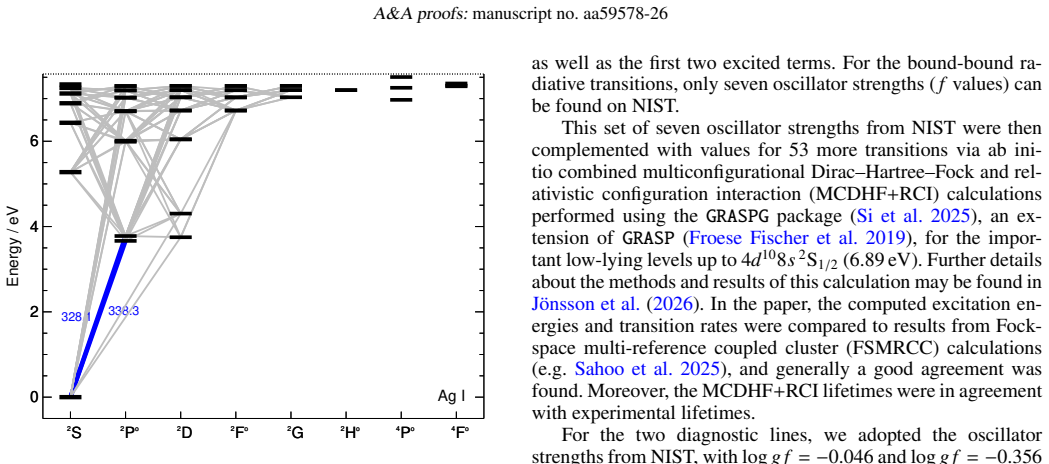
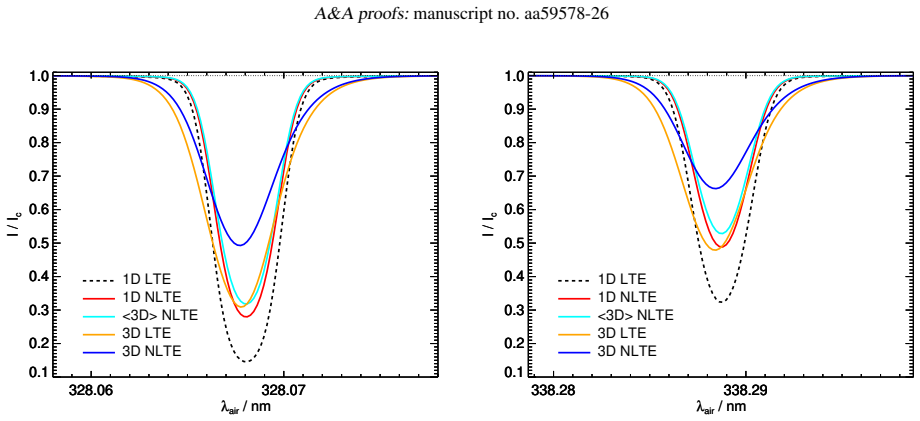
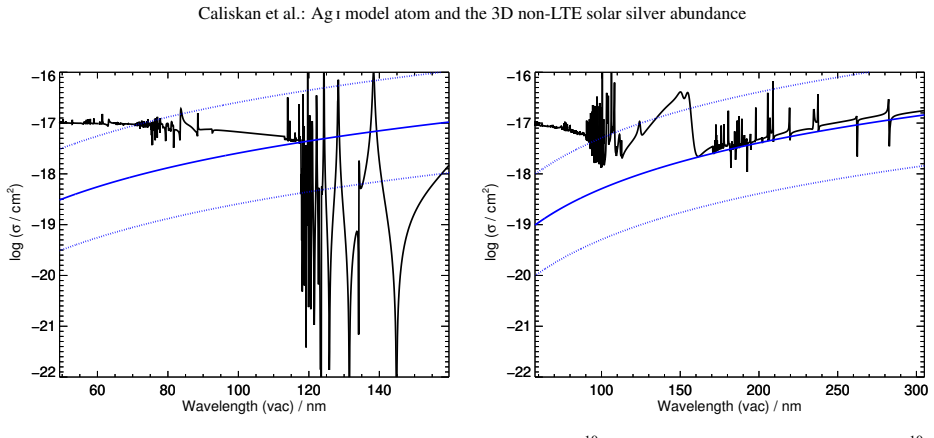
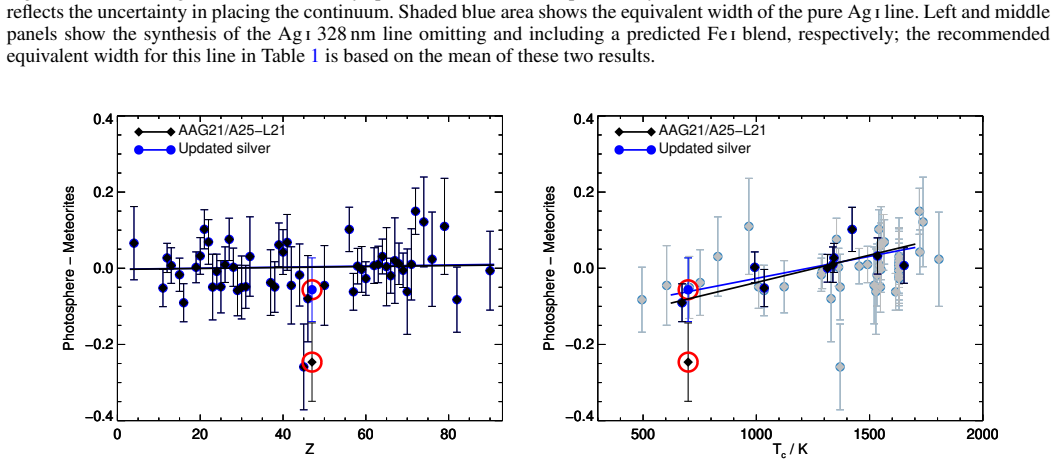
We present a new Ag I model atom built from carefully curated radiative and collisional data, including newly computed oscillator strengths using an ab initio multi-configurational Hartree-Fock method and inelastic hydrogen collision rates based on a combined asymptotic and free-electron model approach. Applying the model to the solar Ag I 328 and 338 nm resonance lines, we find severe positive abundance corrections from coupled 3D and non-LTE effects. Using revised equivalent width measurements, we derive a recommended solar 3D non-LTE silver abundance of 1.15 +/- 0.08. This is an increase of 0.19 dex relative to the current reference value. Our ab initio model significantly reduces the gap
What carries the argument
The Ag I model atom, which assembles new radiative data and hydrogen collision rates to support consistent 3D non-LTE line formation calculations in the solar atmosphere.
Load-bearing premise
The combined asymptotic and free-electron model accurately supplies the inelastic hydrogen collision rates that control the non-LTE level populations under solar photosphere conditions.
What would settle it
An independent calculation or laboratory measurement of the key hydrogen collision rates for Ag I that differs markedly from the adopted values and erases the 0.19 dex abundance correction.
Figures




read the original abstract
Silver is an important light neutron-capture element whose stellar abundances help constrain the origin of the weak r-process. The Sun is an important reference point for such studies; moreover, being a moderately volatile element in CI chondrites, the solar silver abundance is interesting as a diagnostic for the debated Sun-CI abundance vs. condensation temperature trend. These studies require accurate silver abundances that go beyond the commonly used assumptions of 1D atmospheres and local thermodynamic equilibrium (LTE); however, no consistent 3D non-LTE analysis of silver has been available to date. We present a new Ag I model atom built from carefully curated radiative and collisional data, including newly computed oscillator strengths using an ab initio multi-configurational Hartree-Fock method and inelastic hydrogen collision rates based on a combined asymptotic and free-electron model approach. We assess modelling uncertainties via targeted sensitivity tests, finding the results most sensitive to hydrogen collision data. Applying the model to the solar Ag I 328 and 338 nm resonance lines, we find severe positive abundance corrections from coupled 3D and non-LTE effects. Using revised equivalent width measurements, we derive a recommended solar 3D non-LTE silver abundance of 1.15 +/- 0.08. This is an increase of 0.19 dex relative to the current reference value. Our ab initio model significantly reduces the discrepancy with the meteoritic value from 0.25 to 0.06 dex; moreover, this residual offset is consistent with recent results for other moderately volatile elements. The Sun provides the benchmark test for the first Ag I non-LTE model atom presented here. In subsequent work, this model will be applied to determine 3D non-LTE silver abundances in metal-poor dwarfs and giants, enabling improved constraints on Galactic chemical evolution and weak r-process nucleosynthesis.
Editorial analysis
A structured set of objections, weighed in public.
Referee Report
Summary. The manuscript constructs a new Ag I model atom using ab initio multi-configurational Hartree-Fock calculations for oscillator strengths and a hybrid asymptotic plus free-electron model for inelastic hydrogen collision rates. Applying this model in 3D non-LTE radiative transfer to the solar Ag I resonance lines at 328 nm and 338 nm with revised equivalent widths yields a recommended solar abundance A(Ag) = 1.15 ± 0.08 dex. This is 0.19 dex higher than the prior 1D LTE reference value and reduces the discrepancy with the meteoritic abundance from 0.25 dex to 0.06 dex.
Significance. If the modeling holds, the work supplies the first consistent 3D non-LTE solar silver abundance, serving as an essential benchmark for studies of the weak r-process and Galactic chemical evolution in metal-poor stars. The ab initio radiative data and explicit sensitivity tests to collision rates constitute a clear methodological improvement over previous LTE analyses. The reduced meteoritic offset aligns with trends seen for other moderately volatile elements and strengthens the case for using the Sun as a reference in condensation-temperature studies.
major comments (2)
- [§3.2] §3.2 (inelastic collision rates): The paper correctly identifies the Ag-H collision rates as the dominant uncertainty source and performs targeted sensitivity tests. However, because the hybrid asymptotic + free-electron model lacks quantum-mechanical close-coupling benchmarks or laboratory validation for silver, a factor-of-three systematic error in the rates can shift the non-LTE over-ionization and the derived abundance correction by >0.1 dex—comparable to the total quoted uncertainty. The error budget should therefore include an explicit additional component for this unverified absolute scale rather than relying solely on the internal sensitivity range.
- [§5] §5 (abundance derivation and error propagation): The final 1.15 ± 0.08 value incorporates 3D and non-LTE effects, yet the propagation from equivalent-width measurements, atmospheric parameters, and collision-rate variations is not tabulated in detail. A supplementary table showing the contribution of each source to the total uncertainty would make the quoted error bar more transparent and allow readers to assess whether the 0.06 dex residual offset with meteorites is statistically significant.
minor comments (2)
- [Figure 2] Figure 2 (departure coefficients): The plots would be clearer if the LTE reference case were overlaid on the 3D non-LTE curves for direct visual comparison of the over-ionization effect.
- [§4.1] §4.1 (oscillator strengths): The new ab initio f-values are presented without a direct numerical comparison table to the older literature values used in prior solar analyses; adding such a table would help quantify the contribution of the radiative data update.
Simulated Author's Rebuttal
We thank the referee for the positive evaluation of our work and for the constructive comments, which have helped us improve the clarity and robustness of the manuscript. We address each major comment below and have revised the paper accordingly.
read point-by-point responses
-
Referee: [§3.2] §3.2 (inelastic collision rates): The paper correctly identifies the Ag-H collision rates as the dominant uncertainty source and performs targeted sensitivity tests. However, because the hybrid asymptotic + free-electron model lacks quantum-mechanical close-coupling benchmarks or laboratory validation for silver, a factor-of-three systematic error in the rates can shift the non-LTE over-ionization and the derived abundance correction by >0.1 dex—comparable to the total quoted uncertainty. The error budget should therefore include an explicit additional component for this unverified absolute scale rather than relying solely on the internal sensitivity range.
Authors: We agree that the absence of direct quantum-mechanical benchmarks or laboratory data for Ag-H collisions represents a genuine limitation of the hybrid model. Our existing sensitivity tests already vary the rates by factors of 2–3 and show abundance shifts of up to ~0.1 dex, which is reflected in the quoted uncertainty. To make the treatment of this systematic more explicit, we have added a dedicated paragraph in the revised §3.2 that isolates an additional 0.05 dex systematic term for the absolute scale of the collision rates. This term is now folded into the total error budget in §5, yielding a slightly more conservative final uncertainty of ±0.09 dex. We retain the sensitivity tests as the primary diagnostic but acknowledge the referee’s point that an explicit component is warranted. revision: yes
-
Referee: [§5] §5 (abundance derivation and error propagation): The final 1.15 ± 0.08 value incorporates 3D and non-LTE effects, yet the propagation from equivalent-width measurements, atmospheric parameters, and collision-rate variations is not tabulated in detail. A supplementary table showing the contribution of each source to the total uncertainty would make the quoted error bar more transparent and allow readers to assess whether the 0.06 dex residual offset with meteorites is statistically significant.
Authors: We concur that a transparent breakdown of the error sources will help readers evaluate the significance of the remaining meteoritic offset. In the revised manuscript we have inserted a new supplementary table (Table S1) that lists the individual contributions: equivalent-width measurement uncertainty (0.03 dex), atmospheric-parameter uncertainties (0.04 dex), and the collision-rate sensitivity range (0.06 dex). These are combined in quadrature to reproduce the adopted total of 0.08 dex (or 0.09 dex after the additional systematic term noted above). The table is referenced in §5 and the discussion of the 0.06 dex offset has been updated to note that the offset remains within the combined uncertainty. revision: yes
Circularity Check
No significant circularity: ab initio model atom independent of solar abundance derivation
full rationale
The paper constructs the Ag I model atom from ab initio multi-configurational Hartree-Fock oscillator strengths and a combined asymptotic plus free-electron model for H collisions, both generated prior to and independently of the solar line analysis. These inputs are then used to compute departure coefficients and apply the model to observed equivalent widths of the 328/338 nm lines, yielding the 3D non-LTE abundance via standard spectrum synthesis. Sensitivity tests vary the collision rates but do not fit them to the solar data. No equation or step reduces the final A(Ag) value to a pre-fitted parameter, self-citation chain, or definitional tautology; the abundance is an output of the forward model applied to observations.
Axiom & Free-Parameter Ledger
axioms (1)
- domain assumption Standard 3D solar atmosphere model and non-LTE radiative transfer assumptions apply to the Ag I resonance lines
Reference graph
Works this paper leans on
-
[1]
Allen, C. W. 1973, Astrophysical quantities (London: University of London, Athlone Press,|c1973, 3rd ed.) Allende Prieto, C., Asplund, M., & Fabiani Bendicho, P. 2004, A&A, 423, 1109
1973
-
[2]
Amarsi, A. M. 2015, MNRAS, 452, 1612
2015
-
[3]
M., Li, W., Grevesse, N., & Jurewicz, A
Amarsi, A. M., Li, W., Grevesse, N., & Jurewicz, A. J. G. 2025, A&A, 703, A35
2025
-
[4]
M., Lind, K., Asplund, M., Barklem, P
Amarsi, A. M., Lind, K., Asplund, M., Barklem, P. S., & Collet, R. 2016, MN- RAS, 463, 1518
2016
-
[5]
M., Ogneva, D., Buldgen, G., et al
Amarsi, A. M., Ogneva, D., Buldgen, G., et al. 2024, A&A, 690, A128
2024
-
[6]
M., & Grevesse, N
Asplund, M., Amarsi, A. M., & Grevesse, N. 2021, A&A, 653, A141
2021
-
[7]
J., & Scott, P
Asplund, M., Grevesse, N., Sauval, A. J., & Scott, P. 2009, ARA&A, 47, 481
2009
-
[8]
Asplund, M., Nordlund, Å., Trampedach, R., Allende Prieto, C., & Stein, R. F. 2000, A&A, 359, 729
2000
-
[9]
S., Piskunov, N., & O’Mara, B
Barklem, P. S., Piskunov, N., & O’Mara, B. J. 2000, A&AS, 142, 467
2000
-
[10]
& Carlsson, M
Botnen, A. & Carlsson, M. 1999, in Astrophysics and Space Science Library, V ol. 240, Numerical Astrophysics, ed. S. M. Miyama, K. Tomisaka, & T. Hanawa, 379
1999
-
[11]
2011, Sol
Caffau, E., Ludwig, H.-G., Steffen, M., Freytag, B., & Bonifacio, P. 2011, Sol. Phys., 268, 255
2011
-
[12]
M., Racca, M., et al
Caliskan, S., Amarsi, A. M., Racca, M., et al. 2025, A&A, 696, A210
2025
-
[13]
Caliskan, S., Grumer, J., & Amarsi, A. M. 2024, Journal of Physics B Atomic Molecular Physics, 57, 055003
2024
-
[14]
Carlsson, J., Jönsson, P., & Sturesson, L. 1990, Z. Phys. D, 16, 87 Civiš, S., Matulková, I., Cihelka, J., et al. 2010, Physical Review A, 82, 022502
1990
-
[15]
2018, MN- RAS, 475, 3369
Collet, R., Nordlund, Å., Asplund, M., Hayek, W., & Trampedach, R. 2018, MN- RAS, 475, 3369
2018
-
[16]
1973, Atlas photometrique du spectre solaire de [lambda] 3000 a [lambda] 10000
Delbouille, L., Roland, G., & Neven, L. 1973, Atlas photometrique du spectre solaire de [lambda] 3000 a [lambda] 10000
1973
-
[17]
J., Kalyaan, A., & O’D
Desch, S. J., Kalyaan, A., & O’D. Alexander, C. M. 2018, ApJS, 238, 11
2018
-
[18]
1982, ARA&A, 20, 61
Dravins, D. 1982, ARA&A, 20, 61
1982
-
[19]
I., et al
Farouqi, K., Kratz, K.-L., Mashonkina, L. I., et al. 2009, The Astrophysical Jour- nal, 694, L49
2009
-
[20]
2025, Sol
Feller, A., Gandorfer, A., Grauf, B., et al. 2025, Sol. Phys., 300, 65 François, P., Depagne, E., Hill, V ., et al. 2007, Astronomy & Astrophysics, 476, 935 Froese Fischer, C., Gaigalas, G., Jönsson, P., & Biero ´n, J. 2019, Computer Physics Communications, 237, 184
2025
-
[21]
K., & Tobin, R
Gonzalez, G., Carlson, M. K., & Tobin, R. W. 2010, MNRAS, 407, 314
2010
-
[22]
1999, A&A, 342, 881
Goriely, S. 1999, A&A, 342, 881
1999
-
[23]
Gray, D. F. 2022, The observation and analysis of stellar photospheres (Cam- bridge University Press UK)
2022
-
[24]
2015, Astronomy & Astrophysics, 573, A27
Grevesse, N., Scott, P., Asplund, M., & Jacques Sauval, A. 2015, Astronomy & Astrophysics, 573, A27
2015
-
[25]
2008, A&A, 486, 951
Gustafsson, B., Edvardsson, B., Eriksson, K., et al. 2008, A&A, 486, 951
2008
-
[26]
Hansen, C. J. & Primas, F. 2011, Astronomy and Astrophysics, 525, L5
2011
-
[27]
J., Primas, F., Hartman, H., et al
Hansen, C. J., Primas, F., Hartman, H., et al. 2012, Astronomy and Astrophysics, 545, A31
2012
-
[28]
2011, A&A, 529, A158
Hayek, W., Asplund, M., Collet, R., & Nordlund, Å. 2011, A&A, 529, A158
2011
-
[29]
Honda, S., Aoki, W., Ishimaru, Y ., Wanajo, S., & Ryan, S. G. 2006, ApJ, 643, 1180
2006
-
[30]
2025, The Astrophysical Journal, 991, 112 Jönsson, P., Sahoo, B
Huang, P., Zhou, Z., Cui, W., et al. 2025, The Astrophysical Journal, 991, 112 Jönsson, P., Sahoo, B. K., Caliskan, S., & Amarsi, A. M. 2026, A&A, 709, A31
2025
-
[31]
Jurewicz, A. J. G., Amarsi, A. M., Burnett, D. S., & Grevesse, N. 2024, MAPS, 59, 3193
2024
-
[32]
1991, Journal of Physics B Atomic Molecular Physics, 24, L127
Kaulakys, B. 1991, Journal of Physics B Atomic Molecular Physics, 24, L127
1991
-
[33]
K., et al
Korpi-Lagg, A., Gandorfer, A., Solanki, S. K., et al. 2025, Sol. Phys., 300, 75
2025
-
[34]
Ralchenko, Reader, J., & and NIST ASD Team
Kramida, A., Yu. Ralchenko, Reader, J., & and NIST ASD Team. 2022, NIST Atomic Spectra Database (ver. 5.10). [Online]. Available: https://physics.nist.gov/asd[2023, September 11]. National Insti- tute of Standards and Technology, Gaithersburg, MD
2022
-
[35]
2007, The Astrophysical Journal, 662, 39
Kratz, K.-L., Farouqi, K., Pfeiffer, B., et al. 2007, The Astrophysical Journal, 662, 39
2007
-
[36]
Kurucz, R. L. 2017, Canadian Journal of Physics, 95, 825
2017
-
[37]
M., Rodríguez Díaz, L
Lagae, C., Amarsi, A. M., Rodríguez Díaz, L. F., et al. 2023, A&A, 672, A90
2023
-
[38]
& Carlsson, M
Leenaarts, J. & Carlsson, M. 2009, in Astronomical Society of the Pacific Conference Series, V ol. 415, The Second Hinode Science Meeting: Be- yond Discovery-Toward Understanding, ed. B. Lites, M. Cheung, T. Magara, J. Mariska, & K. Reeves, 87
2009
-
[39]
& Amarsi, A
Lind, K. & Amarsi, A. M. 2024, ARA&A, 62, 475
2024
-
[40]
M., Asplund, M., et al
Lind, K., Amarsi, A. M., Asplund, M., et al. 2017, MNRAS, 468, 4311
2017
-
[41]
P., Gao, C., Zeng, J
Liu, Y . P., Gao, C., Zeng, J. L., Yuan, J. M., & Shi, J. R. 2014, ApJS, 211, 30
2014
-
[42]
2003, ApJ, 591, 1220
Lodders, K. 2003, ApJ, 591, 1220
2003
-
[43]
2021, Space Sci
Lodders, K. 2021, Space Sci. Rev., 217, 44
2021
-
[44]
2025, Space Sci
Lodders, K., Bergemann, M., & Palme, H. 2025, Space Sci. Rev., 221, 23
2025
-
[45]
2013, A&A, 557, A26
Magic, Z., Collet, R., Asplund, M., et al. 2013, A&A, 557, A26
2013
-
[46]
Massey, H. S. W. 1949, Reports on Progress in Physics, 12, 248
1949
-
[47]
C., Cowan, J., et al
Montes, F., Beers, T. C., Cowan, J., et al. 2007, The Astrophysical Journal, 671, 1685
2007
-
[48]
E., Minnaert, M
Moore, C. E., Minnaert, M. G. J., & Houtgast, J. 1966, The solar spectrum 2935 A to 8770 A
1966
-
[49]
C., Ludwig, H.-G., & Trampedach, R
Nordlund, A., Spruit, H. C., Ludwig, H.-G., & Trampedach, R. 1997, A&A, 328, 229
1997
-
[50]
& Kratz, K.-L
Ott, U. & Kratz, K.-L. 2008, New Astronomy Reviews, 52, 396
2008
-
[51]
& Valenti, J
Piskunov, N. & Valenti, J. A. 2017, A&A, 597, A16
2017
-
[52]
E., Kupka, F., Ryabchikova, T
Piskunov, N. E., Kupka, F., Ryabchikova, T. A., Weiss, W. W., & Jeffery, C. S. 1995, A&AS, 112, 525
1995
-
[53]
2020, Monthly Notices of the Royal Astronomical Society, 491, 1832 Prša, A., Harmanec, P., Torres, G., et al
Prantzos, N., Abia, C., Cristallo, S., Limongi, M., & Chieffi, A. 2020, Monthly Notices of the Royal Astronomical Society, 491, 1832 Prša, A., Harmanec, P., Torres, G., et al. 2016, AJ, 152, 41
2020
-
[54]
U., Cowan, J
Roederer, I. U., Cowan, J. J., Karakas, A. I., et al. 2010, ApJ, 724, 975
2010
-
[55]
Ross, J. E. & Aller, L. H. 1972, Sol. Phys., 25, 30
1972
-
[56]
Rutten, R. J. 2003, Radiative Transfer in Stellar Atmospheres, 8th edn. (Utrecht University)
2003
-
[57]
K., Jönsson, P., & Gaigalas, G
Sahoo, B. K., Jönsson, P., & Gaigalas, G. 2025, Phys. Rev. A, 112, 012809
2025
-
[58]
Seaton, M. J. 1962, Proceedings of the Physical Society, 79, 1105
1962
-
[59]
2025, Computer Physics Communications, 312, 109604
Si, R., Li, Y ., Wang, K., et al. 2025, Computer Physics Communications, 312, 109604
2025
-
[60]
J., & Gallino, R
Sneden, C., Cowan, J. J., & Gallino, R. 2008, Annual Review of Astronomy and Astrophysics, 46, 241
2008
-
[61]
F., Nordlund, Å., Collet, R., & Trampedach, R
Stein, R. F., Nordlund, Å., Collet, R., & Trampedach, R. 2024, ApJ, 970, 24 van Regemorter, H. 1962, The Astrophysical Journal, 136, 906
2024
-
[62]
& Ishimaru, Y
Wanajo, S. & Ishimaru, Y . 2006, Nuclear Physics A, 777, 676
2006
-
[63]
2023, A&A, 671, A171
Wehrhahn, A., Piskunov, N., & Ryabchikova, T. 2023, A&A, 671, A171
2023
-
[64]
J., Smythe, D
Wood, B. J., Smythe, D. J., & Harrison, T. 2019, American Mineralogist, 104, 844
2019
-
[65]
2015, Astronomy and Astro- physics, 579, A8
Wu, X., Wang, L., Shi, J., Zhao, G., & Grupp, F. 2015, Astronomy and Astro- physics, 579, A8
2015
-
[66]
M., Aguirre Børsen-Koch, V ., et al
Zhou, Y ., Amarsi, A. M., Aguirre Børsen-Koch, V ., et al. 2023, A&A, 677, A98 Article number, page 11 of 11
2023
discussion (0)
Sign in with ORCID, Apple, or X to comment. Anyone can read and Pith papers without signing in.