Recognition: 2 theorem links
· Lean TheoremTowards an Inferentialist Account of Information Through Proof-theoretic Semantics
Pith reviewed 2026-05-11 01:42 UTC · model grok-4.3
The pith
Replacing truth with inferability yields the inferon as information's primitive unit
A machine-rendered reading of the paper's core claim, the machinery that carries it, and where it could break.
Core claim
We replace truth with inferability in the key concepts of information and trace the consequences. Using proof-theoretic semantics, we develop the first steps towards a mathematical-logical theory of an inferentialist primitive unit of information, the 'inferon'. This proof-theoretic approach counterpoints the model-theoretic view of information articulated in situation theory. It facilitates addressing information as range, as correlation, and as code with a focus on correlation. This yields a reasoning-based theory of information flow in models of distributed systems.
What carries the argument
The inferon, the inferentialist primitive unit of information realized through proof-theoretic semantics by substituting inferability for truth.
Load-bearing premise
That replacing truth with inferability in existing information concepts, realized via proof-theoretic semantics, yields a coherent and useful theory for information in distributed systems.
What would settle it
A concrete distributed system example where an inferon-based analysis of information transmission produces inconsistent or incomplete results compared to established truth-based accounts of the same flows.
Figures


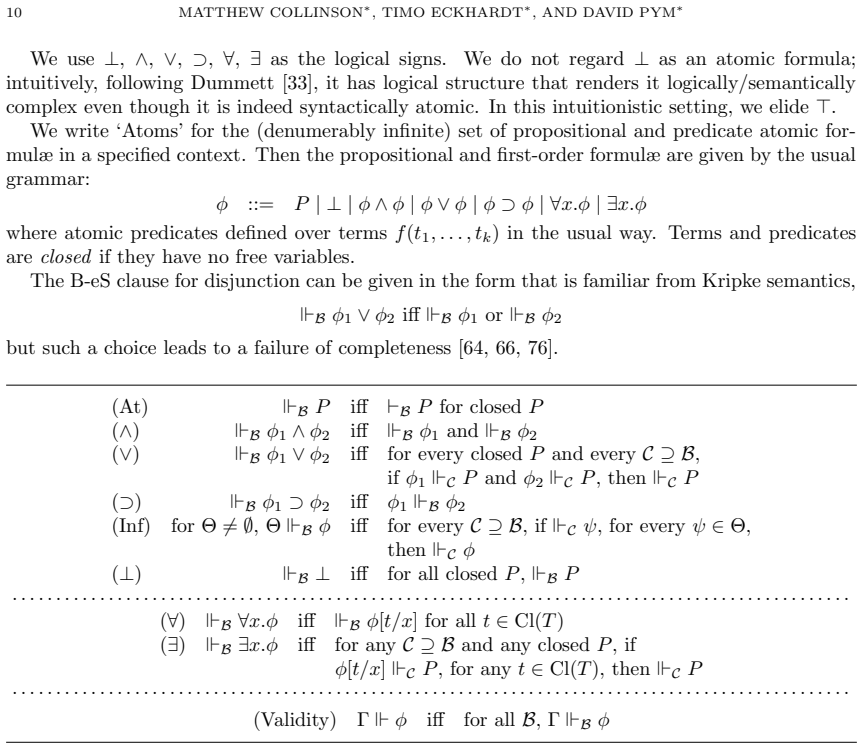

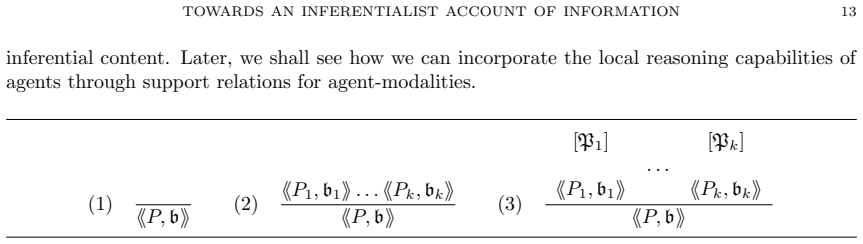
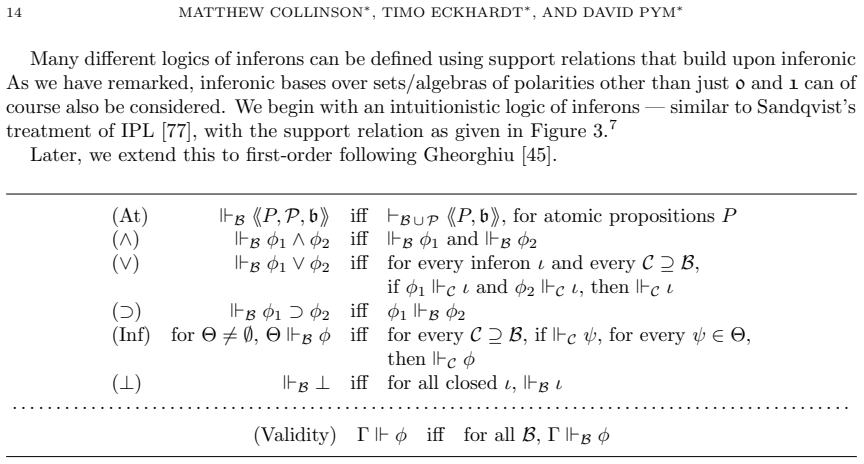

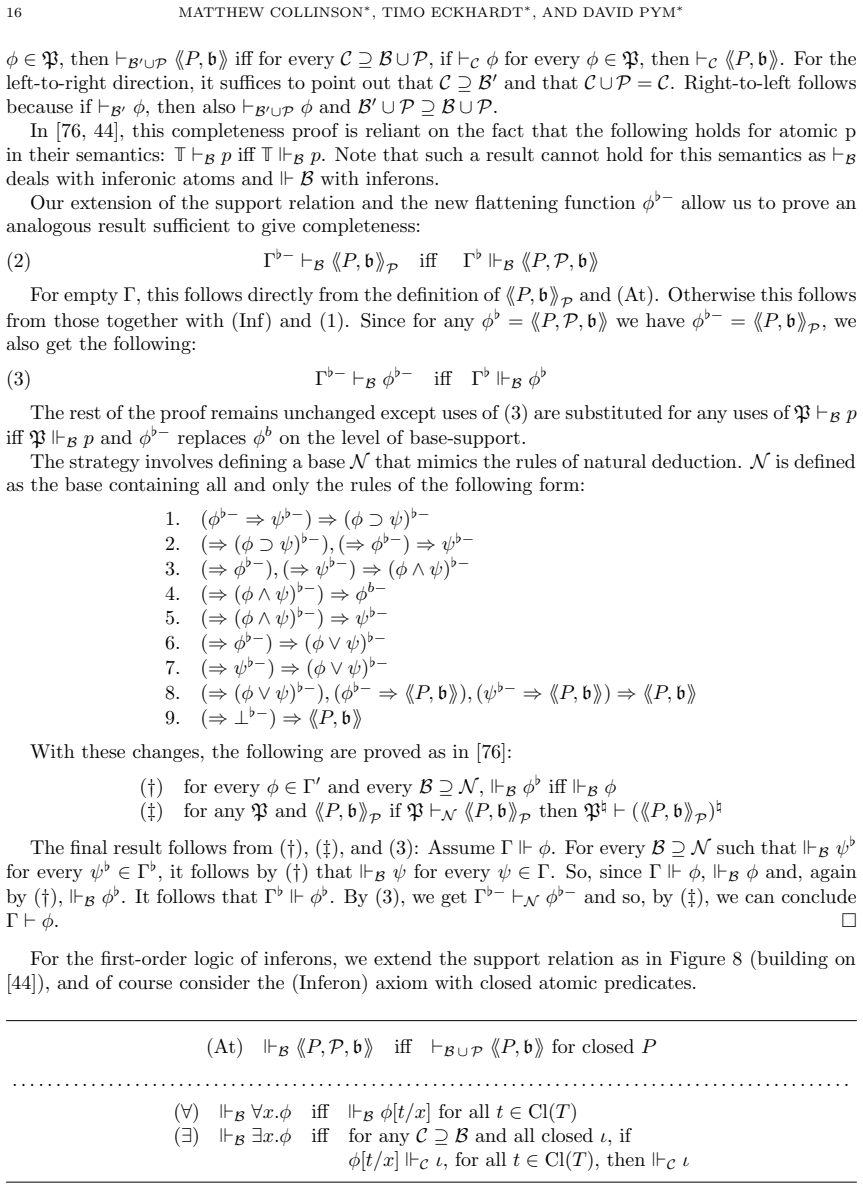


read the original abstract
Information is one of the most widely-discussed concepts of the current era. However, a great deal of insightful work notwithstanding, it is yet to be given wholly convincing logical or mathematical foundations. Without them, we lack adequate reasoning tools for understanding the complex ecosystems of systems upon which the society depends. We seek to rectify this by taking a first step towards developing an inferentialist semantic theory of information. There are three key interacting components. First, conceptual analysis: the metaphysics of information. Dretske expressed the key concepts of information in terms of intentionality, truth, and transmissibility. We replace truth with inferability, and trace the consequences of this replacement. Second, logic: proof-theoretic semantics (P-tS) provides a mathematical-logical realization of inferentialist reasoning. Using P-tS, we develop the first steps towards a mathematical-logical theory of an inferentialist primitive unit of information, the 'inferon'. This proof-theoretic approach counterpoints the model-theoretic view of information articulated in situation theory. Furthermore, we argue that it facilitates addressing all three components of van Benthem and Martinez's categorization of the understandings of information, as range, as correlation, and as code. Our focus is on information-as-correlation. Third, systems: the P-tS tools we develop provide the basis for a mathematical account of distributed systems modelling -- a key tool from informatics for understanding the organization of information processing systems. This yields a reasoning-based theory of information flow in models of distributed systems. Overall, we seek to give a conceptually rigorous mathematical-logical account of information and its role within informatics, grounded in inference and reasoning.
Editorial analysis
A structured set of objections, weighed in public.
Referee Report
Summary. The paper proposes taking first steps toward an inferentialist account of information by replacing truth with inferability in Dretske's framework of intentionality, truth, and transmissibility. It invokes proof-theoretic semantics (P-tS) to introduce the 'inferon' as a primitive unit of information, contrasts this with situation theory, and claims this approach addresses van Benthem and Martinez's three understandings of information (range, correlation, code) with focus on correlation. The work further aims to supply P-tS-based tools for modeling information flow in distributed systems.
Significance. If the announced replacement of truth by inferability were carried out with explicit P-tS constructions and shown to yield coherent notions of transmissibility and intentionality while preserving key properties from Dretske-style information theory, the resulting inferentialist primitive could complement model-theoretic approaches and provide a reasoning-based foundation for information in informatics. The programmatic outline correctly identifies a potential gap in logical foundations for information ecosystems, but the absence of any realized formal objects limits immediate impact.
major comments (2)
- [Abstract] Abstract: The central claim that 'Using P-tS, we develop the first steps towards a mathematical-logical theory of an inferentialist primitive unit of information, the inferon' is unsupported. No explicit definition of the inferon (e.g., as a canonical proof object, a set of introduction/elimination rules, or a derived notion in a P-tS framework), no concrete replacement of truth by inferability in any Dretske-style concept, and no demonstration that the resulting notion preserves or reinterprets transmissibility or intentionality appear anywhere in the manuscript.
- [The manuscript as a whole] The manuscript as a whole: The announced application to distributed systems modeling and to information-as-correlation is presented only at the level of a high-level program. No specific P-tS rules, sequent calculi, or proof-theoretic derivations are supplied that would realize information flow or correlation in a distributed-systems setting, leaving the claim that the tools 'provide the basis for a mathematical account' without technical content.
Simulated Author's Rebuttal
We thank the referee for their careful and constructive report. The comments correctly identify the exploratory character of the work, and we have revised the manuscript to add greater explicitness and illustrative technical content while preserving its framing as first steps toward an inferentialist account.
read point-by-point responses
-
Referee: [Abstract] Abstract: The central claim that 'Using P-tS, we develop the first steps towards a mathematical-logical theory of an inferentialist primitive unit of information, the inferon' is unsupported. No explicit definition of the inferon (e.g., as a canonical proof object, a set of introduction/elimination rules, or a derived notion in a P-tS framework), no concrete replacement of truth by inferability in any Dretske-style concept, and no demonstration that the resulting notion preserves or reinterprets transmissibility or intentionality appear anywhere in the manuscript.
Authors: The paper is deliberately positioned as taking first steps, introducing the inferon conceptually as the primitive unit grounded in inferability rather than truth, realized via the inferentialist resources of proof-theoretic semantics. We trace the replacement of truth by inferability through Dretske's triad and argue that intentionality and transmissibility can be reinterpreted in terms of inferential relations and preservation of inferability across channels. We acknowledge that a fully axiomatized definition with specific introduction/elimination rules is not supplied, as that would exceed the scope of an initial outline. In the revised manuscript we have added a dedicated subsection that characterizes the inferon more precisely as a canonical proof object in a natural-deduction setting and sketches the reinterpretation of transmissibility as preservation of inferability. revision: yes
-
Referee: [The manuscript as a whole] The manuscript as a whole: The announced application to distributed systems modeling and to information-as-correlation is presented only at the level of a high-level program. No specific P-tS rules, sequent calculi, or proof-theoretic derivations are supplied that would realize information flow or correlation in a distributed-systems setting, leaving the claim that the tools 'provide the basis for a mathematical account' without technical content.
Authors: The referee is right that the distributed-systems application remains programmatic; the manuscript's primary contribution is the conceptual and logical groundwork for treating information-as-correlation within a proof-theoretic framework, in contrast to situation theory. No claim is made to a complete implementation. To meet the concern we have inserted a short illustrative example in the revised version, consisting of a simple sequent-calculus derivation that shows how inferons can encode correlation-based information flow between agents in a minimal distributed scenario. This supplies concrete technical content without altering the paper's foundational orientation. revision: partial
Circularity Check
No circularity: conceptual proposal with no load-bearing derivation that reduces to inputs
full rationale
The manuscript presents a high-level program: conceptual replacement of truth by inferability in Dretske-style information notions, followed by the introduction of an 'inferon' as a primitive via proof-theoretic semantics, with the goal of addressing information-as-correlation in distributed systems. No equations, formal definitions, or derived predictions appear in the supplied text that would allow a claimed result to be shown equivalent to the framing by construction. The steps remain programmatic statements rather than a closed mathematical chain. Self-citation (if present) is not invoked to justify a uniqueness theorem or to force the central object. The work is therefore self-contained as an outline of future formalization rather than circular.
Axiom & Free-Parameter Ledger
axioms (2)
- domain assumption Inferentialist semantics can replace truth with inferability while preserving key information concepts
- domain assumption Proof-theoretic semantics realizes inferentialist reasoning mathematically
invented entities (1)
-
inferon
no independent evidence
Lean theorems connected to this paper
-
IndisputableMonolith/Foundation/AbsoluteFloorClosure.leanreality_from_one_distinction unclearWe replace truth with inferability... develop the first steps towards a mathematical-logical theory of an inferentialist primitive unit of information, the 'inferon'
-
IndisputableMonolith/Cost/FunctionalEquation.leanwashburn_uniqueness_aczel unclearbase of atomic rules... inferonic base B... support relation ⊩B
Reference graph
Works this paper leans on
-
[1]
,The Situation in Logic, CSLI Publications, 1988. [10]J. Barwise and J. Etchemendy,Information, infons, and inference, in Situation Theory and Its Applications; Volume 1, Center for the Study of Language (CSLI), 1990, pp. 33–78. [11]J. Barwise, D. Gabbay, and C. Hartonas,On the logic of information flow, Logic Journal of IGPL, 3 (1995), pp. 7–49
work page 1988
-
[2]
,Information flow and the lambek calculus, CSLI Lecture Notes, 58 (1996). [13]J. Barwise and J. Perry,Situations and Attitudes, The Journal of Philosophy, 78 (1981), pp. 668–691
work page 1996
-
[3]
,Situations and Attitudes, MIT Press, Cambridge, MA, 1983. [15]J. Barwise and J. Seligman,Information Flow: The Logic of Distributed Systems, Cambridge University Press, 1997. [16]K. Bimb ´o,Introduction: From Information at Large to Semantics of Logics, in J. Michael Dunn on Information Based Logics, K. Bimb´ o, ed., Springer International Publishing, 20...
work page 1983
-
[4]
Michael Dunn on Information Based Logics, Springer, 2016
, ed.,J. Michael Dunn on Information Based Logics, Springer, 2016. [18]R. Brandom,Making It Explicit: Reasoning, Representing, and Discursive Commitment, Harvard University Press, 1994
work page 2016
-
[5]
,Articulating Reasons: An Introduction to Inferentialism, Harvard University Press, 2000. [20]O. Bueno,Computer Simulations: An Inferential Conception, The Monist, 97 (2014), pp. 378–398. [21]Y. Buzoku and D. J. Pym,Base-extension semantics for intuitionistic modal logics (extended abstract), in Automated Reasoning with Analytic Tableaux and Related Metho...
work page 2000
-
[6]
,The Problem of Relations in Inductive Logic, Philosophical Studies, 2 (1951), pp. 75–80. [25]T. Caulfield, M.-C. Ilau, and D. Pym,Engineering ecosystem models: Semantics and pragmatics, in Sim- ulation Tools and Techniques, D. Jiang and H. Song, eds., Cham, 2022, Springer International Publishing, pp. 236–258. [26]G. Chaitin,Algorithmic Information Theor...
work page 1951
-
[7]
,Situation theory and situation semantics, in Logic and the Modalities in the Twentieth Century, D. M. Gabbay and J. Woods (editors), Handbook of the History of Logic, Volume 7, North-Holland, 2006, pp. 601–664. [30]F. Dretske,The Metaphysics of Information, in Wittgenstein and the Philosophy of Information, Alois Pichler and Herbert Hrachovec, ed., De Gr...
work page 2006
-
[8]
,The Logical Basis of Metaphysics, Harvard University Press, 1991. [34]J. Dunn,The Concept of Information and the Development of Modern Logic, Zwischen traditioneller und moderner Logik: Nichtklassische Ans¨ atze, (2001), pp. 423––447. [35]T. Eckhardt and D. Pym,Base-extension semantics for modal logic, Logic Journal of the IGPL, 33 (2024), p. jzae004
work page 1991
-
[9]
Arxiv, math.LO, eprint=2411.15775,https://arxiv.org/abs/2411.15775
,Inferentialist Public Announcement Logic: Base-extension Semantics, 2024. Arxiv, math.LO, eprint=2411.15775,https://arxiv.org/abs/2411.15775
-
[10]
,Base-extension Semantics for S5 Modal Logic, Logic Journal of the IGPL, (2025). [38]L. Floridi,Is semantic information meaningful data?, Philosophy and phenomenological research, 70 (2005), pp. 351–370
work page 2025
-
[11]
,The Logic of Being Informed, Logique et Analyse, 49 (2006), pp. 433–460
work page 2006
-
[12]
,The Philosophy of Information, Oxford University Press, 2011
work page 2011
-
[13]
,The Logic of Information, Oxford University Press, 2019. [42]N. Fresco and M. Michael,Information and Veridicality: Information Processing and the Bar-Hillel/Carnap Paradox, Philosophy of Science, 83 (2016), pp. 131–151. [43]G. Gentzen,Untersuchungen ¨ uber das logische Schliessen, Mathematische Zeitschrift, 39 (2034), pp. 176–210. [44]A. Gheorghiu,Proof...
work page 2019
-
[14]
,Classical Logic without Bivalance, 2026. [46]A. Gheorghiu and Y. Buzoku,Proof-theoretic semantics for classical propositional logic with assertion and denial, 2025.https://arxiv.org/abs/2503.05364. [47]A. Gheorghiu, T. Gu, and D. Pym,Inferentialist Resource Semantics, ENTICS 14727, 4 (Proceedings of MFPS XL) (2024).https://doi.org/10.46298/entics.14727. ...
-
[15]
,Semantical Analysis of the Logic of Bunched Implications, Studia Logica, 111 (2023), pp. 525–571
work page 2023
-
[16]
,From Proof-theoretic Validity to Base-extension Semantics for Intuitionistic Propositional Logic, Studia Logica, (2025).https://doi.org/10.1007/s11225-024-10163-9
-
[17]
,Proof-theoretic Semantics for Second-order Logic.https://arxiv.org/abs/2508.07786, 2025. [52]J.-Y. Girard, Y. Lafont, and P. Taylor,Proofs and Types, Cambridge University Press, 1989. [53]T. Gu, A. Gheorghiu, and D. Pym,Proof-theoretic Semantics for the Logic of Bunched Implications, Studia Logica, (2025). doi.org/10.1007/s11225-025-10202-z. [54]J. Hinti...
-
[18]
,Incompleteness of Intuitionistic Propositional Logic with Respect to Proof-theoretic Semantics, Studia Logica, 107 (2019), pp. 233–246. [67]D. Prawitz,Ideas and Results in Proof Theory, in Studies in Logic and the Foundations of Mathematics, vol. 63, Elsevier, 1971, pp. 235–307
work page 2019
-
[19]
,Towards a Foundation of General Proof Theory, in Studies in Logic and the Foundations of Mathemat- ics, D. Prawitz, ed., vol. 74, North Holland, Amsterdam, 1973, pp. 225–250
work page 1973
-
[20]
,Natural Deduction: A Proof-theoretical Study, Dover, 2005. Originally published as: Dag Prawitz, Natural Deduction: A Proof-theoretical Study, Almqvist & Wiksell, 1965
work page 2005
-
[21]
,Meaning Approached Via Proofs, Synthese, 148 (2006), pp. 507–524. [71]D. Pym, E. Ritter, and E. Robinson,Categorical proof-theoretic semantics, Studia Logica, (2024).https: //doi.org/10.1007/s11225-024-10101-9. [72]S. Read,Semantic Pollution and Syntactic Purity, The Review of Symbolic Logic, 8(4) (2015), pp. 1–13. [73]G. Restall,Information Flow and Rel...
-
[22]
,Base-extension semantics for intuitionistic sentential logic, Logic Journal of the IGPL, 23 (2015), pp. 719–731
work page 2015
-
[23]
World Logic Day — University College London (Accessed June 2023)
,Atomic bases and the validity of Peirce’s law.https://sites.google.com/view/wdl-ucl2022/ schedule#h.ttn75i73elfw, 2022. World Logic Day — University College London (Accessed June 2023). [78]P. Schroeder-Heister,Validity Concepts in Proof-theoretic Semantics, Synthese, 148 (2006), pp. 525–571
work page 2022
-
[24]
,Proof-Theoretic versus Model-Theoretic Consequence, in The Logica Yearbook 2007, M. Pelis, ed., Filosofia, 2008
work page 2007
-
[25]
,Proof-Theoretic Semantics, in The Stanford Encyclopedia of Philosophy, E. N. Zalta, ed., Metaphysics Research Lab, Stanford University, Spring 2018 ed., 2018. [81]J. Seligman,Situation Theory Reconsidered, Springer International Publishing, Cham, 2014, pp. 895–932. [82]C. E. Shannon,A Mathematical Theory of Communication, University of Illinois Press, 19...
work page 2018
-
[26]
,Logical Dynamics of Information and Interaction, Cambridge University Press, 2011
work page 2011
-
[27]
Michael Dunn on Information Based Logic, K
,Tracking Information, in J. Michael Dunn on Information Based Logic, K. Bimb´ o, ed., Springer Inter- national Publishing, Cham, 2016, pp. 363–389
work page 2016
-
[28]
,Logic, Information, and Agency, CSLI Publications, The University of Chicago Press, 2025. [89]J. van Benthem and M. Martinez,The Stories of Logic and Information, Handbook of the Philosophy of Information, Elsevier Science Publishers, Amsterdam, (2008), pp. 217–280. Commentators: Israel, David and Perry, John. [90]H. van Ditmarsch, W. van der Hoek, and B...
work page 2025
discussion (0)
Sign in with ORCID, Apple, or X to comment. Anyone can read and Pith papers without signing in.