Recognition: unknown
The Impact of Radiation Environment on the Evolution and Fragmentation of Protostellar Discs
Pith reviewed 2026-05-08 16:01 UTC · model grok-4.3
The pith
Stronger radiation fields produce more massive, hotter protostellar discs that fragment into larger bodies capable of disrupting their parent disc.
A machine-rendered reading of the paper's core claim, the machinery that carries it, and where it could break.
Core claim
Discs exposed to stronger radiation fields tend to be more massive, hotter and denser, with their host stars growing more massive through faster accretion. All discs exhibit recurrent instability, yet stability metrics such as the Toomre Q parameter, alpha viscosity and beta cooling time do not reliably predict fragmentation. Fragments formed in solar-like environments are typically planetary-mass and migrate inward, whereas fragments in high-radiation environments exceed 0.1 solar masses and can fully disrupt or accrete the progenitor disc. The overall conclusion is that the evolution and properties of circumstellar discs depend on both their radiation and physical environment.
What carries the argument
Zoom-in hydrodynamical simulations that resolve au-scale disc structures while retaining the parsec-scale molecular-cloud context, run with interstellar radiation fields and cosmic-ray ionisation rates scaled from solar-neighbourhood values up to 1000 times stronger.
If this is right
- Discs in stronger radiation environments accrete onto their stars more rapidly, producing more massive central objects within 100 kyr.
- Fragmentation outcomes shift from planetary-mass bodies that may survive as planets to stellar-mass bodies that destroy the disc.
- Standard analytic stability criteria do not forecast when a disc will fragment, even when evaluated only a few hundred years before breakup.
- Recurrent instability occurs in every radiation regime, implying episodic accretion even when no fragments form.
Where Pith is reading between the lines
- The results suggest that planet-formation efficiency could vary systematically between isolated low-mass star-forming regions and those near OB associations.
- Models of galactic star formation may need to track local radiation intensity when predicting disc lifetimes and multiplicity.
- The failure of Toomre Q and cooling-time metrics to predict fragmentation points to a need for time-dependent or three-dimensional stability diagnostics in future work.
Load-bearing premise
The imposed radiation fields and cosmic-ray rates accurately represent realistic high-radiation environments, and the zoom-in method correctly captures au-scale disc physics without distorting the larger cloud structure.
What would settle it
Systematic measurements showing that discs observed near massive stars or in high-radiation regions are not on average more massive or hotter than discs in low-radiation regions would falsify the environmental dependence.
Figures





read the original abstract
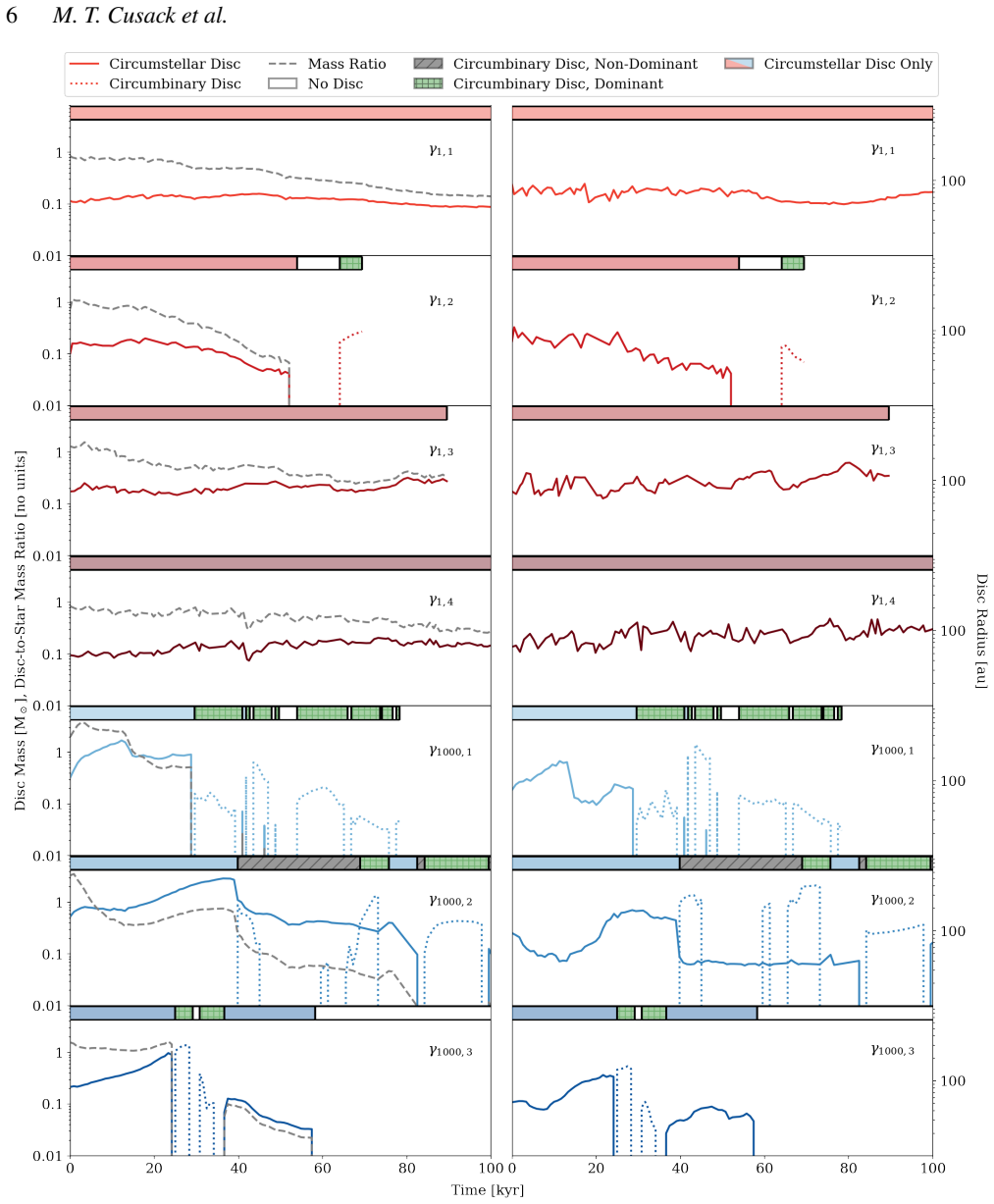
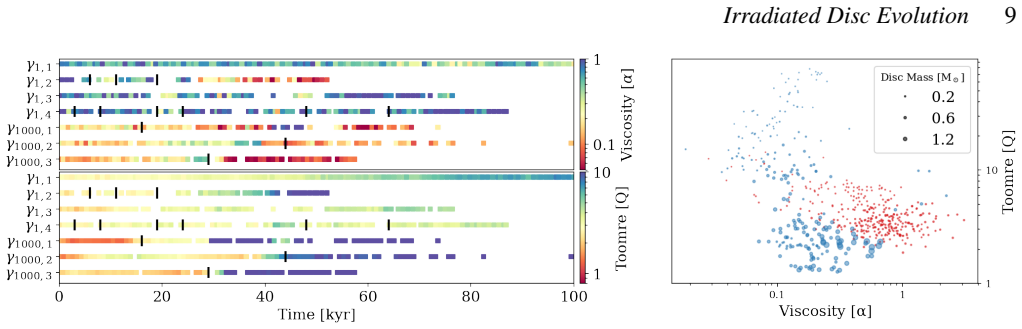
We present high-resolution zoom-in simulations of molecular clouds exposed to an interstellar radiation field and cosmic ray ionisation rate up to 1000 times stronger than that of the solar neighbourhood. We detail the evolution of the accretion discs that form around the first protostar in each simulation, for a total of 7 discs, for up to 100 kyr. The use of a zoom-in procedure allows for the au-scale discs to be well resolved (with resolution < 0.25 au) whilst retaining the structure of the wider parsec-scale molecular cloud. We find that discs exposed to a stronger radiation field tend to be more massive, hotter and denser. Similarly, their host stars grow to become more massive as a result of accreting more rapidly from their surroundings. All the discs show evidence of recurrent instability during the simulations, but only some of them fragment. We investigate whether stability metrics, such as the Toomre $Q$, $\alpha$ viscosity, and $\beta$ cooling parameter, can predict fragmentation by calculating them just before the discs fragment. We find that the metrics are generally unable to do so, as the discs appear stable even up to a few hundred years before fragmenting. In solar-like environments fragments are typically of planetary mass and often migrate to the centre of the disc, whereas fragments in a high-radiation environment are massive ($\rm > 0.1 \, M_\odot$) and fully disrupt/accrete from the progenitor disc. We conclude that the evolution and properties of circumstellar discs depend on both their radiation and physical environment.
Editorial analysis
A structured set of objections, weighed in public.
Referee Report
Summary. The manuscript reports results from high-resolution zoom-in hydrodynamical simulations of molecular clouds subjected to interstellar radiation fields and cosmic ray ionization rates up to 1000 times the solar neighborhood value. Across seven protostellar discs evolved for up to 100 kyr, it finds that stronger radiation environments produce more massive, hotter, and denser discs, leading to faster stellar mass growth. All discs exhibit recurrent gravitational instability, yet fragmentation occurs only in some cases. Standard stability criteria (Toomre Q parameter, α viscosity, and β cooling) fail to predict fragmentation when evaluated shortly before the event. Fragment masses and fates differ markedly: planetary-mass fragments that often migrate inward in solar-like conditions versus massive (>0.1 M⊙) fragments that disrupt the disc in high-radiation cases. The authors conclude that circumstellar disc evolution and fragmentation depend on both radiation and physical environment.
Significance. If substantiated, these findings would demonstrate that environmental radiation plays a key role in determining protostellar disc properties and outcomes, with direct relevance to star and planet formation in high-radiation regions such as the Galactic center or massive star-forming complexes. The zoom-in approach, resolving au-scale discs within parsec-scale clouds, is a methodological strength that allows self-consistent treatment of large-scale context. However, the limited sample size raises questions about the robustness of the reported trends.
major comments (3)
- [Abstract (simulation sample and results)] The study is based on a total of only seven discs, with no indication of multiple realizations per radiation environment or cosmic-ray rate. Given that fragmentation occurs in only a subset and that outcomes are attributed to the imposed radiation field, this small sample makes it difficult to rule out stochastic variations from turbulent seeds or zoom-in choices as the source of the observed differences in disc mass, temperature, density, and fragment properties. This is load-bearing for the central claim that disc evolution systematically depends on the radiation environment.
- [Abstract (resolution and stability metrics)] The abstract states that discs are resolved to <0.25 au but provides no resolution tests, convergence checks, or quantitative assessment of how fragmentation outcomes or stability metrics change with resolution. Without these, the reported failure of Toomre Q, α, and β to predict fragmentation (even a few hundred years prior) cannot be confidently separated from possible numerical artifacts.
- [Abstract (zoom-in procedure)] The zoom-in procedure is presented as preserving parsec-scale context while resolving au-scale discs, yet no tests are described for consistency of the imposed radiation fields and cosmic-ray rates across scales or for sensitivity of disc evolution to the zoom-in implementation. This assumption is load-bearing for attributing differences to the radiation environment rather than numerical setup.
minor comments (2)
- [Abstract] The notation 'rm > 0.1 M_⊙' in the abstract appears to be a LaTeX artifact and should be rendered as >0.1 M_⊙.
- [Abstract] Clarify in the abstract or methods how many discs were simulated per radiation environment to allow readers to assess sample balance.
Simulated Author's Rebuttal
We thank the referee for their constructive and detailed report. We address each major comment point by point below. We have revised the manuscript to incorporate additional discussion of limitations and clarifications where feasible, while maintaining the integrity of the presented results.
read point-by-point responses
-
Referee: [Abstract (simulation sample and results)] The study is based on a total of only seven discs, with no indication of multiple realizations per radiation environment or cosmic-ray rate. Given that fragmentation occurs in only a subset and that outcomes are attributed to the imposed radiation field, this small sample makes it difficult to rule out stochastic variations from turbulent seeds or zoom-in choices as the source of the observed differences in disc mass, temperature, density, and fragment properties. This is load-bearing for the central claim that disc evolution systematically depends on the radiation environment.
Authors: We agree that a sample of seven discs without multiple realizations per radiation environment constitutes a genuine limitation, particularly given the role of turbulence and the subset of cases that fragment. These high-resolution zoom-in simulations are computationally intensive, precluding large ensembles at present. However, the simulations systematically vary the radiation field and cosmic-ray ionization rate over three orders of magnitude, and the reported trends in disc mass, temperature, density, stellar accretion rate, and fragment properties follow physically expected directions (stronger radiation yielding hotter, more massive discs and larger fragments). We have added an explicit paragraph in the revised discussion section acknowledging the sample-size limitation, the possibility of stochastic contributions, and the desirability of future larger statistical samples to strengthen the attribution to environment. revision: yes
-
Referee: [Abstract (resolution and stability metrics)] The abstract states that discs are resolved to <0.25 au but provides no resolution tests, convergence checks, or quantitative assessment of how fragmentation outcomes or stability metrics change with resolution. Without these, the reported failure of Toomre Q, α, and β to predict fragmentation (even a few hundred years prior) cannot be confidently separated from possible numerical artifacts.
Authors: We acknowledge that the original manuscript lacked dedicated resolution tests and convergence checks. This is a valid concern for interpreting the apparent failure of standard stability metrics. In the revised manuscript we have added a methods subsection that quantifies the adopted resolution (Jeans-length criterion, particle number per fragment, and softening lengths) and includes a limited sensitivity analysis performed by re-evaluating the Toomre Q, α, and β parameters at degraded resolution for the fragmenting cases. While full re-simulations at higher resolution for all seven discs remain beyond available resources, the fragmentation events occur at scales substantially larger than the minimum cell size, and the metrics remain sub-critical even under these checks. We have also moderated the language in the abstract and conclusions to reflect the absence of exhaustive convergence tests. revision: partial
-
Referee: [Abstract (zoom-in procedure)] The zoom-in procedure is presented as preserving parsec-scale context while resolving au-scale discs, yet no tests are described for consistency of the imposed radiation fields and cosmic-ray rates across scales or for sensitivity of disc evolution to the zoom-in implementation. This assumption is load-bearing for attributing differences to the radiation environment rather than numerical setup.
Authors: We agree that explicit tests of radiation-field consistency across scales and of zoom-in sensitivity were not provided. The radiation field and cosmic-ray ionization rate are imposed as uniform background values that do not depend on local density or resolution, so they remain consistent by construction; however, we did not demonstrate this numerically. In the revised methods section we have added a description of the zoom-in implementation, including the timing and spatial criteria used, and a brief sensitivity test in which one simulation was repeated with a delayed zoom-in start. The disc evolution and fragmentation outcome remained qualitatively unchanged. We have also inserted a short paragraph discussing possible numerical sensitivities of the zoom-in approach while noting that the large-scale cloud structure is preserved by design. revision: yes
Circularity Check
No circularity: results from direct numerical simulations
full rationale
The paper reports outcomes from high-resolution zoom-in hydrodynamical simulations of molecular clouds under varying radiation and cosmic-ray environments. All claims (disc mass, temperature, density, stellar growth rates, fragmentation behavior, and stability metric performance) are extracted directly from the evolved simulation snapshots rather than from any closed-form derivation, parameter fit, or self-referential equation. Standard diagnostic quantities (Toomre Q, α viscosity, β cooling) are computed post hoc and shown to be non-predictive; this is an empirical observation, not a definitional tautology. No load-bearing self-citation chain or ansatz smuggling is required for the central conclusion that disc properties depend on the imposed radiation environment. The limited sample size raises robustness concerns but does not constitute circularity.
Axiom & Free-Parameter Ledger
Reference graph
Works this paper leans on
-
[1]
Variation of the low-mass end of the stellar initial mass function with redshift and metallicity , volume =. MNRAS , author =. 2025 , pages =. doi:10.1093/mnras/staf059 , abstract =
-
[2]
Alves, F. O. and Girart, J. M. and Caselli, P. and Franco, G. a. P. and Zhao, B. and Vlemmings, W. H. T. and Evans, M. G. and Ricci, L. , month = jul, year =. Molecular outflow launched beyond the disk edge , volume =. Astronomy & Astrophysics, Volume 603, id.L3,. doi:10.1051/0004-6361/201731077 , abstract =
-
[3]
Protostars and. Protostars and Planets VII , author =. 2023 , pages =. doi:10.48550/arXiv.2203.10068 , abstract =
-
[4]
Direct. ApJ , author =. 1996 , pages =. doi:10.1086/117934 , abstract =
-
[5]
Padoan, Paolo and Pan, Liubin and Juvela, Mika and Haugbølle, Troels and Nordlund, Ake , month = sep, year =. The. The Astrophysical Journal , publisher =. doi:10.3847/1538-4357/abaa47 , abstract =
-
[6]
The Astrophysical Journal, Volume 665, Issue 2, pp
Three-. The Astrophysical Journal, Volume 665, Issue 2, pp. 1254-1267. , author =. 2007 , keywords =. doi:10.1086/519767 , abstract =
-
[7]
Origin and evolution of angular momentum of class. A&A , author =. 2025 , keywords =. doi:10.1051/0004-6361/202450682 , abstract =
-
[8]
Kuffmeier, Michael and Haugbølle, Troels and Nordlund, Ake , month = sep, year =. Zoom-in. ApJ , publisher =. doi:10.3847/1538-4357/aa7c64 , abstract =
-
[9]
Massive star cluster formation:. A&A , author =. 2024 , pages =. doi:10.1051/0004-6361/202348840 , abstract =
-
[10]
Angular. A&ARv , author =. 1995 , pages =. doi:10.1146/annurev.aa.33.090195.001215 , abstract =
-
[11]
A&A , author =. 2022 , note =. doi:10.1051/0004-6361/202243310 , abstract =
-
[12]
A&A , author =. 2023 , note =. doi:10.1051/0004-6361/202244183 , abstract =
-
[13]
Protostellar angular momentum evolution during gravoturbulent fragmentation , volume =. A&A , author =. 2004 , pages =. doi:10.1051/0004-6361:20040220 , abstract =
-
[14]
Flow of gas detected from beyond the filaments to protostellar scales in. A&A , author =. 2023 , note =. doi:10.1051/0004-6361/202346357 , abstract =
-
[15]
Numerical simulations of protostellar encounters -. MNRAS , author =. 1998 , pages =. doi:10.1046/j.1365-8711.1998.01987.x , abstract =
-
[16]
Numerical simulations of protostellar encounters -. MNRAS , author =. 1998 , pages =. doi:10.1046/j.1365-8711.1998.01988.x , abstract =
-
[17]
MNRAS , author =. 2023 , pages =. doi:10.1093/mnras/stad3054 , abstract =
-
[18]
Influence of protostellar outflows on star and protoplanetary disk formation in a massive star-forming clump , volume =. A&A , author =. 2024 , pages =. doi:10.1051/0004-6361/202347913 , abstract =
-
[19]
Synthetic populations of protoplanetary disks:. A&A , author =. 2024 , pages =. doi:10.1051/0004-6361/202346558 , abstract =
-
[20]
arXiv e-prints , author =
Disc fragmentation. arXiv e-prints , author =. 2025 , keywords =
2025
-
[21]
arXiv e-prints , author =
Feedback and. arXiv e-prints , author =. 2025 , keywords =
2025
-
[22]
Astronomy and Astrophysics, v.407, p.941-955 (2003) , author =
Monte. Astronomy and Astrophysics, v.407, p.941-955 (2003) , author =. 2003 , keywords =. doi:10.1051/0004-6361:20030918 , abstract =
-
[23]
Durisen, R. H. and Boss, A. P. and Mayer, L. and Nelson, A. F. and Quinn, T. and Rice, W. K. M. , month = jan, year =. Protostars and
-
[24]
Bate, Matthew R. , month = jan, year =. Stellar, brown dwarf and multiple star properties from hydrodynamical simulations of star cluster formation , volume =. MNRAS , publisher =. doi:10.1111/j.1365-2966.2008.14106.x , abstract =
-
[25]
Short-lived gravitational instability in isolated irradiated discs , volume =. MNRAS , author =. 2024 , keywords =. doi:10.1093/mnras/stae2167 , abstract =
-
[26]
Formation, orbital and thermal evolution, and survival of planetary-mass clumps in the early phase of circumstellar disc evolution , volume =. MNRAS , author =. 2013 , keywords =. doi:10.1093/mnras/stt1684 , abstract =
-
[27]
2011, MNRAS, 418, 467, doi: 10.1111/j.1365-2966.2011.19497.x
Classification of the circumstellar disc evolution during the main accretion phase , volume =. MNRAS , author =. 2011 , keywords =. doi:10.1111/j.1365-2966.2011.19081.x , abstract =
-
[28]
Formation and early evolution of circumstellar discs in turbulent molecular cloud cores , volume =. MNRAS , author =. 2013 , keywords =. doi:10.1093/mnras/sts111 , abstract =
-
[29]
A quantification of the non-spherical geometry and accretion of collapsing cores , volume =. MNRAS , author =. 2011 , keywords =. doi:10.1111/j.1365-2966.2010.17775.x , abstract =
-
[30]
A class of self-gravitating accretion disks , volume =. A&A , author =. 1999 , keywords =. doi:10.48550/arXiv.astro-ph/9908095 , abstract =
work page internal anchor Pith review doi:10.48550/arxiv.astro-ph/9908095 1999
-
[31]
Sink particle radiative feedback in smoothed particle hydrodynamics models of star formation , volume =. MNRAS , author =. 2018 , keywords =. doi:10.1093/mnras/sty1969 , abstract =
-
[32]
Computational advances and challenges in simulations of turbulence and star formation
Computational advances and challenges in simulations of turbulence and star formation , url =. arXiv e-prints , author =. 2025 , keywords =. doi:10.48550/arXiv.2510.12203 , abstract =
work page internal anchor Pith review Pith/arXiv arXiv doi:10.48550/arxiv.2510.12203 2025
-
[33]
The relationship between the prestellar core mass function and the stellar initial mass function , volume =. A&A , author =. 2008 , keywords =. doi:10.1051/0004-6361:20078452 , abstract =
-
[34]
Protostars and Planets V , author =
The. Protostars and Planets V , author =. 2007 , keywords =. doi:10.48550/arXiv.astro-ph/0603233 , abstract =
-
[35]
Limits on the primordial stellar multiplicity , volume =. A&A , author =. 2005 , keywords =. doi:10.1051/0004-6361:20052654 , abstract =
-
[36]
The. ApJ , author =. 2025 , keywords =. doi:10.48550/arXiv.2506.10719 , abstract =
-
[37]
ApJ , author =
The. ApJ , author =. 2025 , keywords =
2025
-
[38]
Protoplanetary. ARA&A , author =. 2011 , pages =. doi:10.1146/annurev-astro-081710-102548 , abstract =
-
[39]
The applicability of the viscous α-parameterization of gravitational instability in circumstellar disks , volume =. New Astron. , author =. 2010 , keywords =. doi:10.1016/j.newast.2009.05.007 , abstract =
-
[40]
N., Inutsuka, S.-i., & Matsumoto, T
Machida, Masahiro N. and Inutsuka, Shu-Ichiro and Matsumoto, Tomoaki , month = jun, year =. Effect of. PASJ , publisher =. doi:10.1093/pasj/63.3.555 , abstract =
-
[41]
The. ApJ , author =. 2011 , keywords =. doi:10.1088/0004-637X/736/1/53 , abstract =
-
[42]
Triggered fragmentation in self-gravitating discs: forming fragments at small radii , volume =. MNRAS , author =. 2015 , keywords =. doi:10.1093/mnras/stv2128 , abstract =
-
[43]
Protostellar disks in their natural habitat -- the formation of protostars and their accretion disks in the turbulent and magnetized interstellar medium , url =. MNRAS , author =. 2025 , keywords =. doi:10.48550/arXiv.2506.14394 , abstract =
-
[44]
doi:10.1088/0004-637X/691/1/823 , eprint =
Evolution of. ApJ , author =. 2009 , keywords =. doi:10.1088/0004-637X/691/1/823 , abstract =
-
[45]
On the protostellar mass–luminosity relation , volume =. MNRAS , author =. 2025 , pages =. doi:10.1093/mnras/staf1220 , abstract =
-
[46]
MNRAS , author =
The observable impact of runaway. MNRAS , author =. 2025 , keywords =
2025
-
[47]
The. ApJ , author =. 2008 , keywords =. doi:10.1088/0004-6256/136/5/2136 , abstract =
-
[48]
arXiv e-prints , author =
Turn up the light:. arXiv e-prints , author =. 2025 , keywords =
2025
-
[49]
Prestellar. arXiv e-prints , author =. 2025 , keywords =. doi:10.48550/arXiv.2509.07083 , abstract =
-
[50]
2025, Nature Astronomy [arXiv:2509.06787]
Detection of a septuple stellar system in formation via disk fragmentation , url =. arXiv e-prints , author =. 2025 , keywords =. doi:10.48550/arXiv.2509.06787 , abstract =
-
[51]
arXiv e-prints , author =. 2025 , keywords =. doi:10.48550/arXiv.2509.06749 , abstract =
-
[52]
Late accretion offers pathway to misaligned disk around the planet-hosting. arXiv e-prints , author =. 2025 , keywords =. doi:10.48550/arXiv.2509.06564 , abstract =
-
[53]
Astronomy and Astrophysics , author =. 2025 , keywords =. doi:10.1051/0004-6361/202554645 , abstract =
-
[54]
Monthly Notices of the Royal Astronomical Society , author =
Gravity or turbulence? –. Monthly Notices of the Royal Astronomical Society , author =. 2025 , keywords =. doi:10.1093/mnras/staf1123 , abstract =
-
[55]
Astronomy and Astrophysics , author =
The dynamical impact of cosmic rays in the. Astronomy and Astrophysics , author =. 2025 , keywords =. doi:10.1051/0004-6361/202553754 , abstract =
-
[56]
<monospace>. Monthly Notices of the Royal Astronomical Society, Volume 454, Issue 1, p.380-411 , author =. 2015 , keywords =. doi:10.1093/mnras/stv1906 , abstract =
-
[57]
eprint arXiv:2508.06613 , author =
The. eprint arXiv:2508.06613 , author =. 2025 , keywords =. doi:10.48550/arXiv.2508.06613 , abstract =
-
[58]
Annual Review of Astronomy &Astrophysics, vol
Interstellar. Annual Review of Astronomy &Astrophysics, vol. 41, pp.241-289 , author =. 2003 , keywords =. doi:10.1146/annurev.astro.41.011802.094840 , abstract =
-
[59]
Padoan, P. and Federrath, C. and Chabrier, G. and Evans, II, N. J. and Johnstone, D. and Jørgensen, J. K. and McKee, C. F. and Nordlund, Å. , month = jan, year =. The. doi:10.2458/azu_uapress_9780816531240-ch004 , abstract =
-
[60]
, volume =
The rate of production of ionizing radiation by hot white dwarfs and upper main sequence stars in galaxies. , volume =. Astronomy and Astrophysics , author =. 1973 , keywords =
1973
-
[61]
arXiv , author =:1804.10211 , journal =
Kuiper, R. and Hosokawa, T. , month = aug, year =. First hydrodynamics simulations of radiation forces and photoionization feedback in massive star formation , volume =. Astronomy & Astrophysics, Volume 616, id.A101,. doi:10.1051/0004-6361/201832638 , abstract =
-
[62]
The. ApJ , author =. 2010 , keywords =. doi:10.1088/0004-637X/725/2/1485 , abstract =
-
[63]
The. ApJ , author =. 2006 , keywords =. doi:10.1086/507320 , abstract =
-
[64]
Formation of giant planets and brown dwarfs on wide orbits , volume =. A&A , author =. 2013 , keywords =. doi:10.1051/0004-6361/201220601 , abstract =
-
[65]
Secular evolution of viscous and self-gravitating circumstellar discs , volume =. MNRAS , author =. 2009 , keywords =. doi:10.1111/j.1365-2966.2008.14376.x , abstract =
-
[66]
Gravitational fragmentation and formation of giant protoplanets on orbits of tens of au , volume =. A&A , author =. 2018 , keywords =. doi:10.1051/0004-6361/201833226 , abstract =
-
[67]
The effect of external environment on the evolution of protostellar disks , volume =. A&A , author =. 2015 , keywords =. doi:10.1051/0004-6361/201424583 , abstract =
-
[68]
Tidally. ApJ , author =. 2010 , keywords =. doi:10.1088/0004-637X/717/1/577 , abstract =
-
[69]
Tu, Yisheng and Li, Zhi-Yun and Lam, Ka Ho and Tomida, Kengo and Hsu, Chun-Yen , month = feb, year =. Protostellar discs fed by dense collapsing gravomagneto sheetlets , volume =. MNRAS , publisher =. doi:10.1093/mnras/stad3843 , abstract =
-
[70]
2009, MNRAS, 396, 1383, doi:10.1111/j.1365-2966.2009.14843.x
A numerical study of brown dwarf formation via encounters of protostellar discs , volume =. MNRAS , author =. 2010 , keywords =. doi:10.1111/j.1365-2966.2009.15691.x , abstract =
-
[71]
Protoplanetary disc evolution affected by star-disc interactions in young stellar clusters , volume =. MNRAS , author =. 2014 , keywords =. doi:10.1093/mnras/stu679 , abstract =
-
[72]
Stellar orbit evolution in close circumstellar disc encounters , volume =. MNRAS , author =. 2015 , keywords =. doi:10.1093/mnras/stu2220 , abstract =
-
[73]
Testing the locality of transport in self-gravitating accretion discs -. MNRAS , author =. 2005 , keywords =. doi:10.1111/j.1365-2966.2005.08875.x , abstract =
-
[74]
The. ApJ , author =. 2010 , keywords =. doi:10.1088/0004-637X/710/2/1375 , abstract =
-
[75]
Global. ApJ , author =. 2008 , keywords =. doi:10.1086/587543 , abstract =
-
[76]
Fragmentation of massive protostellar discs , volume =. MNRAS , author =. 2006 , keywords =. doi:10.1111/j.1365-2966.2006.11103.x , abstract =
-
[77]
Fragment. ApJ , author =. 2011 , keywords =. doi:10.1088/0004-637X/740/1/1 , abstract =
-
[78]
Characterizing the gravitational instability in cooling accretion discs , volume =. MNRAS , author =. 2009 , keywords =. doi:10.1111/j.1365-2966.2008.14275.x , abstract =
-
[79]
The response of self-gravitating protostellar discs to slow reduction in cooling time-scale: the fragmentation boundary revisited , volume =. MNRAS , author =. 2007 , keywords =. doi:10.1111/j.1365-2966.2007.12322.x , abstract =
-
[80]
2009, MNRAS, 396, 1383, doi:10.1111/j.1365-2966.2009.14843.x
The effects of opacity on gravitational stability in protoplanetary discs , volume =. MNRAS , author =. 2010 , keywords =. doi:10.1111/j.1365-2966.2009.15835.x , abstract =
discussion (0)
Sign in with ORCID, Apple, or X to comment. Anyone can read and Pith papers without signing in.