Recognition: 3 theorem links
· Lean TheoremConditional Diffusion Under Linear Constraints: Langevin Mixing and Information-Theoretic Guarantees
Pith reviewed 2026-05-08 17:41 UTC · model grok-4.3
The pith
Replacing the unknown tangent score with its unconditional counterpart in diffusion sampling adds an error bounded only by the conditional mutual information between observed and unobserved signal components.
A machine-rendered reading of the paper's core claim, the machinery that carries it, and where it could break.
Core claim
For Gaussian noising, the observed-direction score is exactly determined by the measurement; only the tangent conditional score is unknown. The error incurred by replacing this score by the unconditional tangent score is upper bounded by a dimension-free conditional mutual information between observed and unobserved components. This supplies an information-theoretic decomposition of the total sampling error into initialization error and pathwise score-mismatch error.
What carries the argument
Normal-tangent decomposition of the score function, which isolates the exactly known measurement-determined normal component from the unknown tangent conditional score under the Gaussian forward process.
If this is right
- Projected-Langevin initialization followed by guided reverse denoising produces conditional samples with lower bias than pure projection-based baselines on inpainting and super-resolution tasks.
- The information-theoretic bound separates initialization error from pathwise mismatch, allowing targeted improvements to each component.
- The dimension-free character of the mutual-information bound implies that the guarantee does not degrade with ambient dimension.
- Any sampler that reduces the tangent-score mismatch or improves mixing from the projected initialization will inherit the same decomposition.
Where Pith is reading between the lines
- The same normal-tangent split may be useful for analyzing score-based samplers in other partially observed linear settings beyond diffusion.
- Numerical verification of the bound on synthetic data with known mutual information would provide a direct test of the theory.
- The framework suggests combining the initialization with other guidance techniques to further tighten the pathwise error term.
- If similar decompositions exist for non-Gaussian forward processes, the approach could extend beyond the current Gaussian assumption.
Load-bearing premise
The forward noising process must be exactly Gaussian so that the observed-direction score is fully determined by the linear measurement.
What would settle it
Compute the exact conditional mutual information on a low-dimensional linear-Gaussian example, run the proposed sampler, and check whether the observed total variation or KL error to the true conditional distribution stays within the predicted bound.
Figures



read the original abstract
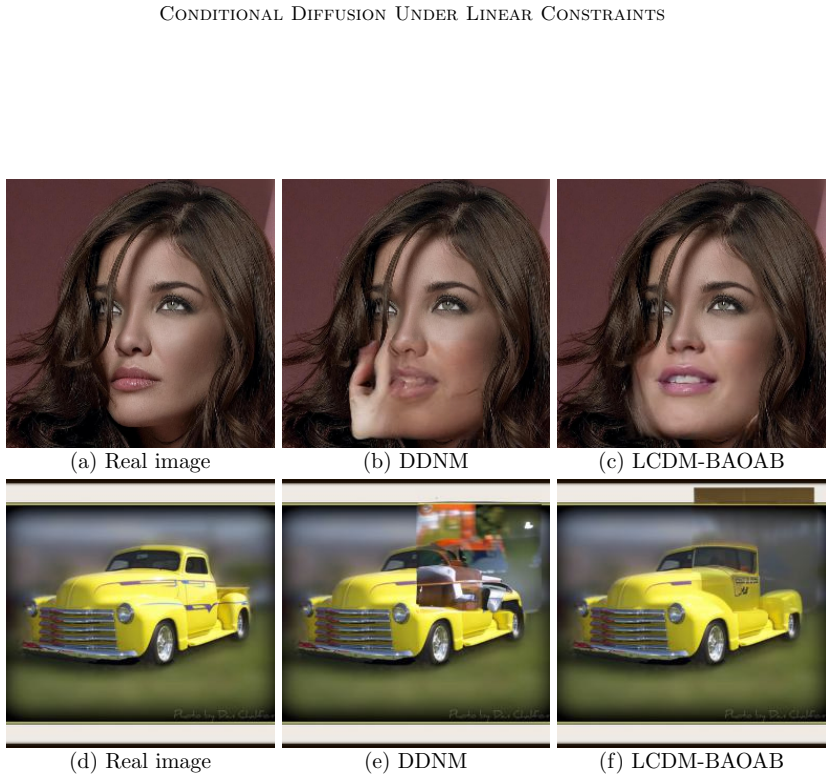
We study zero-shot conditional sampling with pretrained diffusion models for linear inverse problems, including inpainting and super-resolution. In these problems, the observation determines only part of the unknown signal. The remaining degrees of freedom must be sampled according to the correct conditional data distribution. Existing projection-based samplers enforce measurement consistency by correcting the observed component during reverse diffusion. However, measurement consistency alone does not determine how probability mass should be distributed along the feasible set, and this can lead to biased conditional samples. We analyze this issue through a normal--tangent decomposition of the score function. For Gaussian noising, the observed-direction score is exactly determined by the measurement; only the tangent conditional score is unknown. We prove that the error from replacing this score by the unconditional tangent score is upper bounded by a dimension-free conditional mutual information between observed and unobserved components. This gives an information-theoretic decomposition into initialization and pathwise score-mismatch errors. Motivated by the theory, we propose a projected-Langevin initialization followed by guided reverse denoising, which outperforms a strong projection-based baseline in inpainting and super-resolution experiments.
Editorial analysis
A structured set of objections, weighed in public.
Referee Report
Summary. The paper analyzes zero-shot conditional sampling from pretrained diffusion models for linear inverse problems such as inpainting and super-resolution. It introduces a normal-tangent decomposition of the score under Gaussian noising, proves that the error incurred by replacing the conditional tangent score with the unconditional one is upper-bounded by a dimension-free conditional mutual information between observed and unobserved components, and obtains an information-theoretic decomposition of total error into initialization and pathwise mismatch terms. Motivated by the analysis, the authors propose a projected-Langevin initialization followed by guided reverse denoising and report improved performance over a strong projection-based baseline on inpainting and super-resolution tasks.
Significance. If the central bound holds, the work supplies a clean information-theoretic explanation for the bias of pure projection methods and a principled route to reduce pathwise error. The dimension-free character of the mutual-information bound and the explicit separation of initialization versus pathwise contributions are notable strengths that could inform both theory and algorithm design for constrained diffusion sampling.
major comments (2)
- [§3] §3 (normal-tangent decomposition and Theorem 1): the proof that the observed-direction score is exactly recovered from the linear measurement appears to rely on the forward process being exactly Gaussian; the manuscript should state explicitly whether the same exact recovery and the subsequent dimension-free bound continue to hold for non-Gaussian noising schedules or only under the stated Gaussian assumption.
- [§5] §5 (experiments): the reported outperformance is presented without error bars, dataset sizes, or details on how the conditional mutual information was estimated or controlled; these omissions make it difficult to assess whether the observed gains are statistically robust or sensitive to hyper-parameter choices that implicitly affect the initialization error term.
minor comments (2)
- Notation for the tangent and normal components should be introduced once with a clear diagram or equation reference rather than being redefined in multiple sections.
- The abstract claims 'dimension-free' bounds; the manuscript should confirm that the constant hidden in the O(·) notation is indeed independent of ambient dimension.
Simulated Author's Rebuttal
We thank the referee for the careful reading, the positive assessment of the work, and the recommendation for minor revision. We address each major comment below.
read point-by-point responses
-
Referee: [§3] §3 (normal-tangent decomposition and Theorem 1): the proof that the observed-direction score is exactly recovered from the linear measurement appears to rely on the forward process being exactly Gaussian; the manuscript should state explicitly whether the same exact recovery and the subsequent dimension-free bound continue to hold for non-Gaussian noising schedules or only under the stated Gaussian assumption.
Authors: The analysis in §3 is developed under the Gaussian noising assumption, which is stated explicitly in the abstract and at the opening of §3. The exact recovery of the observed-direction score follows directly from the Gaussian property of the forward process (specifically, the fact that the conditional distribution remains Gaussian). For non-Gaussian noising schedules the exact recovery does not hold in general, and the subsequent dimension-free bound on the tangent-score error would require additional assumptions on the noise distribution. We will add a clarifying remark in §3 that makes the scope of the result explicit and notes that the Gaussian assumption is essential for the exact recovery step. revision: yes
-
Referee: [§5] §5 (experiments): the reported outperformance is presented without error bars, dataset sizes, or details on how the conditional mutual information was estimated or controlled; these omissions make it difficult to assess whether the observed gains are statistically robust or sensitive to hyper-parameter choices that implicitly affect the initialization error term.
Authors: We agree that the experimental presentation would be strengthened by these details. In the revised manuscript we will report error bars computed over multiple independent runs, specify the exact dataset sizes used for each task, and add a paragraph describing how the conditional mutual information is estimated (including the approximation method and any controls employed). We will also briefly discuss sensitivity of the observed gains to hyper-parameters that influence the initialization error term. revision: yes
Circularity Check
No significant circularity identified
full rationale
The central derivation establishes an information-theoretic upper bound on tangent-component score mismatch error by conditional mutual information between observed and unobserved components. This bound and the subsequent decomposition into initialization plus pathwise errors follow directly from the stated Gaussian noising assumption and the normal-tangent decomposition of the score; neither step reduces to a fitted parameter, a self-citation chain, or a redefinition of inputs. The resulting guarantees are therefore self-contained against external benchmarks once the forward process is granted.
Axiom & Free-Parameter Ledger
axioms (2)
- domain assumption The forward noising process is Gaussian.
- domain assumption A pretrained unconditional diffusion model is available.
Lean theorems connected to this paper
-
Cost.FunctionalEquation / Foundation.GeneralizedDAlembertwashburn_uniqueness_aczel / dAlembert_cosh_solution_aczel unclearWe analyze this issue through a normal–tangent decomposition of the score function. For Gaussian noising, the observed-direction score is exactly determined by the measurement; only the tangent conditional score is unknown.
Reference graph
Works this paper leans on
-
[1]
Ilvr: Conditioning method for denoising diffusion probabilistic models
Jooyoung Choi, Sungwon Kim, Yonghyun Jeong, Youngjune Gwon, and Sungroh Yoon. Ilvr: Conditioning method for denoising diffusion probabilistic models.arXiv preprint arXiv:2108.02938,
-
[2]
Diffusion Posterior Sampling for General Noisy Inverse Problems
Hyungjin Chung, Jeongsol Kim, Michael T Mccann, Marc L Klasky, and Jong Chul Ye. Diffusion posterior sampling for general noisy inverse problems.arXiv preprint arXiv:2209.14687,
work page internal anchor Pith review arXiv
-
[3]
doi: 10.1109/CVPR.2009. 5206848. Prafulla Dhariwal and Alexander Nichol. Diffusion models beat gans on image synthesis. Advances in neural information processing systems, 34:8780–8794,
-
[4]
Kieran Didi, Francisco Vargas, Simon V Mathis, Vincent Dutordoir, Emile Mathieu, Urszula J Komorowska, and Pietro Lio. A framework for conditional diffusion modelling with applications in motif scaffolding for protein design.arXiv preprint arXiv:2312.09236,
-
[5]
URLhttps://arxiv.org/abs/cs/0412108
doi: 10.1109/TIT.2005.844072. URLhttps://arxiv.org/abs/cs/0412108. Zhengyi Guo, Wenpin Tang, and Renyuan Xu. Conditional diffusion guidance under hard constraint: A stochastic analysis approach.arXiv preprint arXiv:2602.05533,
-
[6]
Classifier-Free Diffusion Guidance
Jonathan Ho and Tim Salimans. Classifier-free diffusion guidance.arXiv preprint arXiv:2207.12598,
work page internal anchor Pith review arXiv
-
[7]
Progressive Growing of GANs for Improved Quality, Stability, and Variation
URLhttps://arxiv.org/abs/1710.10196. Bahjat Kawar, Michael Elad, Stefano Ermon, and Jiaming Song. Denoising diffusion restora- tion models.Advances in neural information processing systems, 35:23593–23606,
work page internal anchor Pith review arXiv
-
[8]
doi: 10.1109/CVPR52688.2022.01117. URL https://arxiv.org/abs/2201.09865. Chenlin Meng, Yutong He, Yang Song, Jiaming Song, Jiajun Wu, Jun-Yan Zhu, and Stefano Ermon. Sdedit: Guided image synthesis and editing with stochastic differential equations. arXiv preprint arXiv:2108.01073,
-
[9]
Denoising Diffusion Implicit Models
Jiaming Song, Chenlin Meng, and Stefano Ermon. Denoising diffusion implicit models. arXiv preprint arXiv:2010.02502, 2020a. Yang Song and Stefano Ermon. Generative modeling by estimating gradients of the data distribution.Advances in neural information processing systems, 32,
work page internal anchor Pith review arXiv 2010
-
[10]
Score-Based Generative Modeling through Stochastic Differential Equations
48 Conditional Diffusion Under Linear Constraints Yang Song, Jascha Sohl-Dickstein, Diederik P Kingma, Abhishek Kumar, Stefano Ermon, and Ben Poole. Score-based generative modeling through stochastic differential equations. arXiv preprint arXiv:2011.13456, 2020b. Yang Song, Liyue Shen, Lei Xing, and Stefano Ermon. Solving inverse problems in medical imagi...
work page internal anchor Pith review arXiv 2011
-
[11]
Masatoshi Uehara, Yulai Zhao, Tommaso Biancalani, and Sergey Levine. Understanding reinforcement learning-based fine-tuning of diffusion models: A tutorial and review.arXiv preprint arXiv:2407.13734,
-
[12]
arXiv preprint arXiv:2212.00490 , year=
Yinhuai Wang, Jiwen Yu, and Jian Zhang. Zero-shot image restoration using denoising diffusion null-space model.arXiv preprint arXiv:2212.00490,
-
[13]
LSUN: Construction of a Large-scale Image Dataset using Deep Learning with Humans in the Loop
Fisher Yu, Ari Seff, Yinda Zhang, Shuran Song, Thomas Funkhouser, and Jianxiong Xiao. Lsun: Construction of a large-scale image dataset using deep learning with humans in the loop.arXiv preprint arXiv:1506.03365,
work page internal anchor Pith review arXiv
discussion (0)
Sign in with ORCID, Apple, or X to comment. Anyone can read and Pith papers without signing in.