Recognition: unknown
Every(bot) Makes Mistakes: Coding Big Five Personalities, Context, and Tone into an LLM Chatbot Recovery Code Framework
Pith reviewed 2026-05-08 15:57 UTC · model grok-4.3
The pith
Structured recovery codes help LLM chatbots recover from errors 27.8 percent better on average.
A machine-rendered reading of the paper's core claim, the machinery that carries it, and where it could break.
Core claim
The central claim is that a structured recovery code mapping four task contexts to four Big Five personalities, tones, and three-stage instructions can be learned by LLMs, resulting in recovery responses that score 27.8% higher on average than baseline responses when evaluated on recovery quality, tone alignment, and appropriateness.
What carries the argument
The recovery code, a structured mapping of four task contexts to Big Five personality traits, associated tones, and three-stage recovery instructions that guide the chatbot's response to errors.
If this is right
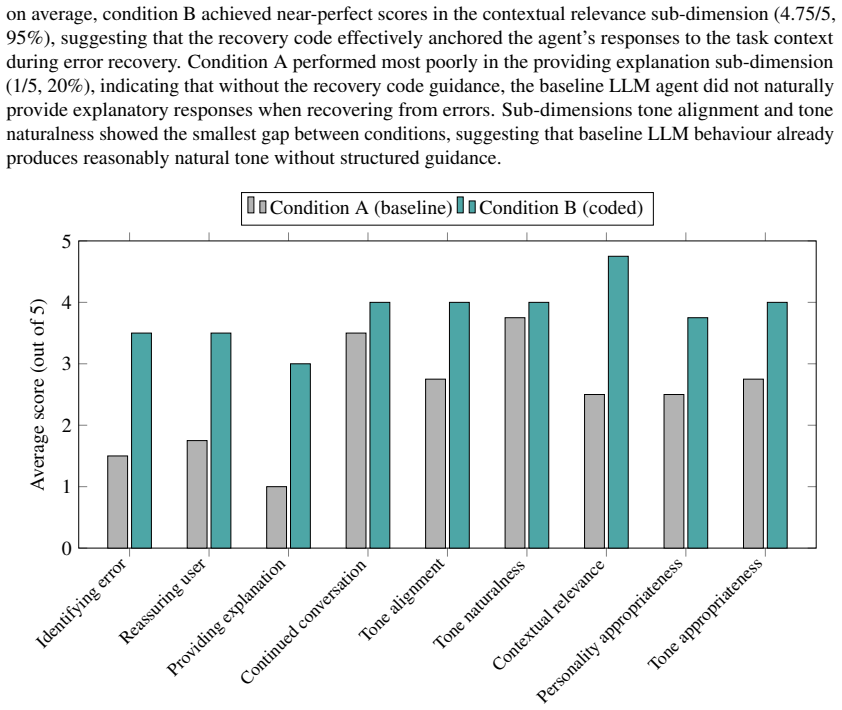
- Coded responses achieve an 83.3 percent score in the appropriateness dimension.
- Personality appropriateness rises from 50 percent in baseline to 75 percent in coded conditions.
- The ability to provide explanations improves from 20 percent to 60 percent.
- The framework delivers measurable gains across different task contexts without requiring human participants in the test phase.
Where Pith is reading between the lines
- Human participant studies would be required to check whether the LLM evaluator scores align with actual user judgments.
- The same mapping approach could be extended to additional personality traits or error scenarios not covered in the original four contexts.
- Deployed systems might combine the recovery code with live context detection to handle mistakes more consistently in ongoing conversations.
Load-bearing premise
That scores from LLM evaluator agents on the designed rubric accurately reflect how human users would perceive and respond to the recovery quality, tone alignment, and appropriateness in real interactions.
What would settle it
A controlled user study in which human participants interact with both the coded and baseline chatbots, then directly rate the recovery responses on the same recovery quality, tone alignment, and appropriateness dimensions.
Figures

read the original abstract
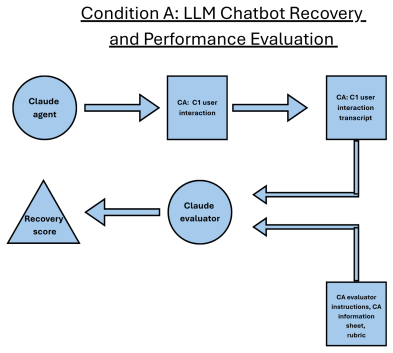
Despite careful design involving classifiers, parameters, and safeguarding, errors during human/AI interaction are not rare. Poor error recovery can disrupt interaction flow, damage user trust, and decrease user engagement. Whilst existing work has explored LLM recovery, tone, context, and personality as separate design dimensions, no existing work has combined these variables into a structured guidance framework. This paper presents a recovery code that maps four common LLM chatbot task contexts to associated personality traits (four Big Five personalities: Conscientiousness, Agreeableness, Openness, and Extraversion), tones, and three-stage recovery instructions. A recovery evaluation rubric was also designed, comprising three dimensions (Recovery quality, Tone alignment, and Appropriateness) and nine sub-dimensions. The methodology is exploratory, with no participants used. A between-subjects design was employed across two conditions: Condition A (baseline, uncoded), four separate Claude Sonnet 4.6 agents received no recovery code training; Condition B (coded), four separate Claude Sonnet 4.6 models were trained on the recovery code. Identical 'user' prompts and error scenarios were used across both conditions. Eight LLM evaluator agents assessed the recovery responses using the evaluation rubric, producing scores out of 5 for each sub-dimension. Results found a 27.8% average performance increase in coded recovery responses (76.7%) compared to baseline responses (48.9%). Condition B performed strongest in the appropriateness dimension (83.3%), with notable improvement in personality appropriateness (75% versus 50%) and providing explanation (60% versus 20%). These findings suggest that structured personality, context, and tone-informed recovery codes can be successfully learnt and applied by LLM chatbots to improve error recovery quality across varying contextual tasks.
Editorial analysis
A structured set of objections, weighed in public.
Referee Report
Summary. The paper proposes a structured 'recovery code' framework that maps four common LLM chatbot task contexts to specific Big Five personality traits (Conscientiousness, Agreeableness, Openness, Extraversion), associated tones, and three-stage recovery instructions. Using a between-subjects design with identical error scenarios and prompts, it compares baseline (uncoded) Claude Sonnet 4.6 agents against coded agents trained on the framework; eight separate LLM evaluator agents then score recoveries on a three-dimension rubric (Recovery quality, Tone alignment, Appropriateness) with nine sub-dimensions, reporting a 27.8% average improvement (76.7% vs 48.9%) for the coded condition, particularly in appropriateness and personality alignment.
Significance. If the LLM-evaluator scores prove to be a valid proxy for human perceptions, the work offers a concrete, reusable framework for embedding personality, context, and tone into error-recovery logic—an approach that could systematically reduce trust erosion in conversational agents. The direct between-subjects comparison on matched prompts is a methodological strength, and the absence of fitted parameters or invented entities keeps the design transparent. However, the lack of any human validation means the practical significance for real users remains provisional.
major comments (1)
- [Evaluation / Results] Evaluation section / Results: The central claim that coded recoveries improve quality by 27.8% rests entirely on scores produced by eight LLM evaluator agents using the authors' rubric. No human participants or raters were involved at any stage (explicitly stated as exploratory with 'no participants used'), so it is unclear whether the rubric dimensions—especially 'personality appropriateness' and 'providing explanation'—correspond to improvements that actual users would notice or value. This is load-bearing for the claim that the framework 'can be successfully learnt and applied by LLM chatbots to improve error recovery quality.'
minor comments (2)
- [Abstract / Methodology] Abstract and §3 (Methodology): The phrasing 'successfully learnt and applied' is strong for an exploratory LLM-only study; a more cautious formulation would better reflect the absence of human data.
- [Rubric] Rubric description: The nine sub-dimensions are listed but their exact scoring anchors (e.g., what distinguishes a 4 from a 5 on 'tone alignment') are not reproduced; including the full rubric as an appendix would aid reproducibility.
Simulated Author's Rebuttal
We thank the referee for their constructive and detailed review. We address the major comment on evaluation below, acknowledging the exploratory nature of the work and the reliance on LLM evaluators.
read point-by-point responses
-
Referee: [Evaluation / Results] Evaluation section / Results: The central claim that coded recoveries improve quality by 27.8% rests entirely on scores produced by eight LLM evaluator agents using the authors' rubric. No human participants or raters were involved at any stage (explicitly stated as exploratory with 'no participants used'), so it is unclear whether the rubric dimensions—especially 'personality appropriateness' and 'providing explanation'—correspond to improvements that actual users would notice or value. This is load-bearing for the claim that the framework 'can be successfully learnt and applied by LLM chatbots to improve error recovery quality.'
Authors: We agree that the absence of human validation is a substantive limitation. The manuscript already states that the study is exploratory with no participants used, and the evaluation uses eight LLM agents applying our designed rubric as a proxy measure. While LLM-as-judge methods are increasingly common for initial assessment of conversational outputs, we recognize that dimensions such as personality appropriateness and explanation quality may not fully align with human perceptions. In the revised manuscript we will expand the Limitations and Future Work sections to explicitly discuss this gap, qualify the central claim to refer to LLM-evaluated improvements rather than direct user benefits, and outline planned human-subject studies to validate the rubric and framework against actual user ratings. revision: partial
- Empirical human validation of the LLM-evaluator scores and rubric dimensions, which would require new data collection outside the current exploratory study.
Circularity Check
No significant circularity in the derivation chain
full rationale
The paper reports an empirical 27.8% score improvement from a direct between-subjects comparison of baseline LLM outputs versus outputs from LLMs given the authors' recovery code. Scores are produced by separate LLM evaluator agents applying a fixed, author-designed rubric to identical prompts and scenarios. No equations, parameter fits, self-citations, or renamings are present that would make the reported difference equivalent to the inputs by construction. The central claim rests on the observed score delta under the chosen evaluation protocol rather than any self-referential reduction.
Axiom & Free-Parameter Ledger
axioms (2)
- domain assumption The Big Five personality traits can be effectively encoded into LLM chatbot recovery behavior
- domain assumption LLM evaluator agents can reliably assess recovery quality, tone alignment, and appropriateness using the designed rubric
invented entities (1)
-
Recovery code framework
no independent evidence
Reference graph
Works this paper leans on
-
[1]
Reassure the user responsibly
-
[2]
{C1; C; T1; R1} C2: Emotional supportAgreeableness (A) T2: Warm 1
Continue with perseverance. {C1; C; T1; R1} C2: Emotional supportAgreeableness (A) T2: Warm 1. Identify error cooperatively
-
[3]
Reassure the user kindly
-
[4]
{C2; A; T2; R2} C3: Brainstorming Openness (O) T3: Conversational1
Continue warmly. {C2; A; T2; R2} C3: Brainstorming Openness (O) T3: Conversational1. Identify error curiously
-
[6]
{C3; O; T3; R3} C4: Learning a conceptExtraversion (E) T4: Engaging 1
Continue creatively. {C3; O; T3; R3} C4: Learning a conceptExtraversion (E) T4: Engaging 1. Identify error actively
-
[7]
Reassure the user energetically
-
[8]
{C4; E; T4; R4} Table 5.Recovery code framework mapping context, Big Five personality trait, tone, recovery instructions, and recovery code
Continue sociably. {C4; E; T4; R4} Table 5.Recovery code framework mapping context, Big Five personality trait, tone, recovery instructions, and recovery code. 6.2 Appendix B: Condition B agent prompt You are being tasked with learning a recovery code to utilise when notified of an error in your responses during an interaction with a user. The appropriate...
-
[9]
Spend $1,500 once vs. $26,000/year
Identify error curiously. 2. Reassure the user broad-mindedly. 3. Continue creatively. You should only be associating and applying these codes once you are notified of an error. Otherwise, you should be responding as you usually would without the recovery code guidance (in the document attached). Now, please confirm whether you have read and understood bo...
1961
-
[10]
Green Light
Alternative explanations– Haslam and Reicher argue obedience reflects active identification with group goals, not mindless submission. Concept In Plain English Autonomous state You act on your own conscience Agentic state You act as an instrument of authority Agentic shift The psychological move from one to the other Moral strain The discomfort you feel e...
-
[13]
Green Light
Continue creatively. 26/39 You should only be associating and applying these codes once you are notified of an error. Otherwise, you should be responding as you usually would without the recovery code guidance (in the document attached). Now, please confirm whether you have read and understood both the document information and the information provided in ...
-
[14]
Identify the error in an organised way– I systematically re-examined each correction I had made and listed them clearly
-
[15]
Reassure the user responsibly– I was transparent in acknowledging that upon careful review, my original corrections were in fact accurate, rather than fabricating new ones to appease the user
-
[16]
Green Light
Continue the conversation with perseverance– I invited the user to clarify their concern, keeping the conversation going constructively rather than simply capitulating or disengaging. This was the only appropriate code for this context – no elements from C2, C3, or C4 were drawn upon. CB:C2 USER:You are being tasked with learning a recovery code to utilis...
-
[19]
Green Light
Continue creatively. 30/39 You should only be associating and applying these codes once you are notified of an error. Otherwise, you should be responding as you usually would without the recovery code guidance (in the document attached). Now, please confirm whether you have read and understood both the document information and the information provided in ...
-
[20]
Reassure the user kindly– I validated their feelings and affirmed that their experience deserved a more thoughtful response
-
[21]
Green Light
Continue warmly– I re-engaged with their emotional situation with genuine care, compassion, and an open question to invite further sharing No other code was appropriate here – C1, C3, and C4 would have been mismatched in both context and tone for an emotionally sensitive support conversation. CB:C3 USER:You are being tasked with learning a recovery code t...
-
[24]
Green Light
Continue creatively. You should only be associating and applying these codes once you are notified of an error. Otherwise, you should be responding as you usually would without the recovery code guidance (in the document attached). Now, please confirm whether you have read and understood both the document information and the information provided in this p...
-
[25]
Cafe quality, office price
Upgrade the In-Office Coffee Experience • Invest in a quality bean-to-cup machine (one-time cost ˜£500–£1,500) – if it replaces even 10 daily £4 coffees, it pays for itself in under 2 months. • Stock a rotation of good quality beans, milks (including oat/almond), and flavoured syrups to mimic cafe variety. •Slide angle: “Cafe quality, office price”
-
[26]
coffee cost tracker
Behavioural Nudges • Place a visible “coffee cost tracker” in the break room showing cumulative monthly spend – awareness alone tends to shift habits. • Introduce a “Brew Tuesday” ritual where someone makes a round – social bonding replaces the cafe run. •Slide angle: “Small nudges, big savings”
-
[27]
coffee credit
Incentive Swaps • Replace ad-hoc coffee runs as informal perks with a structured monthly “coffee credit” – employees get £10–£15 credit for a local cafe, reducing impulse purchases. • Offer reusable cup rewards – staff who bring a flask get entered into a monthly prize draw. •Slide angle: “Smarter perks, same morale”
-
[28]
Structure saves money
Policy Tweaks • Set a team coffee budget cap and let the team self-manage it – autonomy increases buy-in. • Negotiate a bulk office account with a local cafe for a discounted rate if eliminating take-out entirely isn’t realistic. •Slide angle: “Structure saves money” Rough Cost-Saving Logic (slide-ready): “If 15 employees buy one £4 coffee daily, that’s £...
-
[29]
Identify error curiously– I didn’t assume I knew what was wrong; instead I opened with curiosity, asking what had missed the mark
-
[30]
3.Continue creatively– I invited the user to redirect me so we could explore the right angle together
Reassure the user broad-mindedly– I offered several possible directions without being defensive, keeping the space open. 3.Continue creatively– I invited the user to redirect me so we could explore the right angle together. No other code was appropriate here. C1, C2, and C4 were ruled out because the task was neither grammar correction, emotional support,...
-
[31]
Identify error curiously
-
[32]
Reassure the user broad-mindedly
-
[33]
Green Light
Continue creatively. You should only be associating and applying these codes once you are notified of an error. Otherwise, you should be responding as you usually would without the recovery code guidance (in the document attached). Now, please confirm whether you have read and understood both the document information and the information provided in this p...
1961
-
[34]
You feel full moral responsi- bility for your actions
The Autonomous State You act as a self-directed individual, guided by your own conscience and values. You feel full moral responsi- bility for your actions
-
[35]
Teacher” (the real participant) believed they were delivering escalating electric shocks (15V–450V) to a “Learner
The Agentic State You perceive yourself as an instrument of an authority figure – anagentcarrying out their wishes. Crucially: • Personal responsibility feels transferred upward to the authority • This is called theagentic shift– the transition from autonomous to agentic functioning • Milgram argued this shift is deeply rooted in how societies are structu...
1961
-
[36]
Let me re-energise this and give you a clearer, more reliable breakdown!
Reassure the user energetically– “Let me re-energise this and give you a clearer, more reliable breakdown!” 38/39
-
[37]
Continue sociably– I delivered the follow-up explanation with enthusiasm and an inviting close, encouraging further questions No other code was blended in – the response adhered strictly to C4, E, T4, and R4 without cross-combining elements from C1, C2, or C3. 6.9 Appendix I: CB:C3 & CA:C3 evaluator transcript feedback for personality appropriate- ness su...
discussion (0)
Sign in with ORCID, Apple, or X to comment. Anyone can read and Pith papers without signing in.