Recognition: unknown
Policies for the Operation of an Ambulance Fleet under Uncertainty based on a New Preparedness Metric
Pith reviewed 2026-05-08 16:12 UTC · model grok-4.3
The pith
A new preparedness metric quantifies ambulance fleet readiness for unknown future emergencies and guides dispatch decisions.
A machine-rendered reading of the paper's core claim, the machinery that carries it, and where it could break.
Core claim
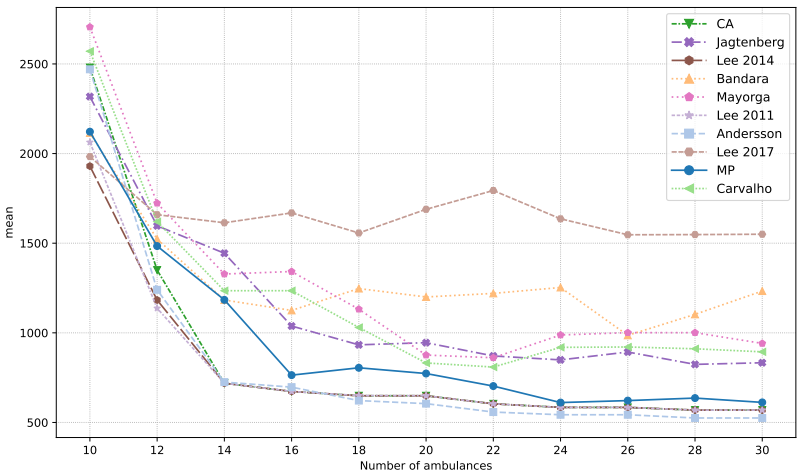
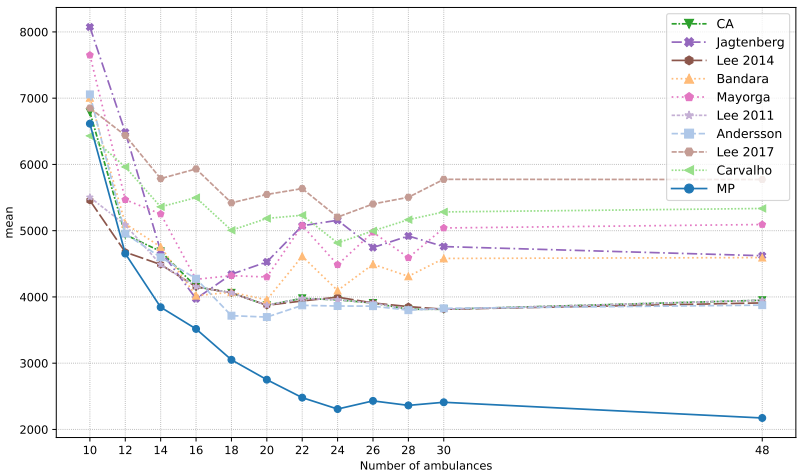
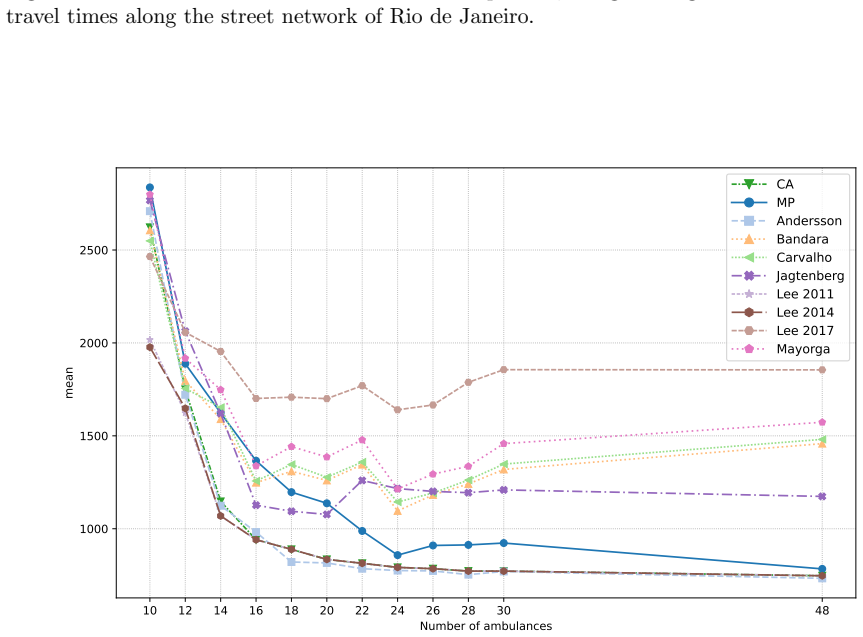
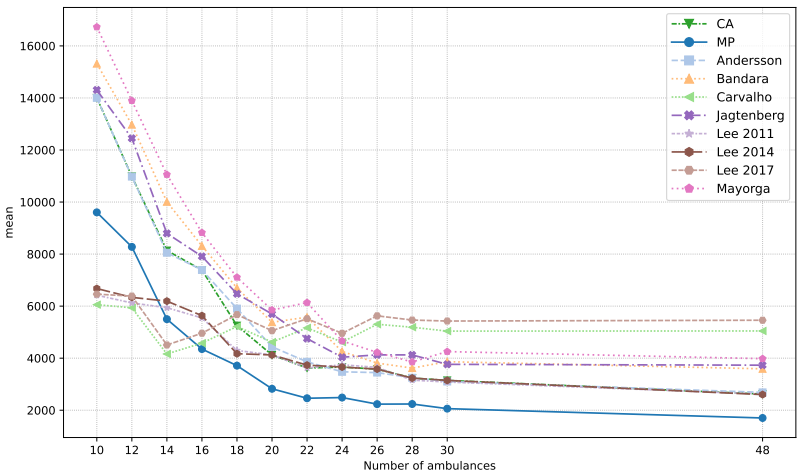
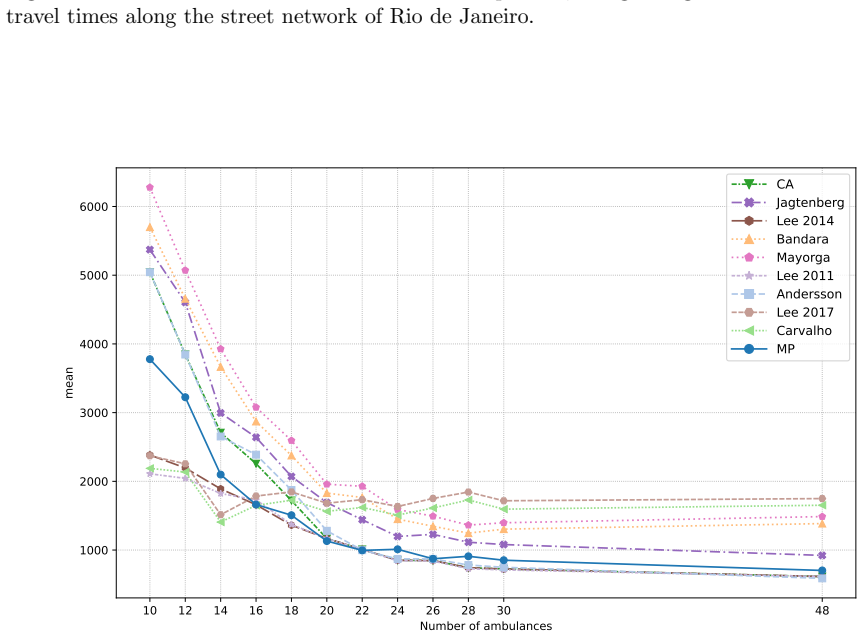
We propose a new preparedness metric that quantifies the ability of the emergency medical service to respond to future emergencies. The preparedness metric can be used to make ambulance selection decisions and ambulance reassignment decisions by solving a tractable optimization problem each time that a decision has to be made. We compare the performance of the resulting method with 9 methods that have been proposed in the literature, based on data from a real emergency medical service for a large city.
What carries the argument
The preparedness metric, which evaluates the effect of current ambulance locations and assignments on the fleet's capacity to cover potential future emergency sites under uncertainty, and is maximized via repeated solution of a tractable optimization problem.
Load-bearing premise
The preparedness metric correctly captures how current decisions affect the ability to respond to unknown future emergencies, and optimizing it produces decisions superior in practice to the nine comparison methods.
What would settle it
If the optimization-based decisions do not produce statistically better response performance than the best of the nine benchmark methods when both are applied to the same historical large-city data set, the central claim would be falsified.
Figures




read the original abstract
Two important decisions in the management of an ambulance fleet are ambulance selection decisions and ambulance reassignment decisions. Ambulance selection decisions determine what to do when an emergency call arrives (such as choosing what ambulance to dispatch to the emergency or putting the emergency in a queue of emergencies waiting for an ambulance to be dispatched). Ambulance reassignment decisions determine where to send an ambulance next when it has finished service for an emergency. Making good ambulance selection decisions and ambulance reassignment decisions is challenging because a decision made at a point in time affects the ability of the emergency medical service to respond to future emergencies (that are typically not known when the decision is made). We propose a new preparedness metric that quantifies the ability of the emergency medical service to respond to future emergencies. The preparedness metric can be used to make ambulance selection decisions and ambulance reassignment decisions by solving a tractable optimization problem each time that a decision has to be made. We compare the performance of the resulting method with 9 methods that have been proposed in the literature, based on data from a real emergency medical service for a large city.
Editorial analysis
A structured set of objections, weighed in public.
Referee Report
Summary. The paper introduces a new preparedness metric that quantifies an EMS fleet's ability to respond to unknown future emergencies. This metric is embedded in a tractable optimization problem solved at each decision epoch to guide ambulance selection (dispatch or queueing) and reassignment decisions. The resulting policy is benchmarked against nine existing methods from the literature using historical data from a real EMS serving a large city, with performance assessed via simulation.
Significance. If the preparedness metric demonstrably improves decisions by correctly capturing the downstream effects of current actions on future response capability, the work could advance dynamic resource allocation in emergency services. The comparison to nine baselines on real data is a positive step toward practical relevance, but the single-city, in-sample simulation design limits claims of general superiority.
major comments (2)
- [Evaluation] Evaluation section: the reported superiority rests on a simulation whose arrival, travel-time, and service distributions are fitted to the same historical dataset used for testing, without temporal hold-out periods, cross-validation, or perturbation of the underlying processes. This setup leaves open the possibility that gains arise from alignment with dataset-specific statistics rather than from a general property of the metric.
- [Introduction and Evaluation] The central claim that the metric 'quantifies the ability ... to respond to future emergencies' and yields superior decisions requires evidence that it is not circular or overfit; the current single-region evaluation does not provide a falsifiable test of robustness to data shifts or new regions.
minor comments (2)
- [Abstract] The abstract states that the method was compared on real data but provides no definition of the metric, no formulation of the optimization problem, and no performance numbers or statistical details; these should be summarized with key equations and tables even in the abstract for clarity.
- [Metric Definition] Notation for the preparedness metric and the optimization objective should be introduced with explicit definitions and assumptions about uncertainty modeling to aid reproducibility.
Simulated Author's Rebuttal
We thank the referee for the constructive and detailed feedback. The points raised regarding the evaluation design are important, and we address them point by point below while proposing targeted revisions to the manuscript.
read point-by-point responses
-
Referee: [Evaluation] Evaluation section: the reported superiority rests on a simulation whose arrival, travel-time, and service distributions are fitted to the same historical dataset used for testing, without temporal hold-out periods, cross-validation, or perturbation of the underlying processes. This setup leaves open the possibility that gains arise from alignment with dataset-specific statistics rather than from a general property of the metric.
Authors: We agree that the simulation uses distributions fitted to the full historical dataset without temporal hold-out or cross-validation, which represents a limitation for establishing robustness. This setup aligns with common practice in the EMS operations literature, where operational datasets are often limited in scale and duration. In the revised manuscript we will add a new subsection on sensitivity analysis that perturbs the fitted parameters (e.g., arrival rates and travel-time means varied by ±15–25 %) and reports how the relative performance of the preparedness metric changes. We will also insert an explicit limitations paragraph in the Evaluation section acknowledging the in-sample character of the tests. These changes directly respond to the concern by providing evidence that performance advantages are not solely an artifact of exact distributional alignment. revision: yes
-
Referee: [Introduction and Evaluation] The central claim that the metric 'quantifies the ability ... to respond to future emergencies' and yields superior decisions requires evidence that it is not circular or overfit; the current single-region evaluation does not provide a falsifiable test of robustness to data shifts or new regions.
Authors: The preparedness metric is constructed from an explicit probabilistic model of future emergency locations, times, and service requirements; it is not estimated from the realized calls used in the simulation, so the formulation itself is not circular. The optimization then uses this forward-looking metric to select actions. We nevertheless accept that the single-city, in-sample simulation does not constitute a strong falsification test against distributional shifts. In the revision we will qualify the central claims in the Introduction and Abstract to reflect the tested setting, and we will add a dedicated paragraph in the Discussion section on the desirability of multi-region validation. We cannot supply results from additional cities because we lack access to comparable operational datasets from other EMS providers. revision: partial
- We do not have access to emergency medical service data from other cities or regions and therefore cannot perform direct validation on new regions or under data shifts.
Circularity Check
No significant circularity; metric and policies derived independently of evaluation data.
full rationale
The paper defines a new preparedness metric to quantify response capability under uncertainty and embeds it in a per-decision optimization problem for ambulance selection and reassignment. Performance is then assessed by comparing the resulting policies against nine literature baselines on historical data from one city via simulation. No equations or steps reduce the metric or its optimality claims to fitted parameters, self-referential definitions, or prior self-citations by construction. The derivation chain remains self-contained: the metric is proposed from first principles as a quantification tool, the optimization is tractable by design, and empirical superiority is tested externally rather than presupposed. This aligns with the default expectation that most papers exhibit no circularity.
Axiom & Free-Parameter Ledger
Reference graph
Works this paper leans on
-
[1]
A Markov Chain Model for an EMS System with Repositioning
Alanis, R., A. Ingolfsson, and B. Kolfal (2013). “A Markov Chain Model for an EMS System with Repositioning”.Production and Operations Management22(1), pages 216–231. Andersson, T. and P. V¨ arbrand (2007). “Decision Support Tools for Ambulance Dispatch and Relocation”.Journal of the Operational Research Society58(2), pages 195–201. 29 Aringhieri, R., M. ...
2013
-
[2]
A Decision-Support System for Ambulance Management: A Case Study of the Portuguese EMS
Edited by J. P. Almeida, F. P. Alvelos, J. O. Cerdeira, S. Moniz, and C. Requejo. Volume 437, pages 31–47. — (2025). “A Decision-Support System for Ambulance Management: A Case Study of the Portuguese EMS”.Computers and Industrial Engineering204, page 111044. Carvalho, A. S., M. E. Captivo, and I. Marques (2020). “Integrating the Ambulance Dispatch- ing a...
-
[3]
EMS Planning and Management
Edited by M. Brandeau, F. Sainfort, and W. Pierskalla. Dordecht: Kluwer. Chapter 4, pages 77–102. Ingolfsson, A. (2013). “EMS Planning and Management”.Operations Research and Health Care Policy. Edited by G. S. Zaric. New York: Springer. Chapter 6, pages 105–128. Jagtenberg, C. J., S. Bhulai, and R. D. Van der Mei (2017). “Dynamic Ambulance Dispatching: I...
2013
-
[4]
Ambulance Redeployment: An Approximate Dynamic Programming Approach
Edited by B. T. Denton. New York: Springer. Chapter 11, pages 289–317. Maxwell, M. S., S. G. Henderson, and H. Topaloglu (2009). “Ambulance Redeployment: An Approximate Dynamic Programming Approach”.Proceedings of the 2009 Winter Simulation Conference. Edited by M. D. Rossetti, R. R. Hill, B. Johansson, A. Dunkin, and R. G. Ingalls, pages 1850–1860. — (20...
2009
-
[5]
Districting and Dispatching Policies for Emergency Medical Service Systems to Improve Patient Survival
Mayorga, M. E., D. Bandara, and L. A. McLay (2013). “Districting and Dispatching Policies for Emergency Medical Service Systems to Improve Patient Survival”.IIE Transactions on Healthcare Systems Engineering3(1), pages 39–56. 32 Nasrollahzadeh, A. A., A. Khademi, and M. E. Mayorga (2018). “Real-Time Ambulance Dis- patching and Relocation”.Manufacturing & ...
2013
-
[6]
GMRES: A generalized minimal residual algorithm for solving nonsymmetric linear systems
O’Keeffe, C., J. Nicholl, J. Turner, and S. Goodacre (2011). “Role of Ambulance Response Times in the Survival of Patients with Out-of-Hospital Cardiac Arrest”.Emergency Medicine Journal28, pages 703–706. Pell, J. P., J. M. Sirel, A. K. Marsden, I. Ford, and S. M. Cobbe (2001). “Effect of Reducing Ambulance Response Times on Deaths from Out of Hospital Ca...
discussion (0)
Sign in with ORCID, Apple, or X to comment. Anyone can read and Pith papers without signing in.