Recognition: unknown
A transition in the hole probability at finite temperature for free fermions in d dimensions
Pith reviewed 2026-05-08 15:30 UTC · model grok-4.3
The pith
The hole probability for free fermions in d dimensions follows an exact scaling function Φ_d(u) with a transition at u_c=2/π due to a gap in the optimal Coulomb gas density.
A machine-rendered reading of the paper's core claim, the machinery that carries it, and where it could break.
Core claim
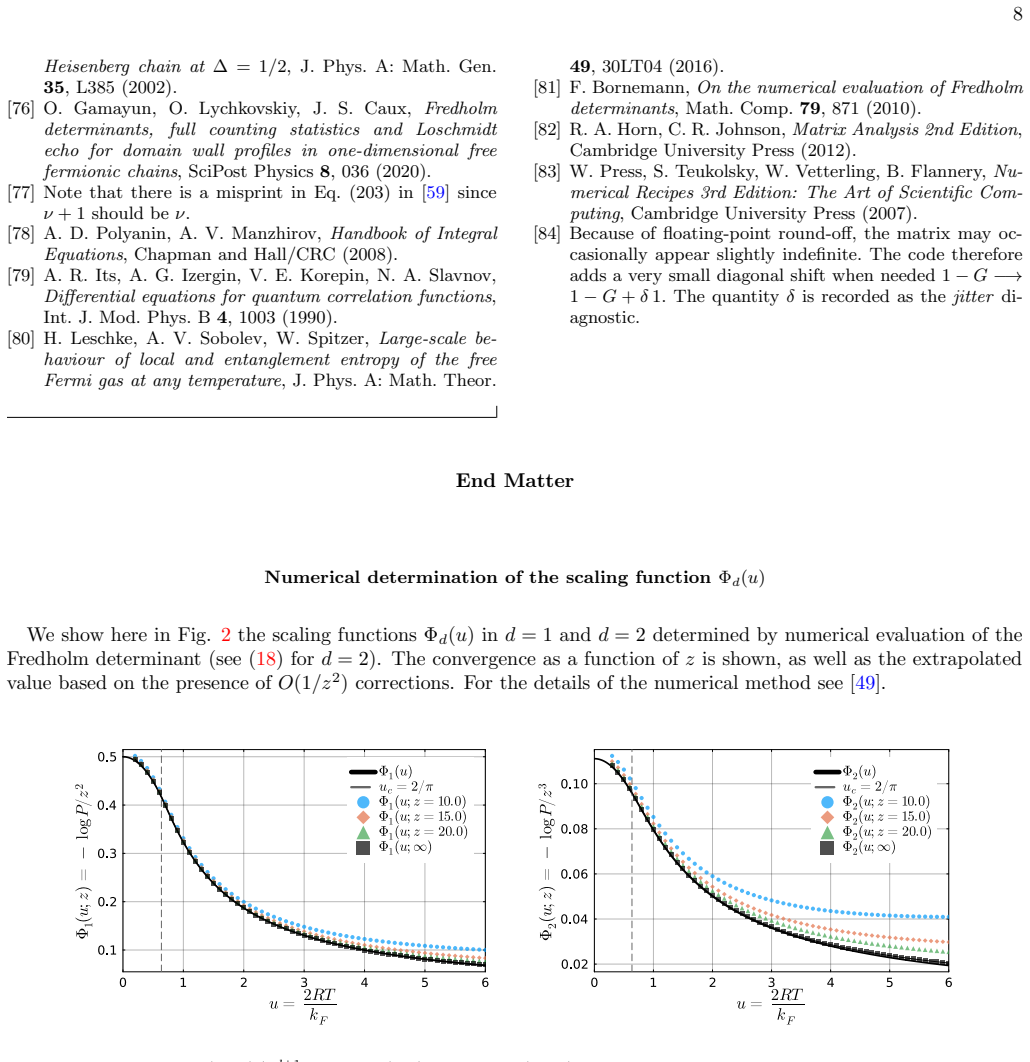
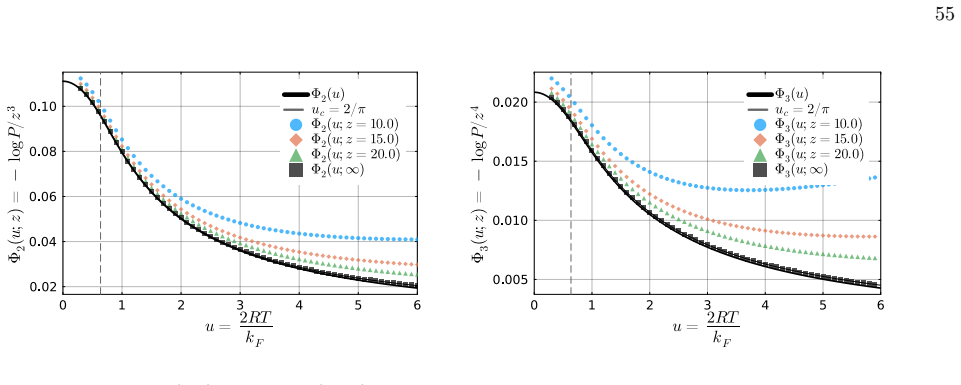
By mapping the hole probability to the partition function of an effective Coulomb gas, we compute exactly the scaling function Φ_d(u) in any dimension d. This function exhibits a transition of order 3/2(d+1) at the universal critical value u_c=2/π, signaling a sharp change in the mechanism of rare fluctuations associated with the emergence of a macroscopic gap in the optimal density of the associated Coulomb gas.
What carries the argument
The effective Coulomb gas obtained from the mapping of the hole probability, whose saddle-point density determines the scaling function Φ_d(u) and develops a gap at the transition.
Load-bearing premise
The hole probability for free fermions can be mapped exactly onto the partition function of an effective Coulomb gas whose saddle-point density yields the scaling function.
What would settle it
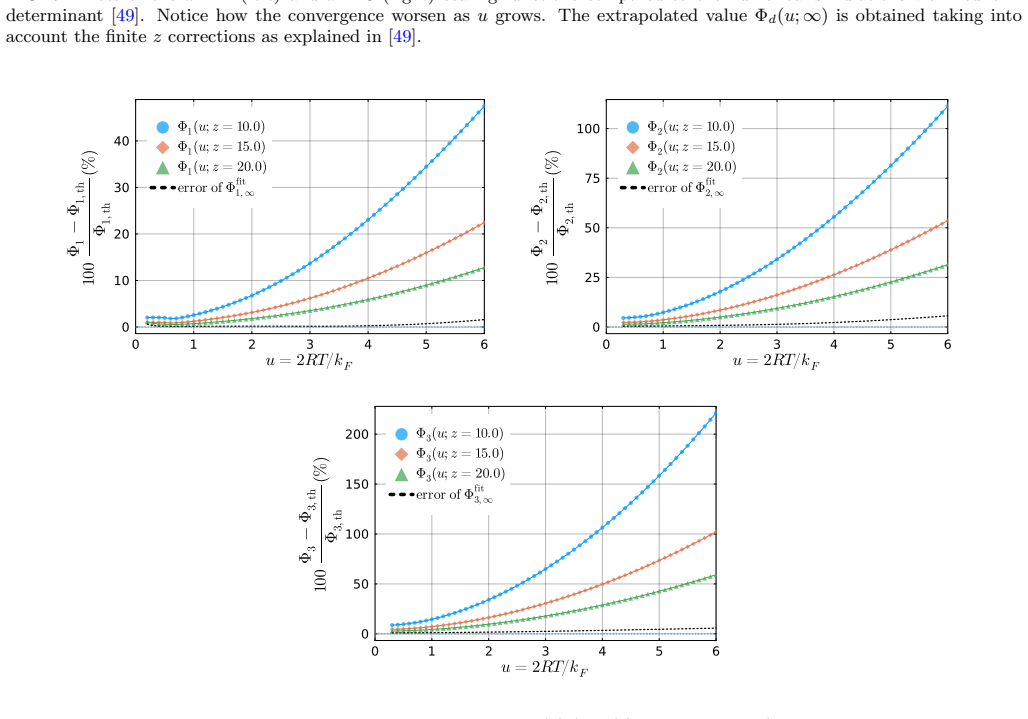
Numerical computation of the Fredholm determinant for the hole probability at u near 2/π, checking whether the scaling function or its derivatives change behavior with the predicted order 3/2(d+1).
Figures




read the original abstract
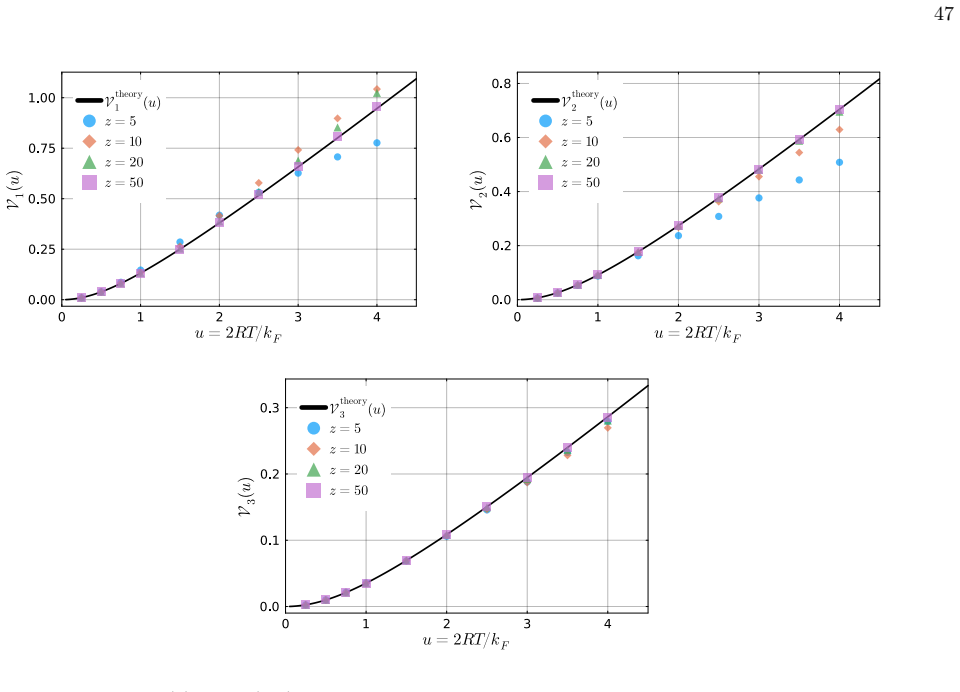
In a free Fermi gas at temperature $T$ much higher than the Fermi temperature one expects that the fluctuations of the number of particles in a given region has Poissonian/classical statistics. On the other hand at low temperature the Pauli exclusion principle leads to non trivial counting statistics. It is of great interest from a theoretical and experimental point of view to characterize the crossover between these two limits. Here we focus on the hole probability $P(R,T)$, i.e. the probability that a region of size $R$ is devoid of particles, in dimension $d$, and on the case of a spherical region of large radius $R$. We show that at low temperature it takes the scaling form $P(R,T)\sim \exp\big[-(k_F R)^{d+1}\Phi_d(u=2R\,T/k_F)\big],$ where $k_F$ is the Fermi momentum. By mapping the problem to an effective Coulomb gas, we compute exactly the scaling function $\Phi_d(u)$ in any dimension. Remarkably, it exhibits a transition of order $\tfrac{3}{2}(d+1)$ at the universal critical value $u_c=2/\pi$, signaling a sharp change in the mechanism of rare fluctuations, associated with the emergence of a macroscopic gap in the optimal density of the associated Coulomb gas. Our analytical predictions are supported by precise numerical evaluations of the corresponding Fredholm determinants.
Editorial analysis
A structured set of objections, weighed in public.
Referee Report
Summary. The paper studies the hole probability P(R,T) for a spherical region of radius R in a d-dimensional free Fermi gas at temperature T. It shows that at low temperature, this probability scales as exp[-(k_F R)^{d+1} Φ_d(u)] where u = 2 R T / k_F. By mapping the fermionic determinant to an effective Coulomb gas, the authors compute the scaling function Φ_d(u) exactly for any dimension d. They report a transition in Φ_d(u) of order 3/2(d+1) at the universal critical value u_c = 2/π, linked to the appearance of a macroscopic gap in the optimal Coulomb gas density. The analytical results are supported by numerical evaluations of the associated Fredholm determinants.
Significance. If the exact mapping and saddle-point calculation hold, this provides a notable exact result for the finite-temperature hole probability in free fermions across dimensions. The universal transition and the change in fluctuation mechanism are significant findings that could impact understanding of rare events in quantum gases. The use of Coulomb gas mapping combined with Fredholm determinant numerics is a strength, offering both analytic insight and verification. This could serve as a benchmark for more complex systems.
major comments (2)
- The central claim relies on an exact mapping of log det(1 - K_T) to the minimum of the Coulomb gas energy functional without subleading corrections to the (k_F R)^{d+1} term. The manuscript should explicitly demonstrate why the saddle-point density ρ* yields the exact leading exponential behavior for all u, particularly around the transition at u_c.
- The derivation of the transition order 3/2(d+1) and the universality of u_c = 2/π independent of d should be detailed with the explicit form of the effective potential and the saddle equation. It is not clear how the d-dependence cancels in u_c while the order depends on d.
minor comments (2)
- Clarify the definition of u = 2 R T / k_F; ensure consistency with the Fermi-Dirac distribution in the kernel.
- Provide more details on the precision of the Fredholm determinant evaluations and how they corroborate the analytic transition.
Simulated Author's Rebuttal
We thank the referee for their careful reading of the manuscript and for the constructive comments. We address each major comment below and will revise the manuscript to incorporate the requested clarifications.
read point-by-point responses
-
Referee: The central claim relies on an exact mapping of log det(1 - K_T) to the minimum of the Coulomb gas energy functional without subleading corrections to the (k_F R)^{d+1} term. The manuscript should explicitly demonstrate why the saddle-point density ρ* yields the exact leading exponential behavior for all u, particularly around the transition at u_c.
Authors: The mapping of log det(1 - K_T) to the Coulomb gas energy functional is exact at the level of the large-deviation rate function. In the limit k_F R ≫ 1 the logarithm of the determinant is given by the minimum of the energy functional plus subleading corrections that are o((k_F R)^{d+1}); these corrections arise from Gaussian fluctuations around the saddle and are of order (k_F R)^d log(k_F R) or lower. The saddle-point density ρ* therefore controls the leading exponential behavior for every fixed u, including at the transition. We will add a new subsection that recalls the large-deviation principle for the underlying determinantal process and shows that the approximation remains uniform in u across the transition point. revision: yes
-
Referee: The derivation of the transition order 3/2(d+1) and the universality of u_c = 2/π independent of d should be detailed with the explicit form of the effective potential and the saddle equation. It is not clear how the d-dependence cancels in u_c while the order depends on d.
Authors: We will expand the relevant section to include the explicit effective potential V_eff(r; u) = (1/2)∫∫ ρ(r)ρ(r')/|r-r'|^{d-2} dr dr' + ∫ ρ(r) V_ext(r; u) dr, together with the saddle-point integral equation obtained by functional differentiation. The critical value u_c = 2/π is fixed by the local condition that the density vanishes at the origin; because of spherical symmetry this condition reduces to a one-dimensional integral equation whose solution is independent of d. The transition order 3/2(d+1) follows from the square-root edge behavior of the density near the gap-opening point: the excess energy scales as (δu)^{3/2} multiplied by the overall prefactor (k_F R)^{d+1} that originates from the d-dimensional volume element. The revised text will contain the full calculation of both the critical point and the scaling exponent. revision: yes
Circularity Check
No circularity; Coulomb-gas saddle-point analysis is an independent large-deviation computation
full rationale
The central result follows from expressing the hole probability as the Fredholm determinant det(1-K_T) of the finite-temperature kernel and then applying the standard Coulomb-gas representation to extract the leading exponential rate function Φ_d(u) via saddle-point minimization of the associated energy functional. This step is not self-definitional: the functional is derived from the kernel (not postulated to reproduce Φ_d), the minimizer ρ* is solved explicitly to reveal the transition at u_c=2/π, and the order 3/2(d+1) is a direct consequence of the gap-opening mechanism in the optimal density. Independent numerical evaluation of the Fredholm determinant for finite R provides external verification of the analytic Φ_d(u), confirming that the derivation does not reduce to its own inputs by construction.
Axiom & Free-Parameter Ledger
axioms (1)
- domain assumption The hole probability of free fermions at finite temperature can be represented exactly as the partition function of an effective Coulomb gas.
Reference graph
Works this paper leans on
-
[1]
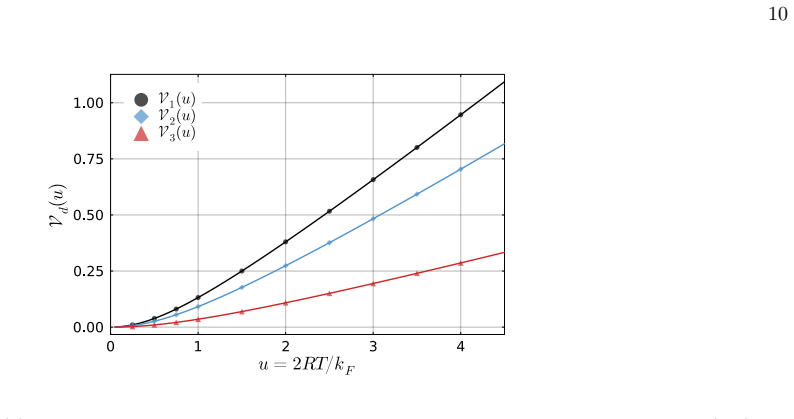
G. D. Mahan, Many-Particle Physics, 3rd ed. (Kluwer Academic/Plenum Publishers, New York, 2000)
2000
-
[2]
Castin, Basic theory tools for degenerate Fermi gases, in Ultra-cold Fermi Gases, Proceedings of the International School of Physics ``Enrico Fermi'', Course CLXIV, edited by M
Y. Castin, Basic theory tools for degenerate Fermi gases, in Ultra-cold Fermi Gases, Proceedings of the International School of Physics ``Enrico Fermi'', Course CLXIV, edited by M. Inguscio, W. Ketterle, and C. Salomon (IOS Press, Amsterdam, 2007)
2007
-
[3]
L. D. Landau, E. M. Lifshitz, Statistical Physics, Part 1, 3rd ed. (Pergamon Press, Oxford, 1980)
1980
-
[4]
Huang, Statistical Mechanics, 2nd ed
K. Huang, Statistical Mechanics, 2nd ed. (John Wiley & Sons, New York, 1987)
1987
-
[5]
Holten, L
M. Holten, L. Bayha, K. Subramanian, C. Heintze, P. M. Preiss, S. Jochim, Observation of Pauli crystals in a strongly interacting Fermi gas, Phys. Rev. Lett. 126 , 020401 (2021)
2021
-
[6]
Gioev, I
D. Gioev, I. Klich, Entanglement entropy of fermions in any dimension and the Widom conjecture, Phys. Rev. Lett. 96 , 100503 (2006)
2006
-
[7]
Calabrese, M
P. Calabrese, M. Minchev, E. Vicari, Entanglement entropies in free-fermion gases for arbitrary dimension, EPL 97 , 20009 (2012)
2012
-
[8]
D. S. Dean, P. Le Doussal, S. N. Majumdar, G. Schehr, Noninteracting fermions at finite temperature in a d -dimensional trap: universal correlations, Phys. Rev. A 94 , 063622 (2016)
2016
-
[9]
L. S. Levitov, H.-W. Lee, G. B. Lesovik, Electron counting statistics and coherent states of electric current, J. Math. Phys. 37 , 4845 (1996)
1996
-
[10]
Klich, Lower entropy bounds and particle number fluctuations in a Fermi sea , J
I. Klich, Lower entropy bounds and particle number fluctuations in a Fermi sea , J. Phys. A: Math. Gen. 39 , L85 (2006)
2006
-
[11]
Klich, L
I. Klich, L. Levitov, Quantum noise as an entanglement meter , Phys. Rev. Lett. 102 , 100502 (2009)
2009
-
[12]
H. F. Song, C. Flindt, S. Rachel, I. Klich, K. Le Hur, Entanglement entropy from charge statistics: Exact relations for noninteracting many-body systems , Phys. Rev. B 83 , 161408(R) (2011)
2011
-
[13]
Calabrese, M
P. Calabrese, M. Mintchev, E. Vicari, Exact relations between particle fluctuations and entanglement in Fermi gases , Europhys. Lett. 98 , 20003 (2012)
2012
-
[14]
Peschel, V
I. Peschel, V. Eisler, Reduced density matrices and entanglement entropy in free lattice models, J. Phys. A: Math. Theor. 42 , 504003 (2009)
2009
-
[15]
A. G. Abanov, D. A. Ivanov, Y. Qian, Quantum fluctuations of one-dimensional free fermions and Fisher--Hartwig formula for Toeplitz determinants, J.\ Phys.\ A: Math.\ Theor.\ 44, 485001 (2011)
2011
-
[16]
Macchi, The coincidence approach to stochastic point processes, Adv
O. Macchi, The coincidence approach to stochastic point processes, Adv. Appl. Probab. 7 , 83 (1975)
1975
-
[17]
M. L. Mehta, Random Matrices, Elsevier (2004)
2004
-
[18]
K. Johansson, Random matrices and determinantal processes, in Lecture Notes of the Les Houches Summer School 2005, Elsevier Science (2006); arXiv:math-ph/0510038
-
[19]
P. J. Forrester, Log-Gases and Random Matrices, London Mathematical Society Monographs (2010)
2010
-
[20]
Borodin, Determinantal point processes, in The Oxford Handbook of Random Matrix Theory, G
A. Borodin, Determinantal point processes, in The Oxford Handbook of Random Matrix Theory, G. Akemann, J. Baik, and P. Di Francesco, Eds. (Oxford University Press, Oxford, 2011)
2011
-
[21]
Eisler, Universality in the full counting statistics of trapped fermions, Phys
V. Eisler, Universality in the full counting statistics of trapped fermions, Phys. Rev. Lett. 111 , 080402 (2013)
2013
-
[22]
Marino, S
R. Marino, S. N. Majumdar, G. Schehr, P. Vivo, Phase transitions and edge scaling of number variance in Gaussian random matrices, Phys. Rev. Lett. 112 , 254101 (2014)
2014
-
[23]
Calabrese, P
P. Calabrese, P. Le Doussal, S. N. Majumdar, Random matrices and entanglement entropy of trapped Fermi gases, Phys.\ Rev.\ A 91, 012303 (2015)
2015
-
[24]
D. S. Dean, P. Le Doussal, S. N. Majumdar, G. Schehr, Noninteracting fermions in a trap and random matrix theory, J. Phys. A: Math. Theor. 52 , 144006 (2019)
2019
-
[25]
N. R. Smith, P. Le Doussal, S. N. Majumdar, G. Schehr, Counting statistics for non-interacting fermions in a d -dimensional potential, Phys. Rev. E 103 , 030105 (2021)
2021
-
[26]
Pr\"ahofer and H
M. Pr\"ahofer and H. Spohn, Scale invariance of the PNG droplet and the Airy process, J.\ Stat.\ Phys.\ 108, 1071 (2002)
2002
-
[27]
Betea, J
D. Betea, J. Bouttier, The periodic Schur process and free fermions at finite temperature Math. Phys. Anal. Geom. 22 , 3 (2019)
2019
-
[28]
R. Bardenet al. , From point processes to quantum optics and back , preprint arXiv:2210.05522
-
[29]
Aggarwal, A
A. Aggarwal, A. Borodin, L. Petrov, M. Wheeler, Free fermion six vertex model: symmetric functions and random domino tilings , Selecta Math. 29 , 36 (2023)
2023
-
[30]
Bloch, J
I. Bloch, J. Dalibard, W. Zwerger, Many-body physics with ultracold gases, Rev. Mod. Phys. 80 , 885 (2008)
2008
-
[31]
Gross, I
C. Gross, I. Bloch, Quantum simulations with ultracold atoms in optical lattices, Science 357 , 995 (2017)
2017
-
[32]
L. W. Cheuk, M. A. Nichols, M. Okan, T. Gersdorf, R. Vinay, W. Bakr, T. Lompe, M. Zwierlein, Quantum-gas microscope for fermionic atoms, Phys. Rev. Lett. 114 , 193001 (2015)
2015
-
[33]
Haller, J
E. Haller, J. Hudson, A. Kelly, D. A. Cotta, B. Peaudecerf, G. D. Bruce, S. Kuhr, Single-atom imaging of fermions in a quantum-gas microscope, Nat. Phys. 11 , 738 (2015)
2015
-
[34]
M. F. Parsons, F. Huber, A. Mazurenko, C. S. Chiu, W. Setiawan, K. Wooley-Brown, S. Blatt, M. Greiner, Site-resolved imaging of fermionic ^6 Li in an optical lattice, Phys. Rev. Lett. 114 , 213002 (2015)
2015
-
[35]
Omran, M
A. Omran, M. Boll, T. Hilker, K. Kleinlein, G. Salomon, I. Bloch, C. Gross, Microscopic Observation of Pauli Blocking in Degenerate Fermionic Lattice Gases, Phys. Rev. Lett. 115 , 263001 (2015)
2015
-
[36]
Greif, M
D. Greif, M. F. Parsons, A. Mazurenko, C. S. Chiu, S. Blatt, F. Huber, G. Ji, M. Greiner, Site-resolved imaging of a fermionic Mott insulator, Science 351 , 953 (2016)
2016
-
[37]
de Jongh, J
T. de Jongh, J. Verstraten, M. Dixm e rias, C. Daix, B. Peaudecerf, T. Yefsah, Quantum Gas Microscopy of Fermions in the Continuum, Phys. Rev. Lett. 134 , 183403 (2025)
2025
-
[38]
Mukherjee, Z
B. Mukherjee, Z. Yan, P. B. Patel, Z. Hadzibabic, T. Yefsah, J. Struck, M. W. Zwierlein, Homogeneous atomic Fermi gases, Phys. Rev. Lett. 118 , 123401 (2017)
2017
-
[39]
Torquato, A
S. Torquato, A. Scardicchio, C. E. Zachary, Point processes in arbitrary dimension from fermionic gases, random matrix theory, and number theory, J. Stat. Mech. P11019 (2008)
2008
-
[40]
Scardicchio, C
A. Scardicchio, C. E. Zachary, S. Torquato, Statistical properties of determinantal point processes in high-dimensional Euclidean spaces, Phys. Rev. E 79 , 041108 (2009)
2009
-
[41]
Gaudin, Une démonstration simplifi\'ee du th\'eoreme de Wick en m\'ecanique statistique , Nucl
M. Gaudin, Une démonstration simplifi\'ee du th\'eoreme de Wick en m\'ecanique statistique , Nucl. Phys. 15 , 89 (1960)
1960
-
[42]
Giamarchi, Quantum physics in one dimension , (Vol
T. Giamarchi, Quantum physics in one dimension , (Vol. 121), Clarendon press (2003)
2003
-
[43]
Goedecker, Decay properties of the finite-temperature density matrix in metals , Phys
S. Goedecker, Decay properties of the finite-temperature density matrix in metals , Phys. Rev. B 58 , 3501
-
[44]
Note that k_F\, _T = (2/ ) T_F/T
-
[45]
Gouraud, P
G. Gouraud, P. Le Doussal, G. Schehr, Hole probability for noninteracting fermions in a d -dimensional trap, Europhys. Lett. 137 , 50003 (2022)
2022
-
[46]
M. Dixmerias, G. Del Vecchio Del Vecchio, C. Daix, J. Verstraten, T. de Jongh, B. Peaudecerf, P. Le Doussal, G. Schehr, T. Yefsah, Universal Random Matrix Behavior of a Fermionic Quantum Gas , preprint arXiv:2510.25735
-
[47]
T^ d/2 A_d(t)= V_d (p( =- ,T)-p( ,T)) where p( ,T) is the pressure of the Fermi gas, see Eq
The volume term can be obtained from simple thermodynamics, i.e. T^ d/2 A_d(t)= V_d (p( =- ,T)-p( ,T)) where p( ,T) is the pressure of the Fermi gas, see Eq. thermowidom in SM
-
[48]
Poissoncorrection1 and Poissoncorrection2 for the explicit volume and area correction terms respectively
See SM , i.e., Eqs. Poissoncorrection1 and Poissoncorrection2 for the explicit volume and area correction terms respectively
-
[49]
Del Vecchio Del Vecchio, P
G. Del Vecchio Del Vecchio, P. Le Doussal, G. Schehr, Supplementary Material
-
[50]
One finds _d= 1 2^d (1+ d 2 ) (2+ d 2 ) and _d = 8 ^2(d^2+4d+3) 1 (d)
-
[51]
Widom, A theorem on translation kernels in n dimensions, Trans
H. Widom, A theorem on translation kernels in n dimensions, Trans. Amer. Math. Soc. 94 , 170 (1960)
1960
-
[52]
D. S. Dean, P. Le Doussal, S. N. Majumdar, G. Schehr, Statistics of the maximal distance and momentum in a trapped Fermi gas at low temperature, J. Stat. Mech. 063301 (2017)
2017
-
[53]
E. L. Basor, T. Ehrhardt, Asymptotics of determinants of Bessel operators, Commun. Math. Phys. 234 , 491 (2003)
2003
-
[54]
Ruzza, Bessel kernel determinants and integrable equations , Annales Henri Poincar \'e 26 , 2035 (2025)
G. Ruzza, Bessel kernel determinants and integrable equations , Annales Henri Poincar \'e 26 , 2035 (2025)
2035
-
[55]
Huang, S
Y. Huang, S. X. Xu, Y. Q. Zhao, Asymptotics of the finite temperature Bessel kernel determinant , private communication
-
[56]
The p_i 's in linstatbesselmain should not be confused with the fermion's momenta p _i 's
-
[57]
F. J. Dyson, The Coulomb fluid and the fifth Painlev\'e transcendent, in Birds and Frogs: Selected Papers, 1990--2014, p. 263 (2015)
1990
-
[58]
F. J. Dyson, Statistical theory of the energy levels of complex systems. I , J. Math. Phys. 3 , 140 (1962)
1962
-
[59]
Lacroix-A-Chez-Toine, P
B. Lacroix-A-Chez-Toine, P. Le Doussal, S. N. Majumdar, G. Schehr, Non-interacting fermions in hard-edge potentials, J. Stat. Mech. 123103, (2018)
2018
-
[60]
The upper limit <1 arises since the centrifugal energy ^2-1/4 2 R^2 is bounded by
-
[61]
D. J. Gross, E. Witten, Possible third-order phase transition in the large- N lattice gauge theory, Phys. Rev. D 21 , 446 (1980)
1980
-
[62]
S. R. Wadia, N= phase transition in a class of exactly soluble model lattice gauge theories, Phys. Lett. B 93 , 403 (1980)
1980
-
[63]
Johansson, The longest increasing subsequence in a random permutation and a unitary random matrix model, Math
K. Johansson, The longest increasing subsequence in a random permutation and a unitary random matrix model, Math. Res. Lett. 5 , 63 (1998)
1998
-
[64]
Katzav, I
E. Katzav, I. P. Castillo, Large deviations of the smallest eigenvalue of the Wishart-Laguerre ensemble, Phys. Rev. E 82 , 040104 (2010)
2010
-
[65]
S. X. Xu, Asymptotics of the finite-temperature sine kernel determinant, Commun. Math. Phys. 406 , 71 (2025)
2025
-
[66]
C. A. Tracy, H. Widom, Level-spacing distributions and the Airy kernel , Commun. Math. Phys. 159 , 151 (1994)
1994
-
[67]
S. N. Majumdar, G. Schehr, Top eigenvalue of a random matrix: large deviations and third order phase transition , J. Stat. Mech. 01012, (2014)
2014
-
[68]
Del Vecchio Del Vecchio, P
G. Del Vecchio Del Vecchio, P. Le Doussal, G. Schehr, in preparation
-
[69]
A. G. Abanov, Hydrodynamics of correlated systems: Emptiness Formation Probability and Random Matrices , In Applications of Random Matrices in Physics (pp. 139-161). Dordrecht: Springer Netherlands (2006)
2006
-
[70]
Allegra, J
N. Allegra, J. Dubail, J. M. St \'e phan, J. Viti, Inhomogeneous field theory inside the arctic circle , J. Stat. Mech. 053108 (2016)
2016
-
[71]
J. S. Pallister, D. M. Gangardt, A. G. Abanov, Limit shape phase transitions: a merger of arctic circles , J. Phys. A: Math. Theor. 55 , 304001 (2022)
2022
-
[72]
J. S. Pallister, S. H. Pickering, D. M. Gangardt, A. G. Abanov, Phase transitions in full counting statistics of free fermions and directed polymers , Phys. Rev. Res. 7 , L022008 (2025)
2025
-
[73]
Dixmerias el al
M. Dixmerias el al. , in preparation
-
[74]
Calabrese, J
P. Calabrese, J. Cardy, Entanglement entropy and quantum field theory , J. Stat. Mech. P06002, (2004)
2004
-
[75]
Kitanine, J
N. Kitanine, J. M. Maillet, N. A. Slavnov, and V. Terras, Emptiness formation probability of the XXZ spin- 12 Heisenberg chain at =1/2 , J. Phys. A: Math. Gen. 35 , L385 (2002)
2002
-
[76]
Gamayun, O
O. Gamayun, O. Lychkovskiy, J. S. Caux, Fredholm determinants, full counting statistics and Loschmidt echo for domain wall profiles in one-dimensional free fermionic chains , SciPost Physics 8 , 036 (2020)
2020
-
[77]
(203) in BLACT2018 since +1 should be
Note that there is a misprint in Eq. (203) in BLACT2018 since +1 should be
-
[78]
A. D. Polyanin, A. V. Manzhirov, Handbook of Integral Equations, Chapman and Hall/CRC (2008)
2008
-
[79]
A. R. Its, A. G. Izergin, V. E. Korepin, N. A. Slavnov, Differential equations for quantum correlation functions , Int. J. Mod. Phys. B 4 , 1003 (1990)
1990
-
[80]
Leschke, A
H. Leschke, A. V. Sobolev, W. Spitzer, Large-scale behaviour of local and entanglement entropy of the free Fermi gas at any temperature , J. Phys. A: Math. Theor. 49 , 30LT04 (2016)
2016
discussion (0)
Sign in with ORCID, Apple, or X to comment. Anyone can read and Pith papers without signing in.