Recognition: unknown
Active Learning for Conditional Generative Compressed Sensing
Pith reviewed 2026-05-08 17:21 UTC · model grok-4.3
The pith
Matching the prompt for sampling design with the recovery prompt preserves optimal recovery bounds in conditional generative compressed sensing for ReLU and Lipschitz generators.
A machine-rendered reading of the paper's core claim, the machinery that carries it, and where it could break.
Core claim
For ReLU and Lipschitz conditional generators, prompt-matched Christoffel sampling retains the same Christoffel complexity constant as existing near-optimal generative compressed sensing theory, while prompt mismatch incurs an explicit compatibility penalty in the stable recovery bounds.
What carries the argument
The prompt-conditioned Christoffel sampling distribution, which selects measurements adapted to the generator's range and separates the sampling prompt from the recovery prompt.
If this is right
- Recovery guarantees hold without degradation when the sampling prompt matches the recovery prompt.
- Prompt mismatch adds a quantifiable penalty term that scales with the degree of incompatibility.
- Prompts can be optimized separately for sampling design and model definition while maintaining computable distributions.
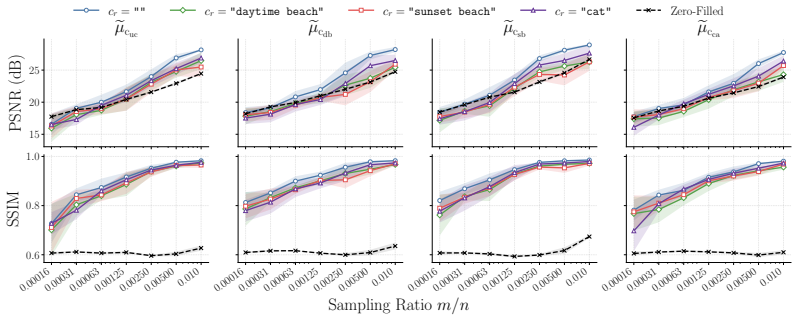
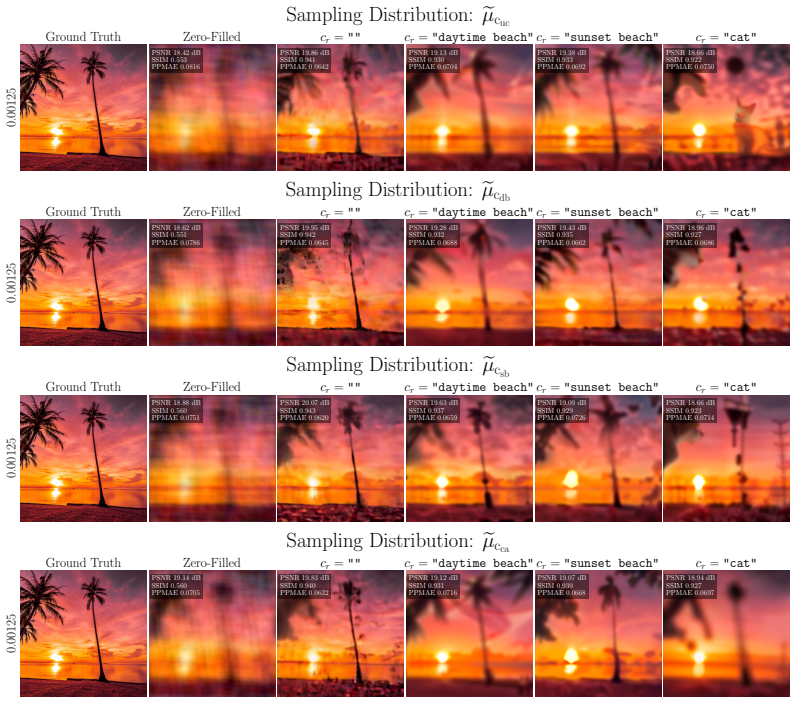
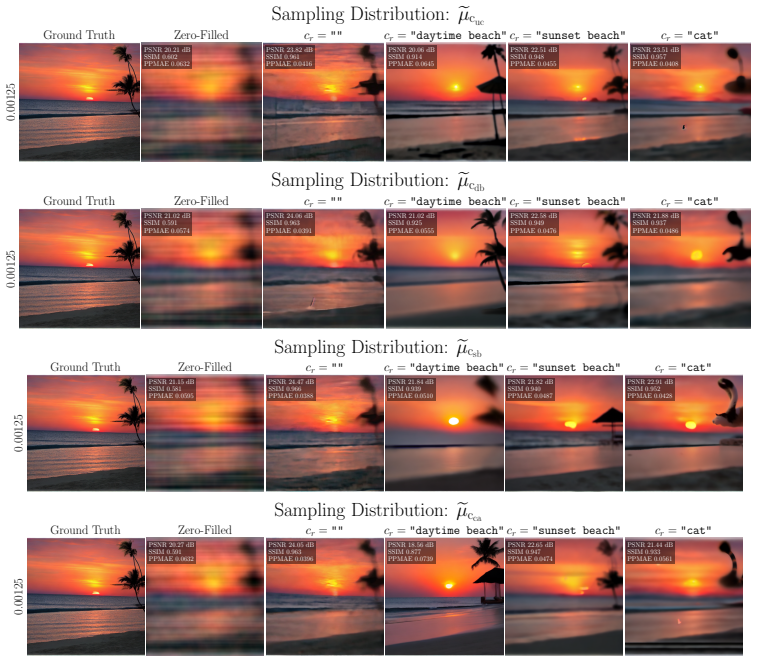
- In practice, prompt choice influences both measurement distribution and image recovery accuracy, as seen in Stable Diffusion tests.
Where Pith is reading between the lines
- This separation of prompt roles could support active learning methods that tune the sampling prompt to reduce the compatibility penalty without retraining the generator.
- The framework may extend to conditional models in other domains like audio or video recovery under limited measurements.
- Treating prompts as tunable variables suggests hybrid systems where sampling strategies adapt based on prompt compatibility metrics.
Load-bearing premise
The analysis assumes conditional generators satisfy ReLU or Lipschitz conditions and that the sampling prompt can be chosen independently while keeping the Christoffel distribution well-defined and computable.
What would settle it
An experiment showing that recovery error bounds remain unchanged under prompt mismatch for a ReLU generator, or that the Christoffel complexity constant increases even with matched prompts.
Figures




read the original abstract
Generative compressed sensing uses the range of a pretrained generator as a nonlinear model for recovering structured signals from limited measurements. We study a conditional version of this problem for image recovery from subsampled Fourier measurements using prompt-conditioned generative models. Our framework separates two roles of conditioning: the prompt used to design the sampling distribution and the prompt used to define the recovery model. For ReLU and Lipschitz conditional generators, we prove stable recovery bounds showing that prompt-matched Christoffel sampling retains the same Christoffel complexity constant as existing near-optimal generative compressed sensing theory, while prompt mismatch incurs an explicit compatibility penalty. Experiments with Stable Diffusion show that prompts meaningfully reshape Christoffel sampling distributions and influence image recovery. Overall, our results suggest that prompts should be treated as design variables with distinct effects on sensing, approximation, and recovery.
Editorial analysis
A structured set of objections, weighed in public.
Referee Report
Summary. The manuscript develops a conditional generative compressed sensing framework for recovering images from subsampled Fourier measurements using prompt-conditioned generators. It explicitly separates the prompt used to design the Christoffel sampling distribution from the prompt defining the recovery model. For ReLU and Lipschitz conditional generators, stable recovery bounds are proved showing that prompt-matched Christoffel sampling preserves the Christoffel complexity constant of prior near-optimal generative CS theory, while prompt mismatch incurs an explicit compatibility penalty. Experiments with Stable Diffusion illustrate that prompts reshape the sampling distributions and influence recovery quality.
Significance. If the stated bounds hold without hidden assumptions, the work meaningfully extends generative compressed sensing to conditional models by positioning prompts as independent design variables for sensing versus recovery. This could enable more principled active sensing strategies when side information is available, with potential impact on applications requiring structured signal recovery under limited measurements.
major comments (2)
- [Theoretical results] Abstract and theoretical results: the claim that prompt-matched Christoffel sampling 'retains the same Christoffel complexity constant' is load-bearing for the central contribution, yet the abstract provides no explicit statement of the bound or the key steps showing the constant is identical rather than asymptotically equivalent; the full derivation (including any error terms for the ReLU/Lipschitz cases) must be supplied to confirm the extension is non-circular.
- [Experiments] Experiments: the abstract states that prompts 'meaningfully reshape Christoffel sampling distributions and influence image recovery,' but without reported quantitative metrics (e.g., recovery error, PSNR/SSIM tables, or ablation on matched vs. mismatched prompts) it is impossible to assess whether the compatibility penalty is observed in practice or remains purely theoretical.
minor comments (2)
- [Abstract] The title emphasizes 'Active Learning' while the abstract and claimed contributions focus on the separation of prompts and the recovery bounds; a brief sentence clarifying the active-learning interpretation of prompt selection would improve clarity.
- Notation for the compatibility penalty and the conditional Christoffel distribution should be introduced with a dedicated definition before the main theorem statements.
Simulated Author's Rebuttal
We thank the referee for their careful reading and constructive feedback. We address each major comment below with clarifications from the manuscript and indicate planned revisions to enhance clarity and completeness.
read point-by-point responses
-
Referee: [Theoretical results] Abstract and theoretical results: the claim that prompt-matched Christoffel sampling 'retains the same Christoffel complexity constant' is load-bearing for the central contribution, yet the abstract provides no explicit statement of the bound or the key steps showing the constant is identical rather than asymptotically equivalent; the full derivation (including any error terms for the ReLU/Lipschitz cases) must be supplied to confirm the extension is non-circular.
Authors: We appreciate the referee drawing attention to the need for explicitness. The full derivations appear in Section 3. Theorem 3.1 (ReLU case) and Theorem 3.2 (Lipschitz case) prove that, when the prompt used for sampling matches the prompt used for recovery, the conditional Christoffel function reduces exactly to its unconditional counterpart; the compatibility penalty term vanishes identically, yielding the same complexity constant as in prior unconditional generative CS results with no additional error terms. The proofs proceed by direct substitution into the definition of the Christoffel measure and application of the same covering-number arguments used in the unconditional setting. To make this load-bearing claim transparent at the abstract level, we will revise the abstract to include a concise statement of the bound. revision: yes
-
Referee: [Experiments] Experiments: the abstract states that prompts 'meaningfully reshape Christoffel sampling distributions and influence image recovery,' but without reported quantitative metrics (e.g., recovery error, PSNR/SSIM tables, or ablation on matched vs. mismatched prompts) it is impossible to assess whether the compatibility penalty is observed in practice or remains purely theoretical.
Authors: We agree that quantitative metrics are necessary to substantiate the practical relevance of the compatibility penalty. The current experiments section provides visual evidence of how prompts alter the Christoffel sampling distributions and affect recovered images with Stable Diffusion, but does not include tabulated numerical results or explicit matched-versus-mismatched ablations. In the revision we will add a table reporting PSNR, SSIM, and relative recovery error across sampling rates for matched and mismatched prompt pairs, together with a short ablation subsection. This will allow readers to observe the penalty empirically. revision: yes
Circularity Check
No significant circularity; derivation extends external GCS theory
full rationale
The paper's central result is a set of stable recovery bounds that explicitly preserve the Christoffel complexity constant from prior near-optimal generative compressed sensing theory while adding an explicit penalty term for prompt mismatch. These bounds are stated under declared assumptions (ReLU/Lipschitz generators and independent sampling vs. recovery prompts) rather than being fitted to data or defined in terms of the target quantities. No equation or step reduces by construction to a self-defined parameter, a fitted input renamed as prediction, or a load-bearing self-citation chain; the analysis treats the existing GCS complexity constant as an external benchmark. The separation of prompt roles is presented as an explicit design choice, not smuggled in via ansatz or prior self-work.
Axiom & Free-Parameter Ledger
axioms (2)
- domain assumption Conditional generators are ReLU networks or Lipschitz continuous functions
- domain assumption Christoffel sampling distribution can be defined from the prompt-conditioned generator range
Reference graph
Works this paper leans on
-
[1]
David L. Donoho. Compressed sensing.IEEE Transactions on Information Theory, 52(4): 1289–1306, 2006
2006
-
[2]
Prior image constrained compressed sensing (PICCS).Medical Physics, 35(2):660–663, 2008
Guang-Hong Chen, Jie Tang, and Shuai Leng. Prior image constrained compressed sensing (PICCS).Medical Physics, 35(2):660–663, 2008
2008
-
[3]
Donoho, and John M
Michael Lustig, David L. Donoho, and John M. Pauly. Sparse MRI: The application of compressed sensing for rapid MR imaging.Magnetic Resonance in Medicine, 58(6):1182–1195, 2007
2007
-
[4]
Duarte, Mark A
Marco F. Duarte, Mark A. Davenport, Dharmpal Takhar, Jason N. Laska, Ting Sun, Kevin F. Kelly, and Richard G. Baraniuk. Single-pixel imaging via compressive sampling.IEEE Signal Processing Magazine, 25(2):83–91, 2008
2008
-
[5]
Brady, and Aggelos K
Xin Yuan, David J. Brady, and Aggelos K. Katsaggelos. Snapshot compressive imaging: Theory, algorithms, and applications.IEEE Signal Processing Magazine, 38(2):65–88, 2021
2021
-
[6]
Herrmann, Michael P
Felix J. Herrmann, Michael P. Friedlander, and Özgür Yılmaz. Fighting the curse of dimension- ality: Compressive sensing in exploration seismology.IEEE Signal Processing Magazine, 29 (3):88–100, 2012
2012
-
[7]
Candès, Justin K
Emmanuel J. Candès, Justin K. Romberg, and Terence Tao. Robust uncertainty principles: Exact signal reconstruction from highly incomplete frequency information.IEEE Transactions on Information Theory, 52(2):489–509, 2006
2006
-
[8]
Candès, Justin K
Emmanuel J. Candès, Justin K. Romberg, and Terence Tao. Stable signal recovery from incomplete and inaccurate measurements.Communications on Pure and Applied Mathematics, 59(8):1207–1223, 2006
2006
-
[9]
Regression shrinkage and selection via the Lasso.Journal of the Royal Statistical Society, Series B, 58(1):267–288, 1996
Robert Tibshirani. Regression shrinkage and selection via the Lasso.Journal of the Royal Statistical Society, Series B, 58(1):267–288, 1996
1996
-
[10]
CRC Press, 2015
Trevor Hastie, Robert Tibshirani, and Martin Wainwright.Statistical Learning with Sparsity: The Lasso and Generalizations. CRC Press, 2015
2015
-
[11]
Krishnaprasad
Yagyensh Chandra Pati, Ramin Rezaiifar, and Perinkulam S. Krishnaprasad. Orthogonal matching pursuit: Recursive function approximation with applications to wavelet decomposition. InAsilomar Conference on Signals, Systems, and Computers, 1993
1993
-
[12]
Tropp and Anna C
Joel A. Tropp and Anna C. Gilbert. Signal recovery from random measurements via orthogonal matching pursuit.IEEE Transactions on Information Theory, 53(12):4655–4666, 2007
2007
-
[13]
Chen, David L
Scott S. Chen, David L. Donoho, and Michael A. Saunders. Atomic decomposition by basis pursuit.SIAM Review, 43(1):129–159, 2001
2001
-
[14]
Hansen.Compressive Imaging: Structure, Sampling, Learning
Ben Adcock and Anders C. Hansen.Compressive Imaging: Structure, Sampling, Learning. Cambridge University Press, 2021. 10
2021
-
[15]
Ashish Bora, Ajil Jalal, Eric Price, and Alexandros G. Dimakis. Compressed sensing using generative models. InInternational Conference on Machine Learning, 2017
2017
-
[16]
Lower bounds for compressed sensing with generative models
Akshay Kamath, Sushrut Karmalkar, and Eric Price. Lower bounds for compressed sensing with generative models. InNeurIPS 2019 Workshop on Solving Inverse Problems with Deep Networks, 2019
2019
-
[17]
On the power of compressed sensing with generative models
Akshay Kamath, Eric Price, and Sushrut Karmalkar. On the power of compressed sensing with generative models. InInternational Conference on Machine Learning, 2020
2020
-
[18]
Information-theoretic lower bounds for compressive sensing with generative models.IEEE Journal on Selected Areas in Information Theory, 1(1): 292–303, 2020
Zhaoqiang Liu and Jonathan Scarlett. Information-theoretic lower bounds for compressive sensing with generative models.IEEE Journal on Selected Areas in Information Theory, 1(1): 292–303, 2020
2020
-
[19]
Dimakis, and Constantine Caramanis
Ajil Jalal, Liu Liu, Alexandros G. Dimakis, and Constantine Caramanis. Robust compressed sensing using generative models. InAdvances in Neural Information Processing Systems, 2020
2020
-
[20]
A unified framework for uniform signal recovery in nonlinear generative compressed sensing
Junren Chen, Jonathan Scarlett, Michael Ng, and Zhaoqiang Liu. A unified framework for uniform signal recovery in nonlinear generative compressed sensing. InAdvances in Neural Information Processing Systems, 2023
2023
-
[21]
Donoho, Juan M
Michael Lustig, David L. Donoho, Juan M. Santos, and John M. Pauly. Compressed sensing MRI.IEEE Signal Processing Magazine, 25(2):72–82, 2008
2008
-
[22]
Hansen, Clarice Poon, and Bogdan Roman
Ben Adcock, Anders C. Hansen, Clarice Poon, and Bogdan Roman. Breaking the coherence barrier: A new theory for compressed sensing.Forum of Mathematics, Sigma, 5:e4, 2017
2017
-
[23]
Compressive sensing with redundant dictionaries and structured measurements.SIAM Journal on Mathematical Analysis, 47(6): 4606–4629, 2015
Felix Krahmer, Deanna Needell, and Rachel Ward. Compressive sensing with redundant dictionaries and structured measurements.SIAM Journal on Mathematical Analysis, 47(6): 4606–4629, 2015
2015
-
[24]
Structure dependent sampling in compressed sensing: theoretical guarantees for tight frames.Applied and Computational Harmonic Analysis, 42(3):402–451, 2017
Clarice Poon. Structure dependent sampling in compressed sensing: theoretical guarantees for tight frames.Applied and Computational Harmonic Analysis, 42(3):402–451, 2017
2017
-
[25]
Cardenas, and Nick Dexter
Ben Adcock, Juan M. Cardenas, and Nick Dexter. CS4ML: A general framework for active learning with arbitrary data based on Christoffel functions. InAdvances in Neural Information Processing Systems, 2023
2023
-
[26]
Scott, Xia Sheng, and Özgür Yılmaz
Aaron Berk, Simone Brugiapaglia, Yaniv Plan, Matthew S. Scott, Xia Sheng, and Özgür Yılmaz. Model-adapted Fourier sampling for generative compressed sensing. InNeurIPS 2023 Workshop on Deep Learning and Inverse Problems, 2023
2023
-
[27]
Scott, and Özgür Yılmaz
Aaron Berk, Simone Brugiapaglia, Babhru Joshi, Yaniv Plan, Matthew S. Scott, and Özgür Yılmaz. A coherence parameter characterizing generative compressed sensing with Fourier measurements.IEEE Journal on Selected Areas in Information Theory, 3(3):502–512, 2022
2022
-
[28]
Scott, Xia Sheng, and Özgür Yılmaz
Yaniv Plan, Matthew S. Scott, Xia Sheng, and Özgür Yılmaz. Denoising guarantees for optimized sampling schemes in compressed sensing.arXiv preprint arXiv:2504.01046, 2025
-
[29]
A statistical perspective of sampling scores for linear regression
Siheng Chen, Rohan Varma, Aarti Singh, and Jelena Kovaˇccevi´c. A statistical perspective of sampling scores for linear regression. InIEEE International Symposium on Information Theory, 2016
2016
-
[30]
Leveraged volume sampling for linear regression
Michal Derezinski, Manfred KK Warmuth, and Daniel J Hsu. Leveraged volume sampling for linear regression. InAdvances in Neural Information Processing Systems, 2018
2018
-
[31]
Generalized leverage scores: Ge- ometric interpretation and applications
Bruno Ordozgoiti, Antonis Matakos, and Aristides Gionis. Generalized leverage scores: Ge- ometric interpretation and applications. InInternational Conference on Machine Learning, 2022
2022
-
[32]
Fourier sparse leverage scores and approximate kernel learning
Tamás Erdélyi, Cameron Musco, and Christopher Musco. Fourier sparse leverage scores and approximate kernel learning. InAdvances in Neural Information Processing Systems, 2020. 11
2020
-
[33]
A universal sampling method for reconstructing signals with simple Fourier transforms
Haim Avron, Michael Kapralov, Cameron Musco, Christopher Musco, Ameya Velingker, and Amir Zandieh. A universal sampling method for reconstructing signals with simple Fourier transforms. InProceedings of the 51st Annual ACM SIGACT Symposium on Theory of Computing, pages 1051–1063, 2019
2019
-
[34]
Compressive sampling
Emmanuel J Candès. Compressive sampling. InProceedings of the International Congress of Mathematicians Madrid, pages 1433–1452, 2007
2007
-
[35]
Stable and robust sampling strategies for compressive imaging
Felix Krahmer and Rachel Ward. Stable and robust sampling strategies for compressive imaging. IEEE Transactions on Image Processing, 23(2):612–622, 2013
2013
-
[36]
On variable density compressive sampling
Gilles Puy, Pierre Vandergheynst, and Yves Wiaux. On variable density compressive sampling. IEEE Signal Processing Letters, 18(10):595–598, 2011
2011
-
[37]
Hyungjin Chung, Dohun Lee, Zihui Wu, Byung-Hoon Kim, Katherine L. Bouman, and Jong Chul Ye. ContextMRI: Enhancing compressed sensing MRI through metadata conditioning. arXiv preprint arXiv:2501.04284, 2025
-
[38]
Prompt-tuning latent diffusion models for inverse problems
Hyungjin Chung, Jong Chul Ye, Peyman Milanfar, and Mauricio Delbracio. Prompt-tuning latent diffusion models for inverse problems. InInternational Conference on Machine Learning, 2024
2024
-
[39]
Regularization by texts for latent diffusion inverse solvers
Jeongsol Kim, Geon Yeong Park, Hyungjin Chung, and Jong Chul Ye. Regularization by texts for latent diffusion inverse solvers. InInternational Conference on Learning Representations, 2025
2025
-
[40]
Kingma, Abhishek Kumar, Stefano Ermon, and Ben Poole
Yang Song, Jascha Sohl-Dickstein, Diederik P. Kingma, Abhishek Kumar, Stefano Ermon, and Ben Poole. Score-based generative modeling through stochastic differential equations. In International Conference on Learning Representations, 2021
2021
-
[41]
Denoising diffusion probabilistic models
Jonathan Ho, Ajay Jain, and Pieter Abbeel. Denoising diffusion probabilistic models. In Advances in Neural Information Processing Systems, 2020
2020
-
[42]
Deep unsuper- vised learning using nonequilibrium thermodynamics
Jascha Sohl-Dickstein, Eric Weiss, Niru Maheswaranathan, and Surya Ganguli. Deep unsuper- vised learning using nonequilibrium thermodynamics. InInternational Conference on Machine Learning, 2015
2015
-
[43]
Goodfellow, Jean Pouget-Abadie, Mehdi Mirza, Bing Xu, David Warde-Farley, Sherjil Ozair, Aaron Courville, and Yoshua Bengio
Ian J. Goodfellow, Jean Pouget-Abadie, Mehdi Mirza, Bing Xu, David Warde-Farley, Sherjil Ozair, Aaron Courville, and Yoshua Bengio. Generative adversarial nets. InAdvances in Neural Information Processing Systems, 2014
2014
-
[44]
Unsupervised Representation Learning with Deep Convolutional Generative Adversarial Networks
Alec Radford, Luke Metz, and Soumith Chintala. Unsupervised representation learning with deep convolutional generative adversarial networks.arXiv preprint arXiv:1511.06434, 2015
work page internal anchor Pith review arXiv 2015
-
[45]
Kingma and Max Welling
Diederik P. Kingma and Max Welling. Auto-encoding variational Bayes. InInternational Conference on Learning Representations, 2014
2014
-
[46]
Optimal sampling for least-squares approximation.Foundations of Computational Mathematics, 25:1975–2034, 2025
Ben Adcock. Optimal sampling for least-squares approximation.Foundations of Computational Mathematics, 25:1975–2034, 2025
1975
-
[47]
High- resolution image synthesis with latent diffusion models
Robin Rombach, Andreas Blattmann, Dominik Lorenz, Patrick Esser, and Björn Ommer. High- resolution image synthesis with latent diffusion models. InIEEE/CVF Conference on Computer Vision and Pattern Recognition, 2022
2022
-
[48]
Diffusers: State-of-the-art diffusion models
Patrick von Platen, Suraj Patil, Anton Lozhkov, Pedro Cuenca, Nathan Lambert, Kashif Rasul, Mishig Davaadorj, Dhruv Nair, Sayak Paul, William Berman, Yiyi Xu, Steven Liu, and Thomas Wolf. Diffusers: State-of-the-art diffusion models. https://github.com/huggingface/ diffusers, 2022
2022
-
[49]
Denoising diffusion implicit models
Jiaming Song, Chenlin Meng, and Stefano Ermon. Denoising diffusion implicit models. In International Conference on Learning Representations, 2021
2021
-
[50]
Classifier-free diffusion guidance
Jonathan Ho and Tim Salimans. Classifier-free diffusion guidance. InNeurIPS 2021 Workshop on Deep Generative Models and Downstream Applications, 2021. 12
2021
-
[51]
Kingma and Jimmy Ba
Diederik P. Kingma and Jimmy Ba. Adam: A method for stochastic optimization. InInterna- tional Conference on Learning Representations, 2015
2015
-
[52]
Sunset Time Tropical Beach Sea with Coconut Palm Tree.https://www.magnific
Magnific. Sunset Time Tropical Beach Sea with Coconut Palm Tree.https://www.magnific. com/free-photo/sunset-time-tropical-beach-sea-with-coconut-palm-tree_ 3531881.htm, n.d. Accessed: 2026-05-02
2026
-
[53]
sunset beach
Alireza Naderi and Yaniv Plan. Beyond independent measurements: General compressed sensing with GNN application. InNeurIPS 2021 Workshop on Deep Learning and Inverse Problems, 2021. 13 A Christoffel Sampling for Machine Learning (CS4ML) In this appendix, we fully outline the abstract CS4ML framework in [25] we harness for Christoffel sampling and bridge t...
2021
discussion (0)
Sign in with ORCID, Apple, or X to comment. Anyone can read and Pith papers without signing in.