Recognition: unknown
Hybridizable discontinuous Galerkin methods for poroelastic wave propagation with symmetric stress approximation
Pith reviewed 2026-05-08 15:38 UTC · model grok-4.3
The pith
Hybridizable discontinuous Galerkin methods for poroelastic waves produce strongly symmetric stress approximations with robust optimal convergence after static condensation.
A machine-rendered reading of the paper's core claim, the machinery that carries it, and where it could break.
Core claim
By recasting the poroelastic equations as a first-order symmetric hyperbolic system and applying a tailored combination of HDG+ and LDG-H discretizations, the method yields a strongly symmetric stress approximation whose errors remain robust with respect to incompressibility and achieve optimal rates after static condensation to displacement and pressure traces; the analysis holds for both semidiscrete and Crank-Nicolson schemes.
What carries the argument
The combined HDG+ and LDG-H discretization of the rewritten first-order symmetric hyperbolic poroelastic system, followed by static condensation that retains only displacement and pressure trace variables.
If this is right
- Strong symmetry of the stress tensor is obtained directly from the discretization without post-processing or additional constraints.
- Error estimates remain uniform as the material approaches the incompressible limit.
- Only displacement and pressure traces survive static condensation, yielding a smaller global algebraic system.
- Optimal convergence rates hold for both the semidiscrete problem and the Crank-Nicolson fully discrete scheme.
Where Pith is reading between the lines
- The trace-only formulation after condensation may simplify coupling to other surface or interface models in multiphysics simulations.
- The symmetry-preserving rewrite could be adapted to related first-order hyperbolic systems such as viscoelastic or thermoelastic wave propagation.
- Because the method avoids locking without extra stabilization, it may enable reliable long-time simulations in geophysical or biomedical porous-media applications where material incompressibility is common.
Load-bearing premise
The original poroelastic equations can be rewritten as a first-order symmetric hyperbolic system that preserves the essential physics so the chosen HDG discretizations remain stable and accurate without extra stabilization.
What would settle it
A numerical experiment on a nearly incompressible test case (Poisson ratio approaching 0.5) that shows either loss of strong stress symmetry or degradation of the predicted optimal convergence rates after condensation.
Figures


read the original abstract
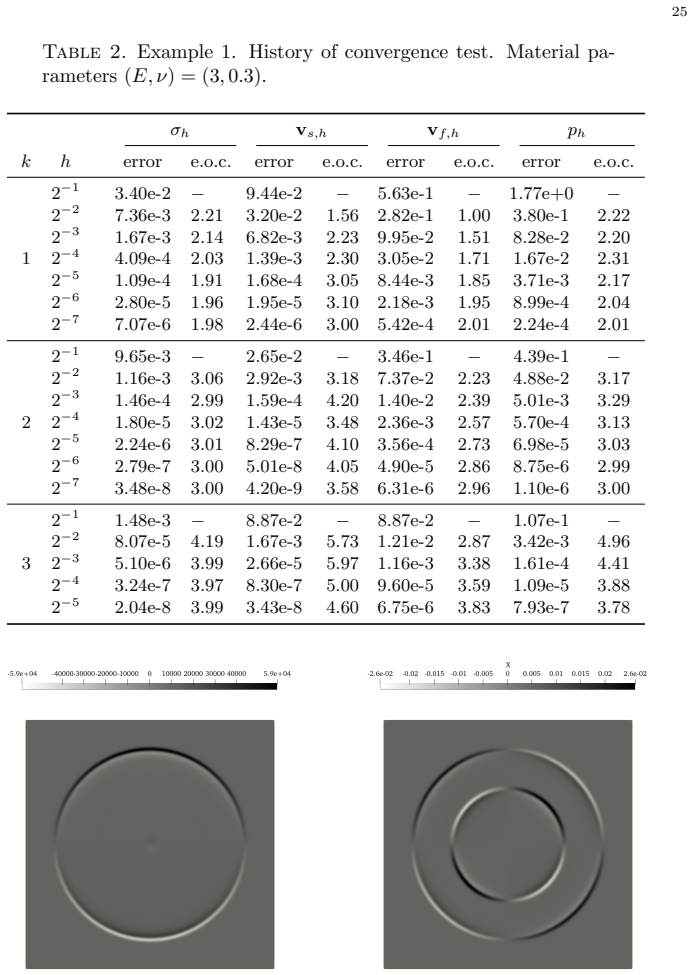
In this paper, we develop hybridized discontinuous Galerkin (HDG) methods for poroelastic wave equations. We first rewrite the governing equations to a first-order symmetric hyperbolic system in order to use dual mixed formulations for discretization. Subsequently, we combine two HDG approaches in the discretization of the system, the $\text{HDG}+$ method for the linear elasticity equations and the $\text{LDG-H}$ method for the diffusion equations, with adjustments for the poroelastic wave equations. In our proposed HDG methods, the numerical approximation of the stress tensor is strongly symmetric and the convergence of the errors are robust for nearly incompressible materials. Upon performing static condensation, the system retains numerical trace variables solely for the solid displacement and the fluid pressure. We provide comprehensive error analyses for both the semidiscrete formulation and the Crank--Nicolson time-stepping scheme. Finally, extensive numerical examples illustrate optimal convergence results and simulate different poroelastic wave propagation scenarios relevant in the literature.
Editorial analysis
A structured set of objections, weighed in public.
Referee Report
Summary. The paper develops hybridized discontinuous Galerkin (HDG) methods for poroelastic wave equations. It first rewrites the governing equations as a first-order symmetric hyperbolic system to enable dual mixed formulations. The discretization then combines the HDG+ method for the linear elasticity component with the LDG-H method for the diffusion component (with adjustments for poroelasticity). This yields strongly symmetric stress approximations that remain robust as the Lamé parameter λ approaches infinity. Static condensation reduces the global system to trace variables for solid displacement and fluid pressure only. Comprehensive error analyses are given for the semidiscrete problem and the Crank–Nicolson time-stepping scheme, and numerical examples demonstrate optimal convergence rates together with simulations of standard poroelastic wave scenarios.
Significance. If the central claims hold, the work supplies a practical and theoretically supported discretization for poroelastic waves that simultaneously enforces strong symmetry of the stress tensor and avoids locking in the nearly incompressible regime. The reduction to displacement and pressure traces via static condensation is a clear computational advantage. The provision of error estimates for both the semidiscrete and fully discrete (Crank–Nicolson) schemes, together with extensive numerical validation, adds concrete value for applications in geophysics and biomechanics. The combination of HDG+ and LDG-H within a single symmetric-hyperbolic framework is a technical contribution worth disseminating once the reformulation step is fully substantiated.
major comments (2)
- [Abstract and §2] Abstract and the reformulation step (presumably §2): The claim that the original poroelastic system can be rewritten as a first-order symmetric hyperbolic system “in order to use dual mixed formulations” is load-bearing for every subsequent result. The abstract does not display the resulting first-order system, so it is impossible to verify that the coupling terms between displacement, stress, pressure, and Darcy velocity remain exactly symmetric and hyperbolic without auxiliary stabilization or loss of the original Biot structure. This must be shown explicitly (with the precise matrix form of the hyperbolic operator) before the error analyses and robustness statements can be accepted.
- [Error-analysis sections (§4–5)] Error-analysis sections (presumably §4–5): The abstract asserts optimal convergence rates that are robust as λ → ∞ for both the semidiscrete and Crank–Nicolson schemes. These rates rest on the assumption that the rewritten symmetric hyperbolic system admits the same stability and approximation properties used in the HDG+ and LDG-H analyses. Without the explicit rewritten equations and the corresponding energy estimates, it is unclear whether the proofs carry over directly or require additional hypotheses that are not stated.
minor comments (2)
- [Numerical examples] Numerical examples: While optimal rates are reported, a direct comparison against a standard (non-hybridized) mixed method or against existing HDG schemes for Biot poroelasticity would strengthen the practical assessment of the new approach.
- [Throughout] Notation: Upon first introduction of the first-order system, all new variables (especially the auxiliary stress and velocity fields) should be listed with their physical meaning and the precise boundary conditions they satisfy.
Simulated Author's Rebuttal
We thank the referee for the thorough review and valuable feedback on our manuscript. We address each major comment below and will make the necessary revisions to strengthen the presentation of the reformulation and error analysis.
read point-by-point responses
-
Referee: [Abstract and §2] Abstract and the reformulation step (presumably §2): The claim that the original poroelastic system can be rewritten as a first-order symmetric hyperbolic system “in order to use dual mixed formulations” is load-bearing for every subsequent result. The abstract does not display the resulting first-order system, so it is impossible to verify that the coupling terms between displacement, stress, pressure, and Darcy velocity remain exactly symmetric and hyperbolic without auxiliary stabilization or loss of the original Biot structure. This must be shown explicitly (with the precise matrix form of the hyperbolic operator) before the error analyses and robustness statements can be accepted.
Authors: We agree that the explicit form of the first-order symmetric hyperbolic system is essential for verifying the symmetry and hyperbolicity. Although the reformulation is derived and presented in Section 2, including the governing equations and the resulting system, we acknowledge that the abstract lacks this detail. In the revised manuscript, we will include the precise matrix form of the hyperbolic operator in the abstract to allow immediate verification. The coupling terms are constructed to maintain symmetry and the original Biot structure without additional stabilization, as shown in the derivation. revision: yes
-
Referee: [Error-analysis sections (§4–5)] Error-analysis sections (presumably §4–5): The abstract asserts optimal convergence rates that are robust as λ → ∞ for both the semidiscrete and Crank–Nicolson schemes. These rates rest on the assumption that the rewritten symmetric hyperbolic system admits the same stability and approximation properties used in the HDG+ and LDG-H analyses. Without the explicit rewritten equations and the corresponding energy estimates, it is unclear whether the proofs carry over directly or require additional hypotheses that are not stated.
Authors: The error analyses in Sections 4 and 5 rely on the well-posedness and stability of the symmetric hyperbolic system, which we establish in Section 2 prior to discretization. The energy estimates for the continuous system are provided there, and the discrete analyses adapt the standard HDG+ and LDG-H techniques accordingly. To clarify, we will add a dedicated subsection in Section 2 summarizing the energy estimates for the rewritten system and explicitly state the hypotheses under which the convergence rates hold, ensuring robustness as λ → ∞. This will make the connection to the error proofs transparent. revision: yes
Circularity Check
No significant circularity; derivation relies on standard reformulation and independent error analysis
full rationale
The paper rewrites the poroelastic equations as a first-order symmetric hyperbolic system to enable dual mixed HDG+ and LDG-H discretizations, then performs static condensation and derives error estimates for the semidiscrete and Crank-Nicolson schemes. This chain is self-contained: the rewrite is presented as a modeling step to fit existing HDG frameworks, the symmetry and robustness claims follow from the subsequent analysis rather than being presupposed by definition, and no fitted parameters are relabeled as predictions. Any self-citations to prior HDG work serve as background for the component methods but are not load-bearing for the central poroelastic extension or its convergence proofs. The derivation does not reduce to its inputs by construction.
Axiom & Free-Parameter Ledger
axioms (1)
- domain assumption Poroelastic wave equations can be rewritten as a first-order symmetric hyperbolic system without loss of essential physical properties.
Reference graph
Works this paper leans on
-
[1]
7, e2020JB021175
Yury Alkhimenkov, Ludovic R¨ ass, Lyudmila Khakimova, Beatriz Quintal, and Yury Podlad- chikov,Resolving wave propagation in anisotropic poroelastic media using graphical pro- cessing units (gpus), Journal of Geophysical Research: Solid Earth126(2021), no. 7, e2020JB021175
2021
-
[2]
H´ el` ene Barucq, Julien Diaz, Rose-Clo´ e Meyer, and Ha Pham,Implementation of hybridizable discontinuous Galerkin method for time-harmonic anisotropic poroelasticity in two dimen- sions, Internat. J. Numer. Methods Engrg.122(2021), no. 12, 3015–3043. MR 4257555
2021
-
[3]
Valtchev, and Jo˜ ao Janela, eds.), Springer Nature Switzerland, 2025, pp
Markus Bause and Mathias Anselmann,Optimal order FEM for dynamic poroelasticity: Error analysis for equal order elements, Numerical Mathematics and Advanced Applications ENUMATH 2023, Volume 1 (Cham) (Ad´ elia Sequeira, Ana Silvestre, Svilen S. Valtchev, and Jo˜ ao Janela, eds.), Springer Nature Switzerland, 2025, pp. 119–128
2023
-
[4]
M. A. Biot,Theory of propagation of elastic waves in a fluid-saturated porous solid. I. Low- frequency range, J. Acoust. Soc. Amer.28(1956), 168–178. MR 134056
1956
-
[5]
,Theory of propagation of elastic waves in a fluid-saturated porous solid. II. Higher frequency range, J. Acoust. Soc. Amer.28(1956), 179–191. MR 134057
1956
-
[6]
Carcione, Christina Morency, and Juan E
Jos´ e M. Carcione, Christina Morency, and Juan E. Santos,Computational poroelasticity — a review, GEOPHYSICS75(2010), no. 5, 75A229–75A243
2010
-
[7]
Lee, and Sander Rhebergen,Analysis of an embedded- hybridizable discontinuous Galerkin method for Biot’s consolidation model, J
Aycil Cesmelioglu, Jeonghun J. Lee, and Sander Rhebergen,Analysis of an embedded- hybridizable discontinuous Galerkin method for Biot’s consolidation model, J. Sci. Comput. 97(2023), no. 3, Paper No. 60, 26. MR 4659441
2023
-
[8]
Yanli Chen, Xin Liu, Wenhui Zhang, and Yufeng Nie,Mixed virtual element methods for the poro-elastodynamics model on polygonal grids, Comput. Math. Appl.174(2024), 431–448. MR 4806433 29
2024
-
[9]
241, Springer, 2016
Alexander H-D Cheng,Poroelasticity, Solid mechanics and its applications, vol. 241, Springer, 2016
2016
-
[10]
Guillaume Chiavassa and Bruno Lombard,Time domain numerical modeling of wave propa- gation in 2D heterogeneous porous media, J. Comput. Phys.230(2011), no. 13, 5288–5309. MR 2799511
2011
-
[11]
11, 2306–2312
Dean Chou, John C Vardakis, Liwei Guo, Brett J Tully, and Yiannis Ventikos,A fully dynamic multi-compartmental poroelastic system: Application to aqueductal stenosis, Journal of biomechanics49(2016), no. 11, 2306–2312
2016
-
[12]
Cockburn, J
B. Cockburn, J. Gopalakrishnan, and R. Lazarov,Unified hybridization of discontinuous Galerkin, mixed, and continuous Galerkin methods for second order elliptic problems, SIAM J Numer Anal47(2009), no. 2, 1319–1365
2009
-
[13]
S´ anchez,A priori error analysis of new semidiscrete, Hamiltonian HDG methods for the time-dependent Maxwell’s equations, ESAIM Math
Bernardo Cockburn, Shukai Du, and Manuel A. S´ anchez,A priori error analysis of new semidiscrete, Hamiltonian HDG methods for the time-dependent Maxwell’s equations, ESAIM Math. Model. Numer. Anal.57(2023), no. 4, 2097–2129. MR 4609879
2023
-
[14]
S´ anchez, and Francisco-Javier Sayas,Stormer-Numerov HDG methods for acoustic waves, J
Bernardo Cockburn, Zhixing Fu, Allan Hungria, Liangyue Ji, Manuel A. S´ anchez, and Francisco-Javier Sayas,Stormer-Numerov HDG methods for acoustic waves, J. Sci. Com- put.75(2018), no. 2, 597–624. MR 3780780
2018
-
[15]
Comp.79(2010), no
Bernardo Cockburn, Jayadeep Gopalakrishnan, and Francisco-Javier Sayas,A projection- based error analysis of HDG methods, Math. Comp.79(2010), no. 271, 1351–1367. MR 2629996
2010
-
[16]
Comp.83(2014), no
Bernardo Cockburn and Vincent Quenneville-B´ elair,Uniform-in-time superconvergence of the HDG methods for the acoustic wave equation, Math. Comp.83(2014), no. 285, 65–85. MR 3120582
2014
-
[17]
Olivier Coussy,Poromechanics, John Wiley & Sons, 2004
2004
-
[18]
Cowin,Bone poroelasticity, Journal of Biomechanics32(1999), no
Stephen C. Cowin,Bone poroelasticity, Journal of Biomechanics32(1999), no. 3, 217–238
1999
-
[19]
Dai,On the asymptotic solution of a wave damping problem arising in inhomogeneous media, Appl
H.-H. Dai,On the asymptotic solution of a wave damping problem arising in inhomogeneous media, Appl. Anal.60(1996), no. 3-4, 327–340. MR 1645587
1996
-
[20]
5, T77– T97
Josep de la Puente, Michael Dumbser, Martin K¨ aser, and Heiner Igel,Discontinuous Galerkin methods for wave propagation in poroelastic media, GEOPHYSICS73(2008), no. 5, T77– T97
2008
-
[21]
Du and F.-J
S. Du and F.-J. Sayas,An invitation to the theory of the hybridizable discontinuous Galerkin method: Projection, estimates, tools, Springer Briefs Math., 2019
2019
-
[22]
Comp.89(2020), no
Shukai Du and Francisco-Javier Sayas,New analytical tools for HDG in elasticity, with ap- plications to elastodynamics, Math. Comp.89(2020), no. 324, 1745–1782. MR 4081917
2020
-
[23]
Comp.90 (2021), no
,A note on devising HDG+ projections on polyhedral elements, Math. Comp.90 (2021), no. 327, 65–79. MR 4166453
2021
-
[24]
Fernandez, A
P. Fernandez, A. Christophe, S. Terrana, N. C. Nguyen, and J. Peraire,Hybridized discontin- uous Galerkin methods for wave propagation, J. Sci. Comput.77(2018), no. 3, 1566–1604. MR 3874786
2018
-
[25]
S. K. Garg, Adnan H. Nayfeh, and A. J. Good,Compressional waves in fluid-saturated elastic porous media, Journal of Applied Physics45(1974), no. 5, 1968–1974
1974
- [26]
-
[27]
MR 2225970
Peter Kunkel and Volker Mehrmann,Differential-algebraic equations, EMS Textbooks in Mathematics, European Mathematical Society (EMS), Z¨ urich, 2006, Analysis and numerical solution. MR 2225970
2006
-
[28]
J. J. Lee, E. Piersanti, K.-A. Mardal, and M. E. Rognes,A mixed finite element method for nearly incompressible multiple-network poroelasticity, SIAM J. Sci. Comput.41(2019), no. 2, A722–A747. MR 3922236
2019
-
[29]
Lee,Robust error analysis of coupled mixed methods for Biot’s consolidation model, J
Jeonghun J. Lee,Robust error analysis of coupled mixed methods for Biot’s consolidation model, J. Sci. Comput.69(2016), no. 2, 610–632. MR 3551338
2016
-
[30]
Lee and Jesus Indalecio Ruiz Bolanos,Analysis of robust hybridized discontin- uous Galerkin methods for viscoacoustic wave equations, J
Jeonghun J. Lee and Jesus Indalecio Ruiz Bolanos,Analysis of robust hybridized discontin- uous Galerkin methods for viscoacoustic wave equations, J. Sci. Comput.102(2025), no. 3, Paper No. 89, 25. MR 4860305
2025
-
[31]
Methods Appl
Christoph Lehrenfeld and Joachim Sch¨ oberl,High order exactly divergence-free hybrid dis- continuous Galerkin methods for unsteady incompressible flows, Comput. Methods Appl. Mech. Engrg.307(2016), 339–361. MR 3511719 30
2016
-
[32]
Lemoine and M
Grady I. Lemoine and M. Yvonne Ou,Finite volume modeling of poroelastic-fluid wave prop- agation with mapped grids, SIAM J. Sci. Comput.36(2014), no. 3, B396–B426. MR 3209731
2014
-
[33]
Lemoine, M
Grady I. Lemoine, M. Yvonne Ou, and Randall J. LeVeque,High-resolution finite volume modeling of wave propagation in orthotropic poroelastic media, SIAM J. Sci. Comput.35 (2013), no. 1, B176–B206. MR 3033065
2013
-
[34]
Y. J. Masson, S. R. Pride, and K. T. Nihei,Finite difference modeling of Biot’s poroelastic equations at seismic frequencies, Journal of Geophysical Research: Solid Earth111(2006), no. B10
2006
-
[35]
Salim Meddahi,Hybridizable discontinuous galerkin method for dynamic poroelasticity: an hp-error analysis, Journal of Numerical Mathematics (2026)
2026
-
[36]
V. C. Mow, S. C. Kuei, W. M. Lai, and C. G. Armstrong,Biphasic creep and stress relaxation of articular cartilage in compression: Theory and experiments, Journal of Biomechanical Engineering102(1980), no. 1, 73–84
1980
-
[37]
Issei Oikawa,A hybridized discontinuous Galerkin method with reduced stabilization, J. Sci. Comput.65(2015), no. 1, 327–340. MR 3394448
2015
-
[38]
,Analysis of a reduced-order HDG method for the Stokes equations, J. Sci. Comput. 67(2016), no. 2, 475–492. MR 3486522
2016
-
[39]
Comp.87(2018), no
Weifeng Qiu, Jiguang Shen, and Ke Shi,An HDG method for linear elasticity with strong symmetric stresses, Math. Comp.87(2018), no. 309, 69–93. MR 3716189
2018
-
[40]
M. A. S´ anchez, C. Ciuca, N. C. Nguyen, J. Peraire, and B. Cockburn,Symplectic Hamiltonian HDG methods for wave propagation phenomena, J. Comput. Phys.350(2017), 951–973. MR 3707190
2017
-
[41]
S´ anchez, Bernardo Cockburn, Ngoc-Cuong Nguyen, and Jaime Peraire,Symplec- tic Hamiltonian finite element methods for linear elastodynamics, Comput
Manuel A. S´ anchez, Bernardo Cockburn, Ngoc-Cuong Nguyen, and Jaime Peraire,Symplec- tic Hamiltonian finite element methods for linear elastodynamics, Comput. Methods Appl. Mech. Engrg.381(2021), Paper No. 113843, 23. MR 4248352
2021
-
[42]
S´ anchez, Shukai Du, Bernardo Cockburn, Ngoc-Cuong Nguyen, and Jaime Peraire, Symplectic Hamiltonian finite element methods for electromagnetics, Comput
Manuel A. S´ anchez, Shukai Du, Bernardo Cockburn, Ngoc-Cuong Nguyen, and Jaime Peraire, Symplectic Hamiltonian finite element methods for electromagnetics, Comput. Methods Appl. Mech. Engrg.396(2022), Paper No. 114969, 27. MR 4425194
2022
-
[43]
Juan Enrique Santos and Ernesto Jorge Ore˜ na,Elastic wave propagation in fluid-saturated porous media. II. The Galerkin procedures, RAIRO Mod´ el. Math. Anal. Num´ er.20(1986), no. 1, 129–139. MR 844520
1986
-
[44]
Sch¨ oberl,NETGEN An advancing front 2D/3D-mesh generator based on abstract rules, Computing and visualization in science1(1997), no
J. Sch¨ oberl,NETGEN An advancing front 2D/3D-mesh generator based on abstract rules, Computing and visualization in science1(1997), no. 1, 41–52
1997
-
[45]
,C++ 11 implementation of finite elements in NGSolve, Institute for Analysis and Scientific Computing, Vienna University of Technology30(2014)
2014
-
[46]
APS Selvadurai and AP Suvorov,Thermo-poroelasticity and geomechanics, Cambridge Uni- versity Press, 2016
2016
-
[47]
de Hoop, and Priyank Jaiswal,A weight-adjusted discontinuous Galerkin method for the poroelastic wave equation: penalty fluxes and micro- heterogeneities, J
Khemraj Shukla, Jesse Chan, Maarten V. de Hoop, and Priyank Jaiswal,A weight-adjusted discontinuous Galerkin method for the poroelastic wave equation: penalty fluxes and micro- heterogeneities, J. Comput. Phys.403(2020), 109061, 34. MR 4045226
2020
-
[48]
Stanglmeier, N
M. Stanglmeier, N. C. Nguyen, J. Peraire, and B. Cockburn,An explicit hybridizable dis- continuous Galerkin method for the acoustic wave equation, Comput. Methods Appl. Mech. Engrg.300(2016), 748–769. MR 3452794
2016
-
[49]
John C Vardakis, Dean Chou, Brett J Tully, Chang C Hung, Tsong H Lee, Po-Hsiang Tsui, and Yiannis Ventikos,Investigating cerebral oedema using poroelasticity, Med. Eng. Phys.38 (2016), no. 1, 48–57
2016
-
[50]
Herbert F Wang,Theory of linear poroelasticity with applications to geomechanics and hy- drogeology, Princeton University Press, 2000
2000
-
[51]
Kosaku Yosida,Functional analysis, 6th ed., Springer Classics in Mathematics, Springer- Verlag, 1980
1980
-
[52]
O. C. Zienkiewicz, A. H. C. Chan, D. K. Paul, and T. Shiomi,Static and dynamic behaviour of soils : a rational approach to quantitative solutions. i. Fully saturated problems, Proc. R. Soc. Lond.A429(1990), 285–309
1990
-
[53]
O. C. Zienkiewicz and T. Shiomi,Dynamic behaviour of saturated porous media; the gener- alized Biot formulation and its numerical solution, International Journal for Numerical and Analytical Methods in Geomechanics8(1984), no. 1, 71–96. 31 Department of Mathematics, Baylor University, Waco, TX 76798, USA Email address:jeonghun lee@baylor.edu Instituto de ...
1984
discussion (0)
Sign in with ORCID, Apple, or X to comment. Anyone can read and Pith papers without signing in.