Recognition: unknown
Model Form Identification in High-Dimensional Functional Linear Regressions
Pith reviewed 2026-05-08 15:50 UTC · model grok-4.3
The pith
MoFI-FLR recovers active functional predictors and correctly classifies their effects as simple or complex.
A machine-rendered reading of the paper's core claim, the machinery that carries it, and where it could break.
Core claim
Under mild regularity conditions, the MoFI-FLR procedure consistently recovers the active covariates and accurately identifies their true functional forms by screening with a functional elastic-net penalty followed by a reproducing-kernel-Hilbert-space decomposition that penalizes only the complementary component of each selected coefficient.
What carries the argument
The MoFI-FLR two-step framework that screens covariates via functional elastic-net and then decomposes each coefficient into a finite simple part and an infinite complementary part, penalizing only the latter to distinguish simple from complex effects.
If this is right
- The procedure selects the truly relevant functional predictors with high probability.
- Each selected predictor is correctly labeled as having only a simple component or as containing additional complex deviations.
- The resulting model remains interpretable because complex effects are isolated to the penalized complementary terms.
- The algorithm runs efficiently enough for datasets with ultra-high-dimensional functional predictors.
Where Pith is reading between the lines
- The selective penalization of deviations from simple forms may transfer to other infinite-dimensional regression problems where interpretability matters.
- Automated distinction between simple and complex functional effects could reduce manual model specification in neuroimaging or longitudinal studies.
- Validation on additional real datasets with partially known functional forms would test whether the identification step generalizes beyond the reported simulations.
Load-bearing premise
Each functional coefficient decomposes into a finite-dimensional simple component and an infinite-dimensional complementary component such that penalizing only the complementary part reliably separates simple effects from complex ones.
What would settle it
A simulation or real dataset with known purely simple true coefficients in which the method returns nonzero estimates for the complementary component on those predictors.
Figures


read the original abstract
High-dimensional functional data are becoming increasingly common in fields such as environmental monitoring and neuroimaging. This paper studies high-dimensional functional linear regression models that relate a scalar response to ultra-high-dimensional functional predictors, where each predictor is treated as a random element in an infinite-dimensional functional space. To address the dual challenges of high-dimensionality and model interpretability, we propose MoFI-FLR, a novel two-step estimation framework rooted in reproducing kernel Hilbert space (RKHS) theory. The first step employs a functional elastic-net penalty to screen out irrelevant covariates, while the second step decomposes each selected predictor's functional coefficient into an interpretable finite-dimensional simple component and an infinite-dimensional complementary complement. By penalizing only the complementary component, our method automatically distinguishes simple effects, which consist only of the simple component, from complex effects, which also include complementary deviations. Under mild regularity conditions, we establish non-asymptotic theoretical guarantees, demonstrating that MoFI-FLR consistently recovers the active covariates and accurately identifies their true functional forms. We develop a computationally efficient algorithm to implement the proposed method and evaluate its performance through comprehensive simulation studies and an application to Psychomotor Vigilance Task EEG data.
Editorial analysis
A structured set of objections, weighed in public.
Referee Report
Summary. The paper proposes MoFI-FLR, a two-step RKHS-based framework for high-dimensional functional linear regression. Step 1 applies a functional elastic-net penalty to screen active covariates from ultra-high-dimensional functional predictors. Step 2 decomposes each selected coefficient into a finite-dimensional 'simple' component plus an infinite-dimensional complementary component, penalizing only the latter to automatically classify effects as simple (exactly in the finite space) or complex. Under mild regularity conditions, the method claims non-asymptotic consistency for recovering active covariates and correctly identifying their true functional forms, supported by an efficient algorithm, simulations, and an EEG data example.
Significance. If the decomposition is provably unique and the non-asymptotic guarantees hold, the work would provide a useful advance in interpretable high-dimensional functional regression, addressing both selection and model-form identification in applications such as neuroimaging. The combination of screening and form classification is novel relative to standard functional lasso or group penalties.
major comments (3)
- [Method description / abstract] The central identification claim rests on the decomposition of each selected functional coefficient into a finite-dimensional simple component and infinite-dimensional complementary component (described in the abstract and method section). The manuscript must explicitly define the construction of the simple space (e.g., choice of basis or subspace), prove uniqueness of the decomposition within the RKHS, and show that penalizing only the complementary norm recovers the true form when the DGP matches one of the two classes. Without this, the distinction between simple and complex effects is not guaranteed to be well-defined or data-adaptive.
- [Theory section] Non-asymptotic theoretical guarantees for consistent form identification (abstract and theory section) are stated under 'mild regularity conditions,' but the conditions are not listed explicitly, nor is it shown that they are satisfied by the proposed decomposition or that the elastic-net screening step preserves the necessary properties for the second step. The error bounds and probability statements therefore cannot be verified as supporting the form-identification claim.
- [Simulation studies] Simulation studies (results section) report performance on recovery and form identification, but the data-generating processes for 'simple' versus 'complex' coefficients are not described in sufficient detail to confirm that the true forms align with the pre-specified finite-dimensional simple space used by MoFI-FLR. This leaves open whether the reported accuracy reflects genuine identification or favorable alignment between simulation design and method assumptions.
minor comments (2)
- Notation for the RKHS inner product, the elastic-net mixing parameter, and the decomposition operators should be introduced with explicit definitions and consistent use across sections.
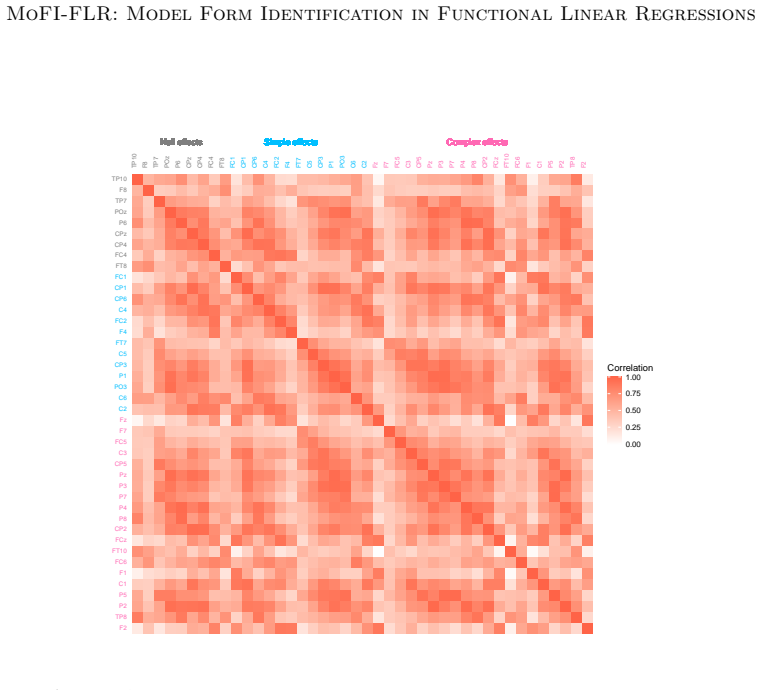
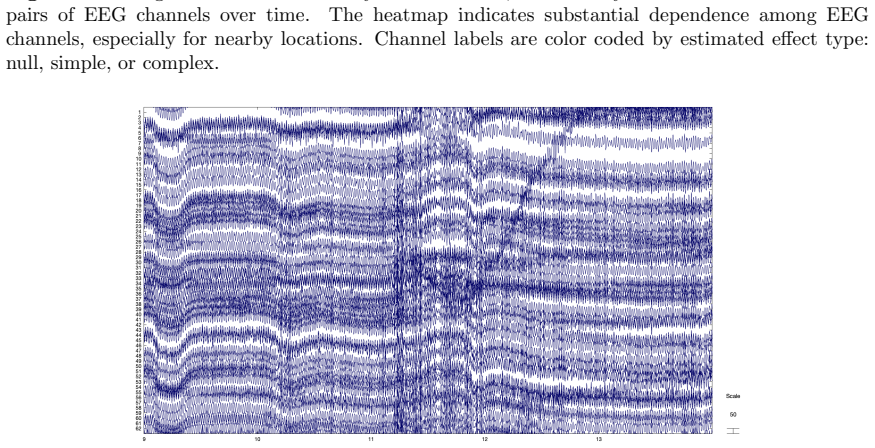
- The real-data EEG application would benefit from a table or figure showing the identified simple versus complex forms for the selected channels, with quantitative measures of fit.
Simulated Author's Rebuttal
We thank the referee for their constructive comments, which have strengthened the clarity and rigor of our work. We address each major comment below and have revised the manuscript to incorporate the suggested clarifications.
read point-by-point responses
-
Referee: The central identification claim rests on the decomposition of each selected functional coefficient into a finite-dimensional simple component and infinite-dimensional complementary component. The manuscript must explicitly define the construction of the simple space (e.g., choice of basis or subspace), prove uniqueness of the decomposition within the RKHS, and show that penalizing only the complementary norm recovers the true form when the DGP matches one of the two classes.
Authors: We appreciate this emphasis on explicit foundations. Section 2.2 already constructs the simple space as the span of the leading K eigenfunctions of the functional predictors' covariance operator (K selected by CV), with the complementary component defined via the orthogonal complement in the RKHS. Uniqueness follows directly from the orthogonal decomposition property of Hilbert spaces. We have added a new proposition in the revised Section 2.3 proving that, when the true coefficient lies in the simple space, the penalty on the complementary norm forces its coefficient to zero. These details are now highlighted in the abstract and method section for clarity. revision: yes
-
Referee: Non-asymptotic theoretical guarantees for consistent form identification are stated under 'mild regularity conditions,' but the conditions are not listed explicitly, nor is it shown that they are satisfied by the proposed decomposition or that the elastic-net screening step preserves the necessary properties for the second step.
Authors: We agree the conditions merit more explicit presentation. The revised theory section (Section 3) now opens with a boxed list of Assumptions 1-4, covering moment bounds, eigenvalue decay, and restricted eigenvalue conditions. A new lemma establishes that the elastic-net screening step preserves the irrepresentable condition needed for form identification in Step 2. The non-asymptotic bounds in Theorems 2-3 are derived under these assumptions, and we verify that the RKHS decomposition satisfies the required smoothness. revision: yes
-
Referee: Simulation studies report performance on recovery and form identification, but the data-generating processes for 'simple' versus 'complex' coefficients are not described in sufficient detail to confirm that the true forms align with the pre-specified finite-dimensional simple space used by MoFI-FLR.
Authors: We have expanded Section 4.1 with full DGP specifications. Simple coefficients are generated exactly within the span of the first five eigenfunctions (matching the method's simple space with K=5). Complex coefficients include controlled orthogonal perturbations from higher eigenfunctions. We added a sensitivity table varying the perturbation magnitude to show that identification accuracy holds beyond perfect alignment, confirming the results reflect genuine form recovery. revision: yes
Circularity Check
No significant circularity detected in derivation chain.
full rationale
The paper presents a two-step RKHS-based procedure: functional elastic-net screening followed by decomposition of selected coefficients into a finite-dimensional simple component plus penalized complementary component. Non-asymptotic consistency results are derived under explicitly stated mild regularity conditions on the functional space and penalties. No load-bearing step reduces by construction to a fitted input, self-definition, or self-citation chain; the identification claim follows from the penalization mechanism and theoretical analysis rather than being presupposed by the decomposition itself.
Axiom & Free-Parameter Ledger
free parameters (1)
- elastic-net penalty parameters
axioms (1)
- domain assumption Mild regularity conditions on the functional spaces, predictors, and data distribution
Reference graph
Works this paper leans on
-
[1]
and Ogden, R
Reiss, Philip T. and Ogden, R. Todd , pages =. Functional generalized linear models with images as predictors , volume =. Biometrics , number =
-
[2]
and Goldsmith, Jeff and Shang, Han Lin and Ogden, R
Reiss, Philip T. and Goldsmith, Jeff and Shang, Han Lin and Ogden, R. Todd , pages =. Methods for Scalar-on-Function Regression , url =. International Statistical Review , doi =
-
[3]
Chemometrics and Intelligent Laboratory Systems , volume=
Chemometrics in food science—a demonstration of the feasibility of a highly exploratory, inductive evaluation strategy of fundamental scientific significance , author=. Chemometrics and Intelligent Laboratory Systems , volume=. 1998 , publisher=
1998
-
[4]
Chemometrics and Intelligent Laboratory Systems , volume=
Exploratory study of sugar production using fluorescence spectroscopy and multi-way analysis , author=. Chemometrics and Intelligent Laboratory Systems , volume=. 1999 , publisher=
1999
-
[5]
Correlation of cognitive dysfunction and diffusion tensor
Hecke, Wim Van and Nagels, Guy and Leemans, Alexander and Vandervliet, Evert and Sijbers, Jan and Parizel, Paul M , journal=. Correlation of cognitive dysfunction and diffusion tensor. 2010 , publisher=
2010
-
[6]
Stat , volume=
Variable selection in generalized functional linear models , author=. Stat , volume=. 2013 , publisher=
2013
-
[7]
Computational Statistics & Data Analysis , volume=
Variable selection for functional regression models via the L1 regularization , author=. Computational Statistics & Data Analysis , volume=. 2011 , publisher=
2011
-
[8]
Computational Statistics & Data Analysis , volume=
Variable and boundary selection for functional data via multiclass logistic regression modeling , author=. Computational Statistics & Data Analysis , volume=. 2014 , publisher=
2014
-
[9]
Journal of Multivariate Analysis , volume=
Consistent variable selection for functional regression models , author=. Journal of Multivariate Analysis , volume=. 2016 , publisher=
2016
-
[10]
Biometrika , volume=
Partially functional linear regression in high dimensions , author=. Biometrika , volume=. 2016 , publisher=
2016
-
[11]
Bioinformatics , volume=
FUNNEL-GSEA: FUNctioNal ELastic-net regression in time-course gene set enrichment analysis , author=. Bioinformatics , volume=. 2017 , publisher=
2017
-
[12]
Canadian Journal of Statistics , volume=
Variable selection in nonparametric functional concurrent regression , author=. Canadian Journal of Statistics , volume=. 2022 , publisher=
2022
-
[13]
Journal of the American Statistical Association , volume=
Linear or nonlinear? Automatic structure discovery for partially linear models , author=. Journal of the American Statistical Association , volume=. 2011 , publisher=
2011
-
[14]
Smoothing spline
Gu, Chong , year=. Smoothing spline
-
[15]
The Annals of Statistics , volume=
Component selection and smoothing in multivariate nonparametric regression , author=. The Annals of Statistics , volume=. 2006 , publisher=
2006
-
[16]
Bernoulli , volume=
Consistent group selection in high-dimensional linear regression , author=. Bernoulli , volume=. 2010 , publisher=
2010
-
[17]
Statistica Sinica, to appear , year=
Variable Selection and Minimax Prediction in High-dimensional Functional Linear Model , author=. Statistica Sinica, to appear , year=
-
[18]
and Yu, B
Jia, J. and Yu, B. , date-added =. On model selection consistency of the elastic net when p n , volume =. Statistica Sinica , pages =
-
[19]
and Zhang, H
Zou, H. and Zhang, H. H. , date-added =. On the adaptive elastic-net with a diverging number of parameters , volume =. The Annals of Statistics , pages =
-
[20]
, date-added =
Zhang, C.-H. , date-added =. Nearly unbiased variable selection under minimax concave penalty , volume =. The Annals of Statistics , pages =
-
[21]
and Li, R
Fan, J. and Li, R. , date-added =. Variable selection via nonconcave penalized likelihood and its oracle properties , volume =. Journal of the American Statistical Association , pages =
-
[22]
and Du, P
Sun, X. and Du, P. and Wang, X. and Ma, P. , date-added =. Optimal penalized function-on-function regression under a reproducing kernel Hilbert space , volume =. Journal of the American Statistical Association , pages =
-
[23]
and Guo, S
Qiao, X. and Guo, S. and James, G. M. , date-added =. Functional Graphical Models , volume =. Journal of the American Statistical Association , number =
-
[24]
Nonparametric inference in generalized functional linear models , volume =
Shang, Zuofeng and Cheng, Guang , date-added =. Nonparametric inference in generalized functional linear models , volume =. The Annals of Statistics , pages =
-
[25]
and Ogden, R
Reiss, Philip T. and Ogden, R. Todd , date-added =. Functional principal component regression and functional partial least squares , volume =. Journal of the American Statistical Association , pages =
-
[26]
Adaptive global testing for functional linear models , volume =
Lei, Jing , date-added =. Adaptive global testing for functional linear models , volume =. Journal of the American Statistical Association , pages =
-
[27]
The Annals of Statistics , pages =
Hall, Peter and M\"uller, Hans-Georg and Wang, Jane-Ling , date-added =. The Annals of Statistics , pages =
-
[28]
Journal of the American Statistical Association , pages =
Yao, Fang and M\"uller, Hans-Georg and Wang, Jane-Ling , date-added =. Journal of the American Statistical Association , pages =
-
[29]
Tony and Hall, Peter , date-added =
Cai, T. Tony and Hall, Peter , date-added =. Prediction in functional linear regression , volume =. The Annals of Statistics , pages =
-
[30]
From sparse to dense functional data and beyond , volume =
Zhang, Xiaoke and Wang, Jane-Ling , date-added =. From sparse to dense functional data and beyond , volume =. The Annals of Statistics , pages =
-
[31]
The Annals of Statistics , pages =
Li, Yehua and Hsing, Tailen , date-added =. The Annals of Statistics , pages =
-
[32]
Generalized Linear Models with Functional Predictor Variables , volume =
James, Gareth , journal =. Generalized Linear Models with Functional Predictor Variables , volume =
-
[33]
uller,Hans-Georg and Stadtm\
M\"uller,Hans-Georg and Stadtm\"uller, Ulrich , date-added =. The Annals of Statistics , pages =
-
[34]
Crambes, Christophe and Kneip, Alois and Sarda, Pascal , journal =
-
[35]
and Wang, Naisyin , journal =
Liu, Yanghui and Li, Yehua and Carroll, Raymond J. and Wang, Naisyin , journal =. Predictive functional linear models with diverging number of semiparametric single-index interactions , volume =
-
[36]
and Lei, E
Yao, F. and Lei, E. and Wu, Y. , date-added =. Biometrika , pages =
-
[37]
Tony and Yuan, Ming , date-added =
Cai, T. Tony and Yuan, Ming , date-added =. Journal of the American Statistical Association , pages =
-
[38]
Cai, T. T. and Yuan, M. , date-added =. Journal of the American Statistical Association , pages =
-
[39]
Tibshirani, R. J. , date-added =. Regression shrinkage and selection via the lasso , volume =. Journal of the Royal Statistical Society, Series B , pages =
-
[40]
and Radchenko, Peter , date-added =
Fan, Yingying and James, Gareth M. and Radchenko, Peter , date-added =. Functional additive regression , volume =. The Annals of Statistics , pages =
-
[41]
Hypothesis Testing in Large-scale Functional Linear Regression , volume =
Xue, Kaijie and Yao, Fang , date-added =. Hypothesis Testing in Large-scale Functional Linear Regression , volume =. Statistica Sinica , pages =
-
[42]
and Silverman, Barnard W
Ramsay, James O. and Silverman, Barnard W. , date-added =. Functional Data Analysis , year =
-
[43]
and Li, Y
Wong, R. and Li, Y. and Zhu, Z. , date-added =. Partially linear functional additive models for multivariate functional data , volume =. Journal of the American Statistical Association , pages =
-
[44]
Regularization and variable selection via the elastic net , volume =
Zou, Hui and Hastie, Trevor , journal =. Regularization and variable selection via the elastic net , volume =
-
[45]
Spline Models for Observational Data , year =
Wahba, Grace , publisher =. Spline Models for Observational Data , year =
-
[46]
Concentration inequalities and moment bounds for sample covariance operators , volume =
Koltchinskii, Vladimir and Lounici, Karim , journal =. Concentration inequalities and moment bounds for sample covariance operators , volume =
-
[47]
Theoretical foundations of functional data analysis, with an introduction to linear operators , volume =
Hsing, Tailen and Eubank, Randall , publisher =. Theoretical foundations of functional data analysis, with an introduction to linear operators , volume =
-
[48]
Sharp thresholds for High-Dimensional and noisy sparsity recovery using _1 -Constrained Quadratic Programming (Lasso) , volume =
Wainwright, Martin J , date-modified =. Sharp thresholds for High-Dimensional and noisy sparsity recovery using _1 -Constrained Quadratic Programming (Lasso) , volume =. IEEE Transactions on Information Theory , number =
-
[49]
A reproducing kernel Hilbert space approach to functional linear regression , volume =
Yuan, Ming and Cai, T Tony , date-modified =. A reproducing kernel Hilbert space approach to functional linear regression , volume =. The Annals of Statistics , number =
-
[50]
On model selection consistency of Lasso , volume =
Zhao, Peng and Yu, Bin , date-modified =. On model selection consistency of Lasso , volume =. Journal of Machine Learning Research , pages =
-
[51]
Pseudosplines , volume =
Hastie, Trevor , date-modified =. Pseudosplines , volume =. Journal of the Royal Statistical Society: Series B , number =
-
[52]
Penalized likelihood regression: general formulation and efficient approximation , volume =
Gu, Chong and Kim, Young-Ju , journal =. Penalized likelihood regression: general formulation and efficient approximation , volume =
-
[53]
Semiparametric Regression , year =
Ruppert, David and Wand, Matt P and Carroll, Raymond J , publisher =. Semiparametric Regression , year =
-
[54]
Efficient computation of smoothing splines via adaptive basis sampling , volume =
Ma, Ping and Huang, Jianhua Z and Zhang, Nan , journal =. Efficient computation of smoothing splines via adaptive basis sampling , volume =
-
[55]
Low-rank approximation for smoothing spline via eigensystem truncation , volume =
Xu, Danqing and Wang, Yuedong , journal =. Low-rank approximation for smoothing spline via eigensystem truncation , volume =
-
[56]
Sparse additive models , volume =
Ravikumar, Pradeep and Lafferty, John and Liu, Han and Wasserman, Larry , journal =. Sparse additive models , volume =
-
[57]
Model selection and estimation in regression with grouped variables , volume =
Yuan, Ming and Lin, Yi , journal =. Model selection and estimation in regression with grouped variables , volume =
-
[58]
The lasso problem and uniqueness , volume =
Tibshirani, Ryan J , date-modified =. The lasso problem and uniqueness , volume =. Electronic Journal of Statistics , pages =
-
[59]
Regression shrinkage and selection via the lasso , volume =
Tibshirani, Robert , journal =. Regression shrinkage and selection via the lasso , volume =
-
[60]
Conditional functional graphical models , volume =
Lee, Kuang-Yao and Ji, Dingjue and Li, Lexin and Constable, Todd and Zhao, Hongyu , journal =. Conditional functional graphical models , volume =
-
[61]
Task-induced brain state manipulation improves prediction of individual traits , volume =
Greene, Abigail S and Gao, Siyuan and Scheinost, Dustin and Constable, R Todd , date-modified =. Task-induced brain state manipulation improves prediction of individual traits , volume =. Nature Communications , number =
-
[62]
The WU-Minn human connectome project: an overview , volume =
Van Essen, David C and Smith, Stephen M and Barch, Deanna M and Behrens, Timothy EJ and Yacoub, Essa and Ugurbil, Kamil and Wu-Minn HCP Consortium and others , journal =. The WU-Minn human connectome project: an overview , volume =
-
[63]
Functional connectome fingerprinting: identifying individuals using patterns of brain connectivity , volume =
Finn, Emily S and Shen, Xilin and Scheinost, Dustin and Rosenberg, Monica D and Huang, Jessica and Chun, Marvin M and Papademetris, Xenophon and Constable, R Todd , date-modified =. Functional connectome fingerprinting: identifying individuals using patterns of brain connectivity , volume =. Nature Neuroscience , number =
-
[64]
A neural basis for general intelligence , volume =
Duncan, John and Seitz, Rudiger J and Kolodny, Jonathan and Bor, Daniel and Herzog, Hans and Ahmed, Ayesha and Newell, Fiona N and Emslie, Hazel , journal =. A neural basis for general intelligence , volume =
-
[65]
The Parieto-Frontal Integration Theory (P-FIT) of intelligence: converging neuroimaging evidence , volume =
Jung, Rex E and Haier, Richard J , date-modified =. The Parieto-Frontal Integration Theory (P-FIT) of intelligence: converging neuroimaging evidence , volume =. Behavioral and Brain Sciences , number =
-
[66]
Adaptive estimation of a quadratic functional by model selection , year =
Laurent, Beatrice and Massart, Pascal , journal =. Adaptive estimation of a quadratic functional by model selection , year =
-
[67]
On the Inverse of the Covariance Matrix of a First Order Moving Average , volume=
Shaman, Paul , journal =. On the Inverse of the Covariance Matrix of a First Order Moving Average , volume=
-
[68]
Biometrika , volume =
Zapata, J and Oh, S Y and Petersen, A , title = ". Biometrika , volume =
-
[69]
Biometrika , volume=
Analysis of correlated random effects: Linear model with two random components , author=. Biometrika , volume=
-
[70]
Component selection and smoothing in multivariate nonparametric regression , author=
-
[71]
, author=
Minimax-optimal rates for sparse additive models over kernel classes via convex programming. , author=. Journal of Machine Learning Research , volume=
-
[72]
Tsybakov, Alexandre B. Introduction to Nonparametric Estimation. 2009. doi:10.1007/b13794
-
[73]
Pathwise Coordinate Optimization , urldate =
Jerome Friedman and Trevor Hastie and Holger Höfling and Robert Tibshirani , journal =. Pathwise Coordinate Optimization , urldate =
-
[74]
Annals of Operations Research , volume=
Some new bounds for singular values and eigenvalues of matrix products , author=. Annals of Operations Research , volume=. 2000 , publisher=
2000
-
[75]
Scientific Data , volume=
Open multi-session and multi-task EEG cognitive Dataset for passive brain-computer Interface Applications , author=. Scientific Data , volume=. 2023 , publisher=
2023
-
[76]
Sleep , volume=
Response speed measurements on the psychomotor vigilance test: how precise is precise enough? , author=. Sleep , volume=. 2021 , publisher=
2021
-
[77]
Sleep Medicine , volume=
Topographic electroencephalogram changes associated with psychomotor vigilance task performance after sleep deprivation , author=. Sleep Medicine , volume=. 2014 , publisher=
2014
-
[78]
Accident Analysis & Prevention , volume=
Electroencephalographic and peripheral temperature dynamics during a prolonged psychomotor vigilance task , author=. Accident Analysis & Prevention , volume=. 2019 , publisher=
2019
-
[79]
Journal of Sleep Research , volume=
Event-related activity and phase locking during a psychomotor vigilance task over the course of sleep deprivation , author=. Journal of Sleep Research , volume=. 2011 , publisher=
2011
-
[80]
low vigilance during a selective visual attention task , author=
Dissociable effects of reward on P300 and EEG spectra under conditions of high vs. low vigilance during a selective visual attention task , author=. Frontiers in Human Neuroscience , volume=. 2020 , publisher=
2020
discussion (0)
Sign in with ORCID, Apple, or X to comment. Anyone can read and Pith papers without signing in.