Recognition: unknown
Pulse-Width-Specific Phase Space Informed Universal Beam Modeling for UHDR electron LINAC in FLASH-RT
Pith reviewed 2026-05-08 15:14 UTC · model grok-4.3
The pith
Regression models from pulse-width-specific phase space files predict electron beam parameters at any width for FLASH radiotherapy while preserving clinical accuracy.
A machine-rendered reading of the paper's core claim, the machinery that carries it, and where it could break.
Core claim
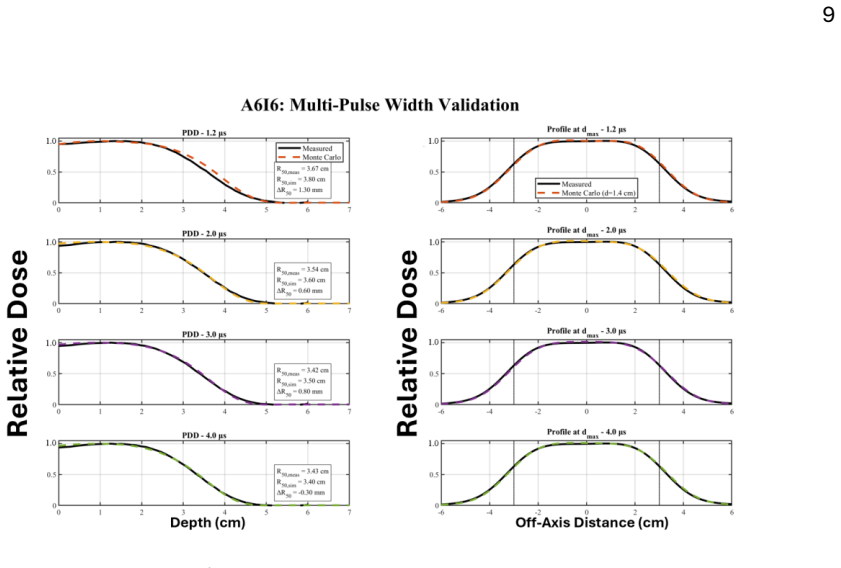
Beam quality shifts caused by RF waveguide loading are independent of downstream collimation, so relationships derived from a single 6 cm aperture apply without adjustment to apertures from 2.5 cm to 10 cm; mean energy falls exponentially from 9.58 to 9.04 MeV and energy spread rises quadratically as pulse width increases, with validated regressions enabling prediction at arbitrary widths and a universal reference that keeps R50 deviations within 1.3 mm and other depth-dose parameters within 2.0 mm.
What carries the argument
Pulse-width-specific phase space files whose source parameters (mean energy matched to R50, energy spread matched to surface dose and build-up) are refined iteratively in GAMOS against phantom measurements.
If this is right
- Regression equations allow beam parameters to be generated for any pulse width without new full Monte Carlo runs.
- The 2.28 microsecond universal reference produces a single phase space file usable for all clinical apertures while meeting AAPM TG-106 tolerances.
- Computational load for treatment planning simulations drops by 75 percent compared with creating separate files for each pulse width.
- Cross-aperture validation confirms energy and spread relationships transfer directly, removing the need to repeat measurements for each collimator size.
Where Pith is reading between the lines
- The same independence of loading effects from aperture could be tested on other UHDR electron systems to see whether the regression forms generalize.
- If the models remain accurate at pulse widths outside the measured 1.2-4.0 microsecond range, they would support real-time adaptation of pulse settings during delivery.
- Integration of the universal reference into planning workflows would reduce the number of pre-computed files that must be stored and validated.
Load-bearing premise
Beam quality shifts from RF waveguide loading remain the same regardless of which clinical aperture is placed downstream.
What would settle it
A direct measurement at fixed pulse width but different apertures showing R50 or surface dose deviating beyond the reported tolerances would show the independence does not hold.
Figures

read the original abstract
Commercial treatment planning systems for electron FLASH radiotherapy are unavailable, and the dosimetric precision required for ultra-high dose rate delivery makes Monte Carlo (MC) simulation the gold standard approach. This work establishes a methodology for generating pulse-width-specific phase space (PHSP) files for the Mobetron UHDR system (9 MeV), accounting for systematic beam quality shifts caused by RF waveguide loading across pulse widths of 1.2-4.0 microsecond. Using GAMOS 6.2.0, source parameters were iteratively refined against experimental targets: mean energy was optimized by matching phantom-measured R50 in the fall-off region, while energy spread was refined using surface dose and build-up gradients. Relationships derived from a mid-range 6 cm aperture were applied across all clinical configurations (2.5-10 cm) to test the aperture-independence of beam loading effects. Mean energy decreased exponentially from 9.58 to 9.04 MeV (R^2=0.99) with increasing pulse width, while energy spread increased quadratically (R^2=0.99), with a strong negative correlation (r=-0.98). Cross-aperture validation confirmed that energy shifts are independent of downstream collimation. The geometric mean pulse width (2.28 microsecond) was evaluated as a universal clinical reference, yielding 9.32 MeV mean energy. Across experimental extremes, R50 deviations were within 1.3 mm and critical depth-dose parameters remained within 2.0 mm, meeting AAPM TG-106 tolerances. Validated regression models enable beam parameter prediction at arbitrary pulse widths, and the universal reference reduces computational burden by 75% while maintaining clinical accuracy.
Editorial analysis
A structured set of objections, weighed in public.
Referee Report
Summary. The manuscript describes a methodology for generating pulse-width-specific phase space files for the Mobetron 9 MeV UHDR electron LINAC in FLASH-RT. Using GAMOS Monte Carlo simulations, mean energy (optimized via R50 matching) and energy spread (optimized via surface dose and build-up) are fitted with exponential and quadratic regressions to pulse widths from 1.2-4.0 μs based on measurements at a single 6 cm aperture. These relationships are applied unchanged to clinical apertures from 2.5-10 cm under an independence assumption, with a proposed universal reference at the geometric mean pulse width of 2.28 μs yielding 9.32 MeV. Validation reports R50 deviations within 1.3 mm and other depth-dose parameters within 2.0 mm across extremes, meeting AAPM TG-106 tolerances, and claims a 75% reduction in computational burden.
Significance. If the aperture-independence assumption holds and the regressions are robust, this work would provide a practical, validated framework for efficient Monte Carlo beam modeling in electron FLASH radiotherapy, where commercial TPS are unavailable. The high R²=0.99 fits, strong correlation (r=-0.98), and tolerance compliance are strengths that could reduce simulation overhead while supporting clinical accuracy; the universal reference concept adds workflow efficiency.
major comments (2)
- [Abstract and Methods] The load-bearing assumption that RF waveguide loading effects on beam quality are independent of downstream collimation is supported only by cross-aperture validation after optimization exclusively on the 6 cm reference aperture (R50 for mean energy; surface dose/build-up for spread). Specific quantitative metrics for the other apertures (e.g., R50 and dose parameter deviations at 2.5 cm and 10 cm) are not detailed enough to exclude residual aperture-dependent scattering or collimator-induced spectral filtering, which could systematically affect transferred phase-space files even if R50 stays within tolerance.
- [Results] No uncertainty quantification is provided for the regression coefficients, the propagated uncertainties in predicted mean energy/energy spread at arbitrary pulse widths, or the sensitivity of the iterative optimization procedure. This limits assessment of robustness when applying the 6 cm-derived models to non-reference apertures without re-fitting.
minor comments (2)
- [Abstract] The abstract states the universal reference reduces computational burden by 75%, but the basis for this figure (e.g., number of simulations avoided or timing comparison) is not explained.
- Consider including a table of the explicit regression coefficients (exponential for mean energy, quadratic for spread) with their fitted values and goodness-of-fit statistics for direct reproducibility.
Simulated Author's Rebuttal
We thank the referee for the constructive and detailed comments. We address each major point below and will incorporate revisions to improve clarity and robustness without altering the core findings or methodology.
read point-by-point responses
-
Referee: [Abstract and Methods] The load-bearing assumption that RF waveguide loading effects on beam quality are independent of downstream collimation is supported only by cross-aperture validation after optimization exclusively on the 6 cm reference aperture (R50 for mean energy; surface dose/build-up for spread). Specific quantitative metrics for the other apertures (e.g., R50 and dose parameter deviations at 2.5 cm and 10 cm) are not detailed enough to exclude residual aperture-dependent scattering or collimator-induced spectral filtering, which could systematically affect transferred phase-space files even if R50 stays within tolerance.
Authors: The mean energy and energy spread models were derived exclusively from the 6 cm aperture because it provides a representative mid-range clinical field size with high measurement reliability. The aperture-independence assumption was then tested by transferring these models unchanged to the 2.5 cm and 10 cm apertures and comparing the resulting simulated depth-dose curves against independent experimental measurements at those apertures. The manuscript already states that R50 deviations remained within 1.3 mm and other depth-dose parameters within 2.0 mm across the pulse-width extremes, satisfying AAPM TG-106 tolerances. To allow direct evaluation of any residual aperture-dependent effects, we will add a new supplementary table in the revised manuscript that tabulates, for the 2.5 cm and 10 cm apertures at both the shortest (1.2 μs) and longest (4.0 μs) pulse widths, the measured versus simulated values of R50, surface dose, dose at dmax, and the 50–90% build-up gradient, together with the absolute deviations. This will make the cross-aperture agreement fully quantitative and transparent. revision: yes
-
Referee: [Results] No uncertainty quantification is provided for the regression coefficients, the propagated uncertainties in predicted mean energy/energy spread at arbitrary pulse widths, or the sensitivity of the iterative optimization procedure. This limits assessment of robustness when applying the 6 cm-derived models to non-reference apertures without re-fitting.
Authors: We agree that explicit uncertainty quantification would strengthen the assessment of model robustness. In the revised manuscript we will report the standard errors of the fitted coefficients for both the exponential mean-energy regression and the quadratic energy-spread regression, obtained directly from the least-squares fits to the five measured pulse widths. These uncertainties will be propagated analytically to the predicted mean energy and energy spread at any arbitrary pulse width, including the proposed universal reference at the geometric mean of 2.28 μs. For the iterative optimization procedure itself, we will add a short sensitivity analysis demonstrating that the final optimized parameters (and the resulting R50 and surface-dose values) remain stable to within 0.5 mm and 1% when the initial guesses are varied over the physically plausible range; this analysis can be performed by re-processing the existing simulation output files without requiring new Monte Carlo runs. revision: yes
Circularity Check
No significant circularity; empirical fits and cross-validation are independent of inputs
full rationale
The derivation fits exponential and quadratic regressions to measured R50, surface dose, and build-up data obtained at discrete pulse widths on the 6 cm reference aperture, then applies the resulting functional forms to predict parameters at unmeasured widths and other apertures. Cross-aperture validation supplies an external check on the independence assumption rather than a self-referential loop. No step equates a claimed prediction to its own fitted inputs by construction, no self-citation chain is load-bearing, and no uniqueness theorem or ansatz is smuggled in. The central claims therefore rest on experimental targets and independent validation rather than tautology.
Axiom & Free-Parameter Ledger
free parameters (3)
- mean energy per pulse width
- energy spread per pulse width
- exponential and quadratic regression coefficients
axioms (3)
- domain assumption Exponential decay accurately describes mean-energy dependence on pulse width
- domain assumption Quadratic increase accurately describes energy-spread dependence on pulse width
- domain assumption RF waveguide loading effects are independent of downstream aperture
Reference graph
Works this paper leans on
-
[1]
Antolak J A, Bieda M R and Hogstrom K R 2002 Using Monte Carlo methods to commission electron beams: a feasibility study Med. Phys. 29 771–86
2002
-
[2]
Arce P , Lagares I J, Harkness L, Pérez-Astudillo D, Cañadas M, Rato P , de Prado M, Abreu Y , de Lorenzo G, Kolstein M and Díaz A 2014 GAMOS: a framework to do Geant4 simulations in 16 different physics fields with an user-friendly interface Nucl. Instrum. Methods Phys. Res. A 735 304–13
2014
-
[3]
Audet S, Beaulieu W, Zerouali K, Guillet D, Bouchard H and Lalonde A 2025 Physics-based energy spectrum optimization (PESO): a new method to model the energy spectrum of a compact ultra- high dose rate electron linac for Monte Carlo dose calculation Phys. Med. Biol. 70 085002
2025
-
[4]
Capote R, Jeraj R, Ma C-M, Rogers D W O, Sánchez-Doblado F, Sempau J, Seuntjens J and Siebers J V 2006 Phase-Space Database for External Beam Radiotherapy IAEA-TECDOC-1540 (Vienna: International Atomic Energy Agency)
2006
-
[5]
105: issues associated with clinical implementation of Monte Carlo-based photon and electron external beam treatment planning Med
Chetty I J, Curran B, Cygler J E, DeMarco J J, Ezzell G, Faddegon B A, Kawrakow I, Keall P J, Liu H, Ma C-M C, Rogers D W O, Seuntjens J, Sheikh-Bagheri D and Siebers J V 2007 Report of the AAPM Task Group No. 105: issues associated with clinical implementation of Monte Carlo-based photon and electron external beam treatment planning Med. Phys. 34 4818–53
2007
-
[6]
Dai T, Sloop A M, Ashraf M R, Sunnerberg J P , Clark M A, Bruza P , Pogue B W, Jarvis L, Gladstone D J and Zhang R 2024 Commissioning an ultra-high-dose-rate electron linac with end-to-end tests Phys. Med. Biol. 69 165028
2024
-
[7]
Das I J, Cheng C-W, Watts R J, Ahnesjö A, Gibbons J, Li X A, Lowenstein J, Mitra R K, Simon W E and Zhu T C 2008 Accelerator beam data commissioning equipment and procedures: report of the TG-106 of the Therapy Physics Committee of the AAPM Med. Phys. 35 4186–215
2008
-
[8]
Faddegon B A, Sawkey D, O'Shea T, McEwen M and Ross C 2009 Treatment head disassembly to improve the accuracy of large electron field simulation Med. Phys. 36 4577–91
2009
-
[9]
Favaudon V, Caplier L, Monceau V, Pouzoulet F, Sayarath M, Fouillade C, Poupon M-F, Brito I, Hupé P , Bourhis J, Hall J, Fontaine J-J and Vozenin M-C 2014 Ultrahigh dose-rate FLASH irradiation increases the differential response between normal and tumor tissue in mice Sci. Transl. Med. 6 245ra93
2014
-
[10]
Guerra P , Udías J M, Herranz E, Santos-Miranda J A, Herraiz J L, Valdivieso M F, Rodríguez R, Calama J A, Pascau J, Calvo F A, Illana C, Ledesma-Carbayo M J and Santos A 2014 Feasibility assessment of the interactive use of a Monte Carlo algorithm in treatment planning for intraoperative electron radiation therapy Phys. Med. Biol. 59 7159–79
2014
-
[11]
Herranz E, Herraiz J L, Ibáñez P , Pérez-Liva M, Puebla R, Cal-González J, Guerra P , Rodríguez R, Illana C and Udías J M 2015 Phase space determination from measured dose data for intraoperative electron radiation therapy Phys. Med. Biol. 60 375–401 17
2015
-
[12]
Hogstrom K R and Almond P R 2006 Review of electron beam therapy physics Phys. Med. Biol. 51 R455–89
2006
-
[13]
ICRU (International Commission on Radiation Units and Measurements) 1984 Radiation Dosimetry: Electron Beams with Energies Between 1 and 50 MeV ICRU Report 35 (Bethesda, MD: ICRU)
1984
-
[14]
Janssen J J, Korevaar E W, van Battum L J, Storchi P R M and Huizenga H 2001 A model to determine the initial phase space of a clinical electron beam from measured beam data Phys. Med. Biol. 46 269–86
2001
-
[15]
Karzmark C J and Morton R J 2017 A Primer on Theory and Operation of Linear Accelerators in Radiation Therapy 3rd edn (Madison, WI: Medical Physics Publishing)
2017
-
[16]
Liu F, Shi J, Zha H, Gao Q, Chen H and Qiu J 2025 Transient study of beam instability due to beam loading in standing-wave low-energy electron linear accelerators Phys. Rev. Accel. Beams 28 050101
2025
-
[17]
Liu K, Palmiero A, Chopra N, Velasquez B, Li Z, Beddar S and Schüler E 2023 Dual beam-current transformer design for monitoring and reporting of electron ultra-high dose rate (FLASH) beam parameters J. Appl. Clin. Med. Phys. 24 e13891
2023
-
[18]
Ma C-M and Jiang S B 1999 Monte Carlo modelling of electron beams from medical accelerators Phys. Med. Biol. 44 R157–89
1999
-
[19]
Montay-Gruel P , Petersson K, Jaccard M, Boivin G, Germond J-F, Petit B, Doenlen R, Favaudon V, Bochud F, Bailat C, Bourhis J and Vozenin M-C 2017 Irradiation in a flash: unique sparing of memory in mice after whole brain irradiation with dose rates above 100 Gy/s Radiother. Oncol. 124 365–9
2017
-
[20]
Palmiero A, Liu K, Colnot J, Chopra N, Neill D, Connell L, Velasquez B, Koong A C, Lin S H, Balter P , Tailor R, Robert C, Germond J-F, Gonçalves Jorge P , Geyer R, Beddar S, Moeckli R and Schüler E 2025 On the acceptance, commissioning, and quality assurance of electron FLASH units Med. Phys. 52 1207–23
2025
-
[21]
Rodrigues A, Sawkey D, Yin F F and Wu Q 2015 A Monte Carlo simulation framework for electron beam dose calculations using Varian phase space files for TrueBeam linacs Med. Phys. 42 2389– 403
2015
-
[22]
Russo S, Bettarini S, Grilli Leonulli B, Esposito M, Alpi P , Ghirelli A, Barca R, Fondelli S, Paoletti L, Pini S and Scoccianti S 2022 Dosimetric characterization of small radiotherapy electron beams collimated by circular applicators with the new microsilicon detector Appl. Sci. 12 600
2022
discussion (0)
Sign in with ORCID, Apple, or X to comment. Anyone can read and Pith papers without signing in.