Recognition: unknown
Exact theory of plasmon reflection and transmission in partially gated two-dimensional system
Pith reviewed 2026-05-08 15:06 UTC · model grok-4.3
The pith
Plasmon reflection and transmission at gated-ungated boundaries in 2D electron systems can be calculated exactly using analytical expressions.
A machine-rendered reading of the paper's core claim, the machinery that carries it, and where it could break.
Core claim
Using the Wiener-Hopf technique, we derive analytical expressions for the complex reflection and transmission coefficients of plasmons incident from both sides of the interface. The theory fully accounts for evanescent fields at the gate edge and radiative losses into free-space electromagnetic waves. In the non-retarded limit and for small gate-2DES separation, the reflected plasmon dominates the total electric field, while radiative losses are negligible. The amplitudes and phases of the reflection and transmission coefficients for plasmons incident from both sides have a complex dependence from 2DES-gate separation and conductivity of 2DES.
What carries the argument
The Wiener-Hopf technique applied to mixed boundary conditions at the gate edge, which allows exact factorization while including evanescent plasmon fields and radiative electromagnetic losses.
Load-bearing premise
The Wiener-Hopf factorization can be performed exactly for the mixed boundary conditions at the gate edge while consistently incorporating both evanescent plasmon fields and radiative electromagnetic losses.
What would settle it
A mismatch between the predicted reflection and transmission coefficients and those obtained from full-wave numerical simulations or direct experimental measurements at specific values of gate separation and conductivity would falsify the exact theory.
Figures


read the original abstract
We develop an exact theory of plasmon scattering at the boundary between gated and ungated regions of a two-dimensional electron system (2DES). Using the Wiener-Hopf technique, we derive analytical expressions for the complex reflection and transmission coefficients of plasmons incident from both sides of the interface. The theory fully accounts for evanescent fields at the gate edge and radiative losses into free-space electromagnetic waves. In the non-retarded limit and for small gate-2DES separation, the reflected plasmon dominates the total electric field, while radiative losses are negligible when plasmon scattering. The amplitudes and phases of the reflection and transmission coefficients for plasmons incident from both sides have a complex dependence from 2DES-gate separation and conductivity of 2DES. Our results provide a rigorous foundation for modeling tunable plasmonic crystals based on 2DES for terahertz detection and modulation.
Editorial analysis
A structured set of objections, weighed in public.
Referee Report
Summary. The paper develops an exact theory of plasmon scattering at the boundary between gated and ungated regions of a two-dimensional electron system (2DES) using the Wiener-Hopf technique. It derives analytical expressions for the complex reflection and transmission coefficients of plasmons incident from both sides of the interface, fully accounting for evanescent fields at the gate edge and radiative losses into free-space electromagnetic waves. In the non-retarded limit and for small gate-2DES separation, the reflected plasmon dominates while radiative losses are negligible; the amplitudes and phases depend on gate separation and 2DES conductivity. The results are positioned as a rigorous foundation for modeling tunable plasmonic crystals for terahertz applications.
Significance. If the central claim of exact, closed-form analytical expressions holds, the work would be significant for the field by supplying a parameter-free analytic framework that replaces common numerical or approximate treatments of plasmon scattering at gate edges, directly enabling better design of 2DES-based THz detectors and modulators.
major comments (2)
- [Theory section on Wiener-Hopf application] The Wiener-Hopf factorization step (following the assembly of the kernel from the Fourier-transformed Green's function that includes both plasmon dispersion and radiation branch cuts): the manuscript must explicitly demonstrate that this factorization yields closed-form expressions without numerical root-finding, truncation of infinite products, or unstated approximations, as this is load-bearing for the repeated claims of an 'exact theory' and 'analytical expressions'.
- [Results and limiting cases] Validation against known limits (non-retarded limit and small gate-2DES separation): the general expressions for reflection/transmission coefficients should be shown to reduce exactly to the stated dominance of the reflected plasmon with negligible radiation, with the reduction steps provided to confirm internal consistency.
minor comments (3)
- [Abstract] Abstract: 'have a complex dependence from 2DES-gate separation' is grammatically incorrect and should read 'on the 2DES-gate separation'.
- [Throughout manuscript] Notation for coefficients: define and consistently distinguish the four coefficients (reflection and transmission for incidence from gated side vs. ungated side) with clear symbols throughout the derivations and figures.
- [Figure captions] Figure captions (if present): specify the normalization of amplitudes and phases, and clarify whether plots include both real/imaginary parts or magnitude/phase.
Simulated Author's Rebuttal
We thank the referee for the careful reading and constructive comments. We address each major point below and will revise the manuscript to improve the explicit presentation of our derivations while maintaining the exact analytical character of the results.
read point-by-point responses
-
Referee: [Theory section on Wiener-Hopf application] The Wiener-Hopf factorization step (following the assembly of the kernel from the Fourier-transformed Green's function that includes both plasmon dispersion and radiation branch cuts): the manuscript must explicitly demonstrate that this factorization yields closed-form expressions without numerical root-finding, truncation of infinite products, or unstated approximations, as this is load-bearing for the repeated claims of an 'exact theory' and 'analytical expressions'.
Authors: We agree that an explicit demonstration of the factorization is necessary to support the claim of exact, closed-form results. The kernel is assembled from the Fourier-transformed Green's function containing the plasmon pole and radiation branch cuts. Factorization proceeds analytically by separating the kernel into upper- and lower-half-plane factors using standard Wiener-Hopf techniques for functions with algebraic branch points; the resulting expressions involve only finite combinations of square roots and no infinite products, root searches, or truncations. We will add a dedicated subsection (or appendix) in the revised manuscript that walks through these algebraic steps in full detail. revision: yes
-
Referee: [Results and limiting cases] Validation against known limits (non-retarded limit and small gate-2DES separation): the general expressions for reflection/transmission coefficients should be shown to reduce exactly to the stated dominance of the reflected plasmon with negligible radiation, with the reduction steps provided to confirm internal consistency.
Authors: We concur that explicit reduction steps are valuable for confirming consistency. In the non-retarded limit the radiation branch-cut contributions to the coefficients vanish identically, leaving only the gated-ungated plasmon mismatch that yields a reflected-plasmon amplitude near unity and negligible radiation. For small gate-2DES separation the evanescent-field terms further suppress transmission. We will insert the algebraic reductions of the general expressions into these limits directly in the revised results section. revision: yes
Circularity Check
No circularity; derivation applies Wiener-Hopf to boundary-value problem
full rationale
The paper states it applies the Wiener-Hopf technique directly to the mixed boundary conditions at the gated-ungated interface, incorporating evanescent plasmon fields and radiative losses to obtain reflection and transmission coefficients. No quoted step reduces a claimed result to a fitted input, self-citation, or definitional tautology; the central expressions are presented as outputs of the standard factorization procedure on the Fourier-transformed Green's function. The derivation chain remains independent of the target coefficients.
Axiom & Free-Parameter Ledger
axioms (1)
- domain assumption The Wiener-Hopf technique applies exactly to the boundary-value problem for plasmon scattering at the gate edge, including evanescent fields and radiative losses.
Reference graph
Works this paper leans on
-
[1]
(10) tugE0 = i Res q=qg E2des(q), (11) where qg is the gated plasmon wave-vector satisfying the dispersion of the gated plasmon ( εg(± qg) = 0)
by the residue of E2des (q) at the poles q = − qu and q = qg timed by i, respectively: ruuE0 = i Res q=− qu E2des(q). (10) tugE0 = i Res q=qg E2des(q), (11) where qg is the gated plasmon wave-vector satisfying the dispersion of the gated plasmon ( εg(± qg) = 0). After several straightforward transformations, we arrive at ruu = − κ(− qu) 2qu M+ (qu)2 e− 2κ...
-
[2]
The ’radiative’ values of q contribute to the modulus of the factorized dielectric functions, while the ’non-radiative’ values do not
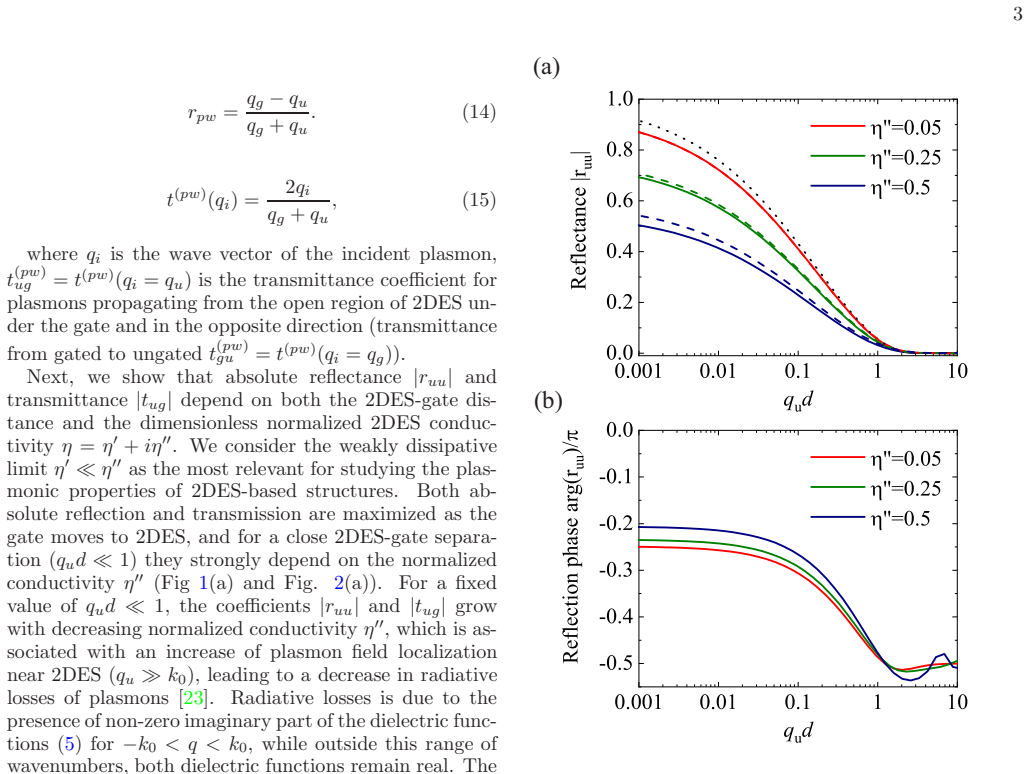
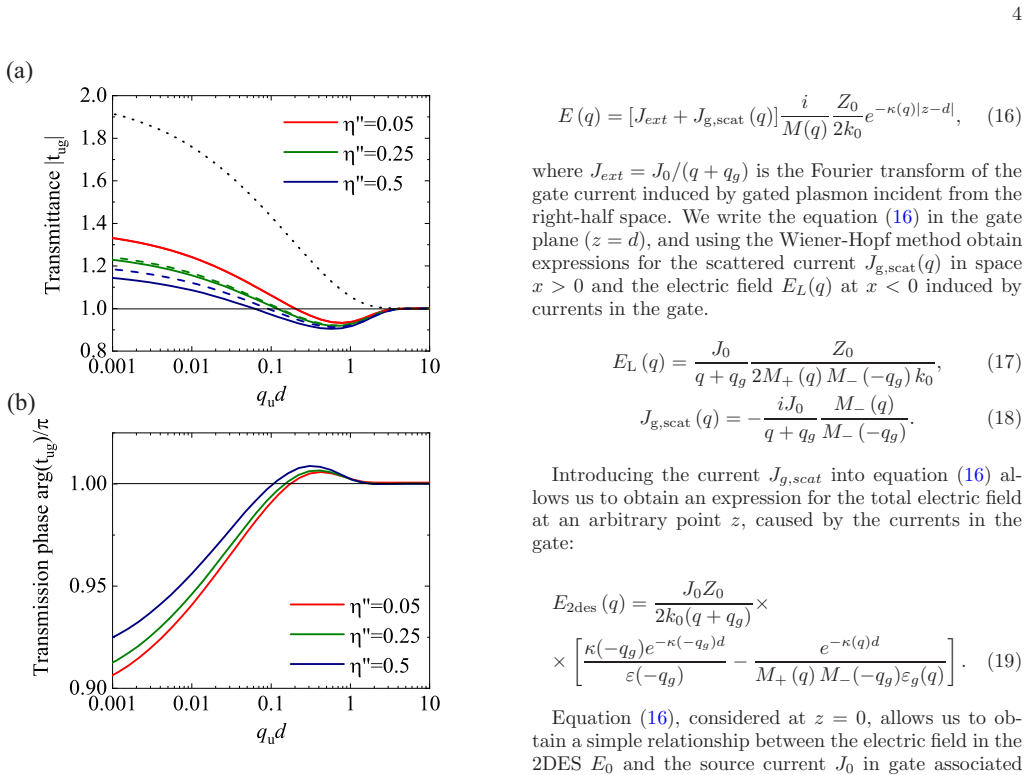
for − k0 < q < k 0, while outside this range of wavenumbers, both dielectric functions remain real. The ’radiative’ values of q contribute to the modulus of the factorized dielectric functions, while the ’non-radiative’ values do not. The absolute transmission coefficient differs from the transmission (
-
[3]
obtained by the plane wave matching method (dashed curve at Fig. 2(a)). This is because the expressions (14) and ( 15) is obtained taking into account the continuity of currents and potentials at the bound- ary of the ungated and gated 2DES, although this is valid only at one point along the vertical z-axis, namely in the 2DES plane, since the 2DES screen...
-
[4]
EL (q) = J0 q + qg Z0 2M+ (q) M− (− qg) k0 , (17) Jg, scat (q) = − iJ0 q + qg M− (q) M− (− qg)
in the gate plane (z = d), and using the Wiener-Hopf method obtain expressions for the scattered current Jg, scat(q) in space x > 0 and the electric field EL(q) at x < 0 induced by currents in the gate. EL (q) = J0 q + qg Z0 2M+ (q) M− (− qg) k0 , (17) Jg, scat (q) = − iJ0 q + qg M− (q) M− (− qg) . (18) Introducing the current Jg,scat into equation ( 16) a...
-
[5]
by the residue of E2DES (q) at the poles q = qg and q = − qu timed by i, respectively: rggE0 = i Res q=qg E2des(q). (21) tguE0 = i Res q=− qu E2des(q), (22) Taking into account ( 20), the reflection rgg and trans- mission tgu coefficients for a gated plasmon propagating to the ungated 2DES have the form: rgg = − i 2qg ηκ (qg) k0M+(qg)2 e− 2κ (qg )d ∂εg/∂q |q...
-
[6]
can present some difficulties. To deter- mine the reflection and transmission amplitudes, we can write simplified expressions for the factorized dielectric functions, retaining only the terms that determine their absolute values. To achieve this, we expand the loga- rithm ln εu,g (q) in powers of small η′′, and retain only the terms contributing to the absolu...
-
[7]
Stern, Polarizability of a two-dimensional electron gas, Phys
F. Stern, Polarizability of a two-dimensional electron gas, Phys. Rev. Lett. 18, 546 (1967)
1967
-
[8]
A. V. Chaplik, Possible crystallization of charge carriers in low-density inversion layers, Zh. Eksp. Teor. Fiz. 62, 746 (1972) , [Sov. Phys. JETP 35, 395 (1972)]
1972
-
[9]
W. Knap, M. Dyakonov, D. Coquillat, F. Teppe, N. Dyakonova, J. /suppress Lusakowski, K. Karpierz, M. Sakow- icz, G. Valusis, D. Seliuta, A. El Fatimy, Y. M. Meziani, and T. Otsuji, Field effect transistors for ter- ahertz detection: Physics and first imaging applications, J. Infrared Millim. Terahertz Waves 30, 1319 (2009)
2009
-
[10]
Moiseenko, E
I. Moiseenko, E. Titova, M. Kaschenko, and D. Svintsov, Plasmon resonance in a sub-thz graphene-based detector: theory and experiment, Russian Microelectronics 54, 958 (2025)
2025
-
[11]
K. R. Dzhikirba, A. Shuvaev, D. Khudaiberdiev, I. V. Kukushkin, and V. M. Muravev, Demonstration of the plasmonic THz phase shifter at room temperature, Appl. Phys. Lett. 123, 052104 (2023)
2023
-
[12]
X. G. Peralta, S. J. Allen, M. C. Wanke, N. E. Harff, J. A. Simmons, M. P. Lilly, J. L. Reno, P. J. Burke, and J. P. Eisenstein, Terahertz photoconductivity and plas- mon modes in double-quantum-well field-effect transis- tors, Appl. Phys. Lett. 81, 1627 (2002)
2002
-
[13]
Boubanga-Tombet, W
S. Boubanga-Tombet, W. Knap, D. Yadav, A. Satou, D. B. But, V. V. Popov, I. V. Gorbenko, V. Kachorovskii, and T. Otsuji, Room-Temperature Amplification of Ter- ahertz Radiation by Grating-Gate Graphene Structures, Physical Review X 10, 031004 (2020)
2020
-
[14]
Aizin, D
G. Aizin, D. Fateev, G. Tsymbalov, and V. Popov, Ter- ahertz plasmon photoresponse in a density modulated two-dimensional electron channel of a gaas/ algaas field- effect transistor, Applied Physics Letters 91 (2007)
2007
-
[15]
G. R. Aizin and G. C. Dyer, Transmission line theory of collective plasma excitations in periodic two-dimensiona l electron systems: Finite plasmonic crystals and Tamm states, Phys. Rev. B 86, 235316 (2012)
2012
-
[16]
V. Y. Kachorovskii and M. S. Shur, Current- induced terahertz oscillations in plasmonic crystal, Appl. Phys. Lett. 100, 232108 (2012)
2012
-
[18]
P. Sai, V. V. Korotyeyev, M. Dub, M. S/suppress lowikowski, M. Filipiak, D. B. But, Y. Ivonyak, M. Sakowicz, Y. M. Lyaschuk, S. M. Kukhtaruk, G. Cywi´ nski, and W. Knap, Electrical tuning of terahertz plasmonic crystal phases, Phys. Rev. X 13, 041003 (2023)
2023
-
[19]
Bylinkin, E
A. Bylinkin, E. Titova, V. Mikheev, E. Zhukova, S. Zhukov, M. Belyanchikov, M. Kashchenko, A. Mi- akonkikh, and D. Svintsov, Tight-Binding Terahertz Plasmons in Chemical-Vapor-Deposited Graphene, Physical Review Applied 11, 054017 (2019)
2019
-
[20]
V. V. Popov, D. V. Fateev, E. L. Ivchenko, and S. D. Ganichev, Noncentrosymmetric plasmon modes and gi- ant terahertz photocurrent in a two-dimensional plas- monic crystal, Phys. Rev. B 91, 235436 (2015)
2015
-
[21]
D. V. Fateev, O. V. Polischuk, K. V. Mashinsky, I. M. Moiseenko, M. Y. Morozov, and V. V. Popov, Terahertz lasing with weak plasmon modes in periodic graphene structures, Physical Review Applied 15, 034043 (2021)
2021
-
[22]
Miranda, Y
D. Miranda, Y. Bludov, N. Asger Mortensen, and N. Peres, Topology in a one-dimensional plasmonic crys- tal: the optical approach, Journal of Optics 26, 125001 (2024)
2024
-
[23]
Gorbenko and V
I. Gorbenko and V. Kachorovskii, Lateral plasmonic cry s- tals: Tunability, dark modes, and weak-to-strong cou- pling transition, Phys. Rev. B 110, 155406 (2024)
2024
-
[24]
V. M. Muravev, A. Shuvaev, A. S. Astrakhantseva, P. A. Gusikhin, I. V. Kukushkin, and A. Pimenov, Tunable ter- ahertz phase shifter based on GaAs semiconductor tech- nology, Appl. Phys. Lett. 121, 051101 (2022)
2022
-
[25]
Moiseenko, D
I. Moiseenko, D. Svintsov, and E. Nikulin, Elec- tromagnetic diffraction and bidirectional plasmon launching in partially gated two-dimensional systems, Phys. Rev. Appl. 24, 014059 (2025)
2025
-
[26]
Sydoruk, K
O. Sydoruk, K. Choonee, and G. C. Dyer, Transmission and Reflection of Terahertz Plas- mons in Two-Dimensional Plasmonic Devices, IEEE Transactions on Terahertz Science and Technology 5, 486 (2015)
2015
-
[27]
G. R. Aizin and G. C. Dyer, Transmission line theory of collective plasma excitations in periodic two-dimensiona l electron systems: Finite plasmonic crystals and Tamm states, Physical Review B 86, 235316 (2012)
2012
-
[28]
Lee and J.-H
S. Lee and J.-H. Kang, Ultranarrow polaritonic cav- ities formed by one-dimensional junctions of two- dimensional in-plane heterostructures, Nanophotonics 14, 5417 (2025)
2025
-
[29]
Moiseenko, Z
I. Moiseenko, Z. Devizorova, O. Polischuk, V. Muravev, and D. Svintsov, Unconventional quantization of 2d plas- mons in cavities formed by gate slots, Physical Review Letters 136, 166901 (2026)
2026
- [30]
-
[31]
Rejaei and A
B. Rejaei and A. Khavasi, Scattering of surface plasmon s on graphene by a discontinuity in surface conductivity, Journal of Optics (United Kingdom) 17, 75002 (2015)
2015
-
[32]
Siaber, S
S. Siaber, S. Zonetti, J. E. Cunningham, and O. Sydoruk, Terahertz Plasmon Resonances in Two- Dimensional Electron Systems: Modeling Approaches, 8 Physical Review Applied 11, 064067 (2019)
2019
-
[33]
L. A. Falkovsky and A. A. Varlamov, Space- time dispersion of graphene conductivity, European Physical Journal B 56, 281 (2007)
2007
-
[34]
Svintsov, Hydrodynamic-to-ballistic crossover in dirac materials, Physical Review B 97, 121405 (2018)
D. Svintsov, Hydrodynamic-to-ballistic crossover in dirac materials, Physical Review B 97, 121405 (2018)
2018
-
[35]
Noble, Methods Based on the Wiener-Hopf Technique for the Solution of Partial Differential Equations (Perg- amon Press, 1958)
B. Noble, Methods Based on the Wiener-Hopf Technique for the Solution of Partial Differential Equations (Perg- amon Press, 1958)
1958
discussion (0)
Sign in with ORCID, Apple, or X to comment. Anyone can read and Pith papers without signing in.