Recognition: unknown
WAAA! Web Adversaries Against Agentic Browsers
Pith reviewed 2026-05-08 16:04 UTC · model grok-4.3
The pith
Agentic browsers exhibit five major failure modes against traditional web attacks and LLM threats, requiring rearchitecture to handle the current web safely.
A machine-rendered reading of the paper's core claim, the machinery that carries it, and where it could break.
Core claim
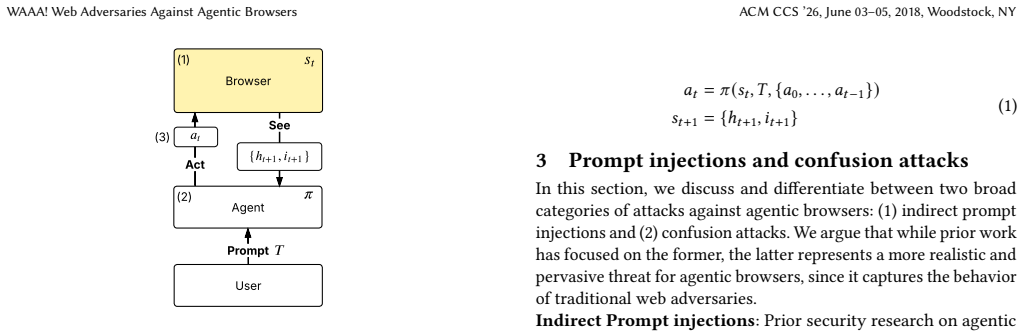
Agentic browsers exhibit five major failure modes when facing traditional and LLM web threats. The work extends the See→Act model to cover all browser components and frames the agent as a confused deputy unable to distinguish task steps from attacks. A taxonomy of 20 attacks is derived, 18 are implemented, and a generalizability study on 14 attacks across four LLMs shows that ten web threats reemerge often in amplified forms, proving that current designs are not ready for the live web.
What carries the argument
The extended See→Act browser agent model, which accounts for all browser components and frames the agent as a confused deputy unable to separate legitimate task steps from untrusted web content.
If this is right
- Ten classic web threats, including social engineering attacks, return in amplified forms once an agent can be influenced by untrusted page content.
- The attacks reproduce across four major LLM models spanning multiple vendors.
- Agentic browsers must be rearchitected before they can be considered ready for the current web.
- The confused deputy framing reveals that agents cannot reliably separate task instructions from malicious content.
Where Pith is reading between the lines
- Developers of agentic browsers may need to add independent verification layers that check page trustworthiness before executing actions.
- Similar confused-deputy problems could appear in other LLM-controlled interfaces that interact with untrusted external data.
- Web standards might eventually need explicit signals that help agents detect when content is trying to hijack their goals.
Load-bearing premise
The 18 implemented attacks plus the tests of 14 attacks on four LLMs are assumed to represent real-world agent behavior on live websites, and the extended See→Act model is assumed to capture every relevant browser interaction without omissions.
What would settle it
A working agentic browser that completes representative user tasks on live websites without triggering any of the five failure modes or falling for the 20 attacks in the taxonomy would show the central claim does not hold.
Figures



read the original abstract
Large language models (LLMs) are increasingly being integrated into web browsers to create agentic browsing systems that execute actions on behalf of the user. Prior work considering the security of agentic browsers focuses exclusively on indirect prompt-injection attacks. However, by failing to consider traditional web attacks, previous agentic browser threat models have a blind spot to web social engineering attacks originally designed to trick humans. In this paper, we propose the first web-focused threat model for agentic browsers and use it to derive a taxonomy of 20 attacks across both the web and LLM space, and implement 18 of the attacks. Our threat model extends the original See$\rightarrow$Act browser agent model to account for all components of a browser, and frames the agent as a confused deputy unable to distinguish task steps from traditional web attacks. We show that 10 web threats can reemerge often in amplified forms once an agent can be influenced by untrusted page content. We further conduct a generalizability study on 14 of the 20 attacks, showing that our attacks reproduce across 4 major LLM models spanning multiple vendors. We show that agentic browsers exhibit five major failure modes when facing traditional and LLM web threats, demonstrating the need to rearchitect agentic browsers before they are ready for the current web.
Editorial analysis
A structured set of objections, weighed in public.
Referee Report
Summary. The paper proposes the first web-focused threat model for agentic browsers by extending the See→Act model to treat the agent as a confused deputy. It derives a taxonomy of 20 attacks spanning web and LLM threats (implementing 18), shows that 10 traditional web threats reemerge in amplified forms, conducts a generalizability study reproducing 14 attacks across 4 LLMs, identifies five major failure modes, and concludes that agentic browsers require rearchitecting before deployment on the current web.
Significance. If the empirical results hold under more detailed scrutiny, the work is significant for bridging traditional web security and LLM agent threats in browsers. The implementation of 18 attacks and cross-model reproduction on 4 LLMs provide concrete, falsifiable examples of vulnerabilities that could influence secure design of agentic systems. This is a timely contribution given the rapid integration of LLMs into browsers.
major comments (3)
- [Threat Model] Threat Model section: the extension of the See→Act model to account for all browser components (security policies, rendering, consent flows) is central to framing the confused deputy and deriving the taxonomy. The paper does not detail how these components are modeled or integrated, raising the possibility that the five failure modes are artifacts of an incomplete model rather than inherent to agentic browsers.
- [Generalizability Study] Generalizability Study section: the reproduction of 14 attacks across 4 LLMs is used to support the five failure modes and the rearchitecting claim. Without full methods, controls, exact success metrics, or raw data, it is not possible to confirm that the modes are general rather than setup-specific, directly undermining the central claim as noted in the soundness assessment.
- [Evaluation] Evaluation of Implemented Attacks: the claim that 10 web threats 'reemerge often in amplified forms' is load-bearing for the taxonomy and conclusion. No quantitative comparison (e.g., success rates or amplification factors versus non-agent baselines) is provided to substantiate 'amplified' or the broad need for rearchitecting.
minor comments (2)
- [Abstract] Abstract: the five failure modes are referenced but not enumerated, reducing clarity for readers skimming the contribution.
- [Taxonomy] The taxonomy derivation process could be more explicitly tied to the threat model with a table or diagram showing how each attack maps to See→Act components.
Simulated Author's Rebuttal
We thank the referee for their insightful comments and the opportunity to clarify and strengthen our manuscript. We address each of the major comments point-by-point below.
read point-by-point responses
-
Referee: [Threat Model] Threat Model section: the extension of the See→Act model to account for all browser components (security policies, rendering, consent flows) is central to framing the confused deputy and deriving the taxonomy. The paper does not detail how these components are modeled or integrated, raising the possibility that the five failure modes are artifacts of an incomplete model rather than inherent to agentic browsers.
Authors: The See→Act extension is presented in Section 3, where we explicitly incorporate browser components such as security policies, rendering, and consent flows into the agent's decision process to frame it as a confused deputy. This modeling directly informs the taxonomy by showing how attacks can exploit these interfaces. To address the concern about potential artifacts, we will provide a more detailed diagram and step-by-step integration description in the revised manuscript to demonstrate that the failure modes arise from the inherent architecture rather than modeling gaps. revision: partial
-
Referee: [Generalizability Study] Generalizability Study section: the reproduction of 14 attacks across 4 LLMs is used to support the five failure modes and the rearchitecting claim. Without full methods, controls, exact success metrics, or raw data, it is not possible to confirm that the modes are general rather than setup-specific, directly undermining the central claim as noted in the soundness assessment.
Authors: We agree that the current description of the generalizability study lacks sufficient detail for full reproducibility. In the revised manuscript, we will expand the Generalizability Study section to include complete methods, experimental controls, precise success metrics (e.g., attack success rate thresholds), and we will release the raw data and prompts used in the experiments via an open repository. This will enable verification that the five failure modes are consistent across the tested LLMs. revision: yes
-
Referee: [Evaluation] Evaluation of Implemented Attacks: the claim that 10 web threats 'reemerge often in amplified forms' is load-bearing for the taxonomy and conclusion. No quantitative comparison (e.g., success rates or amplification factors versus non-agent baselines) is provided to substantiate 'amplified' or the broad need for rearchitecting.
Authors: The observation that 10 web threats reemerge in amplified forms is based on the successful implementation of 18 attacks and the analysis showing that agentic execution removes human oversight, leading to higher success and impact in cases like automated credential theft or content manipulation. While we did not include direct quantitative baselines in the original submission, we will add a comparative evaluation in the revised paper, including success rate comparisons drawn from prior web security literature for non-agentic scenarios where applicable, to better substantiate the amplification claim and the rearchitecting recommendation. revision: partial
Circularity Check
No circularity: empirical attack implementations and taxonomy derivation are independent of inputs.
full rationale
The paper extends the See→Act model to create a threat model, derives a taxonomy of 20 attacks from it, implements 18 attacks, and reproduces 14 across 4 LLMs to identify five failure modes. These steps consist of concrete engineering, attack construction, and empirical testing rather than any self-definitional loop, fitted parameter renamed as prediction, or load-bearing self-citation chain. The central claim that agentic browsers exhibit the failure modes rests on the observed behavior of the implemented attacks, which are falsifiable outside the paper and do not reduce to the threat model by construction. No equations or uniqueness theorems are invoked in a circular manner.
Axiom & Free-Parameter Ledger
Reference graph
Works this paper leans on
-
[1]
d.].Blog | Windsurf
[n. d.].Blog | Windsurf. https://windsurf.com/blog
-
[2]
d.].Cursor Docs
Cursor Documentation [n. d.].Cursor Docs. Cursor Documentation. https: //cursor.com/docs
-
[3]
d.].Dia Browser | AI Chat With Your Tabs
Dia Browser [n. d.].Dia Browser | AI Chat With Your Tabs. Dia Browser. https: //www.diabrowser.com
-
[4]
d.].GitHub Copilot·Your AI Pair Programmer
GitHub [n. d.].GitHub Copilot·Your AI Pair Programmer. GitHub. https: //github.com/features/copilot
-
[5]
d.].Introducing Claude Sonnet 4.5
[n. d.].Introducing Claude Sonnet 4.5. https://www.anthropic.com/news/claude- sonnet-4-5
-
[6]
d.].Microsoft/Playwright-Mcp
Microsoft [n. d.].Microsoft/Playwright-Mcp. Microsoft. https://github.com/ microsoft/playwright-mcp
-
[7]
d.].Piloting Claude for Chrome
[n. d.].Piloting Claude for Chrome. https://www.anthropic.com/news/claude- for-chrome
-
[8]
https://www
2024.Remove Polyfill.Io Code from Your Website Immediately. https://www. theregister.com/2024/06/25/polyfillio_china_crisis/
2024
-
[9]
https://brave.com/blog/comet-prompt-injection/
2025. https://brave.com/blog/comet-prompt-injection/
2025
-
[10]
https://brave.com/blog/unseeable-prompt-injections/
2025. https://brave.com/blog/unseeable-prompt-injections/
2025
-
[11]
https://neuraltrust.ai/blog/openai-atlas-omnibox-prompt-injection
2025. https://neuraltrust.ai/blog/openai-atlas-omnibox-prompt-injection
2025
-
[12]
Microsoft Copi- lot
Microsoft Copilot 2025.AI Browser: Copilot Mode in Edge. Microsoft Copi- lot. https://www.microsoft.com/en-us/microsoft-copilot/for-individuals/do- more-with-ai/ai-for-daily-life/ai-browser-innovation-with-copilot-in-edge
2025
-
[13]
Browseros-Ai/BrowserOS
2025. Browseros-Ai/BrowserOS. BrowserOS
2025
-
[14]
https://www.claude.com/product/claude-code
2025.Claude Code | Claude. https://www.claude.com/product/claude-code
2025
-
[15]
https://www.perplexity.ai/comet/
2025.Comet Browser: A Personal AI Assistant. https://www.perplexity.ai/comet/
2025
-
[16]
https: //www.google.com/chrome/ai-innovations/
2025.Gemini in Chrome | The next Generation of AI in Chrome | Chrome. https: //www.google.com/chrome/ai-innovations/
2025
-
[17]
Introducing ChatGPT Agent: Bridging Research and Action
2025. Introducing ChatGPT Agent: Bridging Research and Action. https: //openai.com/index/introducing-chatgpt-agent/
2025
-
[18]
https://openai.com/index/introducing-chatgpt- atlas/
2025.Introducing ChatGPT Atlas. https://openai.com/index/introducing-chatgpt- atlas/
2025
-
[19]
Google DeepMind
Google DeepMind 2025.Project Mariner. Google DeepMind. https://deepmind. google/models/project-mariner/
2025
-
[20]
Steel-Dev/Awesome-Web-Agents
2025. Steel-Dev/Awesome-Web-Agents. Steel
2025
-
[21]
Devdatta Akhawe, Adam Barth, Peifung E Lam, John Mitchell, and Dawn Song
-
[22]
In2010 23rd IEEE Computer Security Foundations Symposium
Towards a formal foundation of web security. In2010 23rd IEEE Computer Security Foundations Symposium. IEEE, 290–304
-
[23]
Adam Barth, Collin Jackson, Charles Reis, TGC Team, et al. 2008. The security architecture of the chromium browser. InTechnical report. Stanford University
2008
-
[24]
Microsoft Corporate Blogs. [n. d.]. Introducing NLWeb: Bringing Conversational Interfaces Directly to the Web
-
[25]
Leo Boisvert, Mihir Bansal, Chandra Kiran Reddy Evuru, Gabriel Huang, Abhay Puri, Avinandan Bose, Maryam Fazel, Quentin Cappart, Jason Stanley, Alexandre Lacoste, Alexandre Drouin, and Krishnamurthy Dvijotham. 2025. DoomArena: A Framework for Testing AI Agents Against Evolving Security Threats. https: //doi.org/10.48550/arXiv.2504.14064 arXiv:2504.14064 [cs]
-
[26]
CoRR abs/2502.20383(2025) PIIGuard: Mitigating PII Harvesting under Adversarial Sanitization 17
Jeffrey Yang Fan Chiang, Seungjae Lee, Jia-Bin Huang, Furong Huang, and Yizheng Chen. 2025.Why Are Web AI Agents More Vulnerable Than Stan- dalone LLMs? A Security Analysis. https://doi.org/10.48550/arXiv.2502.20383 arXiv:2502.20383 [cs]
-
[27]
Marco Cova, Christopher Kruegel, and Giovanni Vigna. 2010. Detection and Analysis of Drive-by-Download Attacks and Malicious JavaScript Code. In Proceedings of the 19th International Conference on World Wide Web (WWW ’10). Association for Computing Machinery, New York, NY, USA, 281–290. https://doi.org/10.1145/1772690.1772720
-
[28]
Xiang Deng, Yu Gu, Boyuan Zheng, Shijie Chen, Samuel Stevens, Boshi Wang, Huan Sun, and Yu Su. 2023. Mind2Web: Towards a Generalist Agent for the Web. https://doi.org/10.48550/arXiv.2306.06070 arXiv:2306.06070 [cs]
-
[29]
Ivan Evtimov, Arman Zharmagambetov, Aaron Grattafiori, Chuan Guo, and Ka- malika Chaudhuri. 2025.W ASP: Benchmarking Web Agent Security Against Prompt Injection Attacks. https://doi.org/10.48550/arXiv.2504.18575 arXiv:2504.18575 [cs]
-
[30]
Fellou. [n. d.].Fellou Browser 2.0: Faster, More Amazing, and More Reliable than Ever.https://fellou.ai/blog/fellou-v2-launch/
-
[31]
Firefox. [n. d.]. Access AI Chatbots in Firefox. ([n. d.]). https://support.mozilla. org/en-US/kb/ai-chatbot#w_what-to-keep-in-mind-when-using-ai-chatbots
-
[32]
Anny Gakhokidze and Neha Kochar. 2021. Introducing Site Isolation in Firefox
2021
-
[33]
Kai Greshake, Sahar Abdelnabi, Shailesh Mishra, Christoph Endres, Thorsten Holz, and Mario Fritz. 2023. Not What You’ve Signed up for: Compromising Real- World Llm-Integrated Applications with Indirect Prompt Injection. InProceedings of the 16th ACM Workshop on Artificial Intelligence and Security(2023). 79–90
2023
-
[34]
Wang, Stuart Schecter, and Collin Jackson
Lin-Shung Huang, Alex Moshchuk, Helen J. Wang, Stuart Schecter, and Collin Jackson. [n. d.]. Clickjacking: Attacks and Defenses. 413–
-
[35]
https://www.usenix.org/conference/usenixsecurity12/technical- sessions/presentation/huang
-
[36]
Lukas Knittel, Christian Mainka, Marcus Niemietz, Dominik Trevor Noß, and Jörg Schwenk. 2021. XSinator.Com: From a Formal Model to the Automatic Evaluation of Cross-Site Leaks in Web Browsers. InProceedings of the 2021 ACM SIGSAC Conference on Computer and Communications Security (CCS ’21). Association for Computing Machinery, New York, NY, USA, 1771–1788...
-
[37]
Pierre Laperdrix, Oleksii Starov, Quan Chen, Alexandros Kapravelos, and Nick Nikiforakis. 2021. Fingerprinting in Style: Detecting Browser Extensions via Injected Style Sheets. InProceedings of the USENIX Security Symposium. 2507– 2524
2021
-
[38]
Inala, Chenglong Wang, Steven M
Zeyi Liao, Lingbo Mo, Chejian Xu, Mintong Kang, Jiawei Zhang, Chaowei Xiao, Yuan Tian, Bo Li, and Huan Sun. 2025.EIA: Environmental Injection Attack on Generalist Web Agents for Privacy Leakage. https://doi.org/10.48550/arXiv.2409. 11295 arXiv:2409.11295 [cs]
-
[39]
Jungwon Lim, Yonghwi Jin, Mansour Alharthi, Xiaokuan Zhang, Jinho Jung, Rajat Gupta, Kuilin Li, Daehee Jang, and Taesoo Kim. 2021. SOK: On the Analysis of Web Browser Security. https://doi.org/10.48550/arXiv.2112.15561 arXiv:2112.15561 [cs]
- [40]
-
[41]
Xinbei Ma, Yiting Wang, Yao Yao, Tongxin Yuan, Aston Zhang, Zhuosheng Zhang, and Hai Zhao. [n. d.].Caution for the Environment: Multimodal LLM Agents Are Susceptible to Environmental Distractions. https://doi.org/10.48550/arXiv.2408. 02544 arXiv:2408.02544 [cs]
-
[42]
Arunesh Mathur, Gunes Acar, Michael J. Friedman, Eli Lucherini, Jonathan Mayer, Marshini Chetty, and Arvind Narayanan. 2019. Dark Patterns at Scale: Findings from a Crawl of 11K Shopping Websites.Proc. ACM Hum.-Comput. Interact.3, CSCW (Nov. 2019), 81:1–81:32. https://doi.org/10.1145/3359183
-
[43]
2024.Breaking ReAct Agents: Foot-in-the-Door Attack Will Get You In
Itay Nakash, George Kour, Guy Uziel, and Ateret Anaby-Tavor. 2024.Breaking ReAct Agents: Foot-in-the-Door Attack Will Get You In. https://doi.org/10.48550/ arXiv.2410.16950 arXiv:2410.16950 [cs]
-
[44]
Adam Oest, Penghui Zhang, Brad Wardman, Eric Nunes, Jakub Burgis, Ali Zand, Kurt Thomas, Adam Doupé, and Gail-Joon Ahn. 2020. Sunrise to Sunset: Analyz- ing the End-to-end Life Cycle and Effectiveness of Phishing Attacks at Scale. In 29th USENIX Security Symposium (USENIX Security 20). 361–377
2020
-
[45]
Harun Oz, Ahmet Aris, Abbas Acar, Güliz Seray Tuncay, Leonardo Babun, and Selcuk Uluagac. 2023. RøB: Ransomware over Modern Web Browsers. In32nd USENIX Security Symposium (USENIX Security 23). 7073–7090
2023
-
[46]
Nikolaos Pantelaios and Alexandros Kapravelos. 2024. FV8: A Forced Execution JavaScript Engine for Detecting Evasive Techniques. In33rd USENIX Security Symposium (USENIX Security 24). 3747–3764
2024
-
[47]
Qwen Team. 2026. Qwen3.6-Plus: Towards Real World Agents. https://qwen.ai/ blog?id=qwen3.6
2026
-
[48]
Charles Reis, Alexander Moshchuk, and Nasko Oskov. 2019. Site Isolation: Process Separation for Web Sites within the Browser. In28th USENIX Security Symposium (USENIX Security 19). 1661–1678. 13 ACM CCS ’26, June 03–05, 2018, Woodstock, NY Anonymous Author(s)
2019
-
[49]
Ax Sharma. [n. d.].Third Npm Protestware: ’event-Source-Polyfill’ Calls Russia Out. BleepingComputer. https://www.bleepingcomputer.com/news/security/third- npm-protestware-event-source-polyfill-calls-russia-out/
-
[50]
Opera Software. [n. d.].Opera Neon. This Browser Is Built to Act.Opera Neon. https://operaneon.com
-
[51]
Jeffrey Spaulding, DaeHun Nyang, and Aziz Mohaisen. 2017. Understanding the Effectiveness of Typosquatting Techniques. InProceedings of the Fifth ACM/IEEE Workshop on Hot Topics in Web Systems and Technologies (HotWeb ’17). Association for Computing Machinery, New York, NY, USA, 1–8. https://doi.org/10.1145/ 3132465.3132467
-
[52]
Kevin Stubbings. 2024. Attacking Browser Extensions
2024
-
[53]
Antoine Vastel, Walter Rudametkin, Romain Rouvoy, and Xavier Blanc. 2020. FP- Crawlers: Studying the Resilience of Browser Fingerprinting to Block Crawlers. InMADWeb’20 - NDSS Workshop on Measurements, Attacks, and Defenses for the Web, Oleksii Starov, Alexandros Kapravelos, and Nick Nikiforakis (Eds.). San Diego, United States. https://doi.org/10.14722/n...
-
[54]
Michelle Warburg. 2025. LayerX Finds that Perplexity’s Comet Browser is Up To 85% More Vulnerable to Phishing and Web Attacks Than Chrome. https://layerxsecurity.com/blog/layerx-finds-that-perplexitys-comet-browser- is-up-to-85-more-vulnerable-to-phishing-and-web-attacks-than-chrome/
2025
-
[55]
Quantum error thresholds for gauge-redundant digitiza- tions of lattice field theories
Fangzhou Wu, Shutong Wu, Yulong Cao, and Chaowei Xiao. 2024.WIPI: A New Web Threat for LLM-Driven Web Agents. https://doi.org/10.48550/arXiv.2402. 16965 arXiv:2402.16965 [cs]
-
[56]
Shunyu Yao, Jeffrey Zhao, Dian Yu, Nan Du, Izhak Shafran, Karthik Narasimhan, and Yuan Cao. [n. d.].ReAct: Synergizing Reasoning and Acting in Language Models. https://doi.org/10.48550/arXiv.2210.03629 arXiv:2210.03629 [cs]
work page internal anchor Pith review doi:10.48550/arxiv.2210.03629
- [57]
- [58]
-
[59]
WebArena: A Realistic Web Environment for Building Autonomous Agents
Shuyan Zhou, Frank F. Xu, Hao Zhu, Xuhui Zhou, Robert Lo, Abishek Sridhar, Xianyi Cheng, Tianyue Ou, Yonatan Bisk, Daniel Fried, Uri Alon, and Graham Neubig. 2024. WebArena: A Realistic Web Environment for Building Autonomous Agents. https://doi.org/10.48550/arXiv.2307.13854 arXiv:2307.13854 [cs] A Open Science We will release the code for our proof-of-co...
discussion (0)
Sign in with ORCID, Apple, or X to comment. Anyone can read and Pith papers without signing in.