Recognition: unknown
Testing General Relativity with Individual Supermassive Black Hole Binaries
Pith reviewed 2026-05-08 15:41 UTC · model grok-4.3
The pith
Continuous waves from individual supermassive black hole binaries enable tests of gravity beyond general relativity using pulsar timing arrays.
A machine-rendered reading of the paper's core claim, the machinery that carries it, and where it could break.
Core claim
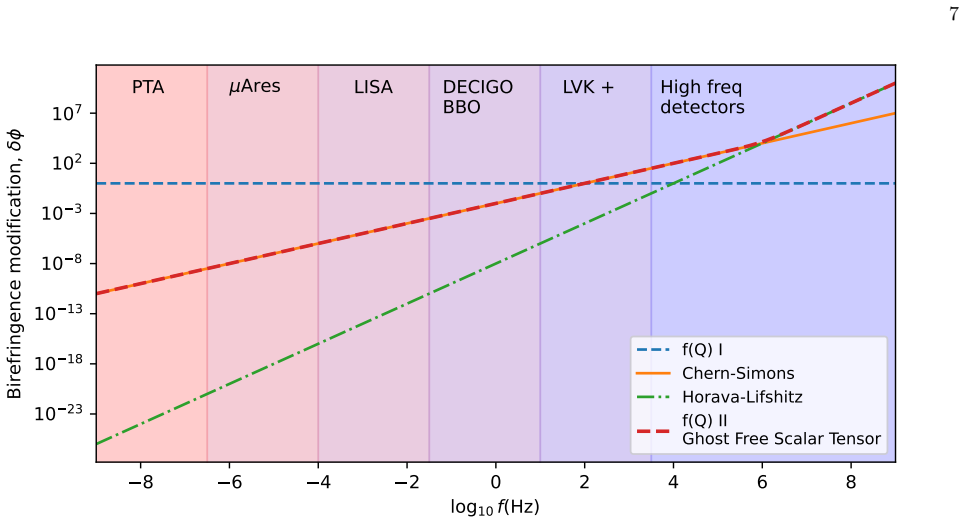
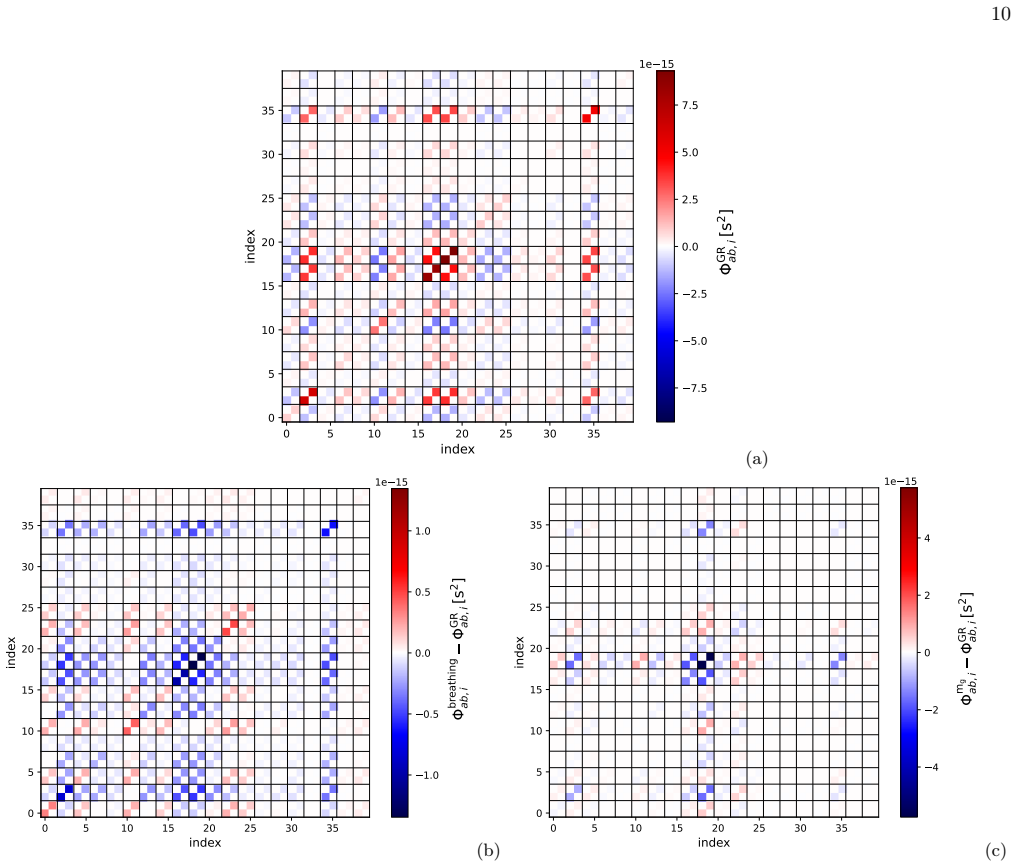
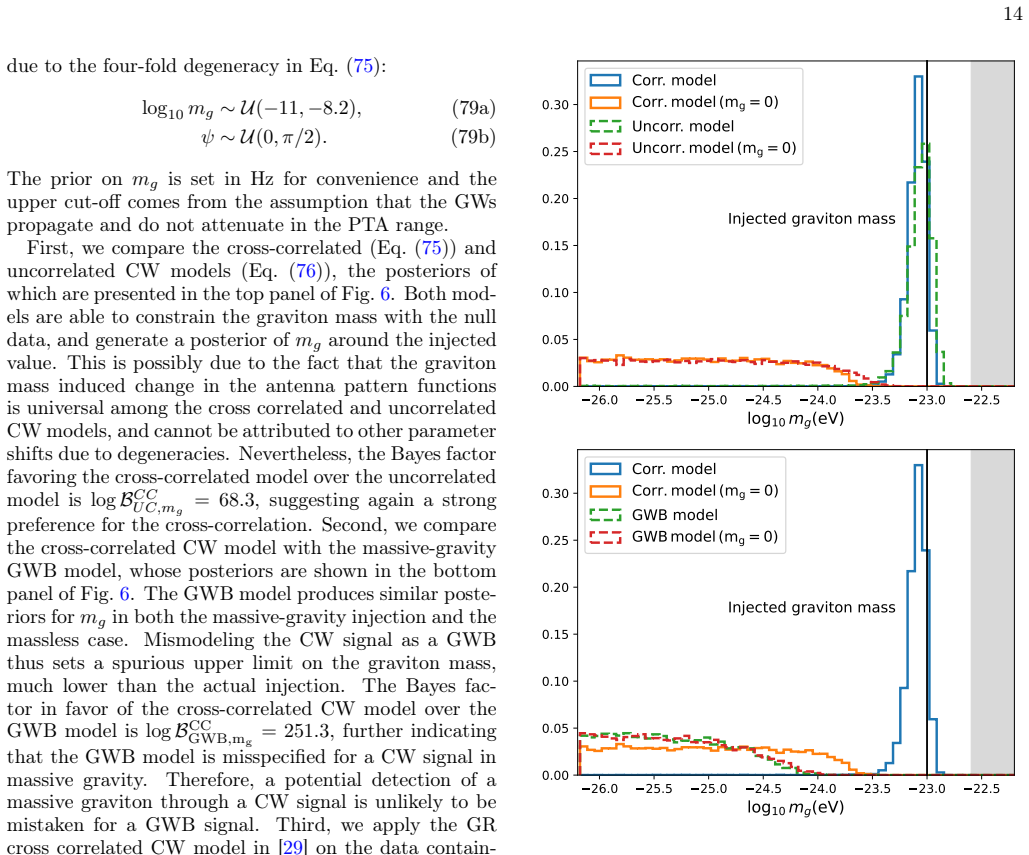
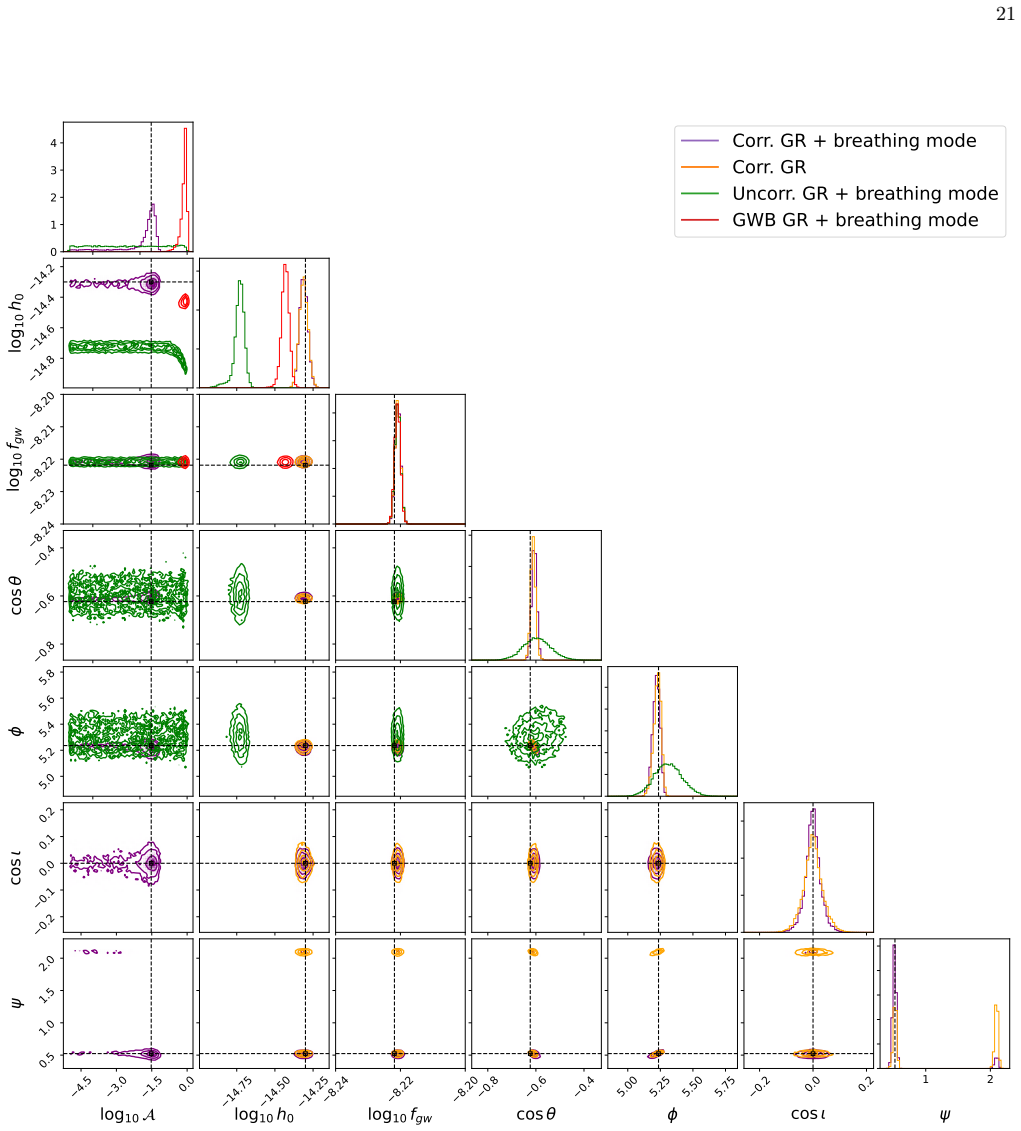
The paper develops a unified framework for testing gravity beyond general relativity with continuous gravitational waves from individual supermassive black hole binaries. For non-tensorial polarizations the cross correlation scales linearly in the alternative amplitude when the modes are sub-dominant. Modified dispersion relations enhance both antenna-pattern modifications and pulsar-term phase delays at low frequencies, while birefringence remains suppressed at nanohertz frequencies. Injection-and-recovery tests recover the injected beyond-general-relativity parameters and distinguish the continuous wave signal from both correlated and uncorrelated background models.
What carries the argument
The inter-pulsar cross-correlation function for continuous waves, modified for beyond-general-relativity effects and scaling linearly with sub-dominant alternative polarization amplitude.
If this is right
- Pulsar timing arrays are competitive for testing modified dispersion relations because low frequencies amplify both the antenna-pattern modification and the pulsar-term phase delay.
- Parity-violating birefringence produces negligible effects at nanohertz frequencies for most theories.
- Individual continuous wave signals can be distinguished from both correlated and uncorrelated gravitational wave background models.
- A two-stage analysis strategy works: first identify candidates under general relativity, then test for deviations without introducing significant bias in source parameters.
Where Pith is reading between the lines
- Future higher-sensitivity pulsar timing arrays could detect the first individual sources and apply these beyond-general-relativity tests immediately.
- The linear scaling for polarization modes means small deviations could appear in continuous waves even when undetectable in the stochastic background.
- The framework could be extended to other continuous wave sources or combined with electromagnetic observations of the same binaries.
Load-bearing premise
Beyond-general-relativity polarization modes remain much weaker than the standard tensor modes so that cross-correlations scale linearly, and the signals remain nearly monochromatic with coherent phase evolution over cosmological distances.
What would settle it
An injection-and-recovery simulation in which the beyond-general-relativity parameters for breathing-mode or massive-graviton signals are not recovered from simulated pulsar timing array data at current observational limits.
Figures






read the original abstract
We develop a unified framework for testing gravity beyond General Relativity (GR) with continuous gravitational waves (CWs) from individual supermassive black hole binaries (SMBHBs). These long-lived, nearly monochromatic nanohertz signals offer unique strengths for precision tests of gravity, since their coherent phase evolution and inter-pulsar correlations in pulsar timing arrays (PTAs) retain detailed information about departures from GR over cosmological propagation distances. We consider three representative classes of deviations from GR: additional polarization states, modified dispersion relations, and parity-violating birefringence. For each, we derive the inter-pulsar cross correlation, the modified antenna response, and the propagation-induced pulsar-term phase delay. For non-tensorial polarizations, the CW cross correlation scales linearly in the alternative-polarization amplitude, compared to the quadratic scaling of the gravitational-wave background (GWB), provided the beyond-GR modes are sub-dominant. PTAs are also competitive for modified dispersion relations, where low frequencies enhance both the antenna-pattern modification and the pulsar-term phase delay. Birefringence, by contrast, is suppressed at nanohertz frequencies for most parity-violating theories. We validate the framework with injection-and-recovery simulations for breathing-mode and massive-graviton signals at current observational limits, recovering the injected beyond-GR parameters and distinguishing the CW signal from both correlated and uncorrelated background models. We further show that a pure-GR CW template recovers source parameters without significant bias when beyond-GR physics is present in the data, supporting a two-stage analysis strategy: identify candidates under GR, then test for deviations.
Editorial analysis
A structured set of objections, weighed in public.
Referee Report
Summary. The paper develops a unified framework for testing gravity beyond GR with continuous gravitational waves from individual SMBHBs in PTAs. It derives the inter-pulsar cross-correlations, modified antenna responses, and propagation-induced pulsar-term phase delays for three classes of deviations: additional polarization states, modified dispersion relations, and parity-violating birefringence. For non-tensorial polarizations the CW cross-correlation is shown to scale linearly with alternative-polarization amplitude (versus quadratic for the GWB) provided the beyond-GR modes are sub-dominant. The framework is validated with injection-and-recovery simulations for breathing-mode and massive-graviton signals at current observational limits, recovering the injected beyond-GR parameters, distinguishing the CW signal from correlated and uncorrelated backgrounds, and showing that a pure-GR template recovers source parameters without significant bias.
Significance. If the central derivations hold, the work supplies a concrete, unified toolkit for precision tests of gravity with nanohertz CWs that exploits their coherent phase evolution and inter-pulsar correlations over cosmological distances. The analytic treatment across deviation classes and the successful injection-recovery tests (including the two-stage analysis strategy) are clear strengths. The approach is particularly competitive for modified dispersion relations at low frequencies and offers a practical way to separate individual-source signals from the GWB. These elements would meaningfully advance PTA-based gravity tests if the sub-dominance assumption and associated scaling are placed on firmer footing.
major comments (1)
- [framework for non-tensorial polarizations (abstract and associated derivations)] The central claim that the CW cross-correlation scales linearly with alternative-polarization amplitude (versus quadratic for the GWB) is conditioned on the beyond-GR modes being sub-dominant. The injection-recovery tests are performed only at current observational limits, which implicitly keep these amplitudes small. An explicit test or analytic discussion of the regime in which alternative amplitudes become comparable to the tensor mode is required, because higher-order interference could modify the correlation structure and affect the claimed ability to distinguish the CW signal from background models.
minor comments (2)
- The manuscript would benefit from additional intermediate steps or explicit definitions when presenting the modified antenna response and pulsar-term phase delay for the three deviation classes.
- Specific numerical values or references for the PTA sensitivity limits used in the injection-recovery tests would help readers assess how close the simulated signals are to current observational reach.
Simulated Author's Rebuttal
We thank the referee for their careful and constructive review, which highlights a key assumption in our framework. We address the major comment below and will revise the manuscript to strengthen the discussion of the sub-dominance regime.
read point-by-point responses
-
Referee: The central claim that the CW cross-correlation scales linearly with alternative-polarization amplitude (versus quadratic for the GWB) is conditioned on the beyond-GR modes being sub-dominant. The injection-recovery tests are performed only at current observational limits, which implicitly keep these amplitudes small. An explicit test or analytic discussion of the regime in which alternative amplitudes become comparable to the tensor mode is required, because higher-order interference could modify the correlation structure and affect the claimed ability to distinguish the CW signal from background models.
Authors: We thank the referee for this insightful comment. Our derivation of the linear scaling for the CW cross-correlation indeed relies on the beyond-GR polarization amplitudes being sub-dominant, as explicitly stated in the manuscript; this yields a cross term linear in the alternative amplitude when computing the expected inter-pulsar correlations for a deterministic signal. For the stochastic GWB the scaling is quadratic by construction. We agree that the comparable-amplitude regime merits explicit treatment, as interference terms (tensor-alternative cross terms and alternative self-terms) would then appear and could alter the correlation structure. In the revised manuscript we will add an analytic discussion (in the section on non-tensorial polarizations) that expands the full correlation function to include these higher-order terms and delineates the regime of validity of the linear approximation. We will further note that when alternative amplitudes become comparable, the signal deviates strongly from a pure-GR template, which is consistent with our two-stage analysis strategy of first identifying candidates under GR and then testing for deviations. While we do not add new injection-recovery simulations at high amplitudes (our focus remains on signals near current observational limits), the analytic treatment will place the assumption on firmer footing without requiring additional computational work. revision: yes
Circularity Check
No significant circularity in derivation chain
full rationale
The paper derives inter-pulsar cross-correlations, modified antenna responses, and pulsar-term phase delays directly from standard modified-gravity Lagrangians for additional polarizations, dispersion relations, and birefringence. These steps compute observables from first principles without reducing predictions to fitted parameters or self-definitions. Injection-and-recovery simulations serve as an independent check, recovering injected parameters without bias in pure-GR templates. No load-bearing self-citations, uniqueness theorems from prior author work, or ansatzes smuggled via citation appear in the provided derivation chain. The sub-dominance condition for linear scaling is an explicit stated assumption, not a derived loop.
Axiom & Free-Parameter Ledger
axioms (2)
- domain assumption Continuous waves from individual SMBHBs are long-lived and nearly monochromatic with coherent phase evolution over cosmological distances.
- domain assumption Beyond-GR polarization modes are sub-dominant, allowing linear scaling of the cross-correlation.
Reference graph
Works this paper leans on
-
[1]
17 •GW propagation direction: ˆΩ = (sinθcosϕ,sinθsinϕ,cosθ)
Geometry of the computational frame In practical computations, we may define a convenient coordinate system as follows: •Pulsars: ˆpa = (0,0,1),ˆp b = (sinζ,0,cosζ). 17 •GW propagation direction: ˆΩ = (sinθcosϕ,sinθsinϕ,cosθ). •Transverse basis: ˆm= (sinϕ,−cosϕ,0),(A4) ˆn= (cosθcosϕ,cosθsinϕ,−sinθ).(A5)
-
[2]
Polarization tensors e+ ij =m imj −n inj,(A6) e× ij =m inj +n imj,(A7) eb ij =m imj +n inj,(A8) eL ij = √ 2 ΩiΩj,(A9) ex ij =m iΩj + Ωimj,(A10) ey ij =n iΩj + Ωinj.(A11)
-
[3]
(A3), F b a (θ) = 1 2 sin2 θ 1 + cosθ , F b b (θ, ϕ, ζ) = 1 2 sin2 ϕsin 2 ζ+ (−sinθcosζ+ sinζcosϕcosθ) 2 1 + sinθsinζcosϕ+ cosθcosζ
Breathing mode Using Eq. (A3), F b a (θ) = 1 2 sin2 θ 1 + cosθ , F b b (θ, ϕ, ζ) = 1 2 sin2 ϕsin 2 ζ+ (−sinθcosζ+ sinζcosϕcosθ) 2 1 + sinθsinζcosϕ+ cosθcosζ . Thus the breathing–mode correlation is Υ(b) ab (θ, ϕ, ζ) = sin2 θ 4(1 + cosθ) sin2 ϕsin 2 ζ+ (−sinθcosζ+ sinζcosϕcosθ) 2 1 + sinθsinζcosϕ+ cosθcosζ . (A12)
-
[4]
Therefore Υ(L) ab (θ, ϕ, ζ) = cos2 θ 2(1 + cosθ) (sinθsinζcosϕ+ cosθcosζ) 2 1 + sinθsinζcosϕ+ cosθcosζ
Longitudinal scalar mode F L a (θ) = √ 2 2 cos2 θ 1 + cosθ , F L b (θ, ϕ, ζ) = √ 2 2 (sinθsinζcosϕ+ cosθcosζ) 2 1 + sinθsinζcosϕ+ cosθcosζ . Therefore Υ(L) ab (θ, ϕ, ζ) = cos2 θ 2(1 + cosθ) (sinθsinζcosϕ+ cosθcosζ) 2 1 + sinθsinζcosϕ+ cosθcosζ . (A13)
-
[5]
This means that F x a = 0, F x b (θ, ϕ, ζ) = (sinϕsinζ) (sinθsinζcosϕ+ cosθcosζ) 1 + sinθsinζcosϕ+ cosθcosζ
Vector-x mode For vector modes, the antenna pattern is transverse basis dependent. This means that F x a = 0, F x b (θ, ϕ, ζ) = (sinϕsinζ) (sinθsinζcosϕ+ cosθcosζ) 1 + sinθsinζcosϕ+ cosθcosζ . Thus in this computational frame Υ(x) ab (θ, ϕ, ζ) = 0.(A14)
-
[6]
sin ω0t+ϕ 0 −sin ω0t+ϕ 0 −ω 0da(1 + 1 vp ˆΩ·ˆpa) # , s×(t) = 2h0 ω0 cosι
Vector-y mode F y a (θ) =− sin(2θ) 2(1 + cosθ) ,(A15) F y b (θ, ϕ, ζ) = (−sinθcosζ+ sinζcosϕcosθ) (sinθsinζcosϕ+ cosθcosζ) 1 + sinθsinζcosϕ+ cosθcosζ . (A16) Thus Υ(y) ab (θ, ϕ, ζ) =− sin(2θ) 2(1 + cosθ) (−sinθcosζ+ sinζcosϕcosθ) (sinθsinζcosϕ+ cosθcosζ) 1 + sinθsinζcosϕ+ cosθcosζ .(A17) Appendix B: Basis transformations of antenna patterns The explicit f...
-
[7]
Bayes factors The Bayes factors used in the model comparisons, which we denote withBModel 1 Model 2, are calculated with logB Model 1 Model 2 = logZ Model 1 −logZ Model 2,(E1) whereZ Model 1,Z Model 2 aretheevidenceforthetwomod- els. For the particular case where the two models are the cross-correlated CW models with and without the beyond-GR modification...
-
[8]
One way to achieve 20 5 4 3 2 1 0 log10 0.00 0.05 0.10 0.15 0.20 Injected breathing mode Corr
Beyond-GR parameter recovery with improving SNRs We show that the beyond-GR parameter recovery may be improved with higher SNRs. One way to achieve 20 5 4 3 2 1 0 log10 0.00 0.05 0.10 0.15 0.20 Injected breathing mode Corr. B ( TOA = 100 ns) Corr. B ( TOA = 10 ns) Corr. B( = 0) ( TOA = 100 ns) Corr. B( = 0) ( TOA = 10 ns) 26.0 25.5 25.0 24.5 24.0 23.5 23....
-
[9]
Joint posteriors of injection and recovery tests We include the joint posterior distributions of the searches on data with beyond-GR signals injected. In Fig. 9, we overlay the search results on the CW data with an additional breathing mode injected using four different models introduced in Section V. Notice that the introduction of the breathing mode to ...
-
[10]
B. P. Abbottet al.(LIGO Scientific, Virgo), Phys. Rev. Lett.116, 061102 (2016), arXiv:1602.03837 [gr-qc]
work page internal anchor Pith review arXiv 2016
- [11]
-
[12]
R. Abbottet al.(LIGO Scientific, Virgo), Phys. Rev. D 103, 122002 (2021), arXiv:2010.14529 [gr-qc]
-
[13]
Tests of General Relativity with GWTC-3
R. Abbottet al.(LIGO Scientific, VIRGO, KAGRA), Phys. Rev. D112, 084080 (2025), arXiv:2112.06861 [gr- qc]
work page internal anchor Pith review arXiv 2025
-
[14]
Joyce, L
A. Joyce, L. Lombriser, and F. Schmidt, Annual Review of Nuclear and Particle Science66, 95–122 (2016)
2016
-
[15]
Capozziello and M
S. Capozziello and M. De Laurentis, Physics Reports 509, 167–321 (2011)
2011
-
[16]
T. P. Sotiriou and V. Faraoni, Rev. Mod. Phys.82, 451 21 log10 0 1 2 3 4 14.8 14.6 14.4 14.2 log10 h0 log10 h0 8.24 8.23 8.22 8.21 8.20 log10 fgw log10 fgw 0.8 0.6 0.4 cos cos 5.0 5.2 5.4 5.6 5.8 0.2 0.1 0.0 0.1 0.2 cos cos 4.5 3.0 1.5 0.0 log10 0.5 1.0 1.5 2.0 14.75 14.50 14.25 log10 h0 8.24 8.22 8.20 log10 fgw 0.8 0.6 0.4 cos 5.00 5.25 5.50 5.75 0.2 0.0...
2010
-
[17]
Agazie, A
G. Agazie, A. Anumarlapudi, A. M. Archibald, Z. Ar- zoumanian, P. T. Baker, B. Bécsy, L. Blecha, A. Brazier, P. R. Brook, S. Burke-Spolaor, R. Case, J. A. Casey- Clyde, M.Charisi, S.Chatterjee, T.Cohen, J.M.Cordes, N. J. Cornish, F. Crawford, H. T. Cromartie, K. Crowter, M. E. DeCesar, P. B. Demorest, M. C. Digman, T. Dolch, B. Drachler, E. C. Ferrara, W....
2023
-
[18]
Agazieet al.(NANOGrav), Astrophys
G. Agazieet al.(NANOGrav), Astrophys. J. Lett.964, L14 (2024), arXiv:2310.12138 [gr-qc]
- [19]
-
[20]
The NANOGrav 15-year Data Set: Evidence for a Gravitational-Wave Background
G. Agazieet al.(NANOGrav), Astrophys. J. Lett.951, L8 (2023), arXiv:2306.16213 [astro-ph.HE]
work page internal anchor Pith review arXiv 2023
-
[21]
Antoniadiset al.(EPTA, InPTA:), Astron
J. Antoniadiset al.(EPTA, InPTA:), Astron. Astrophys. 678, A50 (2023), arXiv:2306.16214 [astro-ph.HE]
-
[22]
D. J. Reardonet al., Astrophys. J. Lett.951, L6 (2023), arXiv:2306.16215 [astro-ph.HE]
work page internal anchor Pith review arXiv 2023
-
[23]
H. Xuet al., Res. Astron. Astrophys.23, 075024 (2023), arXiv:2306.16216 [astro-ph.HE]
work page internal anchor Pith review arXiv 2023
- [24]
-
[25]
Sesana et al.,Unveiling the gravitational universe at µ-Hz frequencies,Exper
A. Sesanaet al., Exper. Astron.51, 1333 (2021), arXiv:1908.11391 [astro-ph.IM]
- [26]
- [27]
- [28]
-
[29]
T. Callister, A. S. Biscoveanu, N. Christensen, M. Isi, A. Matas, O. Minazzoli, T. Regimbau, M. Sakellari- adou, J. Tasson, and E. Thrane, Physical Review X7, 10.1103/physrevx.7.041058 (2017)
- [30]
-
[31]
K. Inomata, M. Kamionkowski, C. M. Toral, and S. R. Taylor, Phys. Rev. D110, 063547 (2024), arXiv:2406.00096 [astro-ph.CO]
-
[32]
R. W. Hellings and G. S. Downs, Astrophys. J. Lett.265, L39 (1983)
1983
-
[33]
G. Agazieet al., Astrophys. J.978, 31 (2025), arXiv:2404.07020 [astro-ph.HE]
-
[34]
Agarwal, G
N. Agarwal, G. Agazie, A. Anumarlapudi, A. M. Archibald, Z. Arzoumanian, J. G. Baier, P. T. Baker, B. Bécsy, L. Blecha, A. Brazier, P. R. Brook, S. Burke- Spolaor, R. Burnette, R. Case, J. A. Casey-Clyde, Y.-T. Chang, M. Charisi, S. Chatterjee, T. Cohen, P. Coppi, J. M. Cordes, N. J. Cornish, F. Crawford, H. T. Cro- martie, K. Crowter, M. E. DeCesar, P. B...
2026
-
[35]
D. Liang, S. Chen, C. Zhang, and L. Shao, Physical Re- view D110, 10.1103/physrevd.110.084040 (2024)
-
[36]
R. Niu and W. Zhao, Science China Physics, Mechan- ics & Astronomy62, 10.1007/s11433-018-9340-6 (2019)
-
[37]
L. O’Beirne, N. J. Cornish, S. J. Vigeland, and S. R. Tay- lor, Physical Review D99, 10.1103/physrevd.99.124039 (2019)
- [38]
-
[39]
H. Takeda, S. Morisaki, and A. Nishizawa, Physical Re- view D105, 10.1103/physrevd.105.084019 (2022)
-
[40]
H. Imafuku, H. Takeda, A. Nishizawa, D. Watarai, and K. Cannon, Physical Review D112, 10.1103/25ym-x87g (2025)
-
[41]
K. Chatziioannou, N. Yunes, and N. Cornish, Phys. Rev. D86, 022004 (2012), [Erratum: Phys.Rev.D 95, 129901 (2017)], arXiv:1204.2585 [gr-qc]
-
[42]
Wu, Z.-C
Y.-M. Wu, Z.-C. Chen, and Q.-G. Huang, The Astro- physical Journal925, 37 (2022)
2022
-
[43]
C. M. Will, Physical Review D57, 2061–2068 (1998)
2061
-
[44]
V. A. Rubakov and P. G. Tinyakov, Physics-Uspekhi51, 759–792 (2008)
2008
-
[45]
Amelino-Camelia, Physics Letters B510, 255–263 (2001)
G. Amelino-Camelia, Physics Letters B510, 255–263 (2001)
2001
-
[46]
J. Magueijo and L. Smolin, Physical Review Letters88, 10.1103/physrevlett.88.190403 (2002)
-
[47]
Amelino-Camelia, Nature418, 34–35 (2002)
G. Amelino-Camelia, Nature418, 34–35 (2002)
2002
-
[48]
Amelino-Camelia, Doubly-special relativity: Facts, myths and some key open issues, inRecent Developments in Theoretical Physics(WORLD SCIENTIFIC, 2009) p
G. Amelino-Camelia, Doubly-special relativity: Facts, myths and some key open issues, inRecent Developments in Theoretical Physics(WORLD SCIENTIFIC, 2009) p. 24 123–170
2009
-
[49]
Sefiedgar, K
A. Sefiedgar, K. Nozari, and H. Sepangi, Physics Letters B696, 119–123 (2011)
2011
-
[50]
Hořava, Journal of High Energy Physics2009, 020–020 (2009)
P. Hořava, Journal of High Energy Physics2009, 020–020 (2009)
2009
-
[51]
P. Hořava, Physical Review D79, 10.1103/phys- revd.79.084008 (2009)
-
[52]
S. I. VACARU, International Journal of Modern Physics D21, 1250072 (2012)
2012
-
[53]
D. Blas and H. Sanctuary, Physical Review D84, 10.1103/physrevd.84.064004 (2011)
-
[54]
R. Garattini and G. Mandanici, Physical Review D83, 10.1103/physrevd.83.084021 (2011)
-
[55]
R. Garattini and G. Mandanici, Physical Review D85, 10.1103/physrevd.85.023507 (2012)
- [56]
- [57]
-
[58]
A. Nishizawa and T. Kobayashi, Physical Review D98, 10.1103/physrevd.98.124018 (2018)
-
[59]
Conroy and T
A. Conroy and T. Koivisto, Journal of Cosmology and Astroparticle Physics2019(12), 016–016
-
[60]
S. Alexander and N. Yunes, Phys. Rept.480, 1 (2009), arXiv:0907.2562 [hep-th]
-
[61]
D. M. Eardley, D. L. Lee, and A. P. Lightman, Physical Review D8, 3308 (1973)
1973
-
[62]
D.M.Eardley, D.L.Lee, A.P.Lightman, R.V.Wagoner, and C. M. Will, Physical Review Letters30, 884 (1973)
1973
-
[63]
K.-F. Lee, W. F. Jenet, and R. H. Price, The Astrophys- ical Journal685, 1304 (2008)
2008
-
[64]
W. Qin, K. K. Boddy, M. Kamionkowski, and L. Dai, Phys. Rev. D99, 063002 (2019), arXiv:1810.02369 [astro- ph.CO]
work page Pith review arXiv 2019
-
[65]
C. M. F. Mingarelli, T. Sidery, I. Mandel, and A. Vec- chio, Physical Review D88, 062005 (2013)
2013
- [66]
-
[67]
C. M. Will, Astrophys. J.214, 826 (1977)
1977
-
[68]
N. Yunes, K. Yagi, and F. Pretorius, Physical Review D 94, 10.1103/physrevd.94.084002 (2016)
-
[69]
K. J. Lee, N. Wex, M. Kramer, B. W. Stappers, C. G. Bassa, G. H. Janssen, R. Karuppusamy, and R. Smits, Monthly Notices of the Royal Astronomical Society414, 3251–3264 (2011)
2011
-
[70]
L. Boyle and U.-L. Pen, Phys. Rev. D86, 124028 (2012), arXiv:1010.4337 [astro-ph.HE]
- [71]
-
[72]
V. Corbin and N. J. Cornish, Pulsar timing array observations of massive black hole binaries (2010), arXiv:1008.1782 [astro-ph.HE]
-
[73]
M. Charisi, S. R. Taylor, C. A. Witt, and J. Run- noe, Efficient large-scale, targeted gravitational-wave probes of supermassive black-hole binaries (2023), arXiv:2304.03786 [gr-qc]
-
[74]
S. Mirshekari, N. Yunes, and C. M. Will, Physical Review D85, 10.1103/physrevd.85.024041 (2012)
-
[75]
Hobbs, F
G. Hobbs, F. Jenet, K. J. Lee, J. P. W. Verbiest, D. Yard- ley, R. Manchester, A. Lommen, W. Coles, R. Edwards, and C. Shettigara, Monthly Notices of the Royal Astro- nomical Society394, 1945–1955 (2009)
1945
-
[76]
K. Lee, F. A. Jenet, R. H. Price, N. Wex, and M. Kramer, The Astrophysical Journal722, 1589–1597 (2010)
2010
-
[77]
W. Zhao, T. Zhu, J. Qiao, and A. Wang, Physical Review D101, 10.1103/physrevd.101.024002 (2020)
-
[78]
A. Lue, L. Wang, and M. Kamionkowski, Physical Re- view Letters83, 1506–1509 (1999)
1999
-
[79]
Jackiw and S.-Y
R. Jackiw and S.-Y. Pi, Phys. Rev. D68, 104012 (2003)
2003
-
[80]
Z.-C. Zhao, Z. Cao, and S. Wang, The Astrophysical Journal930, 139 (2022)
2022
discussion (0)
Sign in with ORCID, Apple, or X to comment. Anyone can read and Pith papers without signing in.