Recognition: unknown
Discrete Elastic Ribbons: A Unified Discrete Differential Geometry Framework for One-Dimensional Energy Models
Pith reviewed 2026-05-08 04:03 UTC · model grok-4.3
The pith
A unified discrete differential geometry framework lets five reduced ribbon models be compared directly, with the Sano model matching full shell finite-element results on width-dependent buckling most closely.
A machine-rendered reading of the paper's core claim, the machinery that carries it, and where it could break.
Core claim
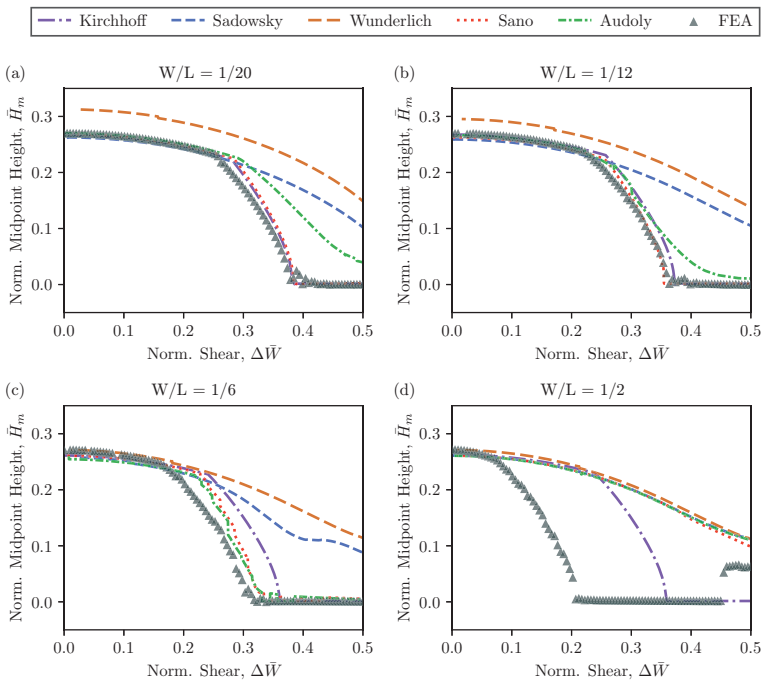
Within a single discrete differential geometry representation, the Kirchhoff, Sadowsky, Wunderlich, Sano, and Audoly ribbon energies are each expressed directly in terms of the discrete curvature and twist strains. When a longitudinally constrained ribbon is driven through a supercritical pitchfork bifurcation by transverse displacement, the Sano energy reproduces the width-induced change in critical displacement that appears in full shell finite-element solutions, while the other four models deviate more noticeably; all five remain computationally comparable to standard discrete elastic rod models.
What carries the argument
The unified discrete differential geometry representation that writes each ribbon energy as a function of coupled bending-twisting strain measures along the centerline, together with the analytically derived gradients and Hessians that support implicit integration.
If this is right
- The Sano energy can be inserted into existing discrete rod codes to add width dependence at negligible extra computational cost.
- Bifurcation thresholds for ribbons of different widths can be obtained from a one-dimensional centerline model instead of a full shell mesh.
- Analytical gradients and Hessians enable stable implicit time stepping for large-deformation ribbon problems at linear per-iteration cost.
- Direct, reproducible ranking of reduced ribbon models becomes possible because they share the same discrete strain measures.
Where Pith is reading between the lines
- The same discrete setting could be used to test new asymptotic derivations of ribbon energies against shell data without rewriting the integrator.
- Designers working with flexible strips or deployable structures could adopt the Sano model for rapid parametric studies before committing to three-dimensional meshes.
- The approach suggests a route to hybrid models in which the discrete centerline is coupled to local shell corrections only where width effects become dominant.
- Contact and self-intersection algorithms already written for discrete rods could be reused for ribbons with almost no change, allowing width-dependent friction studies at scale.
Load-bearing premise
The five reduced centerline energy models, once written in identical discrete variables, can be compared to full shell finite-element results on the pre-buckled arch benchmark without any additional fitting or calibration.
What would settle it
Shell finite-element simulations of the identical pre-buckled arch at several widths in which the Sano model's predicted critical transverse displacement differs from the shell result by more than the agreement reported in the paper.
Figures




read the original abstract
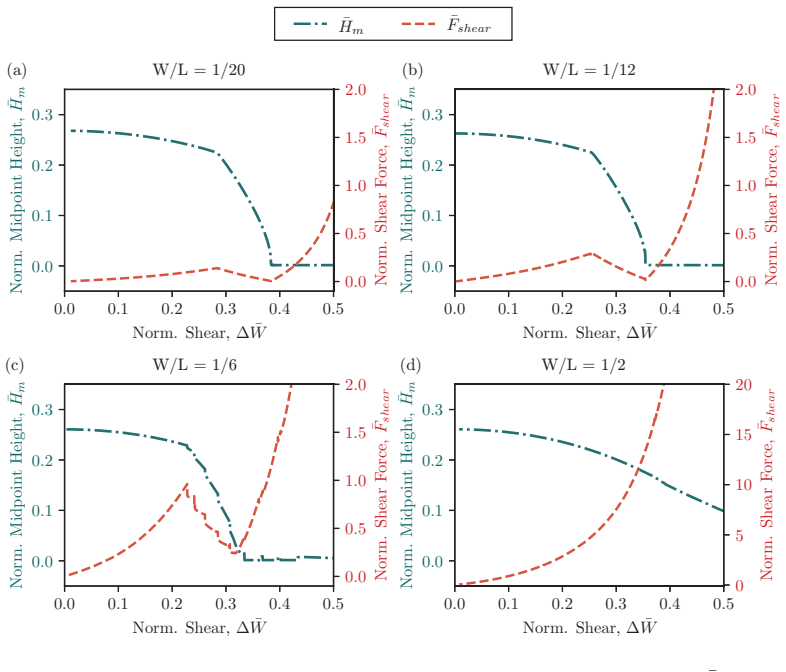
Elastic ribbons, slender structures whose length ($L$), width ($W$), and thickness ($b$) satisfy $L \gg W \gg b$, exhibit mechanical behaviors intermediate between one-dimensional rods ($L \gg W, b$) and two-dimensional plates ($L, W \gg b$). In quadratic Kirchhoff-type rod-based frameworks, such as Discrete Elastic Rods (DER), the governing equilibrium equations are independent of width, and therefore these models cannot capture width-dependent mechanical effects. Reduced centerline-based ribbon models attempt to capture width dependence via coupled bending-twisting energies. However, their relative accuracy remain unclear due to the absence of a unified simulation framework. In this work, we formulate a framework grounded in discrete differential geometry where the energy is expressed as functions of coupled bending-twisting strain measures along the centerline, rather than a linear sum of quadratic bending and twisting energies in DER. We derive analytical gradients and Hessians of the energy that enable implicit time integration. Within this unified setting, we compare five ribbon models: Kirchhoff, Sadowsky, Wunderlich, Sano, and Audoly. As a benchmark, a straight ribbon is longitudinally constrained into a pre-buckled arch and subjected to transverse displacement, inducing a supercritical pitchfork bifurcation. Predicted bifurcation thresholds are compared against shell-based finite element simulations, with the Sano model providing the closest agreement in capturing width-dependent shifts. Our high-performance JAX-based implementation achieves $\mathcal{O}(N)$ per-iteration cost and also confirms that Sano model introduces negligible per-iteration overhead relative to standard DER.
Editorial analysis
A structured set of objections, weighed in public.
Referee Report
Summary. The manuscript introduces a unified discrete differential geometry (DDG) framework for one-dimensional elastic ribbon models. It reformulates five centerline-based energies (Kirchhoff, Sadowsky, Wunderlich, Sano, Audoly) as functions of coupled bending-twisting strain measures rather than independent quadratic terms, derives analytical gradients and Hessians, and implements the resulting implicit integrator in JAX with O(N) per-iteration cost. On a benchmark consisting of a longitudinally constrained straight ribbon forming a pre-buckled arch that undergoes a supercritical pitchfork bifurcation under transverse displacement, the predicted bifurcation thresholds are compared to shell finite-element results; the Sano model is reported to match the width-dependent shifts most closely.
Significance. If the discretization equivalence across models and the fidelity of the discrete operators to the continuous energies can be verified, the work supplies a reproducible, extensible platform for quantitative comparison of reduced ribbon models against each other and against full 2-D shell references. The analytical derivatives and linear-complexity JAX implementation constitute concrete strengths that lower the barrier to further model development and validation in computational mechanics of slender structures.
major comments (1)
- [Abstract] Abstract (benchmark paragraph): the claim that the Sano model yields the closest agreement with shell FEM rests on the premise that the five energies, once rewritten in identical DDG strain variables, produce bifurcation thresholds whose relative ordering is intrinsic to the continuous formulations. No explicit check is described that the shared discrete curvature/twist operators recover the original continuous models in the thin-width limit, nor that the longitudinal constraint and boundary conditions are realized identically for all five models and the shell reference. Without such verification, the reported ordering could be an artifact of the common discretization rather than a property of the energies themselves.
Simulated Author's Rebuttal
We thank the referee for the constructive feedback. We address the single major comment below and will revise the manuscript to incorporate the requested verification.
read point-by-point responses
-
Referee: [Abstract] Abstract (benchmark paragraph): the claim that the Sano model yields the closest agreement with shell FEM rests on the premise that the five energies, once rewritten in identical DDG strain variables, produce bifurcation thresholds whose relative ordering is intrinsic to the continuous formulations. No explicit check is described that the shared discrete curvature/twist operators recover the original continuous models in the thin-width limit, nor that the longitudinal constraint and boundary conditions are realized identically for all five models and the shell reference. Without such verification, the reported ordering could be an artifact of the common discretization rather than a property of the energies themselves.
Authors: We agree that explicit verification is required to confirm the ordering arises from the continuous energy formulations. In the revised manuscript we will add a dedicated subsection (placed after the energy derivations) together with a short appendix that (i) numerically demonstrates convergence of each discrete model to its known continuous thin-width limit (W/L → 0) by recovering the width-independent Kirchhoff-rod bifurcation threshold, and (ii) tabulates the exact discrete constraint equations used for the longitudinal end-to-end distance and the clamped/pinned boundary conditions, showing they are identical across all five models and match the shell-FEM setup. These additions will be supported by convergence plots versus mesh size and width ratio. We believe the new material will remove any ambiguity about discretization artifacts. revision: yes
Circularity Check
No significant circularity; derivation and comparison are self-contained against external benchmark
full rationale
The paper constructs a unified DDG framework expressing five ribbon energies as functions of coupled bending-twisting strains, derives analytical gradients/Hessians for implicit integration, and reports bifurcation thresholds from a pre-buckled arch benchmark. These thresholds are compared directly to independent shell finite-element results rather than to any internally fitted quantities or self-referential definitions. No quoted step reduces a prediction or uniqueness claim to a prior fit, self-citation chain, or ansatz smuggled from the authors' own prior work; the external FEM reference supplies independent grounding. The central ordering (Sano closest) is therefore a genuine empirical outcome within the shared discretization, not a tautology.
Axiom & Free-Parameter Ledger
axioms (1)
- domain assumption Discrete differential geometry provides accurate coupled bending-twisting strain measures for ribbons
Reference graph
Works this paper leans on
-
[1]
Programmable motion of dna origami mechanisms
Alexander E Marras, Lifeng Zhou, Hai-Jun Su, and Carlos E Castro. Programmable motion of dna origami mechanisms. Proceedings of the National Academy of Sciences , 112(3):713–718, 2015
2015
-
[2]
Elasticity sol utions to nonbuckling serpentine ribbons
Shixuan Yang, Shutao Qiao, and Nanshu Lu. Elasticity sol utions to nonbuckling serpentine ribbons. Journal of Applied Mechanics , 84(2):021004, 2017
2017
-
[3]
Stretchable electronic strips for electronic textiles enabled by 3d hel ical structure
Jessica Stanley, Phil Kunovski, John A Hunt, and Yang Wei . Stretchable electronic strips for electronic textiles enabled by 3d hel ical structure. Scientific Reports , 14(1):11065, 2024
2024
-
[4]
Deploymen t dynamics of tape springs
Keith Alexander Seffen and Sergio Pellegrino. Deploymen t dynamics of tape springs. Proceedings of the Royal Society of London. Series A: Mathematical, Physical and Engineering Sciences , 455(1983):1003–1048, 1999
1983
-
[5]
Cubesail: A lo w cost cubesat based solar sail demonstration mission
Vaios Lappas, Nasir Adeli, Lourens Visagie, Juan Fernan dez, Theodoros Theodorou, Willem Steyn, and Matthew Perren. Cubesail: A lo w cost cubesat based solar sail demonstration mission. Advances in Space Re- search, 48(11):1890–1901, 2011
1901
-
[6]
An electro-ribbon actuator for robotic applications
Jianhao Liu, Yangyang Zhao, Heng Fu, Yinshui Liu, and Xin ping Zhou. An electro-ribbon actuator for robotic applications. Journal of Applied Physics, 138(16), 2025
2025
-
[7]
Har- nessing bistability for directional propulsion of soft, un tethered robots
Tian Chen, Osama R Bilal, Kristina Shea, and Chiara Darai o. Har- nessing bistability for directional propulsion of soft, un tethered robots. 55 Proceedings of the National Academy of Sciences , 115(22):5698–5702, 2018
2018
-
[8]
Exploiting dynamic bifurcation in elastic ribbons for mode skip- ping and selection
Weicheng Huang, Tian Yu, Dominic Vella, K Jimmy Hsia, and Mingchao Liu. Exploiting dynamic bifurcation in elastic ribbons for mode skip- ping and selection. Journal of the Mechanics and Physics of Solids , 190:105721, 2024
2024
-
[9]
wunderlich, meet kirc hhoff
Marcelo A Dias and Basile Audoly. “wunderlich, meet kirc hhoff”: A general and unified description of elastic ribbons and thin r ods. Journal of Elasticity , 119(1):49–66, 2015
2015
-
[10]
The shap e of a möbius strip
Evgueni L Starostin and Gert HM Van der Heijden. The shap e of a möbius strip. Nature materials , 6(8):563–567, 2007
2007
-
[11]
Twist-induced snapp ing in a bent elastic rod and ribbon
Tomohiko G Sano and Hirofumi Wada. Twist-induced snapp ing in a bent elastic rod and ribbon. Physical review letters , 122(11):114301, 2019
2019
-
[12]
Ein elementarer Beweis für die Existenz eines ab- wickelbaren Möbiusschen Bandes und Zurückführung des geom etrischen Problems auf ein Variationsproblem
Michael Sadowsky. Ein elementarer Beweis für die Existenz eines ab- wickelbaren Möbiusschen Bandes und Zurückführung des geom etrischen Problems auf ein Variationsproblem . 1930
1930
-
[13]
Über ein abwickelbares möbiusband
Walter Wunderlich. Über ein abwickelbares möbiusband . Monatshefte für Mathematik , 66(3):276–289, 1962
1962
-
[14]
Equilibr ium shapes with stress localisation for inextensible elastic möbius a nd other strips
Eugene L Starostin and Gert HM van der Heijden. Equilibr ium shapes with stress localisation for inextensible elastic möbius a nd other strips. Journal of Elasticity , 119(1):67–112, 2015
2015
-
[15]
Computation of ela stic equi- libria of complete möbius bands and their stability
Alexander Moore and Timothy Healey. Computation of ela stic equi- libria of complete möbius bands and their stability. Mathematics and Mechanics of Solids , 24(4):939–967, 2019
2019
-
[16]
A one-dimension al model for elastic ribbons: a little stretching makes a big difference
Basile Audoly and Sébastien Neukirch. A one-dimension al model for elastic ribbons: a little stretching makes a big difference. Journal of the Mechanics and Physics of Solids , 153:104457, 2021
2021
-
[17]
Numerical modeling of inexten si- ble elastic ribbons with curvature-based elements
Raphaël Charrondière, Florence Bertails-Descoubes, Sébastien Neukirch, and Victor Romero. Numerical modeling of inexten si- ble elastic ribbons with curvature-based elements. Computer Methods in Applied Mechanics and Engineering , 364:112922, 2020. 56
2020
-
[18]
Merci: Mixed curvature-based elements for comp uting equi- libria of thin elastic ribbons
Raphaël Charrondière, Sébastien Neukirch, and Floren ce Bertails- Descoubes. Merci: Mixed curvature-based elements for comp uting equi- libria of thin elastic ribbons. ACM Transactions on Graphics , 43(5):1– 26, 2024
2024
-
[19]
A comput ational approach to obtain nonlinearly elastic constitutive relat ions of strips modeled as a special cosserat rod
Roushan Kumar, Vivek Agarwal, and Ajeet Kumar. A comput ational approach to obtain nonlinearly elastic constitutive relat ions of strips modeled as a special cosserat rod. Computer Methods in Applied Me- chanics and Engineering , 418:116553, 2024
2024
-
[20]
A ruled narrow elastic st rip model with corrected energy
E Vitral, JA Hanna, and L Koens. A ruled narrow elastic st rip model with corrected energy. arXiv preprint arXiv:2512.19895 , 2025
-
[21]
Bifur- cations and stability analysis of elastic slender structur es using static dis- crete elastic rods method
Weicheng Huang, Yingchao Zhang, Tian Yu, and Mingchao L iu. Bifur- cations and stability analysis of elastic slender structur es using static dis- crete elastic rods method. Journal of Applied Mechanics , 90(9):094501, 2023
2023
-
[22]
A d iscrete differential geometry-based numerical framework for exten sible ribbons
Weicheng Huang, Chao Ma, Qiang Chen, and Longhui Qin. A d iscrete differential geometry-based numerical framework for exten sible ribbons. International Journal of Solids and Structures , 248:111619, 2022
2022
-
[23]
Shear induced supercritical pitchfork bifurcation of pre- buckled bands, from narrow strips to wide plates
Weicheng Huang, Yunbo Wang, Xuanhe Li, and Mohammad K Ja wed. Shear induced supercritical pitchfork bifurcation of pre- buckled bands, from narrow strips to wide plates. Journal of the Mechanics and Physics of Solids , 145:104168, 2020
2020
-
[24]
Discrete elastic rods
Miklós Bergou, Max Wardetzky, Stephen Robinson, Basil e Audoly, and Eitan Grinspun. Discrete elastic rods. In ACM Siggraph 2008 Papers , pages 1–12. 2008
2008
-
[25]
Discrete viscous threads
Miklós Bergou, Basile Audoly, Etienne Vouga, Max Warde tzky, and Ei- tan Grinspun. Discrete viscous threads. ACM Transactions on graphics (TOG), 29(4):1–10, 2010
2010
-
[26]
A primer on the kinematics of discrete elastic rods
M Khalid Jawed, Alyssa Novelia, and Oliver M O’Reilly. A primer on the kinematics of discrete elastic rods . Springer, 2018
2018
-
[27]
Radha Lahoti, Ryan Chaiyakul, and M Khalid Jawed. Py-di smech: A scalable and efficient framework for discrete differential ge ometry-based 57 modeling and control of soft robots. arXiv preprint arXiv:2512.09911 , 2025
-
[28]
A finite strain beam formulation
Juan C Simo. A finite strain beam formulation. the three- dimensional dynamic problem. part i. Computer methods in applied mechanics and engineering, 49(1):55–70, 1985
1985
-
[29]
On a stress resultant geometr ically exact shell model
Juan C Simo and David D Fox. On a stress resultant geometr ically exact shell model. part i: Formulation and optimal parametrizati on. Computer Methods in Applied Mechanics and Engineering , 72(3):267–304, 1989
1989
-
[30]
On a stress resul- tant geometrically exact shell model
Juan C Simo, David D Fox, and Mustapha S Rifai. On a stress resul- tant geometrically exact shell model. part iii: Computatio nal aspects of the nonlinear theory. Computer Methods in Applied Mechanics and Engineering, 79(1):21–70, 1990
1990
-
[31]
On a stress resultant g eometri- cally exact shell model
JC Simo, MS Rifai, and DD0746 Fox. On a stress resultant g eometri- cally exact shell model. part iv: Variable thickness shells with through- the-thickness stretching. Computer methods in applied mechanics and engineering, 81(1):91–126, 1990
1990
-
[32]
Discrete is it enough? the revival of piol a–hencky keynotes to analyze three-dimensional elastica
Emilio Turco. Discrete is it enough? the revival of piol a–hencky keynotes to analyze three-dimensional elastica. Continuum Mechanics and Ther- modynamics, 30(5):1039–1057, 2018
2018
-
[33]
Forward and inverse problems in the me chanics of soft filaments
Mattia Gazzola, Levi H Dudte, Andrew G McCormick, and La kshmi- narayanan Mahadevan. Forward and inverse problems in the me chanics of soft filaments. Royal Society open science , 5(6), 2018
2018
-
[34]
Bifurcations of buckled, clamped a nisotropic rods and thin bands under lateral end translations
Tian Yu and JA Hanna. Bifurcations of buckled, clamped a nisotropic rods and thin bands under lateral end translations. Journal of the Me- chanics and Physics of Solids , 122:657–685, 2019
2019
-
[35]
Discrete elasto- plastic rods
Xuanhe Li, Weicheng Huang, and M Khalid Jawed. Discrete elasto- plastic rods. Extreme Mechanics Letters , 38:100767, 2020
2020
-
[36]
Geo metrically exact elastoplastic rods: determination of yield surface i n terms of stress resultants
Ludwig Herrnböck, Ajeet Kumar, and Paul Steinmann. Geo metrically exact elastoplastic rods: determination of yield surface i n terms of stress resultants. Comput. Mech. , 67(3):723–742, March 2021. 58
2021
-
[37]
JAX: composable transformations of Python+NumPy programs , 2018
James Bradbury, Roy Frostig, Peter Hawkins, Matthew Ja mes Johnson, Yash Katariya, Chris Leary, Dougal Maclaurin, George Necul a, Adam Paszke, Jake VanderPlas, Skye Wanderman-Milne, and Qiao Zh ang. JAX: composable transformations of Python+NumPy programs , 2018
2018
-
[38]
T wist- induced bifurcation and path manipulation in compressed ri bbons
Tao Feng, Jinhui Chen, Jie-Wei Wong, Siyang Li, Zhikun M iao, Zhe Wang, Xinge Li, Jiasheng Cao, Yaoting Xue, Xuxu Yang, et al. T wist- induced bifurcation and path manipulation in compressed ri bbons. Jour- nal of the Mechanics and Physics of Solids , page 106328, 2025
2025
-
[39]
Equinox: neural ne tworks in JAX via callable PyTrees and filtered transformations
Patrick Kidger and Cristian Garcia. Equinox: neural ne tworks in JAX via callable PyTrees and filtered transformations. Differentiable Pro- gramming workshop at Neural Information Processing System s 2021 , 2021. 59
2021
discussion (0)
Sign in with ORCID, Apple, or X to comment. Anyone can read and Pith papers without signing in.