Recognition: unknown
Thermodynamics and emergent thermomechanical response of a quantum ring with nonminimal spin--orbit coupling
Pith reviewed 2026-05-08 05:14 UTC · model grok-4.3
The pith
Nonminimal spin-orbit coupling deforms angular-momentum branches in a quantum ring, reorganizing the low-energy spectrum and imprinting on thermodynamic and thermomechanical properties.
A machine-rendered reading of the paper's core claim, the machinery that carries it, and where it could break.
Core claim
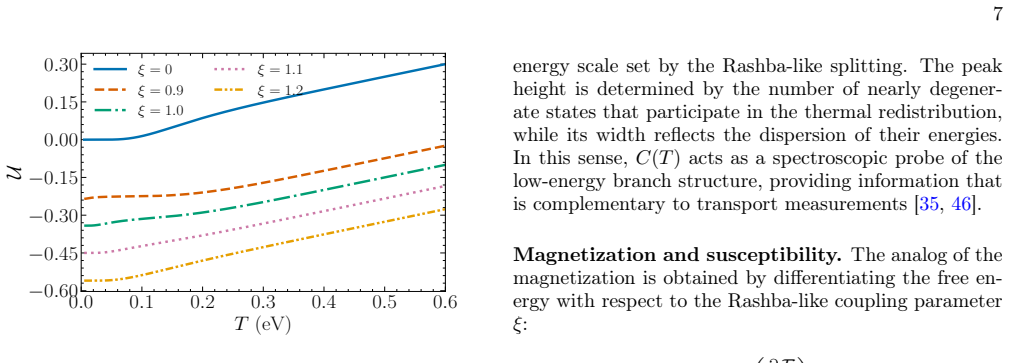
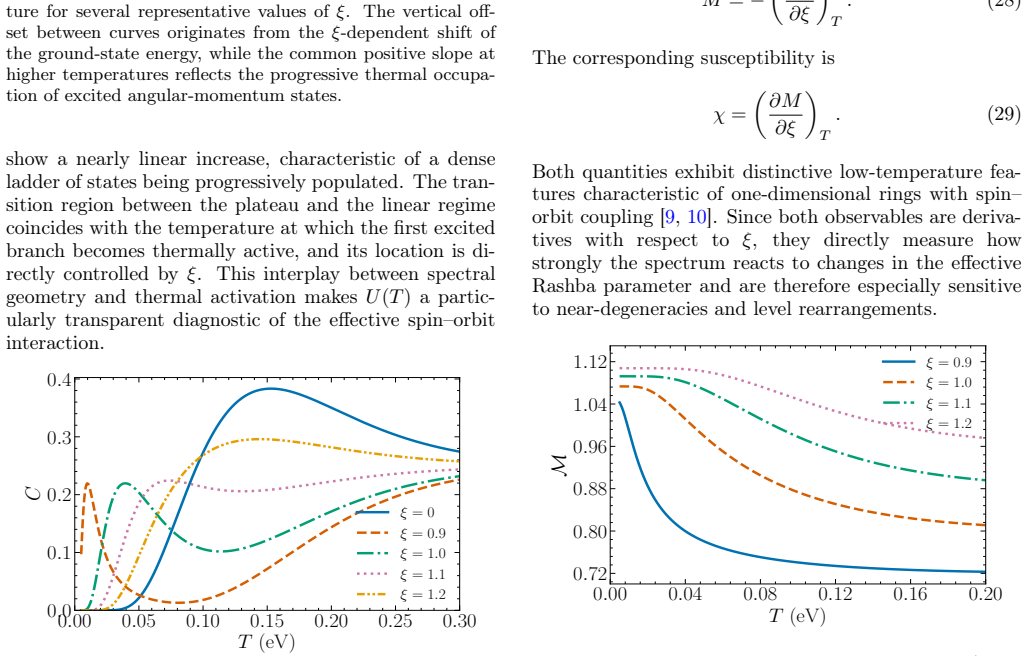
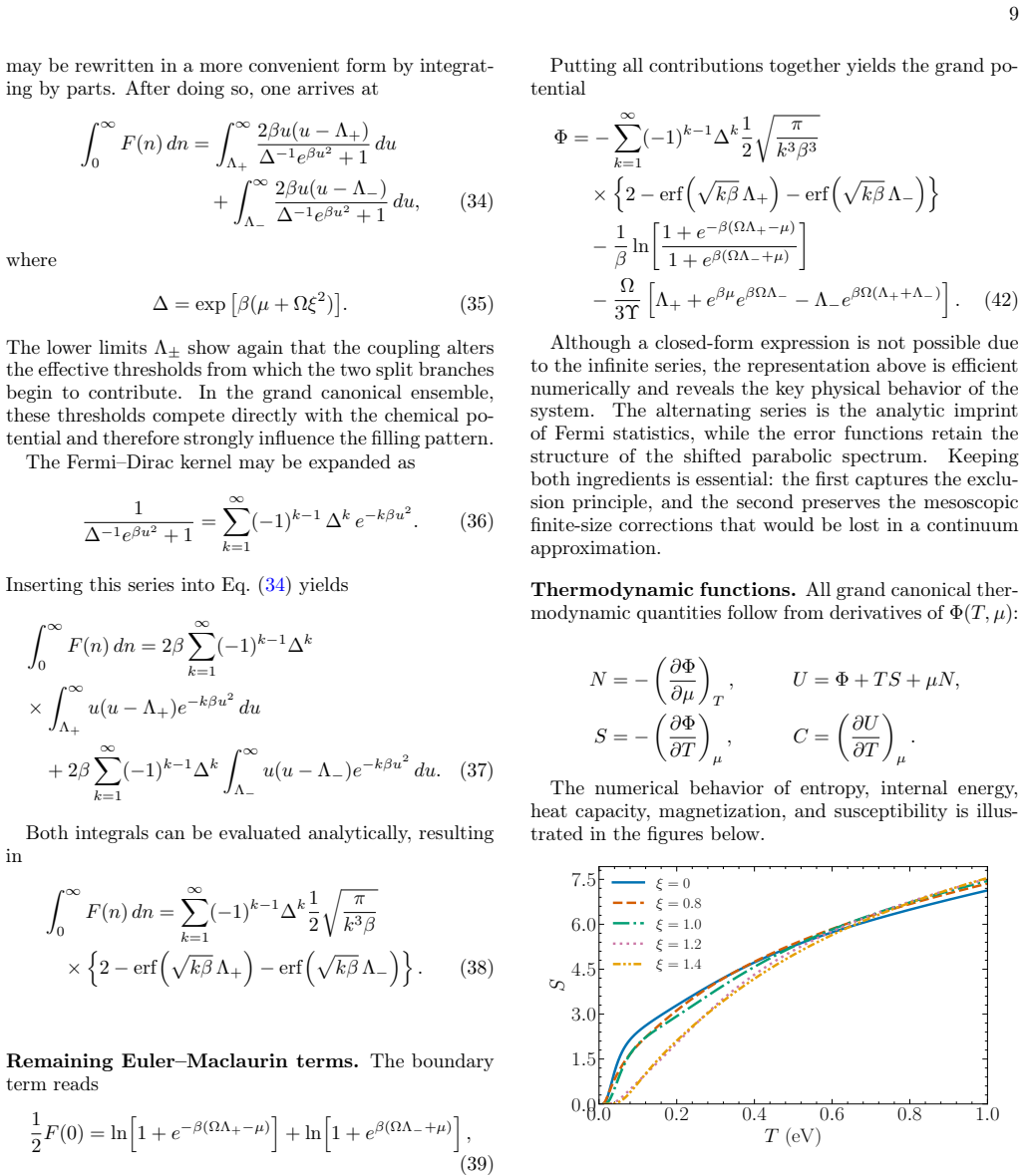
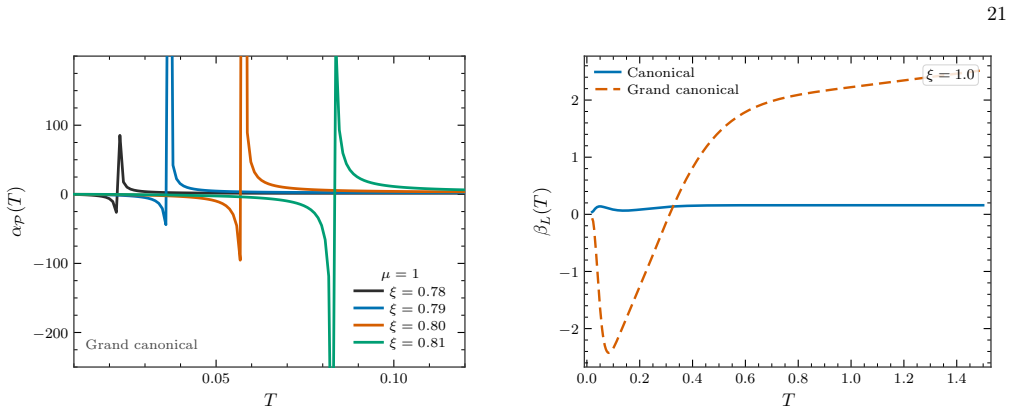
Using the exact spectrum, the nonminimal coupling ξ deforms the angular-momentum branches, reorganizing the low-energy spectrum. This leaves signatures in the internal energy, entropy, heat capacity, and spin-orbit response functions. An effective thermomechanical description is developed by treating the ring circumference as a quasi-static thermodynamic variable, leading to a pressure-like quantity and response coefficients linked to the spectrum. In the grand-canonical ensemble, Fermi statistics strongly enhance the response, producing coupling-dependent instabilities and sign changes reminiscent of mesoscopic de Haas-van Alphen oscillations. A phenomenological interacting extension based
What carries the argument
The nonminimal coupling parameter ξ that deforms angular-momentum branches in the exact spectrum, enabling computation of thermodynamic quantities and definition of thermomechanical responses via the ring circumference.
Load-bearing premise
The exact spectrum from the companion work accurately captures the nonminimal couplings, and the exponential resummation validly approximates collective interacting effects.
What would settle it
An observation or calculation that the grand-canonical response functions lack coupling-dependent sign changes or instabilities would falsify the strong enhancement by Fermi statistics.
Figures







read the original abstract
We investigate the thermodynamic and emergent thermomechanical properties of fermions confined to a one-dimensional quantum ring with effective spin--orbit interactions induced by nonminimal couplings to antisymmetric tensor fields. Using the exact spectrum obtained in the companion work, we develop canonical and grand-canonical descriptions and show that the coupling parameter~$\xi$ deforms the angular-momentum branches, reorganizing the low-energy spectrum and leaving clear signatures in the internal energy, entropy, heat capacity, and spin--orbit response functions. We also formulate an effective thermomechanical description by treating the ring circumference as a quasi-static thermodynamic variable. This leads to a pressure-like quantity and associated response coefficients, directly linked to the microscopic spectrum. In the grand-canonical ensemble, Fermi statistics strongly enhance the response, producing coupling-dependent instabilities and sign changes reminiscent of mesoscopic de~Haas--van Alphen oscillations. Finally, we introduce a phenomenological interacting extension based on an exponential resummation of the free energy, showing that collective effects can sharpen the thermomechanical response and induce anomalous thermal contraction. Our results connect spectral deformation, finite-size thermodynamics, and emergent mechanical behavior in spin--orbit-active quantum rings.
Editorial analysis
A structured set of objections, weighed in public.
Referee Report
Summary. The manuscript develops canonical and grand-canonical thermodynamics for fermions on a one-dimensional quantum ring with nonminimal spin-orbit coupling, using the exact single-particle spectrum obtained in a companion work. It shows that the coupling parameter ξ deforms angular-momentum branches, producing signatures in internal energy, entropy, heat capacity, and spin-orbit response functions. Treating the ring circumference as a quasi-static variable yields a pressure-like quantity and associated thermomechanical coefficients. In the grand-canonical ensemble, Fermi statistics are claimed to enhance responses and generate coupling-dependent instabilities with sign changes analogous to mesoscopic de Haas-van Alphen oscillations. The paper concludes by introducing a phenomenological interacting extension via exponential resummation of the free energy, which is asserted to sharpen the thermomechanical response and induce anomalous thermal contraction.
Significance. If the companion spectrum is accurate and the resummation faithfully represents physical interactions, the work would connect spectral reorganization to emergent thermomechanical instabilities in finite-size spin-orbit systems, extending mesoscopic thermodynamics. The explicit use of an exact spectrum is a positive feature that grounds the thermodynamic calculations. However, the central headline claims about collective sharpening and anomalous contraction rest on an ad-hoc construction whose validity is not demonstrated, limiting the overall significance.
major comments (3)
- [phenomenological interacting extension (final section)] The phenomenological interacting extension (final section, as described in the abstract) is introduced via an exponential resummation of the free energy without derivation from a microscopic Hamiltonian, without error bounds, and without comparison to perturbative or exact small-N treatments. This construction is load-bearing for the claims that collective effects sharpen the thermomechanical response and induce anomalous thermal contraction; if the resummation does not correspond to any physical interaction, those signatures are artifacts.
- [thermodynamic descriptions (canonical and grand-canonical sections)] All thermodynamic quantities and response functions (internal energy, entropy, heat capacity, pressure-like coefficient, and instabilities) are computed directly from the spectrum of the companion work. No independent verification, numerical checks, or explicit formulas for the spectrum are supplied in the present manuscript, so the independence and reproducibility of the reported signatures cannot be assessed from this text alone.
- [grand-canonical ensemble and thermomechanical response] The grand-canonical instabilities and sign changes (reminiscent of de Haas-van Alphen oscillations) are stated to arise from Fermi statistics and the ξ-deformed spectrum, yet no explicit expression for the pressure-like quantity or the response coefficients is given that would allow a reader to reproduce the sign changes without the companion spectrum.
minor comments (2)
- [abstract and introduction] The abstract and introduction refer to 'clear signatures' and 'anomalous thermal contraction' without quantifying the effect sizes or providing a baseline comparison (e.g., ξ=0 case) in the text.
- [throughout] Notation for the coupling ξ and the resummation parameter is introduced without a dedicated table or equation summarizing all symbols and their physical dimensions.
Simulated Author's Rebuttal
We thank the referee for the careful and constructive review of our manuscript. We address each major comment point by point below, providing the strongest honest defense of the work while acknowledging limitations. Revisions will be made to improve clarity, reproducibility, and caveats as detailed in the responses.
read point-by-point responses
-
Referee: The phenomenological interacting extension (final section, as described in the abstract) is introduced via an exponential resummation of the free energy without derivation from a microscopic Hamiltonian, without error bounds, and without comparison to perturbative or exact small-N treatments. This construction is load-bearing for the claims that collective effects sharpen the thermomechanical response and induce anomalous thermal contraction; if the resummation does not correspond to any physical interaction, those signatures are artifacts.
Authors: We agree the extension is phenomenological, as explicitly stated in the manuscript, and serves to illustrate possible effects of interactions on thermomechanical responses rather than to model a specific microscopic Hamiltonian. Such resummation techniques are standard in mesoscopic and statistical mechanics literature for capturing collective behavior in finite systems. We will revise the final section to add explicit caveats on its ad-hoc nature, discuss possible microscopic origins (e.g., via effective interactions), include error estimates where feasible for small N, and tone down headline claims to emphasize that sharpening and anomalous contraction are demonstrated within this model. This addresses the concern without altering the core results. revision: partial
-
Referee: All thermodynamic quantities and response functions (internal energy, entropy, heat capacity, pressure-like coefficient, and instabilities) are computed directly from the spectrum of the companion work. No independent verification, numerical checks, or explicit formulas for the spectrum are supplied in the present manuscript, so the independence and reproducibility of the reported signatures cannot be assessed from this text alone.
Authors: The manuscript focuses on thermodynamic implications using the exact spectrum from the companion paper, as noted in the abstract and introduction. To enhance self-containment and reproducibility, we will include the explicit single-particle energy eigenvalues (including the ξ-dependent deformation of angular-momentum branches) in a new appendix. We will also add numerical verification for small system sizes (e.g., N=2,4) by direct summation and comparison to limiting cases (ξ=0). revision: yes
-
Referee: The grand-canonical instabilities and sign changes (reminiscent of de Haas-van Alphen oscillations) are stated to arise from Fermi statistics and the ξ-deformed spectrum, yet no explicit expression for the pressure-like quantity or the response coefficients is given that would allow a reader to reproduce the sign changes without the companion spectrum.
Authors: The pressure-like quantity is defined as P = -∂F/∂L (where F is the grand potential and L the circumference) and the thermomechanical coefficients follow from its derivatives with respect to temperature and chemical potential. We will add these explicit expressions in the revised manuscript, written as sums over the single-particle states with the ξ-deformed spectrum, enabling direct reproduction of the sign changes and instabilities once the spectrum formula is included. revision: yes
Circularity Check
Phenomenological exponential resummation reduces collective-effects claim to ansatz choice by construction
specific steps
-
other
[Abstract (final sentence) and interacting-extension section]
"Finally, we introduce a phenomenological interacting extension based on an exponential resummation of the free energy, showing that collective effects can sharpen the thermomechanical response and induce anomalous thermal contraction."
The sharpening and anomalous contraction are exhibited by adopting the exponential resummation; because the form is introduced without derivation from a specific interaction and is selected to generate the desired sharpening, the 'showing' is equivalent to the ansatz choice rather than an independent derivation or prediction.
full rationale
Standard thermodynamic quantities (internal energy, entropy, heat capacity, response functions) are obtained by applying canonical/grand-canonical formulas to the spectrum supplied by the companion paper; this step is non-circular because it deploys known statistical mechanics on an externally derived input. The headline assertion that collective effects sharpen thermomechanical response and induce anomalous contraction, however, is demonstrated solely by introducing an exponential resummation of the free energy whose functional form is chosen precisely to produce sharpening and sign changes. No microscopic Hamiltonian, error bound, or comparison to controlled approximations is supplied, so the reported emergent behavior reduces directly to the phenomenological ansatz.
Axiom & Free-Parameter Ledger
free parameters (1)
- ξ
axioms (1)
- domain assumption The exact spectrum of the quantum ring with nonminimal spin-orbit coupling is known from the companion work.
invented entities (1)
-
Phenomenological interacting extension via exponential resummation of the free energy
no independent evidence
Reference graph
Works this paper leans on
-
[1]
Imry,Introduction to Mesoscopic Physics, 2nd ed
Y. Imry,Introduction to Mesoscopic Physics, 2nd ed. (Oxford University Press, Oxford, 2002)
2002
-
[2]
S.Viefers, P.Koskinen, P.SinghaDeo,andM.Manninen, Physica E21, 1 (2004)
2004
-
[3]
M. V. Berry, Proc. R. Soc. London A392, 45 (1984)
1984
-
[4]
Aharonov and J
Y. Aharonov and J. Anandan, Phys. Rev. Lett.58, 1593 (1987)
1987
-
[5]
Büttiker, Y
M. Büttiker, Y. Imry, and R. Landauer, Phys. Lett. A 96, 365 (1983)
1983
-
[6]
L. P. Lévy, G. Dolan, J. Dunsmuir, and H. Bouchiat, Phys. Rev. Lett.64, 2074 (1990)
2074
-
[7]
Chandrasekhar, R
V. Chandrasekhar, R. A. Webb, M. J. Brady, M. B. Ketchen, W. J. Gallagher, and A. Kleinsasser, Phys. Rev. Lett.67, 3578 (1991)
1991
-
[8]
Cheung, Y
H.-F. Cheung, Y. Gefen, E. K. Riedel, and W.-H. Shih, Phys. Rev. B37, 6050 (1988)
1988
-
[9]
Frustaglia and K
D. Frustaglia and K. Richter, Phys. Rev. B69, 235310 (2004)
2004
-
[10]
Splettstoesser, M
J. Splettstoesser, M. Governale, and U. Zülicke, Phys. Rev. B68, 165341 (2003)
2003
-
[11]
M. Z. Hasan and C. L. Kane, Rev. Mod. Phys.82, 3045 (2010)
2010
-
[12]
Qi and S.-C
X.-L. Qi and S.-C. Zhang, Rev. Mod. Phys.83, 1057 (2011)
2011
-
[13]
Y. A. Bychkov and E. I. Rashba, J. Phys. C: Solid State Phys.17, 6039 (1984)
1984
-
[14]
Dresselhaus, Phys
G. Dresselhaus, Phys. Rev.100, 580 (1955)
1955
-
[15]
Nitta, T
J. Nitta, T. Akazaki, H. Takayanagi, and T. Ensslin, Phys. Rev. Lett.78, 1335 (1997)
1997
-
[16]
Grundler, Phys
D. Grundler, Phys. Rev. Lett.84, 6074 (2000)
2000
-
[17]
Žutić, J
I. Žutić, J. Fabian, and S. Das Sarma, Rev. Mod. Phys. 76, 323 (2004)
2004
-
[18]
Manchon, H
A. Manchon, H. C. Koo, J. Nitta, S. M. Frolov, and R. A. Duine, Nat. Mater.14, 871 (2015)
2015
-
[19]
Winkler,Spin–Orbit Coupling Effects in Two- Dimensional Electron and Hole Systems(Springer, Berlin, 2003)
R. Winkler,Spin–Orbit Coupling Effects in Two- Dimensional Electron and Hole Systems(Springer, Berlin, 2003)
2003
-
[20]
Sinova, S
J. Sinova, S. O. Valenzuela, J. Wunderlich, C. H. Back, and T. Jungwirth, Rev. Mod. Phys.87, 1213 (2015)
2015
-
[21]
Colladay and V
D. Colladay and V. A. Kostelecký, Phys. Rev. D58, 116002 (1998)
1998
-
[22]
V. A. Kostelecký and S. Samuel, Phys. Rev. D39, 683 (1989)
1989
-
[23]
V.A.KosteleckýandM.Mewes,Phys.Rev.D66,056005 (2002)
2002
-
[24]
S. M. Carroll, G. B. Field, and R. Jackiw, Phys. Rev. D 41, 1231 (1990)
1990
-
[25]
Mattingly, Living Rev
D. Mattingly, Living Rev. Relativ.8, 5 (2005)
2005
-
[26]
Bakke, H
K. Bakke, H. Belich, and E. O. Silva, Ann. Phys. (Berlin) 523, 910 (2011)
2011
-
[27]
Belich, L
H. Belich, L. P. Colatto, T. Costa-Soares, J. A. Helayël- Neto, and M. T. D. Orlando, Eur. Phys. J. C62, 425 (2009)
2009
-
[28]
Bakke, E
K. Bakke, E. O. Silva, and H. Belich, J. Phys. G: Nucl. Part. Phys.39, 055004 (2012)
2012
-
[29]
Belich, T
H. Belich, T. Costa-Soares, M. M. Santos, and M. T. D. Orlando, Phys. Lett. B641, 265 (2006)
2006
-
[30]
E. O. Silva, J. A. A. S. Reis, and L. Lisboa-Santos, (2026), arXiv:2604.07731, arXiv:2604.07731 [hep-th]
work page internal anchor Pith review Pith/arXiv arXiv 2026
-
[31]
J. A. A. S. Reis, L. Lisboa-Santos, F. M. Andrade, F. dos S.Azevedo,andE.O.Silva,TheEuropeanPhysicalJour- nal Plus140, 758 (2025)
2025
-
[32]
F. E. Meijer, A. F. Morpurgo, and T. M. Klapwijk, Phys. Rev. B66, 033107 (2002). 27
2002
-
[33]
B69, 155335 (2004)
B.Molnár, F.M.Peeters,andP.Vasilopoulos,Phys.Rev. B69, 155335 (2004)
2004
-
[34]
J. S. Sheng and K. Chang, Phys. Rev. B74, 235315 (2006)
2006
-
[35]
Lorke, R
A. Lorke, R. J. Luyken, A. O. Govorov, J. P. Kotthaus, J. M. Garcia, and P. M. Petroff, Phys. Rev. Lett.84, 2223 (2000)
2000
-
[36]
Fuhrer, S
A. Fuhrer, S. Lüscher, T. Ihn, T. Heinzel, K. Ensslin, W. Wegscheider, and M. Bichler, Nature413, 822 (2001)
2001
-
[37]
T. Koga, J. Nitta, T. Akazaki, and H. Takayanagi, Phys. Rev. Lett.89, 046801 (2002)
2002
-
[38]
Bergsten, T
T. Bergsten, T. Kobayashi, Y. Sekine, and J. Nitta, Phys. Rev. Lett.97, 196803 (2006)
2006
-
[39]
König, A
M. König, A. Tschetschetkin, E. M. Hankiewicz, J. Sinova, V. Hock, V. Daumer, M. Schäfer, C. R. Becker, H. Buhmann, and L. W. Molenkamp, Phys. Rev. Lett. 96, 076804 (2006)
2006
-
[40]
Nagasawa, D
F. Nagasawa, D. Frustaglia, H. Saarikoski, K. Richter, and J. Nitta, Nat. Commun.4, 2526 (2013)
2013
-
[41]
Aharonov and D
Y. Aharonov and D. Bohm, Phys. Rev.115, 485 (1959)
1959
-
[42]
Aharonov and A
Y. Aharonov and A. Casher, Phys. Rev. Lett.53, 319 (1984)
1984
-
[43]
Stern, Phys
A. Stern, Phys. Rev. Lett.68, 1022 (1992)
1992
-
[44]
Nitta, F
J. Nitta, F. E. Meijer, and H. Takayanagi, Appl. Phys. Lett.75, 695 (1999)
1999
-
[45]
Gorini, P
C. Gorini, P. Schwab, R. Raimondi, and A. L. Shelankov, Phys. Rev. B82, 195316 (2010)
2010
-
[46]
Tan and J
W.-C. Tan and J. C. Inkson, Phys. Rev. B60, 5626 (1999)
1999
-
[47]
Tan and J
W.-C. Tan and J. C. Inkson, Semicond. Sci. Technol.11, 1635 (1996)
1996
-
[48]
Bakke and C
K. Bakke and C. Furtado, J. Math. Phys.53, 023514 (2012)
2012
-
[49]
F. A. de Lira, L. F. C. Pereira, and E. O. Silva, Physica E: Low-dimensional Systems and Nanostructures158, 115898 (2024)
2024
-
[50]
R. K. Pathria and P. D. Beale,Statistical Mechanics, 3rd ed. (Academic Press, Oxford, 2011)
2011
-
[51]
L. D. Landau and E. M. Lifshitz,Statistical Physics, Part 1, 3rd ed. (Pergamon Press, Oxford, 1980)
1980
-
[52]
Byers and C
N. Byers and C. N. Yang, Phys. Rev. Lett.7, 46 (1961)
1961
-
[53]
Ambegaokar and U
V. Ambegaokar and U. Eckern, Phys. Rev. Lett.65, 381 (1990)
1990
-
[54]
Y.-J. Lin, K. Jiménez-García, and I. B. Spielman, Nature 471, 83 (2011)
2011
-
[55]
Dalibard, F
J. Dalibard, F. Gerbier, G. Juzeli¯ unas, and P. Öhberg, Rev. Mod. Phys.83, 1523 (2011)
2011
-
[56]
Goldman, G
N. Goldman, G. Juzeli¯ unas, P. Öhberg, and I. B. Spiel- man, Rep. Prog. Phys.77, 126401 (2014)
2014
-
[57]
Galitski and I
V. Galitski and I. B. Spielman, Nature494, 49 (2013)
2013
-
[58]
L. D. Landau, Zh. Eksp. Teor. Fiz.7, 19 (1937)
1937
-
[59]
L. D. Landau and E. M. Lifshitz,Statistical Physics, Part 1(Pergamon Press, 1980)
1980
-
[60]
Goldenfeld,Lectures on Phase Transitions and the Renormalization Group(Addison-Wesley, 1992)
N. Goldenfeld,Lectures on Phase Transitions and the Renormalization Group(Addison-Wesley, 1992)
1992
-
[61]
P. M. Chaikin and T. C. Lubensky,Principles of Con- densed Matter Physics(Cambridge University Press, 1995)
1995
-
[62]
Kardar,Statistical Physics of Fields(Cambridge Uni- versity Press, 2007)
M. Kardar,Statistical Physics of Fields(Cambridge Uni- versity Press, 2007)
2007
-
[63]
J. W. Negele and H. Orland,Quantum Many-Particle Systems(Addison-Wesley, 1988)
1988
discussion (0)
Sign in with ORCID, Apple, or X to comment. Anyone can read and Pith papers without signing in.