Recognition: no theorem link
Geometric Phases and Persistent Spin Currents from nonminimal couplings
Pith reviewed 2026-05-10 18:06 UTC · model grok-4.3
The pith
Nonminimal axial couplings in the Dirac Lagrangian induce Rashba-like spin-orbit interactions in quantum rings from both electric and magnetic fields.
A machine-rendered reading of the paper's core claim, the machinery that carries it, and where it could break.
Core claim
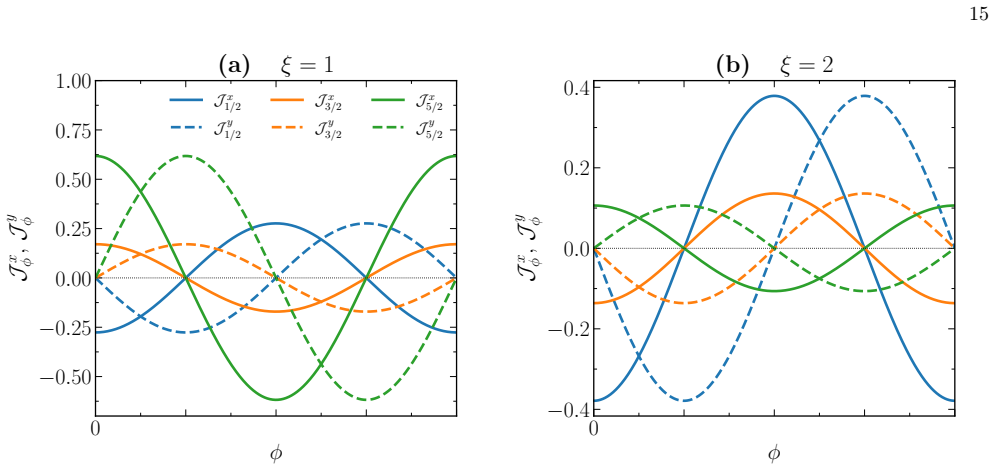
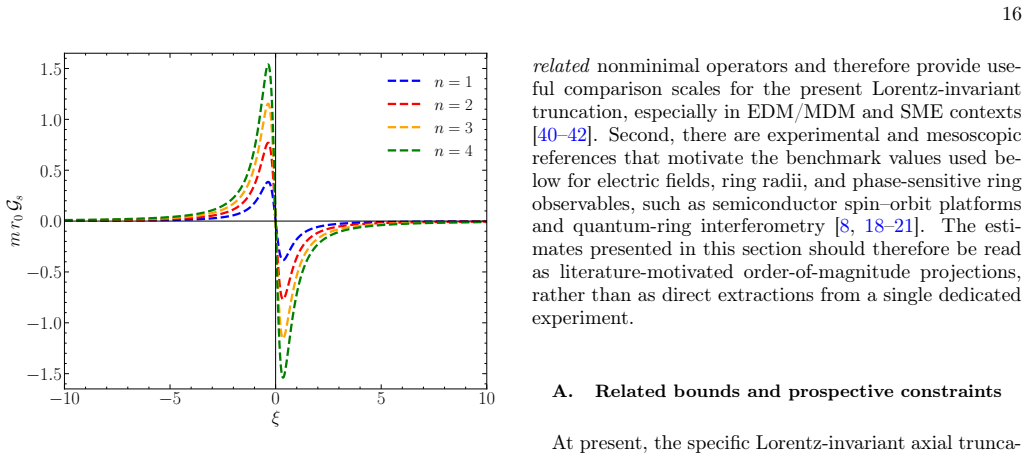
Starting from a generalized Dirac Lagrangian with two axial nonminimal couplings involving F_μν and its dual, the nonrelativistic limit yields effective Hamiltonians of the form F · (p × σ). For fermions confined to a quantum ring this produces exact analytical energy levels and normalized eigenspinors, from which Aharonov-Anandan geometric phases and persistent spin currents (together with the response G_s = ∂J_φ^z / ∂ξ) are computed. The model supplies the first order-of-magnitude bounds on the couplings g1 and g2 from spectroscopic and mesoscopic considerations.
What carries the argument
The two independent axial nonminimal derivative couplings to the electromagnetic field strength and its dual in the generalized Dirac Lagrangian, which reduce in the nonrelativistic limit to the vector term F · (p × σ) that carries the Rashba-like interaction.
If this is right
- Both electric and magnetic background fields can source Rashba-type spin-orbit coupling in the ring geometry.
- Exact analytical control over the ring spectrum permits direct evaluation of geometric phases and persistent currents.
- The differential spin response G_s supplies a concrete observable for the strength of the new couplings.
- The derived bounds on g1 and g2 constrain the size of these interactions in both atomic and mesoscopic regimes.
Where Pith is reading between the lines
- Electric-field control of spin currents in rings could open routes to spintronic devices that avoid magnetic fields.
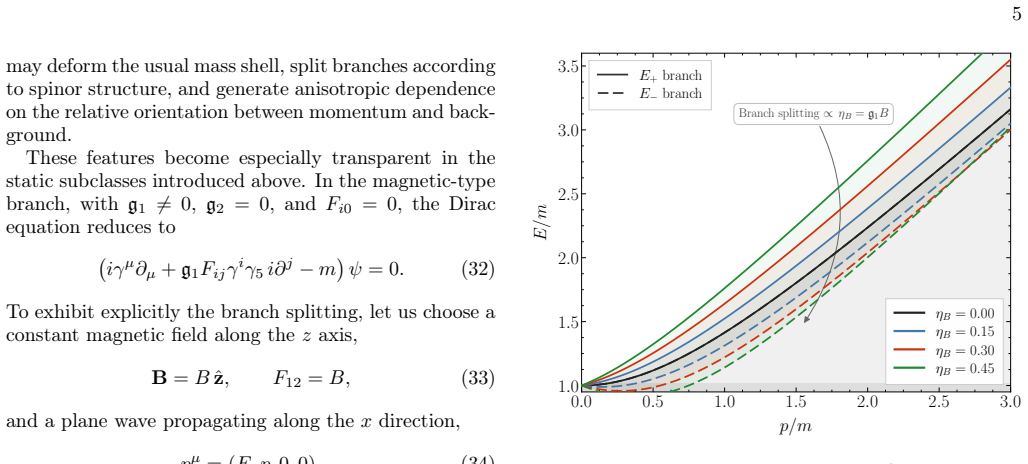
- Relativistic branch splitting in the dispersion relation offers a high-energy signature that might be accessible in analog systems.
- Adding disorder or nonequilibrium driving would likely produce additional measurable signatures of the same operators.
Load-bearing premise
The nonrelativistic expansion of the generalized Dirac operator remains valid for the one-dimensional ring geometry and the chosen background fields introduce no inconsistencies in the canonical structure or conserved currents.
What would settle it
An experiment on a quantum ring that measures spin currents or geometric phase shifts inconsistent with the predicted electric-field contribution, or spectroscopic data that forces the couplings outside the derived order-of-magnitude windows.
Figures


read the original abstract
We investigate a class of nonminimal derivative couplings between fermions and electromagnetic fields that generate Rashba-like spin--orbit interactions in one-dimensional quantum rings. Starting from a generalized Dirac Lagrangian containing two independent axial structures built from the field strength $F_{\mu\nu}$ and its dual $\tilde{F}_{\mu\nu}$, we perform a systematic nonrelativistic expansion and show that both couplings induce effective Hamiltonians of the form $\boldsymbol{\mathcal{F}}\cdot(\boldsymbol{p}\times\boldsymbol{\sigma})$. This reveals that magnetic as well as electric background fields may give rise to Rashba-type interactions, in contrast with standard condensed-matter scenarios. Before passing to the nonrelativistic limit, we analyze the relativistic content of the model in detail: the canonical structure of the deformed Dirac operator, the admissible background classes, the effective bilinear current, and the branch splitting of the relativistic dispersion relation, which constitutes the primary relativistic signature of the theory. We derive exact analytical energy levels and normalized eigenspinors for the resulting ring Hamiltonian, compute Aharonov--Anandan geometric phases, and analyze persistent spin currents together with the associated differential spin response $\mathcal{G}_s = \partial\mathcal{J}_\varphi^z/\partial\xi$. Exploiting the analytical control offered by the model, we derive the first systematic order-of-magnitude bounds on the two Lorentz-invariant couplings $\mathfrak{g}_1$ and $\mathfrak{g}_2$ from both spectroscopic and mesoscopic scenarios, identifying the experimental channels most sensitive to the new physics encoded in these operators. We discuss physical implications, signatures, and possible experimental analogs, and outline several promising directions involving disorder, noise, and nonequilibrium spin dynamics.
Editorial analysis
A structured set of objections, weighed in public.
Referee Report
Summary. The manuscript starts from a generalized Dirac Lagrangian with two independent axial nonminimal couplings built from F_μν and its dual, performs a systematic nonrelativistic expansion to obtain effective Hamiltonians of the form F · (p × σ) for both electric and magnetic backgrounds, derives exact analytical energy levels and eigenspinors for the resulting one-dimensional quantum-ring Hamiltonian, computes Aharonov-Anandan geometric phases, analyzes persistent spin currents together with the differential response G_s = ∂J_φ^z / ∂ξ, and extracts order-of-magnitude bounds on the Lorentz-invariant couplings g1 and g2 from spectroscopic and mesoscopic scales.
Significance. If the central derivations hold, the work supplies a relativistic origin for Rashba-type spin-orbit interactions that can be generated by either electric or magnetic fields, in contrast to conventional condensed-matter realizations. The exact solvability of the ring model permits controlled calculations of geometric phases and persistent currents, while the derived bounds constitute falsifiable predictions. The analytical control and the systematic treatment of admissible backgrounds are strengths that could facilitate further studies of spin dynamics in mesoscopic systems.
major comments (1)
- [Nonrelativistic expansion] Nonrelativistic expansion section: the expansion of the deformed Dirac operator is performed on the free theory before the ring constraint and radial confining potential are imposed. It remains to be shown explicitly that radial derivatives and the thin-ring limit do not generate additional spin-orbit or Darwin-type contributions that survive and modify the coefficient or tensor structure of the claimed F · (p × σ) Hamiltonian; this step is load-bearing for all subsequent ring solutions, phases, and current calculations.
minor comments (2)
- [Abstract and notation] Notation for the couplings is inconsistent between the abstract (mathfrak g_1, mathfrak g_2) and the main text (g1, g2); uniform use throughout would aid readability.
- [Persistent currents] The definition of the differential spin response G_s and the explicit steps connecting the canonical current to the persistent current in the ring would benefit from an expanded derivation for reproducibility.
Simulated Author's Rebuttal
We thank the referee for the careful reading of the manuscript and the positive assessment of its significance. We address the major comment below and will revise the manuscript to provide the requested explicit demonstration.
read point-by-point responses
-
Referee: [Nonrelativistic expansion] Nonrelativistic expansion section: the expansion of the deformed Dirac operator is performed on the free theory before the ring constraint and radial confining potential are imposed. It remains to be shown explicitly that radial derivatives and the thin-ring limit do not generate additional spin-orbit or Darwin-type contributions that survive and modify the coefficient or tensor structure of the claimed F · (p × σ) Hamiltonian; this step is load-bearing for all subsequent ring solutions, phases, and current calculations.
Authors: We agree that an explicit verification is necessary to confirm that the effective Hamiltonian is robust under the ring constraint. In the revised manuscript we will add a dedicated subsection immediately after the nonrelativistic expansion. There we will include the radial confining potential V(r) from the outset, perform the Foldy-Wouthuysen transformation on the full operator, and project onto the lowest radial mode in the thin-ring limit (δ ≪ R). We will show that commutators of the form [∂_r, σ] and higher radial derivatives generate either Darwin-type terms that average to zero for azimuthal motion or corrections suppressed by (δ/R) or 1/(mR). Consequently, no additional spin-orbit structures survive at leading order, and the coefficient and tensor structure of F · (p_φ × σ) remain unmodified. This calculation will be presented in detail, thereby placing the subsequent exact solutions, Aharonov-Anandan phases, and persistent-current analysis on firmer footing. revision: yes
Circularity Check
Derivation self-contained from generalized Lagrangian
full rationale
The paper begins with an assumed generalized Dirac Lagrangian containing two new axial nonminimal couplings built from F_μν and its dual. It performs a systematic nonrelativistic expansion to obtain the effective Rashba-like Hamiltonian, derives exact analytical energy levels and eigenspinors for the ring, computes geometric phases and persistent currents, and extracts order-of-magnitude bounds on g1 and g2 from external spectroscopic and mesoscopic scales. No load-bearing step reduces by construction to a fit, self-citation chain, or redefinition of inputs; the results follow directly from the initial Lagrangian and standard NR reduction without circular renaming or imported uniqueness theorems.
Axiom & Free-Parameter Ledger
free parameters (2)
- g1
- g2
axioms (2)
- domain assumption Generalized Dirac Lagrangian containing two independent axial structures built from F_μν and ~F_μν
- domain assumption Nonrelativistic expansion is valid for the quantum ring system
invented entities (1)
-
Two independent axial structures from F_μν and ~F_μν
no independent evidence
Forward citations
Cited by 1 Pith paper
-
Thermodynamics and emergent thermomechanical response of a quantum ring with nonminimal spin--orbit coupling
Nonminimal spin-orbit coupling deforms angular-momentum branches in a quantum ring, producing distinct signatures in thermodynamic functions and thermomechanical instabilities enhanced by Fermi statistics, with a phen...
Reference graph
Works this paper leans on
-
[1]
Branch-splitting observable.From Eq
Relativistic sector a. Branch-splitting observable.From Eq. (37), the energy splitting between the two propagating branches at fixed momentumpis ∆E(p) = q m2 +p 2(1 +η 2 B) + 2mηBp − q m2 +p 2(1 +η 2 B)−2mη Bp.(140) Thisexpressionadmitstransparentlimitingformsineach kinematic regime. In thenonrelativisticlimitp≪m, 18 TABLE I. Representative bounds in rela...
-
[2]
Mesoscopic sector In the ring geometry, the effective dimensionless cou- pling isξ=mr 0F12, which for the two models reads ξ1 =m ∗r0 g1B,(148) ξ2 =m ∗r0 g2E.(149) The combinationm∗r0 plays the role of the dimensionless leverarmofthemesoscopicsystem. ForaGaAsquantum ring with effective massm∗ = 0.067m e and radiusr 0 = 100 nm, representative of mesoscopic ...
-
[3]
Several observations are in order
Summary and comparison The bounds derived above are collected in Table II. Several observations are in order. First, the nonrelativistic spectroscopic scenario consis- tently outperforms the ultrarelativistic one forg 1, be- cause the splitting∆E≃2η Bpgrows withpin the NR regime, whereas in the UR regime it saturates at2meηB. Second, theg 2 bounds benefit...
2022
-
[4]
Murakami, N
S. Murakami, N. Nagaosa, and S.-C. Zhang, Science301, 1348 (2003)
2003
-
[5]
Sinova, D
J. Sinova, D. Culcer, Q. Niu, N. A. Sinitsyn, T. Jung- wirth,andA.H.MacDonald,Phys.Rev.Lett.92,126603 (2004)
2004
-
[6]
C. L. Kane and E. J. Mele, Phys. Rev. Lett.95, 146802 (2005)
2005
-
[7]
B. A. Bernevig, T. L. Hughes, and S.-C. Zhang, Science 314, 1757 (2006)
2006
-
[8]
M. Z. Hasan and C. L. Kane, Rev. Mod. Phys.82, 3045 (2010)
2010
-
[9]
E. I. Rashba, Sov. Phys. Solid State2, 1109 (1960), [Fiz. Tverd. Tela2, 1224(1960)]; noDOI available for theorig- inal Soviet journal; widely cited as the primary Rashba SOC reference
1960
-
[10]
Y. A. Bychkov and E. I. Rashba, J. Phys. C: Solid State Phys.17, 6039 (1984)
1984
-
[11]
Nitta, T
J. Nitta, T. Akazaki, H. Takayanagi, and T. Enoki, Phys. Rev. Lett.78, 1335 (1997)
1997
-
[12]
Žutić, J
I. Žutić, J. Fabian, and S. Das Sarma, Rev. Mod. Phys. 76, 323 (2004)
2004
-
[13]
Manchon, H
A. Manchon, H. C. Koo, J. Nitta, S. M. Frolov, and R. A. Duine, Nat. Mater.14, 871 (2015)
2015
-
[14]
Datta and B
S. Datta and B. Das, Appl. Phys. Lett.56, 665 (1990)
1990
-
[15]
I. M. Miron, K. Garello, G. Gaudin, P.-J. Zermatten, M. V. Costache, S. Auffret, S. Bandiera, B. Rodmacq, A. Schuhl, and P. Gambardella, Nature476, 189 (2011)
2011
-
[16]
M. V. Berry, Proc. R. Soc. London A392, 45 (1984)
1984
-
[17]
Aharonov and J
Y. Aharonov and J. Anandan, Phys. Rev. Lett.58, 1593 (1987)
1987
-
[18]
Aharonov and D
Y. Aharonov and D. Bohm, Phys. Rev.115, 485 (1959)
1959
-
[19]
Frustaglia and K
D. Frustaglia and K. Richter, Phys. Rev. B69, 235310 (2004)
2004
-
[20]
Bercioux, M
D. Bercioux, M. Governale, V. Cataudella, and V. M. Ramaglia, Phys. Rev. Lett.93, 056802 (2005)
2005
-
[21]
A. F. Morpurgo, J. P. Heida, T. M. Klapwijk, B. J. van Wees, and G. Borghs, Phys. Rev. Lett.80, 814 (1998)
1998
-
[22]
König, A
M. König, A. Tschetschetkin, E. M. Hankiewicz, J. Sinova, V. Hock, V. Daumer, M. Schäfer, C. R. Becker, H. Buhmann, and L. W. Molenkamp, Phys. Rev. Lett. 96, 076804 (2006)
2006
-
[23]
Lorke, R
A. Lorke, R. J. Luyken, A. O. Govorov, J. P. Kotthaus, J. M. Garcia, and P. M. Petroff, Phys. Rev. Lett.84, 2223 (2000)
2000
-
[24]
Fuhrer, S
A. Fuhrer, S. Lüscher, T. Ihn, T. Heinzel, K. Ensslin, W. Wegscheider, and M. Bichler, Nature413, 822 (2001)
2001
-
[25]
Büttiker, Y
M. Büttiker, Y. Imry, and R. Landauer, Phys. Lett. A 96, 365 (1983)
1983
-
[26]
Cheung, Y
H.-F. Cheung, Y. Gefen, E. K. Riedel, and W.-H. Shih, Phys. Rev. B37, 6050 (1988)
1988
-
[27]
L. P. Lévy, G. Dolan, J. Dunsmuir, and H. Bouchiat, Phys. Rev. Lett.64, 2074 (1990)
2074
-
[28]
Chandrasekhar, R
V. Chandrasekhar, R. A. Webb, M. J. Brady, M. B. Ketchen, W. J. Gallagher, and A. Kleinsasser, Phys. Rev. Lett.67, 3578 (1991)
1991
-
[29]
A. G. Mal’shukov and K. A. Chao, Phys. Rev. B65, 241308(R) (2002)
2002
-
[30]
Q.-F.Sun, H.Guo,andJ.Wang,Phys.Rev.B69,054409 (2004)
2004
-
[31]
Sheng and K
J.-S. Sheng and K. Chang, Phys. Rev. B74, 235315 (2006)
2006
-
[32]
Colladay and V
D. Colladay and V. A. Kostelecký, Phys. Rev. D55, 6760 (1997)
1997
-
[33]
Colladay and V
D. Colladay and V. A. Kostelecký, Phys. Rev. D58, 116002 (1998)
1998
-
[34]
V. A. Kostelecký, Phys. Rev. D69, 105009 (2004)
2004
-
[35]
V. A. Kostelecký and Z. Li, Phys. Rev. D99, 056016 (2019)
2019
-
[36]
Wilczek, Phys
F. Wilczek, Phys. Rev. Lett.58, 1799 (1987)
1987
-
[37]
Sikivie, Phys
P. Sikivie, Phys. Rev. Lett.51, 1415 (1983)
1983
-
[38]
G. E. Volovik,The Universe in a Helium Droplet(Oxford University Press, Oxford, 2003)
2003
-
[39]
S. Ryu, A. P. Schnyder, A. Furusaki, and A. W. W. Lud- wig, New J. Phys.12, 065010 (2010)
2010
-
[40]
Dalibard, F
J. Dalibard, F. Gerbier, G. Juzeli¯ unas, and P. Öhberg, Rev. Mod. Phys.83, 1523 (2011)
2011
-
[41]
Goldman, G
N. Goldman, G. Juzeli¯ unas, P. Öhberg, and I. B. Spiel- man, Rep. Prog. Phys.77, 126401 (2014)
2014
-
[42]
Casana, M
R. Casana, M. M. Ferreira, V. Mouchrek-Santos, and E. O. Silva, Phys. Lett. B746, 171 (2015)
2015
-
[43]
J. B. Araujo, R. Casana, and M. M. J. Ferreira, Phys. Rev. D92, 025049 (2015)
2015
-
[44]
J.B.Araujo, A.H.Blin, M.Sampaio,andM.M.Ferreira, Phys. Rev. D100, 015046 (2019)
2019
- [45]
-
[46]
Ozawa, H
T. Ozawa, H. M. Price, A. Amo, N. Goldman, M. Hafezi, L. Lu, M. C. Rechtsman, D. Schuster, J. Simon, O. Zil- berberg, and I. Carusotto, Rev. Mod. Phys.91, 015006 (2019)
2019
discussion (0)
Sign in with ORCID, Apple, or X to comment. Anyone can read and Pith papers without signing in.