Recognition: unknown
The double splitting iteration method for solving the large indefinite least squares problem
Pith reviewed 2026-05-08 07:26 UTC · model grok-4.3
The pith
A double splitting of the normal equations produces an iterative solver for large indefinite least squares problems that is faster and more robust than single-splitting schemes.
A machine-rendered reading of the paper's core claim, the machinery that carries it, and where it could break.
Core claim
The proposed double splitting iterative paradigm outperforms conventional single splitting approaches in both computational efficiency and convergence robustness for the large indefinite least squares problem.
What carries the argument
Double splitting of the normal equations, which partitions the coefficient matrix into two auxiliary matrices to define the iteration operator and to control convergence behavior for indefinite systems.
If this is right
- The double-splitting iteration converges in fewer steps than single-splitting iterations on large indefinite least squares instances.
- Total computational time decreases because fewer matrix-vector products are needed.
- Convergence remains stable across varied problem sizes and conditioning without requiring extra constraints on the coefficient matrix.
- The concrete splitting constructions serve as templates for designing further double-splitting solvers.
Where Pith is reading between the lines
- If the double-splitting construction extends beyond least squares, the same partitioning idea might accelerate iterative solvers for other indefinite linear systems.
- Optimal parameter selection within each split could be studied to further shorten iteration counts on matrices with known spectral properties.
- Direct comparison against Krylov-subspace methods on the same test set would clarify whether the efficiency gain is specific to splitting or holds more broadly.
Load-bearing premise
The specific double splitting implementations will reliably improve convergence and efficiency for general large indefinite least squares problems without additional restrictions on matrix properties or parameter choices.
What would settle it
Numerical tests on a collection of large indefinite least squares problems in which the double-splitting method requires more iterations or fails to converge on cases where a single-splitting method succeeds would falsify the claimed superiority.
Figures
read the original abstract
Addressing large-scale indefinite least squares (ILS) problem poses notable computational bottlenecks in the field of numerical linear algebra. State-of-the-art iterative schemes for such problems are predominantly constructed upon the single splitting of the coefficient matrix derived from the corresponding normal equation. In this work, we put forward an innovative iterative framework grounded in the double splitting of normal equations tailored for ILS problem. Specifically, we elaborate on a distinct implementations of the double splitting strategy, which offer constructive insights and methodological references for subsequent research on double splitting-based iterative methods. Two numerical experiments further corroborate that the proposed double splitting iterative paradigm outperforms conventional single splitting approaches in both computational efficiency and convergence robustness.
Editorial analysis
A structured set of objections, weighed in public.
Referee Report
Summary. The manuscript proposes a double-splitting iterative framework for large-scale indefinite least-squares (ILS) problems, obtained by applying two distinct double-splitting strategies to the normal equations. It presents two concrete implementations and reports two numerical experiments claiming that the new paradigm outperforms conventional single-splitting methods in both computational efficiency and convergence robustness.
Significance. If the empirical superiority can be placed on a firm theoretical footing, the double-splitting approach would constitute a useful methodological extension for ILS problems, where the normal-equation operator can possess negative eigenvalues. The work supplies no machine-checked proofs, reproducible code, or parameter-free derivations, so its significance remains tied to the two reported experiments.
major comments (2)
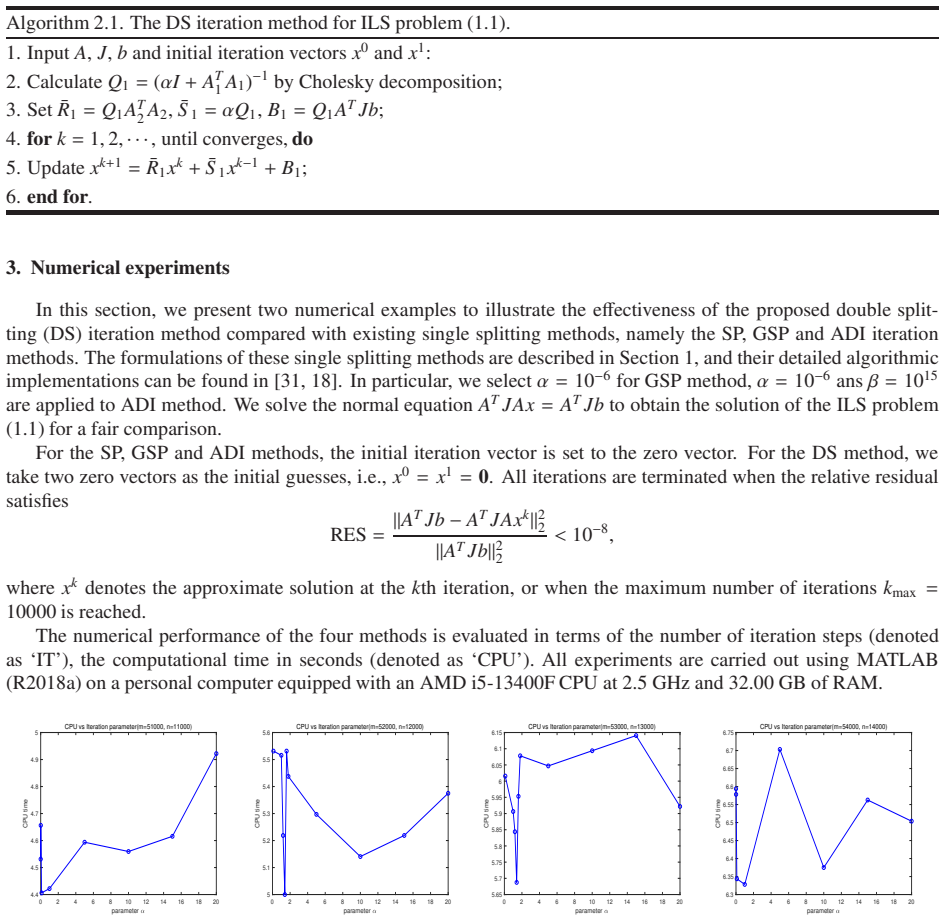
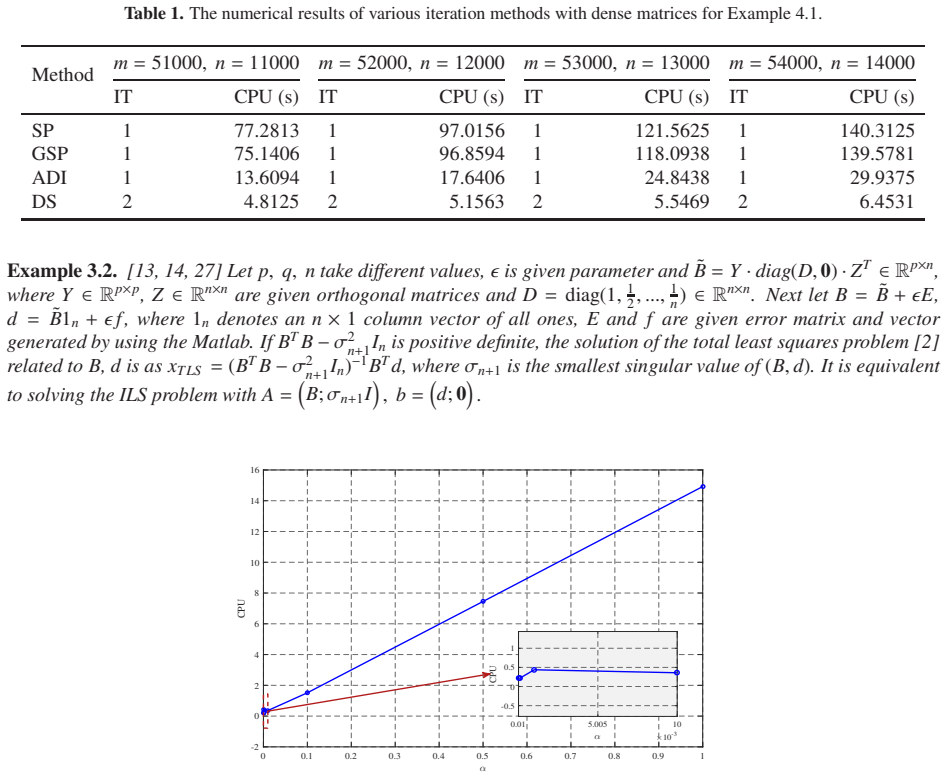
- [Numerical Experiments] The central claim of improved efficiency and robustness rests entirely on two numerical experiments (described in the abstract and the final section). No information is given on matrix dimensions, the spectrum of the normal-equation operator (in particular the location and magnitude of negative eigenvalues), the choice of splitting parameters, or the precise single-splitting baselines used for comparison. Without these details the experiments cannot be verified to cover the indefinite regime where the method is claimed to be advantageous.
- [Theoretical Analysis] No convergence analysis or theorem is supplied for either double-splitting iteration. The claim that the methods converge faster and more reliably than single-splitting schemes on arbitrary large ILS problems therefore lacks the necessary supporting derivation; the admissibility of the splitting parameters for indefinite matrices is not established.
minor comments (2)
- [Abstract] The abstract states that the double-splitting strategy 'offer constructive insights' but does not indicate which concrete algorithmic choices (e.g., how the two splittings are combined or how parameters are selected) constitute the novelty.
- [Method Description] Notation for the two distinct implementations is introduced without an explicit comparison table or pseudocode, making it difficult to see at a glance how they differ from each other and from standard single-splitting schemes.
Simulated Author's Rebuttal
We thank the referee for the constructive comments on our manuscript proposing a double-splitting iterative framework for large-scale indefinite least-squares problems. We address each major comment point by point below and will revise the manuscript accordingly to improve clarity and reproducibility while maintaining the focus on the proposed methodology and its empirical validation.
read point-by-point responses
-
Referee: [Numerical Experiments] The central claim of improved efficiency and robustness rests entirely on two numerical experiments (described in the abstract and the final section). No information is given on matrix dimensions, the spectrum of the normal-equation operator (in particular the location and magnitude of negative eigenvalues), the choice of splitting parameters, or the precise single-splitting baselines used for comparison. Without these details the experiments cannot be verified to cover the indefinite regime where the method is claimed to be advantageous.
Authors: We agree that these details are necessary for full verification and reproducibility. In the revised manuscript we will expand the numerical experiments section to report the dimensions of all test matrices, describe the eigenvalue spectrum of the normal-equation operators (including the location and magnitude of negative eigenvalues), specify the splitting parameters employed, and identify the exact single-splitting baselines used for comparison. These additions will confirm that the experiments address the indefinite regime. revision: yes
-
Referee: [Theoretical Analysis] No convergence analysis or theorem is supplied for either double-splitting iteration. The claim that the methods converge faster and more reliably than single-splitting schemes on arbitrary large ILS problems therefore lacks the necessary supporting derivation; the admissibility of the splitting parameters for indefinite matrices is not established.
Authors: The manuscript introduces the double-splitting framework and supports its advantages through two numerical experiments rather than providing general convergence theorems. The abstract and text do not claim convergence for arbitrary large ILS problems; the stated conclusion is limited to the reported experiments. We will revise the manuscript to clarify the scope of the claims, add a brief discussion of the empirical admissibility of the chosen splitting parameters, and explicitly note that a full theoretical convergence analysis for indefinite matrices is an important topic for future work. revision: yes
Circularity Check
No significant circularity; new method proposal with independent empirical validation
full rationale
The paper introduces a double-splitting iterative framework for the indefinite least squares problem, describes specific implementations, and validates performance claims solely via two numerical experiments. No derivation chain, equations, or theoretical steps are presented that reduce any claim to a self-definitional fit, a fitted input renamed as prediction, or a load-bearing self-citation. The central assertion of outperformance over single-splitting methods rests on external numerical evidence rather than any construction that is equivalent to its own inputs by definition. This is the expected non-finding for a method-proposal paper whose support is empirical.
Axiom & Free-Parameter Ledger
axioms (1)
- domain assumption Standard convergence assumptions for splitting-based iterative methods applied to normal equations of indefinite least squares problems
Reference graph
Works this paper leans on
-
[1]
Benzi, G.H
M. Benzi, G.H. Golub, J. Liesen, Numercial solution of sa ddle point problems. Acta Numer. 14 (2005) 1–137
2005
-
[2]
Bj¨ orck, Numerical Methods for Least Squares Problem s
Å. Bj¨ orck, Numerical Methods for Least Squares Problem s. SIAM, Philadelphia, (1996)
1996
-
[3]
Bojanczyk, N.J
A. Bojanczyk, N.J. Higham, H. Patel, Solving the indefini te least squares problem by hyperbolic QR factorization, SI AM J. Matrix Anal. Appl. 24 (2003) 914–931
2003
-
[4]
Bojanczyk, Algorithms for indefinite linear least s quares problems, Linear Algebra Appl
A.W. Bojanczyk, Algorithms for indefinite linear least s quares problems, Linear Algebra Appl. 623 (2021) 104-127
2021
-
[5]
Chandrasekaran, M
S. Chandrasekaran, M. Gu, A.H. Sayed, A stable and e fficient algorithm for the indefinite linear least-squares pro blem, SIAM J. Matrix Anal. Appl. 20 (1998) 354–362
1998
-
[6]
Diao, T.Y
H.A. Diao, T.Y . Zhou, Backward error and condition numbe r analysis for the indefinite linear least squares problem, I nt. J. Comput. Math. 96 (2019) 1603–1622
2019
-
[7]
Golub, C.F
G.H. Golub, C.F. V an Loan, An analysis of the total least s quares problem, SIAM J. Numer. Anal. 17 (1980) 883–893
1980
-
[8]
Hashemi Sababe, Minimax-Optimal Two-Parameter and M atrix-Weighted Block-Splitting Preconditioners for Inde finite Least Squares
S. Hashemi Sababe, Minimax-Optimal Two-Parameter and M atrix-Weighted Block-Splitting Preconditioners for Inde finite Least Squares. Int. J. Appl. Comput. Math 12 (2026). doi: 10. 1007/s40819-025-02081-8
2026
-
[9]
Hassibi, A.H
B. Hassibi, A.H. Sayed, T. Kailath, Recursive linear est imation in Krein spaces. I. Theory, in: Proceedings of 32nd I EEE Conference on Decision and Control, IEEE, (1993) 3489–3494
1993
-
[10]
Khojasteh Salkuyeh, A parameterized block-splitti ng preconditioner for indefinite least squares problem
D. Khojasteh Salkuyeh, A parameterized block-splitti ng preconditioner for indefinite least squares problem. Afr . Mat. 37 (2026). doi: 10.1007 /s13370-026-01451-9
2026
-
[11]
H.Y . Li, S.X. Wang, On the partial condition numbers for the indefnite least squares problem, Appl. Numer. Math. 123 (2018) 200–220
2018
-
[12]
J. Li, K.L. Xin, L.S. Meng, A block upper triangular prec onditioner for block three-by-three linear systems arisin g form the large indefinite least squares problem. Appl. Math. Comput. 505 (2025) 129546
2025
-
[13]
J. Li, L.S. Meng, The GMRES method for solving the large i ndefinite least squares problem via an accelerated precondi tioner, J. Comput. Appl. Math. 486 (2026) 117706
2026
-
[14]
Liu, X.J
Q.H. Liu, X.J. Li, Preconditioned conjugate gradient m ethods for the solution of indefinite least squares problems , Calcolo. 48 (2011) 261–271
2011
-
[15]
Liu, F.D
Q.H. Liu, F.D. Zhang, Incomplete hyperbolic Gram-Schm idt-based preconditioners for the solution of large indefin ite least squares problems, J. Comput. Appl. Math. 250 (2013) 210–216
2013
-
[16]
Liu, A.J
Q.H. Liu, A.J. Liu, Block SOR methods for the solution of indefinite least squares problems, Calcolo 51 (2014) 367–37 9. 7
2014
-
[17]
Meng, K.L
L.S. Meng, K.L. Xin, J. Li, V ariable parameter Uzawa met hod for solving the indefinite least squares problem. Numer. Algor. 99 (2025) 1043–1061
2025
-
[18]
Meng, P .Z
L.S. Meng, P .Z. Li, K.L. Xin, Alternating direction imp licit iterative method for solving indefinite least squares problem. Appl. Math. Lett. 171 (2025) 109677
2025
-
[19]
Saad, Iterative Methods for Sparse Linear Systems
Y . Saad, Iterative Methods for Sparse Linear Systems. S IAM, Philadephia, 2003
2003
-
[20]
Samar, H.Y
M. Samar, H.Y . Li, Y .M. Wei, Condition numbers for the K- weighted pseudoinverse and their statistical estimation. Linear and Multilinear Algebra. 69 (2021) 752–770
2021
-
[21]
Samar, F.-R
M. Samar, F.-R. Lin, Perturbation analysis and conditi on numbers for the Tikhonov regularization of total least sq uares problem and their statistical estimation. J. Comput. Appl. Math. 411 (2022) 114230
2022
-
[22]
Sayed, B
A.H. Sayed, B. Hassibi, T. Kailath, Inertia properties of indefinite quadratic forms, IEEE. Signal Process. Lett. 3 (1996) 57–59
1996
-
[23]
S. Shen, T. Huang, J. Shao, Convergence and comparison r esults for double splittings of Hermitian positive definite matrices. Calcolo 44 (2007) 127–135
2007
-
[24]
Song, USSOR method for solving the indefinite least sq uares problem, Int
J. Song, USSOR method for solving the indefinite least sq uares problem, Int. J. Comput. Math. 97 (2020) 1781–1791
2020
-
[25]
V an Hu ffel, J
S. V an Hu ffel, J. V andewalle, The Total Least Squares Problem: Computa tional Aspects and Analysis, SIAM, Philadelphia, (1991)
1991
-
[26]
Wo´ znicki, Estimation of the optimum relaxation factors in partial factorization iterative methods
Z.I. Wo´ znicki, Estimation of the optimum relaxation factors in partial factorization iterative methods. SIAM J. Matrix. Anal. Appl. 14 (1993) 59–73
1993
-
[27]
Xin, L.S
K.L. Xin, L.S. Meng, Block-splitting preconditioners for indefinite least squares problem. Comp. Appl. Math. 44 (2 025) 61
-
[28]
Xu, A backward stable hyperbolic QR factorization method for solving indefinite least squares problem, J
H.G. Xu, A backward stable hyperbolic QR factorization method for solving indefinite least squares problem, J. Shan ghai Univ. 8 (2004) 391–396
2004
-
[29]
D. M. Y oung. Iterative Solution of Large Linear Systems . Academic Press, New Y ork, 1971
1971
-
[30]
Zhang, On convergence of double splitting methods fo r non-Hermitian positive semidefinite linear systems
C. Zhang, On convergence of double splitting methods fo r non-Hermitian positive semidefinite linear systems. Calc olo. 47 (2010) 103–112
2010
-
[31]
Zhang, H.Y
Y .J. Zhang, H.Y . Li, Splitting-based randomized itera tive methods for solving indefinite least squares problem. A ppl. Math. Comput. 446 (2023) 127892. 8
2023
discussion (0)
Sign in with ORCID, Apple, or X to comment. Anyone can read and Pith papers without signing in.