Recognition: unknown
Locality-aware Private Class Identification for Domain Adaptation with Extreme Label Shift
Pith reviewed 2026-05-08 11:59 UTC · model grok-4.3
The pith
A score function on optimal transport mass can identify private class samples even when intra-class variance exceeds their separation from shared classes.
A machine-rendered reading of the paper's core claim, the machinery that carries it, and where it could break.
Core claim
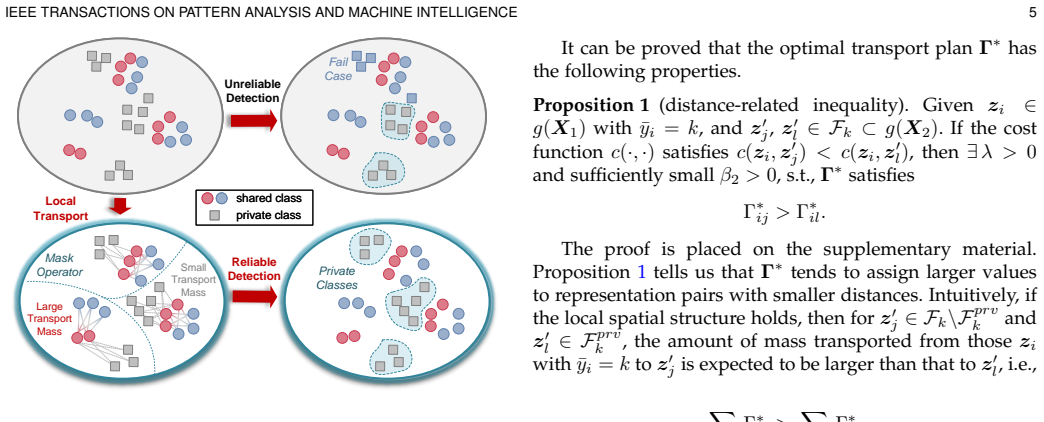
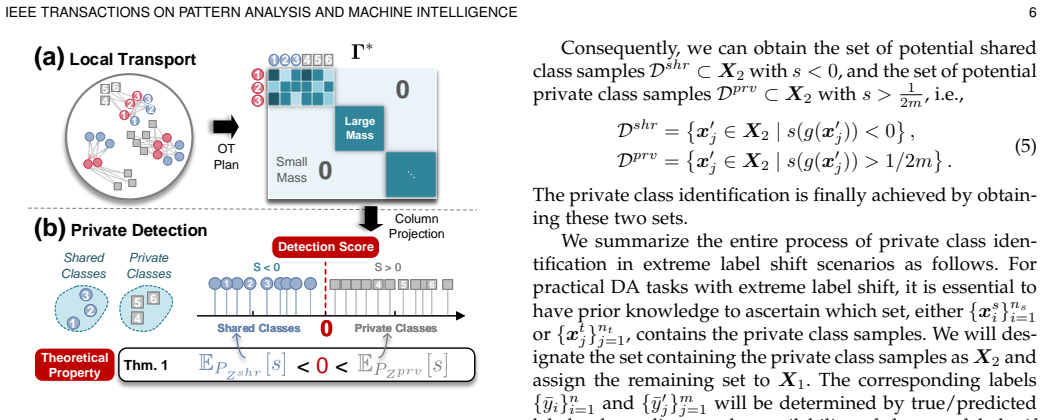
Based on local transportation and metric properties of optimal transport, a locality-aware private class identification approach is proposed in the form of a score function on transport mass. The effectiveness of the proposed approach is theoretically proven, highlighting the score function's strong ability to distinguish between shared and private class samples. Building on this, ReOT minimizes classification risk while learning the separated cluster structure between the identified shared classes and private classes, effectively avoiding mismatch between shared-private sample pairs and ensuring intra-class knowledge transport. A generalization upper bound of the target risk is provided for
What carries the argument
The score function on transport mass, which uses local optimal transport properties to quantify reliable intra-cluster matching and thereby separate private from shared samples.
If this is right
- ReOT learns separated cluster structures for shared and private classes while minimizing classification risk.
- Mismatch between shared and private sample pairs is avoided during alignment.
- Intra-class knowledge is transported, reducing class-conditional distribution discrepancy.
- The provided generalization upper bound on target risk under extreme label shift is minimized.
- Benchmark experiments confirm improved adaptation accuracy when the score is used.
Where Pith is reading between the lines
- The same local-transport score could be inserted into other optimal-transport domain-adaptation pipelines to relax their outlier assumptions.
- Focusing on local rather than global matching distances may resolve class-overlap problems in distribution-alignment methods beyond ReOT.
- The approach implies that private-class handling can be made robust without requiring private classes to lie far from all shared-class support.
Load-bearing premise
Local optimal transport properties produce transport-mass scores that differ enough between private and shared classes even when global distances overlap because of large variance inside shared classes.
What would settle it
A controlled dataset in which private-class samples receive transport-mass scores statistically indistinguishable from shared-class samples, so that the identification step fails and the target-risk bound no longer decreases.
Figures





read the original abstract
Domain adaptation aims to transfer knowledge from a labeled source domain to an unlabeled target domain with different distributions. In real-world scenarios, the label spaces of the two domains often have an inclusion relationship, where some classes exist only in one domain but not the other. These non-overlapping classes are referred to as private classes. Identifying private class samples and mitigating their adverse effects is critical in the literature. Existing methods rely on the assumption that shifts in private classes are large enough to be considered outliers. However, the variance within a single shared class can be significantly larger than the difference between a private class and another shared class, challenging this assumption. Consequently, private classes substantially increase the difficulty of cross-domain classification. To address these issues, based on local transportation and metric properties of optimal transport (OT), a locality-aware private class identification approach is proposed in the form of a score function on transport mass. The effectiveness of the proposed approach is theoretically proven, highlighting the score function's strong ability to distinguish between shared and private class samples. Building on this, we introduce a reliable OT-based method (ReOT) for domain adaptation under severe label shift. ReOT minimizes classification risk while learning the separated cluster structure between the identified shared classes and private classes, effectively avoiding mismatch between shared-private sample pairs, thus ensuring that important knowledge is reliably transported intra-class to mitigate class-conditional discrepancy. Furthermore, a generalization upper bound of the target risk is provided for extreme label shift scenarios, which can be minimized by ReOT. Extensive experiments on benchmarks validate the effectiveness of ReOT.
Editorial analysis
A structured set of objections, weighed in public.
Referee Report
Summary. The paper claims that in domain adaptation with extreme label shift (where private classes exist only in source or target), a score function derived from local optimal transport (OT) transport mass can reliably identify private-class samples even when intra-class variance exceeds inter-class gaps. This identification is theoretically proven to separate shared and private classes; the resulting ReOT method then minimizes a classification risk while enforcing separated cluster structure to avoid shared-private mismatches, and a generalization upper bound on target risk is provided that ReOT can minimize. Effectiveness is supported by experiments on standard benchmarks.
Significance. If the locality-based separation and the generalization bound hold under the stated conditions, the work would meaningfully relax the strong outlier assumption common in prior OT-based DA methods, improving robustness for realistic label-shift scenarios. The explicit bound and the focus on transport-mass scoring constitute a clear technical contribution over heuristic thresholding approaches.
major comments (2)
- [§3] §3 (Theoretical Analysis, proof of the score-function separation): The motivating counter-example in the introduction (intra-class variance larger than distance to a private class) directly challenges the locality assumption. The proof does not state an explicit condition on the cost function, support overlap, or uniqueness of the local OT plan that guarantees the transport-mass threshold still separates the classes in this regime; without it the central claim that the score 'strongly distinguishes' private from shared samples is not yet load-bearing for the extreme-shift setting.
- [§4] §4 (ReOT objective and generalization bound): The bound is presented as minimizable by ReOT, yet the derivation appears to condition on the output of the same OT plan used for private-class scoring. It is unclear whether any data-dependent normalization or threshold inside the score introduces a circular dependence that would invalidate the bound's applicability when the identification step is imperfect.
minor comments (2)
- [§3] Notation for the transport-mass score (Eq. (3) or equivalent) should be accompanied by a short algorithmic box showing how the local neighborhood is extracted and the mass is normalized; current presentation leaves the exact locality radius ambiguous.
- [§5] The experimental section would benefit from an ablation that isolates the contribution of the new score versus a simple global OT baseline under controlled variance ratios matching the motivating counter-example.
Simulated Author's Rebuttal
We thank the referee for the constructive and detailed feedback. We address each major comment below with clarifications on the theoretical foundations and bound derivation. We will revise the manuscript to make assumptions explicit and improve presentation of the conditional bound.
read point-by-point responses
-
Referee: [§3] §3 (Theoretical Analysis, proof of the score-function separation): The motivating counter-example in the introduction (intra-class variance larger than distance to a private class) directly challenges the locality assumption. The proof does not state an explicit condition on the cost function, support overlap, or uniqueness of the local OT plan that guarantees the transport-mass threshold still separates the classes in this regime; without it the central claim that the score 'strongly distinguishes' private from shared samples is not yet load-bearing for the extreme-shift setting.
Authors: We appreciate the referee pointing out the need for explicit conditions. The motivating counter-example shows why global OT and outlier assumptions fail when intra-class variance exceeds inter-class gaps, but the locality-aware score exploits local transport plans to measure neighborhood mass concentration. The proof in §3 uses the metric properties of OT to show that shared-class samples induce higher local transport mass (due to overlapping supports in the same class) while private-class samples yield lower mass (no matching target support locally). To strengthen the claim, we will revise the manuscript by adding an explicit remark after the theorem stating the conditions: the cost is a metric satisfying the triangle inequality, class-conditional supports have bounded overlap, and the local OT plan is unique (guaranteed in practice by entropy regularization). This renders the separation rigorous under the extreme label-shift regime without altering the proof structure. revision: yes
-
Referee: [§4] §4 (ReOT objective and generalization bound): The bound is presented as minimizable by ReOT, yet the derivation appears to condition on the output of the same OT plan used for private-class scoring. It is unclear whether any data-dependent normalization or threshold inside the score introduces a circular dependence that would invalidate the bound's applicability when the identification step is imperfect.
Authors: The generalization bound is derived for the target risk after the private-class identification step has produced fixed sets of shared and private samples. ReOT then minimizes a surrogate that upper-bounds this risk by jointly optimizing the classifier and a knowledge-transfer transport plan; the initial scoring and threshold computation are performed once and do not receive feedback from the subsequent optimization, eliminating circular dependence. The data-dependent threshold is fixed prior to bound minimization. We acknowledge that the bound is stated under the assumption of correct identification for its tightest form. In revision we will add a clarifying paragraph in §4 noting the conditional nature of the bound and discussing robustness to small identification errors (consistent with our empirical results on reliable separation). revision: partial
Circularity Check
No significant circularity; derivation self-contained via OT properties and independent proof
full rationale
The paper derives the locality-aware score function directly from local transportation and metric properties of optimal transport, then states that its effectiveness in distinguishing shared vs. private classes is theoretically proven. ReOT is constructed to minimize classification risk while enforcing separated cluster structure and to minimize the provided generalization upper bound under extreme label shift. No equation or step reduces the claimed distinction, the score, or the bound to a fitted parameter, self-citation chain, or input by construction; the motivating counter-example on variance is addressed by the local OT assumption rather than presupposed in the definition. The central claims rest on external OT theory and the paper's own proof rather than tautological renaming or load-bearing self-reference.
Axiom & Free-Parameter Ledger
Reference graph
Works this paper leans on
-
[1]
COT: Unsupervised domain adap- tation with clustering and optimal transport,
Y. Liu, Z. Zhou, and B. Sun, “COT: Unsupervised domain adap- tation with clustering and optimal transport,” inCVPR, 2023, pp. 19 998–20 007
2023
-
[2]
LC-MSM: Language- conditioned masked segmentation model for unsupervised do- main adaptation,
Y. E. Kim, Y. W. Lee, and S. W. Lee, “LC-MSM: Language- conditioned masked segmentation model for unsupervised do- main adaptation,”Pattern Recognition, vol. 148, p. 110201, 2024
2024
-
[3]
Unsupervised domain adap- tation with class-aware memory alignment,
H. Wang, L. Zheng, H. Zhaoet al., “Unsupervised domain adap- tation with class-aware memory alignment,”IEEE TNNLS, 2024, preprint
2024
-
[4]
Unsupervised domain adaptation with residual transfer networks,
M. Long, H. Zhu, J. Wanget al., “Unsupervised domain adaptation with residual transfer networks,” inNeurIPS, vol. 29, 2016
2016
-
[5]
Domain-adversarial train- ing of neural networks,
Y. Ganin, E. Ustinova, H. Ajakanet al., “Domain-adversarial train- ing of neural networks,”JMLR, vol. 17, pp. 2096–2030, 2016
2096
-
[6]
Conditional adversarial domain adaptation,
M. Long, Z. Cao, J. Wanget al., “Conditional adversarial domain adaptation,” inNeurIPS, vol. 31, 2018
2018
-
[7]
Open set domain adapta- tion by backpropagation,
K. Saito, S. Yamamoto, Y. Ushikuet al., “Open set domain adapta- tion by backpropagation,” inECCV, 2018, pp. 153–168
2018
-
[8]
On the effectiveness of image rotation for open set domain adaptation,
S. Bucci, M. R. Loghmani, and T. Tommasi, “On the effectiveness of image rotation for open set domain adaptation,” inECCV, 2020, pp. 422–438
2020
-
[9]
Adjustment and alignment for unbiased open set domain adaptation,
W. Li, J. Liu, B. Hanet al., “Adjustment and alignment for unbiased open set domain adaptation,” inCVPR, 2023, pp. 24 110–24 119
2023
-
[10]
Partial adversarial domain adapta- tion,
Z. Cao, L. Ma, M. Longet al., “Partial adversarial domain adapta- tion,” inECCV, 2018, pp. 135–150
2018
-
[11]
Generalized label shift correction via minimum uncertainty principle: Theory and algorithm,
Y. W. Luo and C. X. Ren, “Generalized label shift correction via minimum uncertainty principle: Theory and algorithm,”arXiv preprint arXiv:2202.13043, 2022. IEEE TRANSACTIONS ON PATTERN ANAL YSIS AND MACHINE INTELLIGENCE 15 (a) Source-only (b) STA (c) ANNA (d) ReOT Fig. 7. t-SNE [57] visualizations of the representations learned by different OSDA methods ...
-
[12]
Partial domain adaptation via importance sampling-based shift correction,
C. J. Guo, C. X. Ren, Y. W. Luoet al., “Partial domain adaptation via importance sampling-based shift correction,”IEEE TIP, vol. 34, pp. 5009–5022, 2025
2025
-
[13]
Separate to adapt: Open set domain adaptation via progressive separation,
H. Liu, Z. Cao, M. Longet al., “Separate to adapt: Open set domain adaptation via progressive separation,” inCVPR, 2019, pp. 2927– 2936
2019
-
[14]
Select, label, and mix: Learning discriminative invariant feature representations for partial domain adaptation,
A. Sahoo, R. Panda, R. Feriset al., “Select, label, and mix: Learning discriminative invariant feature representations for partial domain adaptation,” inWACV, 2023, pp. 4210–4219
2023
-
[15]
Partial domain adaptation by progressive sample learning of shared classes,
L. Tian, Y. Tang, and W. Zhang, “Partial domain adaptation by progressive sample learning of shared classes,”NPL, vol. 55, 2023
2023
-
[16]
Adversarial reweighting for partial domain adaptation,
X. Gu, X. Yu, J. Sunet al., “Adversarial reweighting for partial domain adaptation,” inNeurIPS, vol. 34, 2021, pp. 14 860–14 872
2021
-
[17]
Manifold regularized joint transfer for open set domain adaptation,
J. Liu, H. He, M. Liuet al., “Manifold regularized joint transfer for open set domain adaptation,”IEEE TMM, 2023
2023
-
[18]
MOT: Masked optimal transport for partial domain adaptation,
Y. W. Luo and C. X. Ren, “MOT: Masked optimal transport for partial domain adaptation,” inCVPR, 2023, pp. 3531–3540
2023
-
[19]
Open set domain adaptation: Theo- retical bound and algorithm,
Z. Fang, J. Lu, F. Liuet al., “Open set domain adaptation: Theo- retical bound and algorithm,”IEEE TNNLS, vol. 32, no. 10, pp. 4309–4322, 2020
2020
-
[20]
Unknown-aware domain adversar- ial learning for open-set domain adaptation,
J. Jang, B. Na, D. H. Shinet al., “Unknown-aware domain adversar- ial learning for open-set domain adaptation,” inNeurIPS, vol. 35, 2022, pp. 16 755–16 767
2022
-
[21]
Progressive graph learning for open-set domain adaptation,
Y. Luo, Z. Wang, Z. Huanget al., “Progressive graph learning for open-set domain adaptation,” inICML, 2020, pp. 6468–6478
2020
-
[22]
Rethinking correlation learning via label prior for open set domain adaptation,
Z. X. Huang and C. X. Ren, “Rethinking correlation learning via label prior for open set domain adaptation,” inIJCAI, 2024
2024
-
[23]
Importance weighted adversarial nets for partial domain adaptation,
J. Zhang, Z. Ding, W. Liet al., “Importance weighted adversarial nets for partial domain adaptation,” inCVPR, 2018, pp. 8156–8164
2018
-
[24]
Learning to transfer examples for partial domain adaptation,
Z. Cao, K. You, M. Longet al., “Learning to transfer examples for partial domain adaptation,” inCVPR, 2019, pp. 2985–2994
2019
-
[25]
Domain adversarial reinforcement learning for partial domain adaptation,
J. Chen, X. Wu, L. Duanet al., “Domain adversarial reinforcement learning for partial domain adaptation,”IEEE TNNLS, vol. 33, no. 2, pp. 539–553, 2022
2022
-
[26]
Deep residual correction network for partial domain adaptation,
S. Li, C. H. Liu, Q. Linet al., “Deep residual correction network for partial domain adaptation,”IEEE TP AMI, vol. 43, no. 7, pp. 2329–2344, 2020
2020
-
[27]
The surprising effec- tiveness of deep orthogonal procrustes alignment in unsupervised domain adaptation,
K. Thopalli, R. Anirudh, P . Turagaet al., “The surprising effec- tiveness of deep orthogonal procrustes alignment in unsupervised domain adaptation,”IEEE Access, vol. 11, pp. 12 858–12 869, 2023
2023
-
[28]
A balanced and uncertainty-aware approach for partial domain adaptation,
J. Liang, Y. Wang, D. Huet al., “A balanced and uncertainty-aware approach for partial domain adaptation,” inECCV, 2020, pp. 123– 140
2020
-
[29]
Contrastive learning assisted-alignment for partial domain adaptation,
C. Yang, Y. M. Cheung, J. Dinget al., “Contrastive learning assisted-alignment for partial domain adaptation,”IEEE TNNLS, vol. 34, no. 10, pp. 7621–7634, 2023
2023
-
[30]
Conditional bures metric for domain adaptation,
Y. W. Luo and C. X. Ren, “Conditional bures metric for domain adaptation,” inCVPR, 2021, pp. 13 989–13 998
2021
-
[31]
Optimal transport for domain adaptation,
N. Courty, R. Flamary, D. Tuia, and A. Rakotomamonjy, “Optimal transport for domain adaptation,”IEEE TP AMI, vol. 39, no. 9, pp. IEEE TRANSACTIONS ON PATTERN ANAL YSIS AND MACHINE INTELLIGENCE 16 1853–1865, September 2017
2017
-
[32]
Enhanced transport distance for unsupervised domain adaptation,
M. Li, Y. M. Zhai, Y. W. Luoet al., “Enhanced transport distance for unsupervised domain adaptation,” inCVPR, 2020, pp. 13 936– 13 944
2020
-
[33]
Joint distribution optimal transportation for domain adaptation,
N. Courty, R. Flamary, A. Habrardet al., “Joint distribution optimal transportation for domain adaptation,” inNeurIPS, vol. 30, 2017
2017
-
[34]
Unbalanced minibatch optimal transport; applications to domain adaptation,
K. Fatras, T. S ´ejourn´e, R. Flamaryet al., “Unbalanced minibatch optimal transport; applications to domain adaptation,” inICML, 2021, pp. 3186–3197
2021
-
[35]
Improving mini-batch optimal transport via partial transportation,
K. Nguyen, D. Nguyen, T. Phamet al., “Improving mini-batch optimal transport via partial transportation,” inICML, 2022, pp. 16 656–16 690
2022
-
[36]
Buresnet: Conditional bures metric for transferable representation learning,
C. X. Ren, Y. W. Luo, and D. Q. Dai, “Buresnet: Conditional bures metric for transferable representation learning,”IEEE TP AMI, vol. 45, no. 4, pp. 4198–4213, 2023
2023
-
[37]
Probability-polarized optimal transport for unsupervised domain adaptation,
Y. Wang, C. X. Ren, Y. M. Zhaiet al., “Probability-polarized optimal transport for unsupervised domain adaptation,” inAAAI, vol. 38, no. 14, 2024, pp. 15 653–15 661
2024
-
[38]
Fine-tuning graph neural networks via graph topology induced optimal transport,
J. Zhang, X. Xiao, L.-K. Huanget al., “Fine-tuning graph neural networks via graph topology induced optimal transport,” inIJCAI, 2022, pp. 3730–3736
2022
-
[39]
Keypoint-guided optimal transport with applications in heterogeneous domain adaptation,
X. Gu, Y. Yang, W. Zeng, J. Sun, and Z. Xu, “Keypoint-guided optimal transport with applications in heterogeneous domain adaptation,” inNeurIPS, vol. 35, 2022, pp. 14 972–14 985
2022
-
[40]
Sinkhorn distances: Lightspeed computation of opti- mal transport,
M. Cuturi, “Sinkhorn distances: Lightspeed computation of opti- mal transport,” inNeurIPS, 2013, pp. 2292–2300
2013
-
[41]
Bridging the theoretical bound and deep algorithms for open set domain adaptation,
L. Zhong, Z. Fang, F. Liuet al., “Bridging the theoretical bound and deep algorithms for open set domain adaptation,”IEEE TNNLS, vol. 34, no. 8, pp. 3859–3873, 2021
2021
-
[42]
On learning invariant representations for domain adaptation,
H. Zhao, R. T. Des Combes, K. Zhanget al., “On learning invariant representations for domain adaptation,” inICML, 2019, pp. 7523– 7532
2019
-
[43]
Learning invariant representations and risks for semi-supervised domain adaptation,
B. Li, Y. Wang, S. Zhanget al., “Learning invariant representations and risks for semi-supervised domain adaptation,” inCVPR, 2021, pp. 1104–1113
2021
-
[44]
Domain adapta- tion with conditional distribution matching and generalized label shift,
R. Tachet des Combes, H. Zhao, Y.-X. Wanget al., “Domain adapta- tion with conditional distribution matching and generalized label shift,” inNeurIPS, vol. 33, 2020, pp. 19 276–19 289
2020
-
[45]
ImageCLEF 2014: Overview and analysis of the results,
B. Caputo, H. M ¨uller, J. Martinez Gomezet al., “ImageCLEF 2014: Overview and analysis of the results,” inInternational Conference of the Cross-Language Evaluation Forum for European Languages, 2014, pp. 192–211
2014
-
[46]
Adapting visual category models to new domains,
K. Saenko, B. Kulis, M. Fritzet al., “Adapting visual category models to new domains,” inECCV, 2010, pp. 213–226
2010
-
[47]
Deep hashing network for unsupervised domain adaptation,
H. Venkateswara, J. Eusebio, S. Chakrabortyet al., “Deep hashing network for unsupervised domain adaptation,” inCVPR, 2017, pp. 5018–5027
2017
-
[48]
VisDA: The Visual Domain Adaptation Challenge
X. Peng, B. Usman, N. Kaushiket al., “VisDA: The visual domain adaptation challenge,”arXiv preprint arXiv:1710.06924, 2017
work page Pith review arXiv 2017
-
[49]
Deep residual learning for image recognition,
K. He, X. Zhang, S. Renet al., “Deep residual learning for image recognition,” inCVPR, 2016, pp. 770–778
2016
-
[50]
ImageNet: A large-scale hierarchical image database,
J. Deng, W. Dong, R. Socheret al., “ImageNet: A large-scale hierarchical image database,” inCVPR, 2009, pp. 248–255
2009
-
[51]
Larger norm more transferable: An adaptive feature norm approach for unsupervised domain adaptation,
R. Xu, G. Li, J. Yanget al., “Larger norm more transferable: An adaptive feature norm approach for unsupervised domain adaptation,” inICCV, 2019, pp. 1426–1435
2019
-
[52]
Unsupervised domain adap- tation via discriminative manifold propagation,
Y. W. Luo, C. X. Ren, D. Q. Daiet al., “Unsupervised domain adap- tation via discriminative manifold propagation,”IEEE TP AMI, vol. 44, no. 3, pp. 1653–1669, 2020
2020
-
[53]
Partial domain adaptation without domain alignment,
W. Li and S. Chen, “Partial domain adaptation without domain alignment,”IEEE TP AMI, 2022
2022
-
[54]
From big to small: Adaptive learning to partial-set domains,
Z. Cao, K. You, Z. Zhanget al., “From big to small: Adaptive learning to partial-set domains,”IEEE TP AMI, vol. 45, no. 2, pp. 1766–1780, 2022
2022
-
[55]
Reinforced adaptation network for partial domain adaptation,
K. Wu, M. Wu, Z. Chenet al., “Reinforced adaptation network for partial domain adaptation,”IEEE TCSVT, 2022
2022
-
[56]
A theory of learning from different domains,
S. Ben-David, J. Blitzer, K. Crammeret al., “A theory of learning from different domains,”Machine Learning, vol. 79, pp. 151–175, 2010
2010
-
[57]
Visualizing data using t-sne
L. Van der Maaten and G. Hinton, “Visualizing data using t-sne.” JMLR, vol. 9, no. 11, 2008
2008
-
[58]
Multi-source domain adaptation in the deep learning era: A systematic survey,
S. Zhao, B. Li, P . Xuet al., “Multi-source domain adaptation in the deep learning era: A systematic survey,”arXiv preprint arXiv:2002.12169, 2020
-
[59]
Multi-target domain adaptation with collaborative consistency learning,
T. Isobe, X. Jia, S. Chenet al., “Multi-target domain adaptation with collaborative consistency learning,” inCVPR, 2021, pp. 8187–8196
2021
-
[60]
Do we really need to access the source data? source hypothesis transfer for unsupervised domain adaptation,
J. Liang, D. Hu, and J. Feng, “Do we really need to access the source data? source hypothesis transfer for unsupervised domain adaptation,” inICLR, 2020, pp. 6028–6039
2020
-
[61]
Unbalanced multi- marginal optimal transport,
F. Beier, J. von Lindheim, S. Neumayeret al., “Unbalanced multi- marginal optimal transport,”Journal of Mathematical Imaging and Vision, vol. 65, no. 3, pp. 394–413, 2023
2023
discussion (0)
Sign in with ORCID, Apple, or X to comment. Anyone can read and Pith papers without signing in.