Recognition: unknown
Multifrequency Floquet Engineering of Magnon Polaritons
Pith reviewed 2026-05-08 07:03 UTC · model grok-4.3
The pith
Modulating a microwave cavity with two commensurate frequencies engineers magnon-polariton spectra with new anticrossings between sidebands.
A machine-rendered reading of the paper's core claim, the machinery that carries it, and where it could break.
Core claim
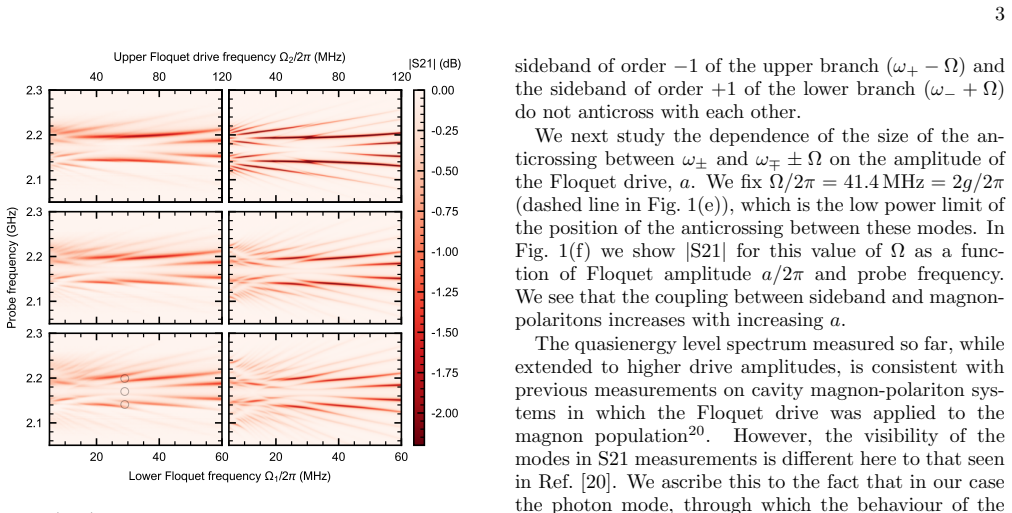
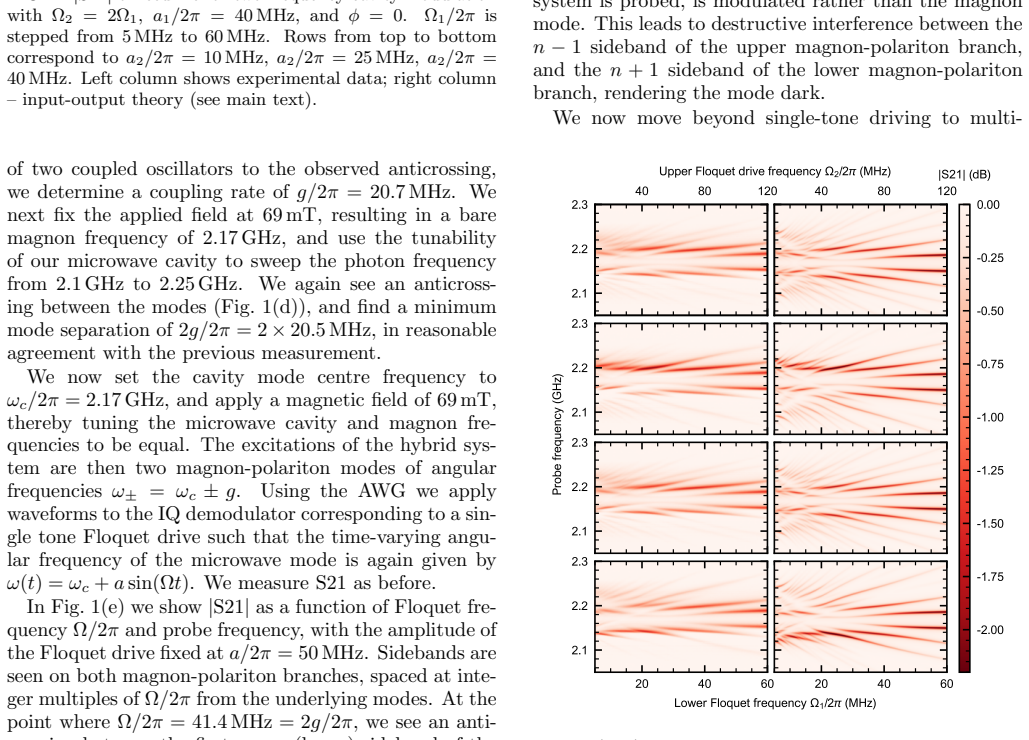
By applying commensurate two-frequency Floquet modulations to the microwave cavity frequency, with the higher frequency at twice and three times the lower frequency, the resulting magnon-polariton spectrum exhibits new anticrossings between previously uncoupled sidebands and the overall features depend on the relative amplitude and phase of the two drive tones, unlike the spectrum obtained with single-frequency modulation.
What carries the argument
Commensurate two-frequency modulation of the cavity resonance frequency, which introduces amplitude- and phase-dependent couplings between magnon and photon sidebands.
If this is right
- The spectrum acquires qualitatively different features, including new anticrossings, that single-frequency drives do not produce.
- The detailed shape of the spectrum can be tuned by changing the relative amplitude and phase between the two drive tones.
- Larger modulation depth and bandwidth become accessible compared with direct modulation of the magnon frequency.
- Quasi-energy levels of the hybrid system can be manipulated through an alternative experimental handle.
Where Pith is reading between the lines
- The same cavity-modulation approach could be tested with other integer frequency ratios to map out additional control parameters for the sideband couplings.
- Multifrequency cavity drives might be combined with existing magnon devices to create effective higher-order interactions without requiring stronger single-tone fields.
- The phase dependence observed here could serve as a handle for dynamic control of magnon-photon coupling in time-varying protocols.
Load-bearing premise
The new anticrossings arise specifically from the combination of the two commensurate modulation frequencies rather than from artifacts of the setup or from the higher frequency tone acting alone.
What would settle it
If the new anticrossings between previously uncoupled sidebands also appear when the experiment is repeated using only the higher-frequency modulation without the lower-frequency tone, the claim that the multifrequency combination is responsible would be weakened.
Figures


read the original abstract
Floquet engineering of cavity magnon-polaritons by periodically modulating the magnon frequency has recently attracted much interest as a way to manipulate the energy spectrum of magnon-photon hybrid systems. However, modulating the frequency of magnons by a time-varying bias magnetic field can be challenging. We demonstrate cavity magnon-polariton Floquet engineering by modulating the microwave cavity frequency, allowing large modulation depth and bandwidth. We apply commensurate two-frequency Floquet modulations with the higher frequency at twice and three times the lower frequency, and demonstrate that the resulting spectrum depends on the relative amplitude and phase of the two drive tones. In comparison with single-frequency Floquet modulations, the spectrum has qualitatively different features; in particular, new anticrossings appear between previously uncoupled sidebands. Our platform offers an alternative way to manipulate Floquet quasi-energy levels in hybrid systems.
Editorial analysis
A structured set of objections, weighed in public.
Referee Report
Summary. The manuscript experimentally demonstrates multifrequency Floquet engineering of cavity magnon-polaritons by modulating the microwave cavity frequency with commensurate two-tone drives (higher frequency at 2f and 3f relative to the base frequency). The resulting spectrum is shown to depend on the relative amplitude and phase of the drive tones, producing qualitatively different features—including new anticrossings between previously uncoupled sidebands—compared to single-frequency modulation. This is positioned as an alternative to magnon-frequency modulation via time-varying bias fields, enabling larger modulation depth and bandwidth.
Significance. If the central experimental claims hold, the work provides a practical platform for manipulating Floquet quasi-energy levels in magnon-photon hybrid systems. The ability to control spectra via relative phase and amplitude of multiple drives, together with the reported new anticrossings, could enable more flexible engineering of hybrid modes than single-frequency approaches. The cavity-modulation method avoids technical challenges of magnetic-field modulation and may generalize to other cavity QED platforms.
major comments (2)
- [§4] §4 (Experimental Results, comparison to single-frequency case): The central claim that new anticrossings arise specifically from the multifrequency (2f/3f) drive requires explicit single-frequency control data acquired at matched total modulation depth and identical cavity conditions. Without this, it remains possible that the features originate from unaccounted higher harmonics in the drive electronics, cavity nonlinearity, or post-processing. The manuscript should add a direct side-by-side comparison (e.g., new Figure or panel) showing the single-tone spectrum under equivalent drive strength.
- [§3] §3 (Theoretical Modeling): A Floquet-matrix calculation or equivalent theoretical prediction of the two-tone sideband couplings (including explicit dependence on relative phase) is needed to confirm that the observed anticrossings are intrinsic to the commensurate multifrequency modulation rather than setup-specific. The current presentation appears to rely primarily on experimental spectra without a quantitative model that isolates the multifrequency contribution.
minor comments (3)
- [Abstract] The abstract states 'new anticrossings appear between previously uncoupled sidebands' but does not specify which sidebands (e.g., n=±1 with n=±2) or the modulation frequencies used; this should be clarified for precision.
- [Figures] Figure captions and axis labels should explicitly state the total modulation depth (or equivalent voltage) used for both single- and two-tone cases to facilitate direct comparison.
- [Methods] A brief discussion of potential artifacts (drive mixing, magnetic-field leakage, or cavity heating) and how they were ruled out would strengthen the methods section.
Simulated Author's Rebuttal
We thank the referee for the positive assessment of our work and for the constructive comments that help strengthen the manuscript. We address each major comment below and will revise the manuscript accordingly.
read point-by-point responses
-
Referee: §4 (Experimental Results, comparison to single-frequency case): The central claim that new anticrossings arise specifically from the multifrequency (2f/3f) drive requires explicit single-frequency control data acquired at matched total modulation depth and identical cavity conditions. Without this, it remains possible that the features originate from unaccounted higher harmonics in the drive electronics, cavity nonlinearity, or post-processing. The manuscript should add a direct side-by-side comparison (e.g., new Figure or panel) showing the single-tone spectrum under equivalent drive strength.
Authors: We agree that a matched single-frequency control experiment is necessary to rigorously isolate the multifrequency contribution. We have acquired additional single-tone data at the same total modulation depth (sum of Fourier components) and under identical cavity conditions. These spectra will be added as a new panel (or supplementary figure) for direct side-by-side comparison with the two-tone results. The single-tone data show only the expected sideband anticrossings without the additional features, confirming that the new anticrossings are due to the commensurate two-tone drive rather than artifacts. revision: yes
-
Referee: §3 (Theoretical Modeling): A Floquet-matrix calculation or equivalent theoretical prediction of the two-tone sideband couplings (including explicit dependence on relative phase) is needed to confirm that the observed anticrossings are intrinsic to the commensurate multifrequency modulation rather than setup-specific. The current presentation appears to rely primarily on experimental spectra without a quantitative model that isolates the multifrequency contribution.
Authors: We have implemented a Floquet-matrix formalism for the two-tone cavity-frequency modulation that explicitly incorporates the relative amplitudes and phases of the drive tones. The calculated quasi-energy spectra reproduce the experimentally observed new anticrossings and their dependence on drive parameters. We will include these theoretical predictions in the revised manuscript (main text or supplementary information) with direct overlays on the experimental data and a description of the model in the Methods section. revision: yes
Circularity Check
No circularity: experimental demonstration with no derivation chain
full rationale
The paper reports an experimental demonstration of multifrequency cavity-frequency modulation in a magnon-polariton system, claiming qualitative spectral differences (new anticrossings) versus single-frequency drives. No equations, fitted parameters, or theoretical derivations appear in the provided abstract or description. The central result is framed as an empirical observation of phase/amplitude dependence and sideband coupling, not as a prediction derived from prior inputs or self-citations. Without any load-bearing mathematical steps that reduce to their own definitions or fits, the work is self-contained as an experimental finding.
Axiom & Free-Parameter Ledger
Reference graph
Works this paper leans on
-
[1]
Lachance-Quirion, Y
D. Lachance-Quirion, Y. Tabuchi, A. Gloppe, K. Usami, and Y. Nakamura, Hybrid quantum systems based on magnonics, Applied Physics Express12, 070101 (2019)
2019
-
[2]
Zare Rameshti, S
B. Zare Rameshti, S. Viola Kusminskiy, J. A. Haigh, K. Usami, D. Lachance-Quirion, Y. Nakamura, C.-M. Hu, H. X. Tang, G. E. W. Bauer, and Y. M. Blanter, Cavity magnonics, Physics Reports Cavity Magnonics, 979, 1 (2022)
2022
-
[3]
Goryachev, W
M. Goryachev, W. G. Farr, D. L. Creedon, Y. Fan, M. Kostylev, and M. E. Tobar, High-Cooperativity Cav- ity QED with Magnons at Microwave Frequencies, Phys- ical Review Applied2, 054002 (2014)
2014
-
[4]
Tabuchi, S
Y. Tabuchi, S. Ishino, T. Ishikawa, R. Yamazaki, K. Usami, and Y. Nakamura, Hybridizing Ferromagnetic Magnons and Microwave Photons in the Quantum Limit, Physical Review Letters113, 083603 (2014)
2014
-
[5]
Zhang, C.-L
X. Zhang, C.-L. Zou, L. Jiang, and H. X. Tang, Strongly Coupled Magnons and Cavity Microwave Photons, Phys- ical Review Letters113, 156401 (2014)
2014
-
[6]
N. J. Lambert, J. A. Haigh, and A. J. Ferguson, Identifi- cation of spin wave modes in yttrium iron garnet strongly coupled to a co-axial cavity, Journal of Applied Physics 117, 053910 (2015)
2015
-
[7]
Bourhill, N
J. Bourhill, N. Kostylev, M. Goryachev, D. L. Creedon, and M. E. Tobar, Ultrahigh cooperativity interactions between magnons and resonant photons in a YIG sphere, Physical Review B93, 144420 (2016)
2016
-
[8]
J. R. Everts, G. G. King, N. J. Lambert, S. Kocsis, S. Rogge, and J. J. Longdell, Ultrastrong coupling be- tween a microwave resonator and antiferromagnetic res- onances of rare-earth ion spins, Physical Review B101, 214414 (2020)
2020
-
[9]
Tabuchi, S
Y. Tabuchi, S. Ishino, A. Noguchi, T. Ishikawa, R. Ya- mazaki, K. Usami, and Y. Nakamura, Coherent coupling between a ferromagnetic magnon and a superconducting qubit, Science349, 405 (2015)
2015
-
[10]
N. J. Lambert, J. A. Haigh, S. Langenfeld, A. C. Doherty, and A. J. Ferguson, Cavity-mediated coherent coupling of magnetic moments, Physical Review A93, 021803 (2016)
2016
-
[11]
Y.-P. Wang, J. W. Rao, Y. Yang, P.-C. Xu, Y. S. Gui, B. M. Yao, J. Q. You, and C.-M. Hu, Nonreciprocity and Unidirectional Invisibility in Cavity Magnonics, Physical Review Letters123, 127202 (2019)
2019
-
[12]
Zhang, A
X. Zhang, A. Galda, X. Han, D. Jin, and V. M. Vinokur, Broadband Nonreciprocity Enabled by Strong Coupling of Magnons and Microwave Photons, Physical Review Applied13, 044039 (2020)
2020
-
[13]
Hisatomi, A
R. Hisatomi, A. Osada, Y. Tabuchi, T. Ishikawa, A. Noguchi, R. Yamazaki, K. Usami, and Y. Nakamura, Bidirectional conversion between microwave and light via ferromagnetic magnons, Phys. Rev. B93, 174427 (2016)
2016
-
[14]
Osada, R
A. Osada, R. Hisatomi, A. Noguchi, Y. Tabuchi, R. Ya- mazaki, K. Usami, M. Sadgrove, R. Yalla, M. Nomura, and Y. Nakamura, Cavity optomagnonics with spin-orbit coupled photons, Phys. Rev. Lett.116, 223601 (2016)
2016
-
[15]
Zhang, N
X. Zhang, N. Zhu, C.-L. Zou, and H. X. Tang, Opto- magnonic whispering gallery microresonators, Phys. Rev. Lett.117, 123605 (2016)
2016
-
[16]
N. Zhu, X. Zhang, X. Han, C.-L. Zou, C. Zhong, C.-H. Wang, L. Jiang, and H. X. Tang, Waveguide cavity op- tomagnonics for microwave-to-optics conversion, Optica 7, 1291 (2020)
2020
-
[17]
K. R. Ferguson, S. E. Beavan, J. J. Longdell, and M. J. Sellars, Generation of Light with Multimode Time- Delayed Entanglement Using Storage in a Solid-State Spin-Wave Quantum Memory, Physical Review Letters 117, 020501 (2016)
2016
-
[18]
Tanji, S
H. Tanji, S. Ghosh, J. Simon, B. Bloom, and V. Vuleti´ c, Heralded Single-Magnon Quantum Memory for Photon Polarization States, Physical Review Letters103, 043601 (2009)
2009
-
[19]
Zhang, C.-L
X. Zhang, C.-L. Zou, N. Zhu, F. Marquardt, L. Jiang, and H. X. Tang, Magnon dark modes and gradient memory, Nature Communications6, 8914 (2015)
2015
-
[20]
J. Xu, C. Zhong, X. Han, D. Jin, L. Jiang, and X. Zhang, Floquet Cavity Electromagnonics, Physical Review Let- ters125, 237201 (2020)
2020
-
[21]
Pishehvar, Z
A. Pishehvar, Z. Wang, Y. Zhu, Y. Jiang, Z. Yan, F. Li, J. M. Jornet, J.-M. Hu, L. Jiang, and X. Zhang, On- demand magnon resonance isolation in cavity magnonics, 6 Physical Review Applied23, 024053 (2025)
2025
-
[22]
Heidarpour, A
S. Heidarpour, A. Abdolali, and B. Z. Rameshti, Floquet- driven control of indirect magnon coupling in microwave cavities, Physical Review B112, 024432 (2025)
2025
-
[23]
X. Zhu, R. Xia, and L. Xu, Floquet-engineering magnonic NOON states with performance improved by soft quan- tum control, Quantum Information Processing22, 454 (2023)
2023
-
[24]
Qi and J
S.-f. Qi and J. Jing, Floquet generation of a magnonic NOON state, Physical Review A107, 013702 (2023)
2023
-
[25]
Chen, F.-J
Q.-H. Chen, F.-J. Huang, Y.-P. Fu, and H. Su, Floquet no-go theorem and engineering topological magnons, Physical Review B111, 064426 (2025)
2025
-
[26]
Minguzzi, Z
J. Minguzzi, Z. Zhu, K. Sandholzer, A.-S. Walter, K. Viebahn, and T. Esslinger, Topological Pumping in a Floquet-Bloch Band, Physical Review Letters129, 053201 (2022)
2022
-
[27]
Olin and W.-C
S. Olin and W.-C. Lee, Topological phase transition in the commensurate multifrequency Floquet Su-Schrieffer- Heeger model, Physical Review B107, 094310 (2023)
2023
-
[28]
Pishehvar, Z
A. Pishehvar, Z. Yan, Z. Wang, Y. Jiang, Y. Huang, J. M. Jornet, L. Jiang, and X. Zhang, Resonance-enhanced Flo- quet cavity electromagnonics, Physical Review Applied 24, 014026 (2025)
2025
-
[29]
Schl¨ omann, Inhomogeneous Broadening of Ferromag- netic Resonance Lines, Physical Review182, 632 (1969)
E. Schl¨ omann, Inhomogeneous Broadening of Ferromag- netic Resonance Lines, Physical Review182, 632 (1969)
1969
-
[30]
J. A. Haigh, N. J. Lambert, S. Sharma, Y. M. Blanter, G. E. W. Bauer, and A. J. Ramsay, Selection rules for cavity-enhanced Brillouin light scattering from magneto- static modes, Phys. Rev. B97, 214423 (2018)
2018
-
[31]
L. R. Walker, Magnetostatic modes in ferromagnetic res- onance, Phys. Rev.105, 390 (1957)
1957
-
[32]
Fletcher, I
P. Fletcher, I. H. Solt, and R. Bell, Identification of the magnetostatic modes of ferrimagnetic resonant spheres, Phys. Rev.114, 739 (1959)
1959
-
[33]
A. N. Poertner and J. D. D. Martin, Validity of many- mode Floquet theory with commensurate frequencies, Physical Review A101, 032116 (2020)
2020
-
[34]
J. H. Shirley, Solution of the Schr¨ odinger Equation with a Hamiltonian Periodic in Time, Physical Review138, B979 (1965)
1965
-
[35]
C. W. Gardiner and M. J. Collett, Input and output in damped quantum systems: Quantum stochastic differen- tial equations and the master equation, Physical Review A31, 3761 (1985)
1985
-
[36]
G. R. Janik, C. B. Carlisle, and T. F. Gallagher, Two- tone frequency-modulation spectroscopy, JOSA B3, 1070 (1986)
1986
-
[37]
J. G. Proakis and M. Salehi, Communication Systems Engineering (Prentice Hall, Upper Saddle River, New Jersey, 2002) 2nd ed., p. 109
2002
-
[38]
N. J. Lambert, A. Schumer, J. J. Longdell, S. Rotter, and H. G. L. Schwefel, Coherent control of magnon– polaritons using an exceptional point, Nature Physics21, 1570 (2025)
2025
discussion (0)
Sign in with ORCID, Apple, or X to comment. Anyone can read and Pith papers without signing in.