Recognition: unknown
A Scalable Digital Twin Framework for Energy Optimization in Data Centers
Pith reviewed 2026-05-08 05:38 UTC · model grok-4.3
The pith
A digital twin framework integrates IoT data and LSTM models to optimize energy use in data centers.
A machine-rendered reading of the paper's core claim, the machinery that carries it, and where it could break.
Core claim
The paper establishes that a scalable Digital Twin framework, incorporating IoT-based data acquisition, cloud computing, and LSTM models for prediction, enables real-time monitoring, energy demand forecasting, and intelligent operational decisions that result in reduced power consumption and improved PUE, as validated through experiments in a small-scale data center environment.
What carries the argument
The Digital Twin framework that mirrors physical data center conditions through IoT sensor streams and LSTM forecasting to drive energy optimization decisions.
If this is right
- The framework enables real-time monitoring and forecasting to inform energy management choices.
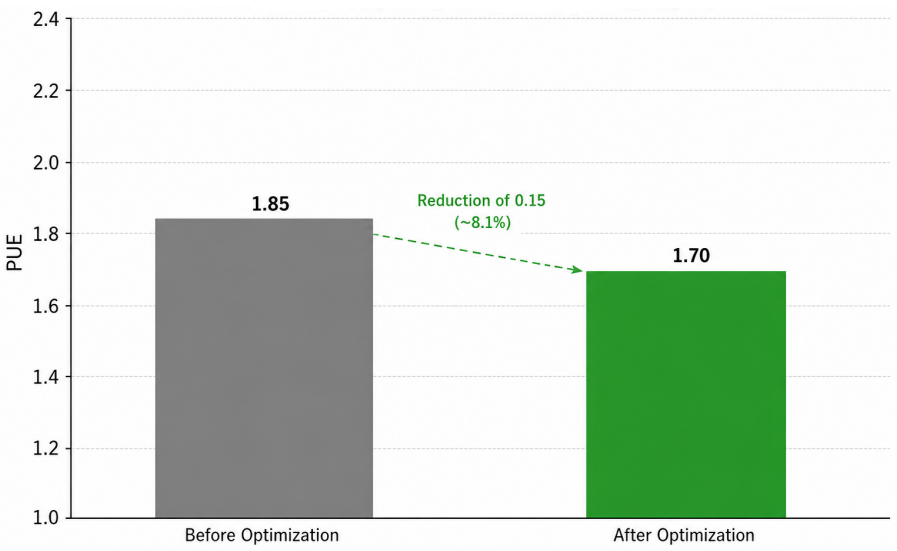
- Tests show concrete drops in power consumption alongside gains in Power Usage Effectiveness.
- It supplies a cost-effective path toward more sustainable data center operations.
- Built-in scalability features point to potential use in larger operational settings.
Where Pith is reading between the lines
- Widespread use could meaningfully shrink the overall electricity demand of computing infrastructure.
- Linking the system to renewable power sources might allow automatic shifts toward cleaner energy periods.
- The same monitoring loop could be adapted to target cooling inefficiencies more directly.
Load-bearing premise
The small-scale controlled environment accurately represents the complexities of large-scale production data centers, allowing the framework to scale effectively.
What would settle it
Deploying the framework in a large production data center and measuring no reduction in power consumption or improvement in PUE relative to standard operations.
Figures

read the original abstract
This study proposes a scalable Digital Twin framework for energy optimization in data centers.The framework integrates IoT-based data acquisition, cloud computing, and machine learning techniques to enable real-time monitoring, forecasting, and intelligent energy management. A controlled small-scale data center environment was developed to monitor variables such as power consumption, temperature, and computational workload. Long Short-Term Memory (LSTM) models were employed to predict energy demand and support operational decision-making. Experimental results demonstrated improvements in energy efficiency, including reductions in power consumption and enhancements in Power Usage Effectiveness (PUE). Despite being evaluated in a constrained environment, the proposed framework demonstrates strong potential as a scalable and cost-effective solution for sustainable data center management.
Editorial analysis
A structured set of objections, weighed in public.
Referee Report
Summary. The manuscript proposes a scalable Digital Twin framework for energy optimization in data centers. It integrates IoT-based data acquisition, cloud computing, and LSTM machine learning models to enable real-time monitoring, energy demand forecasting, and intelligent operational decision-making. A controlled small-scale testbed was constructed to collect data on power consumption, temperature, and computational workload. Experimental results are reported to show reductions in power consumption and improvements in Power Usage Effectiveness (PUE), leading the authors to conclude that the framework has strong potential as a scalable, cost-effective solution for sustainable data center management despite evaluation in a constrained environment.
Significance. If the scalability claims hold, the work could contribute to practical energy management in data centers by demonstrating an integrated DT+ML approach using standard components. The small-scale experimental demonstration provides initial feasibility evidence for the IoT-cloud-LSTM pipeline in a monitoring and control loop. This is a strength for an applied systems paper. However, the current evidence base is too preliminary to establish broader significance, as the headline scalability result rests on untested extrapolation from the constrained testbed.
major comments (2)
- [Experiments] Experiments section: the reported improvements in power consumption and PUE are presented without details on experimental design (number of runs, workload traces, LSTM architecture or hyperparameters), baselines (e.g., static thresholds or other predictors), error metrics, or statistical tests. This directly undermines assessment of whether the efficiency gains are robust or attributable to the framework.
- [Abstract] Abstract and Conclusion: the central claim that the framework is 'scalable' is load-bearing for the contribution, yet all results come from a single 'constrained small-scale' environment with no larger-scale simulation, multi-rack deployment, sensitivity analysis to network latency, heterogeneous servers, dynamic multi-tenant workloads, or cooling coupling. The text only offers 'strong potential' rather than evidence, so the scalability assertion is unsupported.
minor comments (2)
- [Abstract] The abstract and title emphasize 'scalable' while the evaluation text repeatedly qualifies results as limited to a constrained environment; this tension should be resolved by either tempering the title/claims or adding scaling evidence.
- A dedicated related-work subsection comparing the proposed DT framework to prior digital-twin or ML-based energy management systems in data centers is missing; this would help situate the novelty.
Simulated Author's Rebuttal
We thank the referee for the constructive comments on our manuscript. We address each major point below and indicate planned revisions to strengthen the paper.
read point-by-point responses
-
Referee: [Experiments] Experiments section: the reported improvements in power consumption and PUE are presented without details on experimental design (number of runs, workload traces, LSTM architecture or hyperparameters), baselines (e.g., static thresholds or other predictors), error metrics, or statistical tests. This directly undermines assessment of whether the efficiency gains are robust or attributable to the framework.
Authors: We agree that the experimental details were insufficient. In the revised manuscript we will add the number of runs, workload trace descriptions, LSTM architecture and hyperparameters, baseline methods (including static thresholds and other predictors), prediction error metrics, and statistical test results. These additions will allow clearer assessment of result robustness. revision: yes
-
Referee: [Abstract] Abstract and Conclusion: the central claim that the framework is 'scalable' is load-bearing for the contribution, yet all results come from a single 'constrained small-scale' environment with no larger-scale simulation, multi-rack deployment, sensitivity analysis to network latency, heterogeneous servers, dynamic multi-tenant workloads, or cooling coupling. The text only offers 'strong potential' rather than evidence, so the scalability assertion is unsupported.
Authors: We acknowledge the evaluation is confined to a small-scale testbed. The manuscript uses 'strong potential' to reflect the modular design with standard components rather than claiming proven large-scale performance. We will revise the abstract and conclusion to more explicitly state the current scope limitations, avoid any implication of validated scalability, and identify larger-scale validation as future work. revision: partial
Circularity Check
No circularity in derivation chain
full rationale
The paper is an experimental proposal and evaluation of an IoT/cloud/LSTM-based digital twin framework for data-center energy management. All reported outcomes (power reductions, PUE improvements) are direct measurements from a small-scale controlled testbed; no equations, fitted-parameter predictions, or self-citation chains are invoked to derive the central claims. The work is therefore self-contained against its own empirical benchmarks and exhibits no reduction of results to inputs by construction.
Axiom & Free-Parameter Ledger
axioms (1)
- domain assumption LSTM models can effectively predict energy demand from historical power, temperature, and workload data.
Reference graph
Works this paper leans on
-
[1]
Cloud computing: Architecture, vision, challenges, opportunities, and emerging trends
Mahfooz Alam, Suhel Mustajab, Mohammad Shahid, and Faisal Ahmad. Cloud computing: Architecture, vision, challenges, opportunities, and emerging trends. InIEEE International Conference on Computing, Communication and Intelligent Systems (ICCCIS), India, 2023. IEEE. DOI: 10.1109/ICCCIS60361.2023.10425507
-
[2]
Analysis of digital twin applications in energy efficiency: A systematic review.Sustainability, 17:3560–3575, 2025
Labouda Ba, Fatma Tangour, El Abbassi Ikram, and Rafik Absi. Analysis of digital twin applications in energy efficiency: A systematic review.Sustainability, 17:3560–3575, 2025
2025
-
[3]
Luiz Barroso and Urs Holzle.The Datacenter as a Computer: An Introduction to the Design of Warehouse-Scale Machines, volume 8. 01 2009
2009
-
[4]
In the data center, power and cooling costs more than the it equipment it supports.Electron Cool, 13, 01 2007
Christian Belady. In the data center, power and cooling costs more than the it equipment it supports.Electron Cool, 13, 01 2007
2007
-
[5]
An overview of cloud computing and leading cloud service providers
Praveen Borra. An overview of cloud computing and leading cloud service providers. INTERNATIONAL JOURNAL OF COMPUTER ENGINEERING & TECHNOLOGY, 15:122–133, 2024. 10
2024
-
[6]
Green ai: Enhancing sustainability and energy efficiency in ai-integrated enterprise systems.IEEE Access, 2025
Saumya Dash. Green ai: Enhancing sustainability and energy efficiency in ai-integrated enterprise systems.IEEE Access, 2025
2025
-
[7]
Improvingenergyefficiencyinadatacenter: Pueanalyzingandtuning
Daniel Flores-Martin, Miguel Mahillo, Felipe Lemus Prieto, Javier Corral Garcia, and Juan Rico-Gallego. Improvingenergyefficiencyinadatacenter: Pueanalyzingandtuning. pages 01–10, 05 2025
2025
-
[8]
Efficient orchestration of distributed workloads in multi-region kubernetes cluster.Computers, 14:114–129, 2025
Radoslav Furnadzhiev, Mitko Shopov, and Nikolay Kakanakov. Efficient orchestration of distributed workloads in multi-region kubernetes cluster.Computers, 14:114–129, 2025
2025
-
[9]
Fog computing & iot: Overview, architecture and appli- cations
Harshit Gupta and Ajay Bharti. Fog computing & iot: Overview, architecture and appli- cations. 04 2023
2023
-
[10]
Power management optimiza- tion for data centers: A power supply perspective.IEEE Transactions on Sustainable Computing, pages 1–20, 2025
Huikang Huang, Weiwei Lin, Jianpeng Lin, and Keqin Li. Power management optimiza- tion for data centers: A power supply perspective.IEEE Transactions on Sustainable Computing, pages 1–20, 2025
2025
-
[11]
Reinforcement learning for data center energy efficiency optimization: A systematic literature review and research roadmap.Applied Energy, 389, 03 2025
Hussain Kahil, Shiva sharma, Petri Valisuo, and Mohammed Elmusrati. Reinforcement learning for data center energy efficiency optimization: A systematic literature review and research roadmap.Applied Energy, 389, 03 2025
2025
-
[12]
Analytics Press, Oakland, 2011
Jonathan Koomey.Growth in Data Center Electricity Use 2005 to 2010. Analytics Press, Oakland, 2011
2005
-
[13]
A re- view on ai-driven optimization of data center energy efficiency and thermal management
Xiyong LI, Zhiming ZHAO, Xiangjun JIANG, Yingmei CHEN, and Ruxuan HE. A re- view on ai-driven optimization of data center energy efficiency and thermal management. International Journal of Applied Science, 8:108–125, 2025
2025
-
[14]
A survey on digital twin networks: Architecture, technologies, applications and open issues.IEEE Internet of Things Journal, pages 10–19, 2025
Yidan Pan, Lei Lei, Gaoqing Shen, Xinting Zhang, and Pan Cao. A survey on digital twin networks: Architecture, technologies, applications and open issues.IEEE Internet of Things Journal, pages 10–19, 2025
2025
-
[15]
A systematic review of energy efficiency metrics for optimizing cloud data center operations and management
Ashkan Safari, Hoda Sorouri, Afshin Rahimi, and Arman Oshnoei. A systematic review of energy efficiency metrics for optimizing cloud data center operations and management. Electronics, 14:1–31, 05 2025
2025
-
[16]
Harnessing the future: Exploring digital twin applications and implications in renewable energy.Energy Nexus, 18:110–128, 2025
Concetta Semeraro, Haya Aljaghoub, Hamad Al-Ali, Mohammad Abdelkareem, and Abdul Olabi. Harnessing the future: Exploring digital twin applications and implications in renewable energy.Energy Nexus, 18:110–128, 2025
2025
-
[17]
An overview of digital twin technology for power electronics: State-of-the-art and future trends.IEEE Transac- tions on Power Electronics, pages 1–26, 2025
Chenhao Wu, Zhexin Cui, Qian Xia, Jiguang Yue, and Feng Lyu. An overview of digital twin technology for power electronics: State-of-the-art and future trends.IEEE Transac- tions on Power Electronics, pages 1–26, 2025
2025
-
[18]
A data center energy efficiency optimization method based on optimal temperature control of designated active servers.Energy and Buildings, 345:116–126, 2025
Yizhe Xu, Maoyu Tian, Chengchu Yan, Depeng Li, Tao Deng, Puxi Guo, and Kai Hu. A data center energy efficiency optimization method based on optimal temperature control of designated active servers.Energy and Buildings, 345:116–126, 2025
2025
-
[19]
Md Bokhtiar Al Zami, Shaba Shaon, Vu Khanh Quy, and Dinh C. Nguyen. Digital twin in industries: A comprehensive survey.IEEE Access, 13:47291–47336, 2024. 11
2024
discussion (0)
Sign in with ORCID, Apple, or X to comment. Anyone can read and Pith papers without signing in.