Recognition: unknown
AeroJEPA: Learning Semantic Latent Representations for Scalable 3D Aerodynamic Field Modeling
Pith reviewed 2026-05-09 15:49 UTC · model grok-4.3
The pith
AeroJEPA predicts target latents of aerodynamic flows from geometry and condition latents rather than the full field.
A machine-rendered reading of the paper's core claim, the machinery that carries it, and where it could break.
Core claim
AeroJEPA is a Joint-Embedding Predictive Architecture that encodes geometry and operating conditions into a context latent, predicts the corresponding target latent of the flow field, and optionally decodes the field at arbitrary resolution through a continuous implicit decoder. The prediction objective forces the latent space to capture semantic structure in the aerodynamics, while the separation of latent prediction from field reconstruction removes the direct dependence of model cost on output resolution.
What carries the argument
The joint-embedding predictive architecture (JEPA) applied to aerodynamics, in which a context encoder on geometry and conditions predicts the latent embedding that a target encoder would produce from the flow field itself.
If this is right
- Field reconstruction cost remains independent of output resolution, allowing high-fidelity 3D grids without proportional increase in model size.
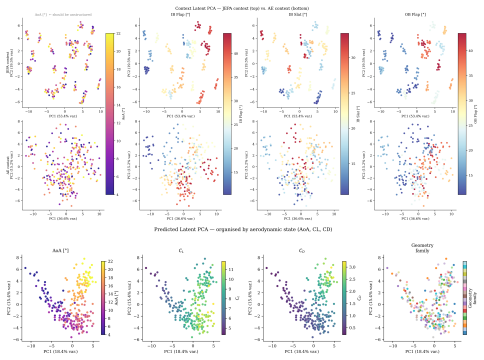
- Latent representations encode aerodynamic quantities even when those quantities are not supplied as direct supervision during training.
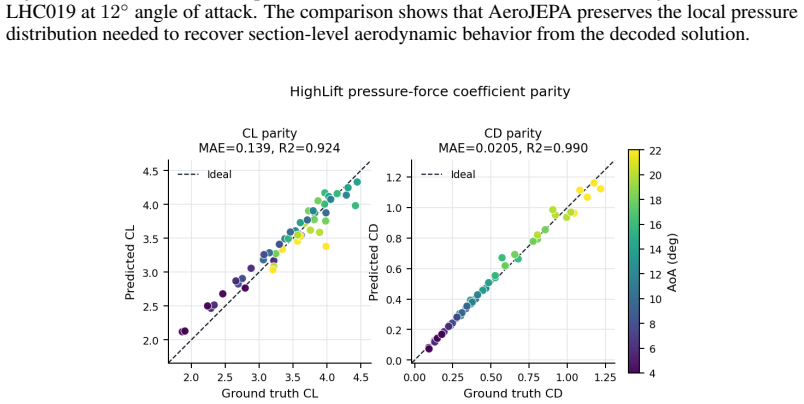
- Linear probes on the latents recover quantities such as lift or drag coefficients for new designs.
- Arithmetic on latent vectors produces controlled changes in geometry or flow features that can be decoded back to fields.
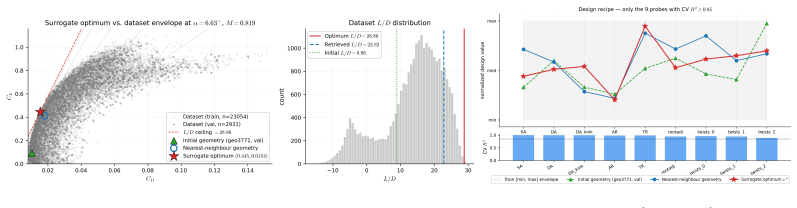
- Constrained optimization can be performed entirely in latent space, reducing the number of full CFD evaluations required for design.
Where Pith is reading between the lines
- The same predictive-latent pattern could be transferred to other high-dimensional physics fields such as structural mechanics or combustion.
- If the semantic organization generalizes, latent-space search might replace many-query CFD loops in early-stage aircraft design.
- Combining AeroJEPA latents with gradient-based optimizers could enable real-time design iteration once the initial training is complete.
Load-bearing premise
The learned latent space will organize semantically and stay useful for interpolation, probing, and optimization when applied to geometries and flow conditions outside the two training data sets.
What would settle it
Performance of latent-space linear probes or design optimization drops sharply when the model is tested on a new family of wing shapes or Reynolds-number regime not represented in HiLiftAeroML or SuperWing.
Figures






read the original abstract
Aerodynamic surrogate models are increasingly used to replace repeated high-fidelity CFD evaluations in many-query design settings, but current approaches still face two important limitations: they often scale poorly to the very large fields arising in realistic 3D aerodynamics, and they rarely produce latent representations that are directly useful for analysis and design. We introduce AeroJEPA, a Joint-Embedding Predictive Architecture for aerodynamic field modeling that addresses both issues. Rather than predicting the full flow field directly from geometry, AeroJEPA predicts a target latent representation of the flow from a context latent representation of the geometry and operating conditions, and optionally reconstructs the field through a continuous implicit decoder. This formulation decouples latent prediction from field resolution while encouraging the latent space to organize semantically. We evaluate AeroJEPA on two complementary datasets: HiLiftAeroML, which stresses the method in a high-fidelity regime with extremely large boundary-layer fields, and SuperWing, which tests large-scale generalization and latent-space optimization over a broad family of transonic wings. Across these benchmarks, AeroJEPA is competitive as a continuous surrogate for aerodynamic fields, scales naturally to high-resolution outputs, and learns context and predicted latents that encode geometry and aerodynamic quantities not used directly as supervision. We further show that the resulting latent space supports controlled interpolation, linear probing, concept-vector arithmetic, and a constrained design latent-optimization experiment. These results suggest that predictive latent learning is a promising direction for scalable and design-meaningful aerodynamic surrogate modeling.
Editorial analysis
A structured set of objections, weighed in public.
Referee Report
Summary. The manuscript introduces AeroJEPA, a Joint-Embedding Predictive Architecture for 3D aerodynamic field modeling. Rather than predicting full flow fields directly, the model predicts a target latent representation of the flow from a context latent derived from geometry and operating conditions, followed by an optional continuous implicit decoder for field reconstruction. This is evaluated on the HiLiftAeroML dataset (high-fidelity boundary-layer fields) and SuperWing dataset (transonic wings), with claims of competitive surrogate accuracy, natural scaling to high-resolution outputs, and semantically organized latents that encode geometry and aerodynamic quantities without direct supervision, enabling interpolation, linear probing, concept arithmetic, and constrained design optimization.
Significance. If the central claims hold, AeroJEPA would offer a useful advance for many-query aerodynamic design by providing both scalable continuous field surrogates and latent representations that support downstream analysis and optimization tasks. The predictive latent formulation is a reasonable way to encourage semantic organization independent of output resolution, and the dual-dataset evaluation (high-fidelity and broad-family) is a strength. Reproducible code or parameter-free derivations are not mentioned, but the empirical demonstrations on two distinct benchmarks add value if the latent utility generalizes.
major comments (2)
- [§4] §4 (Experiments): All demonstrations of latent-space semantic organization, interpolation, probing, concept arithmetic, and design optimization are performed exclusively on splits of HiLiftAeroML and SuperWing. No tests on out-of-family geometries, unseen Reynolds-number regimes, or 3D configurations absent from training are reported, which directly undermines the claim that the latents yield 'design-meaningful' surrogates.
- [§3.2] §3.2 (Architecture): The JEPA-style predictor is described at a high level, but the precise loss formulation, weighting between context/target encoders and the optional decoder, and any regularization that enforces semantic organization are not given as explicit equations. This makes it impossible to verify the claimed decoupling of latent prediction from field resolution or to reproduce the training dynamics.
minor comments (2)
- [Tables 1-2] Table 1 and Table 2: quantitative metrics are reported without error bars or statistical significance tests across multiple random seeds, weakening the 'competitive' claim.
- [Figure 5] Figure 5 (latent visualizations): axis labels and color scales are not fully described in the caption, making it difficult to interpret the encoded aerodynamic quantities.
Simulated Author's Rebuttal
We thank the referee for their constructive and detailed review of our manuscript. We address each major comment below and indicate where revisions will be incorporated to improve clarity and strengthen the presentation.
read point-by-point responses
-
Referee: [§4] §4 (Experiments): All demonstrations of latent-space semantic organization, interpolation, probing, concept arithmetic, and design optimization are performed exclusively on splits of HiLiftAeroML and SuperWing. No tests on out-of-family geometries, unseen Reynolds-number regimes, or 3D configurations absent from training are reported, which directly undermines the claim that the latents yield 'design-meaningful' surrogates.
Authors: We acknowledge that all reported evaluations of latent-space properties use standard train/test splits drawn from the HiLiftAeroML and SuperWing datasets rather than out-of-family geometries or entirely unseen Reynolds-number regimes. These datasets were selected precisely because they contain substantial intra-family geometric and aerodynamic diversity (high-fidelity boundary-layer variations in HiLiftAeroML; broad transonic wing families in SuperWing), which enabled the demonstrations of interpolation, linear probing, concept arithmetic, and constrained optimization. We agree, however, that the absence of cross-family or out-of-distribution tests limits the strength of the claim that the latents are broadly 'design-meaningful.' In the revised manuscript we will add an explicit limitations paragraph in Section 4 that qualifies the current scope of generalization and outlines the need for future out-of-distribution benchmarks. revision: partial
-
Referee: [§3.2] §3.2 (Architecture): The JEPA-style predictor is described at a high level, but the precise loss formulation, weighting between context/target encoders and the optional decoder, and any regularization that enforces semantic organization are not given as explicit equations. This makes it impossible to verify the claimed decoupling of latent prediction from field resolution or to reproduce the training dynamics.
Authors: We thank the referee for highlighting this omission. The current description of the JEPA-style predictor is indeed high-level and lacks the explicit loss equations, weighting coefficients, and regularization terms. In the revised manuscript we will insert the full mathematical formulation of the predictor loss, the combined objective with the optional decoder, and any regularization used to promote semantic organization directly into Section 3.2. These additions will make the claimed decoupling of latent prediction from output resolution verifiable and will enable exact reproduction of the reported training dynamics. revision: yes
Circularity Check
No circularity in derivation chain; method and claims are self-contained.
full rationale
The paper presents AeroJEPA as an architectural extension of JEPA-style latent prediction applied to 3D aerodynamic fields, with the core formulation (context latent to target latent prediction, optional implicit decoder) motivated independently to decouple resolution and encourage semantic organization. No equations or derivations are shown that reduce claimed performance, latent encoding properties, or downstream utility (interpolation, probing, optimization) to quantities defined by the model's own fitted parameters or by self-citation chains. All evaluations are empirical on the two specified datasets using standard training and analysis techniques that remain falsifiable outside the fitted values. This is the normal case of an independent architectural proposal with empirical support.
Axiom & Free-Parameter Ledger
free parameters (1)
- latent dimension
axioms (1)
- domain assumption Aerodynamic fields possess semantically meaningful low-dimensional structure that can be learned via joint-embedding prediction without direct supervision on those semantics.
invented entities (1)
-
AeroJEPA architecture
no independent evidence
Reference graph
Works this paper leans on
-
[1]
Physica D: Nonlinear Phenomena , volume=
Blending machine learning and sequential data assimilation over latent spaces for surrogate modeling of Boussinesq systems , author=. Physica D: Nonlinear Phenomena , volume=. 2023 , publisher=
2023
-
[2]
Proceedings of the IEEE/CVF conference on computer vision and pattern recognition , pages=
Self-supervised learning from images with a joint-embedding predictive architecture , author=. Proceedings of the IEEE/CVF conference on computer vision and pattern recognition , pages=
-
[3]
Journal of Aircraft , volume=
Surrogate model development for optimized blended-wing-body aerodynamics , author=. Journal of Aircraft , volume=. 2023 , publisher=
2023
-
[4]
Nature Reviews Physics , volume=
Neural operators for accelerating scientific simulations and design , author=. Nature Reviews Physics , volume=. 2024 , publisher=
2024
-
[5]
Lejepa: Provable and scalable self-supervised learning without the heuristics , author=. arXiv preprint arXiv:2511.08544 , year=
-
[6]
Leworldmodel: Stable end-to-end joint-embedding predictive architecture from pixels , author=. arXiv preprint arXiv:2603.19312 , year=
-
[7]
arXiv preprint arXiv:2502.03933 , year=
HEP-JEPA: A foundation model for collider physics using joint embedding predictive architecture , author=. arXiv preprint arXiv:2502.03933 , year=
-
[8]
Aerospace Science and Technology , volume=
Dimensionality-reduction-based surrogate models for real-time design space exploration of a jet engine compressor blade , author=. Aerospace Science and Technology , volume=. 2021 , publisher=
2021
-
[9]
Scientific Reports , volume=
Neural fields for rapid aircraft aerodynamics simulations , author=. Scientific Reports , volume=. 2024 , publisher=
2024
-
[10]
Journal of Scientific Computing , volume=
Generalised latent assimilation in heterogeneous reduced spaces with machine learning surrogate models , author=. Journal of Scientific Computing , volume=. 2023 , publisher=
2023
-
[11]
arXiv preprint arXiv:2601.20190 , year=
WirelessJEPA: A Multi-Antenna Foundation Model using Spatio-temporal Wireless Latent Predictions , author=. arXiv preprint arXiv:2601.20190 , year=
-
[12]
arXiv preprint arXiv:2601.00844 , year=
Value-guided action planning with JEPA world models , author=. arXiv preprint arXiv:2601.00844 , year=
-
[13]
arXiv preprint arXiv:2412.10925 , year=
Video representation learning with joint-embedding predictive architectures , author=. arXiv preprint arXiv:2412.10925 , year=
-
[14]
Aerospace Science and Technology , volume=
Rapid airfoil design optimization via neural networks-based parameterization and surrogate modeling , author=. Aerospace Science and Technology , volume=. 2021 , publisher=
2021
-
[15]
Data-Centric Engineering , volume=
Discretization-independent surrogate modeling of physical fields around variable geometries using coordinate-based networks , author=. Data-Centric Engineering , volume=. 2025 , publisher=
2025
-
[16]
arXiv preprint arXiv:2602.02093 , year=
Cell-JEPA: Latent Representation Learning for Single-Cell Transcriptomics , author=. arXiv preprint arXiv:2602.02093 , year=
-
[17]
A-jepa: Joint-embedding predictive architecture can listen.arXiv preprint arXiv:2311.15830,
A-jepa: Joint-embedding predictive architecture can listen , author=. arXiv preprint arXiv:2311.15830 , year=
-
[18]
2008 , publisher=
Engineering design via surrogate modelling: a practical guide , author=. 2008 , publisher=
2008
-
[19]
Proceedings of the Royal Society A: Mathematical, Physical and Engineering Sciences , volume=
Optimization using surrogate models and partially converged computational fluid dynamics simulations , author=. Proceedings of the Royal Society A: Mathematical, Physical and Engineering Sciences , volume=. 2006 , publisher=
2006
-
[20]
Learning and leveraging world models in visual representation learning , author=. arXiv preprint arXiv:2403.00504 , year=
-
[21]
International Journal of Computational Fluid Dynamics , volume=
Training a neural-network-based surrogate model for aerodynamic optimisation using a Gaussian process , author=. International Journal of Computational Fluid Dynamics , volume=. 2022 , publisher=
2022
-
[22]
Computer Methods in Applied Mechanics and Engineering , volume=
Accelerating phase-field predictions via recurrent neural networks learning the microstructure evolution in latent space , author=. Computer Methods in Applied Mechanics and Engineering , volume=. 2022 , publisher=
2022
-
[23]
arXiv preprint arXiv:2412.05333 , year=
Learning symmetry-independent jet representations via jet-based joint embedding predictive architecture , author=. arXiv preprint arXiv:2412.05333 , year=
-
[24]
Nature Communications , volume=
Learning nonlinear operators in latent spaces for real-time predictions of complex dynamics in physical systems , author=. Nature Communications , volume=. 2024 , publisher=
2024
-
[25]
Advances in neural information processing systems , volume=
Connecting joint-embedding predictive architecture with contrastive self-supervised learning , author=. Advances in neural information processing systems , volume=
-
[26]
arXiv preprint arXiv:2405.17995 , year=
Dmt-jepa: Discriminative masked targets for joint-embedding predictive architecture , author=. arXiv preprint arXiv:2405.17995 , year=
-
[27]
arXiv preprint arXiv:2309.16014 , year=
Graph-level representation learning with joint-embedding predictive architectures , author=. arXiv preprint arXiv:2309.16014 , year=
-
[28]
Joint embedding predictive architectures focus on slow features.arXiv preprint arXiv:2211.10831,
Joint embedding predictive architectures focus on slow features , author=. arXiv preprint arXiv:2211.10831 , year=
-
[29]
Physics of Fluids , volume=
Toward aerodynamic surrogate modeling based on -variational autoencoders , author=. Physics of Fluids , volume=. 2024 , publisher=
2024
-
[30]
Nature Communications , volume=
-variational autoencoders and transformers for reduced-order modelling of fluid flows , author=. Nature Communications , volume=. 2024 , publisher=
2024
-
[31]
arXiv preprint arXiv:2511.18424 , year=
CrossJEPA: Cross-Modal Joint-Embedding Predictive Architecture for Efficient 3D Representation Learning from 2D Images , author=. arXiv preprint arXiv:2511.18424 , year=
-
[32]
arXiv preprint arXiv:2512.10942 (2025) 11
Vl-jepa: Joint embedding predictive architecture for vision-language , author=. arXiv preprint arXiv:2512.10942 , year=
-
[33]
arXiv preprint arXiv:2409.15803 , year=
3d-jepa: A joint embedding predictive architecture for 3d self-supervised representation learning , author=. arXiv preprint arXiv:2409.15803 , year=
-
[34]
PI-JEPA: Label-Free Surrogate Pretraining for Coupled Multiphysics Simulation via Operator-Split Latent Prediction , author=. arXiv preprint arXiv:2604.01349 , year=
work page internal anchor Pith review Pith/arXiv arXiv
-
[35]
arXiv preprint arXiv:2603.13227 , year=
Representation Learning for Spatiotemporal Physical Systems , author=. arXiv preprint arXiv:2603.13227 , year=
- [36]
-
[37]
arXiv preprint arXiv:2402.02366 , year=
Transolver: A fast transformer solver for pdes on general geometries , author=. arXiv preprint arXiv:2402.02366 , year=
-
[38]
arXiv preprint arXiv:2601.07139 , year=
AdaField: Generalizable Surface Pressure Modeling with Physics-Informed Pre-training and Flow-Conditioned Adaptation , author=. arXiv preprint arXiv:2601.07139 , year=
-
[39]
Factorized implicit global convolution for automotive computational fluid dynamics prediction,
Factorized implicit global convolution for automotive computational fluid dynamics prediction , author=. arXiv preprint arXiv:2502.04317 , year=
-
[40]
arXiv preprint arXiv:2410.05016 , year=
T-jepa: Augmentation-free self-supervised learning for tabular data , author=. arXiv preprint arXiv:2410.05016 , year=
-
[41]
IFAC-PapersOnLine , volume=
Learning state-space models of dynamic systems from arbitrary data using joint embedding predictive architectures , author=. IFAC-PapersOnLine , volume=. 2025 , publisher=
2025
-
[42]
arXiv preprint arXiv:2405.10093 , year=
Lat-pfn: A joint embedding predictive architecture for in-context time-series forecasting , author=. arXiv preprint arXiv:2405.10093 , year=
-
[43]
Progress in aerospace sciences , volume=
A review on design of experiments and surrogate models in aircraft real-time and many-query aerodynamic analyses , author=. Progress in aerospace sciences , volume=. 2018 , publisher=
2018
-
[44]
Chinese Journal of Aeronautics , volume=
Heterogeneous data-driven aerodynamic modeling based on physical feature embedding , author=. Chinese Journal of Aeronautics , volume=. 2024 , publisher=
2024
-
[45]
AIAA SCITECH 2026 Forum , pages=
High-Fidelity CFD Data Generation for HiLiftAeroML using Solution-Adapted WMLES , author=. AIAA SCITECH 2026 Forum , pages=
2026
-
[46]
SuperWing: a comprehensive transonic wing dataset for data-driven aerodynamic design
SuperWing: a comprehensive transonic wing dataset for data-driven aerodynamic design , author=. arXiv preprint arXiv:2512.14397 , year=
work page internal anchor Pith review Pith/arXiv arXiv
-
[47]
Proceedings of the IEEE/CVF conference on computer vision and pattern recognition , pages=
Point transformer v3: Simpler faster stronger , author=. Proceedings of the IEEE/CVF conference on computer vision and pattern recognition , pages=
-
[48]
International conference on machine learning , pages=
Neural message passing for quantum chemistry , author=. International conference on machine learning , pages=. 2017 , organization=
2017
-
[49]
Proceedings of the IEEE/CVF international conference on computer vision , pages=
Scalable diffusion models with transformers , author=. Proceedings of the IEEE/CVF international conference on computer vision , pages=
-
[50]
Agentic Exploration of PDE Spaces using Latent Foundation Models for Parameterized Simulations
Agentic Exploration of PDE Spaces using Latent Foundation Models for Parameterized Simulations , author=. arXiv preprint arXiv:2604.09584 , year=
work page internal anchor Pith review Pith/arXiv arXiv
-
[51]
arXiv preprint arXiv:2601.05525 , year=
Explainable AI: Learning from the Learners , author=. arXiv preprint arXiv:2601.05525 , year=
-
[52]
Expert Systems with Applications , volume=
Towards extraction of orthogonal and parsimonious non-linear modes from turbulent flows , author=. Expert Systems with Applications , volume=. 2022 , publisher=
2022
discussion (0)
Sign in with ORCID, Apple, or X to comment. Anyone can read and Pith papers without signing in.