Recognition: unknown
Bayesian Multi-Topology Express Transportation Network Design under Posterior Predictive Demand, Sorting-Efficiency and Delivery-Time Uncertainty
Pith reviewed 2026-05-08 03:03 UTC · model grok-4.3
The pith
Bayesian posterior predictive modeling designs multi-topology express networks that trade modest cost for reduced delivery time risk and improved hub reliability.
A machine-rendered reading of the paper's core claim, the machinery that carries it, and where it could break.
Core claim
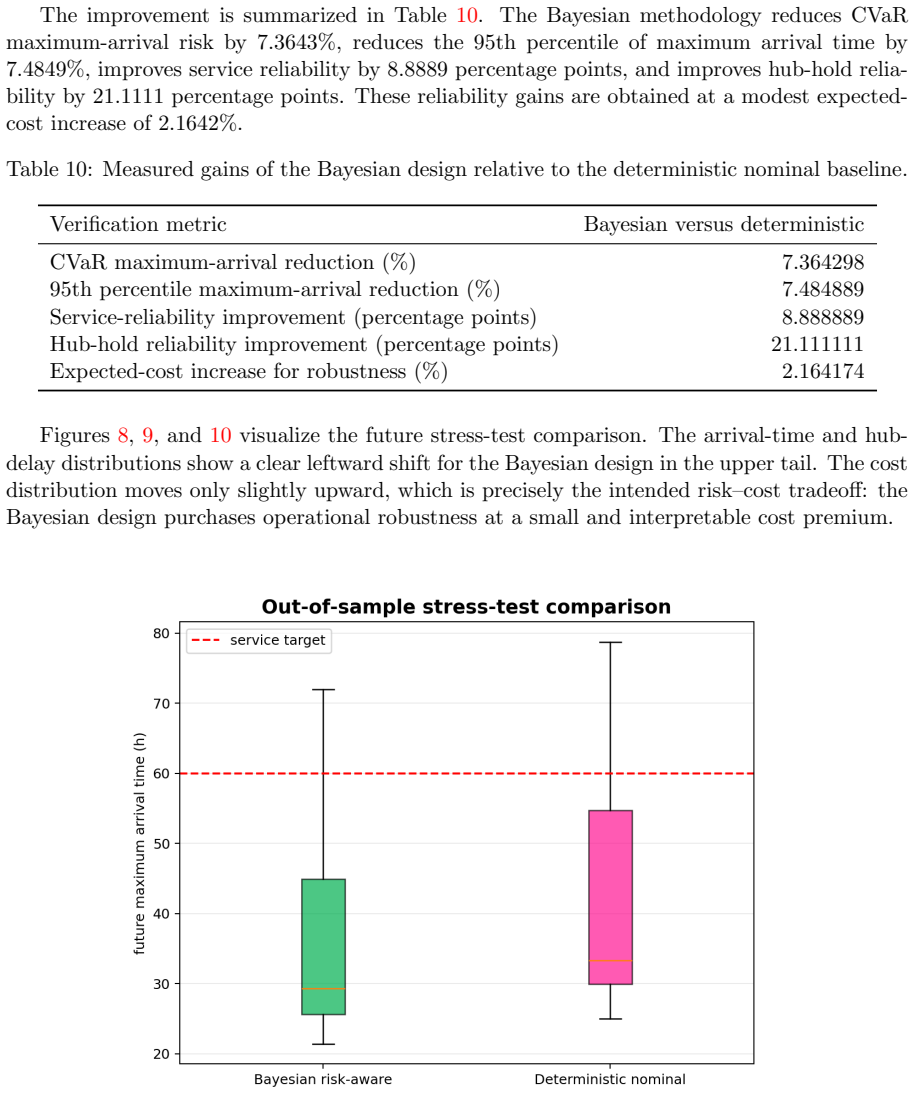
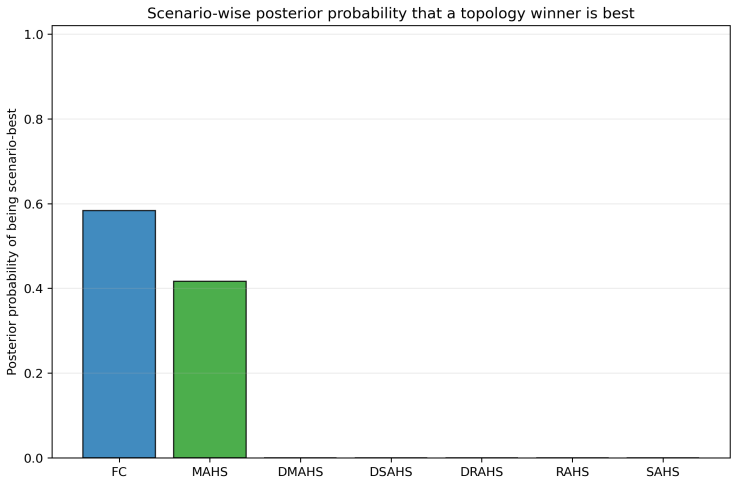
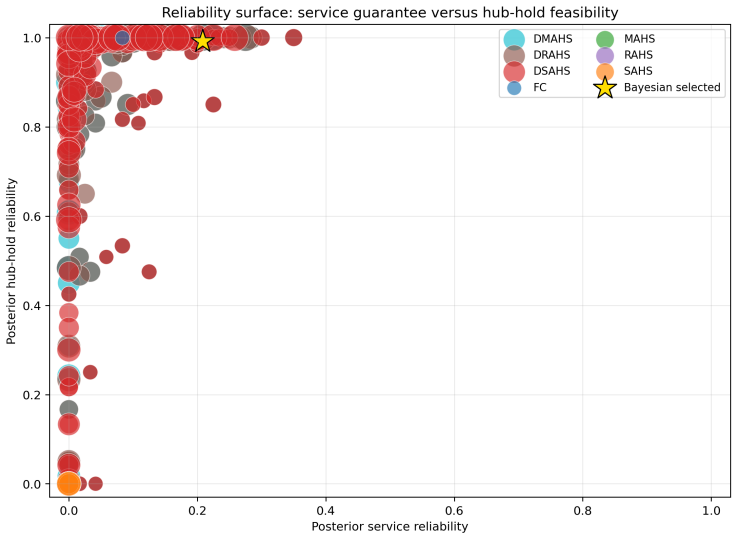
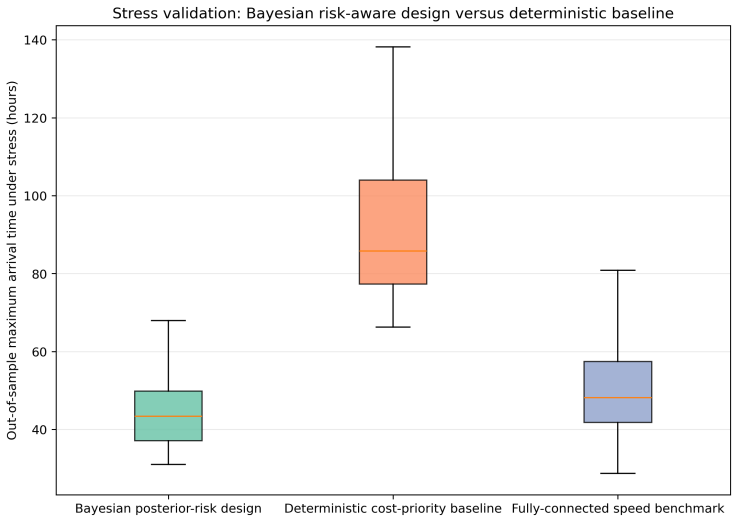
This paper establishes a Bayesian posterior-predictive framework for multi-topology express transportation network design. The model propagates uncertainty in demand, travel time, cost, and hub reliability through posterior predictive scenarios. Candidate designs for fully connected, hub-and-spoke, restricted-allocation, and hybrid topologies are evaluated using posterior expected cost, CVaR of maximum arrival time, service reliability, and other metrics. A methodology using posterior simulation and Bayes-risk selection yields designs with theoretical guarantees of existence, convergence, and stability. Experiments demonstrate the ability to achieve substantial reductions in tail delivery风险s
What carries the argument
The Bayesian multi-structure design methodology, which uses posterior simulation, sample-average approximation, topology-wise optimization, and Bayes-risk selection to identify robust network topologies under uncertainty.
Load-bearing premise
That historical or benchmark-calibrated data can be used to learn and propagate realistic posterior predictive distributions for demand, travel time, cost, and hub reliability that accurately represent future uncertainty.
What would settle it
A real-world test where the Bayesian-optimized network is deployed and compared to a deterministic design under actual demand surges or disruptions; if the Bayesian design does not show lower tail risks, the approach fails.
Figures








read the original abstract
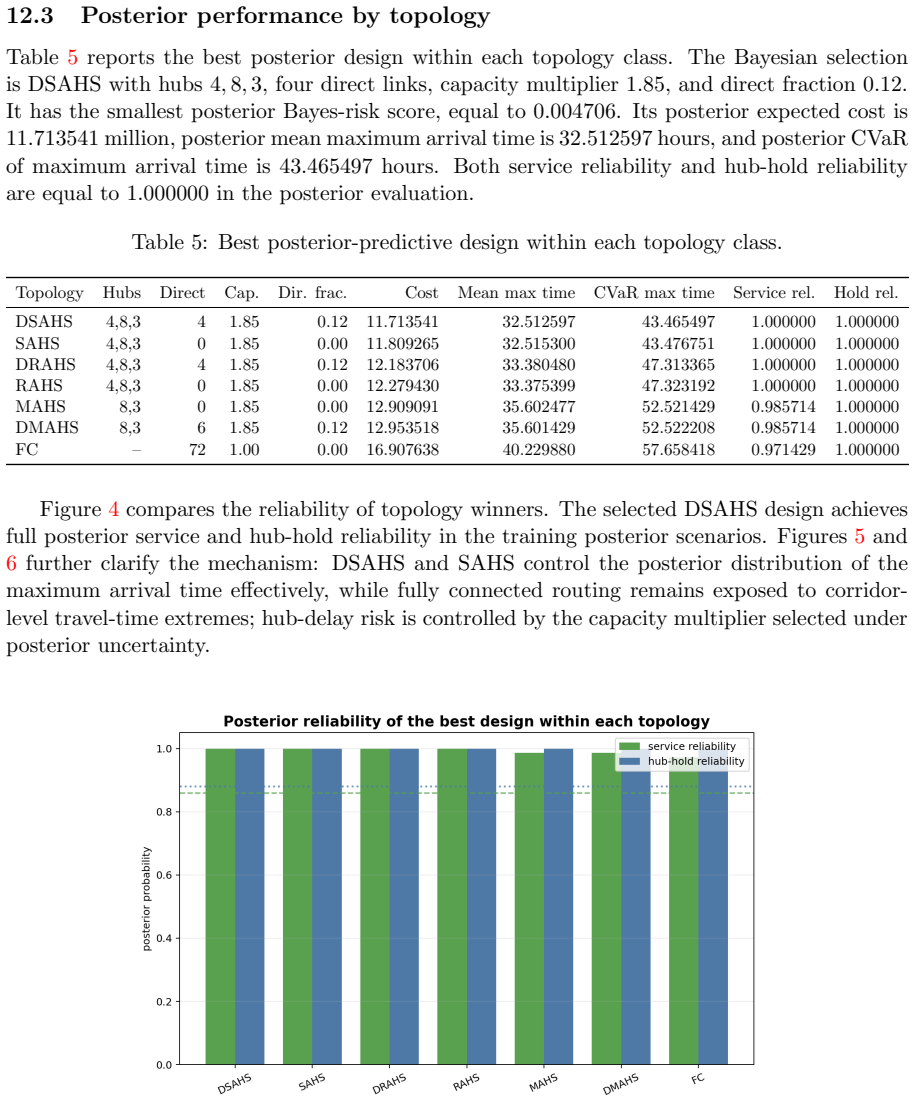
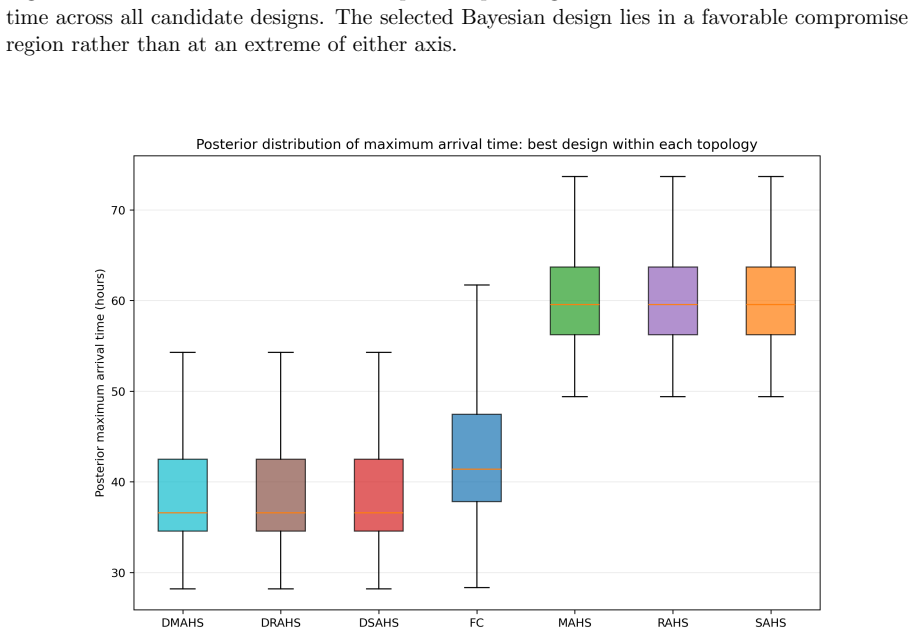
Express transportation network design is uncertain because origin--destination demand, travel time, operating cost, hub congestion, and realized sorting productivity vary over time. Existing multi-topology express network models usually optimize cost and maximum arrival time under fixed input data, which may produce designs that are efficient nominally but fragile under demand surges, route disruptions, and hub productivity losses. This paper develops a Bayesian posterior-predictive framework for multi-topology express transportation network design. The model learns demand, travel-time, cost, and hub-reliability uncertainty from historical or benchmark-calibrated data and propagates them through posterior predictive scenarios. For fully connected, hub-and-spoke, restricted-allocation, and direct-link hybrid topologies, candidate designs are evaluated using posterior expected cost, conditional value-at-risk of maximum arrival time, service reliability, hub hold-time reliability, and emission-aware penalties. A Bayesian multi-structure design methodology is proposed using posterior simulation, sample-average approximation, topology-wise optimization, and Bayes-risk selection. Theoretical results establish existence of a Bayes-optimal design, convergence of posterior scenario risks, and stability of topology selection. Simulation and CAB benchmark experiments show that the Bayesian design can trade modest additional cost for substantial reductions in tail delivery risk and improved hub reliability.
Editorial analysis
A structured set of objections, weighed in public.
Referee Report
Summary. This paper develops a Bayesian posterior-predictive framework for multi-topology express transportation network design under uncertainty in origin-destination demand, travel times, operating costs, hub congestion, and sorting productivity. For topologies including fully connected, hub-and-spoke, restricted-allocation, and direct-link hybrids, designs are evaluated via posterior expected cost, CVaR of maximum arrival time, service and hub-hold-time reliability, and emission-aware penalties. A methodology combining posterior simulation, sample-average approximation, topology-wise optimization, and Bayes-risk selection is proposed. Theoretical results claim existence of a Bayes-optimal design, convergence of posterior scenario risks, and stability of topology selection. Simulation studies and CAB benchmark experiments are reported to show that the Bayesian approach trades modest additional cost for substantial tail-risk reductions and improved hub reliability.
Significance. If the posterior predictives are shown to generalize, the work provides a coherent integration of Bayesian uncertainty propagation with risk-averse multi-objective optimization across network topologies, offering a principled alternative to deterministic or scenario-based express network design. The theoretical guarantees on existence, convergence, and stability, together with the explicit multi-topology comparison, strengthen the contribution for logistics applications where tail delivery failures carry high costs.
major comments (2)
- [Simulation and CAB benchmark experiments] Simulation and CAB benchmark experiments: The central empirical claim that Bayesian designs achieve substantial reductions in tail delivery risk and hub reliability rests on posterior predictive distributions learned from historical or CAB-calibrated data. No hold-out predictive calibration, posterior predictive checks against future realizations, or sensitivity analysis to prior/likelihood misspecification is described; without these, the reported CVaR improvements cannot be distinguished from in-sample artifacts.
- [Methodology] Methodology and theoretical results: The framework generates scenarios from the same historical data used to fit the posterior predictives and then evaluates performance on those scenarios. This creates a potential circularity in which topology selection and risk metrics are optimized against quantities derived from the calibration data, undermining the claim of genuine robustness to future uncertainty.
minor comments (2)
- [Abstract] Abstract: The phrase 'emission-aware penalties' is introduced without indicating whether emissions enter the objective as a linear term, a constraint, or a separate CVaR component; a brief clarification would improve readability.
- [Methodology] Notation: The distinction between posterior expected cost and the Bayes-risk selection criterion should be stated explicitly in the first methodological section to avoid conflation with standard SAA.
Simulated Author's Rebuttal
We thank the referee for the constructive feedback on our manuscript. We address each major comment below with point-by-point responses. We agree that additional empirical validation would strengthen the work and will incorporate sensitivity analyses and clarifications in the revision. We maintain that the Bayesian posterior-predictive approach properly accounts for future uncertainty without circularity.
read point-by-point responses
-
Referee: [Simulation and CAB benchmark experiments] Simulation and CAB benchmark experiments: The central empirical claim that Bayesian designs achieve substantial reductions in tail delivery risk and hub reliability rests on posterior predictive distributions learned from historical or CAB-calibrated data. No hold-out predictive calibration, posterior predictive checks against future realizations, or sensitivity analysis to prior/likelihood misspecification is described; without these, the reported CVaR improvements cannot be distinguished from in-sample artifacts.
Authors: We acknowledge the value of explicit hold-out validation, posterior predictive checks (PPC), and sensitivity analyses for confirming that tail-risk reductions are not in-sample artifacts. The current experiments use simulation studies and the standard CAB benchmark dataset, which is calibrated to historical patterns as is conventional in network design literature. In the revised manuscript, we will add sensitivity analyses varying prior hyperparameters and likelihood assumptions, along with PPC by generating replicated datasets from the posterior predictive and comparing key statistics (e.g., demand variability and travel-time tails) to held-out data splits where feasible. This will provide stronger evidence that the CVaR and reliability improvements generalize. revision: partial
-
Referee: [Methodology] Methodology and theoretical results: The framework generates scenarios from the same historical data used to fit the posterior predictives and then evaluates performance on those scenarios. This creates a potential circularity in which topology selection and risk metrics are optimized against quantities derived from the calibration data, undermining the claim of genuine robustness to future uncertainty.
Authors: We respectfully disagree that the procedure introduces circularity. The posterior is estimated from historical data, but all optimization and risk evaluation occurs on scenarios sampled from the posterior predictive distribution p(new data | historical data). This distribution explicitly represents plausible future realizations under parameter uncertainty, which is the standard Bayesian mechanism for propagating uncertainty to out-of-sample decisions. The sample-average approximation therefore computes posterior expected costs and CVaR with respect to future uncertainty, not the calibration observations themselves. We will expand the methodology section to clarify this distinction and reference the relevant Bayesian decision theory. revision: no
Circularity Check
No circularity: posterior-predictive optimization chain is forward from data to design
full rationale
The derivation proceeds by learning posterior predictive distributions for demand, travel time, cost and reliability from historical or benchmark data, generating scenarios, then optimizing posterior expected cost plus CVaR and reliability penalties across topologies, followed by Bayes-risk selection. Theoretical claims of existence, convergence and stability are stated as separate results. Simulation and CAB experiments evaluate the resulting designs under the same generative process, but this is standard in-sample validation of a stochastic program rather than a definitional reduction or fitted quantity renamed as prediction. No self-citation is load-bearing, no ansatz is smuggled, and no uniqueness theorem is imported from the authors' prior work. The framework remains self-contained against external benchmarks.
Axiom & Free-Parameter Ledger
free parameters (2)
- prior distributions for demand and travel-time parameters
- risk-aversion or CVaR weighting parameters
axioms (2)
- domain assumption Existence of a Bayes-optimal design under the posterior predictive measure
- standard math Convergence of posterior scenario risks as sample size grows
Reference graph
Works this paper leans on
-
[1]
Alumur, S., and Kara, B. Y. (2008). Network hub location problems: The state of the art. European Journal of Operational Research, 190(1), 1--21. doi:10.1016/j.ejor.2007.06.008 https://doi.org/10.1016/j.ejor.2007.06.008
-
[2]
Alumur, S. A., Campbell, J. F., Contreras, I., Kara, B. Y., Marianov, V., and O'Kelly, M. E. (2021). Perspectives on modeling hub location problems. European Journal of Operational Research, 291(1), 1--17. doi:10.1016/j.ejor.2020.09.039 https://doi.org/10.1016/j.ejor.2020.09.039
-
[3]
Ben-Tal, A., El Ghaoui, L., and Nemirovski, A. (2009). Robust Optimization. Princeton University Press. doi:10.1515/9781400831050 https://doi.org/10.1515/9781400831050
-
[4]
Berger, J. O. (1985). Statistical Decision Theory and Bayesian Analysis. Springer. doi:10.1007/978-1-4757-4286-2 https://doi.org/10.1007/978-1-4757-4286-2
-
[5]
Campbell, J. F. (1992). Location and allocation for distribution systems with transshipments and transportation economies of scale. Annals of Operations Research, 40, 77--99. doi:10.1007/BF02060471 https://doi.org/10.1007/BF02060471
-
[6]
Charnes, A., and Cooper, W. W. (1959). Chance-constrained programming. Management Science, 6(1), 73--79. doi:10.1287/mnsc.6.1.73 https://doi.org/10.1287/mnsc.6.1.73
-
[8]
Farahani, R. Z., Hekmatfar, M., Arabani, A. B., and Nikbakhsh, E. (2013). Hub location problems: A review of models, classification, solution techniques, and applications. Computers & Industrial Engineering, 64(4), 1096--1109. doi:10.1016/j.cie.2013.01.012 https://doi.org/10.1016/j.cie.2013.01.012
-
[9]
Gelareh, S., and Nickel, S. (2011). Hub location problems in transportation networks. Transportation Research Part E: Logistics and Transportation Review, 47(6), 1092--1111. doi:10.1016/j.tre.2011.04.009 https://doi.org/10.1016/j.tre.2011.04.009
-
[10]
Gelfand, A. E., and Smith, A. F. M. (1990). Sampling-based approaches to calculating marginal densities. Journal of the American Statistical Association, 85(410), 398--409. doi:10.1080/01621459.1990.10476213 https://doi.org/10.1080/01621459.1990.10476213
-
[11]
Gelman, A., Carlin, J. B., Stern, H. S., Dunson, D. B., Vehtari, A., and Rubin, D. B. (2013). Bayesian Data Analysis, 3rd ed. Chapman and Hall/CRC. doi:10.1201/b16018 https://doi.org/10.1201/b16018
-
[12]
Kingman, J. F. C. (1961). The single server queue in heavy traffic. Mathematical Proceedings of the Cambridge Philosophical Society, 57(4), 902--904. doi:10.1017/S0305004100036094 https://doi.org/10.1017/S0305004100036094
-
[14]
Lin, B., Zhao, Y., and Lin, R. (2020). Optimization for courier delivery service network design based on frequency delay. Computers & Industrial Engineering, 139, 106144. doi:10.1016/j.cie.2019.106144 https://doi.org/10.1016/j.cie.2019.106144
-
[15]
Luedtke, J., Ahmed, S., and Nemhauser, G. L. (2010). An integer programming approach for linear programs with probabilistic constraints. Mathematical Programming, 122, 247--272. doi:10.1007/s10107-008-0247-4 https://doi.org/10.1007/s10107-008-0247-4
-
[17]
Pr\'ekopa, A. (1995). Stochastic Programming. Kluwer Academic Publishers. doi:10.1007/978-94-017-3087-7 https://doi.org/10.1007/978-94-017-3087-7
-
[18]
B., Contreras, I., Cordeau, J.-F., de Camargo, R
Real, L. B., Contreras, I., Cordeau, J.-F., de Camargo, R. S., and de Miranda, G. (2021). Multimodal hub network design with flexible routes. Transportation Research Part E: Logistics and Transportation Review, 146, 102188. doi:10.1016/j.tre.2020.102188 https://doi.org/10.1016/j.tre.2020.102188
-
[19]
Tyrrell Rockafellar and Stanislav Uryasev
Rockafellar, R. T., and Uryasev, S. (2000). Optimization of conditional value-at-risk. The Journal of Risk, 2(3), 21--41. doi:10.21314/JOR.2000.038 https://doi.org/10.21314/JOR.2000.038
-
[20]
Rostami, B., K\"ammerling, N., Naoum-Sawaya, J., Buchheim, C., and Clausen, U. (2021). Stochastic single-allocation hub location. European Journal of Operational Research, 289(3), 1087--1106. doi:10.1016/j.ejor.2020.07.051 https://doi.org/10.1016/j.ejor.2020.07.051
-
[21]
Ruszczy\'nski, A., and Shapiro, A. (2003). Stochastic programming models. In Handbooks in Operations Research and Management Science, 10, 1--64. doi:10.1016/S0927-0507(03)10001-1 https://doi.org/10.1016/S0927-0507(03)10001-1
-
[22]
Serper, E. Z., and Alumur, S. A. (2016). The design of capacitated intermodal hub networks with different vehicle types. Transportation Research Part B: Methodological, 86, 51--65. doi:10.1016/j.trb.2016.01.011 https://doi.org/10.1016/j.trb.2016.01.011
-
[23]
Shapiro, A., Dentcheva, D., and Ruszczy\'nski, A. (2009). Lectures on Stochastic Programming: Modeling and Theory. SIAM. doi:10.1137/1.9780898718751 https://doi.org/10.1137/1.9780898718751
-
[24]
Yaman, H. (2011). Allocation strategies in hub networks. European Journal of Operational Research, 211(3), 442--451. doi:10.1016/j.ejor.2011.01.014 https://doi.org/10.1016/j.ejor.2011.01.014
-
[25]
Zahiri, B., and Suresh, N. C. (2021). Hub network design for hazardous-materials transportation under uncertainty. Transportation Research Part E: Logistics and Transportation Review, 152, 102424. doi:10.1016/j.tre.2021.102424 https://doi.org/10.1016/j.tre.2021.102424
-
[27]
Zhong, J., Wang, X., Li, L., and Garc\'ia, S. (2023). Optimization for bi-objective express transportation network design under multiple topological structures. International Journal of Industrial Engineering Computations, 14, 239--264. doi: 10.5267/j.ijiec.2023.2.003 https://doi.org/10.5267/j.ijiec.2023.2.003
-
[28]
O'Kelly, M. E. (1987). A quadratic integer program for the location of interacting hub facilities. European Journal of Operational Research, 32(3), 393--404. doi: 10.1016/S0377-2217(87)80007-3 https://doi.org/10.1016/S0377-2217(87)80007-3
-
[29]
Beasley, J. E. (1990). OR-Library: distributing test problems by electronic mail. Journal of the Operational Research Society, 41(11), 1069--1072. doi: 10.1057/jors.1990.166 https://doi.org/10.1057/jors.1990.166
-
[30]
Ernst, A. T. and Krishnamoorthy, M. (1996). Efficient algorithms for the uncapacitated single allocation p -hub median problem. Location Science, 4(3), 139--154. doi: 10.1016/S0966-8349(96)00011-3 https://doi.org/10.1016/S0966-8349(96)00011-3
-
[31]
J., Shapiro, A., and Homem-de-Mello, T
Kleywegt, A. J., Shapiro, A., and Homem-de-Mello, T. (2002). The sample average approximation method for stochastic discrete optimization. SIAM Journal on Optimization, 12(2), 479--502. doi: 10.1137/S1052623499363220 https://doi.org/10.1137/S1052623499363220
discussion (0)
Sign in with ORCID, Apple, or X to comment. Anyone can read and Pith papers without signing in.