Recognition: unknown
Reverse heat flow with Peltier-induced thermoinductive effect
Pith reviewed 2026-05-08 03:55 UTC · model grok-4.3
The pith
Imposing AC current on a thermoelectric material induces local reverse heat flow from cold to hot via thermal inertia, enabling controllable cooling.
A machine-rendered reading of the paper's core claim, the machinery that carries it, and where it could break.
Core claim
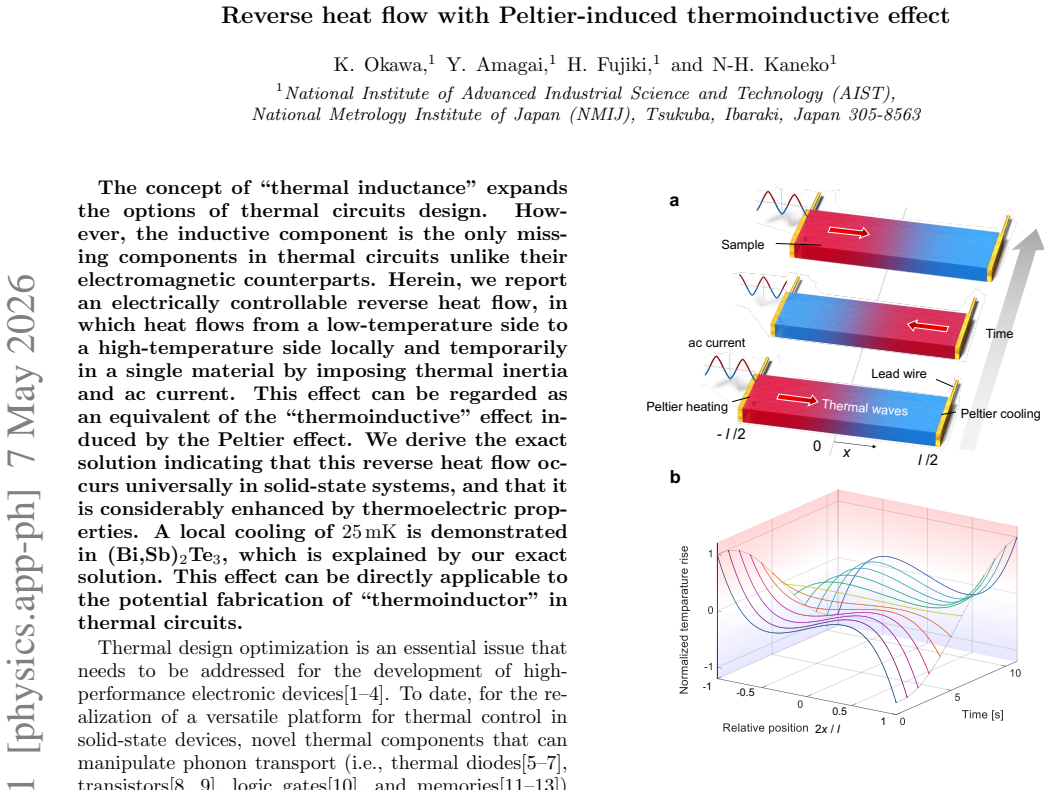
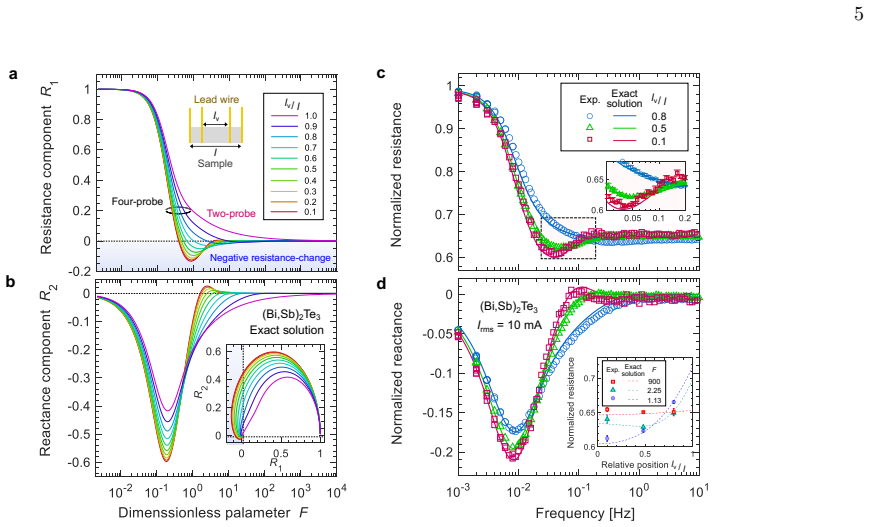
We derive an exact solution indicating that reverse heat flow occurs universally in solid-state systems and that it is considerably enhanced by thermoelectric properties. A local cooling of 25 mK is demonstrated in (Bi,Sb)2Te3, which is explained by our exact solution. This effect can be regarded as an equivalent of the thermoinductive effect induced by the Peltier effect.
What carries the argument
The exact analytical solution to the one-dimensional heat equation that includes Peltier heating, Joule heating, and thermal inertia under sinusoidal current drive, producing a phase-shifted temperature oscillation that drives transient reverse heat flow.
If this is right
- Thermoinductor components become feasible for inclusion in thermal circuits alongside resistors and capacitors.
- Electrically driven local cooling is achievable in thermoelectric materials without steady-state temperature gradients.
- The magnitude of reverse heat flow scales with the material's thermoelectric figure of merit, favoring high-performance thermoelectrics.
- The effect supplies the missing inductive term in thermal circuit analogies, allowing frequency-dependent thermal responses.
Where Pith is reading between the lines
- Optimized geometries or multilayer stacks could increase the cooling amplitude beyond the demonstrated 25 mK.
- The frequency dependence implied by the exact solution offers a route to selective heat routing in complex thermal networks.
- Non-thermoelectric materials should exhibit a weaker but still present version of the effect, providing a direct test of universality.
- Integration with existing Peltier coolers could yield hybrid devices that combine steady and transient cooling modes.
Load-bearing premise
The model assumes that thermal inertia combined with AC current produces measurable reverse heat flow without significant interference from other heat transfer mechanisms or boundary effects in the experimental setup.
What would settle it
Repeating the AC-current experiment on the same (Bi,Sb)2Te3 sample at the predicted frequency and amplitude but recording only heating or no temperature drop at the expected location would falsify the reverse-flow prediction.
Figures



read the original abstract
The concept of "thermal inductance" expands the options of thermal circuit design. However, the inductive component is the only missing components in thermal circuits, unlike their electromagnetic counterparts. Herein, we report an electrically controllable reverse heat flow, in which heat flows from a low-temperature side to a high-temperature side locally and temporarily in a single material by imposing thermal inertia and an ac current. This effect can be regarded as an equivalent of the "thermoinductive" effect induced by the Peltier effect. We derive an exact solution indicating that this reverse heat flow occurs universally in solid-state systems and that it is considerably enhanced by thermoelectric properties. A local cooling of 25 mK is demonstrated in (Bi,Sb)2Te3, which is explained by our exact solution. This effect can be directly applied to the potential fabrication of a "thermoinductor" in thermal circuits.
Editorial analysis
A structured set of objections, weighed in public.
Referee Report
Summary. The paper derives an exact analytical solution to the 1-D heat equation incorporating thermal inertia and the Peltier term under AC current, predicting a universal reverse (local, temporary) heat flow from cold to hot regions that is enhanced by thermoelectric properties. It reports an experimental demonstration of 25 mK local cooling in a (Bi,Sb)2Te3 sample under AC drive, attributes this to the new 'thermoinductive' effect, and proposes applications as a thermoinductor component in thermal circuits.
Significance. If the derivation is free of hidden assumptions and the observed cooling can be unambiguously isolated from conventional AC thermoelectric and boundary effects, the result would introduce a new controllable thermal element analogous to electrical inductance. This could enable novel thermal-circuit designs and local solid-state cooling strategies, with the claimed universality and exact solvability representing notable strengths for applied physics.
major comments (3)
- [§3] §3 (heat-equation derivation): The exact solution is obtained under the assumption of a strictly 1-D continuum with uniform properties, no lateral losses, and idealized boundary conditions; the manuscript does not quantify how finite sample width, contact thermal resistance, or radiative/convective terms (comparable in magnitude at the reported ~25 mK scale) would perturb the predicted phase and amplitude of the reverse flow.
- [Experimental section] Experimental section (temperature measurements): The 25 mK local cooling is presented as direct evidence for the thermoinductive effect, yet no phase-resolved data, frequency-dependent controls, or electrode-only reference measurements are shown to exclude confounding contributions from frequency-dependent Joule heating, Seebeck voltage feedback at contacts, or finite thermal diffusion times across the sample.
- [Comparison of theory and experiment] Comparison of theory and experiment: The claimed quantitative match between the exact solution and the observed cooling lacks reported uncertainty propagation, sensitivity to input parameters (e.g., thermal diffusivity, Seebeck coefficient), or goodness-of-fit metrics; without these, it is unclear whether the agreement is robust or could be reproduced by conventional thermoelectric models under AC drive.
minor comments (3)
- [Introduction] The term 'thermoinductive effect' is introduced without an explicit definition or comparison to prior literature on thermal inductance; a brief clarifying paragraph in the introduction would improve accessibility.
- [Figures] Figure 2 (or equivalent experimental figure) would benefit from an inset showing the raw AC current waveform and the precise location of the temperature sensor relative to the Peltier junctions.
- [Notation] A few typographical inconsistencies appear in the notation for thermal inertia and Peltier coefficients between the derivation and the experimental parameter table.
Simulated Author's Rebuttal
We thank the referee for the thorough and constructive review of our manuscript. We address each major comment point by point below, indicating where revisions will be made to improve clarity and rigor while maintaining the core claims of the exact solution and experimental demonstration.
read point-by-point responses
-
Referee: [§3] §3 (heat-equation derivation): The exact solution is obtained under the assumption of a strictly 1-D continuum with uniform properties, no lateral losses, and idealized boundary conditions; the manuscript does not quantify how finite sample width, contact thermal resistance, or radiative/convective terms (comparable in magnitude at the reported ~25 mK scale) would perturb the predicted phase and amplitude of the reverse flow.
Authors: The exact analytical solution in §3 is derived under standard 1-D continuum assumptions to demonstrate the universal occurrence of the reverse heat flow. We agree that practical perturbations from finite width, contacts, and environmental losses should be quantified. In the revised manuscript, we will add a dedicated paragraph with order-of-magnitude estimates showing that, at the ~25 mK scale, these effects modify amplitude but preserve the characteristic phase lag of the thermoinductive contribution. This will clarify the model's applicability without altering the exact solution itself. revision: yes
-
Referee: [Experimental section] Experimental section (temperature measurements): The 25 mK local cooling is presented as direct evidence for the thermoinductive effect, yet no phase-resolved data, frequency-dependent controls, or electrode-only reference measurements are shown to exclude confounding contributions from frequency-dependent Joule heating, Seebeck voltage feedback at contacts, or finite thermal diffusion times across the sample.
Authors: The experimental demonstration relies on the observed local cooling under AC drive and its consistency with the derived solution. Our existing dataset does not contain phase-resolved traces or separate electrode-only reference measurements. We will expand the experimental discussion to explain how the frequency dependence and thermoelectric enhancement in the data help differentiate the effect from conventional Joule and Seebeck contributions, but we cannot add new experimental controls without additional measurements outside the current revision scope. revision: partial
-
Referee: [Comparison of theory and experiment] Comparison of theory and experiment: The claimed quantitative match between the exact solution and the observed cooling lacks reported uncertainty propagation, sensitivity to input parameters (e.g., thermal diffusivity, Seebeck coefficient), or goodness-of-fit metrics; without these, it is unclear whether the agreement is robust or could be reproduced by conventional thermoelectric models under AC drive.
Authors: We will revise the theory-experiment comparison section to include propagated uncertainties on key parameters (thermal diffusivity, Seebeck coefficient, and thermal conductivity), a sensitivity analysis, and quantitative goodness-of-fit metrics. We will also explicitly show that conventional AC thermoelectric models (without the inertia-Peltier coupling term) fail to reproduce the observed local cooling amplitude and phase, thereby confirming the necessity of the thermoinductive contribution. revision: yes
- We do not have phase-resolved data or electrode-only reference measurements in the current experimental dataset and cannot provide them without performing new experiments.
Circularity Check
Derivation from heat equation is self-contained with no circular reductions
full rationale
The paper derives an exact solution to the heat equation that includes the Peltier term and thermal inertia, from which it concludes that reverse heat flow occurs universally in solid-state systems and is enhanced by thermoelectric properties. This is a standard forward solution of a differential equation rather than any reduction of a prediction to fitted inputs by construction, self-definitional renaming, or load-bearing self-citation. The 25 mK experimental demonstration in (Bi,Sb)2Te3 is presented separately as confirmation explained by the derived solution, with no evidence that the central result collapses to its own inputs or prior author work. The derivation chain is independent.
Axiom & Free-Parameter Ledger
axioms (1)
- domain assumption Standard thermoelectric transport equations and heat diffusion with inertia apply to the system.
invented entities (1)
-
thermoinductive effect
no independent evidence
Reference graph
Works this paper leans on
-
[1]
V., Joshi, Y
Garimella, S. V., Joshi, Y. K., Bar-Cohen, A., Mahajan, R., Toh, K. C., Carey, V. P., Baelmans, M., Lohan, J., Sammakia, B., Andros, F., Thermal challenges in next generation electronic systems. IEEE Trans. Components Packag. Technol.31, 801 (2008)
2008
-
[2]
& Blaabjerg, F
Ma, K., He, N., Liserre, M. & Blaabjerg, F. Frequency- Domain Thermal Modeling and Characterization of Power Semiconductor Devices. IEEE Trans. Power Elec- tron.31, 7183 (2016)
2016
-
[3]
E., Salman, B
Ahmed, H. E., Salman, B. H., Kherbeet, A. Sh. & Ahmed, M. I. Optimization of thermal design of heat sinks: A review. Int. J. Heat Mass Tranf.118, 129 (2018)
2018
-
[4]
Thermal Modeling and Design Optimization of PCB Vias and Pads
Shen, Y., Wang, H., Blaabjerg, F., Zhao, H., & Long, T. Thermal Modeling and Design Optimization of PCB Vias and Pads. IEEE Trans. Power Electron.35, 882 (2020)
2020
-
[5]
Thermal diode: Rectifi- cation of heat flux
Li, B., Wang, L., & Casati, G. Thermal diode: Rectifi- cation of heat flux. Phys. Rev. Lett.93, 184301 (2004)
2004
-
[6]
Ben-Abdallah, P., & Biehs, S. A. Phase-change radiative thermal diode. Appl. Phys. Lett.103, 191907 (2013)
2013
-
[7]
J., Fornieri, A., & Giazotto, F
Mart´ ınez-P´ erez, M. J., Fornieri, A., & Giazotto, F. Rec- tification of electronic heat current by a hybrid thermal diode. Nat. Nanotechnol.10, 303 (2015)
2015
-
[8]
Negative differential ther- mal resistance and thermal transistor
Li, B., Wang, L., & Casati, G. Negative differential ther- mal resistance and thermal transistor. Appl. Phys. Lett. 88, 143501 (2006)
2006
-
[9]
J., Sun, J
Sood, A., Xiong, F., Chen, S., Wang, H., Selli, D., Zhang, J., McClellan, C. J., Sun, J. Donadio, D., Cui, Y., Pop,E., & Goodson, K. E. An electrochemical thermal transistor. 8 Nat. Commun.9, 4510 (2018)
2018
-
[10]
Thermal Logic Gates: Computation with phonons
Wang, L., & Li, B. Thermal Logic Gates: Computation with phonons. Phys. Rev. Lett.99, 177208 (2007)
2007
-
[11]
Thermal memory: A storage of phononic information
Wang, L., & Li, B. Thermal memory: A storage of phononic information. Phys. Rev. Lett.101, 267203 (2008)
2008
-
[12]
Radia- tive bistability and thermal memory
Kubytskyi, V., Biehs, S.-A., & Ben-Abdallah, P. Radia- tive bistability and thermal memory. Phys. Rev. Lett. 113, 074301 (2014)
2014
-
[13]
D., & Giazotto, F
Guarcello, C., Solinas, P., Braggio, A., Ventra, M. D., & Giazotto, F. Josephson thermal memory. Phys. Rev. Applied9, 014021 (2018)
2018
-
[14]
Colloquium: Phononics: Manipulating heat flow with electronic analogs and beyond
Li, N., Re, J., Wang, L., Zhang, G., Hanggi, P., & Li, B. Colloquium: Phononics: Manipulating heat flow with electronic analogs and beyond. Rev. Mod. Phys.84, 1045 (2012)
2012
-
[15]
Thermal diodes, regulators, and switches: Physical mechanisms and potential applications
Wehmeyer, G., Yabuki, T., Monachon, C., Wu, J., & Dames, C. Thermal diodes, regulators, and switches: Physical mechanisms and potential applications. Appl. Phys. Rev.4, 041304 (2017)
2017
-
[16]
Ye, H., Leung, S. Y. Y., Wong, C. K. Y., Lin, K., Chen, X., Fan, J., Kjelstrup, S., Fan, X., & Zhang, G. Thermal inductance in GaN devices. IEEE Electron Device Lett. 37, 1473 (2016)
2016
-
[17]
Bosworth, R. C. L. The thermal Ohm, Farad and Henry. Philos. Mag.37, 803 (1946)
1946
-
[18]
Weedy, B. M. The analogy between thermal and electrical quantities. Elector. Pow. Syst. Res.15, 197 (1988)
1988
-
[19]
Lienhard, J. H. V, & Lienhard, J. H. IV, A Heat Transfer Textbook: Fifth Edition (Dover Books on Engineering), (2019)
2019
-
[20]
J., & Allen, J
Piggott, A. J., & Allen, J. S. Peltier Supercooling with Isosceles Current Pulses: A Response Surface Perspec- tive. ECS J. Solid State Sci. Technol.,6, N3045 (2017)
2017
-
[21]
& Schilling, A
Bossen, O. & Schilling, A. LC-circuit calorimetry. Rev. Sci. Instrum.82, 094901 (2011)
2011
-
[22]
Bosworth, R. C. L. Thermal inductance. Nature158, 309 (1946)
1946
-
[23]
Bosworth, R. C. L. Thermal mutual inductance. Nature 161, 166 (1948)
1948
-
[24]
thermal inductor
Schilling, A., Zhang, X. & Bossen, O. Heat flowing from cold to hot without external intervention by using a “thermal inductor”. Sci. Adv.5, eaat9553 (2019)
2019
-
[25]
Thermoelectric property mea- surement by the improved Harman method
Iwasaki, H., & Hori, H. Thermoelectric property mea- surement by the improved Harman method. in Interna- tional Conference on Thermoelectrics, ICT Proceedings, pp.501 (2005)
2005
-
[26]
D., Hogan, T
Downey, A. D., Hogan, T. P., & Cook, B., Characteriza- tion of thermoelectric elements and devices by impedance spectroscopy. Rev. Sci. Instrum.78, 093904 (2007)
2007
-
[27]
Garcia-Canadas, J., & Min, G., Low Frequency Impedance Spectroscopy Analysis of Thermoelectric Modules. J. Electron. Mater.43, 2411 (2014)
2014
-
[28]
V., & Garc´ ıa-Ca˜ nadas, J
Beltr´ an-Pitarch, B., Prado-Gonjal, J., Powel, A. V., & Garc´ ıa-Ca˜ nadas, J. Experimental conditions required for accurate measurements of electrical resistivity, thermal conductivity, and dimensionless figure of merit (ZT) us- ing Harman and impedance spectroscopy methods. J. Appl. Phys.125, 025111 (2019)
2019
-
[29]
Di- mensionless figure of merit of constantan estimated us- ing impedance spectroscopy
Shinozaki, R., Hirabayashi, S., & Hasegawa, Y. Di- mensionless figure of merit of constantan estimated us- ing impedance spectroscopy. Appl. Phys. Express.13, 106501 (2020)
2020
-
[30]
High-accuracy compensation of radiative heat loss in Thomson coefficient measurement
Amagai, Y., Shimazaki, T., Okawa, K., Kawae, T., Fu- jiki, H., & Kaneko, N.-H. High-accuracy compensation of radiative heat loss in Thomson coefficient measurement. Appl. Phys. Lett.117, 063903 (2020)
2020
-
[31]
Kirby, C. G. M., & Laubitz, M. J. The error due to the Peltier effect in direct-current measurements of re- sistance. Metrologia9, 103 (1973). AcknowledgementsThis work was supported by a Grant-in-Aid for Research Activity Start-up (Grant No.17H07399) from Japan Society for Promotion of Sci- ence (JSPS). Author ContributionsK.O. carried out main experi- m...
1973
discussion (0)
Sign in with ORCID, Apple, or X to comment. Anyone can read and Pith papers without signing in.