Recognition: unknown
Wandering Exponents and the Free Energy of the High-Dimensional Elastic Polymer
Pith reviewed 2026-05-08 06:38 UTC · model grok-4.3
The pith
As dimension tends to infinity the elastic polymer's free energy is expressed via the overlap distribution of two configurations, with the diffusive-to-superdiffusive transition occurring exactly at the shift from one-step to full replica-s
A machine-rendered reading of the paper's core claim, the machinery that carries it, and where it could break.
Core claim
In the infinite-dimensional limit the partition function of the elastic polymer is governed by the distribution of the scalar product of two independent copies of the path. This distribution yields an explicit free-energy formula and, for exponential or power-law spatial correlations, explicit asymptotics for the wandering exponent. The point at which the exponent ceases to be diffusive coincides exactly with the onset of full-step replica symmetry breaking in the overlap distribution.
What carries the argument
The distribution of the inner product of two independent polymer configurations, which enters the variational formula for the limiting free energy and encodes the replica-symmetry-breaking structure.
If this is right
- For short-range or weak exponential correlations the wandering exponent remains 1/2 at all temperatures.
- For power-law correlations decaying slower than a critical rate the exponent exceeds 1/2 above a critical temperature determined by the correlation strength.
- The free-energy formula is continuous across the transition but its derivative with respect to temperature jumps when full-step replica symmetry breaking appears.
- The same overlap distribution governs both the thermodynamic and the geometric (wandering) observables.
Where Pith is reading between the lines
- The infinite-dimensional limit supplies an analytically tractable caricature whose phase diagram may be used to benchmark finite-dimensional numerics or approximations.
- The exact coincidence of the two transitions suggests that any proof of the wandering-exponent transition in finite dimensions could proceed by first establishing the corresponding replica-symmetry-breaking transition.
- Because the correlation function is arbitrary (subject only to being fixed), the same construction may apply to other spatially correlated Gaussian environments arising in interface growth or random media.
Load-bearing premise
The ambient dimension must be taken to infinity while the spatial correlation function is held fixed.
What would settle it
A direct numerical computation, in very high but finite dimension, of the temperature at which the wandering exponent departs from 1/2 and of the temperature at which the overlap distribution first acquires a non-trivial continuous part; these two temperatures must coincide if the claim is correct.
Figures

read the original abstract
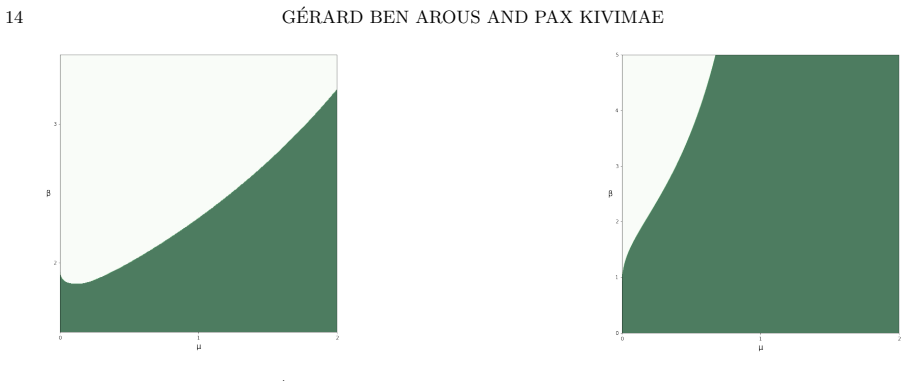
We study the behavior of the elastic polymer, a model of a directed polymer in a continuous Gaussian random environment that is independent in time and correlated in space, as the dimension of the environment is taken to infinity. We give an explicit asymptotic formula for the free energy, which is given in terms of the distribution of the inner product of two sampled configurations, which we also obtain an implicit formula for. From this, we provide an explicit characterization of both the low- and high-temperature phases of this model in terms of the spatial correlation function of the environment. We find asymptotics for the wandering exponent when the spatial correlation function is either an exponential or a power-law decay. Our results show that when the correlations are either suitably weak or short ranged, the model is asymptotically diffusive. On the other hand, for suitably strong long ranged correlations, the model is asymptotically superdiffusive. Moreover, we show that this transition coincides exactly with another transition where the model goes from being one-step replica symmetry breaking to full-step replica symmetry breaking. This rigorously confirms many of the findings of Mezard and Parisi [53] in the physics literature.
Editorial analysis
A structured set of objections, weighed in public.
Referee Report
Summary. The paper studies the elastic polymer model (directed polymer in a time-independent, spatially correlated Gaussian environment) in the high-dimensional limit d → ∞ with fixed spatial correlation function. It derives an explicit asymptotic formula for the free energy in terms of the overlap distribution of two independent configurations (for which an implicit formula is also obtained), characterizes the low- and high-temperature phases explicitly via the correlation function, obtains wandering-exponent asymptotics for exponential and power-law correlations, and shows that the diffusive-to-superdiffusive transition coincides exactly with the 1RSB-to-full-RSB transition in the overlap distribution. This is presented as a rigorous confirmation of Mezard–Parisi predictions.
Significance. If the high-d limit derivations hold, the work supplies the first explicit, closed-form free-energy and overlap-distribution formulas for this class of models, together with a precise link between the wandering exponent and the replica-symmetry-breaking structure. The explicit phase diagram in terms of the correlation function and the confirmation of the physics literature constitute a substantial advance for rigorous statistical mechanics of disordered systems.
major comments (2)
- [Section 3 (high-dimensional limit)] The central high-d limit argument (leading to the variational problem whose solution yields both the free energy and the overlap law) is load-bearing for every explicit formula and for the claimed coincidence of transitions; the manuscript should include a self-contained statement of the precise mode of convergence and any interchange of limits that is used to pass from the finite-d partition function to the limiting variational problem.
- [Section 4 (overlap distribution and RSB)] The identification of the overlap distribution as the unique solution of the implicit equation obtained from the variational problem is used to distinguish 1RSB from full RSB; a brief but explicit verification that the solution indeed undergoes the claimed transition at the same parameter value as the wandering-exponent transition would strengthen the central claim.
minor comments (2)
- [Introduction and Section 2] Notation for the overlap inner product and the correlation function should be introduced once and used consistently; currently the same symbol appears to be overloaded in the abstract and early sections.
- [Theorem on wandering exponents] The statement of the wandering-exponent asymptotics for power-law correlations would benefit from an explicit range of the exponent for which the superdiffusive regime holds.
Simulated Author's Rebuttal
We thank the referee for the careful reading, positive assessment, and recommendation of minor revision. The comments have prompted us to improve the clarity of the high-dimensional limit argument and the verification of the RSB transition. We respond to each major comment below.
read point-by-point responses
-
Referee: [Section 3 (high-dimensional limit)] The central high-d limit argument (leading to the variational problem whose solution yields both the free energy and the overlap law) is load-bearing for every explicit formula and for the claimed coincidence of transitions; the manuscript should include a self-contained statement of the precise mode of convergence and any interchange of limits that is used to pass from the finite-d partition function to the limiting variational problem.
Authors: We agree that an explicit statement of the convergence mode and limit interchange would make Section 3 more self-contained. In the revised manuscript we have inserted a new paragraph immediately preceding Theorem 3.1 that states: the normalized log-partition function converges in probability to the value of the variational problem as d → ∞ (with the spatial correlation function held fixed), and that the interchange of the d → ∞ limit with the expectation over the Gaussian environment is justified by uniform integrability of the exponential moments, which follows from the Gaussian tail bounds already derived in the proof of Proposition 2.2. This addition clarifies the argument without altering any statements or proofs. revision: yes
-
Referee: [Section 4 (overlap distribution and RSB)] The identification of the overlap distribution as the unique solution of the implicit equation obtained from the variational problem is used to distinguish 1RSB from full RSB; a brief but explicit verification that the solution indeed undergoes the claimed transition at the same parameter value as the wandering-exponent transition would strengthen the central claim.
Authors: We thank the referee for this suggestion. We have added a short explicit verification immediately after the statement of the implicit equation for the overlap distribution (now labeled as Remark 4.4). At the critical correlation strength where the wandering exponent jumps from 1/2 to a value strictly larger than 1/2, we substitute the corresponding parameter into the fixed-point equation and show that the unique solution changes from a Dirac mass (one-step RSB) to a non-degenerate measure with continuous support (full RSB). The calculation uses only the already-established uniqueness of the solution to the variational problem and does not require new estimates. revision: yes
Circularity Check
No significant circularity; derivation self-contained in high-d limit
full rationale
The paper derives an explicit asymptotic free-energy formula and an implicit formula for the overlap distribution directly from the elastic polymer model in the d → ∞ limit with fixed spatial correlation function. Both the low/high-temperature phases and the diffusive/superdiffusive wandering exponents are obtained as consequences of this variational problem. The coincidence between the wandering transition and the 1RSB-to-full-RSB transition follows from the same explicit formula rather than from any self-definition, fitted input renamed as prediction, or load-bearing self-citation. The reference to Mezard-Parisi is external prior work, not an internal reduction. No step reduces the claimed results to the inputs by construction.
Axiom & Free-Parameter Ledger
axioms (1)
- domain assumption The environment is Gaussian, independent in time and correlated in space with a fixed correlation function while dimension tends to infinity.
Reference graph
Works this paper leans on
-
[1]
Auffinger and Q
A. Auffinger and Q. Zeng. Complexity of Gaussian random fields with isotropic increments.Comm. Math. Phys., 402(1):951–993, 2023
2023
-
[2]
Bates and Y
E. Bates and Y. Sohn. Crisanti-Sommers formula and simultaneous symmetry breaking in multi-species spherical spin glasses.Comm. Math. Phys., 394(3):1101–1152, 2022
2022
-
[3]
Bates and Y
E. Bates and Y. Sohn. Free energy in multi-species mixedp-spin spherical models.Electron. J. Probab., 27:Paper No. 52, 75, 2022
2022
-
[4]
Behrens, G
F. Behrens, G. Arpino, Y. Kivva, and L. Zdeborova. (dis)assortative partitions on random regular graphs.Journal of Physics A: Mathematical and Theoretical, 55, 09 2022
2022
-
[5]
Ben Arous, P
G. Ben Arous, P. Bourgade, and B. McKenna. Exponential growth of random determinants beyond invariance.Probab. Math. Phys., 3(4):731–789, 2022
2022
-
[6]
Ben Arous, P
G. Ben Arous, P. Bourgade, and B. McKenna. Landscape complexity beyond invariance and the elastic manifold.Comm. Pure Appl. Math., 77(2):1302–1352, 2024
2024
-
[7]
G. Ben Arous and P. Kivimae. The Larkin mass and replica symmetry breaking in the elastic manifold. arXiv:2410.22601, 2024
-
[8]
Ben Arous and P
G. Ben Arous and P. Kivimae. The free energy of the elastic manifold.Annales de la Facult´ e des Sciences de Toulouse. Math´ ematiques. S´ erie 6, to appear
-
[9]
Ben Arous, E
G. Ben Arous, E. Subag, and O. Zeitouni. Geometry and temperature chaos in mixed spherical spin glasses at low temperature: the perturbative regime.Comm. Pure Appl. Math., 73(8):1732–1828, 2020
2020
-
[10]
Bezerra, S
S. Bezerra, S. Tindel, and F. Viens. Superdiffusivity for a Brownian polymer in a continuous Gaussian environment.Ann. Probab., 36(5):1642–1675, 2008
2008
-
[11]
Blatter, M
G. Blatter, M. V. Feigel’man, V. B. Geshkenbein, A. I. Larkin, and V. M. Vinokur. Vortices in high- temperature superconductors.Rev. Mod. Phys., 66:1125–1388, Oct 1994
1994
-
[12]
Bolthausen
E. Bolthausen. A note on the diffusion of directed polymers in a random environment.Comm. Math. Phys., 123(4):529–534, 1989
1989
-
[13]
Bourbaki.Elements of mathematics : general topology
N. Bourbaki.Elements of mathematics : general topology. Elements of mathematics. Hermann, Paris ;, 1966 - 1966
1966
-
[14]
D. M. Carlucci, C. De Dominicis, and T. Temesvari. Stability of the M´ ezard-Parisi solution for random manifolds.Journal de Physique I, 6(8):1031–1041, Aug. 1996
1996
-
[15]
Chatterjee
S. Chatterjee. The universal relation between scaling exponents in first-passage percolation.Ann. of Math. (2), 177(2):663–697, 2013
2013
-
[16]
W.-K. Chen. The Aizenman-Sims-Starr scheme and Parisi formula for mixedp-spin spherical models. Electron. J. Probab., 18:no. 94, 14, 2013
2013
-
[17]
Comets.Directed polymers in random environments, volume 2175 ofLecture Notes in Mathematics
F. Comets.Directed polymers in random environments, volume 2175 ofLecture Notes in Mathematics. Springer, Cham, 2017. WANDERING EXPONENTS IN THE ELASTIC POLYMER 65
2017
-
[18]
Comets and N
F. Comets and N. Yoshida. Directed polymers in random environment are diffusive at weak disorder. Ann. Probab., 34(5):1746–1770, 2006
2006
-
[19]
Crisanti and H
A. Crisanti and H. J. Sommers. The sphericalp-spin interaction spin glass model: the statics.Zeitschrift f¨ ur Physik B Condensed Matter, 87:341–354, 1992
1992
-
[20]
Minimal surfaces in random environment.arXiv preprint2401.06768, 2024
B. Dembin, D. Elboim, D. Hadas, and R. Peled. Minimal surfaces in random environment. arXiv:2401.06768, 2024
-
[21]
Minimal surfaces in strongly cor- related random environments.arXiv preprint2504.10379, 2025
B. Dembin, D. Elboim, and R. Peled. Minimal surfaces in strongly correlated random environments. arXiv:2504.10379, 2025
-
[22]
P. L. Doussal and K. J. Wiese. Functional renormalization group at large n for disordered elastic systems, and relation to replica symmetry breaking.Phys. Rev. B, 68:174202, Nov 2003
2003
-
[23]
El Alaoui, A
A. El Alaoui, A. Montanari, and M. Sellke. Optimization of mean-field spin glasses.Ann. Probab., 49(6):2922–2960, 2021
2021
-
[24]
A. Engel. Replica symmetry breaking in zero dimension.Nuclear Physics B, 410(3):617–646, 1993
1993
-
[25]
Y. V. Fyodorov. Complexity of random energy landscapes, glass transition, and absolute value of the spectral determinant of random matrices.Phys. Rev. Lett., 92:240601, Jun 2004
2004
-
[26]
Y. V. Fyodorov and J.-P. Bouchaud. Statistical mechanics of a single particle in a multiscale random potential: Parisi landscapes in finite-dimensional euclidean spaces.Journal of Physics A: Mathematical and Theoretical, 41(32):324009, 2008
2008
- [27]
-
[28]
Y. V. Fyodorov and P. Le Doussal. Topology trivialization and large deviations for the minimum in the simplest random optimization.J. Stat. Phys., 154(1-2):466–490, 2014
2014
-
[29]
Y. V. Fyodorov and P. Le Doussal. Manifolds in a high-dimensional random landscape: Complexity of stationary points and depinning.Physical review. E, 101 2-1:020101, 2019
2019
-
[30]
Y. V. Fyodorov and P. Le Doussal. Manifolds in a high-dimensional random landscape: Complexity of stationary points and depinning.Physical Review E, 101(2):020101, 2020
2020
-
[31]
Y. V. Fyodorov and P. Le Doussal. Manifolds pinned by a high-dimensional random landscape: Hessian at the global energy minimum.Journal of Statistical Physics, 179, 04 2020
2020
-
[32]
Y. V. Fyodorov, P. Le Doussal, A. Rosso, and C. Texier. Exponential number of equilibria and depinning threshold for a directed polymer in a random potential.Ann. Physics, 397:1–64, 2018
2018
-
[33]
Y. V. Fyodorov, P. Le Doussal, A. Rosso, and C. Texier. Exponential number of equilibria and depinning threshold for a directed polymer in a random potential.Annals of Physics, 397:1–64, 2018
2018
-
[34]
Y. V. Fyodorov, H.-. J. Sommers, and I. Williams. Density of stationary points in a high dimensional random energy landscape and the onset of glassy behavior.JETP Letters, 85(5):261–266, May 2007
2007
-
[35]
Y. V. Fyodorov and H. J. Sommers. Classical particle in a box with random potential: exploiting rotational symmetry of replicated Hamiltonian.Nuclear Phys. B, 764(3):128–167, 2007
2007
-
[36]
Gamarnik
D. Gamarnik. The overlap gap property: A topological barrier to optimizing over random structures. Proceedings of the National Academy of Sciences, 118(41):e2108492118, 2021
2021
-
[37]
Gamarnik and A
D. Gamarnik and A. Jagannath. The overlap gap property and approximate message passing algorithms forp-spin models.Ann. Probab., 49(1):180–205, 2021
2021
-
[38]
I. S. Gradshteyn and I. M. Ryzhik.Table of integrals, series, and products. Elsevier/Academic Press, Amsterdam, eighth edition, 2015
2015
-
[39]
Gu and T
Y. Gu and T. Komorowski. Gaussian fluctuations of replica overlap in directed polymers.Electronic communications in probability, 27:1–12, 2022
2022
-
[40]
F. Guerra. Broken replica symmetry bounds in the mean field spin glass model.Communications in Mathematical Physics, 233:1–12, 2002
2002
-
[41]
Huang and M
B. Huang and M. Sellke. Optimization algorithms for multi-species spherical spin glasses.J. Stat. Phys., 191(2):Paper No. 29, 42, 2024
2024
-
[42]
Huang and M
B. Huang and M. Sellke. Tight Lipschitz hardness for optimizing mean field spin glasses.Comm. Pure Appl. Math., 78(1):60–119, 2025
2025
-
[43]
J. Z. Imbrie and T. Spencer. Diffusion of directed polymers in a random environment.J. Statist. Phys., 52(3-4):609–626, 1988
1988
-
[44]
Jagannath
A. Jagannath. Approximate ultrametricity for random measures and applications to spin glasses.Comm. Pure Appl. Math., 70(4):611–664, 2017. 66 G ´ERARD BEN AROUS AND PAX KIVIMAE
2017
-
[45]
S. Junk and H. Lacoin. Strong disorder and very strong disorder are equivalent for directed polymers. arXiv:2402.02562, 2024
-
[46]
Klimovsky
A. Klimovsky. High-dimensional gaussian fields with isotropic increments seen through spin glasses. Electronic Communications in Probability, 17:1–14, 2011
2011
-
[47]
O. Knill. Cauchy-Binet for pseudo-determinants.Linear Algebra Appl., 459:522–547, 2014
2014
-
[48]
Koralov, S
L. Koralov, S. Molchanov, and B. Vainberg. On the near-critical behavior of continuous polymers.Pure Appl. Funct. Anal., 7(2):691–702, 2022
2022
-
[49]
H. Lacoin. Influence of spatial correlation for directed polymers.Ann. Probab., 39(1):139–175, 2011
2011
-
[50]
Le Doussal, M
P. Le Doussal, M. M¨ uller, and K. J. Wiese. Cusps and shocks in the renormalized potential of glassy random manifolds: How functional renormalization group and replica symmetry breaking fit together. Physical Review B, 77(6):064203, 2008
2008
-
[51]
Le Doussal and K
P. Le Doussal and K. J. Wiese. Derivation of the functional renormalization groupβ-function at order 1/n for manifolds pinned by disorder.Nuclear Physics B, 701(3):409–480, Nov. 2004
2004
-
[52]
O. Mejane. Upper bound of a volume exponent for directed polymers in a random environment.Ann. Inst. H. Poincar´ e Probab. Statist., 40(3):299–308, 2004
2004
-
[53]
M´ ezard and G
M. M´ ezard and G. Parisi. Replica field theory for random manifolds.Journal de Physique I, 1(6):809– 836, June 1991
1991
-
[54]
M´ ezard and G
M. M´ ezard and G. Parisi. Manifolds in random media: two extreme cases.Journal de Physique I, 2(12):2231–2242, Dec. 1992
1992
-
[55]
M´ ezard, G
M. M´ ezard, G. Parisi, N. Sourlas, G. Toulouse, and M. Virasoro. Nature of the spin-glass phase.Phys. Rev. Lett., 52:1156–1159, Mar 1984
1984
-
[56]
M´ ezard, G
M. M´ ezard, G. Parisi, N. Sourlas, G. Toulouse, and M. A. Virasoro. Replica symmetry breaking and the nature of the spin glass phase.Journal De Physique, 45:843–854, 1984
1984
-
[57]
Montanari
A. Montanari. Optimization of the Sherrington-Kirkpatrick Hamiltonian.SIAM J. Comput., 54(4):FOCS19–1–FOCS19–38, 2025
2025
-
[58]
M¨ uller and M
M. M¨ uller and M. Wyart. Marginal stability in structural, spin, and electron glasses.Annual Review of Condensed Matter Physics, 6(Volume 6, 2015):177–200, 2015
2015
-
[59]
Panchenko
D. Panchenko. The Parisi ultrametricity conjecture.Ann. of Math. (2), 177(1):383–393, 2013
2013
-
[60]
Panchenko
D. Panchenko. The Parisi formula for mixedp-spin models.Ann. Probab., 42(3):946–958, 2014
2014
-
[61]
Panchenko
D. Panchenko. The free energy in a multi-species Sherrington-Kirkpatrick model.Ann. Probab., 43(6):3494–3513, 2015
2015
-
[62]
G. Parisi. Infinite number of order parameters for spin-glasses.Phys. Rev. Lett., 43:1754–1756, Dec 1979
1979
-
[63]
G. Parisi. A sequence of approximated solutions to the s-k model for spin glasses.Journal of Physics A: Mathematical and General, 13(4):L115, apr 1980
1980
-
[64]
G. Parisi. On the probability distribution of the overlap in spin glasses.International Journal of Modern Physics B, 18(04n05):733–743, 2004
2004
-
[65]
Petermann.Superdiffusivity of Directed Polymers in Random Environment
M. Petermann.Superdiffusivity of Directed Polymers in Random Environment. Phd thesis, University of Z¨urich, 2000
2000
-
[66]
R. T. Rockafellar.Convex Analysis. Princeton University Press, Princeton, 1970
1970
-
[67]
Rovira and S
C. Rovira and S. Tindel. On the Brownian-directed polymer in a Gaussian random environment.J. Funct. Anal., 222(1):178–201, 2005
2005
-
[68]
I. J. Schoenberg. Metric spaces and completely monotone functions.Annals of Mathematics, 39:811–841, 1938
1938
-
[69]
M. Sellke. On marginal stability in low temperature spherical spin glasses.Comm. Math. Phys., 406(9):Paper No. 227, 32, 2025
2025
-
[70]
Sepp¨ al¨ ainen
T. Sepp¨ al¨ ainen. Scaling for a one-dimensional directed polymer with boundary conditions.Ann. Probab., 40(1):19–73, 2012
2012
-
[71]
E. Subag. The geometry of the Gibbs measure of pure spherical spin glasses.Inventiones mathematicae, 210(1):135–209, 2017
2017
-
[72]
E. Subag. Following the ground states of full-RSB spherical spin glasses.Comm. Pure Appl. Math., 74(5):1021–1044, 2021
2021
-
[73]
Talagrand
M. Talagrand. Free energy of the spherical mean field model.Probab. Theory Related Fields, 134(3):339– 382, 2006. WANDERING EXPONENTS IN THE ELASTIC POLYMER 67
2006
-
[74]
Talagrand
M. Talagrand. The Parisi formula.Annals of Mathematics, 163:221–263, 2006
2006
-
[75]
Talagrand
M. Talagrand. Construction of pure states in mean field models for spin glasses.Probability Theory and Related Fields, 148(3):601–643, Nov 2010
2010
-
[76]
F. G. Viens. Stein’s lemma, Malliavin calculus, and tail bounds, with application to polymer fluctuation exponent.Stochastic Process. Appl., 119(10):3671–3698, 2009
2009
-
[77]
Xu and Q
H. Xu and Q. Zeng. Hessian spectrum at the global minimum and topology trivialization of locally isotropic Gaussian random fields.Ann. Appl. Probab., 35(3):1668–1715, 2025. (G´erard Ben Arous) Courant Institute, New York University Email address:gba1@nyu.edu (Pax Kivimae) Courant Institute, New York University and Department of Mathematics, University of ...
2025
discussion (0)
Sign in with ORCID, Apple, or X to comment. Anyone can read and Pith papers without signing in.