Recognition: unknown
AffectSeek: Agentic Affective Understanding in Long Videos under Vague User Queries
Pith reviewed 2026-05-08 14:54 UTC · model grok-4.3
The pith
AffectSeek uses five staged steps to locate and explain emotions in long videos from vague user queries.
A machine-rendered reading of the paper's core claim, the machinery that carries it, and where it could break.
Core claim
The paper claims that vague-query-driven video affective understanding remains unsolved by existing affective recognition models and single-step vision-language models, and that AffectSeek solves it by decomposing the task into intent interpretation, candidate localization, clip verification, emotion reasoning, and rationale generation, then progressively aligning vague user intent with long-video evidence through role-specialized reasoning and cross-stage verification.
What carries the argument
The five-stage decomposition of intent interpretation, candidate localization, clip verification, emotion reasoning, and rationale generation, together with role-specialized reasoning and cross-stage verification.
If this is right
- VQAU-Bench enables systematic measurement of semantic-temporal-affective alignment, moment localization, emotion classification, and rationale generation.
- Existing affective recognition models and single-step vision-language models perform poorly on the VQAU task.
- AffectSeek supplies a simple, effective framework that improves agentic handling of long-video affective queries.
Where Pith is reading between the lines
- The staged verification approach could apply to other video tasks that start from vague instructions, such as action or event localization.
- Breaking queries into verifiable stages may lower error accumulation in any multi-step video reasoning pipeline.
- Interactive video systems could adopt similar decomposition to support real-time user clarifications during affective searches.
Load-bearing premise
The five-stage process with role-specialized reasoning and cross-stage verification will reliably align vague user intent to long-video affective evidence without introducing compounding errors.
What would settle it
If AffectSeek applied to VQAU-Bench produces no measurable gains in affective moment localization accuracy, emotion classification precision, or rationale quality over single-step vision-language models.
Figures






read the original abstract
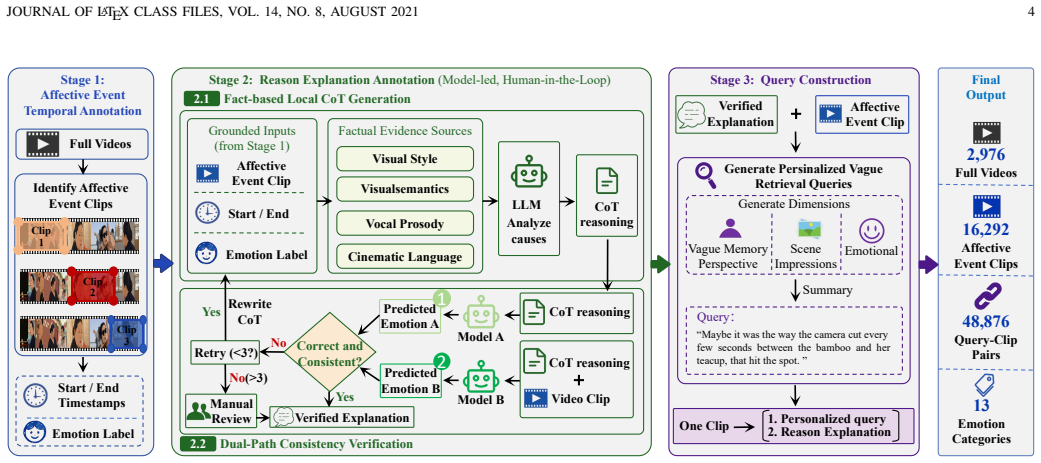
Existing affective understanding studies have mainly focused on recognizing emotions from images, audio signals, or pre-cliped video clips, where the affective evidence is already given. This passive and clip-centered setting does not fully reflect real-world scenarios, in which users often interact with long videos and express their needs through natural-language queries. In this paper, we study \textbf{Vague-Query-driven video Affective Understanding (VQAU)}, a new task that requires models to localize affective moments in long videos, predict their emotion categories, and generate evidence-grounded rationales under vague user queries. To support this task, we construct \textbf{VQAU-Bench}, a benchmark that integrates long videos, vague affective queries, temporal clip annotations, emotion labels, and rationale explanations into a unified evaluation framework. VQAU-Bench enables systematic assessment of semantic-temporal-affective alignment, affective moment localization, emotion classification, and rationale generation. To address the multi-step reasoning challenges of VQAU, we further propose \textbf{AffectSeek}, an agentic framework that actively seeks, verifies, and explains affective moments in long videos. AffectSeek decomposes VQAU into intent interpretation, candidate localization, clip verification, emotion reasoning, and rationale generation, and progressively aligns vague user intent with long-video evidence through role-specialized reasoning and cross-stage verification. Experiments show that VQAU remains challenging for existing affective recognition models and single-step vision-language models, while AffectSeek provides a simple yet effective framework for agentic long-video affective understanding.
Editorial analysis
A structured set of objections, weighed in public.
Referee Report
Summary. The paper introduces Vague-Query-driven video Affective Understanding (VQAU) as a new task requiring localization of affective moments in long videos, emotion category prediction, and evidence-grounded rationale generation from vague natural-language queries. It constructs VQAU-Bench, a unified benchmark combining long videos, vague affective queries, temporal clip annotations, emotion labels, and rationale explanations to evaluate semantic-temporal-affective alignment. The proposed AffectSeek framework decomposes the task into five stages—intent interpretation, candidate localization, clip verification, emotion reasoning, and rationale generation—employing role-specialized agents and cross-stage verification to progressively align vague user intent with long-video evidence. Experiments indicate that existing affective recognition models and single-step vision-language models struggle on VQAU, while AffectSeek offers an effective agentic solution.
Significance. If the experimental results and ablations hold, this work meaningfully extends affective understanding beyond passive, pre-clipped settings to realistic interactive long-video scenarios with vague queries. The VQAU-Bench benchmark enables systematic, multi-dimensional evaluation that was previously unavailable, and the five-stage agentic decomposition with verification provides a concrete, reproducible template for handling multi-step reasoning in video-language tasks. These contributions could influence agentic frameworks in computer vision and multimodal AI.
minor comments (3)
- [Abstract] Abstract: the statement that 'AffectSeek provides a simple yet effective framework' would benefit from a brief quantitative highlight (e.g., improvement margins on key metrics) to substantiate the effectiveness claim without requiring the reader to reach the experiments section.
- The operational definition of 'vague' queries and the criteria used to generate or select them in VQAU-Bench should be stated more explicitly (e.g., ambiguity level, lexical features, or annotation protocol) to support reproducibility and future extensions.
- Ensure all stage-specific prompts or role instructions for the specialized agents are either included in the main text or clearly referenced to an appendix so that the cross-stage verification mechanism can be exactly replicated.
Simulated Author's Rebuttal
We thank the referee for the positive and constructive review. We are pleased that the referee recognizes the novelty of the VQAU task, the utility of VQAU-Bench, and the practical value of the five-stage agentic decomposition in AffectSeek for handling vague queries in long videos.
Circularity Check
No significant circularity; empirical agentic pipeline with no derivations
full rationale
The paper defines a new task (VQAU) and proposes AffectSeek as a five-stage agentic framework (intent interpretation, candidate localization, clip verification, emotion reasoning, rationale generation) with role-specialized agents and cross-stage verification. No equations, fitted parameters, predictions, or first-principles derivations are present that could reduce to their own inputs by construction. The benchmark VQAU-Bench is constructed to support evaluation, and claims rest on experimental results rather than self-referential definitions or self-citation chains. This is a standard empirical proposal of a pipeline, self-contained against external benchmarks.
Axiom & Free-Parameter Ledger
Reference graph
Works this paper leans on
-
[1]
C. Wu, Y . Cai, Y . Liu, P. Zhu, Y . Xue, Z. Gong, J. Hirschberg, and B. Ma, “Multimodal emotion recognition in conversations: A survey of methods, trends, challenges and prospects,”arXiv preprint arXiv:2505.20511, 2025
-
[2]
Facial expression analysis and its potentials in iot systems: A contemporary survey,
Z. Shangguan, Y . Dong, S. Guo, V . C. Leung, M. J. Deen, and X. Hu, “Facial expression analysis and its potentials in iot systems: A contemporary survey,”ACM Computing Surveys, vol. 58, no. 2, pp. 1–39, 2025
2025
-
[3]
Emotion recognition from skeleton data: A comprehensive survey,
H. Lu, J. Chen, Z. Zhang, R. Liu, R. Zeng, and X. Hu, “Emotion recognition from skeleton data: A comprehensive survey,”arXiv preprint arXiv:2507.18026, 2025
-
[4]
Explain- able ai for audio and visual affective computing: A scoping review,
D. S. Johnson, O. Hakobyan, J. Paletschek, and H. Drimalla, “Explain- able ai for audio and visual affective computing: A scoping review,” IEEE Transactions on Affective Computing, vol. 16, no. 2, pp. 518–536, 2025
2025
-
[5]
Poster++: A simpler and stronger facial expression recognition net- work,
J. Mao, R. Xu, X. Yin, Y . Chang, B. Nie, A. Huang, and Y . Wang, “Poster++: A simpler and stronger facial expression recognition net- work,”Pattern Recognition, vol. 157, p. 110951, 2025
2025
-
[6]
Mser: Multimodal speech emotion recognition using cross-attention with deep fusion,
M. Khan, W. Gueaieb, A. El Saddik, and S. Kwon, “Mser: Multimodal speech emotion recognition using cross-attention with deep fusion,” Expert Systems with Applications, vol. 245, p. 122946, 2024
2024
-
[7]
Towards stable cross-domain depression recognition under missing modalities,
J. Chen, M. Tan, H. Lu, Q. Xu, Z. Wang, R. Zeng, and X. Hu, “Towards stable cross-domain depression recognition under missing modalities,”Pattern Recognition, p. 113367, 2026. [Online]. Available: https://www.sciencedirect.com/science/article/pii/S0031320326003328 JOURNAL OF LATEX CLASS FILES, VOL. 14, NO. 8, AUGUST 2021 12
2026
-
[8]
Rmer-dt: robust multimodal emotion recognition in conversational contexts based on diffusion and transformers,
X. Zhu, Y . Wang, E. Cambria, I. Rida, J. S. L ´opez, L. Cui, and R. Wang, “Rmer-dt: robust multimodal emotion recognition in conversational contexts based on diffusion and transformers,”Information Fusion, vol. 123, p. 103268, 2025
2025
-
[9]
Understanding emotional body expressions via large language models,
H. Lu, J. Chen, F. Liang, M. Tan, R. Zeng, and X. Hu, “Understanding emotional body expressions via large language models,” vol. 39, no. 2, Apr. 2025, pp. 1447–1455. [Online]. Available: https://ojs.aaai.org/index.php/AAAI/article/view/32135
2025
-
[10]
Explainable affective body expression recognition with multi-scale spatiotemporal encoding and llm-based reasoning,
T. Wang, H. Lu, J. Duan, T. Meng, R. Mao, S. Liu, and D. Ming, “Explainable affective body expression recognition with multi-scale spatiotemporal encoding and llm-based reasoning,”IEEE Transactions on Affective Computing, pp. 1–13, 2026
2026
-
[11]
Skeleton-based pre-training with discrete labels for emotion recognition in iot environments,
Z. Zhang, F. Liang, W. Wang, R. Zeng, V . C. Leung, and X. Hu, “Skeleton-based pre-training with discrete labels for emotion recognition in iot environments,”IEEE Internet of Things Journal, 2025
2025
-
[12]
From long videos to engaging clips: A human-inspired video editing framework with multimodal narrative understanding,
X. Wang, X. Li, Y . Wei, Y . Song, F. Zeng, Z. Chen, G. Xu, T. Xuet al., “From long videos to engaging clips: A human-inspired video editing framework with multimodal narrative understanding,” inProceedings of the 2025 Conference on Empirical Methods in Natural Language Processing: Industry Track, 2025, pp. 2764–2781
2025
-
[13]
Joint moment retrieval and highlight detection via natural language queries,
R. Luo, A. Peng, H. Yap, and K. Beard, “Joint moment retrieval and highlight detection via natural language queries,”arXiv preprint arXiv:2305.04961, 2023
-
[14]
Reliable crowdsourcing and deep locality- preserving learning for expression recognition in the wild,
S. Li, W. Deng, and J. Du, “Reliable crowdsourcing and deep locality- preserving learning for expression recognition in the wild,” inProceed- ings of the IEEE conference on computer vision and pattern recognition, 2017, pp. 2852–2861
2017
-
[15]
Affectnet: A database for facial expression, valence, and arousal computing in the wild,
A. Mollahosseini, B. Hasani, and M. H. Mahoor, “Affectnet: A database for facial expression, valence, and arousal computing in the wild,”IEEE transactions on affective computing, vol. 10, no. 1, pp. 18–31, 2017
2017
-
[16]
A database of german emotional speech,
F. Burkhardt, “A database of german emotional speech,” 2000
2000
-
[17]
Building naturalistic emotionally balanced speech corpus by retrieving emotional speech from existing podcast recordings,
R. Lotfian and C. Busso, “Building naturalistic emotionally balanced speech corpus by retrieving emotional speech from existing podcast recordings,”IEEE Transactions on Affective Computing, vol. 10, no. 4, pp. 471–483, 2017
2017
-
[18]
Affectgpt: A new dataset, model, and benchmark for emotion understanding with multimodal large language models,
Z. Lian, H. Chen, L. Chen, H. Sun, L. Sun, Y . Ren, Z. Cheng, B. Liu, R. Liu, X. Penget al., “Affectgpt: A new dataset, model, and benchmark for emotion understanding with multimodal large language models,” in Proceedings of the 42nd International Conference on Machine Learning, 2025
2025
-
[19]
Temporal sentiment localization: Listen and look in untrimmed videos,
Z. Zhang and J. Yang, “Temporal sentiment localization: Listen and look in untrimmed videos,” inProceedings of the 30th ACM International Conference on Multimedia, 2022, pp. 199–208
2022
-
[20]
Moviegraphs: Towards understanding human-centric situations from videos,
P. Vicol, M. Tapaswi, L. Castrejon, and S. Fidler, “Moviegraphs: Towards understanding human-centric situations from videos,” inPro- ceedings of the IEEE Conference on Computer Vision and Pattern Recognition, 2018
2018
-
[21]
Emotion-llama: Multimodal emotion recognition and reasoning with instruction tuning,
Z. Cheng, Z.-Q. Cheng, J.-Y . He, J. Sun, K. Wang, Y . Lin, Z. Lian, X. Peng, and A. G. Hauptmann, “Emotion-llama: Multimodal emotion recognition and reasoning with instruction tuning,”Advances in Neural Information Processing Systems, vol. 37, pp. 110 805–110 853, 2024
2024
-
[22]
Emotion-llamav2 and mmeverse: A new framework and benchmark for multimodal emotion understanding,
X. Peng, J. Chen, Z. Cheng, B. Peng, F. Wu, Y . Dong, S. Tu, Q. Hu, H. Huang, Y . Linet al., “Emotion-llamav2 and mmeverse: A new framework and benchmark for multimodal emotion understanding,” arXiv preprint arXiv:2601.16449, 2026
-
[23]
Agent-mer: A cognitive agent with hierarchical deliberation for open-vocabulary multimodal emotion recognition,
Z. Lai, Z. Zhu, X. Hong, and Y . Wang, “Agent-mer: A cognitive agent with hierarchical deliberation for open-vocabulary multimodal emotion recognition,” inProceedings of the 33rd ACM International Conference on Multimedia, MM 2025, Dublin, Ireland, October 27-31, 2025, C. Gurrin, K. Schoeffmann, M. Zhang, L. Rossetto, S. Rudinac, D. Dang-Nguyen, W. Cheng,...
2025
-
[24]
Hawkeye: Discovering and grounding implicit anomalous sentiment in recon-videos via scene- enhanced video large language model,
J. Zhao, J. Wang, Y . Jin, J. Luo, and G. Zhou, “Hawkeye: Discovering and grounding implicit anomalous sentiment in recon-videos via scene- enhanced video large language model,” inProceedings of the 32nd ACM International Conference on Multimedia, 2024, pp. 592–601
2024
-
[25]
Omni-sila: Towards omni-scene driven visual sentiment identifying, locating and attributing in videos,
J. Luo, J. Wang, J. Ma, Y . Jin, S. Li, and G. Zhou, “Omni-sila: Towards omni-scene driven visual sentiment identifying, locating and attributing in videos,” inProceedings of the ACM on Web Conference 2025, 2025, pp. 188–197
2025
-
[26]
Emodetective: Detecting, exploring, and thinking emotional cause in videos,
X. Huang, Y . Zhou, J. Li, S. Lu, and S. Wang, “Emodetective: Detecting, exploring, and thinking emotional cause in videos,” inProceedings of the 33rd ACM International Conference on Multimedia, 2025, pp. 5735– 5744
2025
-
[27]
Vad: A video affective dataset with danmu,
S. Wang, X. Li, F. Zheng, J. Pan, X. Li, Y . Chang, Q. Li, J. Wang, Y . Xiao et al., “Vad: A video affective dataset with danmu,”IEEE Transactions on Affective Computing, 2024
2024
-
[28]
Dense- captioning events in videos,
R. Krishna, K. Hata, F. Ren, L. Fei-Fei, and J. Carlos Niebles, “Dense- captioning events in videos,” inProceedings of the IEEE international conference on computer vision, 2017, pp. 706–715
2017
-
[29]
Tall: Temporal activity local- ization via language query,
J. Gao, C. Sun, Z. Yang, and R. Nevatia, “Tall: Temporal activity local- ization via language query,” inProceedings of the IEEE international conference on computer vision, 2017, pp. 5267–5275
2017
-
[30]
Dfew: A large-scale database for recognizing dynamic facial expressions in the wild,
X. Jiang, Y . Zong, W. Zheng, C. Tang, W. Xia, C. Lu, and J. Liu, “Dfew: A large-scale database for recognizing dynamic facial expressions in the wild,” inProceedings of the 28th ACM international conference on multimedia, 2020, pp. 2881–2889
2020
-
[31]
Ferv39k: A large-scale multi-scene dataset for facial expres- sion recognition in videos,
Y . Wang, Y . Sun, Y . Huang, Z. Liu, S. Gao, W. Zhang, W. Ge, and W. Zhang, “Ferv39k: A large-scale multi-scene dataset for facial expres- sion recognition in videos,” inProceedings of the IEEE/CVF conference on computer vision and pattern recognition, 2022, pp. 20 922–20 931
2022
-
[32]
Mer 2023: Multi-label learning, modality robustness, and semi-supervised learning,
Z. Lian, H. Sun, L. Sun, K. Chen, M. Xu, K. Wang, K. Xu, Y . He, Y . Li, J. Zhaoet al., “Mer 2023: Multi-label learning, modality robustness, and semi-supervised learning,” inProceedings of the 31st ACM international conference on multimedia, 2023, pp. 9610–9614
2023
-
[33]
Meld: A multimodal multi-party dataset for emotion recognition in conversations,
S. Poria, D. Hazarika, N. Majumder, G. Naik, E. Cambria, and R. Mihal- cea, “Meld: A multimodal multi-party dataset for emotion recognition in conversations,” inProceedings of the 57th annual meeting of the association for computational linguistics, 2019, pp. 527–536
2019
-
[34]
Emovit: Revolutionizing emotion insights with visual instruction tuning,
H. Xie, C.-J. Peng, Y .-W. Tseng, H.-J. Chen, C.-F. Hsu, H.-H. Shuai, and W.-H. Cheng, “Emovit: Revolutionizing emotion insights with visual instruction tuning,” inProceedings of the IEEE/CVF Conference on Computer Vision and Pattern Recognition, 2024, pp. 26 596–26 605
2024
-
[35]
Mafw: A large-scale, multi-modal, compound affective database for dynamic facial expression recognition in the wild,
Y . Liu, W. Dai, C. Feng, W. Wang, G. Yin, J. Zeng, and S. Shan, “Mafw: A large-scale, multi-modal, compound affective database for dynamic facial expression recognition in the wild,” inProceedings of the 30th ACM international conference on multimedia, 2022, pp. 24–32
2022
-
[36]
Open-vocabulary multimodal emotion recog- nition: Dataset, metric, and benchmark,
Z. Lian, H. Sun, L. Sun, L. Chen, H. Chen, H. Gu, Z. Wen, S. Chen, Z. Siyuan, H. Yaoet al., “Open-vocabulary multimodal emotion recog- nition: Dataset, metric, and benchmark,” 2024
2024
-
[37]
Building machines that learn and think like people,
B. M. Lake, T. D. Ullman, J. B. Tenenbaum, and S. J. Gershman, “Building machines that learn and think like people,”Behavioral and brain sciences, vol. 40, p. e253, 2017
2017
-
[38]
Qwen3.5: Accelerating productivity with native multimodal agents,
Q. Team, “Qwen3.5: Accelerating productivity with native multimodal agents,” February 2026. [Online]. Available: https://qwen.ai/blog?id= qwen3.5
2026
-
[39]
Gemini: A Family of Highly Capable Multimodal Models
G. Team, R. Anil, S. Borgeaud, J.-B. Alayrac, J. Yu, R. Soricut, J. Schalkwyk, A. M. Dai, A. Hauth, K. Millicanet al., “Gemini: a family of highly capable multimodal models,”arXiv preprint arXiv:2312.11805, 2023
work page internal anchor Pith review arXiv 2023
-
[40]
Introducing gpt-5.4,
OpenAI, “Introducing gpt-5.4,” https://openai.com/index/ introducing-gpt-5-4/, 2026, accessed: 2026-04-29
2026
-
[41]
Kimi K2.5: Visual Agentic Intelligence
K. Team, T. Bai, Y . Bai, Y . Bao, S. Cai, Y . Cao, Y . Charles, H. Che, C. Chen, G. Chenet al., “Kimi k2. 5: Visual agentic intelligence,”arXiv preprint arXiv:2602.02276, 2026
work page internal anchor Pith review arXiv 2026
discussion (0)
Sign in with ORCID, Apple, or X to comment. Anyone can read and Pith papers without signing in.