Recognition: unknown
Hollow-Core Fiber for Long-Span Optical Frequency Transfer: Improved Instability and Extended Single-Span Reach
Pith reviewed 2026-05-08 07:21 UTC · model grok-4.3
The pith
Hollow-core fiber enables single-span optical frequency transfer over 152 km with 7.3 x 10^{-21} instability at 10,000 s.
A machine-rendered reading of the paper's core claim, the machinery that carries it, and where it could break.
Core claim
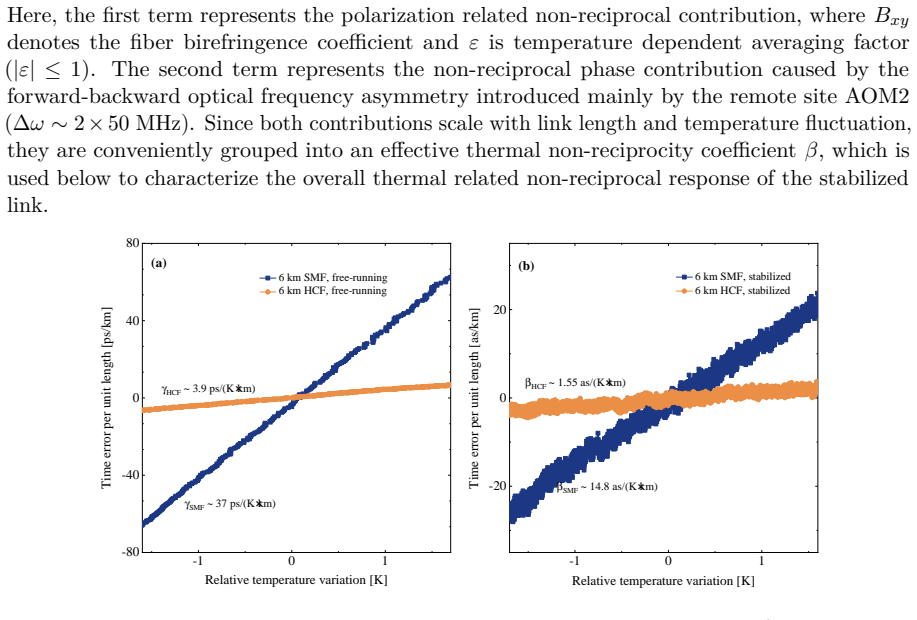
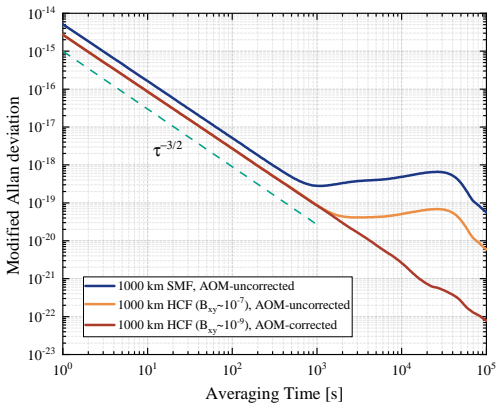
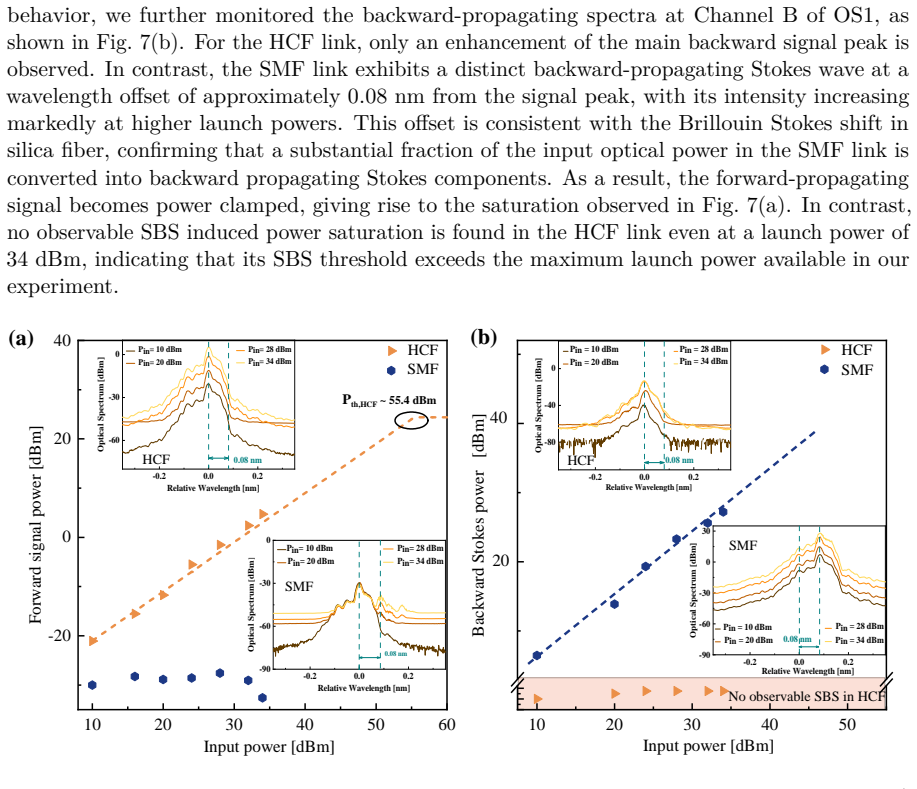
Hollow-core fiber exhibits lower fiber-induced phase noise and shorter propagation delay than standard single-mode fiber, yielding improved short-term instability; its much lower thermal sensitivity yields nearly one-order-of-magnitude better long-term instability; and its stimulated Brillouin scattering threshold remains above 34 dBm, allowing high-power injection without saturation. Combined with low attenuation, these properties enable single-span optical frequency transfer over 152 km, demonstrated at 7.3 x 10^{-21} fractional instability at 10,000 s and 1.8 x 10^{-20} uncertainty, opening a route to intercontinental networks without dense repeater infrastructure.
What carries the argument
Hollow-core fiber (HCF) transmission link, which confines light to an air-filled core and thereby reduces material-induced thermal phase fluctuations and Brillouin scattering.
If this is right
- Short-term instability improves because of lower phase noise and shorter light travel time through the fiber.
- Long-term instability improves by nearly an order of magnitude because thermal phase fluctuations are suppressed.
- Single-span reach extends to at least 152 km because the Brillouin threshold allows full-power injection and attenuation is low.
- The architecture of long-haul frequency networks simplifies by eliminating the need for densely spaced amplifiers and repeater control systems.
- Intercontinental optical frequency networks become feasible with ultrahigh precision using fewer intermediate stations.
Where Pith is reading between the lines
- If the lab advantages hold in installed cables, the number of repeater stations required for a 1000 km link would drop sharply.
- Optical clock networks for geodesy could be built with lower infrastructure cost and simpler operation.
- Testing a 300 km or longer HCF span under field conditions would directly test whether the stability scales as expected.
- The same fiber properties may benefit other phase-sensitive applications such as long-distance quantum key distribution or precision timing.
Load-bearing premise
The measured reductions in thermal sensitivity and the high Brillouin threshold will remain unchanged when the fiber is deployed in the field and subjected to real temperature gradients and mechanical stress over distances beyond 152 km.
What would settle it
A deployed HCF link longer than 152 km that shows either rising long-term phase noise above the lab value or stimulated Brillouin scattering saturation below 34 dBm under outdoor temperature swings.
Figures





read the original abstract
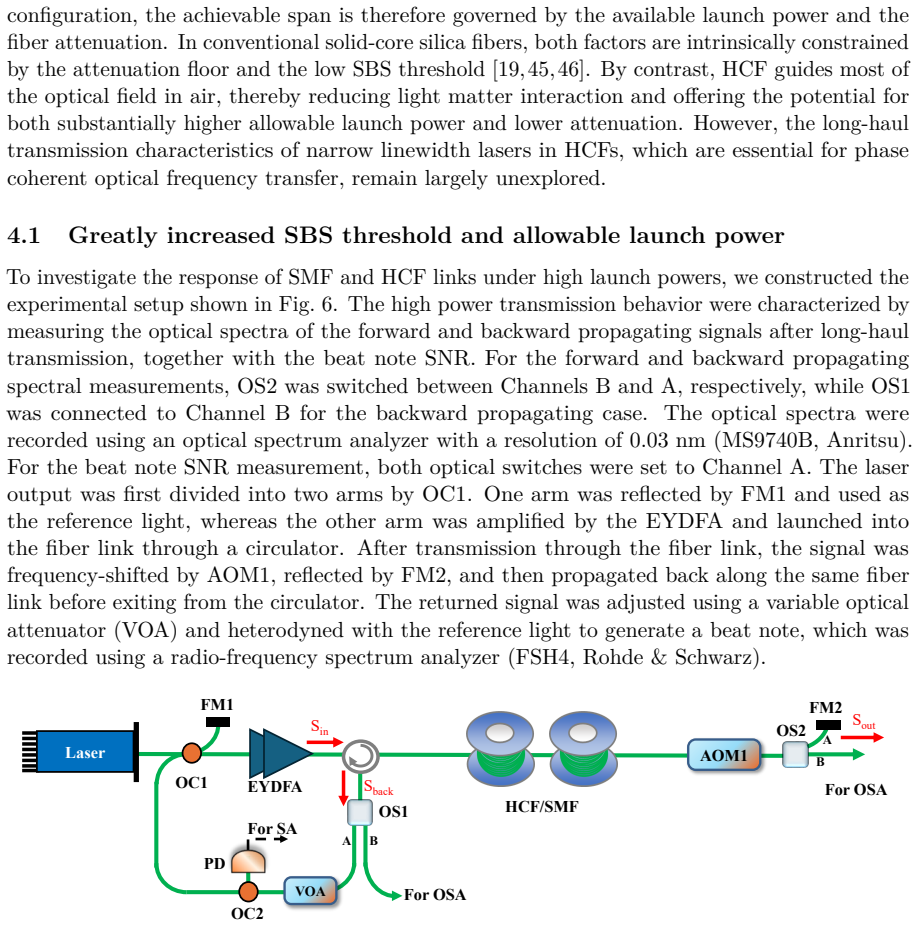
Phase-coherent optical frequency transfer is essential for optical clock networking, relativistic geodesy, and distributed precision metrology. However, realizing coherent optical networks spanning thousands of kilometers in standard single-mode fiber (SMF) generally requires densely distributed amplifiers or repeater stations together with complex operational control, while long-term instability remains limited by thermally driven residual phase fluctuations. Here we show that hollow-core fiber (HCF) can simultaneously improve transfer instability and relax the reach limitation of long-span optical frequency transfer. Compared with SMF, HCF exhibits lower fiber-induced phase noise and shorter propagation delay, supporting improved short-term instability, while its much lower thermal sensitivity supports nearly one-order-of-magnitude better long-term instability. In addition, for long-haul HCF links, no observable stimulated Brillouin scattering induced saturation is found up to the maximum available injected power of 34 dBm, whereas the threshold of an equal-length SMF link remains only a few dBm. Together with the lower attenuation achievable in modern HCF, this enables ultra-long single-span optical frequency transfer. Using a 152 km HCF link with an average attenuation of 0.18 dB/km, we demonstrate single-span optical frequency transfer, achieving a fractional frequency instability of 7.3 x 10^-21 at 10,000 s and a fractional uncertainty of 1.8 x 10^-20. These results establish HCF as a transmission medium that simultaneously improves instability and extends single-span reach, opening a practical route toward future intercontinental optical frequency networks with ultrahigh precision.
Editorial analysis
A structured set of objections, weighed in public.
Referee Report
Summary. The manuscript reports an experimental demonstration of phase-coherent optical frequency transfer over a 152 km hollow-core fiber (HCF) link with average attenuation 0.18 dB/km. It compares HCF to standard single-mode fiber (SMF), showing lower phase noise, shorter propagation delay, lower thermal sensitivity, and higher stimulated Brillouin scattering threshold (no saturation up to 34 dBm in HCF vs. few dBm in SMF). This enables single-span transfer, yielding a fractional frequency instability of 7.3 × 10^{-21} at 10,000 s and fractional uncertainty of 1.8 × 10^{-20}.
Significance. If the laboratory results hold, this has substantial significance for optical clock networking and precision metrology. The work supplies concrete instability and uncertainty numbers together with direct SMF comparisons, establishing that HCF simultaneously improves long-term stability and extends single-span reach. These strengths support the potential to reduce reliance on dense amplifier chains in large-scale networks.
major comments (1)
- Abstract and Results: The central claim that HCF 'opens a practical route toward future intercontinental optical frequency networks' rests on the laboratory-observed reductions in thermal sensitivity and Brillouin threshold persisting in deployed fiber. No field-deployment data, environmental-stress testing, or discussion of performance under uncontrolled temperature gradients, vibrations, or mechanical stress is provided, which is load-bearing for the extrapolation beyond the 152 km lab link.
Simulated Author's Rebuttal
We thank the referee for the positive assessment of the significance of our work and for the constructive feedback. We address the major comment below, agreeing that the extrapolation requires qualification and proposing targeted revisions to the manuscript.
read point-by-point responses
-
Referee: Abstract and Results: The central claim that HCF 'opens a practical route toward future intercontinental optical frequency networks' rests on the laboratory-observed reductions in thermal sensitivity and Brillouin threshold persisting in deployed fiber. No field-deployment data, environmental-stress testing, or discussion of performance under uncontrolled temperature gradients, vibrations, or mechanical stress is provided, which is load-bearing for the extrapolation beyond the 152 km lab link.
Authors: We agree that the manuscript does not include field-deployment data or environmental-stress testing, and that this limits the strength of the extrapolation to intercontinental scales. The demonstrated reductions in thermal sensitivity (arising from the anti-resonant guidance and minimal silica overlap) and the elevated SBS threshold (due to the larger effective mode area and hollow-core nonlinearity) are intrinsic waveguide properties independent of the laboratory environment. Prior HCF deployments in telecommunications have indicated robustness to vibrations and temperature variations, though we do not claim equivalence here. To address the concern, we will revise the abstract to replace 'opens a practical route' with 'suggests a promising route based on laboratory characterization' and add a dedicated paragraph in the discussion section. This paragraph will explicitly note the absence of field data, outline why the core advantages are expected to translate (with supporting references to HCF material properties), and identify key environmental factors (temperature gradients, vibrations, mechanical stress) that would require future validation or mitigation strategies analogous to those used in SMF links. revision: yes
Circularity Check
No significant circularity: experimental demonstration with no derivation chain
full rationale
The manuscript is an experimental measurement campaign reporting direct observations of phase noise, thermal sensitivity, Brillouin threshold, and frequency transfer instability over a 152 km HCF link. No equations, fitted parameters, or derivations are presented that reduce the central results (7.3e-21 instability at 10 ks, 1.8e-20 uncertainty) to prior inputs by construction. Comparisons to SMF are empirical, and no self-citation load-bearing steps, ansatz smuggling, or uniqueness theorems appear in the text. The work is self-contained against external benchmarks.
Axiom & Free-Parameter Ledger
Reference graph
Works this paper leans on
-
[1]
Safronova, and Jun Ye
Alexander Aeppli, Kyungtae Kim, William Warfield, Marianna S. Safronova, and Jun Ye. A clock with8×10−19systematic uncertainty.Physical Review Letters, 133:023401, 2024
2024
-
[2]
Marshall and Daniel A
Mason C. Marshall and Daniel A. Rodriguez Castillo. High-stability single-ion clock with 5.5×10⁻¹⁹systematic uncertainty.Physical Review Letters, 135(3):033201, 2025
2025
-
[3]
A zero-dead-time strontium lattice clock with a stability at10−19level.Physical Review Letters, 135(26):263402, 2025
Xiao-Yong Liu, Peng Liu, Jie Li, and Yu-Chen Zhang. A zero-dead-time strontium lattice clock with a stability at10−19level.Physical Review Letters, 135(26):263402, 2025
2025
-
[4]
McGrew, X
William F. McGrew, X. Zhang, R. J. Fasano, S. A. Schäffer, K. Beloy, D. Nicolodi, R. C. Brown, N. Hinkley, G. Milani, M. Schioppo, T. H. Yoon, and A. D. Ludlow. Atomic clock performance enabling geodesy below the centimetre level.Nature, 564(7734):87–90, 2018
2018
-
[5]
Robinson, Christian Sanner, and Jun Ye
Kyungtae Kim, Alexander Aeppli, Tobias Bothwell, Dolev Kedar, John M. Robinson, Christian Sanner, and Jun Ye. Evaluation of lattice light shift at low10−19uncertainty for a shallow lattice sr optical clock.Physical Review Letters, 130(11):113203, 2023
2023
-
[6]
Godun, et al
Thomas Lindvall, Marco Pizzocaro, Rachel M. Godun, et al. Coordinated international comparisons between optical clocks connected via fiber and satellite links.Optica, 12(6):843– 852, 2025
2025
-
[7]
Grotti et al
J. Grotti et al. Long-distance chronometric leveling with a portable optical clock.Physical Review Applied, 21:L061001, 2024
2024
-
[8]
A clock network for geodesy and fundamental science.Nature Communications, 7:12443, 2016
Christian Lisdat, Gesine Grosche, Nicolas Quintin, and Chunhui Shi. A clock network for geodesy and fundamental science.Nature Communications, 7:12443, 2016
2016
-
[9]
Caldwell, Theodora M
Emily D. Caldwell, Theodora M. Triano, and Laura C. Sinclair. High-precision optical time and frequency transfer.Advances in Optics and Photonics, 17(2):375–440, 2025. 16
2025
-
[10]
Year-long optical time scale with sub-nanosecond capabilities.Optica, 11(4):523–530, 2024
Valerio Formichella, Giovanna Signorile, Tung Thanh Thai, Lorenzo Galleani, Marco Pizzocaro, et al. Year-long optical time scale with sub-nanosecond capabilities.Optica, 11(4):523–530, 2024
2024
-
[11]
Time and frequency comparisons using radiofrequency signals from satellites.Comptes Rendus Physique, 16(5):531–539, 2015
Andreas Bauch, Masaki Fujieda, Takayuki Gotoh, Diedrich Piester, and Martin Werner. Time and frequency comparisons using radiofrequency signals from satellites.Comptes Rendus Physique, 16(5):531–539, 2015
2015
-
[12]
Barwood, Alexandre Bercy, Sébastien Bize, Davide Calonico, Cecilia Clivati, Martin Fermann, et al
Franziska Riedel, Erik Benkler, Michel Abgrall, Jihad Achkar, Aiman Al-Masoudi, Gra- ham P. Barwood, Alexandre Bercy, Sébastien Bize, Davide Calonico, Cecilia Clivati, Martin Fermann, et al. Direct comparisons of european primary and secondary frequency standards via satellite links.Metrologia, 57(4):045005, 2020
2020
-
[13]
Caldwell, Laura C
Emily D. Caldwell, Laura C. Sinclair, Nathan R. Newbury, et al. Quantum-limited optical time transfer for future geosynchronous links.Nature, 2023
2023
-
[14]
Q. Shen, Q. Zhang, C.-Z. Peng, H.-F. Jiang, et al. Free-space dissemination of time and frequency with10−19instability over 113 km.Nature, 610:661–666, 2022
2022
-
[15]
Hänsch, Harald Schnatz, Gesine Grosche, and Ronald Holzwarth
Stefan Droste, Frank Ozimek, Thomas Udem, Klaus Predehl, Theodor W. Hänsch, Harald Schnatz, Gesine Grosche, and Ronald Holzwarth. Optical-frequency transfer over a single- span 1840 km fiber link.Physical Review Letters, 111(11):110801, 2013
2013
-
[16]
Predehl, G
K. Predehl, G. Grosche, S. M. F. Raupach, S. Droste, O. Terra, J. Alnis, T. Legero, T. W. Hänsch, Th. Udem, R. Holzwarth, and H. Schnatz. A 920-kilometer optical fiber link for frequency metrology at the 19th decimal place.Science, 336(6080):441–444, 2012
2012
-
[17]
Cascaded optical fiber link using the internet network for remote clocks comparison.Optics Express, 23(26):33927–33937, 2015
Nicola Chiodo, Nicolas Quintin, Fabio Stefani, Fabrice Wiotte, Emilie Camisard, Christian Chardonnet, Giorgio Santarelli, Anne Amy-Klein, Paul-Eric Pottie, and Olivier Lopez. Cascaded optical fiber link using the internet network for remote clocks comparison.Optics Express, 23(26):33927–33937, 2015
2015
-
[18]
Sebastian M. F. Raupach, Andreas Koczwara, and Gesine Grosche. Brillouin amplification supports1 ×10−20uncertainty in optical frequency transfer over 1400 km of underground fiber.Physical Review A, 92:021801, 2015
2015
-
[19]
Stimulated brillouin scattering in optical fibers.Advances in Optics and Photonics, 2(1):1–59, 2010
Andrey Kobyakov, Michael Sauer, and Dipak Chowdhury. Stimulated brillouin scattering in optical fibers.Advances in Optics and Photonics, 2(1):1–59, 2010
2010
-
[20]
Terra, G
O. Terra, G. Grosche, and H. Schnatz. Brillouin amplification in phase coherent transfer of optical frequencies over 480 km fiber.Optics Express, 18(15):16102–16111, 2010
2010
-
[21]
Ultra-stable long distance optical frequency distribution using the internet fiber network.Optics Express, 20(21):23518– 23526, 2012
Olivier Lopez, Alain Haboucha, Frédéric Kéfélian, Hongyang Jiang, Benjamin Chanteau, Christian Chardonnet, Anne Amy-Klein, and Giorgio Santarelli. Ultra-stable long distance optical frequency distribution using the internet fiber network.Optics Express, 20(21):23518– 23526, 2012
2012
-
[22]
An accurate and robust metrological network for coherent optical frequency dissemination.New Journal of Physics, 23(5):053027, 2021
Etienne Cantin, Martin Tønnes, Rémy Le Targat, Christian Chardonnet, Anne Amy-Klein, and Paul-Éric Pottie. An accurate and robust metrological network for coherent optical frequency dissemination.New Journal of Physics, 23(5):053027, 2021
2021
-
[23]
Realization of highly reliable10−20-level instability optical phase transmission over a 1402-kilometer commercial fiber-optic network.Chinese Physics Letters, 42(12):120401, 2025
Yang Xu, Libo Li, Kan Zhao, Pingan Ma, Zhiwei Zhang, Qi Shen, Faxi Chen, and Haifeng Jiang. Realization of highly reliable10−20-level instability optical phase transmission over a 1402-kilometer commercial fiber-optic network.Chinese Physics Letters, 42(12):120401, 2025. 17
2025
-
[24]
Fa-Xi Chen, Li-Bang Li, Jiu-Peng Chen, Kun Zhao, Jie-Yang Guan, Yu Xu, Li Hou, et al. E-21 level instability frequency dissemination over 2067 km noisy telecommunication infrastructure.arXiv preprint arXiv:2507.14192, 2025
-
[25]
Non-reciprocity in optical fiber links: experimental evidence.Optics Express, 29(11):17476–17490, 2021
Dan Xu, Olivier Lopez, Anne Amy-Klein, and Paul-Eric Pottie. Non-reciprocity in optical fiber links: experimental evidence.Optics Express, 29(11):17476–17490, 2021
2021
-
[26]
Hayes, Nicholas V
Radan Slavík, Gabriele Marra, Eric Numkam Fokoua, John R. Hayes, Nicholas V. Wheeler, Marco N. Petrovich, and David J. Richardson. Ultralow thermal sensitivity of phase and propagation delay in hollow core optical fibres.Scientific Reports, 5:15447, 2015
2015
-
[27]
Low-loss microwave photonics links using hollow core fibres.Light: Science & Applications, 11(1):213, 2022
Xi Zhang, Zitong Feng, David Marpaung, Eric Numkam Fokoua, Francesco Poletti, and Radan Slavík. Low-loss microwave photonics links using hollow core fibres.Light: Science & Applications, 11(1):213, 2022
2022
-
[28]
Jasion, Thomas D
Hesham Sakr, Yong Chen, Gregory T. Jasion, Thomas D. Bradley, John R. Hayes, Hans Christian H. Mulvad, Ian A. Davidson, Eric Numkam Fokoua, and Francesco Poletti. Hollow core optical fibres with comparable attenuation to silica fibres between 600 and 1100 nm. Nature Communications, 11:6030, 2020
2020
-
[29]
Cooper, Joseph Wahlen, Stephanos Yerolatsitis, Daniel Cruz-Delgado, Daniel Parra, B
Matthew A. Cooper, Joseph Wahlen, Stephanos Yerolatsitis, Daniel Cruz-Delgado, Daniel Parra, B. Tanner, Pouya Ahmadi, Olivier Jones, Md. Selim Habib, Ivan Divliansky, Jose En- rique Antonio-Lopez, Axel Schülzgen, and Rodrigo Amezcua Correa. 2.2 kw single-mode narrow-linewidth laser delivery through a hollow-core fiber.Optica, 10(10):1253–1259, 2023
2023
-
[30]
H. C. H. Mulvad, S. Abokhamis Mousavi, V. Zuba, L. Xu, H. Sakr, T. D. Bradley, J. R. Hayes, G. T. Jasion, E. Numkam Fokoua, A. Taranta, S.-U. Alam, D. J. Richardson, and F. Poletti. Kilowatt-average-power single-mode laser light transmission over kilometre-scale hollow-core fibre.Nature Photonics, 16(6):448–453, 2022
2022
-
[31]
Hayes, Eric Numkam Fokoua, Meng Ding, Francesco Poletti, David J
Zitong Feng, Hesham Sakr, John R. Hayes, Eric Numkam Fokoua, Meng Ding, Francesco Poletti, David J. Richardson, and Radan Slavík. Hollow-core fiber with stable propagation delay between−150◦Cand+60 ◦C.Optics Letters, 48(3):763–766, 2023
2023
-
[32]
Jasion, David J
Eric Numkam Fokoua, Seyed Abokhamis Mousavi, Gregory T. Jasion, David J. Richardson, and Francesco Poletti. Loss in hollow-core optical fibers: Mechanisms, scaling rules, and limits.Advances in Optics and Photonics, 15(1):1–85, 2023
2023
-
[33]
Support tube hollow-core fiber with 0.05 db/km attenuation
Yuxin Ding, Peng Li, Guoqun Chen, Jun Chu, Anqing Jia, Lei Zhang, and Jie Luo. Support tube hollow-core fiber with 0.05 db/km attenuation. In2025 European Conference on Optical Communications (ECOC), pages 1–4, Copenhagen, Denmark, September 2025
2025
-
[34]
Broadband optical fibre with an attenuation lower than 0.1 decibel per kilometre.Nature Photonics, 2025
Marco Petrovich and et al. Broadband optical fibre with an attenuation lower than 0.1 decibel per kilometre.Nature Photonics, 2025
2025
-
[35]
Tb/s-class optical transmission over ar-hcfs: Field deployment, characterization, and performance.Journal of Lightwave Technology, 44(3):1094–1112, 2026
Dawei Ge, Dechao Zhang, Xiaodong Duan, Dong Wang, Mingqing Zuo, Yingying Wang, Jie Luo, Han Li, and Zhangyuan Chen. Tb/s-class optical transmission over ar-hcfs: Field deployment, characterization, and performance.Journal of Lightwave Technology, 44(3):1094–1112, 2026
2026
-
[36]
R. R. Khrapko, M. A. Yablonsky, M. V. Gurkin, and E. M. Dianov. Quasi single-mode fiber with record-low attenuation of 0.1400 db/km.IEEE Photonics Technology Letters, 36(9):539–542, 2024. 18
2024
-
[37]
Numkam Fokoua, Hesham Sakr, John R
Zitong Feng, Giuseppe Marra, Xi Zhang, Eric R. Numkam Fokoua, Hesham Sakr, John R. Hayes, Francesco Poletti, David J. Richardson, and Radan Slavík. Stable optical frequency comb distribution enabled by hollow-core fibers.Laser & Photonics Reviews, 16(11):2200167, 2022
2022
-
[38]
Temperature-induced noise-insensitive laser repeater station for optical frequency transfer.IEEE Transactions on Instrumentation and Measurement, 74:1–11, 2025
Ziang Qiu, Zijie Zhou, Liang Hu, Jiao Liu, Guiling Wu, Jianping Chen, Xiang Zhang, Ruifang Dong, Tao Liu, and Shougang Zhang. Temperature-induced noise-insensitive laser repeater station for optical frequency transfer.IEEE Transactions on Instrumentation and Measurement, 74:1–11, 2025. Art. no. 7008011
2025
-
[39]
Nested antiresonant nodeless hollow core fiber.Optics Express, 22(20):23807–23828, 2014
Francesco Poletti. Nested antiresonant nodeless hollow core fiber.Optics Express, 22(20):23807–23828, 2014
2014
-
[40]
Renninger
Anand Iyer, Wei Xu, Jose Enrique Antonio-Lopez, Rodrigo Amezcua Correa, and William H. Renninger. Ultra-low brillouin scattering in anti-resonant hollow-core fibers.APL Photonics, 5(9):096109, 2020
2020
-
[41]
N. R. Newbury, P. A. Williams, and W. C. Swann. Coherent transfer of an optical carrier over 251 km.Optics Letters, 32(21):3056–3058, 2007
2007
-
[42]
P. A. Williams, W. C. Swann, and N. R. Newbury. High-stability transfer of an optical frequency over long fiber-optic links.Journal of the Optical Society of America B, 25(8):1284– 1293, 2008
2008
-
[43]
Reciprocity of propagation in optical fiber links demonstrated to10−21.Optics Express, 27(25):36965– 36975, 2019
Dan Xu, Pacôme Delva, Olivier Lopez, Anne Amy-Klein, and Paul-Eric Pottie. Reciprocity of propagation in optical fiber links demonstrated to10−21.Optics Express, 27(25):36965– 36975, 2019
2019
-
[44]
Low polarization mode dispersion double nested antiresonant nodeless fiber cable by fiber spinning.Journal of Lightwave Technology, 44(3):967–973, 2026
Chenyang Hou, Xiaokai Wang, Guoqun Chen, Liyan Zhang, Peng Li, Jinmin Ding, Yiming Zhao, Zeyi Duan, Sheng Liang, and Jie Luo. Low polarization mode dispersion double nested antiresonant nodeless fiber cable by fiber spinning.Journal of Lightwave Technology, 44(3):967–973, 2026
2026
-
[45]
Silica-core single-mode fiber with lowest loss of 0.1397 db/km.Journal of Lightwave Technology, 43(4):1837–1842, 2025
Shin Sato, Yuki Kawaguchi, Hirotaka Sakuma, Tetsuya Haruna, and Takemi Hasegawa. Silica-core single-mode fiber with lowest loss of 0.1397 db/km.Journal of Lightwave Technology, 43(4):1837–1842, 2025
2025
-
[46]
The first 0.14-db/km loss optical fiber and its impact on submarine transmission.Journal of Lightwave Technology, 36(1):44–49, 2018
Yoshiaki Tamura, Hirotaka Sakuma, Keisei Morita, Masato Suzuki, Yoshinori Yamamoto, Kensaku Shimada, Yuya Honma, Kazuyuki Sohma, Takashi Fujii, and Takemi Hasegawa. The first 0.14-db/km loss optical fiber and its impact on submarine transmission.Journal of Lightwave Technology, 36(1):44–49, 2018
2018
-
[47]
Soto, and Luc Thévenaz
Yuting Yang, Marcelo A. Soto, and Luc Thévenaz. Absolute thermometry based on brillouin scattering in gases.Light: Science & Applications, 15:69, 2026
2026
-
[48]
Intense brillouin amplification in gas using hollow-core waveguides.Nature Photonics, 14(11):700–708, 2020
Fan Yang, Flavien Gyger, and Luc Thévenaz. Intense brillouin amplification in gas using hollow-core waveguides.Nature Photonics, 14(11):700–708, 2020
2020
-
[49]
M. C. Teich and R. Y. Yen. On the signal-to-noise ratio for optical heterodyne detection. Journal of Applied Physics, 43(5):2480–2481, 1972
1972
-
[50]
Risaro et al
M. Risaro et al. Improving the resolution of comb-based frequency measurements.Physical Review Applied, 18:064033, 2022
2022
-
[51]
On the relation between uncertainties of weighted frequency averages and the various types of allan deviations.Metrologia, 52(4):565–574, 2015
Erik Benkler, Christian Lisdat, and Uwe Sterr. On the relation between uncertainties of weighted frequency averages and the various types of allan deviations.Metrologia, 52(4):565–574, 2015. 19
2015
-
[52]
The uncertainty associated with the weighted mean frequency of a phase-stabilized signal with white phase noise.Metrologia, 47(1):24–32, 2010
Won-Kyu Lee, Dai-Hyuk Yu, Chang Yong Park, and Jongchul Mun. The uncertainty associated with the weighted mean frequency of a phase-stabilized signal with white phase noise.Metrologia, 47(1):24–32, 2010. 20
2010
discussion (0)
Sign in with ORCID, Apple, or X to comment. Anyone can read and Pith papers without signing in.