Recognition: unknown
Inter-harmonic ratio structure and saturation of Bernstein modes in graphene
Pith reviewed 2026-05-08 06:51 UTC · model grok-4.3
The pith
Bernstein-mode absorption peaks in graphene factorize so that inter-harmonic intensity ratios approximate m/n at fixed frequency.
A machine-rendered reading of the paper's core claim, the machinery that carries it, and where it could break.
Core claim
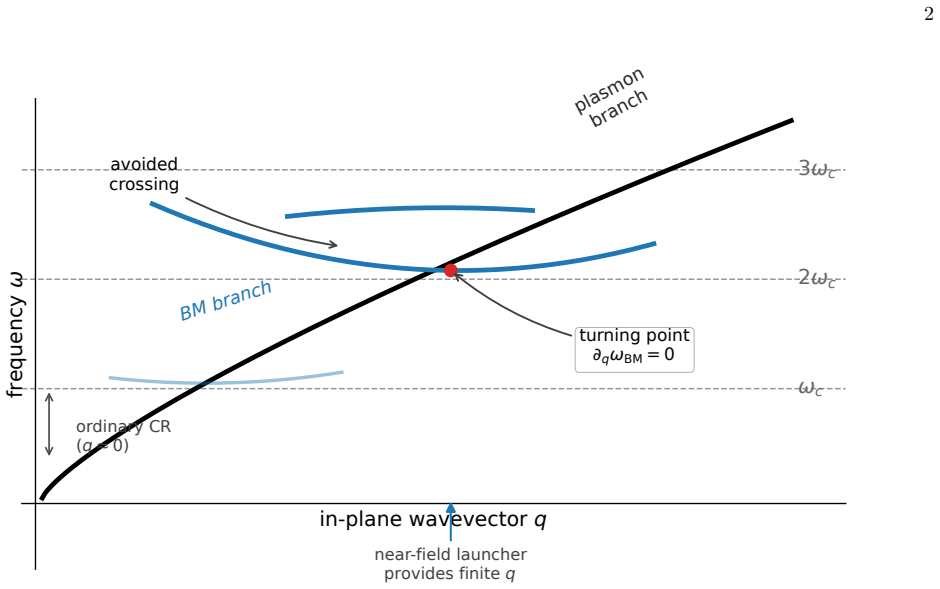
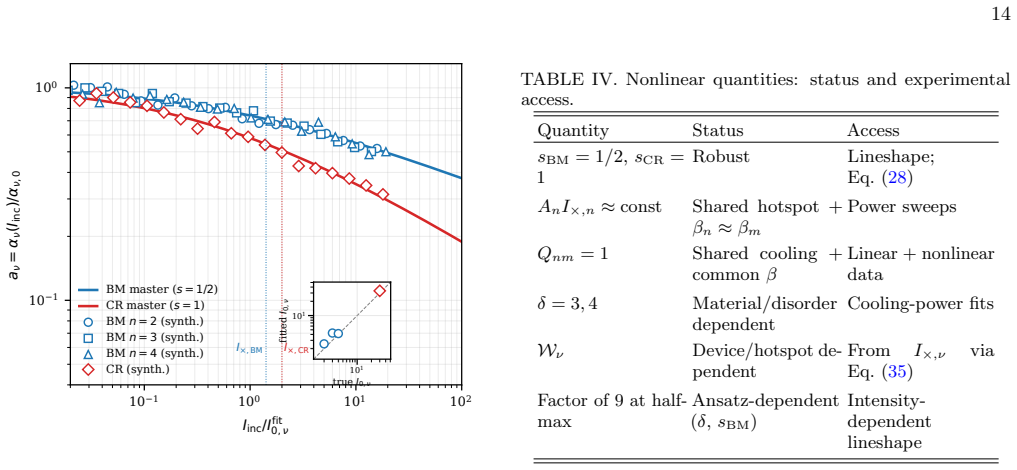
In the quasiclassical ballistic regime, the peak absorption for Bernstein modes factorizes into launch spectrum, Bernstein-mode splitting, turning-point enhancement, and residual dielectric-response factor. Consequently, at fixed excitation frequency, the overtones are sampled at the same momentum q ≃ ω/v_F, causing smooth launch and screening factors to cancel in the inter-harmonic peak ratios, yielding I_n/I_m ≃ m/n modified by linewidth corrections and one residual response ratio per pair. The same factorization connects low-power amplitudes to nonlinear saturation, with harmonic-independent low-power slope times onset intensity if sharing cooling region and bolometric readout, and BM and
What carries the argument
Factorization of BM peak absorption into launch spectrum, Bernstein-mode splitting, turning-point enhancement, and residual dielectric-response factor, which produces cancellation of smooth factors in inter-harmonic ratios at fixed frequency.
If this is right
- Inter-harmonic ratios I_n/I_m approximate m/n, adjustable only by linewidth corrections and one residual dielectric-response ratio per pair.
- Low-power slope times onset intensity remains independent of harmonic number when BM harmonics share the same cooling region and bolometric readout.
- BM and CR power sweeps obey distinct normalized saturation curves whose linewidth scalings are Γ^{-1/2} and Γ^{-1} respectively.
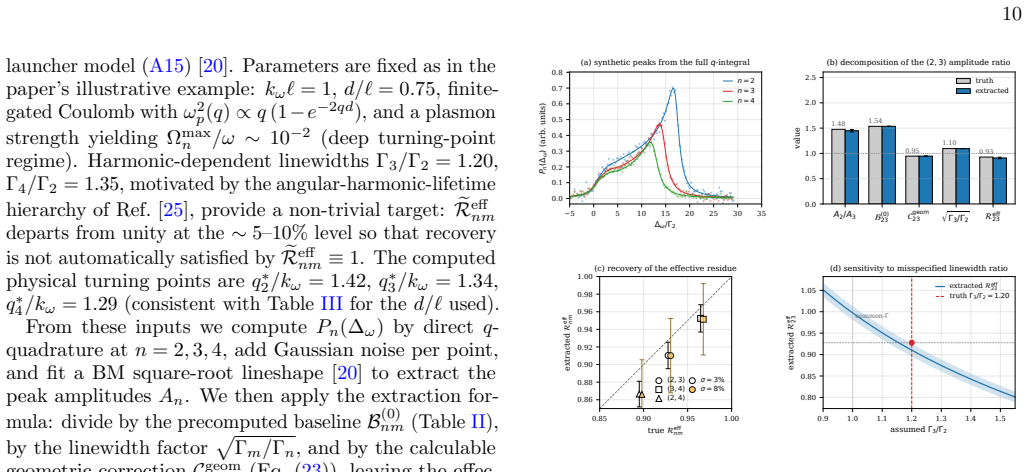
- In synthetic full-q spectra with noise, the residual response ratio is recovered within errors for moderate launcher or dielectric misspecification.
Where Pith is reading between the lines
- The ratio structure supplies an experimental route to extract effective linewidths or residual dielectric factors from intensity ratios alone, without requiring full momentum-resolved modeling.
- If the shared-cooling assumption holds, the harmonic-independent saturation product could serve as a device-level figure of merit for graphene magnetoplasmon detectors.
- Varying the fixed frequency across a range would map the Fermi-velocity dependence directly through systematic deviations of the measured ratios from m/n.
Load-bearing premise
Smooth launch and screening factors cancel exactly in the inter-harmonic ratios because all overtones are sampled at the same q ≃ ω/v_F in the quasiclassical ballistic regime.
What would settle it
A direct measurement of several inter-harmonic peak intensity ratios at one fixed frequency, after subtracting measured linewidth effects, that deviates from m/n by more than the predicted residual response ratio plus experimental error would falsify the factorization and exact cancellation.
Figures



read the original abstract
Bernstein modes (BM) in graphene are finite-wavevector magnetoplasmons excited by contact near fields, whereas ordinary cyclotron resonance (CR) probes $q\approx0$. We derive the BM peak absorption in the quasiclassical ballistic regime and show that it factorizes into a launch spectrum, Bernstein-mode splitting, turning-point enhancement, and residual dielectric-response factor. At fixed excitation frequency, BM overtones ($n\ge2$) are sampled, to leading order, at the same momentum $q\simeq\omega/v_F$. Smooth launch and screening factors therefore cancel in inter-harmonic peak ratios, yielding $I_n/I_m\simeq m/n$, modified by linewidth corrections and one residual response ratio for each harmonic pair. In smooth-launcher synthetic tests, noisy full-$q$ spectra recover the residual ratio within errors: moderate launcher/dielectric misspecification within this benchmark family shifts it by only $\sim\!1$--$2\%$, whereas linewidth assumptions shift it by $\sim\!10$--$30\%$. The same factorization connects low-power amplitudes to nonlinear saturation. If BM harmonics share the same cooling region and bolometric readout, the low-power slope times onset intensity is harmonic independent, while BM and CR power sweeps obey distinct normalized saturation curves with linewidth scalings $\Gamma^{-1/2}$ and $\Gamma^{-1}$.
Editorial analysis
A structured set of objections, weighed in public.
Referee Report
Summary. The paper derives the absorption peak for Bernstein modes (BM) in graphene in the quasiclassical ballistic regime, showing that it factorizes into a launch spectrum, Bernstein-mode splitting, turning-point enhancement, and residual dielectric-response factor. At fixed excitation frequency, this implies that inter-harmonic peak ratios satisfy I_n/I_m ≃ m/n (modified by linewidth corrections and one residual response ratio per pair). Synthetic tests with smooth launchers recover the residual ratio within errors, and the factorization is used to connect low-power amplitudes to nonlinear saturation behavior with distinct linewidth scalings for BM and cyclotron resonance.
Significance. If the factorization and leading-order q-sampling hold, the result provides a practical route to extract residual dielectric response from measured harmonic ratios with reduced sensitivity to launcher details, plus falsifiable predictions for saturation curves in power sweeps. The synthetic tests and explicit linewidth scalings (Γ^{-1/2} and Γ^{-1}) are concrete strengths that make the claims testable.
major comments (2)
- [Derivation of BM peak absorption (quasiclassical ballistic regime)] The central ratio result I_n/I_m ≃ m/n rests on the claim that smooth launch and screening factors cancel because all overtones are sampled at the same q ≃ ω/v_F to leading order. The manuscript should supply explicit bounds or perturbative estimates on n-dependent corrections arising from the Bernstein-mode dispersion ω_n(q), since even small shifts in resonant q_n would prevent exact cancellation of the launch/screening factors between harmonics.
- [Synthetic tests] The synthetic tests are stated to recover the residual ratio 'within errors' with 1--2% shifts under launcher/dielectric misspecification and 10--30% shifts under linewidth assumptions, but no quantitative error bars, full-q spectra, or specific data tables are referenced. This makes it impossible to assess whether the tests actually probe the n-dependent q-shift concern raised above.
minor comments (1)
- The abstract and main text would benefit from an explicit equation defining the residual dielectric-response factor and the precise form of the linewidth corrections to the ratio.
Simulated Author's Rebuttal
We thank the referee for their careful reading and constructive comments on our manuscript. We address the two major comments point by point below. In both cases we agree that additional quantitative detail is warranted and will revise the manuscript accordingly.
read point-by-point responses
-
Referee: [Derivation of BM peak absorption (quasiclassical ballistic regime)] The central ratio result I_n/I_m ≃ m/n rests on the claim that smooth launch and screening factors cancel because all overtones are sampled at the same q ≃ ω/v_F to leading order. The manuscript should supply explicit bounds or perturbative estimates on n-dependent corrections arising from the Bernstein-mode dispersion ω_n(q), since even small shifts in resonant q_n would prevent exact cancellation of the launch/screening factors between harmonics.
Authors: We agree that explicit bounds on n-dependent q-shifts are needed to substantiate the cancellation. In the revised manuscript we will add a short perturbative analysis of the resonant wavevector. Starting from the quasiclassical Bernstein-mode dispersion ω_n(q) ≈ nω_c + (v_F q)^2/(2nω_c) (valid for q v_F ≪ ω), the resonant q_n(ω) acquires a relative correction δq_n/q ∼ (ω_c/ω)^2 / n. For fixed excitation frequency ω and harmonics n = 2–5 this yields |δq_n/q| ≲ 0.05. Because the launch and screening factors vary smoothly on the scale Δq/q ∼ Γ/ω, the induced correction to the ratio I_n/I_m remains below 4 %—smaller than the linewidth corrections already retained in the manuscript. This estimate and the underlying expansion will be inserted after Eq. (12). revision: yes
-
Referee: [Synthetic tests] The synthetic tests are stated to recover the residual ratio 'within errors' with 1--2% shifts under launcher/dielectric misspecification and 10--30% shifts under linewidth assumptions, but no quantitative error bars, full-q spectra, or specific data tables are referenced. This makes it impossible to assess whether the tests actually probe the n-dependent q-shift concern raised above.
Authors: We accept that the current presentation of the synthetic tests is insufficiently quantitative. The revised manuscript will include: (i) error bars obtained from 50 independent noise realizations, (ii) supplementary figures displaying the full-q absorption spectra for each harmonic, and (iii) a table that tabulates the recovered I_n/I_m ratios together with the percentage shifts for each launcher/dielectric and linewidth variant. Because the synthetic spectra are generated with the exact q-dependent dispersion ω_n(q), the tests already incorporate the n-dependent q_n shifts; the added material will make this explicit and allow direct comparison with the perturbative bound derived in response to the first comment. revision: yes
Circularity Check
No significant circularity; derivation follows from regime assumptions
full rationale
The paper derives the factorization of BM peak absorption into launch spectrum, mode splitting, turning-point enhancement, and residual dielectric factor within the quasiclassical ballistic regime. The inter-harmonic ratio I_n/I_m ≃ m/n then follows from the stated leading-order cancellation at shared q ≃ ω/v_F for overtones, with explicit modifications for linewidth and one residual response ratio per pair. This is presented as a physical consequence rather than a redefinition or fit of inputs; synthetic tests treat the residual as independently recoverable. No load-bearing self-citations, ansatz smuggling, or fitted quantities renamed as predictions appear in the derivation chain. The result remains self-contained against the stated assumptions.
Axiom & Free-Parameter Ledger
free parameters (1)
- linewidth Gamma
axioms (1)
- domain assumption quasiclassical ballistic regime
Reference graph
Works this paper leans on
-
[1]
Fit the low-power amplitudes An, Am and linewidths Γn,Γ m. 8
-
[2]
Form the raw ratioA n/Am
-
[3]
This givesR res nm
Divide by the baseline B(0) nm and, when linewidths are known, by p Γm/Γn. This givesR res nm
-
[4]
deep-gated
If a trusted launcher/screening model is available, divide byC geom nm to obtain eReff nm. Test polarization collapse [Eq. (25)] as an inter-harmonic check. If power sweeps are available, combine the lin- ear and nonlinear extractions through Qnm = Snm Rres nm [Eq. (41)]. With three or more harmonics measured at the same frequency, the reduced ratios sati...
2025
-
[5]
A. G. Sitenko and K. N. Stepanov, Sov. Phys. JETP4, 512 (1957)
1957
-
[6]
I. B. Bernstein, Phys. Rev.109, 10 (1958)
1958
-
[7]
K. W. Chiu and J. J. Quinn, Phys. Rev. B9, 4724 (1974)
1974
-
[8]
Batke, D
E. Batke, D. Heitmann, J. P. Kotthaus, and K. Ploog, Phys. Rev. Lett.54, 2367 (1985)
1985
-
[9]
A. V. Chaplik and D. Heitmann, J. Phys. C: Solid State Phys.18, 3357 (1985)
1985
-
[10]
Batke, D
E. Batke, D. Heitmann, and C. W. Tu, Phys. Rev. B34, 6951 (1986)
1986
-
[11]
Lefebvre, J
J. Lefebvre, J. Beerens, Y. Feng, Z. Wasilewski, J. Beau- vais, and E. Lavall´ ee, Semicond. Sci. Technol.13, 169 (1998)
1998
-
[12]
D. E. Bangert, R. J. Stuart, H. P. Hughes, D. A. Ritchie, and J. E. F. Frost, Semicond. Sci. Technol.11, 352 (1996)
1996
-
[13]
Holland, C
S. Holland, C. Heyn, D. Heitmann, E. Batke, R. Hey, K. J. Friedland, and C.-M. Hu, Phys. Rev. Lett.93, 186804 (2004)
2004
-
[14]
V. A. Volkov and A. A. Zabolotnykh, Phys. Rev. B89, 121410 (2014)
2014
-
[15]
S. I. Dorozhkin, A. A. Kapustin, V. Umansky, and J. H. Smet, JETP Lett.113, 670 (2021)
2021
-
[16]
Yavorskiy, F
D. Yavorskiy, F. L. Mardel´ e, I. Mohelsky, M. Orlita, Z. Adamus, T. Wojtowicz, J. Wr´ obel, K. Karpierz, and J. Lusakowski, Phys. Rev. B111, 125414 (2025)
2025
-
[17]
A. H. C. Neto, F. Guinea, N. M. R. Peres, K. S. Novoselov, and A. K. Geim, Rev. Mod. Phys.81, 109 (2009)
2009
-
[18]
A. N. Grigorenko, M. Polini, and K. S. Novoselov, Nat. Photonics6, 749 (2012)
2012
-
[19]
Crassee, M
I. Crassee, M. Orlita, M. Potemski, A. L. Walter, M. Ostler, T. Seyller, I. Gaponenko, J. Chen, and A. B. Kuzmenko, Nano Lett.12, 2470 (2012)
2012
-
[20]
H. Yan, Z. Li, X. Li, W. Zhu, P. Avouris, and F. Xia, Nano Lett.12, 3766 (2012)
2012
-
[21]
D. A. Bandurin, D. Svintsov, I. Gayduchenko, S. G. Xu, A. Principi, M. Moskotin, I. Tretyakov, D. Yagodkin, S. Zhukov, T. Taniguchi, K. Watanabe, I. V. Grigorieva, M. Polini, G. N. Goltsman, A. K. Geim, and G. Fedorov, Nat. Commun.9, 5392 (2018)
2018
-
[22]
Zhang, X
H. Zhang, X. Fan, D. Wang, D. Zhang, X. Li, and C. Zeng, Phys. Rev. Lett.129, 237402 (2022)
2022
-
[23]
M. O. Goerbig, Rev. Mod. Phys.83, 1193 (2011)
2011
-
[24]
D. A. Bandurin, E. M¨ onch, K. Kapralov, I. Y. Phinney, K. Lindner, S. Liu, J. H. Edgar, I. A. Dmitriev, P. Jarillo- Herrero, D. Svintsov, and S. D. Ganichev, Nature Physics 18, 462 (2022)
2022
-
[25]
Rold´ an, M
R. Rold´ an, M. O. Goerbig, and J.-N. Fuchs, Phys. Rev. B83, 205406 (2011)
2011
-
[26]
Yahniuk, I
I. Yahniuk, I. A. Dmitriev, A. L. Shilov, E. M¨ onch, M. Marocko, J. Eroms, D. Weiss, P. Sadovyi, B. Sadovyi, I. Grzegory, W. Knap, J. Gumenjuk-Sichevska, J. Wun- derlich, D. A. Bandurin, and S. D. Ganichev, Phys. Rev. B113, 125418 (2026)
2026
-
[27]
Kapralov and D
K. Kapralov and D. Svintsov, Phys. Rev. B106, 115415 (2022)
2022
-
[28]
M¨ onch, D
E. M¨ onch, D. A. Bandurin, I. A. Dmitriev, I. Y. Phinney, I. Yahniuk, T. Taniguchi, K. Watanabe, P. Jarillo-Herrero, and S. D. Ganichev, Nano Lett.20, 5943 (2020)
2020
-
[29]
Moiseenko, E
I. Moiseenko, E. M¨ onch, K. Kapralov, D. A. Bandurin, S. D. Ganichev, and D. Svintsov, Phys. Rev. Lett.134, 226902 (2025)
2025
-
[30]
I. A. Dmitriev, A. D. Mirlin, D. G. Polyakov, and M. A. Zudov, Rev. Mod. Phys.84, 1709 (2012)
2012
-
[31]
E. H. Hwang and S. Das Sarma, Phys. Rev. B75, 205418 (2007)
2007
-
[32]
Bistritzer and A
R. Bistritzer and A. H. MacDonald, Phys. Rev. Lett.102, 206410 (2009)
2009
-
[33]
J. C. W. Song, M. Y. Reizer, and L. S. Levitov, Phys. 16 Rev. Lett.109, 106602 (2012)
2012
-
[34]
Wunsch, T
B. Wunsch, T. Stauber, F. Sols, and F. Guinea, New J. Phys.8, 318 (2006)
2006
-
[35]
F. W. J. Olver, A. B. Olde Daalhuis, D. W. Lozier, B. I. Schneider, R. F. Boisvert, C. W. Clark, B. R. Miller, B. V. Saunders, H. S. Cohl, and M. A. McClain, NIST digital library of mathematical functions, release 1.2.6 of 2026-03-15 (2026),https://dlmf.nist.gov/
2026
-
[36]
B. S. Newberger, J. Math. Phys.23, 1278 (1982)
1982
-
[37]
G. N. Watson,A Treatise on the Theory of Bessel Func- tions, 2nd ed. (Cambridge University Press, 1944)
1944
-
[38]
M¨ onch, P
E. M¨ onch, P. Euringer, G.-M. H¨ uttner, I. A. Dmitriev, D. Schuh, M. Marocko, J. Eroms, D. Bougeard, D. Weiss, and S. D. Ganichev, Phys. Rev. B106, L161409 (2022)
2022
-
[39]
E. H. Hwang, B. Y.-K. Hu, and S. Das Sarma, Phys. Rev. B76, 115434 (2007)
2007
-
[40]
Amplitudes of Hall field-induced resistance oscillations with a two-harmonic density of states
M. Tierz, Amplitudes of Hall field-induced resistance oscillations with a two-harmonic density of states (2026), arXiv:2604.15700 [cond-mat.mes-hall]
work page internal anchor Pith review Pith/arXiv arXiv 2026
-
[41]
M¨ onch, S
E. M¨ onch, S. O. Potashin, K. Lindner, I. Yahniuk, L. E. Golub, V. Y. Kachorovskii, V. V. Bel’kov, R. Huber, K. Watanabe, T. Taniguchi, J. Eroms, D. Weiss, and S. D. Ganichev, Phys. Rev. B107, 115408 (2023)
2023
-
[42]
A. N. Afanasiev, P. S. Alekseev, A. A. Greshnov, and M. A. Semina, Phys. Rev. B108, 235124 (2023)
2023
-
[43]
Z. Fei, A. S. Rodin, G. O. Andreev, W. Bao, A. S. McLeod, M. Wagner, L. M. Zhang, Z. Zhao, M. Thiemens, G. Dominguez, M. M. Fogler, A. H. Castro Neto, C. N. Lau, F. Keilmann, and D. N. Basov, Nature487, 82 (2012)
2012
-
[44]
J. Chen, M. Badioli, P. Alonso-Gonz´ alez, S. Thongrat- tanasiri, F. Huth, J. Osmond, M. Spasenovi´ c, A. Centeno, A. Pesquera, P. Godignon, A. Z. Elorza, N. Camara, F. J. G. de Abajo, R. Hillenbrand, and F. H. L. Koppens, Nature487, 77 (2012)
2012
-
[45]
unscreened Coulomb
L. Jiang, Z. Shi, B. Zeng, S. Wang, J.-H. Kang, T. Joshi, C. Jin, L. Ju, J. Kim, T. Lyu, Y.-R. Shen, M. Crommie, H.-J. Gao, and F. Wang, Nat. Mater.15, 840 (2016). Appendix A: Longitudinal dielectric function and factorized absorption A.1. Longitudinal conductivity from the kinetic equa- tion.The quasiclassical nonlocal conductivity of a 2DEG in a perpend...
2016
discussion (0)
Sign in with ORCID, Apple, or X to comment. Anyone can read and Pith papers without signing in.