Recognition: unknown
Amplitudes of Hall field-induced resistance oscillations with a two-harmonic density of states
Pith reviewed 2026-05-10 08:47 UTC · model grok-4.3
The pith
A two-harmonic density of states makes the amplitudes of odd HIRO harmonics depend on combinations of forward and backward scattering rates while the leading even amplitude stays fixed by backscattering alone.
A machine-rendered reading of the paper's core claim, the machinery that carries it, and where it could break.
Core claim
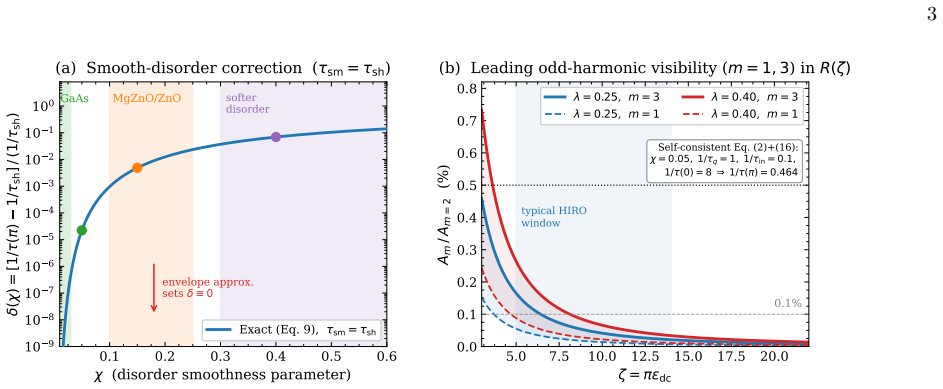
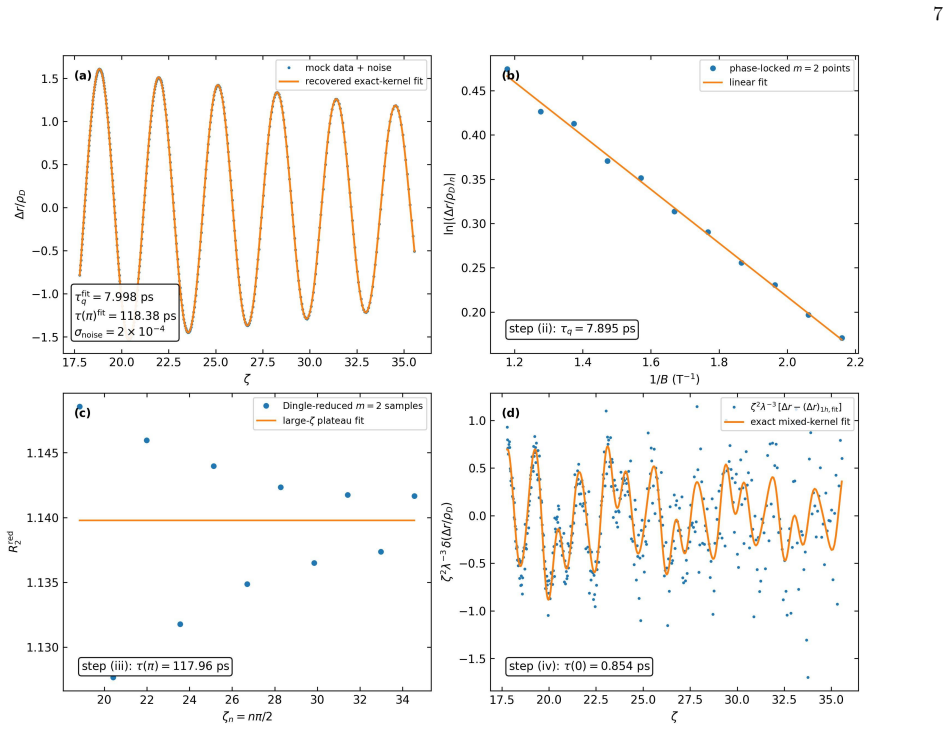
Within the Vavilov-Aleiner-Glazman kinetic framework, a density of states with two harmonics produces an exact single-integral representation for the off-diagonal mixed kernel γ12. The strong-field asymptotics that follow from this representation give odd harmonics whose coefficients are linear combinations of 1/τ(0) and 1/τ(π), while the leading m=2 amplitude remains determined solely by the full backscattering rate 1/τ(π). When the resulting expressions are applied to exact-kernel mock data with fixed transport and inelastic scattering times, the protocol extracts τq, τ(π), and τ(0) to sub-percent accuracy, with τ(0) serving as a consistency check on the disorder model.
What carries the argument
The off-diagonal mixed kernel γ12, which for a two-harmonic density of states possesses an exact single-integral representation that directly supplies the strong-field asymptotics of the oscillation amplitudes.
If this is right
- The m=2 amplitude is unchanged from the single-harmonic case and continues to be set exclusively by the backscattering rate 1/τ(π).
- Coefficients of the m=1 and m=3 harmonics become explicit combinations of 1/τ(0) and 1/τ(π), allowing separation of forward and backward scattering contributions.
- Application of the derived expressions to mock data generated inside the model recovers τq, τ(π), and τ(0) to sub-percent accuracy whenever the odd harmonics are resolved.
- The extracted value of τ(0) provides an internal consistency check on the assumed form of the disorder.
Where Pith is reading between the lines
- The two-harmonic extraction protocol could be applied to real HIRO data to test whether a minimal two-harmonic density of states suffices for a given sample.
- If the predicted relations between odd-harmonic amplitudes and the two scattering rates hold, the approach would tighten constraints on microscopic scattering mechanisms beyond what single-harmonic fits allow.
Load-bearing premise
The density of states is accurately captured by exactly two harmonics throughout the strong-field regime and the Vavilov-Aleiner-Glazman kinetic equation remains valid.
What would settle it
Experimental measurement of the m=1 and m=3 HIRO amplitudes whose values fail to match the predicted linear combinations of independently determined 1/τ(0) and 1/τ(π) would falsify the two-harmonic asymptotics.
Figures


read the original abstract
We derive explicit strong-field asymptotics for the normalized differential resistance in Hall field-induced resistance oscillations (HIRO) within the Vavilov-Aleiner-Glazman kinetic framework. For a single-harmonic density of states, the leading oscillation amplitude is set by the full backscattering rate $1/\tau(\pi)$. Extending the theory to a two-harmonic density of states, we show that the off-diagonal mixed kernel $\gamma_{12}$ admits an exact single-integral representation, from which the strong-field asymptotics follow directly. The resulting odd harmonics, notably $m=1$ and $m=3$, have coefficients determined by combinations of $1/\tau(0)$ and $1/\tau(\pi)$, while the leading $m=2$ amplitude remains unchanged. On exact-kernel mock data generated and fit within the same model, with $\tau_{\rm tr}$ and $\tau_{\rm in}$ held fixed, the resulting extraction protocol recovers $\tau_q$, $\tau(\pi)$, and -- when the $m=1,3$ harmonics are resolved -- $\tau(0)$ to sub-percent accuracy, with $\tau(0)$ providing a consistency check on the disorder description.
Editorial analysis
A structured set of objections, weighed in public.
Referee Report
Summary. The paper derives explicit strong-field asymptotics for the amplitudes of Hall field-induced resistance oscillations (HIRO) in the Vavilov-Aleiner-Glazman kinetic framework. For single-harmonic density of states the leading amplitude depends on the backscattering rate 1/τ(π). Extending to a two-harmonic density of states, it obtains an exact single-integral form for the mixed kernel γ12 and shows that the resulting odd harmonics (m=1,3) are controlled by linear combinations of 1/τ(0) and 1/τ(π) while the m=2 amplitude is unchanged. A fitting protocol is proposed that recovers τ_q, τ(π) and (when resolved) τ(0) to sub-percent accuracy on mock data generated inside the same model with τ_tr and τ_in held fixed.
Significance. If the two-harmonic ansatz and the derived asymptotics remain accurate for realistic densities of states, the work supplies an analytical route to extract an additional microscopic scattering time τ(0) from HIRO data. The exact integral representation of γ12 is a technical improvement that could be reused in related transport calculations.
major comments (1)
- [Abstract and extraction-protocol section] The only numerical test of the extraction protocol (abstract and the section on parameter recovery) consists of fitting the identical two-harmonic VAG model to synthetic data generated from that same model. This confirms algebraic consistency of the single-integral γ12 representation but supplies no information on accuracy when the true density of states contains higher harmonics, when the strong-field kinetic approximation is violated, or in the presence of experimental noise.
minor comments (1)
- The manuscript would benefit from an explicit statement of the range of magnetic fields and temperatures over which the two-harmonic truncation is expected to remain valid.
Axiom & Free-Parameter Ledger
free parameters (2)
- τ_tr
- τ_in
axioms (1)
- domain assumption Vavilov-Aleiner-Glazman kinetic framework
invented entities (1)
-
two-harmonic density of states
no independent evidence
Forward citations
Cited by 1 Pith paper
-
Inter-harmonic ratio structure and saturation of Bernstein modes in graphene
Bernstein-mode absorption in graphene factorizes so that inter-harmonic ratios approximate m/n and low-power saturation products are harmonic-independent while BM and CR obey different linewidth-scaled saturation curves.
Reference graph
Works this paper leans on
-
[1]
C. L. Yang, J. Zhang, R. R. Du, J. A. Simmons, and J. L. Reno, Zener tunneling between landau orbits in a high-mobility two-dimensional electron gas, Phys. Rev. Lett.89, 076801 (2002)
2002
-
[2]
A. A. Bykov, J.-q. Zhang, S. Vitkalov, A. K. Kalagin, and A. K. Bakarov, Effect of dc and ac excitations on the longitudinal resistance of a two-dimensional electron gas in highly doped GaAs quantum wells, Phys. Rev. B72, 245307 (2005)
2005
-
[3]
Zhang, H.-S
W. Zhang, H.-S. Chiang, M. A. Zudov, L. N. Pfeiffer, and K. W. West, Magnetotransport in a two-dimensional electron system in dc electric fields, Phys. Rev. B75, 041304(R) (2007)
2007
-
[4]
V. I. Ryzhii, Photoconductivity characteristics in thin films subjected to crossed electric and magnetic fields, Sov. Phys. Solid State11, 2078 (1970). 8
2078
-
[5]
R. G. Mani, J. H. Smet, K. von Klitzing, V. Narayana- murti, W. B. Johnson, and V. Umansky, Zero-resistance states induced by electromagnetic-wave excitation in GaAs/AlGaAs heterostructures, Nature420, 646 (2002)
2002
-
[6]
M. A. Zudov, R. R. Du, L. N. Pfeiffer, and K. W. West, Evidence for a new dissipationless effect in 2d electronic transport, Phys. Rev. Lett.90, 046807 (2003)
2003
-
[7]
I. A. Dmitriev, A. D. Mirlin, D. G. Polyakov, and M. A. Zudov, Nonequilibrium phenomena in high landau levels, Rev. Mod. Phys.84, 1709 (2012)
2012
-
[8]
M. G. Vavilov, I. L. Aleiner, and L. I. Glazman, Nonlinear resistivity of a two-dimensional electron gas in a magnetic field, Phys. Rev. B76, 115331 (2007)
2007
-
[9]
I. A. Dmitriev, A. D. Mirlin, and D. G. Polyakov, Cyclotron-resonance harmonics in the ac response of a 2d electron gas with smooth disorder, Phys. Rev. Lett.91, 226802 (2003)
2003
-
[10]
A. C. Durst, S. Sachdev, N. Read, and S. M. Girvin, Radiation-induced magnetoresistance oscillations in a 2d electron gas, Phys. Rev. Lett.91, 086803 (2003)
2003
-
[11]
I. A. Dmitriev, M. G. Vavilov, I. L. Aleiner, A. D. Mirlin, and D. G. Polyakov, Theory of microwave-induced oscil- lations in the magnetoconductivity of a two-dimensional electron gas, Phys. Rev. B71, 115316 (2005)
2005
-
[12]
M. G. Vavilov and I. L. Aleiner, Magnetotransport in a two-dimensional electron gas at large filling factors, Phys. Rev. B69, 035303 (2004)
2004
-
[13]
Khodas and M
M. Khodas and M. G. Vavilov, Effect of microwave radia- tion on the nonlinear dc resistivity of a two-dimensional electron gas, Phys. Rev. B78, 245319 (2008)
2008
-
[14]
I. A. Dmitriev, M. Khodas, A. D. Mirlin, D. G. Polyakov, and M. G. Vavilov, Mechanisms of the microwave pho- toconductivity in two-dimensional electron systems with mixed disorder, Phys. Rev. B80, 165327 (2009)
2009
-
[15]
T. Ando, A. B. Fowler, and F. Stern, Electronic properties of two-dimensional systems, Rev. Mod. Phys.54, 437 (1982)
1982
-
[16]
M. A. Zudov, I. A. Dmitriev, B. Friess, Q. Shi, V. Uman- sky, K. von Klitzing, and J. Smet, Hall field-induced resistance oscillations in a tunable-density GaAs quantum well, Phys. Rev. B96, 121301(R) (2017)
2017
-
[17]
Q. Shi, M. A. Zudov, J. Falson, Y. Kozuka, A. Tsukazaki, M. Kawasaki, K. von Klitzing, and J. Smet, Hall field-induced resistance oscillations in MgZnO/ZnO het- erostructures, Phys. Rev. B95, 041411(R) (2017)
2017
-
[18]
B. S. Newberger, New sum rule for products of Bessel functions with application to plasma physics, J. Math. Phys.23, 1278 (1982)
1982
-
[19]
G. N. Watson,A Treatise on the Theory of Bessel Func- tions, 2nd ed. (Cambridge University Press, 1944)
1944
-
[20]
F. W. J. Olver, D. W. Lozier, R. F. Boisvert, and C. W. Clark, NIST digital library of mathematical functions (2024),https://dlmf.nist.gov/
2024
-
[21]
A. T. Hatke, M. A. Zudov, L. N. Pfeiffer, and K. W. West, Role of contactless resistivity measurements in dc-driven two-dimensional systems, Phys. Rev. B84, 241302(R) (2011)
2011
-
[22]
Z. T. Wang, M. Hilke, N. Fong, D. G. Austing, S. A. Studenikin, K. W. West, and L. N. Pfeiffer, Nonlinear transport phenomena and current-induced hydrodynamics in ultrahigh mobility two-dimensional electron gas, Phys. Rev. B107, 195406 (2023)
2023
-
[23]
X. Wang, P. Jia, R.-R. Du, L. N. Pfeiffer, K. W. Bald- win, and K. W. West, Hydrodynamic charge transport in GaAs/AlGaAs ultrahigh-mobility two-dimensional elec- tron gas, Phys. Rev. B106, L241302 (2022)
2022
-
[24]
P. S. Alekseev and M. A. Semina, Analytical model for nonlinear magnetotransport in a viscous electron fluid, Phys. Rev. B112, L241406 (2025)
2025
-
[25]
P. S. Alekseev and A. P. Alekseeva, Highly correlated two- dimensional viscous electron fluid in moderate magnetic fields, Phys. Rev. B111, 235202 (2025)
2025
-
[26]
M. L. Savchenko, A. Shuvaev, I. A. Dmitriev, A. A. Do- bretsova, Z. D. Kvon, N. N. Mikhailov, and A. Pimenov, High harmonics of the cyclotron resonance in microwave transmission of a high-mobility two-dimensional electron system, Phys. Rev. Res.3, L012013 (2021)
2021
-
[27]
M. L. Savchenko, J. Gospodariˇ c, A. Shuvaev, I. A. Dmitriev, V. Dziom, A. A. Dobretsova, N. N. Mikhailov, Z. D. Kvon, and A. Pimenov, Optical Shubnikov–de Haas oscillations in two-dimensional systems, Phys. Rev. Res. 6, L022027 (2024)
2024
-
[28]
Kapralov and D
K. Kapralov and D. Svintsov, Ballistic-to-hydrodynamic transition and collective modes for two-dimensional elec- tron systems in magnetic field, Phys. Rev. B106, 115415 (2022)
2022
-
[29]
P. S. Alekseev, Magnetic resonance in a high-frequency flow of a two-dimensional viscous electron fluid, Phys. Rev. B98, 165440 (2018)
2018
-
[30]
Tierz, Factorized absorption and saturation thresholds for Bernstein modes in graphene (2025), to appear
M. Tierz, Factorized absorption and saturation thresholds for Bernstein modes in graphene (2025), to appear
2025
-
[31]
J. G. Russo and M. Tierz, Analytical exploration of the optomechanical attractor diagram and of limit cycles, Phys. Rev. A112, 043522 (2025)
2025
-
[32]
A. T. Hatke, M. A. Zudov, L. N. Pfeiffer, and K. W. West, Nonlinear magnetotransport in microwave-illuminated two-dimensional electron systems, Phys. Rev. B77, 201304(R) (2008)
2008
-
[33]
Y. Dai, R. R. Du, L. N. Pfeiffer, and K. W. West, Two- dimensional electrons in a strong magnetic field under dc excitation: Evidence for a new state of matter, Phys. Rev. Lett.105, 246802 (2010)
2010
-
[34]
Khodas, H
M. Khodas, H. S. Chiang, A. T. Hatke, M. A. Zudov, L. N. Pfeiffer, and K. W. West, Nonlinear magnetoresis- tance oscillations in intensely irradiated two-dimensional electron systems, Phys. Rev. Lett.104, 206801 (2010)
2010
-
[35]
Bartels, L
F. Bartels, L. I. Glazman, O. Budak, Q. Shi, K. W. West, L. N. Pfeiffer, J. H. Smet, and M. A. Zudov, Hall field induced resistance oscillations by designed random obstacle arrays, Phys. Rev. B111, 165301 (2025)
2025
-
[36]
M. L. Savchenko, A. Shuvaev, I. A. Dmitriev, S. D. Ganichev, Z. D. Kvon, and A. Pimenov, Demonstration of high sensitivity of microwave-induced resistance oscilla- tions to circular polarization, Phys. Rev. B106, L161408 (2022)
2022
-
[37]
M¨ onch, D
E. M¨ onch, D. A. Bandurin, I. A. Dmitriev, I. Y. Phinney, I. Yahniuk, T. Taniguchi, K. Watanabe, P. Jarillo-Herrero, and S. D. Ganichev, THz-induced giant magnetooscilla- tions in graphene, Nano Lett.20, 5943 (2020)
2020
-
[38]
Toeplitz
G. Dattoli, L. Giannessi, L. Mezi, and A. Torre, The- ory and applications of generalized Bessel functions, Riv. Nuovo Cimento13, 1 (1990). 9 Appendix A: Integral representation forγ 12 The Bessel function of the first kind, Jn(x), is de- fined for integer order n by the Jacobi–Anger expansion eixsinθ =P n Jn(x) einθ [19, 20]. The HIRO kernels are built f...
1990
discussion (0)
Sign in with ORCID, Apple, or X to comment. Anyone can read and Pith papers without signing in.