Recognition: unknown
Eigenvalues of one family of tridiagonal skew-self-adjoint Toeplitz matrices with complex perturbations on the corner
Pith reviewed 2026-05-08 02:56 UTC · model grok-4.3
The pith
An asymptotic formula locates every eigenvalue of the perturbed Toeplitz matrix to within O(1/n^3).
A machine-rendered reading of the paper's core claim, the machinery that carries it, and where it could break.
Core claim
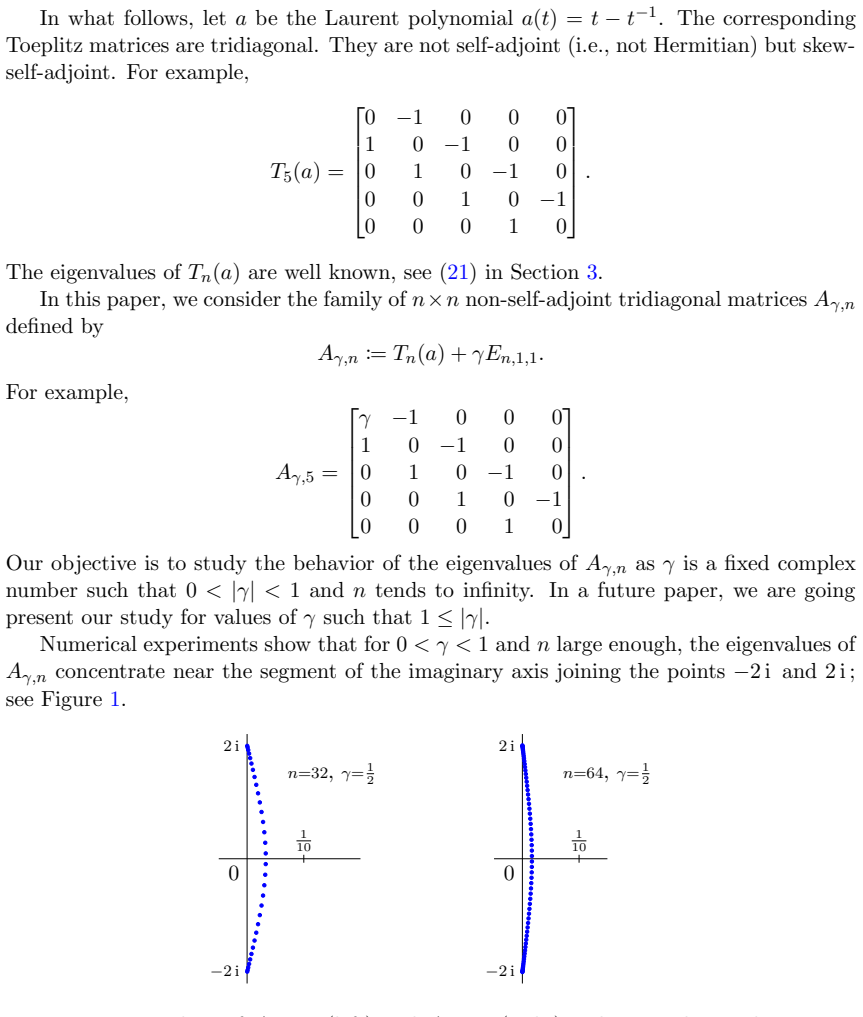
The eigenvalues of the matrices T_n(a) + gamma E_{n,1,1}, where a(t) = t - t^{-1} and 0 < |gamma| < 1, are asymptotically distributed according to the function 2i sin(x) for x in [0, 2pi]. For every eigenvalue an explicit asymptotic formula holds whose remainder term is of order O(1/n^3) as n tends to infinity.
What carries the argument
The Toeplitz matrix generated by the symbol a(t) = t - t^{-1} together with the rank-one corner perturbation gamma at position (1,1).
If this is right
- The eigenvalues remain distributed along the curve traced by 2i sin(x) even after the corner perturbation is added.
- Each individual eigenvalue can be approximated by solving a lower-order or transcendental equation rather than computing the full n-by-n determinant.
- The perturbation does not alter the leading-order spectral distribution of the underlying Toeplitz matrix.
- The O(1/n^3) error term holds uniformly for every eigenvalue as the matrix dimension grows.
Where Pith is reading between the lines
- The same asymptotic technique may extend to other corner positions or to symbols whose range is a smooth curve on the complex plane.
- The explicit formula could be used to construct fast eigensolvers for structured matrices arising in discretizations of skew-adjoint differential operators.
- Verification of the error rate for moderate n would also test the robustness of the derivation when |gamma| approaches the boundary of the allowed interval.
Load-bearing premise
The base matrix must be generated exactly by the symbol a(t) = t - t^{-1} and the perturbation parameter must satisfy 0 < |gamma| < 1.
What would settle it
Numerical computation of the eigenvalues for a sequence of increasing n (for example n=50, 100, 200) followed by direct comparison of the observed deviation from the stated asymptotic expression against the claimed O(1/n^3) bound.
Figures
read the original abstract
In this paper, we study the eigenvalues of the matrices $T_n(a)+\gamma E_{n,1,1}$ where $T_n(a)$ is the Toeplitz matrix with generating symbol $a(t)=t-t^{-1}$, $E_{n,1,1}$ is the $n\times n$ matrix whose upper left component is $1$ and the other components are zero, and $\gamma$ is a fixed complex number such that $0<|\gamma|<1$. As $n\to\infty$, the eigenvalues of these matrices are asymptotically distributed as the function $2 i \sin(x)$, $x\in[0,2\pi]$. Our main result is an asymptotic formula for every eigenvalue with a residue of the order $O(1/n^3)$.
Editorial analysis
A structured set of objections, weighed in public.
Referee Report
Summary. The paper examines the eigenvalues of the perturbed tridiagonal skew-self-adjoint Toeplitz matrices T_n(a) + γ E_{n,1,1} with symbol a(t) = t - t^{-1} and 0 < |γ| < 1. It establishes the asymptotic distribution of the eigenvalues along the curve 2i sin(x) for x ∈ [0, 2π] as n → ∞, and provides a main result consisting of an asymptotic formula for each eigenvalue with an error of order O(1/n^3).
Significance. If valid, this work contributes a high-order asymptotic expansion for the eigenvalues of a specific family of non-Hermitian Toeplitz matrices under rank-one corner perturbation. The explicit O(1/n^3) remainder is a strength, offering more precision than typical distribution theorems and potentially enabling applications in stability analysis or numerical methods for such matrices. The choice of the symbol allows the unperturbed spectrum to be explicitly known, facilitating the perturbation analysis.
minor comments (3)
- [Abstract] The term 'residue of the order O(1/n^3)' should be clarified; it appears to refer to the remainder term in the asymptotic expansion for the eigenvalues.
- [Introduction] Consider adding a brief comparison to existing results on perturbed Toeplitz matrices, such as those involving bulk spectrum perturbations or other corner modifications, to better contextualize the novelty.
- [Main theorem] Ensure that the indexing of the eigenvalues (e.g., ordered by argument or real part) is clearly defined in the statement of the asymptotic formula.
Simulated Author's Rebuttal
We thank the referee for the positive evaluation of our manuscript, including the assessment of its significance and the recommendation for minor revision. No specific major comments were provided in the report, so we have no points requiring point-by-point rebuttal or clarification at this stage. We will address any minor editorial or typographical issues in the revised version as needed.
Circularity Check
No significant circularity; derivation self-contained
full rationale
The central claim is an asymptotic formula for each eigenvalue of the explicitly defined rank-one perturbed Toeplitz matrix T_n(a) + γ E_{n,1,1} (with a(t)=t-t^{-1} and 0<|γ|<1) that holds with remainder O(1/n^3). This is obtained by direct analysis of the matrix symbol, the essential spectrum 2i sin(x), and the secular equation induced by the corner perturbation; the error term is controlled uniformly under the stated hypotheses. No step reduces a prediction to a fitted quantity defined from the same data, no uniqueness theorem is imported from the authors' prior work as an external fact, and no ansatz is smuggled via self-citation. The derivation therefore stands on the explicit matrix structure and standard asymptotic techniques for Toeplitz operators.
Axiom & Free-Parameter Ledger
axioms (1)
- standard math Eigenvalues of the unperturbed Toeplitz matrix T_n(a) are known to lie near the range of a(t) on the unit circle.
Reference graph
Works this paper leans on
-
[1]
(2018): Eigenvalues of even very nice Toeplitz matrices can be unexpectedly erratic
Barrera, M.; B¨ ottcher, A.; Grudsky, S.M.; Maximenko, E.A. (2018): Eigenvalues of even very nice Toeplitz matrices can be unexpectedly erratic. Oper. Theory: Adv. Appl. 268, 51–77. Birkh¨ auser, Cham. https://doi.org/10.1007/978-3-319-75996-8_2
-
[2]
Bogoya, J.M.; Grudsky, S.M.; Maximenko, E.A. (2017): Eigenvalues of Hermitian Toeplitz matrices generated by simple-loop symbols with relaxed smoothness. In: Bini, D.; Ehrhardt, T.; Karlovich, A.; Spitkovsky, I. (eds), Large Truncated Toeplitz Matrices, Toeplitz Operators, and Related Topics. Oper. Theory: Adv. Appl. 259, 179–212. Birkh¨ auser, Cham. http...
-
[3]
(2015): Eigenvalues of Hermitian Toeplitz matrices with smooth simple-loop symbols
Bogoya, J.M.; B¨ ottcher, A.; Grudsky, S.M.; Maximenko, E.A. (2015): Eigenvalues of Hermitian Toeplitz matrices with smooth simple-loop symbols. J. Math. Anal. Appl. 422, 1308–1334. https://doi.org/10.1016/j.jmaa.2014.09.057
-
[4]
(2014): Toeplitz determi- nants with perturbations in the corners
B¨ ottcher, A.; Fukshansky, L.; Garcia, S.R.; Maharaj, H. (2014): Toeplitz determi- nants with perturbations in the corners. J. Funct. Anal. 268, 171–193. https://doi.org/10.1016/j.jfa.2014.10.023
-
[5]
(2026): Approximating eigenvalues of a class of perturbed tridiagonal systems
Chorianopoulos, C.; Famelis, I.T. (2026): Approximating eigenvalues of a class of perturbed tridiagonal systems. Mathematics 14(6), 1063. https://doi.org/10.3390/math14061063
-
[6]
(2000): Non-equilibrium statistical mechanics of strongly anharmonic chains of oscillators
Eckmann, J.P.; Hairer, M. (2000): Non-equilibrium statistical mechanics of strongly anharmonic chains of oscillators. Commun. Math. Phys. 212, 105–164. https://doi.org/10.1007/s002200000216
-
[7]
(1980): The construction of Jacobi and periodic Jacobi matrices with prescribed spectra
Ferguson, W.E. (1980): The construction of Jacobi and periodic Jacobi matrices with prescribed spectra. Math. Comput. 35, 1203–1220. https://doi.org/10.2307/2006386
-
[8]
(2009): The inverse eigenvalue problem for Hermi- tian matrices whose graphs are cycles
Fernandes, R.; Da Fonseca, C.M. (2009): The inverse eigenvalue problem for Hermi- tian matrices whose graphs are cycles. Linear Multilinear Algebra 57, 673–682. https://doi.org/10.1080/03081080802187870
-
[9]
(2009): On the spectra of certain directed paths
Da Fonseca, C.M.; Veerman, J.J.P. (2009): On the spectra of certain directed paths. Appl. Math. Lett. 22, 1351–1355. https://doi.org/10.1016/j.aml.2009.03.006
-
[10]
(2017): Generalized Locally Toeplitz Sequences: The- ory and Applications, vol
Garoni, C., Serra-Capizzano, S. (2017): Generalized Locally Toeplitz Sequences: The- ory and Applications, vol. I, Springer, Cham. 23
2017
-
[11]
Grudsky, S.M.; Maximenko, E.A.; Soto-Gonz´ alez, A. (2021): Eigenvalues of tridiag- onal Hermitian Toeplitz matrices with perturbations in the off-diagonal corners. In: Karapetyants, A.N.; Kravchenko, V.V.; Liflyand, E.; Malonek, H.R. (eds), Operator Theory and Harmonic Analysis. Springer Proc. Math. Stat. 357, 179–202. Springer, Cham. https://doi.org/10....
-
[12]
(2022): Eigenvalues of the Laplacian matrices of the cycles with one weighted edge
Grudsky, S.M.; Maximenko, E.A.; Soto-Gonz´ alez, A. (2022): Eigenvalues of the Laplacian matrices of the cycles with one weighted edge. Linear Algebra Appl. 653, 86–115. https://doi.org/10.1016/j.laa.2022.07.011
-
[13]
(2023): Eigenvalues of Laplacian matrices of the cycles with one negative-weighted edge
Grudsky, S.M.; Maximenko, E.A.; Soto-Gonz´ alez, A. (2023): Eigenvalues of Laplacian matrices of the cycles with one negative-weighted edge. Linear Algebra Appl. https://doi.org/10.1016/j.laa.2023.12.003
-
[14]
(2025): Eigenvalues of the Laplacian matrices of cycles with one overweighted edge
Grudsky, S.M.; Maximenko, E.A.; Soto-Gonz´ alez, A. (2025): Eigenvalues of the Laplacian matrices of cycles with one overweighted edge. In: B¨ ottcher, A.; Karlovych, O.; Shargorodsky, E.; Spitkovsky, I.M. (eds), Achievements and Challenges in the Field of Convolution Operators. Oper. Theory: Adv. Appl. 306, 215–246. Birkh¨ auser, Cham. https://doi.org/10...
-
[15]
(2003): The Analysis of Linear Partial Differential Operators I
H¨ ormander, L. (2003): The Analysis of Linear Partial Differential Operators I. Springer, Berlin, Heidelberg
2003
-
[16]
(2007): Finite Difference Methods for Ordinary and Partial Differential Equations: Steady-State and Time-Dependent Problems
LeVeque, R.J. (2007): Finite Difference Methods for Ordinary and Partial Differential Equations: Steady-State and Time-Dependent Problems. SIAM, Philadelphia
2007
-
[17]
(2003): Chebyshev Polynomials
Mason, J.C.; Handscomb, D.C. (2003): Chebyshev Polynomials. CRC Press, Boca Raton, FL
2003
-
[18]
(2015): On the inverse and determinant of general bordered tridiagonal matrices
Jia, J.; Li, S. (2015): On the inverse and determinant of general bordered tridiagonal matrices. Comput. Math. Appl. 69, 503–509. https://doi.org/10.1016/j.camwa.2015.01.012
-
[19]
(2017): On determinants of cyclic pentadiagonal matrices with Toeplitz structure
Jia, J.; Li, S. (2017): On determinants of cyclic pentadiagonal matrices with Toeplitz structure. Comput. Math. Appl. 73, 304–309. https://doi.org/10.1016/j.camwa.2016.11.031
-
[20]
(1967): Properties of a harmonic crystal in a stationary nonequilibrium state
Rieder, Z.; Lebowitz, J.L.; Lieb, E. (1967): Properties of a harmonic crystal in a stationary nonequilibrium state. J. Math. Phys. 8(5), 1073–1078. https://doi.org/10.1063/1.1705319. 24
-
[21]
(2023): Analytical potential formulae and fast algorithm for a horn torus resistor network
Jiang, Z.; Zhou, Y.; Jiang, X.; Zheng, Y. (2023): Analytical potential formulae and fast algorithm for a horn torus resistor network. Phys. Rev. E 107. https://doi.org/10.1103/PhysRevE.107.044123
-
[22]
Yueh, W.C.; Cheng, S.S. (2008): Explicit eigenvalues and inverses of tridiagonal Toeplitz matrices with four perturbed corners. ANZIAM J. 49, 361–387. https://doi.org/10.1017/S1446181108000102
-
[23]
Zhang, M.; Jiang, X.; Jiang, Z. (2019): Explicit determinants, inverses and eigenval- ues of four band Toeplitz matrices with perturbed rows. Special Matrices 7, 52–66. https://doi.org/10.1515/spma-2019-0004
-
[24]
Zhang, G.; Jiang, X.; Zheng, Y.; Jiang, Z. (2024): New analytical function of potential and fast algorithm for solving potentials inm×nfan resistor network. ScienceAsia 6, 1–10. https://doi.org/10.2306/scienceasia1513-1874.2024.100. Authors’ data C´ edric Bernardin, sedric.bernardin@gmail.com, https://orcid.org/0000-0002-3467-2804. National Research Unive...
discussion (0)
Sign in with ORCID, Apple, or X to comment. Anyone can read and Pith papers without signing in.