Recognition: unknown
ATOMIUM: Inner circumstellar envelopes of oxygen-rich AGB stars as revealed by highly excited SiO lines
Pith reviewed 2026-05-08 05:22 UTC · model grok-4.3
The pith
High-excitation SiO lines show mass loss and CSE geometry shaping emission in oxygen-rich AGB stars.
A machine-rendered reading of the paper's core claim, the machinery that carries it, and where it could break.
Core claim
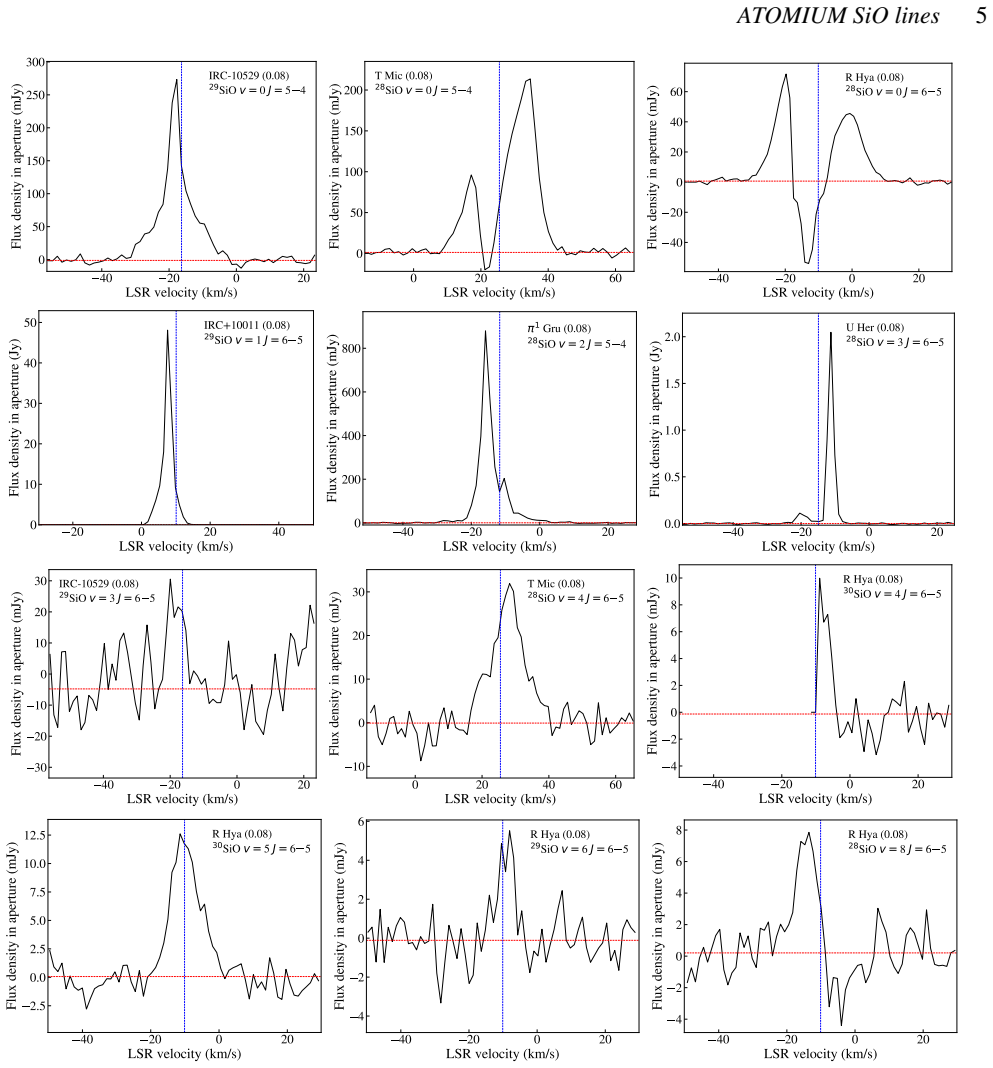
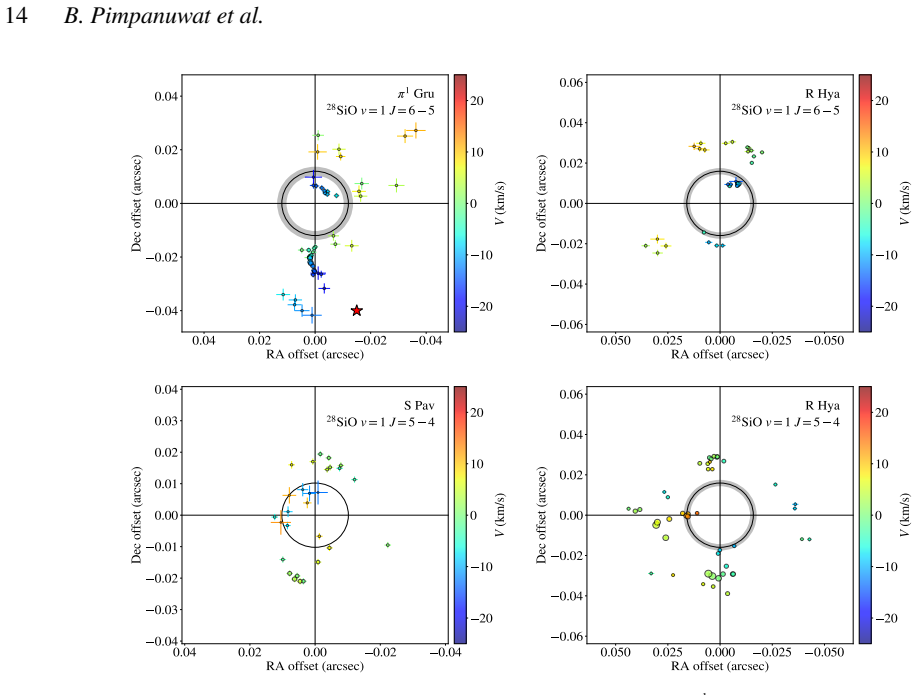
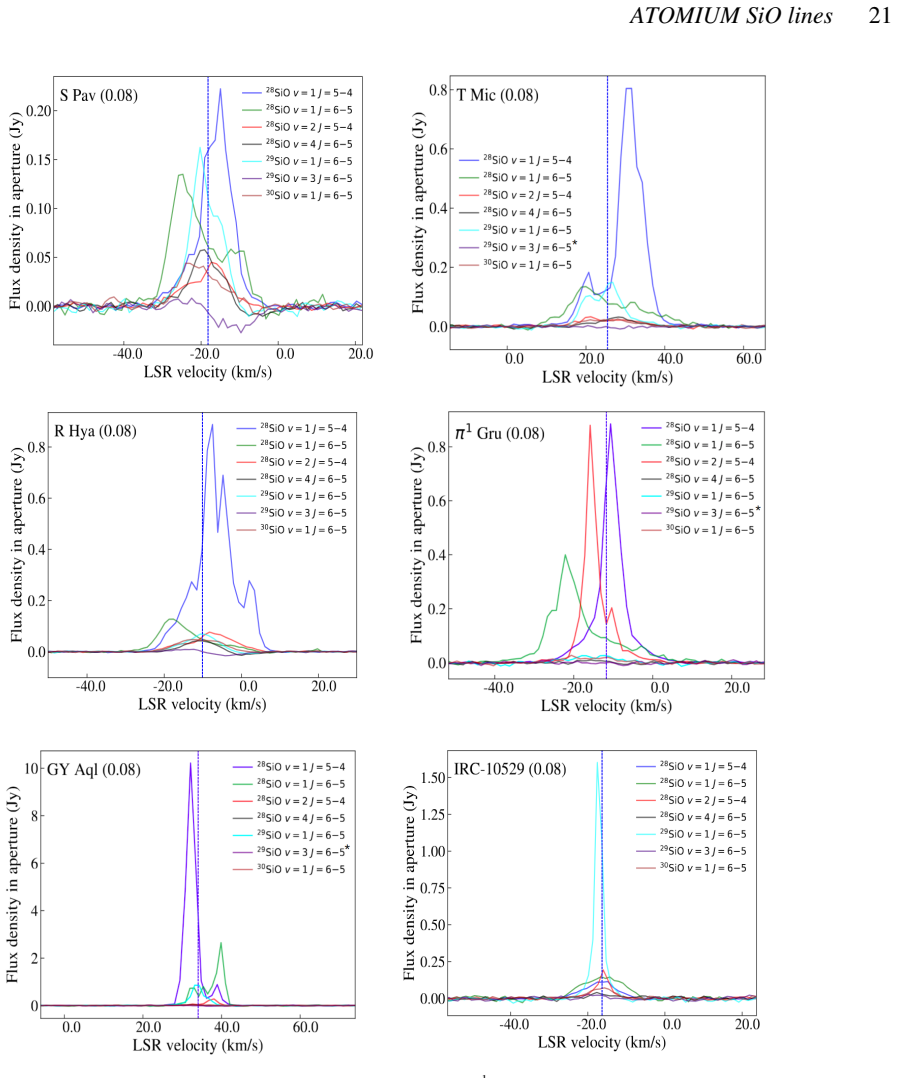
High-resolution ALMA observations detect highly excited SiO emission, including first sightings of 28SiO v=3,4,8 J=6-5 and several isotopic lines up to v=8, in 14 oxygen-rich AGB stars. The v=8 line is the highest vibrational state yet seen in an AGB star. Emission is frequently distributed in arcs or clumps that display clear velocity gradients; in R Hya and U Her these components coincide with expected shock locations. Absorption in the v=0 J=6-5 line appears in four stars and indicates both infalling and outflowing gas. Overall detection statistics are similar for low- and high-mass-loss objects, and the 90-percent emission radius shows a possible correlation with mass-loss rate.
What carries the argument
ALMA Band 6 spectral mapping of SiO lines from v=0 to v=8 that resolves spatial distributions and velocity fields in the inner circumstellar envelopes.
If this is right
- The radius enclosing 90 percent of compact SiO emission correlates tentatively with mass-loss rate.
- SiO components in R Hya and U Her coincide with predicted shock fronts.
- Maser detections occur independently of pulsation period or phase.
- Absorption features in the J=6-5 line trace both infalls and outflows in several stars.
- Line overlap can alter some intensities but leaves overall detection rates similar across mass-loss regimes.
Where Pith is reading between the lines
- If the arc and clump patterns trace shocks, asymmetric mass loss must already operate within a few stellar radii.
- The tentative size-mass-loss relation offers a potential observable proxy for envelope properties in stars too distant for direct imaging.
- Absence of pulsation-phase dependence implies the high-v excitation is set by time-averaged envelope conditions rather than the instantaneous pulsation state.
Load-bearing premise
The observed line profiles, spatial clumps, and velocity gradients accurately reflect true physical conditions and dynamics without major distortion from optical depth, line blending, or misidentification.
What would settle it
Higher-resolution imaging or full radiative-transfer modeling of one well-observed star that shows the reported arcs and gradients are projection artifacts or optical-depth illusions would falsify the geometric interpretation.
Figures





read the original abstract
Silicon monoxide (SiO) traces the physical conditions and dynamics in the circumstellar envelopes (CSEs) of AGB stars. We present high-resolution ALMA Band 6 observations of highly excited SiO emission in 14 oxygen-rich AGB stars. We cover transitions from v = 0 to v = 8, including first detections of 28SiO v = 3, 4, 8, J = 6-5, 29SiO v = 6, J = 6-5, and 30SiO v = 4, 5, J = 6-5, some of which are masers. The v = 8 transition is the highest v-state observed in an AGB star yet. Masers in v = 0 are detected clearly in V PsA and IRC+10011 and tentatively in T Mic. R Hya exhibits the richest SiO spectrum. SiO J = 6-5 absorption is seen in R Aql, R Hya, S Pav, and T Mic, with features indicative of both infalls and outflows, and tentative detection of 28SiO v = 8, J = 6-5 absorption is found towards S Pav and R Aql. Highly excited SiO emission is often distributed in arcs or clumps with velocity gradients; components in R Hya and U Her align with predicted shock fronts. Detection rates show no significant difference between low and high mass-loss rate stars, although line overlap may affect some intensities. Maser detections appear uncorrelated with pulsation period or phase. The radius enclosing 90 per cent of compact SiO emission shows a tentative correlation with mass-loss rate. These results highlight the role of mass loss and CSE geometry in shaping high-excitation SiO emission.
Editorial analysis
A structured set of objections, weighed in public.
Referee Report
Summary. The paper presents new high-resolution ALMA Band 6 observations of SiO transitions from v=0 to v=8 (including first detections of several 28SiO, 29SiO, and 30SiO lines, some masers) toward 14 oxygen-rich AGB stars. It reports spatial distributions often in arcs or clumps with velocity gradients, absorption features indicating infall/outflow in several sources, tentative alignments with predicted shock fronts in R Hya and U Her, no significant difference in detection rates between low- and high-mass-loss stars, and a tentative correlation between the 90% emission radius and mass-loss rate. The central claim is that mass loss and CSE geometry shape the high-excitation SiO emission.
Significance. If the geometric and dynamical interpretations hold after addressing optical-depth concerns, the work supplies a valuable multi-star survey of inner-CSE conditions using high-v SiO lines as tracers, extending the observed excitation ladder to v=8 and providing new constraints on shock and mass-loss processes in AGB stars. The strength lies in the uniform high-resolution dataset and the empirical correlations across a range of mass-loss rates.
major comments (2)
- [§5 (Discussion) and abstract] §5 (Discussion) and abstract: The interpretation that observed arcs, clumps, velocity gradients, and the tentative radius–mass-loss correlation directly trace CSE geometry and dynamics is load-bearing for the central claim, yet the manuscript provides no radiative-transfer calculations or optical-depth estimates for the v=0–8 ladder. The abstract notes that line overlap may affect intensities and reports absorption plus tentative v=8 features, but without quantification it remains unclear whether the reported alignments with shock fronts (R Hya, U Her) or the lack of detection-rate difference between low- and high-mass-loss stars survive self-absorption, maser amplification, or isotopic blends.
- [Results section on individual sources and the 90% emission radius analysis] Results section on individual sources and the 90% emission radius analysis: The tentative correlation between the radius enclosing 90% of compact SiO emission and mass-loss rate is presented without reported uncertainties on the radii, details of how the 90% contour is defined (e.g., beam deconvolution, noise threshold), or a statistical test of significance; this weakens the cross-star claim until quantified.
minor comments (2)
- [Abstract and results] Abstract and results: Clarify the exact significance thresholds used for 'tentative' detections (e.g., v=8 absorption in S Pav and R Aql) and 'clear' vs. 'tentative' masers.
- [Figure captions and methods] Figure captions and methods: Ensure all maps and spectra include explicit velocity ranges, beam sizes, and noise levels so that spatial distributions and gradients can be independently assessed.
Simulated Author's Rebuttal
We thank the referee for their careful reading and constructive comments, which have helped improve the clarity and rigor of our manuscript. We address each major comment below and have made revisions where appropriate to strengthen the discussion of optical-depth effects and to quantify the emission-radius analysis.
read point-by-point responses
-
Referee: [§5 (Discussion) and abstract] §5 (Discussion) and abstract: The interpretation that observed arcs, clumps, velocity gradients, and the tentative radius–mass-loss correlation directly trace CSE geometry and dynamics is load-bearing for the central claim, yet the manuscript provides no radiative-transfer calculations or optical-depth estimates for the v=0–8 ladder. The abstract notes that line overlap may affect intensities and reports absorption plus tentative v=8 features, but without quantification it remains unclear whether the reported alignments with shock fronts (R Hya, U Her) or the lack of detection-rate difference between low- and high-mass-loss stars survive self-absorption, maser amplification, or isotopic blends.
Authors: We agree that full radiative-transfer modeling would provide the most robust assessment of optical-depth, maser, and line-overlap effects. However, such modeling for 14 individual sources with poorly constrained temperature and density profiles is a major computational effort that exceeds the scope of this observational survey. In the revised manuscript we have added a dedicated paragraph in §5 that uses observed line-intensity ratios (including between v-states and isotopologues) to argue that the v ≥ 4 transitions are likely optically thin while lower-v lines may experience maser amplification or self-absorption. We have also inserted explicit caveats in both the abstract and §5 stating that the shock-front alignments and radius–mass-loss trend are empirical and should be interpreted cautiously pending detailed RT calculations. These additions directly address the referee’s concern without overstating the robustness of the geometric interpretations. revision: partial
-
Referee: [Results section on individual sources and the 90% emission radius analysis] Results section on individual sources and the 90% emission radius analysis: The tentative correlation between the radius enclosing 90% of compact SiO emission and mass-loss rate is presented without reported uncertainties on the radii, details of how the 90% contour is defined (e.g., beam deconvolution, noise threshold), or a statistical test of significance; this weakens the cross-star claim until quantified.
Authors: We thank the referee for highlighting this omission. In the revised results section we now describe the 90 % radius measurement explicitly: the contour is drawn at the radius that encloses 90 % of the total integrated flux above a 3σ noise threshold in the moment-0 maps, with beam deconvolution applied using the synthesized beam. Uncertainties are derived from the beam size (0.1–0.2 arcsec) and the noise level at the contour edge. We have also added a Spearman rank-order correlation test, yielding ρ ≈ 0.65 and p ≈ 0.01, which we report together with the individual radii and their uncertainties in a new supplementary table. The correlation is still labeled “tentative” owing to the modest sample size, but it is now quantitatively supported. revision: yes
Circularity Check
No circularity: purely observational survey with empirical findings only
full rationale
This is an observational ALMA survey paper reporting new detections of highly excited SiO lines (v=0 to v=8), spatial distributions, velocity gradients, absorption features, and a tentative radius-mass-loss correlation across 14 AGB stars. The abstract and described content contain no derivations, model fits, predictions from fitted parameters, or load-bearing self-citations that reduce claims to inputs by construction. Central statements about mass loss and CSE geometry shaping emission are presented as direct interpretations of the data, with explicit caveats on line overlap and optical depth. No equations, ansatzes, uniqueness theorems, or renamings of prior results appear that would trigger any of the enumerated circularity patterns. The analysis is self-contained against external benchmarks as raw observational reporting.
Axiom & Free-Parameter Ledger
axioms (1)
- domain assumption Standard molecular line frequencies and quantum numbers from databases accurately identify the observed SiO transitions
Reference graph
Works this paper leans on
-
[1]
(Sub)stellar companions shape the winds of evolved stars. Science , keywords =. doi:10.1126/science.abb1229 , archivePrefix =. 2009.11694 , primaryClass =
-
[2]
Motivation, sample, calibration, and initial results
ATOMIUM: ALMA tracing the origins of molecules in dust forming oxygen rich M-type stars. Motivation, sample, calibration, and initial results. , keywords =. 2022 , volume =. doi:10.1051/0004-6361/202140431 , archivePrefix =. 2112.04399 , primaryClass =
-
[3]
Hoyle, F. and Wickramasinghe, N. C. , title = ". , year =. doi:10.1093/mnras/124.5.417 , adsurl =
-
[4]
Mass loss of stars on the asymptotic giant branch
H. Mass loss of stars on the asymptotic giant branch. Mechanisms, models and measurements. , keywords =. 2018 , volume =. doi:10.1007/s00159-017-0106-5 , adsurl =
-
[5]
Very fast variations of SiO maser emission in evolved stars. , keywords =. 2020 , volume =. doi:10.1051/0004-6361/202037499 , archivePrefix =. 2009.09771 , primaryClass =
-
[6]
Advances in Space Research , keywords =
Masers: Precision probes of molecular gas. Advances in Space Research , keywords =. 2020 , volume =. doi:10.1016/j.asr.2019.05.052 , adsurl =
-
[7]
Evolved star water maser cloud size determined by star size. , keywords =. doi:10.1051/0004-6361/201219514 , archivePrefix =. 1207.2583 , primaryClass =
-
[8]
doi:10.1007/978-94-011-2394-5 , adsurl =
Astronomical masers. doi:10.1007/978-94-011-2394-5 , adsurl =
-
[9]
Maser Sources in Astrophysics
-
[10]
Symposium-International Astronomical Union , year = 1999, volume =
Structure and Evolution of AGB Stars. Symposium-International Astronomical Union , year = 1999, volume =
1999
-
[11]
Cosmic Masers: From Proto-Stars to Black Holes , year = 2002, volume =
Topics in basic maser theory. Cosmic Masers: From Proto-Stars to Black Holes , year = 2002, volume =
2002
-
[12]
SiO maser emission in Miras. , keywords =. doi:10.1111/j.1365-2966.2008.14237.x , archivePrefix =. 0811.2770 , primaryClass =
-
[13]
Dynamical Modeling of Long-Period Variable Star Atmospheres. , keywords =. doi:10.1086/166378 , adsurl =
-
[14]
The onset of the AGB wind tied to a transition between sequences in the period-luminosity diagram. , keywords =. doi:10.1093/mnras/stz324 , archivePrefix =. 1901.06325 , primaryClass =
-
[15]
doi:10.1007/978-1-4757-3876-6 , adsurl =
Asymptotic Giant Branch Stars. doi:10.1007/978-1-4757-3876-6 , adsurl =
-
[16]
Ground Vibrational State SiO Emission in the VLA BAaDE Survey. , keywords =. doi:10.3847/1538-3881/abd479 , archivePrefix =. 2012.09348 , primaryClass =
-
[17]
, keywords =
Explanation of \^29\^SiO, \^30\^SiO and high-v \^28\^SiO maser emission. , keywords =
-
[18]
Detection of SiO J=7-6 maser emission. , keywords =. doi:10.1093/mnras/277.1.L67 , adsurl =
-
[19]
High-Excitation SiO Masers in Evolved Stars. , keywords =. doi:10.1086/165868 , adsurl =
-
[20]
SiO, ^ 29 SiO, and ^ 30 SiO Emission from 67 Oxygen-rich Stars: A Survey of 61 Maser Lines from 7 to 1 mm. , keywords =. doi:10.3847/1538-4365/abe469 , archivePrefix =. 2102.03548 , primaryClass =
-
[21]
High-Excitation 29SiO and 30SiO Maser Emission. , keywords =. doi:10.1086/186683 , adsurl =
-
[22]
Nearly simultaneous observations of vibrationally excited J=1-O, J=2-1,J=3-2, and J=4-3 SiO masers. , keywords =. doi:10.1086/183795 , adsurl =
-
[23]
86 GHz SiO maser survey of late-type stars in the Inner Galaxy. I. Observational data. , keywords =. doi:10.1051/0004-6361:20021017 , archivePrefix =. astro-ph/0207284 , primaryClass =
-
[24]
SiO maser survey of late-type stars. I. Simultaneous observations of six transitions of \^28\^SiO and \^29\^SiO. , keywords =
-
[25]
The Bulge Asymmetries and Dynamical Evolution (BAaDE) SiO Maser Survey at 86 GHz with ALMA. , keywords =. doi:10.3847/1538-4365/ab3c35 , archivePrefix =. 1909.02090 , primaryClass =
-
[26]
A new 3D maser code applied to flaring events. , keywords =. doi:10.1093/mnras/sty576 , archivePrefix =. 1803.01625 , primaryClass =
-
[27]
Proceedings of the 2016 ALMA Conference , year = 2016, month = sep, eid =
The ALMA Science Pipeline: Current Status. Proceedings of the 2016 ALMA Conference , year = 2016, month = sep, eid =
2016
-
[28]
, year = 1996, month = jan, volume =
Circumstellar envelopes and Asymptotic Giant Branch stars. , year = 1996, month = jan, volume =. doi:10.1007/PL00013287 , adsurl =
-
[29]
, year = 2005, month = sep, volume =
Evolution of Asymptotic Giant Branch Stars. , year = 2005, month = sep, volume =. doi:10.1146/annurev.astro.43.072103.150600 , adsurl =
-
[30]
2012, MNRAS, 420, 1825, doi: 10.1111/j.1365-2966.2011.19805.x
The 43-GHz SiO maser in the circumstellar envelope of the asymptotic giant branch star R Cassiopeiae. , keywords =. doi:10.1111/j.1365-2966.2011.18629.x , archivePrefix =. 1105.1089 , primaryClass =
-
[31]
ATOMIUM: A high-resolution view on the highly asymmetric wind of the AGB star ^ 1 Gruis. I. First detection of a new companion and its effect on the inner wind. , keywords =. doi:10.1051/0004-6361/202039185 , archivePrefix =. 2010.05509 , primaryClass =
-
[32]
ATOMIUM: The astounding complexity of the near circumstellar environment of the M-type AGB star R Hydrae. I. Morpho-kinematical interpretation of CO and SiO emission. , keywords =. doi:10.1051/0004-6361/202140512 , archivePrefix =. 2104.07297 , primaryClass =
-
[33]
High-Excitation SiO Maser Emission in VY Canis Majoris: Detection of the V = 4 J = 5--4 Transition. , keywords =. doi:10.1086/186799 , adsurl =
-
[34]
SiO isotopic maser emission from VY Canis Majoris. , keywords =. doi:10.1086/183945 , adsurl =
-
[35]
Astrophysical Masers , year = 1993, editor =
SiO masers in VY CMa: detection of maser emission in the v = 4 state. Astrophysical Masers , year = 1993, editor =. doi:10.1007/3-540-56343-1_294 , adsurl =
-
[36]
The Mira variable S Orionis: relationships between the photosphere, molecular layer, dust shell, and SiO maser shell at 4 epochs. , keywords =. doi:10.1051/0004-6361:20077168 , archivePrefix =. 0705.4614 , primaryClass =
-
[37]
Astronomy and Astrophysics , author =
Gaia Data Release 3. Summary of the content and survey properties. , keywords =. doi:10.1051/0004-6361/202243940 , archivePrefix =. 2208.00211 , primaryClass =
-
[38]
Distance estimates for AGB stars from parallax measurements. , keywords =. doi:10.1051/0004-6361/202243670 , archivePrefix =. 2209.03906 , primaryClass =
-
[39]
The VLT/SPHERE view of the ATOMIUM cool evolved star sample. I. Overview: Sample characterization through polarization analysis. , keywords =. doi:10.1051/0004-6361/202245398 , archivePrefix =. 2301.02081 , primaryClass =
-
[40]
The Physics and Chemistry of the Interstellar Medium
-
[41]
Evolution and Mass Loss of Cool Ageing Stars: a Daedalean Story. , keywords =. doi:10.1146/annurev-astro-090120-033712 , archivePrefix =. 2011.13472 , primaryClass =
-
[42]
Astronomical Data Analysis Software and Systems XVI , year = 2007, editor =
CASA Architecture and Applications. Astronomical Data Analysis Software and Systems XVI , year = 2007, editor =
2007
-
[43]
The atmospheric structure and fundamental parameters of the red supergiants AH Scorpii, UY Scuti, and KW Sagittarii. , keywords =. doi:10.1051/0004-6361/201220920 , archivePrefix =. 1305.6179 , primaryClass =
-
[44]
VLBI Observations of SiO Masers around AH Scorpii. , keywords =. doi:10.1086/588186 , archivePrefix =. 0803.1690 , primaryClass =
-
[45]
Measuring the Distance of VX Sagittarii with SiO Maser Proper Motions. , keywords =. doi:10.1088/1009-9271/7/4/09 , adsurl =
-
[46]
Mass loss rates of a sample of irregular and semiregular M-type AGB-variables. , keywords =. doi:10.1051/0004-6361:20020841 , archivePrefix =. astro-ph/0206172 , primaryClass =
-
[47]
Mass-loss from dusty, low outflow-velocity AGB stars. I. Wind structure and mass-loss rates. , keywords =. doi:10.1051/0004-6361:20031110 , adsurl =
-
[48]
Millimeter and some near infra-red observations of short-period Miras and other AGB stars. , keywords =. doi:10.1051/aas:1999418 , adsurl =
-
[49]
Probing the mass-loss history of AGB and red supergiant stars from CO rotational line profiles. II. CO line survey of evolved stars: derivation of mass-loss rate formulae. , keywords =. doi:10.1051/0004-6361/200913771 , archivePrefix =. 1008.1083 , primaryClass =
-
[50]
A CO(3--2) Survey of Nearby Mira Variables. , keywords =. doi:10.1086/175747 , archivePrefix =. astro-ph/9501020 , primaryClass =
-
[51]
, year = 2006, month = apr, volume =
CO line emission from circumstellar envelopes. , year = 2006, month = apr, volume =. doi:10.1051/0004-6361:20053759 , adsurl =
-
[52]
DEATHSTAR: Nearby AGB stars with the Atacama Compact Array. I. CO envelope sizes and asymmetries: A new hope for accurate mass-loss-rate estimates. , keywords =. doi:10.1051/0004-6361/201936874 , archivePrefix =. 2008.07885 , primaryClass =
-
[53]
APEX observations and radiative transfer modelling
Submillimetre water masers at 437, 439, 471, and 474 GHz towards evolved stars. APEX observations and radiative transfer modelling. , keywords =. doi:10.1051/0004-6361/202037774 , archivePrefix =. 2005.12624 , primaryClass =
-
[54]
CO Emission from Evolved Stars and Proto--Planetary Nebulae. , keywords =. doi:10.1086/167052 , adsurl =
-
[55]
The extended molecular envelope of the asymptotic giant branch star ^ 1 Gruis as seen by ALMA. I. Large-scale kinematic structure and CO excitation properties. , keywords =. doi:10.1051/0004-6361/201730703 , archivePrefix =. 1709.09435 , primaryClass =
-
[56]
Insights into the formation of barium and Tc-poor S stars from an extended sample of orbital elements. , keywords =. doi:10.48550/arXiv.astro-ph/9801272 , archivePrefix =. astro-ph/9801272 , primaryClass =
-
[57]
A catalogue - mass loss rates and distributions
CO and HCN observations of circumstellar envelopes. A catalogue - mass loss rates and distributions. , keywords =
-
[58]
Effects of an eccentric binary orbit
The circumstellar envelope around the S-type AGB star W Aql. Effects of an eccentric binary orbit. , keywords =. doi:10.1051/0004-6361/201730934 , archivePrefix =. 1709.07327 , primaryClass =
-
[59]
The mass-loss rates of red supergiants and the de Jager prescription. , keywords =. doi:10.1051/0004-6361/201013993 , archivePrefix =. 1010.5369 , primaryClass =
-
[60]
Mass-losing M Supergiants in the Solar Neighborhood. , keywords =. doi:10.1086/191488 , adsurl =
-
[61]
, keywords =
Evolution of massive stars under new mass-loss rates for RSG: is the mystery of the missing blue gap solved?. , keywords =
-
[62]
New observations and models of circumstellar CO line emission of AGB stars in the Herschel SUCCESS programme. , keywords =. doi:10.1051/0004-6361/201526705 , archivePrefix =. 1506.09065 , primaryClass =
-
[63]
``Thermal'' SiO radio line emission towards M-type AGB stars: A probe of circumstellar dust formation and dynamics. , keywords =. doi:10.1051/0004-6361:20031068 , archivePrefix =. astro-ph/0302179 , primaryClass =
-
[64]
The Parallax of the Red Hypergiant VX Sgr with Accurate Tropospheric Delay Calibration. , keywords =. doi:10.3847/1538-4357/aabba6 , archivePrefix =. 1804.00894 , primaryClass =
-
[65]
A global 3D RHD model of a dust-forming M-type AGB star
Exploring the origin of clumpy dust clouds around cool giants. A global 3D RHD model of a dust-forming M-type AGB star. , keywords =. doi:10.1051/0004-6361/201834799 , archivePrefix =. 1902.04074 , primaryClass =
-
[66]
R Aquarii: First Detection of Circumstellar SiO Maser Proper Motions. , keywords =. doi:10.1086/310896 , adsurl =
-
[67]
SiO masers in Mira variables at a single stellar phase. , keywords =. doi:10.1093/mnras/282.4.1359 , adsurl =
-
[68]
Ground-State SiO Maser Emission toward Evolved Stars. , keywords =. doi:10.1086/386541 , archivePrefix =. astro-ph/0403217 , primaryClass =
-
[69]
^ 28 SiO v = 0 J = 1-0 emission from evolved stars. , keywords =. doi:10.1051/0004-6361/201527174 , archivePrefix =. 1603.01163 , primaryClass =
-
[70]
Observation of a Ring Structure in SiO Maser Emission from Late-Type Stars. , keywords =. doi:10.1086/187438 , adsurl =
-
[71]
High resolution observations of SiO masers: Comparing the spatial distribution at 43 and 86 GHz. , keywords =. doi:10.1051/0004-6361:20041139 , archivePrefix =. astro-ph/0409467 , primaryClass =
-
[72]
Asymmetric distributions of H _ 2 O and SiO masers towards V627 Cas. , keywords =. doi:10.1093/mnras/staa1206 , archivePrefix =. 2006.01344 , primaryClass =
-
[73]
Near-infrared Observations of SiO Maser-emitting Asymptotic Giant Branch (AGB) Stars. , keywords =. doi:10.3847/0004-637X/817/2/115 , adsurl =
-
[74]
2012, MNRAS, 420, 1825, doi: 10.1111/j.1365-2966.2011.19805.x
Dynamical opacity-sampling models of Mira variables - II. Time-dependent atmospheric structure and observable properties of four M-type model series. , keywords =. doi:10.1111/j.1365-2966.2011.19469.x , archivePrefix =. 1107.3619 , primaryClass =
-
[75]
A long-term VLBA monitoring campaign of the v = 1, J = 1 0 SiO masers towards TX Cam - I. Morphology and shock waves. , keywords =. doi:10.1093/mnras/stt954 , archivePrefix =. 1306.0274 , primaryClass =
-
[76]
V., Melchior, A.-L., & Zolotukhin, I
Kinematics of the v=1, J=1->0 SiO masers at 43 GHz towards TX Cam - a new 73-frame movie. , keywords =. doi:10.1111/j.1365-2966.2010.16716.x , adsurl =
-
[77]
Investigation of the effect of shocks
Numerical simulations of stellar SiO maser variability. Investigation of the effect of shocks. , keywords =. doi:10.1051/0004-6361:20020202 , archivePrefix =. astro-ph/0202426 , primaryClass =
-
[78]
Short time scale monitoring of SiO sources. , keywords =. doi:10.48550/arXiv.astro-ph/9402061 , archivePrefix =. astro-ph/9402061 , primaryClass =
work page internal anchor Pith review doi:10.48550/arxiv.astro-ph/9402061
-
[79]
Eleven years of short spaced monitoring
^ 28 SiO v = 1 and v = 2, J = 1-0 maser variability in evolved stars. Eleven years of short spaced monitoring. , keywords =. doi:10.1051/0004-6361:20040309 , adsurl =
-
[80]
Observations of SiO masers at 43 GHz with the Parkes radio telescope. , keywords =. doi:10.1093/mnras/180.3.415 , adsurl =
discussion (0)
Sign in with ORCID, Apple, or X to comment. Anyone can read and Pith papers without signing in.