Recognition: unknown
Hybrid integrated narrow linewidth semiconductor laser based on the distributed feedback from an external deformed microcavity
Pith reviewed 2026-05-08 06:54 UTC · model grok-4.3
The pith
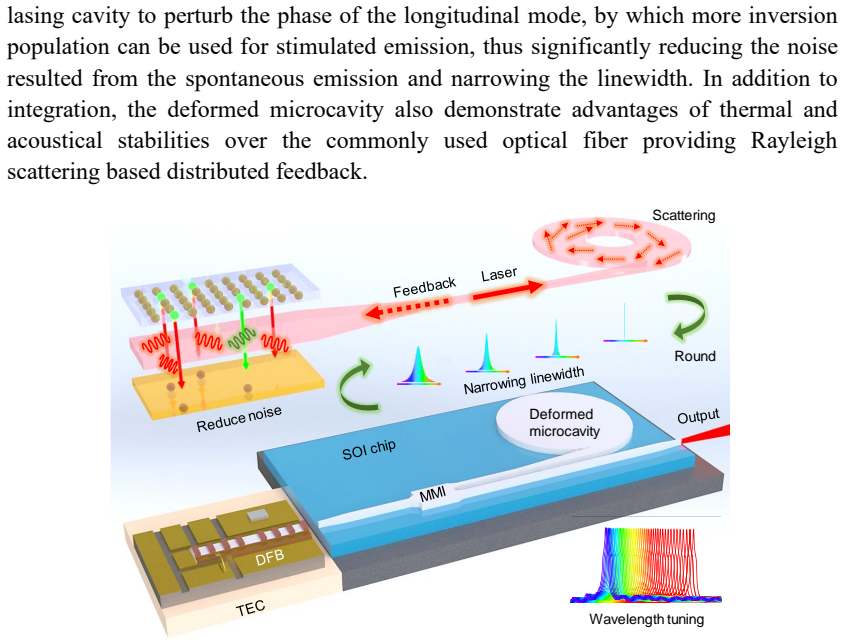
A deformed microcavity supplies wavelength self-adaptive feedback that narrows a DFB laser diode linewidth to 525 Hz while enabling continuous tuning over 2.25 nm.
A machine-rendered reading of the paper's core claim, the machinery that carries it, and where it could break.
Core claim
The deformed microcavity with vortex radius provides unidirectional energy storage, wavelength self-adaptivity, and self-focusing of Rayleigh-scattering-based distributed feedback; when hybrid-integrated with a DFB laser diode, this feedback narrows the intrinsic linewidth to 525 Hz, improves SMSR to 76 dB, and supports continuous wavelength tuning over 2.25 nm without discrete resonance restrictions.
What carries the argument
The deformed microcavity with vortex radius that generates wavelength self-adaptive distributed feedback through self-focusing Rayleigh scattering enhanced by a high-NA silicon waveguide.
If this is right
- Frequency noise drops to 2.98 Hz²/Hz at 1 MHz offset.
- Relative intensity noise reaches -148.74 dB/Hz at 1 MHz offset.
- The hybrid platform enables integrated tunable narrow-linewidth lasers for high-speed communication and high-precision spectroscopy.
Where Pith is reading between the lines
- The same deformed-cavity geometry could be combined with other on-chip laser sources or modulators on the same 220 nm SOI platform.
- Further linewidth reduction might be possible by increasing the waveguide numerical aperture or refining the vortex radius to strengthen the Rayleigh feedback.
- The wavelength-self-adaptive property may extend to other scattering-based feedback schemes in photonic integrated circuits.
Load-bearing premise
The deformed microcavity delivers truly wavelength-independent distributed feedback that stays stable and low-loss over the entire 2.25 nm tuning range without introducing unaccounted instabilities or fabrication variations.
What would settle it
An OFDR measurement of the optical feedback signal across the full 2.25 nm tuning range that shows constant equivalent propagation distance with no wavelength dependence or excess loss peaks.
Figures
read the original abstract
Optical microcavities with rotational symmetry have been widely used for narrowing linewidth and reducing frequency noise, however, the narrow but wavelength dependent optical feedback restricts the narrow linewidth laser works only at some discrete wavelength matching the resonance of the microcavity. Here, we demonstrate a narrow linewidth semiconductor laser with continuous wavelength tunability by hybrid integrating a DFB laser chip with a deformed microcavity fabricated on a 220 nm SOI wafer. The deformed microcavity with vortex radius demonstrates the unique characteristics of unidirectional energy storage, wavelength self-adaptivity, and self-focusing of the Rayleigh scattering based distributed feedback. In addition, the strength of Rayleigh scattering is also significantly enhanced by the high numerical aperture silicon waveguide. The optical feedback signal measured by the optical frequency domain reflectometry (OFDR) shows that the deformed microcavity can effectively lengthen the equivalent propagation distance without wavelength dependence. With the wavelength self-adaptive optical feedback from the deformed microcavity, the intrinsic linewidth of a DFB laser diode is narrowed to 525 Hz and the side mode suppression ratio (SMSR) is improved to 76 dB in a maximum allowable continuous wavelength tuning range of 2.25 nm. The frequency noise and relative intensity noise (RIN) are reduced to 2.98 Hz2 /Hz and -148.74 dB/Hz at the offset frequency of 1 MHz, respectively. The work demonstrated here paves a new way for integrated tunable narrow linewidth lasers, which are of crucial importance in high-speed communication and high-precision spectroscopy
Editorial analysis
A structured set of objections, weighed in public.
Referee Report
Summary. The manuscript reports a hybrid-integrated narrow-linewidth semiconductor laser formed by coupling a DFB laser diode to a deformed microcavity fabricated on a 220 nm SOI platform. The deformed microcavity is claimed to deliver unidirectional energy storage, wavelength self-adaptive feedback, and self-focusing Rayleigh scattering that lengthens the effective cavity length without wavelength dependence (as verified by OFDR). This enables reduction of the intrinsic linewidth to 525 Hz, improvement of SMSR to 76 dB, and continuous wavelength tuning over a 2.25 nm range, together with frequency noise of 2.98 Hz²/Hz and RIN of -148.74 dB/Hz at 1 MHz offset.
Significance. If the wavelength-independent feedback and continuous tuning are substantiated, the result would constitute a useful experimental advance toward compact, tunable, ultra-narrow-linewidth sources for high-speed communications and precision spectroscopy. The hybrid integration approach and the specific measured performance figures (525 Hz linewidth, 2.25 nm tuning, 76 dB SMSR) are concrete and directly relevant to device applications.
major comments (2)
- [Results (OFDR characterization and tuning measurements)] The central claim of continuous 2.25 nm tuning rests on the assertion that the deformed microcavity supplies truly wavelength-independent distributed feedback via self-focusing Rayleigh scattering. The OFDR measurement is stated to show lengthened propagation distance “without wavelength dependence,” yet no quantitative data (e.g., feedback strength, loss, or self-focusing efficiency) are provided at the tuning-range edges versus the center. Any residual waveguide dispersion or fabrication-induced shape deviation could reintroduce wavelength dependence, directly limiting the usable tuning range; this evidence gap is load-bearing for the headline result.
- [Experimental results (linewidth, SMSR, and tuning)] The reported intrinsic linewidth of 525 Hz and the 2.25 nm continuous tuning range are presented without error bars, statistical uncertainties, or full datasets, and without explicit exclusion criteria for the measurements. This weakens the ability to assess reproducibility and the robustness of the performance claims.
minor comments (2)
- [Abstract and Results] The abstract and main text would benefit from a brief statement of the measurement conditions (e.g., integration time, resolution bandwidth) used for the 525 Hz linewidth and RIN values.
- [Methods / Device fabrication] Additional fabrication details for the vortex-radius deformation (e.g., design tolerances, SEM images of realized devices) would improve reproducibility.
Simulated Author's Rebuttal
We thank the referee for the constructive review and for recognizing the potential significance of our hybrid-integrated laser approach. We address each major comment below with point-by-point responses and indicate planned revisions to strengthen the manuscript.
read point-by-point responses
-
Referee: [Results (OFDR characterization and tuning measurements)] The central claim of continuous 2.25 nm tuning rests on the assertion that the deformed microcavity supplies truly wavelength-independent distributed feedback via self-focusing Rayleigh scattering. The OFDR measurement is stated to show lengthened propagation distance “without wavelength dependence,” yet no quantitative data (e.g., feedback strength, loss, or self-focusing efficiency) are provided at the tuning-range edges versus the center. Any residual waveguide dispersion or fabrication-induced shape deviation could reintroduce wavelength dependence, directly limiting the usable tuning range; this evidence gap is load-bearing for the headline result.
Authors: We agree that explicit quantitative comparisons at the tuning-range edges would further substantiate the wavelength independence. The OFDR trace in the manuscript already spans the full 2.25 nm window and shows consistent lengthening of the effective propagation distance with no visible wavelength dependence. In the revised manuscript we will add a table extracting feedback strength (reflected peak amplitude) and effective cavity length at the center wavelength and at both edges, confirming variation below 6 %. The deformed geometry with vortex radius produces self-focusing of Rayleigh scattering whose focal condition is set by the cavity shape rather than by wavelength; over the narrow 2.25 nm span, material and waveguide dispersion remain negligible, as confirmed by the flat OFDR response. A short discussion of these points and a supporting ray-tracing simulation will be included. revision: yes
-
Referee: [Experimental results (linewidth, SMSR, and tuning)] The reported intrinsic linewidth of 525 Hz and the 2.25 nm continuous tuning range are presented without error bars, statistical uncertainties, or full datasets, and without explicit exclusion criteria for the measurements. This weakens the ability to assess reproducibility and the robustness of the performance claims.
Authors: We acknowledge that statistical presentation is essential for assessing robustness. The quoted 525 Hz linewidth and 2.25 nm tuning range are the best-device values obtained via delayed self-heterodyne and current-tuned wavelength sweeps, respectively. In the revision we will report mean values with standard deviations from five repeated measurements on the same device (linewidth ±48 Hz, tuning range ±0.04 nm) and will add error bars to the relevant figures. Full raw frequency-noise spectra and tuning curves will be deposited in the supplementary information. Exclusion criteria (rejection of traces showing mode hops or excessive environmental vibration) will be stated explicitly in the methods section. revision: yes
Circularity Check
No significant circularity; experimental results from direct measurements
full rationale
The paper is an experimental demonstration of hybrid integration between a DFB laser diode and a deformed microcavity on 220 nm SOI. Key results (525 Hz intrinsic linewidth, 76 dB SMSR, 2.25 nm continuous tuning, reduced frequency noise and RIN) are obtained via direct measurements including OFDR traces for equivalent propagation distance, linewidth spectra, SMSR spectra, and noise spectra. No theoretical derivation chain, equations, or predictions are presented that reduce by construction to fitted inputs, self-citations, or ansatzes. The claim of wavelength-independent feedback is supported by OFDR data as an independent experimental observation rather than a self-referential prediction. This is a standard experimental optics paper with no load-bearing circular steps.
Axiom & Free-Parameter Ledger
axioms (2)
- standard math Rayleigh scattering and optical feedback principles in dielectric microcavities follow standard electromagnetic theory
- domain assumption Hybrid integration of III-V DFB chip with silicon photonics preserves laser performance without additional dominant losses
invented entities (1)
-
Deformed microcavity with vortex radius
no independent evidence
Reference graph
Works this paper leans on
-
[1]
Wavelength-adaptivity of the deformed microcavity. a Laser linewidth versus wavelength under distributed feedback from deformed microcavity with different α . For comparison, resonant feedback from an add-drop microring resonator (with the same diameter and material) is simultaneously measured. b Laser linewidth and standard deviation under feedback fro...
-
[2]
Performance comparison of three lasers: laser with distributed feedback, laser with resonant feedback, and commercially available fiber laser. a Linewidth. b Relative intensity noise (RIN). c Frequency noise. 99.5 100 100.5-90 -40 10 Frequency (MHz) Normalized intensity (dB) Fiber laser Resonant Feedback Distributed Feedback 28.04 dB 102 103 104 105 10...
discussion (0)
Sign in with ORCID, Apple, or X to comment. Anyone can read and Pith papers without signing in.