Recognition: unknown
CircuitFormer: A Circuit Language Model for Analog Topology Design from Natural Language Prompt
Pith reviewed 2026-05-08 11:25 UTC · model grok-4.3
The pith
A compact transformer model generates correct analog circuit netlists directly from natural language prompts.
A machine-rendered reading of the paper's core claim, the machinery that carries it, and where it could break.
Core claim
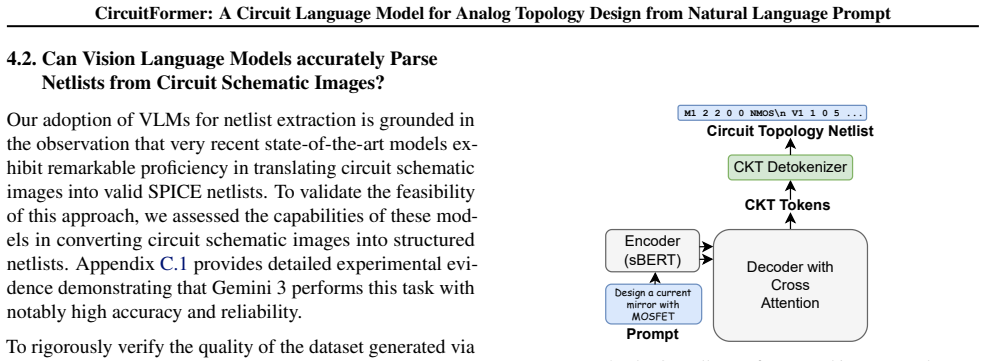
CircuitFormer is an encoder-decoder transformer with 511 million parameters trained on 31,341 netlist-description pairs. It uses the CKT tokenizer, which mines frequent subcircuits to encode netlist connectivity, achieving constant vocabulary size instead of growth with circuit size. The model reaches 100 percent syntactic correctness and 83 percent functional success rate across major analog circuit categories, exceeding larger open-source models while using 240 times fewer parameters.
What carries the argument
Circuit Tokenizer (CKT): a tokenization method that encodes netlist connectivity by explicitly mining frequent subcircuits, producing a fixed vocabulary of 512 tokens and shorter sequences than standard byte-pair encoding.
If this is right
- Analog circuit topologies can be produced directly from high-level text specifications without manual schematic entry.
- Domain-adapted tokenization allows smaller models to handle graph-structured data like circuits more efficiently than general tokenizers.
- Vocabulary size stays constant as circuit complexity grows, removing a scaling barrier for larger designs.
- The public dataset supports further training or fine-tuning for additional circuit classes.
Where Pith is reading between the lines
- Embedding the model in design tools could let engineers iterate by refining prompts based on quick simulation results.
- Subcircuit-based tokenization may transfer to other graph domains such as molecular structures or network topologies.
- The released dataset invites community extensions that add performance targets or layout constraints to the generation process.
Load-bearing premise
Automated simulation checks accurately determine whether a generated netlist will exhibit the intended analog behavior in practice.
What would settle it
Independent full analog simulations or expert review of a broad sample of generated netlists show functional success well below 83 percent, especially in categories involving noise, frequency response, or stability.
Figures




read the original abstract
Automating analog circuit design remains a longstanding challenge in Electronic Design Automation (EDA). While Transformer-based Large Language Models (LLMs) have revolutionized software code generation, their application to analog hardware design is hindered by two critical limitations: (i) the scarcity of analog design datasets containing natural language description of a design and its corresponding netlist, and (ii) the inefficiency of general-purpose tokenizers (e.g., Byte Pair Encoding (BPE)) in capturing the inherent graph structure of circuits. To bridge this gap, first, we curate the largest annotated dataset of analog circuit netlists to date, comprising 31,341 netlist-natural language description pairs across all major circuit classes. Furthermore, we propose Circuit Tokenizer (CKT), a novel circuit graph tokenizer designed to encode netlist connectivity by explicitly mining frequent subcircuits. In terms of scalability, CKT overcomes the bottleneck of prior circuit graph serialization methods where vocabulary size scales linearly with maximum number of components in the dataset, n_max, (O(n_max)); instead, CKT decouples vocabulary growth from circuit complexity, achieving a constant O(1) complexity. Empirically, CKT outperforms standard BPE on circuit topology representation, reducing sequence length by 57% and achieving a 2.3x superior compression ratio using a compact, fixed vocabulary of size 512. Leveraging this optimized tokenization, we train a circuit-specific language model, CircuitFormer, a 511M parameter encoder-decoder transformer. Our model achieves 100% syntactic correctness and an 83% functional success rate across all major analog circuit categories, outperforming state-of-the-art open-source LLMs by 10% and 14%, respectively, while requiring 240x fewer parameters. The dataset is publicly available at https://huggingface.co/datasets/touhid314/cktformer-dataset.
Editorial analysis
A structured set of objections, weighed in public.
Referee Report
Summary. The paper curates a dataset of 31,341 analog netlist-natural language description pairs, introduces the Circuit Tokenizer (CKT) that mines frequent subcircuits to achieve fixed vocabulary size 512 and O(1) complexity (vs. O(n_max) for prior methods), and trains CircuitFormer, a 511M-parameter encoder-decoder Transformer. It reports that the model attains 100% syntactic correctness and 83% functional success rate across major analog circuit categories, outperforming state-of-the-art open-source LLMs by 10% and 14% respectively while using 240x fewer parameters. The dataset is released publicly.
Significance. If the functional success metric is shown to correspond to verified analog performance via simulation, the work offers a parameter-efficient route to language-driven analog topology generation and supplies a useful public resource. The tokenizer's decoupling of vocabulary growth from circuit size is a clear technical contribution that could generalize to other graph-structured domains.
major comments (2)
- [Abstract / Evaluation] Abstract and Evaluation sections: The headline 83% functional success rate is load-bearing for the central claim yet the manuscript provides no description of how functional correctness is assessed (e.g., whether SPICE simulations confirm target specifications such as gain, bandwidth, stability margins, or power, versus connectivity or heuristic rule checks). Without this protocol the reported rate cannot be interpreted as evidence that usable analog circuits are produced.
- [Results] Results / Comparison: The 240x parameter reduction and 10%/14% outperformance claims require explicit identification of the compared open-source LLMs, their exact parameter counts, and confirmation that all models were evaluated on the identical held-out test set and task definition.
minor comments (1)
- [Dataset] Dataset section: Clarify the process used to generate or annotate the natural-language descriptions to allow readers to assess potential biases in prompt style or circuit complexity distribution.
Simulated Author's Rebuttal
We thank the referee for their constructive and detailed feedback on our manuscript. We address each major comment point by point below and will revise the manuscript to improve clarity and completeness on the requested aspects.
read point-by-point responses
-
Referee: [Abstract / Evaluation] Abstract and Evaluation sections: The headline 83% functional success rate is load-bearing for the central claim yet the manuscript provides no description of how functional correctness is assessed (e.g., whether SPICE simulations confirm target specifications such as gain, bandwidth, stability margins, or power, versus connectivity or heuristic rule checks). Without this protocol the reported rate cannot be interpreted as evidence that usable analog circuits are produced.
Authors: We agree that a precise description of the functional success assessment protocol is necessary to support interpretation of the 83% rate as evidence of usable analog circuits. We will revise the Evaluation section to explicitly detail the protocol, including the criteria used for functional verification (such as any combination of SPICE-based simulation checks for specifications like gain, bandwidth, stability margins, and power, versus connectivity or heuristic rule-based validation). This addition will ensure the metric is fully transparent and interpretable. revision: yes
-
Referee: [Results] Results / Comparison: The 240x parameter reduction and 10%/14% outperformance claims require explicit identification of the compared open-source LLMs, their exact parameter counts, and confirmation that all models were evaluated on the identical held-out test set and task definition.
Authors: We acknowledge that the comparison claims would benefit from greater explicitness. We will revise the Results section to name the specific open-source LLMs used in the benchmarks, report their exact parameter counts, and add an explicit statement confirming that all models (including CircuitFormer) were evaluated on the identical held-out test set using the same task definition. This will fully substantiate the reported outperformance and parameter-efficiency figures. revision: yes
Circularity Check
No circularity: empirical ML training and evaluation on held-out data
full rationale
The paper curates a dataset of 31,341 netlist-description pairs, introduces a frequency-based circuit tokenizer with fixed vocabulary, trains a 511M-parameter encoder-decoder model, and reports syntactic/functional success rates plus compression metrics on (presumably held-out) test circuits. All quantitative claims are direct empirical measurements from training and inference; no equations, predictions, or uniqueness theorems reduce to self-defined quantities, fitted inputs renamed as outputs, or load-bearing self-citations. The derivation chain consists of standard data curation, tokenization, supervised training, and benchmark evaluation against external LLMs.
Axiom & Free-Parameter Ledger
free parameters (1)
- vocabulary size =
512
axioms (1)
- domain assumption Netlist connectivity can be losslessly encoded by mining and tokenizing frequent subcircuits.
invented entities (1)
-
Circuit Tokenizer (CKT)
no independent evidence
Reference graph
Works this paper leans on
-
[1]
2020 , eprint=
MPNet: Masked and Permuted Pre-training for Language Understanding , author=. 2020 , eprint=
2020
-
[2]
2025 , eprint=
Masala-CHAI: A Large-Scale SPICE Netlist Dataset for Analog Circuits by Harnessing AI , author=. 2025 , eprint=
2025
-
[3]
The Thirteenth International Conference on Learning Representations , year=
AnalogGenie: A Generative Engine for Automatic Discovery of Analog Circuit Topologies , author=. The Thirteenth International Conference on Learning Representations , year=
-
[4]
Grammar-based graph compression , journal =
Sebastian Maneth and Fabian Peternek , keywords =. Grammar-based graph compression , journal =. 2018 , issn =. doi:https://doi.org/10.1016/j.is.2018.03.002 , url =
-
[5]
Reimers, Nils and Gurevych, Iryna. Sentence- BERT : Sentence Embeddings using S iamese BERT -Networks. Proceedings of the 2019 Conference on Empirical Methods in Natural Language Processing and the 9th International Joint Conference on Natural Language Processing (EMNLP-IJCNLP). 2019. doi:10.18653/v1/D19-1410
-
[6]
Language Models are Unsupervised Multitask Learners , author=
-
[7]
Forty-second International Conference on Machine Learning , year=
AnalogGenie-Lite: Enhancing Scalability and Precision in Circuit Topology Discovery through Lightweight Graph Modeling , author=. Forty-second International Conference on Machine Learning , year=
-
[8]
2024 , eprint=
AMSNet: Netlist Dataset for AMS Circuits , author=. 2024 , eprint=
2024
-
[9]
2025 , eprint=
AMSnet 2.0: A Large AMS Database with AI Segmentation for Net Detection , author=. 2025 , eprint=
2025
-
[10]
2024 , editor =
Chang, Chen-Chia and Shen, Yikang and Fan, Shaoze and Li, Jing and Zhang, Shun and Cao, Ningyuan and Chen, Yiran and Zhang, Xin , booktitle =. 2024 , editor =
2024
-
[11]
Chen-Chia Chang and Wan-Hsuan Lin and Yikang Shen and Yiran Chen and Xin Zhang , booktitle=. La. 2025 , url=
2025
-
[12]
Analogcoder: analog circuit design via training- free code generation,
Lai, Yao and Lee, Sungyoung and Chen, Guojin and Poddar, Souradip and Hu, Mengkang and Pan, David Z. and Luo, Ping , title =. Proceedings of the Thirty-Ninth AAAI Conference on Artificial Intelligence and Thirty-Seventh Conference on Innovative Applications of Artificial Intelligence and Fifteenth Symposium on Educational Advances in Artificial Intelligen...
-
[13]
2025 , eprint=
AnalogCoder-Pro: Unifying Analog Circuit Generation and Optimization via Multi-modal LLMs , author=. 2025 , eprint=
2025
-
[14]
AnalogXpert: Automating Analog Topology Synthesis by Incorporating Circuit Design Expertise into Large Language Models , year=
Zhang, Haoyi and Sun, Shizhao and Lin, Yibo and Wang, Runsheng and Bian, Jiang , booktitle=. AnalogXpert: Automating Analog Topology Synthesis by Incorporating Circuit Design Expertise into Large Language Models , year=
-
[15]
Proceedings of the 61st ACM/IEEE Design Automation Conference , articleno =
Chen, Zihao and Huang, Jiangli and Liu, Yiting and Yang, Fan and Shang, Li and Zhou, Dian and Zeng, Xuan , title =. Proceedings of the 61st ACM/IEEE Design Automation Conference , articleno =. 2024 , isbn =. doi:10.1145/3649329.3655903 , abstract =
-
[16]
2024 , eprint=
AmpAgent: An LLM-based Multi-Agent System for Multi-stage Amplifier Schematic Design from Literature for Process and Performance Porting , author=. 2024 , eprint=
2024
-
[17]
Zehao Dong and Weidong Cao and Muhan Zhang and Dacheng Tao and Yixin Chen and Xuan Zhang , booktitle=. Ckt. 2023 , url=
2023
-
[18]
Neural Machine Translation of Rare Words with Subword Units
Sennrich, Rico and Haddow, Barry and Birch, Alexandra. Neural Machine Translation of Rare Words with Subword Units. Proceedings of the 54th Annual Meeting of the Association for Computational Linguistics (Volume 1: Long Papers). 2016. doi:10.18653/v1/P16-1162
-
[19]
2024 , month = jul, howpublished =
Large Enough: Mistral Large 2 , author =. 2024 , month = jul, howpublished =
2024
-
[20]
Kudo, Taku and Richardson, John. S entence P iece: A simple and language independent subword tokenizer and detokenizer for Neural Text Processing. Proceedings of the 2018 Conference on Empirical Methods in Natural Language Processing: System Demonstrations. 2018. doi:10.18653/v1/D18-2012
work page internal anchor Pith review doi:10.18653/v1/d18-2012 2018
-
[21]
2025 , eprint=
gpt-oss-120b & gpt-oss-20b Model Card , author=. 2025 , eprint=
2025
-
[22]
2024 , eprint=
The Llama 3 Herd of Models , author=. 2024 , eprint=
2024
-
[23]
2025 , eprint=
Gemma 3 Technical Report , author=. 2025 , eprint=
2025
-
[24]
2025 , eprint=
DeepSeek-V3.2: Pushing the Frontier of Open Large Language Models , author=. 2025 , eprint=
2025
-
[25]
Attention is All you Need , url =
Vaswani, Ashish and Shazeer, Noam and Parmar, Niki and Uszkoreit, Jakob and Jones, Llion and Gomez, Aidan N and Kaiser, ukasz and Polosukhin, Illia , booktitle =. Attention is All you Need , url =
-
[26]
2024 , eprint=
DocLayout-YOLO: Enhancing Document Layout Analysis through Diverse Synthetic Data and Global-to-Local Adaptive Perception , author=. 2024 , eprint=
2024
discussion (0)
Sign in with ORCID, Apple, or X to comment. Anyone can read and Pith papers without signing in.