Recognition: unknown
HEDP: A Hybrid Energy-Distance Prompt-based Framework for Domain Incremental Learning
Pith reviewed 2026-05-08 11:21 UTC · model grok-4.3
The pith
A hybrid energy-distance prompt framework lets models adapt to new data domains without erasing knowledge from old ones.
A machine-rendered reading of the paper's core claim, the machinery that carries it, and where it could break.
Core claim
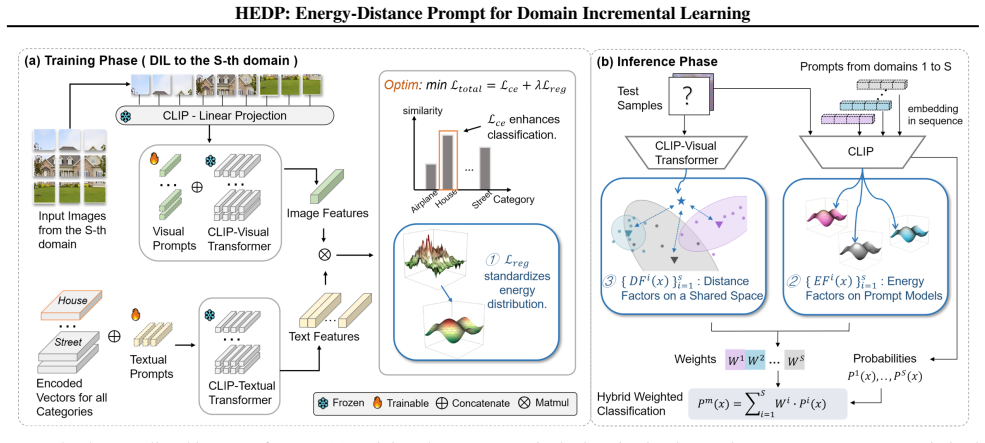
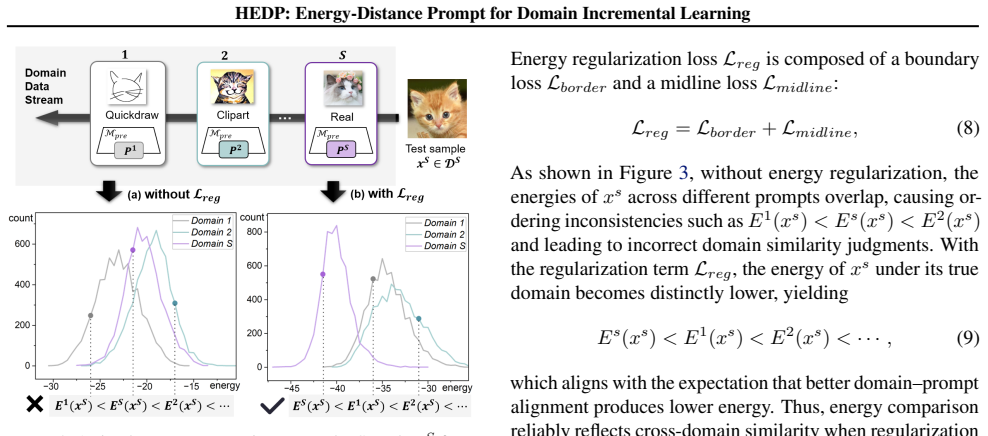
HEDP augments prompt-based models with an energy regularization loss that increases separability among domain representations and a hybrid energy-distance weighted mechanism that combines energy-based and distance-based selection cues. On benchmarks including CORe50 this produces a 2.57 percent accuracy lift on unseen domains while reducing catastrophic forgetting and supporting better open-world performance.
What carries the argument
The hybrid energy-distance weighted mechanism that fuses energy-based and distance-based cues to select and generalize domain knowledge.
If this is right
- Accuracy on unseen domains rises without requiring complete model retraining from scratch.
- Knowledge from earlier domains is retained rather than overwritten during new domain training.
- The model becomes more robust when deployed in environments where data distributions continue to vary.
- The same prompt structure can be reused across multiple sequential domain arrivals.
Where Pith is reading between the lines
- The same energy-distance fusion idea could be tested in task-incremental or class-incremental settings where the shift is not purely domain-based.
- Deployed systems might use this mechanism to decide locally whether to update or to rely on stored domain cues.
- Additional experiments that deliberately create more extreme or adversarial domain gaps would clarify the limits of the separability gain.
Load-bearing premise
The energy regularization loss and hybrid weighting will improve domain separability and selection for any real-world domain shifts, not only the specific benchmarks tested.
What would settle it
Running the same method on a fresh benchmark whose domain shifts differ markedly from CORe50 and observing zero accuracy gain or increased forgetting on prior domains would show the approach does not generalize.
Figures



read the original abstract
Domain Incremental Learning is a critical scenario that requires models to continuously adapt to new data domains without retraining. However, domain shifts often cause severe performance degradation. To address this, we propose Hybrid Energy-Distance Prompt, a domain-incremental framework inspired by Helmholtz free energy. HEDP introduces an energy regularization loss to enhance the separability of domain representations and a hybrid energy-distance weighted mechanism that fuses energy-based and distance-based cues to improve domain selection and generalization. Experiments on multiple benchmarks, including CORe50, show that HEDP achieves superior performance on unseen domains with a 2.57\% accuracy gain, effectively mitigating catastrophic forgetting and enhancing open-world adaptability. Our code is \href{https://github.com/dannis97500/HEDP/}{available here}.
Editorial analysis
A structured set of objections, weighed in public.
Referee Report
Summary. The manuscript proposes HEDP, a Hybrid Energy-Distance Prompt framework for domain incremental learning inspired by Helmholtz free energy. It introduces an energy regularization loss to enhance separability of domain representations and a hybrid energy-distance weighted mechanism to fuse cues for improved domain selection and generalization. Experiments on benchmarks including CORe50 report a 2.57% accuracy gain on unseen domains, with claims of reduced catastrophic forgetting and better open-world adaptability. Code is provided at a GitHub link.
Significance. If the central claims hold under broader testing, the physics-inspired regularization and hybrid selection could provide a useful addition to prompt-based continual learning methods, particularly for handling domain shifts. The public code release supports reproducibility and is a clear strength. However, the current evidence base is narrow, limiting the immediate impact on the field.
major comments (2)
- [Experiments] Experiments section: The reported 2.57% accuracy gain on CORe50 and superior performance claims are presented without error bars, ablation studies, baseline comparisons, or statistical significance tests. This absence makes it impossible to verify whether the gains are robust or attributable to the proposed energy regularization and hybrid mechanism rather than implementation details.
- [Experiments] Experiments section: Evaluation is restricted to standard incremental benchmarks (e.g., CORe50) featuring relatively structured domain shifts. No results are provided for more heterogeneous real-world shifts involving simultaneous changes in sensor, lighting, and semantics, leaving the claim of enhanced open-world adaptability and reliable domain separability under-supported.
minor comments (1)
- [Abstract] Abstract: The summary of contributions is unusually high-level and omits any mention of specific baselines, dataset details, or quantitative metrics beyond the single 2.57% figure, which hinders quick assessment of novelty and scope.
Simulated Author's Rebuttal
Thank you for the constructive feedback on our manuscript arXiv:2605.05776. We have carefully addressed the major comments by enhancing the experimental section with additional analyses and clarifications. Point-by-point responses are provided below.
read point-by-point responses
-
Referee: Experiments section: The reported 2.57% accuracy gain on CORe50 and superior performance claims are presented without error bars, ablation studies, baseline comparisons, or statistical significance tests. This absence makes it impossible to verify whether the gains are robust or attributable to the proposed energy regularization and hybrid mechanism rather than implementation details.
Authors: We fully agree that the original presentation lacked these elements, which are crucial for validating the results. In the revised manuscript, we now report all accuracy figures with error bars computed over 5 independent runs. We have included a comprehensive ablation study table showing the impact of removing the energy regularization loss and the hybrid weighting separately. Baseline comparisons have been expanded with more methods, and we added p-values from statistical tests confirming the significance of the 2.57% gain and other improvements. These changes confirm the robustness and attribution to our proposed techniques. revision: yes
-
Referee: Experiments section: Evaluation is restricted to standard incremental benchmarks (e.g., CORe50) featuring relatively structured domain shifts. No results are provided for more heterogeneous real-world shifts involving simultaneous changes in sensor, lighting, and semantics, leaving the claim of enhanced open-world adaptability and reliable domain separability under-supported.
Authors: We recognize that CORe50 and similar benchmarks feature controlled domain shifts, which may not fully capture the complexity of real-world scenarios with concurrent changes in multiple factors. To mitigate this, we have added t-SNE plots and energy distribution analyses in the revised paper to illustrate improved domain separability. We have also expanded the discussion section to elaborate on how the Helmholtz-inspired energy regularization aids in handling such shifts theoretically. While we cannot include entirely new benchmark results in this revision without additional extensive experimentation, we believe the current evidence, combined with the public code, allows for community validation on more diverse datasets. revision: partial
Circularity Check
No circularity in derivation; framework is explicitly constructed and empirically tested
full rationale
The paper defines HEDP as a novel prompt-based framework explicitly inspired by Helmholtz free energy, then introduces concrete components—an energy regularization loss for domain separability and a hybrid energy-distance weighting rule for selection—followed by empirical evaluation on benchmarks such as CORe50. No equation or claim reduces a reported result to a fitted parameter renamed as prediction, nor does any load-bearing premise collapse to a self-citation or self-definition. The performance numbers are presented as experimental outcomes of the proposed architecture rather than tautological consequences of its inputs, rendering the derivation chain self-contained.
Axiom & Free-Parameter Ledger
axioms (1)
- domain assumption Domain representations can be assigned meaningful energy values inspired by Helmholtz free energy to quantify separability.
invented entities (1)
-
Hybrid Energy-Distance Prompt mechanism
no independent evidence
Reference graph
Works this paper leans on
-
[1]
Neural networks , volume=
Continual lifelong learning with neural networks: A review , author=. Neural networks , volume=. 2019 , publisher=
2019
-
[2]
arXiv preprint arXiv:1910.02718 , year=
Continual learning in neural networks , author=. arXiv preprint arXiv:1910.02718 , year=
-
[3]
Three scenarios for continual learning , author=. arXiv preprint arXiv:1904.07734 , year=
-
[4]
Psychology of learning and motivation , volume=
Catastrophic interference in connectionist networks: The sequential learning problem , author=. Psychology of learning and motivation , volume=. 1989 , publisher=
1989
-
[5]
European Conference on Computer Vision , pages=
Visual prompt tuning , author=. European Conference on Computer Vision , pages=. 2022 , organization=
2022
-
[6]
Proceedings of the 32nd ACM International Conference on Multimedia , pages=
CP-Prompt: Composition-Based Cross-modal Prompting for Domain-Incremental Continual Learning , author=. Proceedings of the 32nd ACM International Conference on Multimedia , pages=
-
[7]
Predicting structured data , volume=
A tutorial on energy-based learning , author=. Predicting structured data , volume=
-
[8]
Proceedings of the IEEE/CVF Conference on Computer Vision and Pattern Recognition , pages=
Dytox: Transformers for continual learning with dynamic token expansion , author=. Proceedings of the IEEE/CVF Conference on Computer Vision and Pattern Recognition , pages=
-
[9]
Julien Nicolas and Florent Chiaroni and Imtiaz Masud Ziko and Ola Ahmad and Christian Desrosiers and Jose Dolz , title =
-
[10]
arXiv preprint arXiv:2105.13127 , year=
Continual learning at the edge: Real-time training on smartphone devices , author=. arXiv preprint arXiv:2105.13127 , year=
-
[11]
Yabin Wang, Zhiheng Ma, Zhiwu Huang, Yaowei Wang, Zhou Su and Xiaopeng Hong , title =
-
[12]
arXiv preprint arXiv:2203.16773 , year=
Speechprompt: An exploration of prompt tuning on generative spoken language model for speech processing tasks , author=. arXiv preprint arXiv:2203.16773 , year=
-
[13]
International Journal of Computer Vision , volume=
Learning to prompt for vision-language models , author=. International Journal of Computer Vision , volume=. 2022 , publisher=
2022
-
[14]
Advances in neural information processing systems , volume=
Language models are few-shot learners , author=. Advances in neural information processing systems , volume=
-
[15]
BERT: Pre-training of Deep Bidirectional Transformers for Language Understanding
Bert: Pre-training of deep bidirectional transformers for language understanding , author=. arXiv preprint arXiv:1810.04805 , year=
work page internal anchor Pith review arXiv
-
[16]
Representation Learning with Contrastive Predictive Coding
Representation learning with contrastive predictive coding , author=. arXiv preprint arXiv:1807.03748 , year=
work page internal anchor Pith review arXiv
-
[17]
arXiv preprint arXiv:2211.12701 , year=
Continual learning of natural language processing tasks: A survey , author=. arXiv preprint arXiv:2211.12701 , year=
-
[18]
arXiv preprint arXiv:2302.03241 , year=
Continual pre-training of language models , author=. arXiv preprint arXiv:2302.03241 , year=
-
[19]
Nature Machine Intelligence , volume=
Three types of incremental learning , author=. Nature Machine Intelligence , volume=. 2022 , publisher=
2022
-
[20]
A comprehensive survey of continual learning: Theory, method and application, 2024 a
A comprehensive survey of continual learning: Theory, method and application , author=. arXiv preprint arXiv:2302.00487 , year=
-
[21]
Neural Information Processing Systems Workshop , volume=
Theoretical insights into memorization in GANs , author=. Neural Information Processing Systems Workshop , volume=
-
[22]
arXiv preprint arXiv:1908.01091 , year=
Toward understanding catastrophic forgetting in continual learning , author=. arXiv preprint arXiv:1908.01091 , year=
-
[23]
Proceedings of the IEEE/CVF conference on computer vision and pattern recognition , pages=
Learning to remember: A synaptic plasticity driven framework for continual learning , author=. Proceedings of the IEEE/CVF conference on computer vision and pattern recognition , pages=
-
[24]
Connection Science , volume=
Catastrophic forgetting, rehearsal and pseudorehearsal , author=. Connection Science , volume=. 1995 , publisher=
1995
-
[25]
Soda10m: Towards large-scale object detection benchmark for autonomous driving , author=
-
[26]
IEEE Transactions on Intelligent Transportation Systems , year=
Crossfuser: Multi-modal feature fusion for end-to-end autonomous driving under unseen weather conditions , author=. IEEE Transactions on Intelligent Transportation Systems , year=
-
[27]
Algorithms , volume=
Object detection in autonomous vehicles under adverse weather: a review of traditional and deep learning approaches , author=. Algorithms , volume=. 2024 , publisher=
2024
-
[28]
arXiv preprint arXiv:2401.16386 , year=
Continual learning with pre-trained models: A survey , author=. arXiv preprint arXiv:2401.16386 , year=
-
[29]
2023 IEEE Intelligent Vehicles Symposium (IV) , pages=
I had a bad day: Challenges of object detection in bad visibility conditions , author=. 2023 IEEE Intelligent Vehicles Symposium (IV) , pages=. 2023 , organization=
2023
-
[30]
Proceedings of the IEEE/CVF conference on computer vision and pattern recognition , pages=
Scalability in perception for autonomous driving: Waymo open dataset , author=. Proceedings of the IEEE/CVF conference on computer vision and pattern recognition , pages=
-
[31]
arXiv preprint arXiv:2112.02714 , year=
CLASSIC: Continual and contrastive learning of aspect sentiment classification tasks , author=. arXiv preprint arXiv:2112.02714 , year=
-
[32]
Continual learning and catastrophic forgetting.arXiv preprint arXiv:2403.05175, 2024
Continual Learning and Catastrophic Forgetting , author=. arXiv preprint arXiv:2403.05175 , year=
-
[33]
Proceedings of the IEEE/CVF Conference on Computer Vision and Pattern Recognition , pages=
Probing representation forgetting in supervised and unsupervised continual learning , author=. Proceedings of the IEEE/CVF Conference on Computer Vision and Pattern Recognition , pages=
-
[34]
Proceedings of the IEEE/CVF Conference on Computer Vision and Pattern Recognition , pages=
Coda-prompt: Continual decomposed attention-based prompting for rehearsal-free continual learning , author=. Proceedings of the IEEE/CVF Conference on Computer Vision and Pattern Recognition , pages=
-
[35]
Advances in Neural Information Processing Systems , volume=
A unified approach to domain incremental learning with memory: Theory and algorithm , author=. Advances in Neural Information Processing Systems , volume=
-
[36]
IEEE Transactions on Geoscience and Remote Sensing , year=
Domain Incremental Learning for Remote Sensing Semantic Segmentation with Multi-Feature Constraints in Graph Space , author=. IEEE Transactions on Geoscience and Remote Sensing , year=
-
[37]
Remote Sensing , volume=
DILRS: Domain-incremental learning for semantic segmentation in multi-source remote sensing data , author=. Remote Sensing , volume=. 2023 , publisher=
2023
-
[38]
Proceedings of the IEEE/CVF Conference on Computer Vision and Pattern Recognition , pages=
An efficient domain-incremental learning approach to drive in all weather conditions , author=. Proceedings of the IEEE/CVF Conference on Computer Vision and Pattern Recognition , pages=
-
[39]
Neurocomputing , volume=
Online continual learning in image classification: An empirical survey , author=. Neurocomputing , volume=. 2022 , publisher=
2022
-
[40]
arXiv preprint arXiv:1906.05226 , year=
Continual and multi-task architecture search , author=. arXiv preprint arXiv:1906.05226 , year=
-
[41]
Proceedings of the AAAI Conference on Artificial Intelligence , volume=
Multi-domain incremental learning for face presentation attack detection , author=. Proceedings of the AAAI Conference on Artificial Intelligence , volume=
-
[42]
Neural Networks , volume=
A survey on few-shot class-incremental learning , author=. Neural Networks , volume=. 2024 , publisher=
2024
-
[43]
IEEE Transactions on Pattern Analysis and Machine Intelligence , year=
Class-incremental learning: A survey , author=. IEEE Transactions on Pattern Analysis and Machine Intelligence , year=
-
[44]
Proceedings of the AAAI Conference on Artificial Intelligence , volume=
Continual relation extraction via sequential multi-task learning , author=. Proceedings of the AAAI Conference on Artificial Intelligence , volume=
-
[45]
Proceedings of the AAAI Conference on Artificial Intelligence , volume=
Isolation and impartial aggregation: A paradigm of incremental learning without interference , author=. Proceedings of the AAAI Conference on Artificial Intelligence , volume=
-
[46]
2022 IEEE 34th International Conference on Tools with Artificial Intelligence (ICTAI) , pages=
Similarity-Driven Adaptive Prototypical Network for Class-incremental Few-shot Named Entity Recognition , author=. 2022 IEEE 34th International Conference on Tools with Artificial Intelligence (ICTAI) , pages=. 2022 , organization=
2022
-
[47]
2022 IEEE 34th International Conference on Tools with Artificial Intelligence (ICTAI) , pages=
Convolutional Decoupled cVAE-GANs for Pseudo-Replay Based Continual Learning , author=. 2022 IEEE 34th International Conference on Tools with Artificial Intelligence (ICTAI) , pages=. 2022 , organization=
2022
-
[48]
arXiv preprint arXiv:2110.11334 , year=
Generalized out-of-distribution detection: A survey , author=. arXiv preprint arXiv:2110.11334 , year=
-
[49]
Informative outlier matters: Robustifying out-of-distribution detection using outlier mining , author=
-
[50]
Proceedings of the AAAI Conference on Artificial Intelligence , volume=
Self-supervised learning for generalizable out-of-distribution detection , author=. Proceedings of the AAAI Conference on Artificial Intelligence , volume=
-
[51]
A Baseline for Detecting Misclassified and Out-of-Distribution Examples in Neural Networks
A baseline for detecting misclassified and out-of-distribution examples in neural networks , author=. arXiv preprint arXiv:1610.02136 , year=
work page internal anchor Pith review arXiv
-
[52]
Enhancing the reliability of out-of-distribution image detection in neural networks , author=. arXiv preprint arXiv:1706.02690 , year=
-
[53]
Journal of chemical education , volume=
A simple derivation of the Boltzmann distribution , author=. Journal of chemical education , volume=. 1999 , publisher=
1999
-
[54]
Advances in Neural Information Processing Systems , volume=
React: Out-of-distribution detection with rectified activations , author=. Advances in Neural Information Processing Systems , volume=
-
[55]
Proceedings of the IEEE/CVF Conference on Computer Vision and Pattern Recognition , pages=
Generalized odin: Detecting out-of-distribution image without learning from out-of-distribution data , author=. Proceedings of the IEEE/CVF Conference on Computer Vision and Pattern Recognition , pages=
-
[56]
International Conference on Machine Learning , pages=
Out-of-distribution detection with deep nearest neighbors , author=. International Conference on Machine Learning , pages=. 2022 , organization=
2022
-
[57]
Advances in neural information processing systems , volume=
A simple unified framework for detecting out-of-distribution samples and adversarial attacks , author=. Advances in neural information processing systems , volume=
-
[58]
Advances in neural information processing systems , volume=
Csi: Novelty detection via contrastive learning on distributionally shifted instances , author=. Advances in neural information processing systems , volume=
-
[59]
Ssd: A unified framework for self-supervised outlier detection.arXiv preprint arXiv:2103.12051, 2021
Ssd: A unified framework for self-supervised outlier detection , author=. arXiv preprint arXiv:2103.12051 , year=
-
[60]
International conference on learning representations , year=
Deep autoencoding gaussian mixture model for unsupervised anomaly detection , author=. International conference on learning representations , year=
-
[61]
Proceedings of the IEEE/CVF conference on computer vision and pattern recognition , pages=
Latent space autoregression for novelty detection , author=. Proceedings of the IEEE/CVF conference on computer vision and pattern recognition , pages=
-
[62]
arXiv preprint arXiv:1812.02765 (2018)
Improving reconstruction autoencoder out-of-distribution detection with mahalanobis distance , author=. arXiv preprint arXiv:1812.02765 , year=
-
[63]
Proceedings of the IEEE/CVF Conference on Computer Vision and Pattern Recognition , pages=
Rethinking reconstruction autoencoder-based out-of-distribution detection , author=. Proceedings of the IEEE/CVF Conference on Computer Vision and Pattern Recognition , pages=
-
[64]
Proceedings of the IEEE/CVF Conference on Computer Vision and Pattern Recognition , pages=
Energy-based latent aligner for incremental learning , author=. Proceedings of the IEEE/CVF Conference on Computer Vision and Pattern Recognition , pages=
-
[65]
International Journal of Remote Sensing , volume=
Energy-based learning for open-set classification in remote sensing imagery , author=. International Journal of Remote Sensing , volume=. 2022 , publisher=
2022
-
[66]
Advances in Neural Information Processing Systems , volume=
Secure out-of-distribution task generalization with energy-based models , author=. Advances in Neural Information Processing Systems , volume=
-
[67]
Maximilian Stadler, Bertrand Charpentier, Simon Geisler, Daniel Zügner, and Stephan Günnemann
Energy-based out-of-distribution detection for graph neural networks , author=. arXiv preprint arXiv:2302.02914 , year=
-
[68]
Advances in neural information processing systems , volume=
Energy-based out-of-distribution detection , author=. Advances in neural information processing systems , volume=
-
[69]
Proceedings of the National Academy of Sciences , volume=
Alleviating catastrophic forgetting using context-dependent gating and synaptic stabilization , author=. Proceedings of the National Academy of Sciences , volume=. 2018 , publisher=
2018
-
[70]
Lifelong Learning with Dynamically Expandable Networks
Lifelong learning with dynamically expandable networks , author=. arXiv preprint arXiv:1708.01547 , year=
-
[71]
Proceedings of the 2019 on International Conference on Multimedia Retrieval , pages=
Increasingly packing multiple facial-informatics modules in a unified deep-learning model via lifelong learning , author=. Proceedings of the 2019 on International Conference on Multimedia Retrieval , pages=
2019
-
[72]
Advances in Neural Information Processing Systems , volume=
Compacting, picking and growing for unforgetting continual learning , author=. Advances in Neural Information Processing Systems , volume=
-
[73]
Proceedings of the national academy of sciences , volume=
Overcoming catastrophic forgetting in neural networks , author=. Proceedings of the national academy of sciences , volume=. 2017 , publisher=
2017
-
[74]
IEEE transactions on pattern analysis and machine intelligence , volume=
Learning without forgetting , author=. IEEE transactions on pattern analysis and machine intelligence , volume=. 2017 , publisher=
2017
-
[75]
International conference on machine learning , pages=
Continual learning through synaptic intelligence , author=. International conference on machine learning , pages=. 2017 , organization=
2017
-
[76]
Advances in Neural Information Processing Systems , volume=
Continual deep learning by functional regularisation of memorable past , author=. Advances in Neural Information Processing Systems , volume=
-
[77]
Advances in Neural Information Processing Systems , volume=
Selective amnesia: A continual learning approach to forgetting in deep generative models , author=. Advances in Neural Information Processing Systems , volume=
-
[78]
Advances in neural information processing systems , volume=
Gradient episodic memory for continual learning , author=. Advances in neural information processing systems , volume=
-
[79]
Efficient Lifelong Learning with A-GEM
Efficient lifelong learning with a-gem , author=. arXiv preprint arXiv:1812.00420 , year=
-
[80]
Advances in neural information processing systems , volume=
Gradient based sample selection for online continual learning , author=. Advances in neural information processing systems , volume=
discussion (0)
Sign in with ORCID, Apple, or X to comment. Anyone can read and Pith papers without signing in.